The Ageing Runner – Part 2 Sprinters

If you missed part 1 you can find it here

This series grew out of my attempts to write about Sports Psychology because it’s a topic which dominated my reading for a couple of decades. I wanted to impart the wisdom I’d learned along the way, but it’s a big topic ranging across all sorts of areas such as goal-setting, attributions, mental skills, relaxation and learning among many more; so being unsure of how to start writing it, I did the obvious thing and gave up for the time being!

During my research however, I looked up Dr Steve Peters to sharpen up on the details of his work. He’s famous for writing The Chimp Paradox; a best seller that brings together many of the ideas and methods he used while working as a sports psychologist for Great Britain Cycling to support their successful Olympic programme of the past two decades. Given his association with the cycling programme I was surprised to find out he’s been a highly successful Masters athlete in sprinting, to the extent that he won multiple gold medals at the World Masters Championships in the M50, M55 and M60 categories between 2005 and 2015.

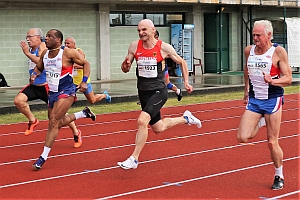
Steve Peters competing in the British Masters

On the UK Athletics’ website, The Power of 10, there are records of his performances in the 100, 200 and 400 since 1996 when he was age forty-three up to pre-pandemic. It makes for interesting viewing to see the decline, or should I say lack of decline in his sprinting over that period. Even in his late sixties, he’s still running under 13s for 100m, under 26s for 200m and breaking a minute for 400m. There’s been a noticeable decline in the last couple of years which is more likely due to lack of competition or injury than age itself.

Would you have thought those times were possible for someone who was never an elite sprinter in the first place? At fifty I can’t even run the times he’s achieving in his late sixties. Not because it’s necessarily beyond me but because I’ve never trained specifically for them. How you train is a bigger determinant of your performance than your age.

Steve Peters is the World Champion for his age group, so he is obviously something of an outlier, but there are many former Olympians who are no longer competing who could be faster. Steve isn’t even the world record holder in his age categories. Below are tables of the age-graded world records for both men and women, updated in June 2022.

Age group world records for 100m

TimeMaleDateTimeFemaleDate
World Record9.58Usain Bolt16-Aug-09 10.49Florence Griffith Joyner16-Jul-88
V359.87Justin Gatlin30-Jun-19 10.74Merlene Ottey07-Sep-96
V409.93Kim Collins29-May-16 11.09Merlene Ottey03-Aug-04
V4510.72Willie Gault24-Jun-06 11.34Merlene Ottey12-Aug-06
V5010.88Willie Gault07-May-11 11.67Merlene Ottey13-Jul-10
V5511.3Willie Gault07-May-16 12.24Julie Brims13-Feb-21
V6011.7Ronald Taylor04-Jun-94 13.63Karla Del Grande18-Jul-14
V6512.31Damien Leake16-Jun-18 13.91Karla Del Grande11-Aug-18
V7012.77Bobby Whilden06-Oct-05 14.73Ingrid Meier30-Jun-17
V7513.25Kenton Brown03-Oct-20 15.03Carol LaFayette-Boyd04-Aug-18
V8014.35Payton Jordan10-May-97 16.26Kathy Bergen06-Jun-21
V8515.08Hiroo Tanaka25-Jun-17 18.49Christa Bortignon07-May-22
V9016.86Hiroo Tanaka01-May-21 23.15Mitsu Morita06-Oct-13
V9520.41Frederico Fischer30-Jun-12 30.16Elena Pagu28-Aug-21

Age group world records for 200m

TimeMaleDateTimeFemaleDate
World Record19.19Usain Bolt20-Aug-09 21.34Florence Griffith Joyner29-Sep-88
V3520.11Linford Christie25-Jun-95 21.93Merlene Ottey25-Aug-95
V4020.64Troy Douglas09-Aug-03 22.72Merlene Ottey23-Aug-04
V4521.8Willie Gault26-Apr-08 23.82Merlene Ottey27-Aug-06
V5022.44Willie Gault07-May-11 24.33Merlene Ottey18-Jul-10
V5523.24Willie Gault07-May-16 25.07Julie Brims07-Mar-21
V6024.00Ronald Taylor10-Jun-94 28.11Karla Del Grande22-Oct-13
V6524.65Charles Allie26-Jul-13 28.53Karla Del Grande05-Aug-18
V7025.75Charles Allie21-Jun-18 31.3Ingrid Meier02-Jul-17
V7527.73Robert Lida05-Aug-12 31.56Carol
LaFayette-Boyd
09-Sep-18
V8029.54Hijiya Hisamitsu16-Sep-12 35.34Kathy Bergen06-Jun-21
V8531.69Hijiya Hisamitsu17-Sep-16 41.58Emiko Saito12-Nov-17
V9036.02Hiroo Tanaka23-May-21 55.62Mitsu Morita30-Jun-13
V9548.69Friederich
Ernst Mahlo
10-Sep-07 1:12.99Diane Friedman22-Jul-17

Age group world records for 400m

TimeMaleDateTimeFemaleDate
World Record43.03Wayde
van Niekerk
14-Aug-16 47.60Marita Koch06-Oct-85
V3544.54Chris Brown30-May-15 49.46Allyson Felix06-Aug-21
V4047.81Enrico Saraceni25-Jul-04 52.50Geisa Aparecida Coutinho09-Apr-21
V4549.09Allen Woodard18-Mar-17 56.14Angee Henry-Nott23-Jul-21
V5050.51Juan Luis
Lopez Anaya
16-Jul-21 57.66Marie Lande
Mathieu
14-Sep-07
V5552.24Charles Allie12-Jul-03 59.36Julie Brims23-Jan-21
V6053.88Ralph Romain22-Jul-95 1:04.3Caroline Powell12-Aug-15
V6556.09Charles Allie18-May-13 1:08.0Karla Del Grande12-Jul-19
V7057.26Charles Allie11-Sep-18 1:11.8Barbara Blurton10-Dec-20
V751:02.4Guido Müller28-Jun-14 1:19.5Christa Bortignon22-Aug-13
V801:10.0Hisamitsu Hijiya09-Sep-12 1:29.8Rietje Dijkman09-Sep-19
V851:17.1Earl Fee12-Jul-14 1:41.6Emiko Saito29-Apr-17
V901:29.2Earl Fee19-Jul-19 2:16.2Melitta
Czerwenka-Nagel
14-Sep-20
V952:21.8Orville Rogers12-Jul-13 3:21.0Diane Friedman27-Jul-19

It’s my guess that most runners, male or female, can’t even run the times being set by the 80-year-old women; let alone run close to the times for their own age or gender. It’s only when these runners get into their eighties that the times begin to noticeably degrade and I suspect this is as much down to circumstance, as it is ageing. There are fewer of these runners competing and most of them probably took it up later in life.

Lots of facts and figures so far but here’s a chance to enjoy watching M70 Charles Allie in action over 200m.

You can read Part 3 by clicking here
The Ageing Runner – Part 1

When I began parkrunning I was in my thirties. I’d never been a serious runner but my Saturday morning endeavours motivated me to get training and as I began my forties I started recording Personal Bests at all distances. As I approached forty-five I ran my first sub-40 10K. I was getting better with age.

Now as I move into the VM50-54 category at parkrun, I still believe there’s more to come. This is not to say that age doesn’t see a decline in your capabilities, only that I never fulfilled my potential when I was younger.

I’ve never believed the limitations of the human body are as pronounced as other people like to believe and in this five-part series of posts I’ll detail how fast older runners, both men and women, can be as they go up through the age categories and over different distances. I think you’ll be surprised to find out it’s much more than you can imagine.


There’s no doubt a fifty-something runner is not going to be capable of the times they could have achieved in their twenties, but there is a belief that this decline is rapid. It’s generally agreed athletes peak at around twenty-seven but it can be a couple of years either side. Becoming a world class athlete takes a decade of development and while the body finishes its growth by eighteen years old, there are still maturation processes going on within the brain and hormones that continue into the twenties.

Here’s a question to ponder for a moment …

If an athlete’s peak is twenty-seven and they begin to decline after this, at what age are they achieving the same standards as when they were seventeen? For example, if your parkrun PB at seventeen was twenty minutes and you continued training for the rest of your life hitting a lifetime best of fifteen minutes at twenty-seven; what is the age when you will last be able to record twenty minutes again?

I’ll give you the answer at the end of the article.

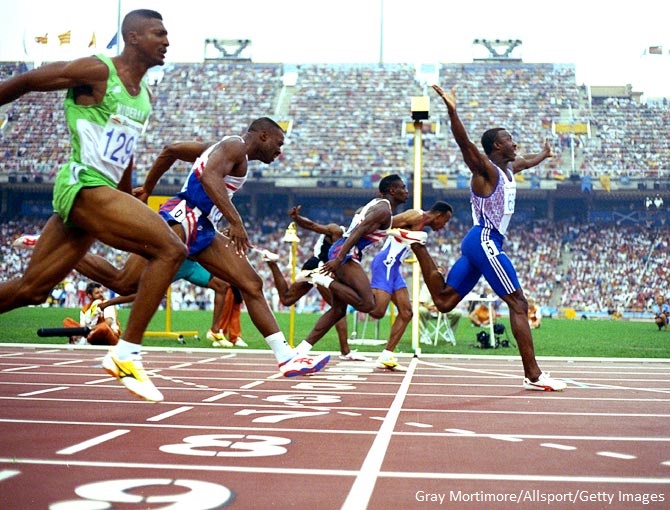
Ageing in sport is one of those myths that is slowly being deconstructed. In most professional sports, athletes are usually finished in their mid-30s with just the occasional highly skilled technician or specialist (think golfers, goalkeepers or quarterbacks) making it into their forties. I recall watching the Barcelona Olympics where Linford Christie became the oldest sprinter ever to win the Olympic Gold at the advanced age of 32!

32-year-old Linford Christie becomes Olympic Champion

In recent years we’ve seen athletes extending their careers into their late thirties despite professional sport now being played at a higher level than it was. In tennis we see Roger Federer and Serena Williams still near the top as they close in on forty; while sprinter Justin Gatlin won the World Championship in 2017 at age 35 and is still running sub-10 second 100 metres. Eliud Kipchoge just won his second Olympic marathon at 36.

As you’d expect these elite athletes are gradually losing their ability to compete at the top of their sports. I often meet runners who, having given up for twenty years or, never run when they were young, believe that because they’re older, the faster times are going to be beyond them. Now while well-trained elite runners are never going to be as fast as when they were younger, for those of us who start late, didn’t train or got poor coaching there’s every chance we can be faster and fitter than we’ve ever been before.


Within this series of articles I’m going to give you the facts and figures about what runners over the age of thirty-five are achieving. While you won’t necessarily be able to match them, what it should give you is a realistic view of how slow the decline is and how quick it’s possible to stay running well into what most people consider old age. I want you to come away from this series feeling inspired about what is possible. Whether you decide to get the best out of yourself is your choice, but age is not going to be an excuse if you don’t!

  • In part 2 I’ll examine the Masters sprinters (100m / 200m / 400m)
  • In part 3 It’s the turn of the middle-distance runners (800m / Mile / 3,000m)
  • In part 4 We’ll look at the long distances (5,000m / 10,000m / Marathon)
  • In part 5 I’ll give a brief overview of what’s happening as the body ages and what you can do to delay the effects

Answer to the quiz questionthe old age equivalent of being seventeen is sixty-five years old. That’s right. Your physical maturity peaks at age twenty-seven but the decline is so gradual that over thirty years later you’re still capable of doing what you could at seventeen years old. This, of course, requires you to stay healthy and training.

Mental toughness

In Is this sustainable? I quoted Chris Boardman talking about how it feels during a race. He said “There’s a constant calculation going on between … How far is it to go? How hard am I trying? Is this sustainable? And if the answer is yes [to the sustainable question], you’re not going hard enough. If the answer is no, it’s too late [because you’ve dropped time by not going harder] so you’re looking for maybe”. I was thinking about this as I ran parkrun and it occurred to me that how you respond to this question shows your level of mental toughness.

The difference between the mentally tough and the ordinary person is that the ordinary person gives up when they realise something isn’t sustainable. The mentally tough person doesn’t accept No for an answer. As I wrote in Denial, they dig in and try to gut it out. They’ll keep trying, hoping to find some kind of energy reserve – they may find it, they may not. In a race against opponents (especially mentally weak ones) not knowing your limitations can make the difference between winning and losing.

It’s fairly obvious that the mentally weak are happy to continue when the answer is Yes and they’ll give up for a No; but I’d venture that it’s the Maybe answer which is enough to get them shutting it down and giving up. As soon as the answer changes to “I’m not entirely sure this is sustainable” which Boardman says is the very thing you’re looking for; the doubt begins to creep in and they give up and fall back to a safe zone.


In recent years, theories of fatigue have moved on from it being caused by a build-up of waste products in the muscles; to being about the brain taking feedback about those build-ups and subconsciously allowing the athlete to keep going, or the mind tempting them to slow down by experiencing build-ups as pain. Therefore elite distance runners are beginning to add mental stress to training sessions to teach the brain, it can cope with more and it’s safe to continue going. You could liken it to walking up a street in the dark. The first time you do it, you’re tentative with each step because you don’t know what’s ahead. But if you repeat the experience and know you managed ten steps safely, you walk those steps quickly the second time.

If you can push through pain in training or races, it’ll give you an extra dimension to your running – it’ll teach your brain that it’s safe to release the unused reserves. This is the bit where mentally weak athletes have a disadvantage. If they aren’t willing to push through the pain, their brain isn’t going to feel safe to allow them to break into their reserves. I’ve met a good many runners who always play it safe. They start off slowly, start at the back of the field, or ease off when exhaustion or heavy breathing threaten. They don’t try to push through the temptation of giving up, they simply give up.

I believe the role of the mental side of running is overplayed in modern literature. No matter how much you want or desire to be the Olympic champion, you still have to train before you can get close to that stage. Physical limitations are still limitations to be addressed by training, not by thinking you can run harder.  But, when Eliud Kipchoge ran the first two sub-2 hour marathon, it’s possible the knowledge of getting within twenty-five seconds on his first attempt was enough to help him find the extra seconds. That’s what mental toughness and training is about, having a confidence to push through Maybe and give it your all.

When the going gets tough, there’s probably more to be eked out than you realise. Pushing hard occasionally in training and races will help the mind know it’s possible.

Short sprint – Hitting top speed

The last three weeks at Upton House I’ve been taking the parkruns at a comfortable pace. It’s never felt too effortful as I run times in the mid-20s. About a mile into the run we have a steep downhill into the mini-loop and I just let my legs do whatever they want. I don’t go at it, I just take the brakes off and fly down the hill past those with more caution. I’ve seen myself hitting pace around 5:20-30 over the weeks. This interests me because a few years back I simply couldn’t go this fast even on downhills.

I was coming off a core muscle injury that forced me to take three months off. I’d tried to keep running but eventually I admitted defeat and took time off for it to heal. When I returned, I began to build up carefully. I deliberately didn’t do any speed sessions as I wanted to test whether I could build Endurance from the ground up – much like Maffetone suggests – long story short, you can’t but that’s for other days.

At the end of my second week I ran a tentative 33-min parkrun and the following week it was 29-minutes. I then went to visit friends and gave Chichester parkrun a try. It’s a surprisingly tough course, mostly on grass, around rugby pitches, with a gradual climb uphill before you run down a path back to the start-finish three times over. At the end of the third lap, I was sweating and came charging down into the finish trying to break twenty-seven minutes but couldn’t quite do it. What was surprising was my top end speed on this final downhill, going as fast as I could, trying to sprint, I could only hit 6:30/mile. Free energy yet I had nothing like the downhill speed I’m getting nowadays.

I’m not entirely sure what the reason behind this is other than it’s connected to being stronger and fitter than I was three years ago. I don’t think it’s that my legs are more resilient on the downhills but I do think they may be striding longer because of all the strides and speedwork I’ve been doing with my 800m training. I also have a much better aerobic base. My recent parkruns have felt comfortable while being faster than Chichester. At the latter, with all the hills and effort I was putting in I was working more anaerobically, which creates by-products that causes the legs to tie up. It may be this. Either way it’s nice to fly down the hills effortlessly.

Muscles need recovery

The week I tweaked my hamstring I did two big workouts. It was all interval work and I was pushing hard, breathing hard and hitting paces I haven’t seen in a while. It was on the final effort of the second session, that I pumped my legs as hard as possible, hoping to end with a quick time, when the hamstring tightened and knotted.

The following day I ran a careful recovery run; the same again on the day after. The hamstring was already feeling 95% healed and offered no issues on the third day – a long Sunday run. I expected to run quicker than usual after two easy days but, while my legs didn’t feel tired, it wasn’t faster. My heart-rate barely went over 145bpm and although I had the energy, my legs just didn’t have the bounce or verve to go fast.

The next day was totally different. I went for my usual recovery run and my legs were full of power. Now I couldn’t slow down, it was the run I’d hoped to do the day before.

That’s the point of this opening: it had taken 4-6 days to recover from the workouts of the previous week. The hamstring tightening had been a sign I’d already done enough and once that recovered, it still took until the Monday for my legs to be ready to run like I’d hoped they would on the Sunday.

This is where many runners training falls apart – they push too hard, too often – they don’t let their bodies dictate the pace, particularly on their recovery or easy days. I know many runners who would have pushed hard on the Sunday and it would have delayed the recovery further.


A few years ago I became enamoured with doing 8-mile threshold runs. Start off with 15-mins of warm-up then push the pace up to the point where my breathing was on the edge of threshold and force it along for the better part of an hour. Warmdown, recover for two days then repeat the same session again later in the week. On paper, I was doing everything right. I was following the 80-20 rule, I was getting lots of recovery and so on.

For a couple of weeks, it went really well. My pace improved and I began to get faster. Then, on weeks 3 and 4 I saw no improvement. Around the same time my lower back began to tighten up. I went another week with the runs but the aches were increasing. It reached the point where they affected my day-to-day living and reluctantly I concluded I was going to have to back off the running until it subsided. So I went back to easy running and let my body dictate the pace rather than try to force things. Within two weeks everything eased up and I raced a decent 10K.


My experience is not uncommon among runners. At least in the sense that when they overdo things they start to tighten up and get aches and pains. This is the body’s reaction to trying to use muscles that haven’t recovered. It might be felt in the Achilles, it might be in the plantar, I’ve even had it in my shoulders! The only uncommon thing about my experience is that I didn’t whine and complain or put it down to bad luck or old age; I looked at my running and changed my training plan so I was able to train without pain.

This is why keeping recovery days genuinely easy is important, it gives muscles time to recover without putting extra stress in. Most runners are used to their legs aching the day after a run, they might even get some DOMS on the second and, after half and full marathons I’ve still been struggling on days three and four. They understand the need for recovery at those times because it’s obvious. But they rarely understand aches and pains in day-to-day living are general signs of needing recovery. It’s the aggregation of unrecovered muscles being called back into action too soon. Any time I have aches, pains or tightness, I know I’m going to have to back off my training. That doesn’t mean a rest day although it could. It may just be changing a workout to an easy run; it may be delaying it by a day, it may be cutting the workout down.

The moral of the story is muscles need recovery. The more effort you put in, combined with how much you do, dictates how long it’ll take to recover. It can take ten days to recover from a good speed workout. Old runner wisdom says it takes a month to recover from a marathon. While you don’t have to be perfectly fresh to train harder, you do need to listen to your body. Aches, pains and tightness that come from nowhere are always a sign that you’re pushing hard. If you continue to push hard they’ll get worse to the point where you’re forced to let them recover one way or another.

Olympic thoughts – Fast women

Tuesday afternoon, day eleven of the 2021 Tokyo Olympics, gave me an opportunity to look at world-class 800m running. It was the final of the women’s competition and from a British perspective there was huge interest. Three women making the final brought back memories of the 1980-84 Olympics when British men ruled middle distance running with Seb Coe, Steve Ovett, Steve Cram and Peter Elliott at the top of their game.

Racing two laps of the track, beginning in lanes with a standing start, runners break at the end of the first bend so that by the 200m mark they’re running together. I’d estimate the time for the first 200m was 27.7 seconds, the next 200 was a relatively slow 30.12s to give a first lap of 57.82s. The second lap was 57.39s (29.33s + 28.06s) for a winning time of 1:55.21

The race was won by USA’s 19-year-old Athing Mu and she is something of a sensation, as is silver medallist Keely Hodgkinson who is the same age. There’s a possibility they could be pushing each other to faster times for the next decade. There was almost a bronze medal for Britain’s Jemma Reekie but she was beaten on the line by Raevyn Rogers; and Britain’s third runner Alexandra Bell finished 7th out of eight.

This was one of the faster 800m finals but they’re usually won in the 1:55-57 range. From what I’ve learned about running the 800 the first lap is typically faster with the second about two seconds slower; but today was a negative split. The slower second 200m was the culprit and would have been part of Mu’s gameplan as she has run 49.57sec for the 400m. She would have been confident that if she could be leading at the bell, she’d be able to outpace the rest of the field over the second lap. Consequently she took the lead as the pack formed on the back straight of the first lap and then imperceptibly slowed the pace. She never relinquished first place and went on to win by two-thirds of a second which is huge at this level.


There is nothing slow about these women. The pace of the winning time is 3:52/mile (2:24/km) with the average per 200m being 28.8 secs. If they could do a parkrun at this pace, they’d be done in twelve minutes. But remember, as I wrote in my article on True Speed, top speed is a lot higher.

As it happened the women’s 800m final was followed twenty-five minutes later by the women’s 200m final and gives us a good chance to compare. Having already won the 100m title with the 2nd fastest time in history, Elaine Thompson-Herah was now going for a “double double”. She didn’t disappoint as she went on to run the 2nd fastest 200m time in history at 21.53s – that’s six seconds quicker than the fastest 800m split.

By comparison, the PBs of the three British women for 200m aren’t close. Alexandra Bell ran 25.74s in 2016, Keely Hodgkinson ran 26.5s in 2018 and Jemma Reekie a wind-assisted 27.3s in 2015. These times are not poor by the standards of the rest of us but, as you can see, they’re a long way off being close to competitive over a sprint distance. There’s a genetic element to what event you’re best suited to, but also note how the longer the distance you run, the more you trade off speed for endurance. Mu’s two laps of fifty-seven seconds were significantly slower than her 400m ability.

Olympic thoughts – Empty seats

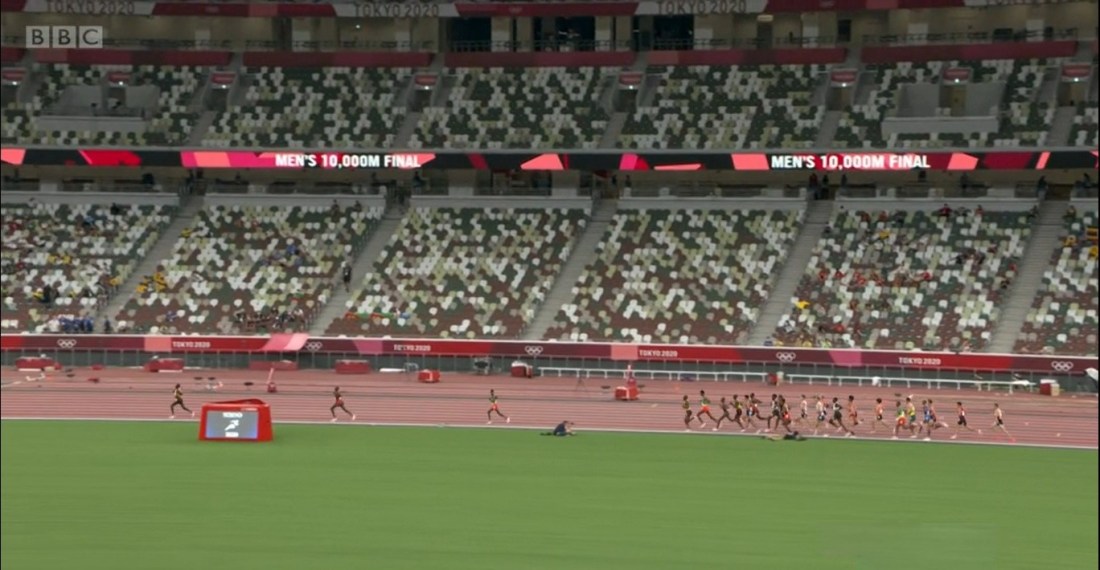
Day 7 of the Tokyo Olympics brought the opening sessions of the athletics. Empty seats have been a feature of sporting events throughout the pandemic and while the Japanese organisers had managed to break up the monotony of the seating with blocks of black, white, grey and brown creating something resembling QR codes or pixelated photos, it brought back memories for me. I attended the opening night of the athletics at the 2004 Olympics in Athens in a stadium that was three-quarters full.

The spectator-less seats of Tokyo provide a back drop to the men’s 10,000m final

It was the final night of my two-week trip to Greece during which, the second week had been spent rushing between Olympic venues to watch as many different sports as possible. To top it off, it was my birthday so a great way to finish off my holiday before heading for home.

The session started at 7:30pm and went on past midnight. The athletics ticket was the most expensive one I bought at 90 Euros, which was £60 at the exchange rates of the time, but I didn’t mind paying that to watch world-class athletics on my birthday. By comparison the much sought after swimming tickets, cost as much as 200 Euros if memory serves me right. Funnily enough I didn’t go to the swimming!

The Olympic stadium from the outside with Olympic flame alight.

I arrived early from an afternoon at the beach volleyball and took a final look round the Olympic complex before entering the stadium. I knew my way round the complex by now from all the time I’d spent there and I’d seen the inside of the stadium on grainy television from watching the torch lighting and opening ceremony a week earlier. Since then it had been Olympics morning, noon and night.


My seat was at the start of the back straight, opposite the finish line, at the end of the first bend. It was on the lower tier, many rows back and, as I walked down the aisle, there were already many other spectators in place. I had to squeeze past twenty people to get to my seat with all the attendant standing up, sitting down and apologising. Once I finally got to my seat, I realised how cramped it was going to be. Elbows touching with people on both sides of me and my knees against the seat in front. I wondered how I’d get through four hours of this.

As had become my tendency, I said “Hello” to the people either side of me and this turned into a chat with the chap on my left. “Are you on your own?” he asked. I replied affirmatively and he went on to explain that he and his wife had been given complimentary tickets by the IT company for whom he worked. The only problem was her ticket was at the other end of the stadium and they weren’t next to each other. Then he pounced.

“Would you mind swapping with her?”

Always happy to help and not feeling it could be any worse, I agreed and we went back through the embarrassing process of squeezing past the twenty seated people to get to the aisle. Up the stairs and out of the arena. We walked around the outside of the stadium, which seemed to take forever, until we were right below the Olympic flame that I’d seen being lit a week before.

I never questioned what was happening as the man phoned his wife. She came out of the stadium handed me her ticket, I handed her mine, they thanked me and that was it – I never saw them again. I walked up to the entrance, showed the ticket to the checker and they let me in with no problem. I emerged into a section full of empty white seats, my heart leapt into my mouth and I thought I’d been duped.

The rows of empty seats where I was to be seated. More empty seats are visible at the other end.

Rationality took over. The ticket was ok, security had let me in and I was just in a section where there was no-one else. On reflection, the organisers probably wanted to fill other areas first, particularly where my original seat was, as that would be seen on television. I strode down the steps to my seat in row 13 and was able to stretch out. There were perhaps fifteen people dotted around the whole section and I certainly wasn’t bumping elbows anymore.

I relax. Comfortably socially-distanced when it wasn’t needed!

There was no-one within ten metres of me – perfect for today’s social distancing but in 2004 we had different issues. Previous Olympics had been disrupted by a bomb in Atlanta and terrorists in Munich and we were only a few years removed from Sept 11th and the invasion of Iraq, security was always tight. There was a long list of things you couldn’t take into stadia and backpacks were always checked. I bought and lived off snack food and drink from vendors the whole week because you weren’t even allowed to take so much as bottled water into an event. Fortunately the prices were reasonable even if it wasn’t healthy. Looking at the photos I’m surprised at how bloated I look.

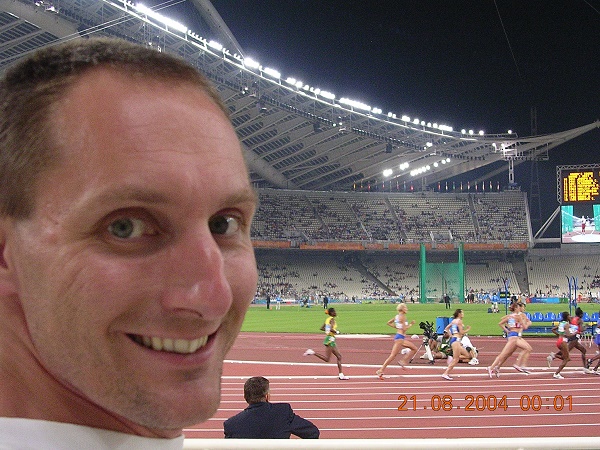
I tried to get a selfie at every event. The second heat of the women’s 5,000m going on in the background.

With only empty seats between me and the front, I wondered whether I could move down there but didn’t want to risk a confrontation with security or the threat of being removed from the stadium, so for half an hour I sat thirteen rows back with the raft of empty seats stretching out in front of me. At 8pm I snuck down to the front row and sat within metres of the track for the rest of the night. Whenever an event was due to take place, the competing athletes would enter the arena, parade clockwise around the edge for spectators to see them. For me, they were almost in touching distance.

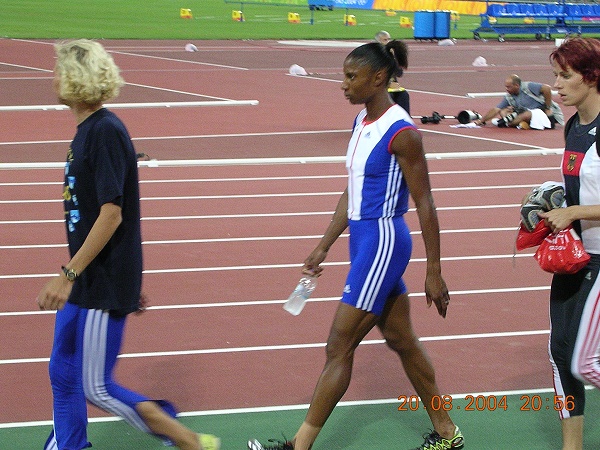
Denise Lewis and other heptathletes parade past on the way to their next event. Twenty-four hours later, Denise would no longer be the reigning champion.

Some events, such as the men’s high jump and discus, took place down the other end of the stadium so I watched them on the video screen. But situated where I was, on the bend, I got to see the 200m and shot putt of the women’s heptathlon featuring reigning champion Denise Lewis and fellow Brit Kelly Sotherton while, of course, all the other track events went past. It was amazing to be so close to the action. The organisers had scheduled a mixture of events for the session such that, almost every discipline was on display.

Kelly Holmes begins her pursuit of double gold beginning in the 800m.

The highlight of the night was the final of the men’s 10,000m; most other events were heats or qualifiers. I wasn’t into running enough then to appreciate the significance of reigning champion Heile Gebrselassie handing over his crown to Kenenisa Bekele. Of course, these days I know much more about running and looking back though all these photos has given me a new appreciation for what I experienced that night and who I saw.

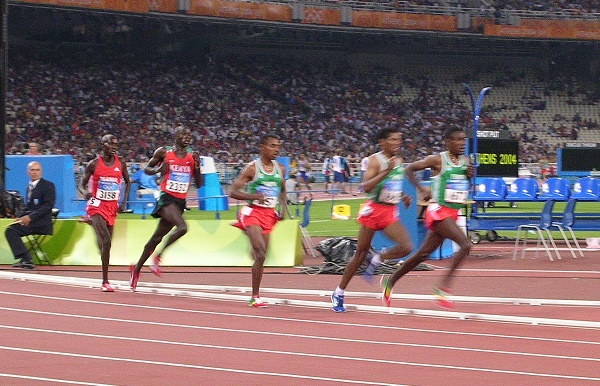
The final of the men’s 10,000m. Ethiopia’s Sileshi Sihine, Heile Gebrselassie and Keninisa Bekele ahead of Kenya’s Moses Mosop and Uganda’s Boniface Kiprop.

At 11pm some people from the neighbouring section realised it would be much more comfortable in my empty section than their own crowd-filled one so they snuck over. After having had it almost to myself, I felt strangely territorial about them entering my space even though there were more than enough seats for everyone. Maybe it was they were loud and noisy that irked me but no matter, it really didn’t take anything away from my experience. I was just tired after a week of constantly rushing from venue to venue; getting up at 6am, getting to bed at midnight and surviving on less sleep than I needed. Four hours of athletics had been a great end to my Olympic experience. When London rolled around eight years later, I was happy to sit at home and watch on television as I’d already been there, done that.

Another view of the empty seats as I stand below the scoreboard with Olympic torch towering behind it.

I would apologise for the low quality photos and video but it was the early days of digital. My camera was only 3MP, couldn’t record sound and I borrowed a 512MB SD card from someone at work to be able to store more images. Watching these video after so many years reminds me of the serendipity and luck that came my way when I agreed to swap seats with someone I’d never met!

A silent pan round the Olympic stadium – many empty seats

Eventual gold medallist Sweden’s Caroline Kluft runs in lane 3 (lane 1 is empty) while GB’s bronze medallist, Kellly Sotherton, runs nearest the camera. Powerful running in the final heptathlon event of day 1 – the 200m

Kenenisa Bekele in the final 200 metres on his way to gold holds off Sihine with the legendary Heile Gebrselassie twenty seconds adrift and featuring from 21-30secs in

A heat of the women’s 100m takes place in the distance. Heptathletes can be seen warming up in the foreground

Olympic thoughts – Is this sustainable?

Day 5 of the Tokyo Olympics had me watching cycling again with more commentary from Chris Boardman. This time it was the men’s individual time trial which was eventually won by Primoz Roglic of Slovenia.

Boardman accurately predicted it would take around 55-mins to cover the course, not too difficult maths when the riders are going at 48km/hr and the course is 44.1km long. At just under an hour it’s an event that’s comparable to elite men’s half marathon running, or in physiological terms it’s being run at Threshold. For lesser runners that might be a 10-mile run or only a 10K – it’s applies to whatever you can cover in an hour.

The nugget of commentary that really struck me was Boardman’s description about riding at Threshold. He stated:

“The first five minutes is free, you don’t feel the pain. That’s the bit where you have to use your head rather than your heart and then it becomes self-regulating, you start to get a feel for the pace, the pain sets in and then you manage it”

What he was describing was how, when you begin a race the legs are free of lactate and waste products that eventually begin to make them feel heavy and the effort to keep them moving gets tougher. With fresh legs it’s easy to go off too fast – build up the lactate quickly and then suffer; the ideal is to ration the build-up evenly over the course of the race. This is true at all race distances and even true during interval training.

After co-commentator Simon Brotherton mentioned that there’s a “fine line between pushing as hard as you can but not going too far into the red” to viewers, Boardman responded with more gold dust:

“There’s a constant calculation going on between …

How far is it to go?

How hard am I trying?

Is this sustainable? And if the answer is yes, you’re not going hard enough. If the answer is no, it’s too late so you’re looking for maybe”

What a fantastic piece of commentary. I must admit the idea of maybe seems quite novel to me. I’ve probably always pushed myself into maybe without realising it and just aimed to hang on, but I’d usually coach people to keep in the comfort zone of yes. We like things to be black-or-white, yes-or-no; Boardman showed that the best in world are risking playing on the edge with maybe!

Next time you’re on the start line at parkrun remember these quotes from Boardman and see how they reflect your experience. The great thing about parkrun is you can test “yes”, “no”, “maybe” over the weeks and begin to learn what each feels like.

Bolt runs the 800m

Usain Bolt recently ran his first 800m race. As I’m training for this distance, my interest was piqued to see what he achieved. Bolt, of course, is generally seen as the best sprinter of all time winning multiple gold medals in the 100m and 200m at consecutive Olympics and the World Championships from 2008 to 2016. As a junior his coach had wanted him to become a 400m runner, his best time was 45.28s, but he didn’t enjoy the longer training sessions and it became apparent he could be a champion at the short sprints. Running his first 800 race would be a big step up.

Out of athletics for the past four years, he said he’d been training for this race but it turned out to be part of an advert for a used car dealership. Its premise was that you can get an online valuation for your car quicker than Usain Bolt can run 800m. Bolt in lane 1 versus the customer in lane 6 sat in a comfy chair typing her car’s details into her phone. I’ll embed the video at the bottom, if you want to watch it, but Bolt appears to be jogging round on his way to a 2:40 time for 800 metres. The commentary is overlaid and there’s no sound from the track so I’m tempted to believe it’s masking the director telling him to speed up or slow down to ensure he finishes just slower than the customer. After all it wouldn’t be much of an advert if Bolt wins easily. Actually it’s not much of an advert anyway because I thought they were providing insurance quotes, not a price for your used car.

What I could glean from the footage is Bolt is running at a cadence of around 160 steps per minute which equates to a stride length of 1.88m per step. That’s not unbelievable given he’s 6’5” and when he’s in full sprint mode he’s averaging closer to 2.50 metre per step (and his cadence also up at 250 per minute). It’s deceptive watching the video because it really doesn’t seem like he’s covering much ground until you see his strides around the start-finish line. The slow cadence really does make it look like he’s taking it casually.

Even allowing for some play-acting, I doubt Bolt could currently run it that much faster – bear in mind his pace is 5:20/mile, it’s not that slow. He’s not overweight or unfit but of course he has detrained from his peak athleticism. As the best sprinter in the world, his genetics are geared towards speed. He stated in a 2013 interview that he could run the 800m in 2min05 so that gives us a reference for his ability when he was a trained sprinter. There’s also a segment from Superstars in 1986 on Youtube of Carl Lewis, who was the Olympic champion in the same events as Bolt – the 100m, 200m, 4x100m, where he ran 2min15 for the half mile. So I’m inclined to think a detrained Bolt couldn’t have run 800m much quicker than he did in the advert.

A short postrace interview with Bolt shows him lying on the ground having his legs massaged and breathing hard. His splits for this 800 were 35s and 39s for a 1:14 first lap followed by 44s and 42s for a second lap 1:26. That final 200m being faster suggests he did try to pick up the pace. These splits are fairly consistent with what I experienced in my 800m time trials – when I ran 2:53, my splits were 39 / 43 / 45 / 46 secs and I tried to sprint at the end but my legs were tying up with lactate. It’s a fast start and then struggle to hang on.

One difference is that Bolt can run a significantly faster 200m than I can – his world record is 19.19s – yet at 35sec his opening 200 isn’t much quicker than when I time trialled at 39s. His controlled start may have avoided building up the oxygen debt that leads to heavy breathing.


What I’ve found with all my distance races is that it doesn’t matter how hard you train for speed and to handle oxygen debt, there comes a limit to how fast you can go because the by-products seize the muscles up. When your body is trained for speed lactate and waste products are being produced from start to finish. It’s why for in distance running you need to build a good aerobic system to delay their production so they are only produced at higher speeds.

I can remember finishing parkruns when I was speed-trained, saying there was more to come because my legs never felt tired, yet it was only when I did more easy running that my times got quicker. I had to build aerobically through daily easy, steady and long runs to improve at parkrun and longer distances.

Some people are naturally full of slow-twitch muscle and therefore find it easier to build their aerobic capacity – they’ll start with a bigger base. For those with more fast-twitch, either you stick to the sprints as Bolt did or commit to doing the miles that will develop them aerobically.


Usain Bolt’s 800m in 2:40

Skip to 2min43 to see the race won by American footballer James Lofton in 2:03 with Lewis taking 2nd place

Update on my 800m training – June-July 2021

I’m now six weeks into the second time round with my 800m training. My first go-round, following a Jack Daniel’s plan, lasted from December to May and didn’t provide great results as my 800 time only improved from 2min58 to 2min53. But I knew I was running faster, felt fitter and hoped a second go-around would show better results.

This training block is full of intervals ranging from 200-600m in length. As you’ll see in the stats the vast majority are short with just four 600s planned. Last time I was aiming to run at 48sec/200m but later realised I should have been using 48½ which I could only just scrape on the 400s and 600s.

I’ve been working to 47sec/200m which is the training for a 2:52 800m. Trouble is, I’ve been averaging 43s for 200m, 1:31 for 400m and 2:15 for 600m. It seems like this reflects the discrepancy between my time trials and how I actually felt my fitness had been progressing.

More speed

Last time I tried to be accurate with my interval efforts – not going fast than necessary but always hitting target. This time I’ve thrown caution to the wind and allowed myself to run without holding back. That’s not to say I’ve gone all-out, I haven’t; just not held back.

Target timeOn targetMissedEffortsFastest
200m47s66470(14.0km)37.9s(5:05/mile)
400m1min342424(9.6km)1:26.83(5:49/mile)
600m2min21-2233(1.8km)2:13.78(5:59/mile)
Total93497(25.4km)
Some interval stats for those who love them!

I’ve also introduced 8 strides of 10secs after my Friday morning recovery run. Ideally Jack would have me doing these on two of my recovery days but I didn’t want to undermine my aerobic base too much. Last time around, I didn’t do any; this time I’m doing one set. Next time around, if everything is going well, I’ll introduce the other day.

I suspect it’s (a lack of) this faster running that was holding my 800m time back in the past. I’m beginning to see my fastest pace come down from 5min/miling to 4:30/mile during strides and this may partly be down to the limitations of how quickly my GPS watch can produce an accurate pace.

Injury risk

The bigger danger is pushing too hard may lead to injury and it happened. I suffered a minor hamstring issue in week 5. It was the final 200 of a session that had already totalled 2,800m, and when I’m feeling good as I was, I tend to like to finish strongly; so  I pumped my legs as hard as I could but felt a tightening in the right hamstring and it began to knot. I eased off, finished out the effort and jogged home.

I was fortunate to have this happen on the Thursday as it gave me five days to recover before my next set of intervals. I still ran on the days in between and by the Tuesday my legs were feeling great during the warm-up. I eased into the efforts but by the 4th 200 I was getting a sense I might not last. The next 400m I felt some tightening and on the next it was even more notable so I backed out and jogged home. That was last week and I missed the final day of intervals opting to keep runs easy and never push them along. I did a couple of strides on my Sunday long run and that seem to confirm the hammy is ok so I’ll resume training to the plan.

Long runs and mileage

The switch from a block of pure endurance work to repicking up speed work left the legs struggling on the general runs but it didn’t last past the first couple of weeks. But the introduction of the strides also sapped the legs going into the Sunday and so I haven’t seen much progress on their pace, they’re still around the same pace as last time around.

The six weeks of training I’ve done so far have resulted in 41.3, 45.1, 44.7, 45.7, 42.0, 43.8 miles.

Running form

Since April, I’ve been looking at how sprinters run and trying to apply some of their techniques and drills to my own running. The strides have been useful for this and I’ve particularly been focused on minimising hip rotation through better knee lift. I seem to be getting higher cadences on many runs and that’s going to be an important part of getting faster. The higher cadence corresponds with a concomitant rise in my glutes doing the work.


Once again I’ve really enjoyed this block of training. Getting out and running fast is fun especially as I’ve been finding it so easy to hit target. The hamstring injury is frustrating but I’m hoping that with the next phase of training being longer intervals at a slower pace that it’ll survive. I can run on it as long as I don’t overdo the forces going through it.

In the next phase, I’m meant to up my paces for fast efforts by a 1-sec/200m but, given I’ve been finding it so easy, I’m going to compromise by adding 2-secs so that I’ll actually be aiming for 45s per 200 which is what I’ve usually been running them at. This isn’t recommended as you should train at paces that relate to proven times and I haven’t actually run a 2:48 800 that would justify it.

Parkrun is also due to restart at the end of July and I’d like to attend. I’m not going to run hard every week but I’d like to see where I’m after all this training. I feel like I’m close to sub-20 form. It’ll mean dropping a workout, which isn’t ideal when you’re following a plan, but a fast parkrun will still have benefits.

But the priority is keeping the hamstring healthy.