Update on my 800m training – Sept 2021

The second cycle of 800m training is coming to a close. Next week I’ll go do an 800 time trial and see how successful it’s been. The last block of training through July-August was mixed in its success. I felt stronger by the end of it but quite often missed the target times due to overly tired legs. Missing target was a little demoralising yet seeing other things going well helped offset that.

This month’s training has been about sharpening up for the 800TT. Its focus has been miles at Threshold pace to help build Lactate Clearance, along with short intervals at 800m and mile pace for building Lactate Tolerance. The hardest efforts, which need some psyching up for, are the long 600m efforts at 800m pace. On their own it wouldn’t be awful but often they’re thrown in as one part of a bigger session. For example, the first week was simply three 600m efforts with a 1km jog recovery – each effort takes a full-on effort.

Threshold running (T-pace)

The early efforts for these came in around 6:50-55/mile pace. This was a good twenty seconds faster than the same workouts six months ago. But as my fitness sharpened up I began to run them faster and by the past week I was running at 6:40.

The dilemma has been whether to stick to pace or trying to go based on how the body is reacting. As I’m not one for staring at the GPS anymore I’ve opted for the latter hence why my fastest effort came in at 6:34! Considering during July-August I was struggling to run my kilometre intervals at this pace, it all suggests training has been going in the right direction.

Mile-pace running (R-pace)

The plan has been packed with 200s at mile pace but, they’re often at the end of a Threshold session when the legs are tired and heavy with lactate. Sometimes they’ve been hard to get on-target, needing lots of effort to scrape in; other times it’s seemed easy to hit target with lots to spare.

Given the aim was to hit 44sec there’s only been one over 44½sec which was into a headwind; I judge them as having been a success.

800m-pace running (FR-pace)

These have been the rewarding part of training. Last time I was aiming to complete 600s in 2:06 and I only managed it once. This time, I was aiming for 2:00 and managed to get under it three times along with two more at sub-2:02 – not too far off.

There have also been some slower 600s and last Thursday finished on a low note with them coming in at 2:07 and 2:09. I can throw out excuses about high winds but, in the end, I still like to hit target. Yet when I think back to the start of the year I was running my initial 600s in around 2:23 there is something good happening overall.

There were a couple of 400s mid-month which came in on target at 1:18-19 compared to 1:27-29 in the equivalent session six months ago. And again at the beginning of training I remember one misjudged effort came in at 1:41!

The shorter intervals of 200, 300 have been interesting. Generally I’ve struggled to run them much faster than last time around. Fastest 200 in March was 37.45s, this time it’s 36.73sec; so there is a little more quickness but it’s not been a massive leap.  I got a couple of sub-37s on a wind-assisted day and sub-59 300s on another.

So it really seems like I’ve improved my speed endurance this go-around but haven’t done much for my actual top end speed. The 200s are averaging sub-5 pace now which is pleasing given I couldn’t even hit that pace at the start of the year. Doing strides has been a factor on the speed side and I managed to get the pace down to 4:07/mile momentarily on one so hopefully there is more to come.

Stats

I’m not going to go overboard on the stats as they’ve been so variable. But to give an indication of my fastest efforts in time and pace; plus what that multiplies up to over 800m. It’s noticeable that the longer efforts of 400-600 are about the same pace.

FastestPace800m pro-rata
200m36.73s(4:55/mile)2:26.9
300m58.23s(5:12/mile)2:35.3
400m1:18.9(5:17/mile)2:37.7
600m1:58.22(5:17/mile)2:37.6

Running form

Since starting the second time around with the plan, I’ve been working on my running form. I’ve specifically been trying to figure out how to sprint faster and somewhere over the past month or so it all began to come together. I found my legs were beginning to spring off the pavement and each stride would cover more distance. This has caused muscles in my right hip and glutes to get more active to fire produce thee springing action but also involved protecting muscles around the calves and quads that absorb the landing forces. These actions are beginning to become second nature now and with the initial stimulus over, I expect them to build in coming weeks.

Summary

The most pleasing part of training is that my fitness has remained throughout. There have been one or two sessions where I couldn’t get it done but that’s to be expected. There are always ups and downs.

When I did this same training block six months ago, I struggled to get any of the 600s on target and they even slipped backwards by the last couple of weeks. I think this is part of why my time trial barely improved last time around (2:58-55). This time I’ve been hanging in there and am now hoping my 800TT will see a significant improvement – at least scraping down into the 2:30s.

My easy runs have begun to get quicker over the last week or so and I’m beginning to feel like I’m getting back to the form I had back in 2012. Not quite there yet but I am intending to do a fast parkrun in October as well. So that’s all to look forward to in the next update!

Starting intervals

A recent Thursday workout was a combination of fast intervals – 600, 400s, 200s. The first came in at 2min05. The 400s both pleasingly scraped under 1min20 while the 200s were a final gasping all-out effort to get on target. Arriving home the 400s and 600 were what stuck out in my mind because they were close to the times I used to clock when running round Poole Park cricket pitch. In fact, when I looked them up I discovered the workouts I did were exactly a decade ago. How times move on.

In September 2011, I wasn’t the committed runner I am now. My first six months of the year had only seen me bank less than two hundred miles but I could run a 21:30 parkrun. In July I started doing a proper warm-up which knocked over thirty seconds off taking me sub-21. I then entered New Forest half marathon for late September and this triggered my “train harder” instinct.

My belief about getting faster at running then was based around the same idea as most people – run faster in training. But, as a sports and exercise science graduate, I’d also read up on the ideas of increasing VO2max through hard interval training and Lactate Threshold through tempo runs and through Stephen Seiler’s MAPP website thought this was the way to train. It was unsophisticated stuff but to the untrained runner it has initial benefits.


I decided hard intervals, aiming for a 19-min parkrun pace, were the way forward. After all, if I wanted to run nineteen minutes I needed to train at the pace. It didn’t seem insurmountable as I’d run a 5:55 mile in the summer which is a similar pace.

I didn’t own a GPS watch but had a sportswatch to time my runs and used a heart-rate monitor. The watch could store some basic info with the lap button but I’d often simply commit numbers to memory and write them down when I got back to the office! I have many spreadsheets filled with this sort of data.

I found a website (Gmap-pedometer) which allowed me to measure distances and found a lap of the cricket pitch to be a third of a mile. Starting from a particular blue bin and running to the pavilion is 400m. I still use these measurements to this day.What I did next is some maths. I calculated with the cricket being about 530m, I’d need to run nine or ten laps to cover the 5,000m distance of a parkrun. Nine laps would fall short at 4,770m; ten would come in at 5,300m and ensure I had a little extra in the tank. With a 19-min parkrun being about six minutes per mile, each of these lap would need to be covered in two minutes, 400m in 1min30. I’d give myself one minute’s recovery between laps and push hard on the efforts. After all, if I could run them faster it must be better and lead to improvement?

This was my plan for improving and it had worked for me on the rowing machine many years before.  But there were two immediate flaws with what I did.

  1. With my then-parkrun pace at around 6:40/mile, I was asking a lot to jump down to running 6min/mile with nothing to bridge the gap. Certainly I was capable of the pace but to do ten intervals with only sixty seconds’ recovery was asking too much of myself. When I succeeded on the rower I’d been aiming a few seconds faster than my existing times. It’s why when I became a successful parkrunner six months later, and got my time down to nineteen minutes, it was because I only ran intervals at a few seconds faster than my existing parkrun pace.
  2. I tried to cover the distance rather than do enough work to stimulate improvement. These days I’d wouldn’t do more than 3,200m worth of work at mile pace and around 1,600 – 2,400m is more usual. A full 5,000m is simply too much stress on the body to recover from. Think about it, when you train for a marathon, you only do a long run of 20-22 miles maximum. If you’re doing 10K training then the elites will only do 6-8K at race pace. It’s a mistake to believe just because the race distance is relatively short, you need to cover it in training.

The biggest flaw though is that, when I began doing these intervals ten years ago, I didn’t lack speed. As I wrote in filling in the gaps, you have to figure out what’s missing. My issue was endurance and lack of aerobic capacity. My parkruns improved three months later after I’d logged many easy miles with just the occasional fast parkrun thrown in. I already had the top end speed, it was the endurance base that was missing.

Update on my 800m training – Aug 2021

I’d say the past six weeks have been the most difficult block of training since I started in December. I knew this was going to be tough because the same block in January-February was tough. But it was tough for different reasons. Last time, it was tough because I got aches, pains and tightness as the training hit ‘new’ muscles and pushed me to my limits. This time, I just found myself struggling to hit target times and paces in many sessions. When I ran well, I ran really well but when it was poor, it was really poor!

There’s a few possible explanations for this. Firstly I came into it recovering from a strained hamstring, so fitness in the first week was below par, but the injury never recurred, and I’ve been strong since. I took the first week carefully and deliberately didn’t do some of the faster work.

Secondly I pushed the paces up to the level I felt I was achieving rather than following Jack’s guidelines. Maybe I expected too much? I don’t think so as when I’ve been on form, I’ve been smashing target times and numbers by a decent margin.

The most likely explanation is simply that I’m under-recovering. As I say, last time around I got tight with aches and pains; this time the body is used to using those muscles but they were still recovering from previous sessions.

The other reason for being under-recovered may be the return of parkrun. I’ve attended each week since it returned on July 24th and while I’ve been careful not to race them, I have been running close to my steady pace. This may just have been taking more out of my legs than I realised especially as it’s an undulating course on uneven paths.

The training itself has been a mix of three sessions – long intervals, short intervals and threshold runs.

Long Intervals

Long intervals have been the centrepiece of the work, starting at three minutes in the early weeks and lengthening out to five minutes by the last. I’ve been aiming to run these at 6:30/mile pace and when I’ve been on form, they’ve been fine.

In February I was on target, for 6:50/mile pace, 33 out of 34 times – just one effort too slow. This time it’s been about half. Weeks one, five, six have been complete misses while weeks two, three, four have all been on-target. This all-or-nothing phenomena supports why I believe the legs were under-recovered. At my best in week four I ran 5x1K all at sub 4-min pace (6:17-24/mile) but when I struggled I’ve barely been able to reach 6:35/mile pace.

Short Intervals

As ever these have ranged from 200 – 600m aiming for either 6min/mile or 5min30/mile pace. I’ve usually felt confident about achieving the slower of these efforts even when the interval length is longer but the reality is that often I’ve just been a touch slow – closer to 6:10/mile. The faster efforts have generally been daunting, because they usually crop up at the end and you wonder how you’ll ever complete them, yet quite often I’ve found something extra to give to them.

I’ve noted that while Jack gives you three mins jog recovery between these efforts, I’m usually recovering my pace and heart-rate within a minute to ninety seconds. Many years ago, when I was on the way to my first sub-40 10K, I was successfully running these sort of intervals with a 200m jog recovery that equated to 1min10.

Tempo / Marathon pace

The plan had three of the standard Sunday long runs replaced by these sessions. As it happened I only did the two Tempo efforts because I ran an all-out parkrun during the block. The Tempo runs seemed to come in comfortably around 7-min/mile which was what I was aiming for.

As I say, parkrun returned. I’ve been consistently hitting 7:20-25/mile paces without undue effort which seems to fit with my marathon pace prediction.  At the end of week five, I ran my all-out parkrun which came in at 21:24. I was expecting quicker – something in the 20:30-45 range – but the time reflected that my legs seem to have been missing something. The first kilometre was slower than my best interval efforts and the last two miles were slower than the pace of my Tempo runs.

To accommodate the Saturday morning effort, I ditched the plan’s 400m intervals on the Thursday and ran for 30-mins at Poole Park. I intended it to be an easy run but it turned out to be around marathon pace. On reflection it was probably too close to the parkrun for my legs to fully recover but it did effectively replace the planned 40-mins at marathon pace scheduled for the Sunday.

Strength and Conditioning

I’m going to write a separate post detailing the strength and conditioning I’ve been doing over the last couple of months. It’s not a massive amount – some corework, press-ups and bicep curls. They seem to have been beneficial in burning off a layer of body fat, which I didn’t know I had. No-one would ever have called me fat. On the heavy weights days I’ve found myself getting tired in the afternoons and I wonder if the energy used for recovering from these sessions has affected my recovery from running.

Running Form

As I’ve written in previous updates, I’ve been working on sprint drills and techniques during my short interval efforts and strides. I felt like it’s been heading in the right direction and in recent weeks I’ve noticed its effects coming through. I’m beginning to get up on my toes more, my core stabilising my running and best of all, finding myself trampolining down the road with each step. On a couple of occasions I felt the back of my shoulders get very painful towards the end of runs, which I see as a good sign – I’m engaging previously unused muscles that needed to develop the strength and endurance to hold the new running form together.

Summing Up

Writing all that up has given me some good insight as to what’s been going on. Week one, I struggled but was coming off the hamstring problem so accepted my fitness was slightly down. The next three weeks I began to really motor and feel confident about how I was progressing. It felt like I’d filled in a missing link that had stopped me from achieving my best in the time trials. But the combination of sessions, pushing them too hard, extra effort and parkrun may have been too much to run well in the final two weeks.

My mileage remains about the same as previously and the six weeks resulted in 43 / 43 / 44 / 46 / 41 / 48 miles. These have usually required about 6 hours training, but week five was 5hr30 as I tried to freshen my legs up and then week six came in at nearly seven hours!

Target timeOn targetMissedEffortsFastest
200m45s7310(2km)38.06s(5:06/mile)
41s88(1.6km)
300m1min01639(2.7km)58.99s(5:16/mile)
400m1min30516(2.4km)1:19.7(5:18/mile)
1min2211(0.4km)
500m1min5311(0.5km)1:53.9(6:07/mile)
600m2min156410(6km)2:07.4(5:42/mile)
I-Pace6min30211334(27.7km)
T-Pace7min0277(11.2km)
Total612586(54.5km)
Stats for those who love them!

Despite all the missed I-paced targets I feel positive. I’ve run my fastest 300s and 400s and not necessarily in perfect conditions. My very last session of the block was a repeat of one I did at the beginning. It began with three 600m efforts. In January, I ran these at around 2:20-24, in February it was 2:17-18, in July they were 2:15-16 and then this past week they came in at 2:07-08. My fastest in the last block, as I came to my peak, was only 2:05. It’s very gratifying to see some tangible progress and this wasn’t my hardest effort possible. There is more to come!

The Ageing Runner – Part 1

When I began parkrunning I was in my thirties. I’d never been a serious runner but my Saturday morning endeavours motivated me to get training and as I began my forties I started recording Personal Bests at all distances. As I approached forty-five I ran my first sub-40 10K. I was getting better with age.

Now as I move into the VM50-54 category at parkrun, I still believe there’s more to come. This is not to say that age doesn’t see a decline in your capabilities, only that I never fulfilled my potential when I was younger.

I’ve never believed the limitations of the human body are as pronounced as other people like to believe and in this five-part series of posts I’ll detail how fast older runners, both men and women, can be as they go up through the age categories and over different distances. I think you’ll be surprised to find out it’s much more than you can imagine.


There’s no doubt a fifty-something runner is not going to be capable of the times they could have achieved in their twenties, but there is a belief that this decline is rapid. It’s generally agreed athletes peak at around twenty-seven but it can be a couple of years either side. Becoming a world class athlete takes a decade of development and while the body finishes its growth by eighteen years old, there are still maturation processes going on within the brain and hormones that continue into the twenties.

Here’s a question to ponder for a moment …

If an athlete’s peak is twenty-seven and they begin to decline after this, at what age are they achieving the same standards as when they were seventeen? For example, if your parkrun PB at seventeen was twenty minutes and you continued training for the rest of your life hitting a lifetime best of fifteen minutes at twenty-seven; what is the age when you will last be able to record twenty minutes again?

I’ll give you the answer at the end of the article.

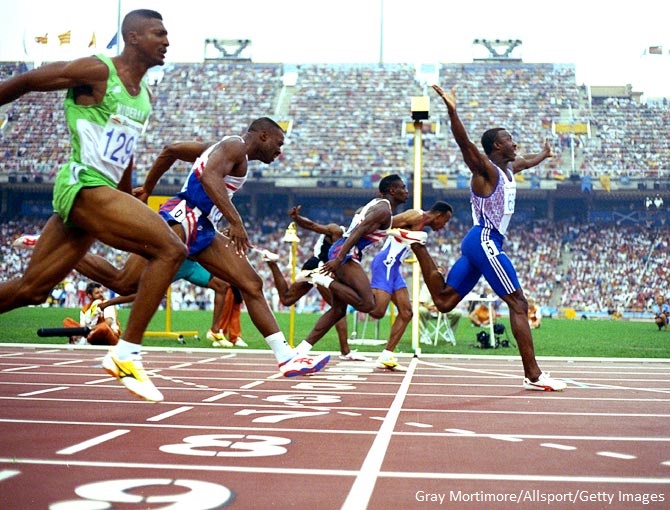
Ageing in sport is one of those myths that is slowly being deconstructed. In most professional sports, athletes are usually finished in their mid-30s with just the occasional highly skilled technician or specialist (think golfers, goalkeepers or quarterbacks) making it into their forties. I recall watching the Barcelona Olympics where Linford Christie became the oldest sprinter ever to win the Olympic Gold at the advanced age of 32!

32-year-old Linford Christie becomes Olympic Champion

In recent years we’ve seen athletes extending their careers into their late thirties despite professional sport now being played at a higher level than it was. In tennis we see Roger Federer and Serena Williams still near the top as they close in on forty; while sprinter Justin Gatlin won the World Championship in 2017 at age 35 and is still running sub-10 second 100 metres. Eliud Kipchoge just won his second Olympic marathon at 36.

As you’d expect these elite athletes are gradually losing their ability to compete at the top of their sports. I often meet runners who, having given up for twenty years or, never run when they were young, believe that because they’re older, the faster times are going to be beyond them. Now while well-trained elite runners are never going to be as fast as when they were younger, for those of us who start late, didn’t train or got poor coaching there’s every chance we can be faster and fitter than we’ve ever been before.


Within this series of articles I’m going to give you the facts and figures about what runners over the age of thirty-five are achieving. While you won’t necessarily be able to match them, what it should give you is a realistic view of how slow the decline is and how quick it’s possible to stay running well into what most people consider old age. I want you to come away from this series feeling inspired about what is possible. Whether you decide to get the best out of yourself is your choice, but age is not going to be an excuse if you don’t!

  • In part 2 I’ll examine the Masters sprinters (100m / 200m / 400m)
  • In part 3 It’s the turn of the middle-distance runners (800m / Mile / 3,000m)
  • In part 4 We’ll look at the long distances (5,000m / 10,000m / Marathon)
  • In part 5 I’ll give a brief overview of what’s happening as the body ages and what you can do to delay the effects

Answer to the quiz questionthe old age equivalent of being seventeen is sixty-five years old. That’s right. Your physical maturity peaks at age twenty-seven but the decline is so gradual that over thirty years later you’re still capable of doing what you could at seventeen years old. This, of course, requires you to stay healthy and training.

Mental toughness

In Is this sustainable? I quoted Chris Boardman talking about how it feels during a race. He said “There’s a constant calculation going on between … How far is it to go? How hard am I trying? Is this sustainable? And if the answer is yes [to the sustainable question], you’re not going hard enough. If the answer is no, it’s too late [because you’ve dropped time by not going harder] so you’re looking for maybe”. I was thinking about this as I ran parkrun and it occurred to me that how you respond to this question shows your level of mental toughness.

The difference between the mentally tough and the ordinary person is that the ordinary person gives up when they realise something isn’t sustainable. The mentally tough person doesn’t accept No for an answer. As I wrote in Denial, they dig in and try to gut it out. They’ll keep trying, hoping to find some kind of energy reserve – they may find it, they may not. In a race against opponents (especially mentally weak ones) not knowing your limitations can make the difference between winning and losing.

It’s fairly obvious that the mentally weak are happy to continue when the answer is Yes and they’ll give up for a No; but I’d venture that it’s the Maybe answer which is enough to get them shutting it down and giving up. As soon as the answer changes to “I’m not entirely sure this is sustainable” which Boardman says is the very thing you’re looking for; the doubt begins to creep in and they give up and fall back to a safe zone.


In recent years, theories of fatigue have moved on from it being caused by a build-up of waste products in the muscles; to being about the brain taking feedback about those build-ups and subconsciously allowing the athlete to keep going, or the mind tempting them to slow down by experiencing build-ups as pain. Therefore elite distance runners are beginning to add mental stress to training sessions to teach the brain, it can cope with more and it’s safe to continue going. You could liken it to walking up a street in the dark. The first time you do it, you’re tentative with each step because you don’t know what’s ahead. But if you repeat the experience and know you managed ten steps safely, you walk those steps quickly the second time.

If you can push through pain in training or races, it’ll give you an extra dimension to your running – it’ll teach your brain that it’s safe to release the unused reserves. This is the bit where mentally weak athletes have a disadvantage. If they aren’t willing to push through the pain, their brain isn’t going to feel safe to allow them to break into their reserves. I’ve met a good many runners who always play it safe. They start off slowly, start at the back of the field, or ease off when exhaustion or heavy breathing threaten. They don’t try to push through the temptation of giving up, they simply give up.

I believe the role of the mental side of running is overplayed in modern literature. No matter how much you want or desire to be the Olympic champion, you still have to train before you can get close to that stage. Physical limitations are still limitations to be addressed by training, not by thinking you can run harder.  But, when Eliud Kipchoge ran the first two sub-2 hour marathon, it’s possible the knowledge of getting within twenty-five seconds on his first attempt was enough to help him find the extra seconds. That’s what mental toughness and training is about, having a confidence to push through Maybe and give it your all.

When the going gets tough, there’s probably more to be eked out than you realise. Pushing hard occasionally in training and races will help the mind know it’s possible.

Muscles need recovery

The week I tweaked my hamstring I did two big workouts. It was all interval work and I was pushing hard, breathing hard and hitting paces I haven’t seen in a while. It was on the final effort of the second session, that I pumped my legs as hard as possible, hoping to end with a quick time, when the hamstring tightened and knotted.

The following day I ran a careful recovery run; the same again on the day after. The hamstring was already feeling 95% healed and offered no issues on the third day – a long Sunday run. I expected to run quicker than usual after two easy days but, while my legs didn’t feel tired, it wasn’t faster. My heart-rate barely went over 145bpm and although I had the energy, my legs just didn’t have the bounce or verve to go fast.

The next day was totally different. I went for my usual recovery run and my legs were full of power. Now I couldn’t slow down, it was the run I’d hoped to do the day before.

That’s the point of this opening: it had taken 4-6 days to recover from the workouts of the previous week. The hamstring tightening had been a sign I’d already done enough and once that recovered, it still took until the Monday for my legs to be ready to run like I’d hoped they would on the Sunday.

This is where many runners training falls apart – they push too hard, too often – they don’t let their bodies dictate the pace, particularly on their recovery or easy days. I know many runners who would have pushed hard on the Sunday and it would have delayed the recovery further.


A few years ago I became enamoured with doing 8-mile threshold runs. Start off with 15-mins of warm-up then push the pace up to the point where my breathing was on the edge of threshold and force it along for the better part of an hour. Warmdown, recover for two days then repeat the same session again later in the week. On paper, I was doing everything right. I was following the 80-20 rule, I was getting lots of recovery and so on.

For a couple of weeks, it went really well. My pace improved and I began to get faster. Then, on weeks 3 and 4 I saw no improvement. Around the same time my lower back began to tighten up. I went another week with the runs but the aches were increasing. It reached the point where they affected my day-to-day living and reluctantly I concluded I was going to have to back off the running until it subsided. So I went back to easy running and let my body dictate the pace rather than try to force things. Within two weeks everything eased up and I raced a decent 10K.


My experience is not uncommon among runners. At least in the sense that when they overdo things they start to tighten up and get aches and pains. This is the body’s reaction to trying to use muscles that haven’t recovered. It might be felt in the Achilles, it might be in the plantar, I’ve even had it in my shoulders! The only uncommon thing about my experience is that I didn’t whine and complain or put it down to bad luck or old age; I looked at my running and changed my training plan so I was able to train without pain.

This is why keeping recovery days genuinely easy is important, it gives muscles time to recover without putting extra stress in. Most runners are used to their legs aching the day after a run, they might even get some DOMS on the second and, after half and full marathons I’ve still been struggling on days three and four. They understand the need for recovery at those times because it’s obvious. But they rarely understand aches and pains in day-to-day living are general signs of needing recovery. It’s the aggregation of unrecovered muscles being called back into action too soon. Any time I have aches, pains or tightness, I know I’m going to have to back off my training. That doesn’t mean a rest day although it could. It may just be changing a workout to an easy run; it may be delaying it by a day, it may be cutting the workout down.

The moral of the story is muscles need recovery. The more effort you put in, combined with how much you do, dictates how long it’ll take to recover. It can take ten days to recover from a good speed workout. Old runner wisdom says it takes a month to recover from a marathon. While you don’t have to be perfectly fresh to train harder, you do need to listen to your body. Aches, pains and tightness that come from nowhere are always a sign that you’re pushing hard. If you continue to push hard they’ll get worse to the point where you’re forced to let them recover one way or another.

Olympic thoughts – Is this sustainable?

Day 5 of the Tokyo Olympics had me watching cycling again with more commentary from Chris Boardman. This time it was the men’s individual time trial which was eventually won by Primoz Roglic of Slovenia.

Boardman accurately predicted it would take around 55-mins to cover the course, not too difficult maths when the riders are going at 48km/hr and the course is 44.1km long. At just under an hour it’s an event that’s comparable to elite men’s half marathon running, or in physiological terms it’s being run at Threshold. For lesser runners that might be a 10-mile run or only a 10K – it’s applies to whatever you can cover in an hour.

The nugget of commentary that really struck me was Boardman’s description about riding at Threshold. He stated:

“The first five minutes is free, you don’t feel the pain. That’s the bit where you have to use your head rather than your heart and then it becomes self-regulating, you start to get a feel for the pace, the pain sets in and then you manage it”

What he was describing was how, when you begin a race the legs are free of lactate and waste products that eventually begin to make them feel heavy and the effort to keep them moving gets tougher. With fresh legs it’s easy to go off too fast – build up the lactate quickly and then suffer; the ideal is to ration the build-up evenly over the course of the race. This is true at all race distances and even true during interval training.

After co-commentator Simon Brotherton mentioned that there’s a “fine line between pushing as hard as you can but not going too far into the red” to viewers, Boardman responded with more gold dust:

“There’s a constant calculation going on between …

How far is it to go?

How hard am I trying?

Is this sustainable? And if the answer is yes, you’re not going hard enough. If the answer is no, it’s too late so you’re looking for maybe”

What a fantastic piece of commentary. I must admit the idea of maybe seems quite novel to me. I’ve probably always pushed myself into maybe without realising it and just aimed to hang on, but I’d usually coach people to keep in the comfort zone of yes. We like things to be black-or-white, yes-or-no; Boardman showed that the best in world are risking playing on the edge with maybe!

Next time you’re on the start line at parkrun remember these quotes from Boardman and see how they reflect your experience. The great thing about parkrun is you can test “yes”, “no”, “maybe” over the weeks and begin to learn what each feels like.

Bolt runs the 800m

Usain Bolt recently ran his first 800m race. As I’m training for this distance, my interest was piqued to see what he achieved. Bolt, of course, is generally seen as the best sprinter of all time winning multiple gold medals in the 100m and 200m at consecutive Olympics and the World Championships from 2008 to 2016. As a junior his coach had wanted him to become a 400m runner, his best time was 45.28s, but he didn’t enjoy the longer training sessions and it became apparent he could be a champion at the short sprints. Running his first 800 race would be a big step up.

Out of athletics for the past four years, he said he’d been training for this race but it turned out to be part of an advert for a used car dealership. Its premise was that you can get an online valuation for your car quicker than Usain Bolt can run 800m. Bolt in lane 1 versus the customer in lane 6 sat in a comfy chair typing her car’s details into her phone. I’ll embed the video at the bottom, if you want to watch it, but Bolt appears to be jogging round on his way to a 2:40 time for 800 metres. The commentary is overlaid and there’s no sound from the track so I’m tempted to believe it’s masking the director telling him to speed up or slow down to ensure he finishes just slower than the customer. After all it wouldn’t be much of an advert if Bolt wins easily. Actually it’s not much of an advert anyway because I thought they were providing insurance quotes, not a price for your used car.

What I could glean from the footage is Bolt is running at a cadence of around 160 steps per minute which equates to a stride length of 1.88m per step. That’s not unbelievable given he’s 6’5” and when he’s in full sprint mode he’s averaging closer to 2.50 metre per step (and his cadence also up at 250 per minute). It’s deceptive watching the video because it really doesn’t seem like he’s covering much ground until you see his strides around the start-finish line. The slow cadence really does make it look like he’s taking it casually.

Even allowing for some play-acting, I doubt Bolt could currently run it that much faster – bear in mind his pace is 5:20/mile, it’s not that slow. He’s not overweight or unfit but of course he has detrained from his peak athleticism. As the best sprinter in the world, his genetics are geared towards speed. He stated in a 2013 interview that he could run the 800m in 2min05 so that gives us a reference for his ability when he was a trained sprinter. There’s also a segment from Superstars in 1986 on Youtube of Carl Lewis, who was the Olympic champion in the same events as Bolt – the 100m, 200m, 4x100m, where he ran 2min15 for the half mile. So I’m inclined to think a detrained Bolt couldn’t have run 800m much quicker than he did in the advert.

A short postrace interview with Bolt shows him lying on the ground having his legs massaged and breathing hard. His splits for this 800 were 35s and 39s for a 1:14 first lap followed by 44s and 42s for a second lap 1:26. That final 200m being faster suggests he did try to pick up the pace. These splits are fairly consistent with what I experienced in my 800m time trials – when I ran 2:53, my splits were 39 / 43 / 45 / 46 secs and I tried to sprint at the end but my legs were tying up with lactate. It’s a fast start and then struggle to hang on.

One difference is that Bolt can run a significantly faster 200m than I can – his world record is 19.19s – yet at 35sec his opening 200 isn’t much quicker than when I time trialled at 39s. His controlled start may have avoided building up the oxygen debt that leads to heavy breathing.


What I’ve found with all my distance races is that it doesn’t matter how hard you train for speed and to handle oxygen debt, there comes a limit to how fast you can go because the by-products seize the muscles up. When your body is trained for speed lactate and waste products are being produced from start to finish. It’s why for in distance running you need to build a good aerobic system to delay their production so they are only produced at higher speeds.

I can remember finishing parkruns when I was speed-trained, saying there was more to come because my legs never felt tired, yet it was only when I did more easy running that my times got quicker. I had to build aerobically through daily easy, steady and long runs to improve at parkrun and longer distances.

Some people are naturally full of slow-twitch muscle and therefore find it easier to build their aerobic capacity – they’ll start with a bigger base. For those with more fast-twitch, either you stick to the sprints as Bolt did or commit to doing the miles that will develop them aerobically.


Usain Bolt’s 800m in 2:40

Skip to 2min43 to see the race won by American footballer James Lofton in 2:03 with Lewis taking 2nd place

Update on my 800m training – June-July 2021

I’m now six weeks into the second time round with my 800m training. My first go-round, following a Jack Daniel’s plan, lasted from December to May and didn’t provide great results as my 800 time only improved from 2min58 to 2min53. But I knew I was running faster, felt fitter and hoped a second go-around would show better results.

This training block is full of intervals ranging from 200-600m in length. As you’ll see in the stats the vast majority are short with just four 600s planned. Last time I was aiming to run at 48sec/200m but later realised I should have been using 48½ which I could only just scrape on the 400s and 600s.

I’ve been working to 47sec/200m which is the training for a 2:52 800m. Trouble is, I’ve been averaging 43s for 200m, 1:31 for 400m and 2:15 for 600m. It seems like this reflects the discrepancy between my time trials and how I actually felt my fitness had been progressing.

More speed

Last time I tried to be accurate with my interval efforts – not going fast than necessary but always hitting target. This time I’ve thrown caution to the wind and allowed myself to run without holding back. That’s not to say I’ve gone all-out, I haven’t; just not held back.

Target timeOn targetMissedEffortsFastest
200m47s66470(14.0km)37.9s(5:05/mile)
400m1min342424(9.6km)1:26.83(5:49/mile)
600m2min21-2233(1.8km)2:13.78(5:59/mile)
Total93497(25.4km)
Some interval stats for those who love them!

I’ve also introduced 8 strides of 10secs after my Friday morning recovery run. Ideally Jack would have me doing these on two of my recovery days but I didn’t want to undermine my aerobic base too much. Last time around, I didn’t do any; this time I’m doing one set. Next time around, if everything is going well, I’ll introduce the other day.

I suspect it’s (a lack of) this faster running that was holding my 800m time back in the past. I’m beginning to see my fastest pace come down from 5min/miling to 4:30/mile during strides and this may partly be down to the limitations of how quickly my GPS watch can produce an accurate pace.

Injury risk

The bigger danger is pushing too hard may lead to injury and it happened. I suffered a minor hamstring issue in week 5. It was the final 200 of a session that had already totalled 2,800m, and when I’m feeling good as I was, I tend to like to finish strongly; so  I pumped my legs as hard as I could but felt a tightening in the right hamstring and it began to knot. I eased off, finished out the effort and jogged home.

I was fortunate to have this happen on the Thursday as it gave me five days to recover before my next set of intervals. I still ran on the days in between and by the Tuesday my legs were feeling great during the warm-up. I eased into the efforts but by the 4th 200 I was getting a sense I might not last. The next 400m I felt some tightening and on the next it was even more notable so I backed out and jogged home. That was last week and I missed the final day of intervals opting to keep runs easy and never push them along. I did a couple of strides on my Sunday long run and that seem to confirm the hammy is ok so I’ll resume training to the plan.

Long runs and mileage

The switch from a block of pure endurance work to repicking up speed work left the legs struggling on the general runs but it didn’t last past the first couple of weeks. But the introduction of the strides also sapped the legs going into the Sunday and so I haven’t seen much progress on their pace, they’re still around the same pace as last time around.

The six weeks of training I’ve done so far have resulted in 41.3, 45.1, 44.7, 45.7, 42.0, 43.8 miles.

Running form

Since April, I’ve been looking at how sprinters run and trying to apply some of their techniques and drills to my own running. The strides have been useful for this and I’ve particularly been focused on minimising hip rotation through better knee lift. I seem to be getting higher cadences on many runs and that’s going to be an important part of getting faster. The higher cadence corresponds with a concomitant rise in my glutes doing the work.


Once again I’ve really enjoyed this block of training. Getting out and running fast is fun especially as I’ve been finding it so easy to hit target. The hamstring injury is frustrating but I’m hoping that with the next phase of training being longer intervals at a slower pace that it’ll survive. I can run on it as long as I don’t overdo the forces going through it.

In the next phase, I’m meant to up my paces for fast efforts by a 1-sec/200m but, given I’ve been finding it so easy, I’m going to compromise by adding 2-secs so that I’ll actually be aiming for 45s per 200 which is what I’ve usually been running them at. This isn’t recommended as you should train at paces that relate to proven times and I haven’t actually run a 2:48 800 that would justify it.

Parkrun is also due to restart at the end of July and I’d like to attend. I’m not going to run hard every week but I’d like to see where I’m after all this training. I feel like I’m close to sub-20 form. It’ll mean dropping a workout, which isn’t ideal when you’re following a plan, but a fast parkrun will still have benefits.

But the priority is keeping the hamstring healthy.

Learning from Tour cyclists

Here we are in July with an array of sports to choose from. Football’s European Championships, Wimbledon, the Olympics starting on the 23rd and three weeks of the Tour de France. It’s only in recent years I’ve got into watching the Tour which is mostly a procession through beautiful French countryside until a final sprint for the line in the last kilometre of a 150-250km race. Occasionally they throw in a short time trial of 30km and of course there are the gruelling climbs of the mountain stages in the Pyrenees and Alps.

With ITV having over four hours live coverage to get through, the adverts are frequently interrupted by some excellent commentary by Ned Boulting and David Millar. They’re joined from time to time by Chris Boardman, who won gold at the Barcelona Olympics at a time when British cycling wasn’t that good. Nicknamed “The Professor” because he’s studied the details, Boardman brings great technical analysis to any broadcast discussing the build of bikes, aerodynamics, streamlined skinsuits, nutrition and tactics among other things. While I’m never going to be a cyclist, I enjoy listening and learning what I can from watching the Tour.

Notice the beauty of of the logo creating a cyclist riding in a tucked position

One of the things I picked up last year was that “fat burns in the light of a carbohydrate flame”. This is a saying which relates to needing some carbohydrates ingested to kickstart the process of fat-burning. Specifically Boardman stated riders will eat 20g of carbohydrate before going out on an early morning ride otherwise they’re burning through their glycogen stores. Certainly I’ve always found my heart-rate is lower (which suggests better fat-burning) after I’ve had breakfast.

I tried experimenting with eating two digestive biscuits before setting out on my long runs. I’d put two on my bedside table ready for the morning then, on waking I’d immediately eat them before getting up, getting my kit on and going straight out for my run. I never saw any notable difference when I did this so I’ve returned to running fasted but having a decent breakfast definitely helps on my workout or race days.

If you want to try it the information about grams of carbohydrates is usually there on the side of the box or packet so take a look. A couple of Weetabix is my go-to breakfast. Not too heavy and the milk helps with hydration.

The other thing I learned is that even when the Tour schedules a rest day, which are the two Mondays in this year’s three week schedule, the riders still go out on it for a two-hour ride. I could barely believe this when I first heard it. After all when you consider the riders are riding hard for the better part of 3,500km (2,200 miles), you’d think they’d jump at the chance of a day off. But, without it, I suppose they’d be almost forty-eight hours without riding.

A little closer inspection of riders’ data shows their rest day ‘recovery rides’ tend to be closer to an hour, maybe stretching out towards ninety minutes. On tour days they’re riding at an average of 40km/h with an average power of over 300W (with the ability to sprint at over 1000W); whereas a recovery day is closer to 25km/h with only 90-130W of effort being put in. It really is an exercise in keeping the legs turning over, flushing out any waste products and providing stimulus for hormonal and nutrient delivery. Unlike runners where the body’s muscular-skeletal system takes a pounding with each step, it’s much easier to cycle for over an hour without any detrimental effect. Nonetheless runners can still use recovery runs as a way to trigger recovery as well as maintain lower aerobic fitness.