Storm Arwen, the first storm of this winter hit the British Isles on Friday night. While the North was battered by 100mph winds, the South coast got off lighter with winds of only 30mph and gusts of 44mph. I wasn’t surprised to hear that three of the local parkruns cancelled including Upton House. Poole parkrun went ahead and the turnout was down on recent weeks. Again no surprises there.
It had been my intention to do one more fast parkrun in the lead-up to Christchurch 10K (two weeks away) but I didn’t fancy dragging to Poole on a cold, windy day, just like many others didn’t. So I ran from home and did an interval session – 6x1km with 200m jog recovery aiming for 10K intensity. This is one of my favourite sessions for preparing for a 10K so I’d had it in mind to do this week.
I wasn’t sure how it would go with the conditions. I ummed and ahhed about routes but went for the one where I usually do this session to give me consistency for comparing where I’m at with my training and also I know all my waypoints for the interval lengths. The only doubt I had was whether there’d be trees down on route as there have been in the past. As it turned out there weren’t any other than a few small branches / twigs that I was able to high step over without issue.
The wind, on the other hand, was quite brutal. I resorted to leggings, long sleeve top, gloves and hat for the first time this year. It kept me warm and because I wasn’t aiming for top speed, only 10K intensity, the headwind was rarely problematic.
A good session and I jogged home at a decent warmdown pace to complete an hour’s running. No parkrun this week but so what? There are multiple ways to achieve your running goals and there’s no rule which says you can’t do an interval or speedwork session on a Saturday morning.
Full disclosure – I didn’t make a ground-breaking medical discovery; I simply found a new muscle .I’d never heard of. Running along the prom last Tuesday, with my legs pepped up, I found myself springing forwards almost effortlessly. As the run progressed, I began to feel an ache in my buttocks in a place which had never ached before. There’s nothing untoward in this, muscles fatigue and this leads to aching. But late in the run, when I focused on readopting my early run form, the muscle ached more, my stride improved and the springing returned. I’d discovered a new muscle!
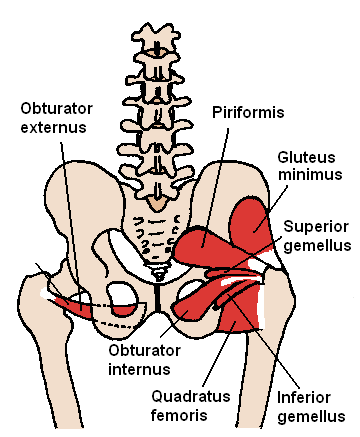
This isn’t the first time this has happened to me in recent weeks. When I began doing squat workouts in October with the goal of being able to do pistol squats, I found a weakness on the outside of my hip. I took a look at the medical dictionary i.e. Googled “buttock muscles” and concluded it was probably the Gluteus Medius or Gluteus Minimus being activated. While I already knew of the three Glute muscles (the other being the Gluteus Maximus) and the Piriformis, I failed to notice the Obturator Internus hereby referred to as the OI (or its companion the Obturator Externus, the OE). My self-diagnosis of where the ache was leads me to believe it was the OI I’d discovered but it might be the OE.
Reading up on the OI and OE muscles, it seems they’re used in hip extension and rotation. That explains why I began to feel an ache as my stride lengthened out. Over the past month I’ve been doing sprint drills twice per week for just ten minutes and these have been helping me to learn how not to (excessively) rotate my hips when running. Running along the prom I could actually feel my core holding the hips square as I pushed off with each step. The sprint drills have helped correct the motion and along with the strengthening effect of the squats the consequence is the OI/OE muscles starting to ache. On Wednesday’s drills and strides, I found myself powering along like I’ve rarely done before. I remember perhaps two occasions, in my whole lifetime, when I felt like a sprinter – running on air.
Last week’s I was bemoaning being in a VO2 lull and expecting it to last for 10-13 days. On day 10, I had my best run and my legs were pretty much back in action. To give you some hard data to work with let’s go through the days.
Day 0 – Saturday 6th November
All-out parkrun, full of surges and efforts takes 25 seconds off my time of two weeks before and puts me into the VO2 lull.
Day 1 – Sunday 7th November
Sunday morning long run fasted at 6:35am. Distance run is 11.7 miles in 1hr38 – 8:22/mile. Fastest two miles are #4-5 at 8:04 / 7:38 on a downhill stretch but nothing else came in quicker than 8:14 and the 11th mile was a glycogen-depleted 8:56. Average heart-rate was 133bpm and I could barely find the effort to get it above the low 140s.
Day 2 – Monday 8th November
30-min recovery run, fasted at 7am. Distance of 3.9 miles in 31:48 at 8:09/mile.
This wasn’t a bad run in itself but then I did some run drills after and a 40-min core session which may have tipped me over the edge. Average heart-rate similar to yesterday at 134 and only just hitting low 140s.
Day 3 – Tuesday 9th November
A 9-mile Steady run at the beach taking 1hr14 and averaging 8:10/mile.
Conditions were great for running when I set off – nice and sunny. Legs felt ok to begin with and after a half mile warmup the first mile came in at 7:29 followed by 7:34, 39, 49. But when I turned round it was a little colder and my legs faded to the extent I was running at 8:40/mile.
Heart-rate reached high 140s on the outward leg but dropped as the run went on to end up averaging 142bpm.
When I arrived back at the car I found my feet were covered in spots and blemishes, I believe it was a sweat rash.
Day 4 – Wednesday 10th November
Recovering run of 4.4 miles taking 40:39. Average pace 9:10/mile, fastest mile 8:47; HR-avg 124 and barely able to reach 130s.
The sweat rash was still present when feet got hot and woke me in the night 3-4 times. It’s probable I’d gone into anaerobic overtraining and was over revving the Central Nervous System.
Day 5 – Thursday 11th November
Improvement over yesterday. Same route with a little extra tacked on to make it 4.7 miles in 41:02. Average pace was 8:44/mile, heart-rate only 2 beats higher at 126 but still unable to find any power to push it up beyond 135bpm. Fastest mile came in at 8:22.
Day 6 – Friday 12th November
A repeat of Tuesday’s 9-mile run. A real lowpoint. The wind was 18-20mph and the run took 1h23 – an average pace of 9:11/mile for a heart-rate average of 129.
Even with a tailwind, the outward leg got no faster than 8:06 but on the way back, into the wind, I was over 10min/mile with a trudging 10:29 mile towards the end as I could barely lift my legs. The sweat rash had all but gone now and I had a night of nearly unbroken sleep.
Day 7 – Saturday 13th November
Back to parkrun. I ran 26mins for the parkrun with my fastest mile coming in at 8:15.
Day 8 – Sunday 14th November
Standard 11.7 miles long run, fasted at 7am. At last an indication of the legs beginning to feel better. The run was three minutes quicker than last Sunday at 1hr35 and averaging 8:07/mile for a HR-average of 138bpm. Note how I couldn’t even reach this heart-rate on some of the runs earlier in the week. Fastest mile was 7:35 (downhill) with three more sub-8s thrown in.
Day 9 – Monday 15th November
Early morning, fasted run with legs beginning to feel better. Distance was 3.8 miles in 30:44 – an average of 8:04/mile with a fastest mile of 7:36. On paper very similar to last week but legs were feeling more like running.
Day 10 – Tuesday 16th November
The game changer! Legs felt great and there was an early indication as I waited for GPS to lock in. My standing heart-rate dropped quickly from 50+ beats per minute to 37-38. That’s always a sign I’m ready to run.
Once again the 9-mile route at the beach and I found my legs were propelling me forwards with each stride. Where I’d run this route in 1hr14 and 1hr23 last week, today I ran it in 1hr05 – an average of 7:11/mile. More importantly that’s an improvement of 8-secs/mile from two weeks ago before the parkrun. My heart-rate ended up averaging 152bpm for the run and peaking at 161bpm. I pushed quite hard on the run back and managed to run the last two miles at 7:15/mile each – no dropoff.
Yet while I think my legs are back, I’m not sure there isn’t a little more to come. My fastest mile was only 6:53 and the next fastest was 7:01. Two weeks ago, I ran the first two miles in 6:47 and 6:46.
So there we go – a detailed look at how I recovered from an all-out parkrun, a VO2 lull and possible anaerobic overtraining by listening to my body and letting my legs run only as fast as they were willing. I’m sure had I wanted to I could have pushed harder on some days but I’m not sure it would have done me good. Most likely it would have delayed the recovery process and possibly trigged an injury – strain or otherwise.
If you go through again you’ll see the legs generally had noting extra to give in the early days and this reflects in the low heart-rates. Low heart-rates suggest I’m burning mostly fats and less glycogen. As the fast-twitch muscles (which use glycogen and will have taken longer to repair) became available again I was able to start going faster and the heart-rates rose. When they had really regained their oomph, I found my legs were much bouncier and I was popping off the pavement with each step.
Now I’m going to take a few more easy days as I look to improve on my parkrun time on Saturday.
I’m currently going through what I term a “VO2 lull”. It’s something I’ve encountered across my running years but taken a long time to understand, and even longer to recognise when it’s happening. Last Saturday I ran a good, hard parkrun at Upton House. Combining efforts up the hills with surges to try and catch runners ahead of me, as well as bursts to stay in front of those behind me, it was an all-out effort. With fresh legs going into it, from three days of easy running, I found an extra gear whenever I needed it. While I felt fairly good immediately afterwards, my legs have had nothing all week. I’ve lost a good minute off my easy run pace and this is what I’m calling the VO2 lull.
First off I need to explain the V02 part. Exercise physiologists like putting runners on treadmills and measuring the effects of running at ever-increasing speeds. One of the key measurements they take is the amount of oxygen breathed in, as well as carbon dioxide breathed out and heart-rate. When they measure the oxygen (O2) intake and utilisation it is correctly termed V̇O2 with a little dot over the V indicating it’s a rate but most people refer to it as VO2 partly because how do you pronounce a dot? It’s partly because it’s too onerous for them to figure out how to get the dotted V̇ on a word processor!
In chapter 8 of Build Your Running Body, Pete Magill details the growth cycle of mitochondria which are fundamental to producing aerobic energy. Mitochondria are often described as the powerhouses of the cell as they convert oxygen to energy which then powers your exercise. The importance of mitochondria to any distance runner cannot be overstated enough – they are the source of your aerobic ability which itself is key to distance running success.
Magill explains that it takes 4-5 weeks for mitochondria to fully grow but there’s a problem. “When mitochondria first begin adapting, they can’t contribute to aerobic energy production … this phase lasts from ten to thirteen days and creates an “oxygen utilistation problem” … you can expect to feel sluggish doing workouts that were easy the previous week” (p.142)
That’s exactly where I’ve been this week. Last week I was running a 20:55 parkrun at 6:45/mile pace; the next day my legs could barely achieve eight minute miles on my long run. This might have been due to recovery factors but it’s continued on through the week. My Tuesday Steady run which I was running at an average of 7:20/mile last week came in at 8:10/mile this week. Wednesday’s recovery run averaged 9:10/mile; today’s, five days after parkrun, came in at 8:44/mile. My legs have got nothing – no bounce, oomph or power. I’m barely getting out of the fat-burning zone on these runs.
So I now just have to wait for the mitochondrial adaptation to take place and in the meantime, plod along. This isn’t the first time I’ve been here but this phenomena is so poorly known that, in the past, I would start to take action to try and get back ontrack. I might rest (not a bad option if it’s only a day or two), do some strides (poor option as legs are already tired), do less mileage (not great as you won’t necessarily reinforce the growth), or try to continue doing what I usually do at the usual paces (effectively overtraining which usually led to injury). When it happened to me after marathons, it usually led me to quit running for six months or more. It’s only now I realise you just have to jog until the legs splutter back into life as they eventually will. It’s quite a remarkable experience because one day running feels awful, the next it’s like you’re running on bedsprings as the adaptations finally kick in.
Whenever we train the body has to go through a process of recovery. How long it takes depends on how hard you worked and how long it lasted. You could be able to run again later in the day after a genuinely easy run whereas a full-on marathon takes the better part of a month to recover from.
While I don’t pretend to understand all the details, the recovery process broadly breaks into four areas:
Refuelling
If it lasts long enough even the easiest-paced run will eventually lead you to run out of fuel. If you’re very well-trained you may be able to get by on fats but for most runners it’s their glycogen stores (sugar-based fuel) which needs to be replenished.
Usually eating some carbohydrates e.g. a banana, sandwich, cereal, bagel on arriving home helps the refuelling. The body is geared towards restocking its fuel supplies within an hour of finishing exercise. After this it will take longer to fully effect. There is a loading rate of how quickly the body can convert food into glycogen and for the hardest training athletes it’s slower than they can use it up! But, for the average runner, just eating sensibly after a run should be enough.
Muscle damage
The process of training is all about putting the body under stress so that it has to repair stronger. The harder you train or race, the more muscle fibres are torn apart to be rebuilt. Anyone who has done a hard race or a big interval session knows about the aches and pains it leads to.
Often training hard doesn’t express itself as soreness for long, certainly later in the day or a struggle on the next day’s run but not for days on end. Yet a good Threshold run can take 4-5 days to recover from, speedwork 10-14 days. As I say, there may not be any obvious aches or pains but if you’re attentive to your running you can find there’s something missing for a while. By then it’s certainly not a case of being underfuelled, it’s just waiting for the muscles to repair and other adaptations to take place.
Ramped up sympathetic nervous system
High levels of anaerobic training and the waste products it creates can lead the body to rev up the sympathetic nervous system – it’s the equivalent of being in ‘fight or flight’. You can have trouble sleeping, concentrating, feel thirsty or hungry without realising why. The body shifts from being in a mildly alkaline state to a mildly acidic one and takes time to recover back.
Neuromuscular fatigue
Neuromuscular connections are simply how the brain communicates with the body. Some of it is conscious like putting out your hand, others of it is automatic like breathing.
Whenever you train, the brain and the central nervous system has to rewire itself to integrate the changes. For example, if you do balance on one leg, the brain has to figure out and store the new ‘motor programmes’ that enable you to learn to balance better. Likewise if you run quicker the brain stores new ‘motor programmes’ detailing which muscles fire, what sequence they fire in and how strongly. This is, of course, a simple overview with much more deeper ‘programming’ going on as the heart speeds up to pump more blood, sweat rates improve, lungs breath deeper among many more.
There’s an overlap between this point and the previous one. If you train very hard, especially in ways you haven’t done before, there’s more for the brain and sympathetic nervous system to reprogram and adapt to. If you do too much then you feel tired and overloaded until it calms down. This is one of the reasons why sprinters don’t do too much sprint training in each session.
Summary
Most of the effects of training are recovered from within a day or two of the training session. This is typically why we only train hard 2-3 times each week – taking at least one easy day in between. A good recovery run shouldn’t be using up any significant fuel stores and because it’s low-intensity it won’t do much, if any, muscle damage. The “hard-easy” combination is a simple rule of thumb because people know they can’t train hard every day.
Of course how much time you actually need to recover depends on how hard and how long you trained for. JackD estimates you need one day of recovery per mile of racing. That fits with the traditional advice that you need a month to recover from a marathon. In my experience a 10K (6.22 miles) takes a week to fully recover from. Muscle damage is the thing that takes longest to recover from which is why we never push training sessions all-out but leave it for race day.
Ultimately when you’re in the middle of a training plan, it’s a collection of workouts, easy run and long runs which each overlaps with the others and from which you’ve rarely fully recovered. This is why a good taper into a race boosts your racing ability. You finally give the body enough time to recover from all the different workouts and be at its peak!
The time had come to run another 800m time trial and find out whether JackD’s plan was working.
A quick recap – last December I ran 2:58 to set a baseline. In April, after following Jack’s plan for a cycle, it reduced by only five seconds to 2:55. I then did six weeks of endurance training and it reduced a little more to 2:53 in early June. This was where I started my second cycle of Jack’s training from. The summer was then spent following the plan as best possible allowing for hamstring strain in July and a fast parkrun in August. I did all but three of the scheduled sessions.
So here I was back at Poole Park and having gone through my usual pre-run routines, this time I ran 2:50, maybe 2:49. Still no significant improvement. This was highly disappointing given I thought I was capable of breaking 2:40. Back in early September I ran 1:58 for 600 in training – that’s 2:40 pace so I should have been faster on the time trial. But it wasn’t to be. Realistically when I got to the October time trial I’d already passed my peak and was on the way downwards hence the poor showing on the day.
There’s no doubt I’ve generally got faster and fitter from the training but it’s not resulting in faster times over 800. If anything all I’ve done is brought the average of training up. I’ve not got significantly faster in the top-end speed – I ran 37-38secs for the first 200m of this time trial, back in December it was 39-40 secs. That two second per 200m improvement simply reflects what’s happened in the time trials.
World class 800m runners are easily capable of running twenty-five seconds for 200m – even the women. I’m nowhere close to that, maybe thirty-five seconds at best. So I’ve got to find a way to improve top-end speed because if you start running 200 quicker then the subsequent sections all get quicker. Even with a drop-off 400 is covered in under a minute and so on.
Endurance rebuild
Following the time trial, I knew I needed to let my legs recover. I spent a week doing very easy jogging. And that’s all it was – jogging. I’ve come to realise that when I’m past my peak it’s because my body has begun switching Intermediate fast-twitch fibres over to anaerobic mechanism and these can only be rebuilt through endurance training – lots of easy running, no speedwork.
My first Sunday run of the rebuild saw my heart-rate barely going over 130bpm during the entire run. Yet it still felt effortful in its own way which always highlights a drop in endurance. In the following days the pace picked up but I was still only barely running 8-min/mile until my legs came back. Yet by end of month I was beginning to see some miles closer to seven minutes and even putting in a couple of 6:50s on Steady runs. My final Sunday long run of the month was close to where I’d been in late August. Theoretically I could have picked up the 800 training again but I want to spend the winter on endurance as all world-class runners have a large aerobic base.
Form drills
Recognising my top-end speed isn’t good enough, I started looking at how to improve my general sprint speed without resorting to hillwork which usually overpowers my endurance. As I detailed in Stride Length, I’ve been thinking about how to improve this and started doing more drillwork – marching, A-skips, B-skips and straight leg bounding – to try and improve my running form. And boy, did it improve.
From the first day of drills I could feel my left glute hasn’t been working, my knees haven’t been lifting enough and my lower legs (the calf) have been inhibited in extending the stride. That inhibition has come from previous attempts to improve form where I looked to get rid of heel striking. There is so much conflicting information out there, most of it by people who are interested in very, long distance running rather than speed.
Given it’s ten minutes after an easy run twice per week, I’ve really enjoyed doing the drill work. I think it’s a new challenge and I can feel it’s going to help. The disappointment of the time trial has quickly gone.
Pistol squats
When I was researching exactly how to do sprint drills I came across heptathete Chari Hawkins doing a pistol squat.
Trying one I couldn’t get anywhere close even hanging onto my kitchen counter! It occurs to me that at the bottom of the pistol squat is very much the sort of position sprinters push out of from the start blocks. Developing it must be useful for getting faster especially as Chari Hawkins can run a 24.4sec 200m.
So I’ve begun doing daily squat work and discovered my left leg is weaker than my right. Much of that is related to muscles around the left hip which has impacted my running stride in the past. Doing the squat work has begun to strengthen this.
Combined with the drill work, my running form has changed massively in a couple of weeks. I’m feeling stronger and more balanced in my running. I’m sure my stride length is increasing simply because I have a stronger push off.
Coming up
The next block of dedicated 800m training is a long way off. I’m going to use this winter to build endurance. I feel that’s also holding me back. The best 800m runners in the world all have big aerobic systems which reflects in their easy runs being in the 6-7min/mile range – currently that’s top end aerobic running for me; not easy. I need to build mine up while maintaining contact with my speed.
I’m hoping to maintain speed through a fortnightly fast parkrun (as well as drills and strides). It’s a long time since I went to parkrun and ran fast regularly. I feel sometimes I’ve got so focused on training that I don’t get the reward of actually racing fast. My first fast parkrun on Oct 23rd came in at 21:20 at Upton House. While it was a four second PB over August, I know there’s much more to come as the legs were fatigued from a big week of running.
The other thing I’m looking forward to is Christchurch 10K in mid-December. While I’m not intending to do any specific 10K training for it, I am focusing on it and will taper for it. After that I will probably look to run a decent half-marathon next spring before resuming 800m training again. It’s all a long way off and yet it’ll fly by!
The more I look this year, the more I realise what natural talent for distance running is. And I don’t have much of it! But that’s not to say I can’t develop into a decent distance runner with good training.
Let’s talk about three runners. There’s me – whose talent is for speed and building muscle. There’s Slow-twitch Sam– who I believe has talent for distance – he’s light and thin. Then there’s Intermediate Ian who sits somewhere around the average – he’s got decent speed and endurance but doesn’t excel one way or the other. (Names have been changed).
Both Sam and Ian ran a half marathon last weekend. Ian ran sub-1:29 while Sam ran 1:24. My Personal Best – dating back to 2012-13, when I was at one of my running peaks, is 1hr31.
I’ve seen Ian’s training on Garmin and he generally trains five days per week. Mondays and Wednesday are some kind of workout, either short intervals at fast paces, or longer intervals lasting 5-10 minutes at threshold or marathon pace. On a Friday he runs a 10-mile long run. On the days in between – Tuesday and Thursday he usually does an easy 5K. That’s it.
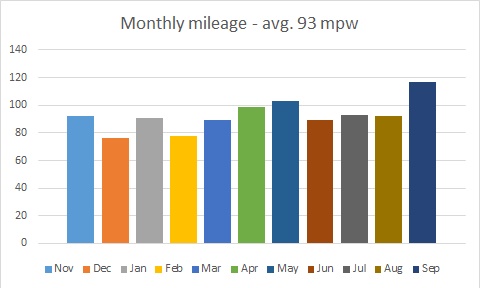
I looked back at his run training over the past year and he’s totalled 1,219 miles. Here’s the monthly totals from November to September, notably there’s only two months where he exceeded 100 miles.
I used to be a low volume runner barely eking out more than one hundred miles per month, same as he does now. A decent, concentrated block of training in 2010 reduced my half marathon PB from 1hr50 to 1hr38. I ran a decent marathon in 3hr41. The next year I upped my mileage to 150 per month, worked on my endurance and set my half marathon PB (1hr31). I had to do more mileage to get there.
The most notable thing about Ian’s ability to run a half marathon in under 1hr29 is that he never did the distance in training. His long runs topped out at ten mile runs. By comparison, if I don’t doing my long run for a few weeks, I’m struggling in the final miles when I next do one. Some years ago Ian’s first marathon was 3hr25, the next 3hr15 then he ran close to 3hrs a few times before finally breaking it.
Sam took up running again in April and got down to nineteen minutes at parkrun in six weeks. In July he ran a 1hr32 half off a total of around 500 miles training. Since then he has trained harder with back-to-back 200+ mile months in August and September but still hasn’t totalled a thousand miles this year. Yet he’s running even faster than Ian. And much quicker than I have ever even though I run close to two hundred miles every month with a variety of sessions. Of course my training is dedicated towards the 800m so I wouldn’t necessarily expect to run great times in a half at the moment.
What all this begins to show is how natural talent helps out at the beginning of your running career.
My early half marathons were 1hr51, Ian’s is 1hr29, Sam’s is 1hr24. But, due to my lack of natural talent I’ve been forced to figure out what needs to be done to get quicker. I’ve improved from 1hr51 to 1hr31. Ian has only gone from 1hr29 to 1hr25; Sam from 1hr24 to 1hr21. I’m sure they’ve trained hard to achieve what they have but what I’m seeing is how easily it comes with natural talent. Of course, that IS the definition of natural talent.
No wonder I’ve been on the decline for the past month. I went for my long run at 6:25am this morning, in the dark, determined to keep it easy. Remember easy is a feeling, not a pace. It took me thirteen minutes longer than last week to do the same ten mile run. My heart-rate barely got out of the 120s yet my body didn’t want to run any faster. I’m sure I could have run faster but that wasn’t the aim, I was listening to my body and letting it decide. Truth is, I’ve spent most of the past month training faster than this and it explains why I’ve slowly been spiralling towards decrepitude.
I can’t call this overtraining because that’s a serious condition that can take months to recover from. Usually the term for having pushed the body past its best while not having become overtrained is known as overreaching. Overreaching is something most athletes actually want to do just prior to competition because it gives them a higher level of performance yet because they taper they get to freshen up. Generally speaking overreaching can be recovered from quickly whereas overtaining takes months.
Whatever I should call it, my training and running isn’t going forwards like it was a few weeks ago. I sensed the signs of a couple of weeks ago, but I wanted to finish out JackD’s 800m training plan so I could say I followed it to the letter.
These are the signs I spotted
Loss of motivation
A couple of weeks ago I found myself no longer caring about the next 800m time trial. After almost four months training I should have been excited that it was only a couple of weeks away but I wasn’t. My mind didn’t care and I was actually looking past it to the next phase of training I’ve got planned.
For someone as dedicated as I am, the loss of motivation was a huge red flag that my body wanted to back off. I’ve had it before and it’s always the same – simply wishing that I could get past the remainder of training, start tapering (which is of course reduced training) and get to the race. Often I never made it to the race as an injury or illness would kick in – those were probably the result of doing too much.
As an aside, I believe many first time marathoners experience this sort of thing. They start off their training excited and motivated, then as the long runs pile up and they trudge through four hour Sunday runs, they start to wish it all over.
High resting heart-rate
Before I start a run I have to wait for my GPS watch to lock in the satellites. This usually takes at least a minute of standing around on my driveway or by the car before I can start running. When I’m fit and healthy my heart-rate will drop to somewhere around 40bpm, quite possibly in the high 30s. When I’ve trained harder the day before it may be mid-40s. When I’ve trained very hard the day before it’ll be in the 50s. It might even do this for a day or two extra. Over the past two weeks I’ve barely seen my heart-rate barely dip into the 40s, moreover it’s been low 50s. That’s a red flag.
Sometimes, while HR will still drop down it takes a while to occur. It seems to be stuck in the 50s for thirty seconds before dropping rapidly to the low 40s. That’s an amber flag that things may be becoming problematic.
I don’t think there’s an issue per se with the occasional high resting heart-rate but, as I say, I’ve been seeing these without fail for the past couple of weeks.
Tightness, aches and pains
I previously wrote about how tightness, aches and pains are a sign of overdoing things in this post. They’re probably the earliest physical sign that crops up but also isn’t actually debilitating unless you continue to push hard. Usually though when any aches or pains ease off during running as joints and muscles get warm and loosen up. It’s later in the day or first thing in the morning when they’re a problem. I’ve been struggling with stiff ankles and hip pains regularly recently.
Other signs
These first three things are the most reliable, obvious indicators that things aren’t right. Any one of these three would usually be enough for me to begin reconsidering my training plan and slot in recovery sessions until the issue is gone.
What follows are less noticeable or isolated. The following signs usually need to be seen as one part of the jigsaw. Individually I don’t think they’re enough because they’re also somewhat vague and harder to measure accurately. Diagnosing yourself as overcooked is no easy thing to spot with certainty.
Affected sleep
If you overtrain and rev up your central nervous system it can affect your sleep patterns. These past couple of weeks I’ve found myself waking multiple times during the night and dropping straight back to sleep. But on a couple of occasions, I found myself sleeping solidly for nine hours on back-to-back nights.
When I seriously overreached a few years ago, I found I’d wake in the night to use the toilet. Then struggle to drop back to sleep and just lie there for 2+ hours thinking of absolutely nothing. No stress or anxious thinking, simply unable to drop off to sleep. This is another way the over-revved CNS can affect sleep.
Affected appetite
When I’m training too hard I find I tend to start wanting more sugary foods – crisps, cakes, beer. Basically my body is craving anything that will give me more calories and quickly. This isn’t always an issue as for many years I used to eat a lot more calories in response to playing sports hard. Similarly, I have found myself drinking more cups of tea or fluid in general.
While I haven’t experienced it, I’m sure overdoing things could also result in loss of appetite.
Failing to hit target times in workouts
Missing workout targets happens from time to time so you need to see it becoming a pattern. Throughout the earlier periods of my 800 training there were days where I struggled to hit targets but would come back refreshed a few days later and be on time. One session isn’t a problem, two should be noted, three in a row becomes a concern.
General runs are slightly slower
Looking back my Sunday long runs peaked a month ago and I’ve struggled to run them as quick since. Likewise when parkrun returned in July, I was running them at the limits of comfort in 23-24 minutes; this has slipped closer to 25-minutes. It’s been a small difference that I’d attributed to my legs being tired from the fastest speedwork being done in this phase of training.
But sometimes heavy legs or slower general runs can be a symptom of the initial response to an increase in training.
Loss of strength
I do strength training once per week. Two Wednesdays ago I found myself barely able to flex my biceps and lift the weight. The struggle was there again this week. I wasn’t sure if it was the “introducing new stuff” drop off that I mention above so I gave it another week.
Steve Magness lists examples of CNS fatigue as including reduced grip strength, worse ground reaction times during depth jumps or hops, and slower reaction times.
Summary
I’ve listed some of the key things I’ve noticed in the past two weeks that were suggesting I’d overcooked it. As I said, the main reason I didn’t back off was because I wanted to see JackD’s plan through to completion but it was also because I was so close to finishing that I was trying to hang on – that becomes a dilemma.
Many elite runners say they notice their moods before any physical signs show up. Apart from aches and pains, I’d certainly say my change in motivation was the most noticeable harbinger for me this time around.
And in case you’re wondering, the solution if you do decide you’re overcooked is to back off your training. Ensure easy runs are easy – as I did this morning. Cut some or all of the intensity out and give the body less training to recover from. It often only needs a few days to two weeks get back on track, and I don’t think it’s been more than three weeks at the most.
Like all runners I want to get faster. How you do this is, of course, the difficult part. Having a coach or following a plan takes you through the workouts you need to do to improve speed, stamina and endurance appropriately to your event.
There are certain guidelines for what you’re trying to do; for example, 100m sprinters are working on top-end speed and trying to be as efficient with their running form as possible. Marathon runners are training to improve their aerobic efficiency and top-end speed isn’t too important to them. Everybody in between is working on some variation between these.
Paula Radcliffe still getting air time at mile 25 of 2002 Chicago marathon
But even when you think the marathon is more about endurance than speed, you discover world class marathoners are fast. Take Paula Radcliffe, she can run 4min25 for a single mile where most parkrunners can’t even run 200 metres at this pace.
The Formula
The simple mechanical explanation of speed is that it’s the amalgamation of how quickly you move your legs and how far you travel with each step. More commonly this is quoted as a formula of Speed = Stride Length x Stride Frequency. I first learned about this in the mid-1990s but never really thought about what to do with it.
On the stride frequency (cadence) side there’s a lot of talk about how the magic number of steps to take is 180 per minute. I’m not going to dig into that here today as it’s much discussed around the internet, only to say there is no magic number to achieve. It’s the Stride Length side I’m currently interested in. [Note: I have now written a series of articles on Cadence which begin here and provide some interesting data – clicking on the link will cause it to open in a new browser tab].
What is Stride Length?
Around the time I learned the formula, I started to hear about how the great 400m hurdler Ed Moses had a stride length of 2.70 metres which enabled him to take thirteen steps between each hurdle.
When I looked up what a stride was, it was defined as two steps e.g. right foot then left foot or vice versa. So by that definition your stride length would be how far you cover from when your left foot hits the ground to when it hits the ground again. That would suggest each single step by Moses was only covering 1.35 metres yet when I did the calculations that didn’t seem right.
It turns out when runners, coaches or commentators talk about stride length they’re using the term interchangeably with step length. For runners, stride length is the distance you cover with one step. If you stand with both feet together and step onto the right foot, it is the distance you’ve covered in this step.
If you’re going to try measuring it, remember to measure consistently from the heel-to-heel or toe-to-toe. Often though you can find out from the stats produced by GPS watches – if they’re capable of measuring cadence.
Garmin stats from a run – avg stride length highlighted
Elite stride length
400m hurdlers
I said that Ed Moses is famous for his 2.70 metre stride but it’s not just him. When I was watching the Tokyo Olympics over the summer, I switched onto the final of the women’s 400m hurdles. The commentators were discussing how Sydney McLaughlin – the world record holder – runs 14 steps between the hurdles until the final one when she increases to 15 steps because of fatigue shortening her stride. I found out the distance between the hurdles is thirty-five meters making her long stride to be 2.50 metres and dropping down to 2.35 metres when she tires. That’s big and it’s stunning.
Measure out 2.50 metres and you’ll realise why I still harboured some doubt about whether I was understanding what stride length is. Were elite runners really covering the length of a small car in one step? Or was their stride the technical ‘two step’ definition? I went looking for direct evidence.
David Rudisha – 800m
I found some decent Youtube footage of David Rudisha running the 800m at the London Olympics. It’s the race where he set a new world record. As he crossed the line he was well ahead of the rest of the field and there was a good angle on it.
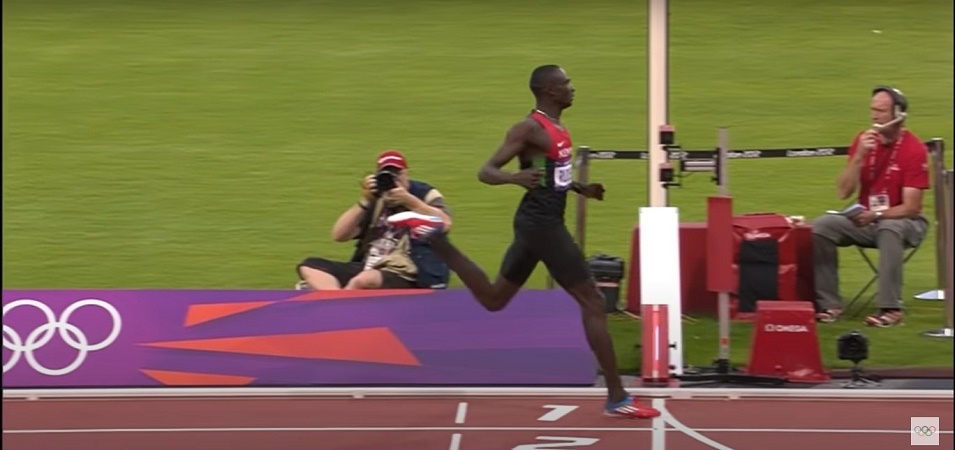
And below he is one step before! It seems unimaginable how he will go from toeing off at the red triangle next to the Olympic logo and ending up on the finish line but he does.
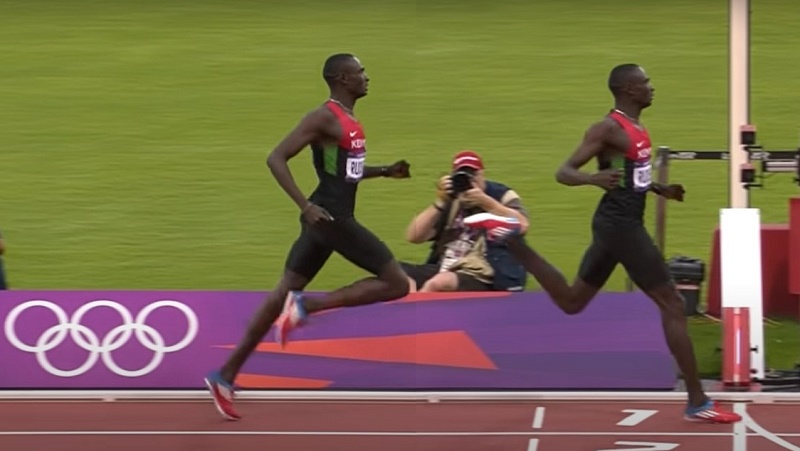
Here’s a combined picture to make things simpler. We can see it’s quite some distance.
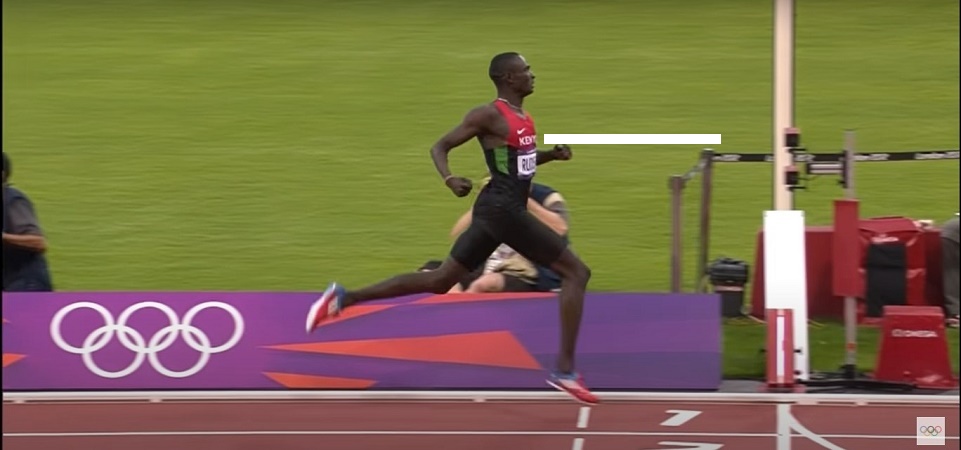
Rudisha is recorded as being 1.88m tall so let’s put some lines on the photo and estimate how long his stride is.
He’s not standing fully upright so the yellow line is around 1.75m. The red line is just above his knee and, fortunately as I’m the same height, I can estimate it to be around 70cm. That’s a total of 2.45m.
The exact measurement doesn’t really matter, what’s important is we now have visual proof that a world class runner takes well over two metres with a single step.
Finally here’s a look at his last two steps, he’s easily covering the better part of five metres. His black shorts make it harder to identify which leg is forward or backwards but if you look at his shoulders there’s no doubt about it. And you can also see how far his body moves over the top of his support leg as he pivots from landing up to toe-off.
Women’s 10K
So far I’ve talked about the stride length of the 400m hurdler and 800m runners. These shorter distance track athletes always have a longer stride than distance runners because the speeds they run (around 3 – 3min30/mile) are that much quicker.
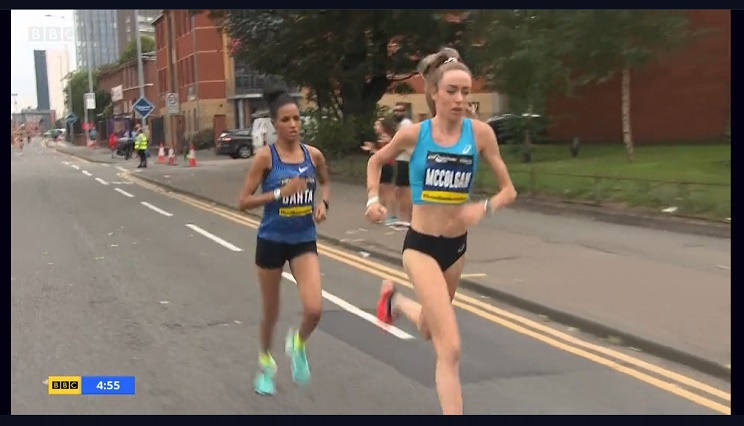
Last weekend the BBC were showing the Great Manchester Runs. A friend who was watching the women’s 10K race messaged to point out the difference in running styles of the two lead ladies – Eilish McColgan and Meraf Bahta.
It was clear McColgan has a long, bouncy stride with a high back kick – probably because she’s still doing shorter track races – whereas Bahta’s stride was shorter and flatter. By flatter I mean she’s staying more level with the ground, less bounce.
Rewatching footage from the second kilometre I counted their respective cadences. McColgan was running at 172 steps per minute, Bahta up at 200. It’s a notable difference and knowing that they were running together slightly faster than 3min/km (4:45/mile) you get an indication of their stride lengths – McColgan’s is 1.97m and Bahta’s 1.70m.
Ordinary runners
McColgan is impressive but it’s Bahta who really makes the point. Even for a high cadence runner, she still has a stride length far above that of most runners. Most of the ordinary runners I know have short stride lengths according to their Garmins. If it’s much over a metre on a general run that’s unusual. Of course you can’t big stride all the time but I doubt many have the strength and technique to extend their stride out when required.
My 10K races have an upper end value of something like 1.4m when I’m fresh and usually drop into the 1.30s by the end. I’m sure I’m not unusual in this respect and of course I’m not running world class pace so it’s naturally going to be shorter at my slower race paces.
Most ordinary runners work on their cadence with no thought for improving their mechanics or top-end speed to create a longer stride length. This is a mistake because as we’re seeing with someone like Bahta, that longer stride length is still beneficial when you have a high cadence.
The way you develop a decent stride length is by pushing off more powerfully. You don’t reach out in front of you, you launch yourself forwards through the air with each step. Think of it like being on a pogo stick using the spring to load up and travel forwards for as much distance as possible. As a runner when your leg is behind you, you extend your hip, your knee, your ankle to push forwards. Learning this technique is best done during strides or hill sprints. Short efforts where you’re not concerned about running out of energy or fatiguing.
One last picture of David Rudisha to marvel at. It’s during the flight phase of the last step. His foot is a good half metre or more before the line and looks like he will land there yet somehow he travels on., His effort at toe-off propels him forwards the extra distance before his foot hits the ground. It happens quickly and horizontally. There is very little drop which is what the white line is there to help see.
The white line is lined up with the word “Kenya” on his vest and level just above the black tape by the finish. Take another look below at the finish line photo and you can see he’s only dropped a matter of inches to now be level with it.
When he was in the air, he wasn’t actually high off the ground. His effort goes towards pushing him forwards not up into the air. If you watch slow runners they use a lot of energy bouncing up and down rather than going forwards – this is bad.
If you want to marvel at Rudisha’s running, here’s the video of his 2012 Olympic run. There’s a good, slow motion close-up at the 7min10 mark.
I wrote another article looking at Eliud’s Kipchoge’s stride length and detailing how I calculated it here.
The second cycle of 800m training is coming to a close. Next week I’ll go do an 800 time trial and see how successful it’s been. The last block of training through July-August was mixed in its success. I felt stronger by the end of it but quite often missed the target times due to overly tired legs. Missing target was a little demoralising yet seeing other things going well helped offset that.
This month’s training has been about sharpening up for the 800TT. Its focus has been miles at Threshold pace to help build Lactate Clearance, along with short intervals at 800m and mile pace for building Lactate Tolerance. The hardest efforts, which need some psyching up for, are the long 600m efforts at 800m pace. On their own it wouldn’t be awful but often they’re thrown in as one part of a bigger session. For example, the first week was simply three 600m efforts with a 1km jog recovery – each effort takes a full-on effort.
Threshold running (T-pace)
The early efforts for these came in around 6:50-55/mile pace. This was a good twenty seconds faster than the same workouts six months ago. But as my fitness sharpened up I began to run them faster and by the past week I was running at 6:40.
The dilemma has been whether to stick to pace or trying to go based on how the body is reacting. As I’m not one for staring at the GPS anymore I’ve opted for the latter hence why my fastest effort came in at 6:34! Considering during July-August I was struggling to run my kilometre intervals at this pace, it all suggests training has been going in the right direction.
Mile-pace running (R-pace)
The plan has been packed with 200s at mile pace but, they’re often at the end of a Threshold session when the legs are tired and heavy with lactate. Sometimes they’ve been hard to get on-target, needing lots of effort to scrape in; other times it’s seemed easy to hit target with lots to spare.
Given the aim was to hit 44sec there’s only been one over 44½sec which was into a headwind; I judge them as having been a success.
800m-pace running (FR-pace)
These have been the rewarding part of training. Last time I was aiming to complete 600s in 2:06 and I only managed it once. This time, I was aiming for 2:00 and managed to get under it three times along with two more at sub-2:02 – not too far off.
There have also been some slower 600s and last Thursday finished on a low note with them coming in at 2:07 and 2:09. I can throw out excuses about high winds but, in the end, I still like to hit target. Yet when I think back to the start of the year I was running my initial 600s in around 2:23 there is something good happening overall.
There were a couple of 400s mid-month which came in on target at 1:18-19 compared to 1:27-29 in the equivalent session six months ago. And again at the beginning of training I remember one misjudged effort came in at 1:41!
The shorter intervals of 200, 300 have been interesting. Generally I’ve struggled to run them much faster than last time around. Fastest 200 in March was 37.45s, this time it’s 36.73sec; so there is a little more quickness but it’s not been a massive leap. I got a couple of sub-37s on a wind-assisted day and sub-59 300s on another.
So it really seems like I’ve improved my speed endurance this go-around but haven’t done much for my actual top end speed. The 200s are averaging sub-5 pace now which is pleasing given I couldn’t even hit that pace at the start of the year. Doing strides has been a factor on the speed side and I managed to get the pace down to 4:07/mile momentarily on one so hopefully there is more to come.
Stats
I’m not going to go overboard on the stats as they’ve been so variable. But to give an indication of my fastest efforts in time and pace; plus what that multiplies up to over 800m. It’s noticeable that the longer efforts of 400-600 are about the same pace.
Fastest
Pace
800m pro-rata
200m
36.73s
(4:55/mile)
2:26.9
300m
58.23s
(5:12/mile)
2:35.3
400m
1:18.9
(5:17/mile)
2:37.7
600m
1:58.22
(5:17/mile)
2:37.6
Running form
Since starting the second time around with the plan, I’ve been working on my running form. I’ve specifically been trying to figure out how to sprint faster and somewhere over the past month or so it all began to come together. I found my legs were beginning to spring off the pavement and each stride would cover more distance. This has caused muscles in my right hip and glutes to get more active to fire produce thee springing action but also involved protecting muscles around the calves and quads that absorb the landing forces. These actions are beginning to become second nature now and with the initial stimulus over, I expect them to build in coming weeks.
Summary
The most pleasing part of training is that my fitness has remained throughout. There have been one or two sessions where I couldn’t get it done but that’s to be expected. There are always ups and downs.
When I did this same training block six months ago, I struggled to get any of the 600s on target and they even slipped backwards by the last couple of weeks. I think this is part of why my time trial barely improved last time around (2:58-55). This time I’ve been hanging in there and am now hoping my 800TT will see a significant improvement – at least scraping down into the 2:30s.
My easy runs have begun to get quicker over the last week or so and I’m beginning to feel like I’m getting back to the form I had back in 2012. Not quite there yet but I am intending to do a fast parkrun in October as well. So that’s all to look forward to in the next update!





 Big Red Running
