Olympic thoughts – Empty seats

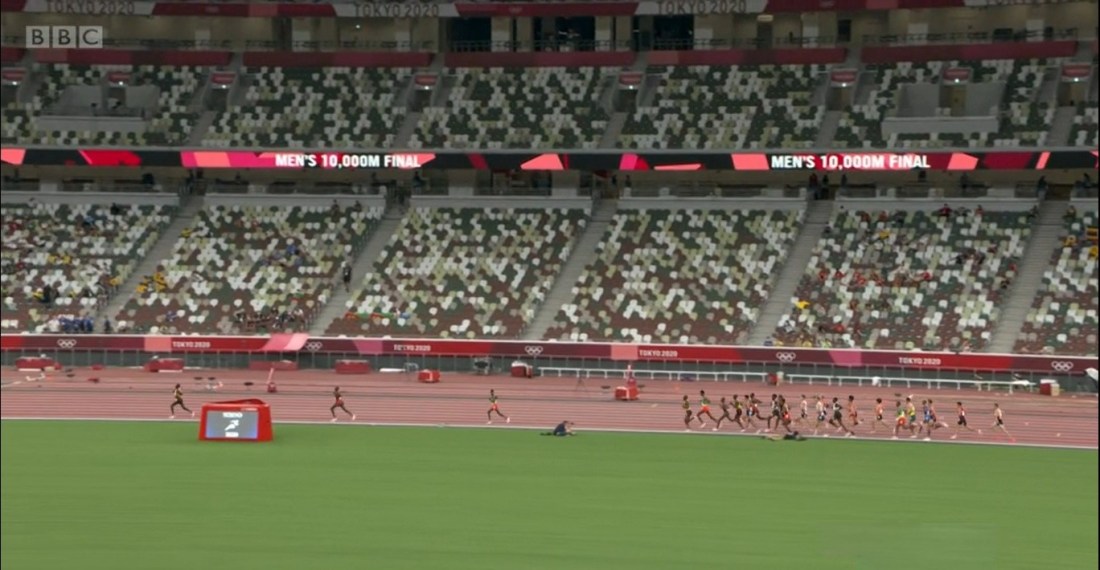
Day 7 of the Tokyo Olympics brought the opening sessions of the athletics. Empty seats have been a feature of sporting events throughout the pandemic and while the Japanese organisers had managed to break up the monotony of the seating with blocks of black, white, grey and brown creating something resembling QR codes or pixelated photos, it brought back memories for me. I attended the opening night of the athletics at the 2004 Olympics in Athens in a stadium that was three-quarters full.

The spectator-less seats of Tokyo provide a back drop to the men’s 10,000m final

It was the final night of my two-week trip to Greece during which, the second week had been spent rushing between Olympic venues to watch as many different sports as possible. To top it off, it was my birthday so a great way to finish off my holiday before heading for home.

The session started at 7:30pm and went on past midnight. The athletics ticket was the most expensive one I bought at 90 Euros, which was £60 at the exchange rates of the time, but I didn’t mind paying that to watch world-class athletics on my birthday. By comparison the much sought after swimming tickets, cost as much as 200 Euros if memory serves me right. Funnily enough I didn’t go to the swimming!

The Olympic stadium from the outside with Olympic flame alight.

I arrived early from an afternoon at the beach volleyball and took a final look round the Olympic complex before entering the stadium. I knew my way round the complex by now from all the time I’d spent there and I’d seen the inside of the stadium on grainy television from watching the torch lighting and opening ceremony a week earlier. Since then it had been Olympics morning, noon and night.


My seat was at the start of the back straight, opposite the finish line, at the end of the first bend. It was on the lower tier, many rows back and, as I walked down the aisle, there were already many other spectators in place. I had to squeeze past twenty people to get to my seat with all the attendant standing up, sitting down and apologising. Once I finally got to my seat, I realised how cramped it was going to be. Elbows touching with people on both sides of me and my knees against the seat in front. I wondered how I’d get through four hours of this.

As had become my tendency, I said “Hello” to the people either side of me and this turned into a chat with the chap on my left. “Are you on your own?” he asked. I replied affirmatively and he went on to explain that he and his wife had been given complimentary tickets by the IT company for whom he worked. The only problem was her ticket was at the other end of the stadium and they weren’t next to each other. Then he pounced.

“Would you mind swapping with her?”

Always happy to help and not feeling it could be any worse, I agreed and we went back through the embarrassing process of squeezing past the twenty seated people to get to the aisle. Up the stairs and out of the arena. We walked around the outside of the stadium, which seemed to take forever, until we were right below the Olympic flame that I’d seen being lit a week before.

I never questioned what was happening as the man phoned his wife. She came out of the stadium handed me her ticket, I handed her mine, they thanked me and that was it – I never saw them again. I walked up to the entrance, showed the ticket to the checker and they let me in with no problem. I emerged into a section full of empty white seats, my heart leapt into my mouth and I thought I’d been duped.

The rows of empty seats where I was to be seated. More empty seats are visible at the other end.

Rationality took over. The ticket was ok, security had let me in and I was just in a section where there was no-one else. On reflection, the organisers probably wanted to fill other areas first, particularly where my original seat was, as that would be seen on television. I strode down the steps to my seat in row 13 and was able to stretch out. There were perhaps fifteen people dotted around the whole section and I certainly wasn’t bumping elbows anymore.

I relax. Comfortably socially-distanced when it wasn’t needed!

There was no-one within ten metres of me – perfect for today’s social distancing but in 2004 we had different issues. Previous Olympics had been disrupted by a bomb in Atlanta and terrorists in Munich and we were only a few years removed from Sept 11th and the invasion of Iraq, security was always tight. There was a long list of things you couldn’t take into stadia and backpacks were always checked. I bought and lived off snack food and drink from vendors the whole week because you weren’t even allowed to take so much as bottled water into an event. Fortunately the prices were reasonable even if it wasn’t healthy. Looking at the photos I’m surprised at how bloated I look.
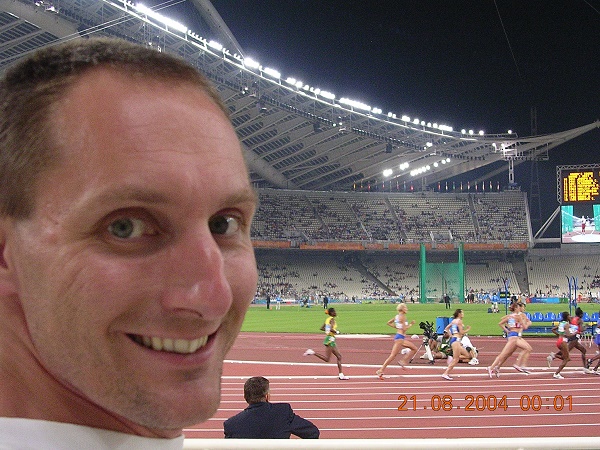
I tried to get a selfie at every event. The second heat of the women’s 5,000m going on in the background.

With only empty seats between me and the front, I wondered whether I could move down there but didn’t want to risk a confrontation with security or the threat of being removed from the stadium, so for half an hour I sat thirteen rows back with the raft of empty seats stretching out in front of me. At 8pm I snuck down to the front row and sat within metres of the track for the rest of the night. Whenever an event was due to take place, the competing athletes would enter the arena, parade clockwise around the edge for spectators to see them. For me, they were almost in touching distance.
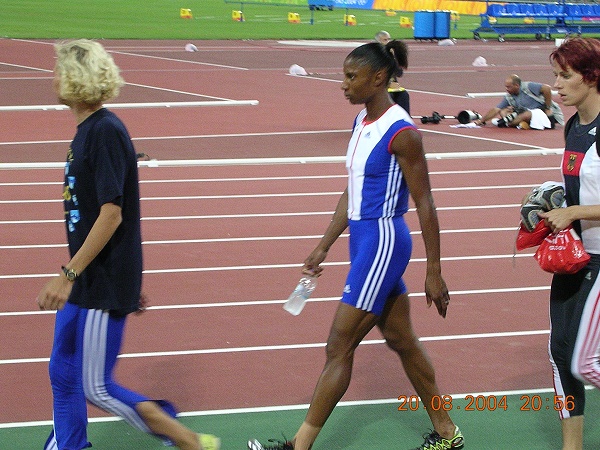
Denise Lewis and other heptathletes parade past on the way to their next event. Twenty-four hours later, Denise would no longer be the reigning champion.

Some events, such as the men’s high jump and discus, took place down the other end of the stadium so I watched them on the video screen. But situated where I was, on the bend, I got to see the 200m and shot putt of the women’s heptathlon featuring reigning champion Denise Lewis and fellow Brit Kelly Sotherton while, of course, all the other track events went past. It was amazing to be so close to the action. The organisers had scheduled a mixture of events for the session such that, almost every discipline was on display.

Kelly Holmes begins her pursuit of double gold beginning in the 800m.

The highlight of the night was the final of the men’s 10,000m; most other events were heats or qualifiers. I wasn’t into running enough then to appreciate the significance of reigning champion Heile Gebrselassie handing over his crown to Kenenisa Bekele. Of course, these days I know much more about running and looking back though all these photos has given me a new appreciation for what I experienced that night and who I saw.
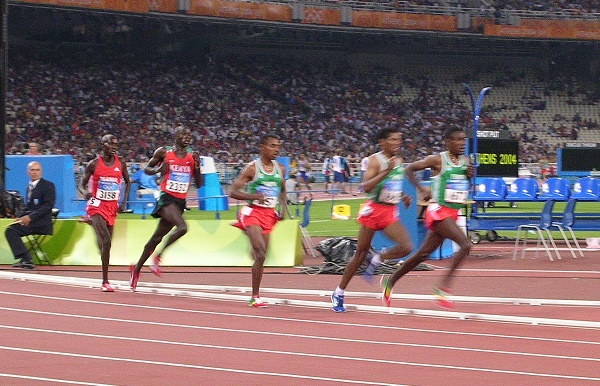
The final of the men’s 10,000m. Ethiopia’s Sileshi Sihine, Heile Gebrselassie and Keninisa Bekele ahead of Kenya’s Moses Mosop and Uganda’s Boniface Kiprop.

At 11pm some people from the neighbouring section realised it would be much more comfortable in my empty section than their own crowd-filled one so they snuck over. After having had it almost to myself, I felt strangely territorial about them entering my space even though there were more than enough seats for everyone. Maybe it was they were loud and noisy that irked me but no matter, it really didn’t take anything away from my experience. I was just tired after a week of constantly rushing from venue to venue; getting up at 6am, getting to bed at midnight and surviving on less sleep than I needed. Four hours of athletics had been a great end to my Olympic experience. When London rolled around eight years later, I was happy to sit at home and watch on television as I’d already been there, done that.

Another view of the empty seats as I stand below the scoreboard with Olympic torch towering behind it.

I would apologise for the low quality photos and video but it was the early days of digital. My camera was only 3MP, couldn’t record sound and I borrowed a 512MB SD card from someone at work to be able to store more images. Watching these video after so many years reminds me of the serendipity and luck that came my way when I agreed to swap seats with someone I’d never met!
A silent pan round the Olympic stadium – many empty seats

Eventual gold medallist Sweden’s Caroline Kluft runs in lane 3 (lane 1 is empty) while GB’s bronze medallist, Kellly Sotherton, runs nearest the camera. Powerful running in the final heptathlon event of day 1 – the 200m

Kenenisa Bekele in the final 200 metres on his way to gold holds off Sihine with the legendary Heile Gebrselassie twenty seconds adrift and featuring from 21-30secs in

A heat of the women’s 100m takes place in the distance. Heptathletes can be seen warming up in the foreground

Olympic thoughts – Is this sustainable?

Day 5 of the Tokyo Olympics had me watching cycling again with more commentary from Chris Boardman. This time it was the men’s individual time trial which was eventually won by Primoz Roglic of Slovenia.

Boardman accurately predicted it would take around 55-mins to cover the course, not too difficult maths when the riders are going at 48km/hr and the course is 44.1km long. At just under an hour it’s an event that’s comparable to elite men’s half marathon running, or in physiological terms it’s being run at Threshold. For lesser runners that might be a 10-mile run or only a 10K – it’s applies to whatever you can cover in an hour.

The nugget of commentary that really struck me was Boardman’s description about riding at Threshold. He stated:

“The first five minutes is free, you don’t feel the pain. That’s the bit where you have to use your head rather than your heart and then it becomes self-regulating, you start to get a feel for the pace, the pain sets in and then you manage it”

What he was describing was how, when you begin a race the legs are free of lactate and waste products that eventually begin to make them feel heavy and the effort to keep them moving gets tougher. With fresh legs it’s easy to go off too fast – build up the lactate quickly and then suffer; the ideal is to ration the build-up evenly over the course of the race. This is true at all race distances and even true during interval training.

After co-commentator Simon Brotherton mentioned that there’s a “fine line between pushing as hard as you can but not going too far into the red” to viewers, Boardman responded with more gold dust:

“There’s a constant calculation going on between …

How far is it to go?

How hard am I trying?

Is this sustainable? And if the answer is yes, you’re not going hard enough. If the answer is no, it’s too late so you’re looking for maybe”

What a fantastic piece of commentary. I must admit the idea of maybe seems quite novel to me. I’ve probably always pushed myself into maybe without realising it and just aimed to hang on, but I’d usually coach people to keep in the comfort zone of yes. We like things to be black-or-white, yes-or-no; Boardman showed that the best in world are risking playing on the edge with maybe!

Next time you’re on the start line at parkrun remember these quotes from Boardman and see how they reflect your experience. The great thing about parkrun is you can test “yes”, “no”, “maybe” over the weeks and begin to learn what each feels like.

Bolt runs the 800m

Usain Bolt recently ran his first 800m race. As I’m training for this distance, my interest was piqued to see what he achieved. Bolt, of course, is generally seen as the best sprinter of all time winning multiple gold medals in the 100m and 200m at consecutive Olympics and the World Championships from 2008 to 2016. As a junior his coach had wanted him to become a 400m runner, his best time was 45.28s, but he didn’t enjoy the longer training sessions and it became apparent he could be a champion at the short sprints. Running his first 800 race would be a big step up.

Out of athletics for the past four years, he said he’d been training for this race but it turned out to be part of an advert for a used car dealership. Its premise was that you can get an online valuation for your car quicker than Usain Bolt can run 800m. Bolt in lane 1 versus the customer in lane 6 sat in a comfy chair typing her car’s details into her phone. I’ll embed the video at the bottom, if you want to watch it, but Bolt appears to be jogging round on his way to a 2:40 time for 800 metres. The commentary is overlaid and there’s no sound from the track so I’m tempted to believe it’s masking the director telling him to speed up or slow down to ensure he finishes just slower than the customer. After all it wouldn’t be much of an advert if Bolt wins easily. Actually it’s not much of an advert anyway because I thought they were providing insurance quotes, not a price for your used car.

What I could glean from the footage is Bolt is running at a cadence of around 160 steps per minute which equates to a stride length of 1.88m per step. That’s not unbelievable given he’s 6’5” and when he’s in full sprint mode he’s averaging closer to 2.50 metre per step (and his cadence also up at 250 per minute). It’s deceptive watching the video because it really doesn’t seem like he’s covering much ground until you see his strides around the start-finish line. The slow cadence really does make it look like he’s taking it casually.

Even allowing for some play-acting, I doubt Bolt could currently run it that much faster – bear in mind his pace is 5:20/mile, it’s not that slow. He’s not overweight or unfit but of course he has detrained from his peak athleticism. As the best sprinter in the world, his genetics are geared towards speed. He stated in a 2013 interview that he could run the 800m in 2min05 so that gives us a reference for his ability when he was a trained sprinter. There’s also a segment from Superstars in 1986 on Youtube of Carl Lewis, who was the Olympic champion in the same events as Bolt – the 100m, 200m, 4x100m, where he ran 2min15 for the half mile. So I’m inclined to think a detrained Bolt couldn’t have run 800m much quicker than he did in the advert.

A short postrace interview with Bolt shows him lying on the ground having his legs massaged and breathing hard. His splits for this 800 were 35s and 39s for a 1:14 first lap followed by 44s and 42s for a second lap 1:26. That final 200m being faster suggests he did try to pick up the pace. These splits are fairly consistent with what I experienced in my 800m time trials – when I ran 2:53, my splits were 39 / 43 / 45 / 46 secs and I tried to sprint at the end but my legs were tying up with lactate. It’s a fast start and then struggle to hang on.

One difference is that Bolt can run a significantly faster 200m than I can – his world record is 19.19s – yet at 35sec his opening 200 isn’t much quicker than when I time trialled at 39s. His controlled start may have avoided building up the oxygen debt that leads to heavy breathing.


What I’ve found with all my distance races is that it doesn’t matter how hard you train for speed and to handle oxygen debt, there comes a limit to how fast you can go because the by-products seize the muscles up. When your body is trained for speed lactate and waste products are being produced from start to finish. It’s why for in distance running you need to build a good aerobic system to delay their production so they are only produced at higher speeds.

I can remember finishing parkruns when I was speed-trained, saying there was more to come because my legs never felt tired, yet it was only when I did more easy running that my times got quicker. I had to build aerobically through daily easy, steady and long runs to improve at parkrun and longer distances.

Some people are naturally full of slow-twitch muscle and therefore find it easier to build their aerobic capacity – they’ll start with a bigger base. For those with more fast-twitch, either you stick to the sprints as Bolt did or commit to doing the miles that will develop them aerobically.


Usain Bolt’s 800m in 2:40

Skip to 2min43 to see the race won by American footballer James Lofton in 2:03 with Lewis taking 2nd place

Olympic thoughts – All you need is love

Day 3 of the Tokyo Olympics brought Great Britain’s first golds in mountain biking, swimming and diving where it was a story of at last for Tom Daley. Thirteen years ago in Beijing, the nation watched as 14-year-old Tom became a sensation reaching the final. Four years later, at the home games in London he was one of the “poster boys” with his good looks and friendly, amiable personality but could only win bronze in the 10 metre individual event. Another Olympic cycle on brought another bronze in Rio this time in the synchronised event. Many thought he might retire after his tears at not winning again but he rebounded to win gold in the 2017 World Championships.

An Olympic cycle is a long time. Tom has been lucky to have started early and is now in his fourth Olympics at only 27. Yesterday I read Uzbekistan gymnast, Oksana Chusovitina, has retired after her eighth games at age forty-six – her first was in Barcelona almost thirty years ago.

In the years since Rio, Tom has got married to American Dustin Lance Black and become a father. He credits that with helping him to arrive in Tokyo feeling less pressured to win. In the post-gold interviews Tom said he knew that whatever he achieved, good or bad, he’d go home and still feel loved by his husband and three year old Robbie.

It seems to me that buried somewhere in Tom’s psyche was a belief that he was only loveable when he was achieving. I don’t think it’s an unusual belief particularly among many of the younger generation who are constantly being set targets in school and herded into activities to bolster their future CVs rather than for the enjoyment of doing them. The success of our Olympic programmes in recent years has been down to a harder-nosed approach to success and failure, if you aren’t a medal prospect your lottery funding ends and a lifetime of hard work and trying in your sport is dashed in the stroke of an administrator’s pen. The TeamGB Olympic successes we celebrate every four years hide a darker fallout of athletes, swimmers, rowers, boxers, cyclists, martial artists and gymnasts, among others, who couldn’t make the cut.

But the trap of conditional love is also prevalent among older generations who were simply brought up in environments where love wasn’t easily expressed, mistakes were punished and you had to be a genuine winner for your success to be celebrated – they didn’t get participation trophies.

Unconditional love is a concept that most people don’t understand because they don’t see any further than skin deep. They don’t look at the real person beneath but instead choose to love or hate based on looks, behaviours and material success. They allow their own emotional reactions to project onto the other person rather than accepting them for both their flaws and strengths. They don’t understand unconditional love is about valuing people for who they are, not what they are.

Somewhere along the way Tom must have absorbed some kind of message like this. It’s not necessarily down to his parents, it could be his coaches, his teachers or anyone else he’s come into contact with. He seems a rather sensitive soul and was bullied when younger. Dents to his self-esteem may have been papered over through his diving success. Even when he wasn’t winning Olympic golds, he was still receiving love and affection for being one of the best divers in the world, not simply for being Tom Daley.

Return to parkrun

Even overnight rain and thunderstorms couldn’t dampen the enthusiasm for the return of parkrun. I was up at 6:15am for breakfast and headed out to Upton House parkrun a couple of hours later. As I parked the car, just a warm-up jog away, I saw familiar faces who I’d parked by so long ago.

Since I was last at the country park it’s undergone some renovations with bushes around the tea rooms being cleared and the children’s play area refurbished. Consequently the parkrunners have been shoved out through the gate to a new start line and the course revised. I quite like the new route as it’s more open although the uphill finish is going to be taxing when I get up to speed.

The Run Director struggled through the opening speeches because the PA system’s battery wouldn’t recharge after not being used in eighteen months but unusually all the runners stayed quiet so that was good. New parkrun protocols instruct the pre-start speeches to be over quickly and a prompt start at 9am to avoid runners gathering together too long. I was pleased we still had time to clap the one new First Timer who’d turned up, as well as the four runners who were about to complete their 250th run. Imagine being stuck on two hundred and forty-nine all that time.  For me, it was number three hundred and twenty-five – but no t-shirts for that!

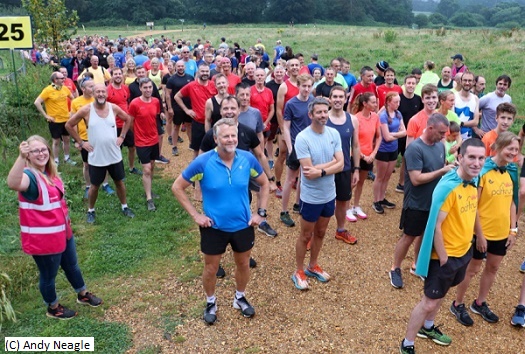
It’s like Where’s Wally – I’m somewhere in there with the red headband!

With runners expected to seed themselves according to time, I positioned myself just level with the 25-min marker and it didn’t seem like there were too many ahead of me. I ran with Rob for the first 2K and it was nice to run unhindered, able to pass others easily whenever we needed to. At the start of the mini-loop, I left Rob as I took the brakes off and went with the downhill. Despite a light rain, it was all rather enjoyable and I gradually eased past some of the fast starters; always keeping my breathing easy. First mile 7:56, second 7:40, third in 7:26 to finish 49th in a time of 23:57.

Collecting my finish token there was lots of space past the funnel to go and get my token scanned. I then returned to the finish line, chatted to a friend and cheered runners in. The tailwalker came round in just over an hour to complete the field of 295. Elsewhere Poole had 565 and Bournemouth 529 which were the 3rd and 5th biggest attendances in the country, then add in Blandford 133 for a total of over 1,500 local runners out at 9am on a Saturday morning. A successful return for parkrun and I even had my result before midday. Admittedly it was 11:58am but it’s still impressive.

Update on my 800m training – June-July 2021

I’m now six weeks into the second time round with my 800m training. My first go-round, following a Jack Daniel’s plan, lasted from December to May and didn’t provide great results as my 800 time only improved from 2min58 to 2min53. But I knew I was running faster, felt fitter and hoped a second go-around would show better results.

This training block is full of intervals ranging from 200-600m in length. As you’ll see in the stats the vast majority are short with just four 600s planned. Last time I was aiming to run at 48sec/200m but later realised I should have been using 48½ which I could only just scrape on the 400s and 600s.

I’ve been working to 47sec/200m which is the training for a 2:52 800m. Trouble is, I’ve been averaging 43s for 200m, 1:31 for 400m and 2:15 for 600m. It seems like this reflects the discrepancy between my time trials and how I actually felt my fitness had been progressing.

More speed

Last time I tried to be accurate with my interval efforts – not going fast than necessary but always hitting target. This time I’ve thrown caution to the wind and allowed myself to run without holding back. That’s not to say I’ve gone all-out, I haven’t; just not held back.

Target timeOn targetMissedEffortsFastest
200m47s66470(14.0km)37.9s(5:05/mile)
400m1min342424(9.6km)1:26.83(5:49/mile)
600m2min21-2233(1.8km)2:13.78(5:59/mile)
Total93497(25.4km)
Some interval stats for those who love them!

I’ve also introduced 8 strides of 10secs after my Friday morning recovery run. Ideally Jack would have me doing these on two of my recovery days but I didn’t want to undermine my aerobic base too much. Last time around, I didn’t do any; this time I’m doing one set. Next time around, if everything is going well, I’ll introduce the other day.

I suspect it’s (a lack of) this faster running that was holding my 800m time back in the past. I’m beginning to see my fastest pace come down from 5min/miling to 4:30/mile during strides and this may partly be down to the limitations of how quickly my GPS watch can produce an accurate pace.

Injury risk

The bigger danger is pushing too hard may lead to injury and it happened. I suffered a minor hamstring issue in week 5. It was the final 200 of a session that had already totalled 2,800m, and when I’m feeling good as I was, I tend to like to finish strongly; so  I pumped my legs as hard as I could but felt a tightening in the right hamstring and it began to knot. I eased off, finished out the effort and jogged home.

I was fortunate to have this happen on the Thursday as it gave me five days to recover before my next set of intervals. I still ran on the days in between and by the Tuesday my legs were feeling great during the warm-up. I eased into the efforts but by the 4th 200 I was getting a sense I might not last. The next 400m I felt some tightening and on the next it was even more notable so I backed out and jogged home. That was last week and I missed the final day of intervals opting to keep runs easy and never push them along. I did a couple of strides on my Sunday long run and that seem to confirm the hammy is ok so I’ll resume training to the plan.

Long runs and mileage

The switch from a block of pure endurance work to repicking up speed work left the legs struggling on the general runs but it didn’t last past the first couple of weeks. But the introduction of the strides also sapped the legs going into the Sunday and so I haven’t seen much progress on their pace, they’re still around the same pace as last time around.

The six weeks of training I’ve done so far have resulted in 41.3, 45.1, 44.7, 45.7, 42.0, 43.8 miles.

Running form

Since April, I’ve been looking at how sprinters run and trying to apply some of their techniques and drills to my own running. The strides have been useful for this and I’ve particularly been focused on minimising hip rotation through better knee lift. I seem to be getting higher cadences on many runs and that’s going to be an important part of getting faster. The higher cadence corresponds with a concomitant rise in my glutes doing the work.


Once again I’ve really enjoyed this block of training. Getting out and running fast is fun especially as I’ve been finding it so easy to hit target. The hamstring injury is frustrating but I’m hoping that with the next phase of training being longer intervals at a slower pace that it’ll survive. I can run on it as long as I don’t overdo the forces going through it.

In the next phase, I’m meant to up my paces for fast efforts by a 1-sec/200m but, given I’ve been finding it so easy, I’m going to compromise by adding 2-secs so that I’ll actually be aiming for 45s per 200 which is what I’ve usually been running them at. This isn’t recommended as you should train at paces that relate to proven times and I haven’t actually run a 2:48 800 that would justify it.

Parkrun is also due to restart at the end of July and I’d like to attend. I’m not going to run hard every week but I’d like to see where I’m after all this training. I feel like I’m close to sub-20 form. It’ll mean dropping a workout, which isn’t ideal when you’re following a plan, but a fast parkrun will still have benefits.

But the priority is keeping the hamstring healthy.

Return of parkrun

It’s been a long time since I ran a parkrun. Some countries and areas have been reopening sooner than others but finally England is ready to allow them again. Just one week to go and I’m wondering what the response will be.

Parkrun HQ have spent the past year figuring out the logistics to make parkrun Covid safe. Start speeches will be kept brief to avoid people gathering together for too long. A new app has been developed to allow volunteers to do the barcode scanning and timing from their phones rather than using shared equipment. The finish position tokens are to be washed or quarantined every week. Academic research supports the idea that gathering on a start line within close proximity of other runners is safe.

I’m guessing it will all work out as parkrun has been going ahead around the world with (I assume) the same changes in place and things haven’t collapsed there or needed a rethink. But different cultures have different attitudes and that’s the thing I’m wondering about. How will Englanders respond to the return of parkrun? Will we accept the changes? Will we believe the science? Do we care enough to get back out running on a Saturday morning?


My last parkrun was in early January 2020. I stopped going two months before the pandemic put them on pause. This wasn’t some prescient act of foreboding, it was my choice.

With New Year’s weight-loss and fitness resolutions kicking in, attendances swelled. In the weeks leading up to Christmas the average attendance at Upton House parkrun had been about 300; in the New Year it was closer to 500. It’s great to see all those new participants but I was getting trapped among them. I was running heavy mileage on Fridays and could only manage a recovery run on Saturdays. The narrow paths of Upton Country Park allow little room for manoeuvre past runners who’ve started off too quick and who then stop or walk to avoid stepping in the winter puddles. I found it hard to enjoy myself when my rhythm and flow were constantly being broken up.

New Year resolutions never last for everybody but parkrun was always a gamechanger and a high percentage of the newbies continued to come back. But more than a year on, will they? The not-parkrun stopgap that Headquarters tried to promote never took off. For whatever reason, people are only interested in going for a free, timed 5K when it’s part of something bigger. Their own volition and fitness weren’t enough for many people. Maybe it was really the coffee and cake afterwards.


In deciding whether to attend, will people accept the science that says standing on a parkrun startline is safe?  My initial instinct, knowing how close we stand to each other, is that they could become super-spreader events. Parkrun’s academic research says it’ll be safe but I have some reservations because it’s modelled on an attendance of 263 participants and March Covid levels that were much lower than they are now. Our parkruns are much bigger than that.

The reality of the situation is with about 2,000 runners attending our local parkruns, the current case rate of 250 per 100,000 suggests five infected people will turn up. My odds on actually standing next to one of the five seem little worse than I could achieve in the aisles of the supermarket.

The parkrun Covid Code asks runners not to attend if they’ve got any signs of it present e.g. positive test, high temperature etc. Generally speaking the parkrun community is good at looking after one another so there’s a good chance they’ll comply. Most people wouldn’t want to run if they’re feeling under the weather anyway.


I know the local parkruns have been doing trial events to familiarise with new processes and these events have been well-attended by members of local running clubs. That’s no surprise, they were invited and they are regular runners but what about the ‘ordinary’ runners who were parkrunning as something to do once a week? My guess is it’ll be a tentative return to action by those who aren’t regular runners.

While about 95% of England’s parkruns are set to return, Moors Valley and Brockenhurst are among those without permission – yet. That will probably push some of their regulars to Bournemouth and maybe further afield to places like Salisbury, Blandford or wherever.

As the restart coincides with the beginnings of the school holidays they may not be the only visitors to other areas. In the past, we usually saw an influx of visitors to our local parkruns either on their way to or from a holiday in the South-west. I assume that will still be the case as more families are choosing to holiday in Britain this year but of course some of our local families will also be going off to visit elsewhere so the net effect is likely the same. Nonetheless with family routines broken up and school out, I don’t think numbers will settle down to their regular levels until September. By then, we’ll know the new processes and have a true picture of whether parkrunning is viable in the new normal.


Ultimately I’m a believer in trusting that life will all work out in the end. Committed parkrunners will be back quickly, the more tentative will take time to return. It will be a while before it settles down but we’ll get there and adapt to whatever challenges come up. It’s quite possible there’ll be more hiatuses along the way.

Finally to say, if you’re not in England or your parkrun hasn’t been given permission to return, then stay strong, it’ll be back eventually. We’ve been through the worst of this and life is gradually returning to old activities.

How much do you want it?

I was woken early by the tap, tap, tapping of a bird outside my bedroom window. With it being nesting season, the birds have built a nest up in the eaves and are flying in and out of it frequently. Trying to locate exactly what part of the house the bird was tapping, I looked out from behind the curtains and noticed my neighbour working out in his back yard. It was 6:15am. Most of it was stretching and limbering up as he prepared to do pull-ups on a frame he’s bought. I was impressed as I watched him machining up and down, one, two, three; nice square angles at the shoulders and elbows, four, five, six; barely pausing or fatiguing as he went on all the way up to fifteen. A little rest then another set before pulling the tarp over the frame and going in.

I’d love to be good at pull-ups but I’ve always struggled with them. I claim that with my long arms, I’m mechanically disadvantaged. There may be some truth to this. Most people have a reach (measured from fingertip to fingertip across the chest) that is the same as their height. This is one of those anatomical novelties* you can easily test. Lie on the floor feet against the wall and put a marker against your height. Then lie the other way and stretch your arms from the wall to the marker and you should find you can just touch it. Except when I do this I stretch out four inches wider than I’m tall! Of course doing pull-ups isn’t simply about arms, they’re also about lats, shoulders and other body muscles which I’ve never been dedicated to working out. My days of going to the gym didn’t last long, it always seemed so soulless.

My “I’d love to be good at pull-ups” never translated into action. I may say it when I see a parkour runner effortlessly pulling themselves over a wall, or when I try them at the gym but I’ve never really committed to getting good at pull-ups. It’s the same with playing the keyboard, playing the harmonica, being able to do handstand press-ups, dunk a basketball or win the lottery. They’re all things I believe would be cool or, great to be able to do, but I’ve never taken committed action long enough to be able to do them.

This isn’t uncommon. I’ve heard the words “I’d love to break …” followed by a time for parkrun or a marathon leave the mouth of numerous runners who then take very little action to achieve that goal.


I felt somewhat in awe of my neighbour’s commitment at being out there, working out at such an early hour until I realised I was doing the same thing with my own plyometric and hill sprint workouts last summer, my 800m training this past winter and my current Sunday long runs at 5am.

It takes a dedicated, longterm approach to get good at a sport or complex activity, few people are naturals.  Before the 800m training, I know there were other things I took action to get good at. I began playing volleyball as an adult and scraped up to playing National League 2nd division. I took golf lessons for three years to be able to break 80 and score a hole-in-one. My running took three months of dedicated training to build a base that took me sub-20 at parkrun and onto other running glories.

I’m not sure why some activities find the power of inspiration to invoke perspiration while others fall by the wayside after a week of trying. But if you ever find yourself saying “I’d love to break 20 minutes for parkrun” or “I’d love to run a marathon in under four hours” ask yourself what’s stopping you. Would you really love to do it or are you in love with the idea of doing it?


If it turns out you do want to improve as a runner (or even just think you do) my weekly sessions can help you improve your speed and fitness, along with oodles of free training advice. If you’re interested in personal coaching to help you reach goals you’d love to achieve then I can help you out with that too. Just drop me a line from the Contact page.

* Another anatomical novelty is your foot should measure the same as the inside of your elbow to the crease of your wrist!

Short sprint – Denial

The runner always had an excuse for why he’d struggled or failed. It was the heat, it was the new shoes, people getting in his way, asthma, a summer cold, anything but the way he trained or his attitude to racing. He never improved and year on year the excuses would keep coming eventually evolving into a simplistic one of getting older and more complicated, but unbreakable, ones like rheumatism or arthritis.


I’ve struggled for years to discern what the semantic difference between an excuse and an explanation is. When a runner tells you why they didn’t do well in the race or training session, an explanation can sound like an excuse, an excuse can sound like an explanation.

I believe the difference is in what you do with that information. By definition, an explanation explains what went wrong. It doesn’t necessarily place the blame here or there, it just observes events and tries to find reasons for poor performance. But an explanation can also provide reasons for a good performance. There’s a detached observation going on which can be used to improve performance next time around. It can take the explanations behind good performance and make them a regular, routine part of training. It can take the explanations behind poor performance and look for countermeasures, interventions and ways to address them so they won’t be problematic in the future.

Excuses though only ever relate to poor performance as a deflection of blame. They’re not there to find reasonable explanations which can be addressed, they’re there to protect ego. At their simplest they’re a denial of the facts and reality. It’s said with alcoholics and other addicts that the first step is admitting there’s a problem. If you’ve ever been around one of these types of people you’ll know how difficult, even impossible, it is to get them to accept the reality of the situation. Until they stop denying there’s a problem they can’t begin to look for ways to address it.


From all this you might think denial is a bad thing. For the most part it is. Yet when you play sport or race, being able to deny the circumstances can be a route to success. Charlie Spedding recounts in his autobiography how, prior to the Seoul Olympic he’d been injured and was struggling in training, but went on to finish 6th through sheer willpower. On the day, he denied his recent form and overachieved. But, it’s important to note, he didn’t use excuses during his training as a reason to give up; he kept training as best he could never making excuses. It was only on the day, he used denial as a short-term strategy to get the absolute best out of himself.

Learning from Tour cyclists

Here we are in July with an array of sports to choose from. Football’s European Championships, Wimbledon, the Olympics starting on the 23rd and three weeks of the Tour de France. It’s only in recent years I’ve got into watching the Tour which is mostly a procession through beautiful French countryside until a final sprint for the line in the last kilometre of a 150-250km race. Occasionally they throw in a short time trial of 30km and of course there are the gruelling climbs of the mountain stages in the Pyrenees and Alps.

With ITV having over four hours live coverage to get through, the adverts are frequently interrupted by some excellent commentary by Ned Boulting and David Millar. They’re joined from time to time by Chris Boardman, who won gold at the Barcelona Olympics at a time when British cycling wasn’t that good. Nicknamed “The Professor” because he’s studied the details, Boardman brings great technical analysis to any broadcast discussing the build of bikes, aerodynamics, streamlined skinsuits, nutrition and tactics among other things. While I’m never going to be a cyclist, I enjoy listening and learning what I can from watching the Tour.

Notice the beauty of of the logo creating a cyclist riding in a tucked position

One of the things I picked up last year was that “fat burns in the light of a carbohydrate flame”. This is a saying which relates to needing some carbohydrates ingested to kickstart the process of fat-burning. Specifically Boardman stated riders will eat 20g of carbohydrate before going out on an early morning ride otherwise they’re burning through their glycogen stores. Certainly I’ve always found my heart-rate is lower (which suggests better fat-burning) after I’ve had breakfast.

I tried experimenting with eating two digestive biscuits before setting out on my long runs. I’d put two on my bedside table ready for the morning then, on waking I’d immediately eat them before getting up, getting my kit on and going straight out for my run. I never saw any notable difference when I did this so I’ve returned to running fasted but having a decent breakfast definitely helps on my workout or race days.

If you want to try it the information about grams of carbohydrates is usually there on the side of the box or packet so take a look. A couple of Weetabix is my go-to breakfast. Not too heavy and the milk helps with hydration.

The other thing I learned is that even when the Tour schedules a rest day, which are the two Mondays in this year’s three week schedule, the riders still go out on it for a two-hour ride. I could barely believe this when I first heard it. After all when you consider the riders are riding hard for the better part of 3,500km (2,200 miles), you’d think they’d jump at the chance of a day off. But, without it, I suppose they’d be almost forty-eight hours without riding.

A little closer inspection of riders’ data shows their rest day ‘recovery rides’ tend to be closer to an hour, maybe stretching out towards ninety minutes. On tour days they’re riding at an average of 40km/h with an average power of over 300W (with the ability to sprint at over 1000W); whereas a recovery day is closer to 25km/h with only 90-130W of effort being put in. It really is an exercise in keeping the legs turning over, flushing out any waste products and providing stimulus for hormonal and nutrient delivery. Unlike runners where the body’s muscular-skeletal system takes a pounding with each step, it’s much easier to cycle for over an hour without any detrimental effect. Nonetheless runners can still use recovery runs as a way to trigger recovery as well as maintain lower aerobic fitness.