When endurance training works

I’ve written at length about MAF training, or more specifically, the ineffectiveness of low heart-rate training especially when linked to age. It seems to me that most people don’t understand what is meant when it’s said building endurance will help them get faster. I hope this post will be useful by giving an example of when it works and how it affects your runs.

In September 2017 I ran the Solent half marathon in 1hr36. I set off way too quickly – running the first quarter mile at about 6:20/mile pace and the first mile coming in at 6:41. After that it was a slide as my endurance failed me and I got slower by the mile. Around mile 9 the course turned up hill which made the slowdown even more pronounced until I managed a final effort to the finish line. Here’s a graph clearly showing the decline!

After a week of recovery running, I embarked on building my endurance using my own method which doesn’t involve having my watch beep at me to stay under a certain heart-rate. Following a simple schedule of one hour Steady endurance runs on Tuesday and Fridays with a long run on a Sunday, I slotted in recovery runs lasting up to an hour on the other days. This gave me a total of around eight weeks where I was hitting around 60 miles – with a peak of 69 in mid-November.

Over these eight weeks, I took only one rest day and yet my legs were always ready to run the key Steady and Long runs. Each run I marvelled at how well it went and doubted that I would be able to repeat it a few days later. Yet each run came up and I never felt too tired or got injured. I could barely believe how my legs kept churning out the miles.

I ran the half marathon on September 24th where the pace began at 6:41 and just got slower. Two months later, on November 29th, I ran along the seafront for nine miles and here’s what the splits looked like:

After a first mile at 7:14 where my body was still warming up, each subsequent mile came in at 7:01 or faster. Mile 4 was the fastest at 6:51 but I barely slowed down. The time for these nine miles was 1:02:48 (avg. pace 6:59/mile).

Compare that to the first nine miles of my half marathon which were 1:03:57 (avg. pace 7:06/mile). You might think there isn’t much of a difference but remember this was a training run, not a race. I was doing this sort of run every three days, not taking a recovery week after it.

Remember that by the ninth mile of the race I was down to 7:39; here I was still at 7:01. The gap would only have got wider – it’s very clear to see here.

I ran a hard parkrun three days later on December 2nd. My last one had been in mid-August when I clocked 20:29; this time it was 19:37 – almost a minute faster. On my Steady runs I was only hitting a fastest mile at around 6:50/mile, on parkrunday I was able to push harder and run at 6:15/mile even though I’d done no training at that level in months.

Mile 1Mile 2Mile 3Last 0.11
19 August06:1606:4306:4906:1020:29
02 December06:1306:1106:2305:3619:37
(Apologies for using mile splits on a 5k but it’s easier for reference against the other data)

At both parkruns I set off with a fast first mile of around 6:15 but, before the endurance training I slowed significantly in the second and third miles just like when I ran the half marathon. On the latter parkrun, the endurance training came to the fore and while I still set off quickly the decline by the 3rd mile was much less. I remember running that day and it feeling like I had a booster on top of the endurance runs I’d been doing – an extra 30-40secs/mile dug out for when I raced.


It’s clear I was able to get faster through endurance training.

While I never trained to heart-rate I will highlight that on Solent 1/2M I averaged 163bpm; while on my Steady run of Nov 29th I averaged 149bpm with a max of 158bpm. I certainly wasn’t pushing as hard in training as I did during the race.

On the Steady run, which was typical during this training block, I spent over fifty mins at heart-rates over 150bpm which demolishes the age-related MAF formula’s calculation that as a 46-year-old man I should have been training to a heart-rate below 134. I certainly felt no strain and there were no health consequences incurred from doing so.

The other thing to note is the benefit of the endurance work was only possible because I already had the speed. At parkrun in August my fastest mile was 6:16 and, at the half marathon it was 6:41. All the endurance training did was train the body to hold onto that existing speed for longer. This is the nature of the endurance training – faster times occur because you are more consistent in your mile splits; not because it digs out more speed. Throughout this period, I never went to the track or did any interval work; I just worked on endurance.

A Glimpse of 400m training

I often wondered whether I could have been a decent 400m runner after I met Iwan Thomas, the British record holder, at Eastleigh parkrun back on New Year’s Day 2012. What I realised standing face-to-face with him is that we are about the same size and build. I never found distance running easy and it’s only as I’ve stumbled across the training of friends and acquaintances on Strava, who have achieved so much more, off much less training, that I realised my struggles are because I’m full of fast-twitch, anaerobic muscle and suited to something shorter. That’s why I’ve been giving the 800m a try.

I’d never seen any sprint training plans, but when I was doing my run coaching courses under the guidance of UK Athletics, I came across a video titled Training for the 400m with Richard Buck (embedded at the end). This 45+ minute video is a fly-on-the-wall documentary of sorts following the training session of a Great Britain medallist.

While Richard isn’t a well-known athlete, he medalled at the 2011 European Indoor championships in Paris. He competed for GB frequently at major indoor championships with his Personal Bests being 6.98s (60m), 10.92 (100m), 21.32 (200m), 45.61 (400m), 1:57.2 (800m).


Any training plan is a progression to build up speed and endurance appropriately for the event. You start off with a small amount of overall work and this grows to be a large one. That doesn’t necessarily mean low volume, remember that the overall amount of work being done is a product of the volume and intensity.

Richard’s training is based on a long-to-short methodology which means he starts his training plan with longer efforts at slower speeds, gradually shortening the distance covered but getting faster. In the video his coach talks about how some of the earlier sessions totalled 3,000m at a medium intensity (5×600 or 10x300m). During the filmed session he only completes 690m of running but all at close to race-pace.

(The alternative to long-to-short is a short-to-long approach which is about always doing work at race pace but starting with short distances and gradually lengthening out the distance of efforts as endurance builds).

As I say the total volume of this session is 690m which breaks down into 4x10m, 3x30m, 1×60, 1×300, 1x200m with breaks of 10-20mins between the final three efforts. Low volume, high intensity, long recoveries. This is not how distance runners should train.

Video overview breakdown

The video is embedded at the bottom of the post but for those who don’t have over forty-five minutes to watch very little happening (!) here’s a breakdown of what goes on.

Warm-up at 4:45

This isn’t shown in full, but involves various movements and dynamic stretching

Heel walks at 6:30

A drill specifically for Richard to help him with dorsiflexion and activation of the muscle in the shin that pulls this up to help with his running action.

Therapy screen at 7:15

His coach does manual manipulation and movement of his lower body, particularly ankles, to check everything feels ok.

Muscle activation at 9:20

The coach applies manual pressure to the back of his left leg and glute to get this ready for being recruited in the training session. The coach states that if it isn’t activated properly, Richard feel pain in the top of his hamstring the next day (because this will have be doing more of the work).

Drills at 10:30

A simple slow march (A-walk) for Richard to work on his motor programming to get the correct movement patterns.

Trackside Therapy Intervention at 12:20

The coach has noticed some internal rotation on his left side so does some physical therapy to try and correct this as he thinks it may be a tight TFL (tensor fasciae latar) muscle on the outside of the hip.

Accelerations at 13:25

4x10m, 3x30m from a crouch position allowing the body weight to fall forward

Block starts at 19:15

3x30m from starting blocks

Speedwork at 23:40

A single 1x60m @95% instead of 100%. Timed at 6.6sec

Nutrition at 25:10

The coach discusses the changes they’ve made to Richard’s nutrition timings – in particularly getting him to eat immediately in the hours after a session. Then a look at drinks, Richard is taking during the session.

Training plan progression discussed at 28:20

Other sessions mention at 30:05 which were 5x600m, another 10x300m where the intensity was medium with appropriate volume and recoveries.

Explanation of recovery between intervals at 32:20

1-2mins per 10metres. Since he ran a 60m at high intensity there has been a break of 10-15 minutes between this and the 300m.

Using the same methodology there will be a break of twenty minutes between the 300 and the final 200m effort.

300m effort at 32:40

After further physical therapy and the fifteen minute break Richard run an all-out 300m effort in 33.4sec. The first 200 is run in 21.5sec.

200m effort at 37:50

After twenty minutes of rest and some more physical therapy during it, Richard runs his final effort of the session – a 200m in 21.6sec slowing down towards the end.

Throughout the session the coaches remark about how fatigued Richard is looking and that this is due to the high volume of training he’s undertaking during this phase. They discuss how when he starts to taper, he will freshen up and his times will improve.

Breakdown of seventeen weeks’ training at 43:50

In these seventeen weeks before his competition, Richard completed 51 specific sessions (95% of race-pace or better) for a total volume of 30,580m. That’s just over 76 laps of a 400m track or in miles – it’s nineteen.

The average volume per session was 600m with a peak of around 1,400m early on. This session videoed was a total volume of 690m.

Of course these stats relate to running on or around race pace and there will be have been many other sessions at lower paces (e.g. running 300m in 36-37 rather than the 33 in this video) but it gives an indication of how training for the long sprint of the 400m is in comparison to distance running.


MAF Training review – Part 5 Why MAF why?

This post is the 5th in a series of six. Other posts can be accessed from the Readables menu tab.

My previous posts on MAF training are among the most popular I’ve written. Recently I’ve been wondering WHY people keep raving about this method before going quiet on it. It seems like every three or four months there’s someone on Strava or Youtube giving it a go. That I get so many people reading my posts about it is an indication they’re researching it.

Although my experience of Maffetone training was relatively recent, my first experience of low heart-rate training dates back to 1995 using the method in John Douillard’s “Body, Mind and Sport” book. I trained to a heart-rate max of 130bpm for a few months and got nowhere. I came back to it on at least three more occasions in the next decade and a half, still no success. I’ve been trying to remember back to when I first picked up Douillard’s book and what enticed me to give his method a try. While he’s not MAF, the premise is the same – build an aerobic base to get faster using low heart-rate training.

1) Grand promises

When I first read the Douillard book I was seduced by the grand promises it made. The story of Warren Wechsler, a 38-year-old guy who easily ran a 2hr53 marathon within eighteen months of starting the programme and could run six minute miles at heart-rates below 130bpm. Or the high school girl sprinting the last half mile of a cross-country race with her heart-rate maxing at only 140bpm. There was other stuff in the book about getting “into the zone” which tempted me and it all sounded great.

While MAF is never quite as brazen as this, his method also uses testimonials to make grand promises. Here’s a story straight out of his Big Book of Endurance Training and Racing (p.93-94):

Marianne Dickerson was a 23-year-old marathon runner who’d won the silver medal at the 1983 World Championships in a time of 2hr31.  She struggled in the following year with a lower back injury until meeting Maffetone. Using the aerobic heart-rate he calculated for her, she found she couldn’t run a mile in under eleven minutes. Over the next eight weeks she changed her diet and kept her training to MAF-HR. She picks up the story “Each week, I noticed my pace became quicker as I was able to run faster within my aerobic limits. After eight weeks of base building, he had me enter a 10K race. I was shocked at how easy the race felt. And my finish time was a personal record of 33:02. Miraculous, I thought, given that a mere eight weeks ago, I could barely run a mile under eleven minutes aerobically and now I was running 6.2 miles at an average pace of 5:18/mile.”

Wow! Who doesn’t want to be running 10K races in thirty-three minutes off a couple of months’ training?

2) Endurance not speed

MAF training is a method that will get you running faster. But what does the word “faster” really mean?  When you hear faster, you imagine your parkrun going from thirty minutes to twenty minutes or even quicker. (Fill in whatever a major improvement is for your level). After all, this is the hope which the Marianne Dickerson story is giving you. Except, this isn’t really what MAF training can do for you.

The actual benefit of MAF training is that it will build endurance – which is being able to hold onto a pace for longer. Let’s say your thirty minute parkrun has kilometre splits beginning at 5:30 and slows down by fifteen seconds each subsequent kilometre thus 5:45, 6:00, 6:15, 6:30. All MAF training will enable you to do is run every kilometre at 5:30 pace and therefore reduce your time to 27:30.

It’s not a lie or incorrect to refer to this as helping you get faster because your parkrun has improved and many would be happy with knocking two and a half minutes off. The problem is continuing with MAF training from there isn’t going to help you get any faster because it won’t add any speed i.e. your fastest kilometre will continue to be around 5:30/km.

To add speed you need to do some interval work or hills and these require you to exceed your MAF-HR which, by definition, is no longer MAF training. If you don’t do the speedwork, you’ll be running around to a limited heart-rate for months and seeing no further improvements.

The reason it worked for Marianne Dickerson is she already had her top speed in place and simply needed to refresh the endurance to get back to running 10K races quickly in a matter of months.

3) Simplicity

The simplicity of the age-related formula is a big temptation. It all sounds so easy – “All you have to do is take your age away from 180 to get your MAF heart-rate then avoid going over that number when you run”. It couldn’t be easier. People like things which are easy.

When I first bought a heart-rate monitor it came with an instruction guide to setting zones. 60-79% for aerobic, 80-90% hard workout, 90-100% hard anaerobic or some such. But you needed to know your maximum heart-rate and do some mathematics to set those zones. Then you needed to structure your weekly training to train within the appropriate zones and it was all beginning to get complex and need some thought which is one reason I never did it.

The encouraging simplicity of MAF is you just go out and do every run using the same MAF-HR.

4) Science and technology

The technology of using a heart-rate monitor suggests this is science and therefore it must work.

The reality, as I stated in my The Good, the Bad and The Ugly post is there is no science behind MAF’s formula and the heart-rate monitor can’t identify when you’re going aerobic or anaerobic to help you train effectively.

There is no science behind MAF’s age-related formula, only coincidence.

5) MAF training gives people who train too hard a break.

It’s a revelation to many people how easy an easy run should really be. I reckon many people who take up MAF training find it gives them a chance to have a break from their usual training regime. Amateur runners are notorious for pushing sessions too hard, week-in week-out, so when they discover the formula with all its promises, and find out how easy the runs feel it’s a revelation.

6) It avoids coaches and planning

Many runners have a routine or follow the training of the people they run with. When they’re not getting faster, they’re looking for a quick fix (as MAF promises) and don’t want to plan training sessions or ask for help. The simplicity of MAF training avoids both these things.

7) “It’s going to take a while to see results”

Many MAF trialists start off patiently because they’ve been told it takes a while to see results. This is both true and false. If your endurance training is working, you should see some kind of change within weeks. When I’ve gone back to base training, I start to see or feel some kind of improvement within two to four weeks. Training begins to feel easier, my legs get their spring back, heart-rates on similar runs can go up (“yes up!”) or down, you might begin to see better pace at the end of longer runs. These things begin happening within a matter of weeks if you’re getting it right.

On the other hand, if you’re an established runner building your endurance base from scratch, it will take a while for it to impact your races. There’s probably a big gap between your aerobic pace and your race pace. Arthur Lydiard stated it takes three years to see a marked improvement, but you will see an improvement in the first year and a greater one in the second but it’s later that you begin to see the major benefits.

8) Get rich quick

Like a pyramid investment scheme or multilevel marketing sales, you only hear from the people saying how great it is in the beginning. This encourages others into the fad. When they’re starting out on their get-rich-quick scheme they’re enthusiastic and motivated until they realise it’s not working and slink off quietly into the sunset.

There are rarely dissenting voices who say “I tried this and it didn’t work”. Even then, outside of my own posts, I’ve never seen anyone lay out what they did in their training, detail the ineffectiveness of MAF training and give solid explanations for why it didn’t work.

There’s many people talking about MAF training and what it promises but rarely do you hear from those same people when they’ve given up on it.

NB This isn’t to say well-executed endurance training is a get-rich-quick scheme, it’s not. I honestly believe Phil Maffetone was able to help athletes improve their endurance and times using his methods. I just don’t believe those methods are as simple as the age-related formula has people believing.

Why do they give up?

They get bored of jogging around at low heart-rate numbers doing the same thing every day and waiting for results. Ironically the simplicity of the system becomes its Achilles Heel as lack of variety leads to boredom. For most runners, a month of training is a long time and if they haven’t seen improvement by then, they start to lose interest (and rightly so in my opinion). If they have a race coming up, it takes priority and they go back into speedwork or workout mode.

For some people, the low heart-rate number has them jogging at excruciatingly slow places. There are issues of ego and embarrassment about being someone who usually clips along at seven minute mile paces having to slow down to barely quicker than walking pace. They start to fudge the numbers either stating the formula must be wrong because they have a high maximum or allowing themselves to regularly go over the limit as long as the average is lower than their MAF-HR. If they don’t see quick results, they bail on the method.

Ultimately the main reason runners give up is because it doesn’t deliver the grand promises. I’ve never heard of anyone successfully using MAF training outside of the books. Maybe there is someone for whom it works but I’ve not met them.

There is now a sixth post about MAF training which looks at what circumstances might lead indicate you need to rethink your approach to training.

If you’ve given MAF training a go – please comment and let me know of your experiences – success or failure. Why did you give it a try? How long did you try it? What caused you to give up on it?

Update on my 800m training – January 2022

January has been a revealing month for training. It has really ebbed and flowed, showing the typical pattern of ups and downs that every runner can expect. While the intricate details of my training may not be of interest to everybody, the pattern should be.

In mid-December, I concluded I was struggling for aerobic speed. While my top-end speed hasn’t been fantastic I have been able to run 200s at 5min/mile pace but, at all the parkruns I ran through Oct-Nov-Dec, I’d struggled to run any kilometre quicker than 3:55. Compare this to my past and I could run one in 3:45 in 2019 and much faster in the years before that.

I embarked on running kilometre intervals with three minutes standing recovery which had always been an old session favourite. The route I use is undulating with definite up and downhill legs. The recent sessions were slightly complicated by workmen creating a cycle path on the other side of the road and parking their vehicles along the verge. But only on one occasion did this impact me.

I began these efforts on Dec 23rd and did them once per week. The first three weeks showed little to no change but during this time I struggled with my general running. This probably wasn’t helped by running a Christmas Day parkrun (20:11) between the first two sessions and seemed to send me into a running spiral.

Intervals – 5x1K with 3-min standing recovery

Below are the results of the 5x1K with 3-min standing recovery, plus I’ve included Christmas Day parkrun to illustrate how my running looked without the recoveries and what I was trying to improve upon. It’s noticeable that my first intervals weren’t much faster than the parkrun.

 Effort 12 (uphill)34 (uphill)5
23-Dec3:553:583:534:013:56
25-Dec (flat parkrun 20:11)4:014:014:014:084:00
30-Dec3:563:563:543:583:54
5-Jan3:543:594:003:573:59
11-Jan3:444:003:574:114:02
18-Jan3:424:013:504:063:49
25-Jan3:433:543:493:593:50

You can see for the first three weeks, the first kilometre was still only capable of being run in around 3:55 and then on 11-Jan, I clocked 3:44 and went faster the following weeks. What’s noticeable is how slow the other intervals were on the 11th and I think this is because my legs had dug out more fast-twitch muscle which was producing more lactate and this then made it harder to run the following intervals especially the uphills. Over the next couple of weeks, the body began to adapt so either less lactate was produced or it was cleared / tolerated by the body allowing the later efforts to speed up.

The highlight of running a kilometre in 3:42 is it’s the same pace as my 800m a year ago. Not only did I run 200m further on this training effort but I was then able to do further efforts three minutes later. Remembering back to my original time trial, I did jog immediately after but my breathing was rasping away and my lungs burning for the next fifteen minutes and beyond.

Long runs – 11.7 miles every Sunday

I have a standard long run to Broadstone which I’ve been running fasted (no breakfast) at about 7am. In late November, I clocked my quickest ever time of 1:29:06 (7:38/mile) with an average heart-rate of 151.  The following weeks I prepared for Christchurch 10K so didn’t run it again until December 19. This came in at 1hr32 and set a baseline for where training was about to go. The start of January saw my body absolutely crash with heavy legs after Christmas Day parkrun and two sessions of intervals. Just too much and I needed recovery hence a 1hr45 run where heart-rate barely got out of the fat-burning zone. As the weeks passed, the long run quickened up until I ran a course PB on January 30. The variability of the long run highlights how when you move the body towards faster work, the endurance drops off.

 Run timePace per mileAvg HR
19-Dec (before ints)1:31:537:53149
26-Dec1:36:438:14139
2-Jan1:45:069:00127
9-Jan1:37:088:20143
16-Jan1:35:238:09140
23-Jan1:33:117:58145
30-Jan1:28:287:35147

Steady run – 7.4 miles

My second workout of the week has been a Steady run usually on a Thursday. I hadn’t run this route in a while but my previous best ever was 56:25 set years ago. Often it takes over an hour if I’m doing an easy run.

For the Steady I would head out and push up to an upper aerobic feel – what I feel is marathon pace intensity and just hang on, never pushing it. It’s a route with a long uphill at mile 3, heads back down for faster miles at 4 & 5 before a gradual uphill to home.

I was pleased when I ran a course PB two days after the first set of intervals but when I overloaded in the next few days, I took it easy the following week. Once my legs were back, I began to see the same improvement and benefits that I’ve experienced on my long runs.

Run TimePace per mileFastest mile
23-Dec55:597:337:04
30-Dec60:398:107:34
6-JanNo steady run
13-Jan56:237:347:11
20-Jan54:457:217:04
27-Jan53:397:136:51

The run on January 27 was done with an extra day of recovery, on the Friday rather than the usual Thursday. I’m sure it helped and I was really pleased to achieve three sub-7 miles during the run – admittedly on downhill miles! It’s a long time, if ever, that I’ve run those sorts of splits on a local route outside of a race or workout.

Drills and strides

These have continued twice weekly and, as I’ve said before, they seem to have made a massive improvement to my running form. I feel I’m beginning to skim over the ground with all my effort applying horizontally rather than a bouncy, up and down stride which you see in many runners.

I added in a C-skip at the start of January as the B-skips had become coordinated and I was no longer having to break them down into smaller parts. C-skips are what most people would think of as “butt kicks” (heel flicking up to kick the backside) and they unlocked some of the tightness in the quads. But there was a small downside as the increased efficiency began to put a strain on previously unused muscles and I’ve been struggling with a painful left glute which then began to extend down into the left ankle area. Nothing terrible and never a problem when I’ve been running but flaring up during long periods of sitting.

On the week of 6-Jan when I didn’t do the Steady run, it was because I ran the intervals on the Wednesday to give myself extra recovery. The following day, after doing drills, I ran one 200m to get an idea of where I was at and it came in at 35.81secs. The fastest since I began 800m training and close to my best recorded ever. The cadence was consistent, starting up at 206 before dropping slightly to 204 then 202 – but it was very smooth. I was pleased with it considering I’d run hard intervals the day before.

January over, looking forward to February

So that’s how January’s training has gone. The only negative is I only attempted one fast parkrun on 22 January and that came in at a disappointing 21:19 at Upton House, over twenty seconds slower than my PB there. But I know I’d been training hard and my legs were recovering from it. The fastest kilometre was only 4:05 which is notably slower than the sub 3:45 I was running in training.

While I’d like to have continued with the 5x1K to see how they evolve, I’ve decided to take training in a slightly different direction for February and March as I’m intending to run the Bournemouth Bay Half marathon on April 3. So I’m going to fill in the gaps with some 10K-paced work on the next 2-3 Tuesdays then switch those workouts to half-marathon paced work and looking to build the endurance to support it for the longer distance race. That will round off my winter training and set me up for getting back to 800m work in the spring.

Positive and wishful thinking

At Christmas Day parkrun in Poole, I arrived unsure of what to expect. I’d run 20:26 at The Great Field a month before and 21:01 at Upton House more recently. With Poole being notably faster there was a glimmer of hope I might squeeze under twenty minutes. But I knew I’d run 5x1K intervals earlier in the week so my legs could still be tired. I was happy when I recorded 20:11.

What’s always intrigued me are the runners who can’t be happy with the time they get. My 20:11 on Christmas Day was my fastest parkrun in four years. Yet I know some runners who wouldn’t be happy with that. In response to a time of 20:11 they’d say something like “I wish I could have got under twenty minutes”. Instead of being happy with their fastest time in years they manage to diminish the achievement.

This is wishful thinking in all its glory. Their minds are off somewhere else wishing for what they want, not what’s actually happened. If they could live in the moment they’d savour that time.

– If they ran hard from start to end, giving their absolute best, then there is nothing more they could have done. So what’s to be unhappy about?

– If for some reason, they know didn’t put in full effort then they got the result they deserved. They can’t be unhappy with the time, they need to be unhappy with themselves and their approach. They need to hold themselves accountable, learn the lesson and adjust in the future. With running times, you get out whatever you put in.


People often talk about needing to develop positive thinking or optimism, this is different to wishful thinking. When I run a time of 20:11, it gives me confidence that I will be able to break twenty minutes. I think of all the things I haven’t yet worked on in training. All the sessions of speedwork, tempo running, base-building and pace development that are there to be worked on. On top of that there’s all the potential supplemental stuff like shoes, nutrition, compression socks that might shave seconds off. That’s my version of positive thinking. The only time I ever got downhearted and lost my optimism was a period when I couldn’t see any new openings to try. Even when I’m running badly – it is what it is. Having a plan for how I’m going to work my way out of the slump keeps me positive.

The interesting thing about the wishful thinkers is they call themselves realists yet they don’t live in reality. The truth is they’re pessimists – they can’t even be honest with themselves about what to call themselves. They never dare to dream big or set challenging goals, trying everything they can in pursuit of achieving them. They don’t take responsibility for their training, they don’t try new things or different approaches they keep it as safe as possible. When they run out of their limited array of options, all they can do is wish they could have been faster.

The Learning Process

As a coach I’m fascinated by the learning process. Having coached and participated for years, it’s very easy to forget how difficult learning new skills is. When I started doing sprint drills back in October, I got a reminder of what it’s like to be a clumsy beginner. Three months after regular repetition and careful attention, I’ve got them looking competent and am now finding nuances of technique to work on.

This is not the first thing I’ve learned recently. Just before Christmas I finally acquired another skill which I’ve been struggling with for over thirty years. I started doing The Times Quick Cryptic crossword online. Cryptic crosswords aren’t new to me, a friend first explained them circa 1990. Occasionally, whenever I’ve been sat in a waiting room or there’s a newspaper on the table, I’ve attempted the cryptic with varying levels of success. The ones in the broadsheets have always been beyond me, but I could usually do a few clues in the lesser papers.

My resurgence of interest in cryptics came from a video on Youtube and then I was helped by a daily blog which breaks down each day’s crossword. I was able to look at the answers and see how the clues had been constructed. That’s like getting a coach to help you with your running and point you in the right direction. It’s a shortcut to eliminate doubt and confusion which is a huge issue for beginners of cryptic crosswords and equally problematic when you’re a self-coached runner. When you encounter a problem in your run training, you may find ten different explanations for it online, a good coach will immediately narrow it down to two or three and hopefully pick the correct solution.


What I’d never understood is there’s a language to cryptic crosswords. Certainly I understood the mechanics of hidden words, anagrams and wordplay which is why I could solve the simpler examples. What I didn’t realise is there are many initialisms and abbreviations that crop up time and time again and you can only really learn by regular participation and repetition. To give you concrete examples from today’s; we had the letters ER representing the Queen (Elizabeth Regina), RM for Royal Marine but less obviously a letter D for the word daughter in a clue. On other days you might get MP for politicians, DE for German or EL for the Spanish word and so many more.

Like any language, it takes time to learn. Running has its own language words like aerobic, anaerobic, pace, effort, lactate threshold, fast-twitch muscle all have meanings which are a mystery to the uninitiated.

There is also the language of sessions  – does a runner know what a fartlek is? How to do an A-skip drill? What being asked to run 4 sets of 4x200m with 200m jog recovery and 5-mins between sets means.

All languages take time to learn. It becomes more familiar, the more often you engage with it. Repetition and regular participation help you get accustomed to the language so you barely need to think about what you’re being told. Regular and frequent training get your body used to the physical language of actual movement.


When I began the cryptics it was taking two hours or more to complete one crossword. As you might guess, I had a lot of free time over the Christmas period! But I didn’t sit and stare at the crossword for two hours, I did it in 20-40 minutes stints. I’d do as much as I could, ponder the clues for another ten minutes then give up and come back later. Over the course of a day I’d get most of the crossword done in these stints and that approach is like how runners start to get faster. They do little manageable stints that total up to something approaching success. They start off running every other day for a short time. Then they lengthen the time and add in extra days. Eventually they try an interval session to break the fast efforts down into something more manageable.


Initially I couldn’t complete a cryptic without using an anagram solver, needing the online reveal to get a particular answer, or making wild guesses and checking the answer to narrow down correct letters. My first decent effort took a good 2hr30 to complete and I was super proud of myself to get it done, even if I did finish it with a little help on the last 2-3 clues. Perhaps the most significant part was what came next, it gave me confidence that I could do these damn cryptics and so I persevered.

As the week wore on, I found myself getting more familiar with the language of clues. I began to look at them as a set of words and be able to parse what answer the crossword setter was looking for me to provide. That familiarity is rather like what happens with your body as you get used to running. The first occasion you go out and run, you probably go off too quick and feel uncomfortable. Subsequent sessions you begin to know your limitations and your body begins to feel less wonky than it did. This feeling is familiar to almost any runner, even the dedicated coming back from injury.


The first time I completed the crossword without any help at all, it took me just under an hour and I did it in one stint. The following week I managed one in thirty-one minutes. The improvement was exciting, I began to get the idea I’d cracked these and I’d always be doing them in half an hour. How wrong I was. The next day I was back to wrestling with it for over an hour and a quarter. I bet there’s not a runner alive who hasn’t thought “I’ve finally got training cracked” and then been surprised when it all goes backwards a month later!

Nonetheless the general trend was upwards and in New Year’s week I recorded a time of 24:04. Of course, I was excited. The excitement was slightly dampened when, reading the help blog, it became clear many people had recorded quick times on this one. It was an easy one! But then there’s many people who come to Poole parkrun in search of Personal Bests on its fast, flat course rather than tackle the hills of Upton House or further afield.

All of this summarises to the idea you don’t have to be perfect from the get go. Getting help can quicken up your journey. Repetition and frequent attempts are fundamental to progress. Doing small, manageable stints or efforts avoid overdoing things and getting demotivated. Feeling uncomfortable when you attempt something new is unavoidable. Persistence and a willingness to keep coming back through the tough times are a must. Running is quite literally a journey.

Review of the year – 2021

I’m not sure what to make of 2021 as a running year. My goal at the start of the year was to train for the 800m and improve on the 2:58 time I recorded in December 2020. I’m under no illusions that this is not a particularly good time even for a fifty year old. I religiously followed Jack Daniels’ training plan and when I next time trialled in April, I’d only improved to 2:55. Another time trial in early June was 2:53 and after another round of following the training plan I was only down to 2:49 in October. It really hasn’t been very satisfying progress from a results perspective.

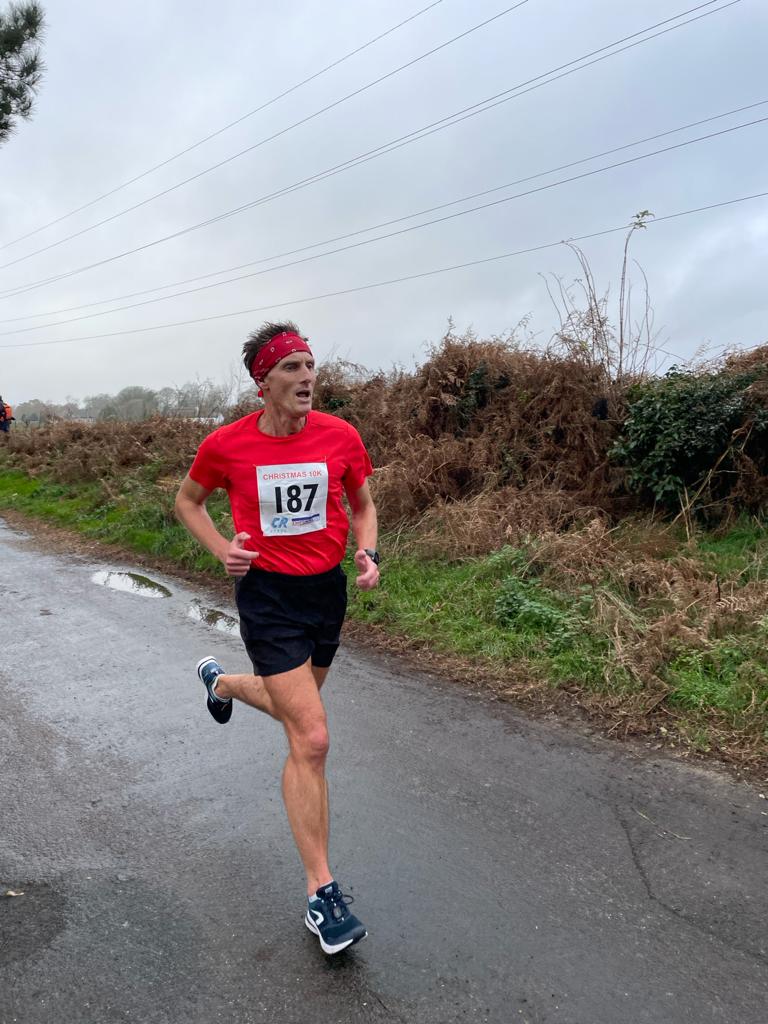
Final sprint to the line at Christchurch 10K in 2021

From a process perspective, much seems to have happened. I’ve generally got fitter. At start of year I was running some of my recovery miles as slow as ten minutes; by year end I was feeling comfortable at eight minute miles. My general training speed has improved and there was a notable difference in how I felt on my 800 time trial. Last December I was absolutely gasping by the end of it with the lactate build-up leaving me coughing for the next hour. Each of this year’s time trials has felt progressively better, less hard breathing, even if I’ve not been significantly faster. All of this summarises to having built a better aerobic system.

Over the year, I’ve lost a stone in weight. I started the year at 188lbs (13st 6lbs) and am now below 175lbs. I’ve never been this light or chiselled in my life. Half the weight loss happened in the early months when I geared up and did the tough interval training; the other half when I started doing a low volume of press-ups and bicep curls daily. On that front, I’ve at least doubled my capacity for doing press-ups in six months.


While endurance has improved. I’ve been wondering about my top-end speed. At year start, I knew I was struggling there as I couldn’t even hit a peak speed of five minute per mile pace running flat out. Now, I will say this is to be treated with a little scepticism because the accuracy of my GPS watch is not quick to lock in. It takes fifteen seconds but even so, by year end I’ve seen myself hit 4:13/mile on it. Again I’m aware this is not a great top end speed, given that Olympic distance runners do whole races at this pace.

Digging back through my records, I found myself hitting 3:38/mile when I was younger at the end of parkruns. Again I treat this with some scepticism as GPS can be wonky but I also suspect it’s relatively accurate. Ultimately the best 800m runners in the world are averaging a 3:20/mile pace for the men and 3:50/mile for the women. They can run fast over short distances – I can’t even hit these paces yet.

Throughout 2021 I’ve been exploring ways to improve my top end speed. This has ranged from looking at cadence and trying step-over drills; thinking about form generally; to doing twice-weekly sessions of sprint drills which really seem to be making a difference. As I exited 2021, my running form had begun to feel different in a positive way. I finally feel like I’ve got a back kick and the trail leg is shortening when I try to run quickly. I’m becoming glute-powered rather than quad-powered.

What I haven’t done to improve my speed, for deliberate reasons, is any hill work. I tried that in 2020 and within two weeks, I’d blown my aerobic base as the fast-twitch muscle began to overpower it. While it would be useful to get the fast-twitch speed back, I need to do it in a controlled manner, waiting until base is bigger and capable of handling high levels of anaerobic work.


From a racing perspective there hasn’t been much. The big positive was the return of parkrun in July. At my fiftieth birthday, I managed a 21:20 Upton House Personal Best. Then over the last few months I’ve been reducing that with runs of 20:55 there again, 20:26 at The Great Field parkrun and a touching distance of sub-twenty – 20:11 at Poole on Christmas Day.

The great thing about running 20:11 on Christmas Day is it’s not notably worse than ten years ago when I was forty and running 20:00 on Christmas Eve 2011. This is also true of my 10K.  At Christchurch in 2011 I ran 42:23; this year I was one second slower at 42:24 !!

Ten years ago, I was on my way up with my run training and I didn’t have any understanding of the interaction of speed, endurance and recovery; and how to bring them together to perform at your best. I had much more speed then because it’s all I tried to do, whereas now I’m coming at running from the endurance end. I’m hopeful I’ll be adding aerobic speed this winter that will see me surpassing all previous bests. I don’t like to rely on luck or hope but … fingers crossed!

This reflects the negative about Jack’s plan. I don’t feel it’s helped me improve at the top-end speed as there’s nothing in the schedule dedicated to building it in the first place. The best 800m runners are often coming to the event capable of running 400m in less than fifty seconds (as young adults) and then building the endurance to hang on. For this reason, I’m going to reintroduce my own ideas about the things that helped me to get fast when I was young – which mostly involve more standing recoveries and interval work done in sets to allow lactate to clear. I just need to make sure I don’t undermine the aerobic base by doing too much.

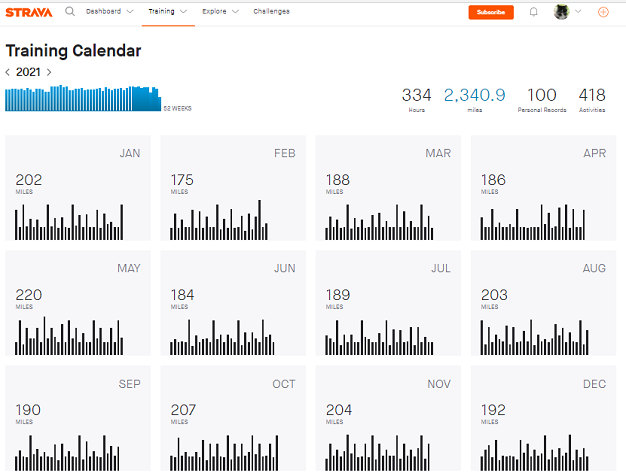
So that’s been my 2021. I’ve enjoyed the year’s running – there’s no way I could have got out every day if I didn’t. I covered about 100 miles more than in 2020 and that has been down to a consistent schedule. I usually run around six hours per week training and that’s led to more miles as I’ve speeded up. Of course the schedule flexed through the year depending on where I was at with Jack’s plan but generally speaking it’s been a consistent outlay of six to six-and-a-half hours each week resulting in 40-50 miles.

Update on my 800m training – Nov-Dec 2021

Traditional winter training for middle-distance runners is a combination of building endurance and running cross-country. In my case, I’ve replaced cross-country with an all-out parkrun effort every couple of weeks.

After my last 800m time trial (2:49) in October, I took a recovery week and then began the endurance work. Using a fortnightly cycle the plan was to do two Steady runs (Tuesday and Friday) and a long run on Sunday on week one; a Steady run on the Tuesday and a faster-than-Recovery paced run on Thursday with the fast parkrun on Saturday. It worked quite well and my first three parkruns came in at 21:20 (Oct 23rd) and 20:55 (Nov 6th) at Upton House then a road trip to The Great Field parkrun (Nov 20th) where I ran 20:26.

With Christchurch 10K on December 12th I wasn’t planning to do specific training other than to taper and run on fresh legs. I’d planned to run one more fast parkrun between Dorchester and the race but Storm Arwen hit so I replaced it with some cruise intervals.

The 10K was a little disappointing as I went in expecting to be somewhere in the 41-42min range and ended up clocking 42:25. Not a terrible time by any means but my legs never felt good. I have a feeling I killed them in the preceding week by running a low volume of 200s and 400s. On the Friday (3x400m), Tuesday (2x400m) and Thursday (2x200m). That really is a low volume but perhaps I ran them too fast as I originally was aiming to hit 5-10K pace and the 200s came in at 37s which is faster than my 800 pace. That was a fun session as I ran it at the cricket pitch. Groups of college sixth formers on their lunch breaks were dotted around and they began heckling and cheering me on!

Since the 10K, I ran another 21:01 at Upton House and then on Christmas Day on the flats of Poole, I was among 798 runners as I ripped round to finish in 20:11. Touching distance of being back under twenty minutes.


After giving the legs a week to recover from the 10K, I decided I’m lacking decent aerobic capacity. On the parkruns and race I’ve barely been able to run quicker than 3:55 for a km. In 2020 I could run 3:48, two years ago I was hitting 3:45 and five years ago I was close to 3:30. The endurance training has been good but it’s been to the detriment of my aerobic speed. Even my top-end speed isn’t great and I believe this has contributed to the disappointing 800m time trials this year. I’ve noticed as my leg speed has disappeared so has the size of my quads – at least a couple of inches smaller than they were.

The consequence is I’ve begun running my old favourite session – 5x1K with 3-min recovery. It’s a great combination of distance, pushing the aerobic capacity and improving lactate clearance and tolerance.

The endurance training itself has begun to look great. I’m running twelve mile Sunday runs at sub-8 pace – close to 1hr30 most weeks. But also my recovery runs have got faster despite me keeping them easy wherever possible. This has really set me in position to build the speed side with the kilometre intervals and I’m hopeful this will have me close to nineteen minutes at parkrun by end of January.


Supplemental to the running, I’ve been finding sprint drills and strength work have been highly beneficial. The drills have been great in identifying inefficient running form and after two weekly sessions for two months, I’m finding the improved posture and muscle activation are beginning to bleed into my runs. Most significantly I’m start to get the feel for how to sprint and this can only be a good thing for my 800m time.

The squat work has strengthened up my legs but also the muscles in the hips and glutes. It highlighted a weakness in the left glute on the outside which was clearly not contributing to my running. As it strengthened up, it began to fire during runs and, in the long term, I’m expecting it to make a difference. On the negative side, I did too much squatting too soon and after about three weeks began to find my legs were getting sore so I stopped to let them recover for a week.

It’s been a useful two months, especially as I’ve taken over a minute off my parkrun time with my best time in four years at 20:11. I’m intending to stay with this plan through early 2022 and maybe run Bournemouth Bay half marathon in the spring. I’m sure a big part of improving my 800m time is going to be improving my aerobic capacity with the 5x1K intervals – I’ve really allowed my leg strength to drop in favour of efficiency the past few years.

Dealing with going anaerobic

In the last post I talked briefly about going anaerobic. The word anaerobic means to be without air and, at its simplest, it’s when the body cannot get enough oxygen for the work being done. More accurately, anaerobic metabolism occurs independently of oxygen – the distinction being there can be oxygen present but for whatever reason it’s not being used. I’ve experienced this on occasions when my heart-rate has been lower than 130 bpm but I can feel the signs of working anaerobically. If I were training by my heart-rate monitor I’d shoot on past this and for many years I never realised it was holding back my running.

Going anaerobic is quite normal. As I said in the last post we do it the moment we begin an exercise as simple as getting up off the sofa. The problem with going anaerobic is that we can only handle a limited amount of it. While that’s not an issue for daily tasks like going upstairs, it quite often turns out to be the limiter for runners exerting themselves for significant periods of time.

Going anaerobic produces all sorts of by-products that feel uncomfortable, as well as using up fuel stores much quicker than aerobic metabolism. While fuel isn’t an issue in shorter races, some of the by-products are. For example, carbon-dioxide is a by-product which results in you breathing heavier. The faster you run, the quicker by-products build up which is why you get out of breath very quickly when you sprint.

Not all by-products are bad. One which you may have heard of is lactate, also incorrectly referred to as “lactic acid”. Historically because it’s easy to measure it was originally thought to be the root of all the problems and most people still associate it with bad things e.g. runners saying “my legs were full of lactic acid”. So while it’s technically wrong to say it causes bad things, the real world uses it in this sense because it’s become the norm and coaches use it because it correlates to the waste products which are bad. I’m not going to buck the trend!

Three ways your body handles going anaerobic

Lactate Clearance – any time lactate is being produced, the body shuttles it out of the muscles to other areas of the body where it can be broken down or used as fuel. This is done by monocarboxylate transporters (MCTs). While you don’t need to remember the name of these, it is worth understanding the body can only build a finite number of them. This means only a certain amount of lactate can be cleared. Typically this is an hour’s worth while running at Threshold. In fact it’s the other way around in reality, your Threshold is defined by the MCTs. When you’re doing a run of less than an hour, you can run proportionately faster than your Threshold.

When the level of lactate production is equal to the level of lactate clearance, the body is referred to as being in a Steady State. The lactate neither increases nor decreases. Most people train here because the steady state doesn’t feel bad. It’s a combination of aerobic and anaerobic energy.

Lactate Tolerance – if the rate of lactate production exceeds the rate at which it can be cleared out then all the body can do is tolerate it by buffering the acids. Just as there is a limit to how many MCTs can be built, there is a limit to how much lactate tolerance can be built through training.

Slowing down – the third way the body responds to a build-up of lactate is the one most of us have experienced – it slows us down.

If we go out very fast, we use up lactate tolerance quickly and can then only run in a steady state at best. When the anaerobic energy production or MCTs run out, all we have left is aerobic energy to fuel us and drop down to the aerobic level. This is something most have experienced in half and full marathons.

The slow down can be voluntarily reset at any time by dropping back to aerobic mechanism. After a period of this, the lactate has cleared out and we’re able to pick up the speed again. Most runners unconsciously know this as they push themselves to the point of getting out of breath, slow down and then later find the energy to give it another effort.

Implications for training

Anaerobic training, such as speedwork and intervals, has its benefits but they are limited, less than 10% of your parkrun is anaerobic ! There is only so much clearance and tolerance that can be built by the body. Spending your time training anaerobically only provides so much benefit. All those rest periods keep resetting the anaerobic systems.

These limitations don’t change for the best runners, they are just as limited in the anaerobic department as the rest of us. The difference is they have better aerobic systems. Quite often they have a naturally large aerobic system but they’ve also improved it through training and that’s where all of us should be spending the majority of our training time.

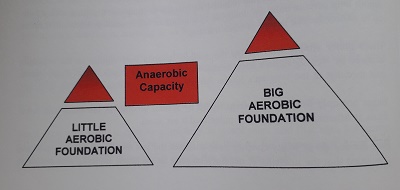
This is best encapsulated in a picture from Keith Livingstone’s Healthy Intelligent Training book. The Anaerobic contribution is the same in both but, the bigger the aerobic contribution, the more that can be achieved i.e. running faster.

Going anaerobic

I remember when I was in my twenties, and I knew absolutely nothing about how to train for running. I just thought you ran as fast as you could for 10-20 mins and assumed you’d get faster. Compared to now, there was a dearth of information on how to train although there were books on it; but anyone who was decent learned how to run by the osmosis of running with others at a club.

These days there’s more information, jargon and approaches to getting better than ever before. Although it wasn’t running, I remember meeting some rowers – which as another endurance sport mirrors running – and one of them talking about “going anaerobic” and “oxygen debt”. These phrases were about as technical as people got in those days and while “anaerobic” still gets bandied around; the concept of oxygen debt is one that’s rarely mentioned these days.

My understanding of going anaerobic back then was based on the idea that sprinters use anaerobic energy while distance runners use the aerobic system. It was one-or-another in my head and anaerobic equalled the breathlessness of sprinting. The truth is more complicated as both groups use varying degrees of aerobic and anaerobic energy in their events. This post isn’t going to break that down but it’s taken me some years to get closer to the truth about when we go anaerobic. The fact is any breathlessness, which can happen for an untrained runner at paces as slow as nine or ten minute miles involves anaerobic metabolism. You don’t have to be running at high speeds to go anaerobic.

When you read running books that mention anaerobic training there is much confusion as different authors define it differently. Again, I’m not going to dive too far into that debate other than to say some authors see it as what happens when you exceed V̇O2max. Others believe it is what happens when you exceed Lactate Threshold / Anaerobic Threshold (or whatever term they use to name the point where you begin to exhale harder and faster). Whereas I believe it starts much earlier than that, back at what may be called the Aerobic Threshold, but is confusingly also called the Lactate Threshold by some groups, and consequently I refer to as the First Threshold to try and avoid confusion. Even then I’m not entirely correct about when it happens – it’s simply a nice approximation.

What I can say with confidence is that going anaerobic happens any time your aerobic system is overwhelmed. If you’ve been sitting quietly on the sofa and suddenly jump up and run upstairs; your heart doesn’t have time to speed up to supply more oxygen so you have to go anaerobic to meet the demand. For a while you go into “oxygen debt” until the body is able to handle the exertion – which is partly about getting to the top of the stairs and stop the high intensity work; and partly because the heart races and you breath hard in response. Another example is the start of a run, you’ll be using anaerobic energy until the body can meet the demand; once you’re settled in every thing steadies up but if you come to a hill and start to get out of breath going up it – yep, you’ve gone anaerobic again.

All of this is simply background information setting up my next post on how the body responds to going anaerobic. It’s very easy to get bogged down in the detail, I’m trying to keep it simple but if you have questions please do ask in the Comments.