The autumn marathons are upon us and first we’ve seen Eliud Kipchoge set a world record time in Berlin and then Keninisa Bekele placing 5th in London in under 2hr06. What makes these runs so impressive is Kipchoge turns 38 next month and Bekele is already 40. These are not the sort of times or placings you expect men approaching their midlife crisis to achieve.
Kenenisa Bekele readies himself for the off …
Both, of course have a long history as elite runners with both of them winning gold medals at the 2003 World Championship in Paris. Kipchoge won the 5,000m; Bekele the 10,000m. Since then Kipchoge has become the world’s premier marathoner and Bekele set a world record in the 5,000m. In 2019 he ran the second fastest marathon in history behind Kipchoge.
Both runners are naturally better suited to distance running than the rest of us and at around 3:50 their mile times are some way down on what the best can achieve but it doesn’t make them slow compared to the rest of us. Less than 2,000 men have managed a sub-4 minute mile and basic speed is the foundation of Kipchoge and Bekele’s distance running success.
Two marathon world record holders (Kipchoge and Radcliffe) watch near London’s finish lline
The pace of their recent marathons comes in at 4:36/mile (or 2:52/km) for Kipchoge and 4:48/mile (2:59/km) for Bekele. Few of the runners I meet can even run 400m in a time under 1:12, let alone a mile.
This harks back to a point I often make about how people returning or taking up running at forty say they’re getting old and can’t expect to be as fast as they were when they were young. Technically they’re right, but realistically they’re just making excuses in case they aren’t.
There is no reason why a decently trained man or woman in their forties can’t be near the front of local races, winning their age category and running their best times. One of my good friends ran his first sub-3 marathon (2hr58) at age 38 then spent his forties training properly with a club and was running 2hr34 as he was about to hit fifty. Improvement is easily possible for almost all the runners I meet.
For the most part staying fast as you age is simply about dedication and getting the training right. If you’d like me to help you improve as a runner then do not hesitate to contact me.
In my last update I detailed that I had gone back to endurance training as all the hills and speedwork of the spring had toppled my aerobic base. It was somewhat disappointing but also necessary if I’m to sort out my 800m. I now realise I’m done for this year and it’s going to be a winter of building endurance and stamina. The introduction of hills and sprints was great fun but also introduced way too much naturally anaerobic fast-twitch muscle. As I haven’t been near these areas in years, things toppled quickly. Hopefully by next winter, my base will be bigger and I’ll be able to handle the anaerobic side better.
Having restarted endurance training in early July I found I wasn’t making much progress; then in early August I realised I was beginning to get aches and pains of the sort when you’re training too anaerobically. I had to reset AGAIN. My focus became to ensure I set off on runs at a slower pace and built up to my aerobic limits. That reset did the trick as the pains dissipated and the endurance began to build. Even so I was still a good 30+ secs/mile down on where I was back in March. It was a surprise to me how easy it is undo everything.
Mid-August I did an all-out parkrun at Poole and clocked 20:25. Quicker than running there at Easter (20:40) but slower than last Christmas (20:11). I cannot tell you how frustrated I am feeling at not being able to get back under twenty minutes. Another parkrun at Sandhurst Memorial parkrun in late September was even worse at 20:48 but it’s a tougher course and my legs were fatigued so that didn’t concern me.
I’ve entered a couple of 10Ks – Boscombe on Nov 27 and Christchurch two weeks later. I’ve gone back to using the training system I used on my only ever sub-40 run back in 2015. Controlled threshold work on a Tuesday, a Steady run on Fridays and a long run on Sunday. This is the same as I was doing in February and March this year.
My plan is to do intervals at Threshold pace (6:50/mile) for three weeks, then up the pace to 6:40 for three weeks and again to 6:30 which will take me through to the end of October. After that I’m going to do shorter intervals at 5K and 10K pace which will hopefully see me breaking forty minutes again. It’s an aggressive schedule but so far the body has been holding up.
Endurance-wise it took me until mid-September to get back to where I was in February. That said, my fasted Sunday morning long runs have all been coming in at a decent pace, usually sub-8 average for 12-miles, no stops. For whatever reason, I seem to be running these quicker than in February.
Possibly some of the drop off I’ve been experiencing is down to a change in running form. Since last October I’ve been working on my form using drills at least once per week and somewhere around late June, combined with the sprints I was doing, I began to feel I was running differently. Less hip rotation and more power from the glutes. Of course, using muscles that have never been involved in my running, meant they needed to be trained and quite possibly they had a lower lactate threshold due to this. Whatever it is, the form change is beginning to feel powerful at times and I just have to keep working at it.
Behind the scenes I’ve been wondering about whether I’m cut out for training like this. For all the miles and effort, I’ve put in over the years; my improvements have been sporadic. I’ve decided this winter will be the acid test. Hopefully when spring arrives next April, I will see a decent improvement in my half marathon time. If I don’t then I’m scrapping the endurance focus and putting my training time into working on speed and to see whether I can get my 200/400 times down, even if it’s at the expense of longer distances.
I’m going to give it a fair crack of the whip and train the best way I know how to. The one sticking point is I entered the London Marathon ballot yesterday not realising the race is in six months’ time (April). If this were to be the year I get a place then my training would have to look at lengthening my long run out to twenty miles. Even so I’d expect the training I’ve got planned, to fit in well with how I would need to train. We’ll see when the ballot results are announced at the end of October. I’m currently doing just shy of fifty miles per week and have been for the past two years so the base is there for whichever direction I need to go.
Given I already have a strong aerobic system, I didn’t feel any particular need to give Wim Hof Method (WHM) a go with the cold showers. Yet as I read I began to wonder whether his method would be able to help me with the cold hands I’ve suffered from my entire life. While I’ve never been officially diagnosed I probably have Raynaud Syndrome where blood flow to the hands is non-existent in cold weather so they become like ice blocks. When the blood returns, it’s incredibly painful to the point where I’m on the verge of crying !!
I can remember it happening in the winter of 1978 when I came in after playing in deep snow in our back garden and 7-year-old me cried as my hands warmed back up because I’d put them straight on the radiator. It happened a decade or so ago, when I played golf on a January day and my hands were so frozen by the end of the second hole I couldn’t feel the golf club. In recent years, I’ve been caught on unseasonably cold autumn runs where I didn’t wear gloves and arrived home barely able to get the key in the doorlock, let alone turn it.
So I was wondering if I should email Wim and ask him about whether his method could help an otherwise very healthy me. Then, as I turned to page 34, I read Wim Hof Method Experiment #1 –“Ice-water bath for warmer hands and feet” detailing a protocol to kickstart the vascular system by putting hands in ice-cold water for two minutes.
Warming cold hands
Initially I followed Wim’s protocol by filling my bathroom basin with cold water and putting an icepack in it. Ideally the mix would have been two-thirds cold water, one-third ice but I simply don’t have access to enough ice to do this every day. So the water may have been a touch warmer than Wim would like but I plunged my hands in for five minutes each day. It never felt too bad but it became something of a hassle to stand, bent over the sink for five minutes so I changed tack after four days.
I decided I would simply hold the icepack pressed between my hands while sat on the sofa. Each day at about fifteen seconds, the cold of the ice would begin to seep into my palms and start to hurt. By around a minute the pain would seem almost unbearable and the pain spreading through my wrists down into my forearms. Initially it took the better part of two minutes for the pain to subside and then the remainder of the five minute period would be okay.
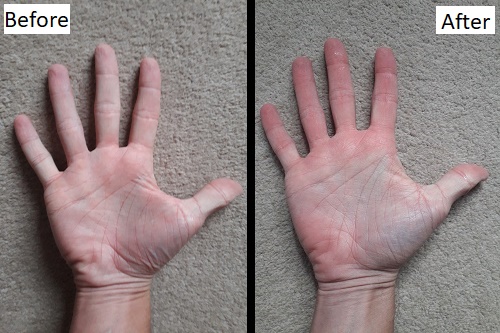
Hands with blood in the fingertips after five minutes of icepack holding
Wim Hof says that what happens is the body has to adapt to the sudden cold and the microscopic blood vessels have to open up to allow blood to flow to them and warm the hands. I also noticed I was getting some discomfort across my chest during this part of the process and wondered if it would have any effect on my heart-rate. I gave it a try while wearing my heart-rate monitor on one occasion and I’m not sure it showed anything significant. My heart-rate was resting at 40 as I began and dropped to 32 by the time I’d ended. Later when I was sat there, with the icepack now back in the freezer, my resting heart-rate was again down at the 31-32 level, so I don’t think there was any difference.
By the end of the first week of holding the icepack I was noticing the time for my hands to respond and the ‘unbearable’ pain to go diminishing until it only last a minute. By the tenth day, I was no longer finding the ice difficult to hold at any stage. I noticed my hands were much redder afterwards (a sign of the bloodflow to them) and despite feeling externally very cold when I put my hand to my face or on my thighs, I no longer seemed to mind the cold.
At the start of week three – fifteenth day from when I started the initial basin immersions – I found, as I was putting the icepack away, that a large splinter of ice dropped off the freezer compartment and split into two. Initially I threw it in the kitchen sink but then decided to try a new experiment. I picked up an ice sliver in each hand wondering whether I could melt them. Certainly they began to drip but it wasn’t a rapid melting and after three minutes, I’d had enough. I could have held them for longer but I was beginning to feel the ice affecting the skin. There wasn’t much mental pain, just some discomfort. After dropping the ice, it was noticeable my hands were very cold. I put my left hand on my other forearm just below the elbow and it was noticeable how much heat it was giving off. Yet despite the externally cold temperature caused by holding the ice, my hands didn’t feel uncomfortable. They were definitely cold but I wasn’t in the sort of pain I’d experienced all those years ago on autumn and winter days.
Five weeks on from starting, holding the icepack is barely noticeable and I’ve started applying it to the backs of my hands and forearms. There’s been a small amount of discomfort and change but I feel I’ve adapted quickly.
So, all was looking good until this past weekend (mid-September). We had our first slightly more chilly mornings and I can’t say it was encouraging for my hands. On both Saturday and Sunday I ran without gloves and, on the latter, the fingers of my right hand were feeling numb at the end of the run. It wasn’t excruciating but then it wasn’t an overly cold day. I’ll stick with the daily icepack holding and see whether I can effect a difference by the time the real winter arrives.
Warning – if you decide to try this, don’t force it. You always need to go a little beyond your comfort zone but it doesn’t have to put you in the hole. Your body will learn to adapt and so what if it takes two weeks instead of ten days. The important thing is to stay consistent and get there in the end.
Horse Stance
Horse stance is a pose where you squat down with feet out wide. Wim Hof set a world record by being able to hold this pose for three hours.
On the first day I tried it, my legs were beginning to shake after a minute and at 1min30 I quit. The next day I repeated it and then on day three, I reached 1min45. Day four was two minutes; day five was 2min15 and on day seven – only a week in, I reached three minutes. I was surprised how quickly I had been able to double my endurance on this.
It’s not a completely unfamiliar pose to me as when I played volleyball many years ago, I would spend a lot of time squatting low in the backcourt hoping to dig and recover opponent’s hits. But playing volleyball was a long time ago so I doubt I have any residual strength from that.
It also reminded me of the couple of years where I did yoga regularly. Many stances you just hold with a bent knee or bearing your weight. These never seemed difficult then and because I only went once per week, the body adapted without me realising. Yet I recall there were other members of the class who would struggle which I believe highlights Hof’s point about needing to stay healthy for low exertion.
Hof’s explanation for this ability to hold a pose longer each time is because the body becomes able to remove the lactic acid. Lactic acid (or more precisely lactate) has always been blamed for making the legs of runners heavy and while this isn’t strictly true, it’s a convention that everybody agrees to use. As much as I dislike being inaccurate, I will stand by convention for the rest of this post.
The following weeks of my trial saw further rapid improvement – week 2 out to five minutes and week 3 reached six minutes. This was the longest pose I held and it was notable that while my legs had begun to feel discomfort at three minutes, I was able to hold it longer. Yet on day 1, I would have struggled to go longer than the minute and a half I managed. I have come to learn over the last few years is that there is a difference between when the body simply cannot go any longer due to the lactate build-up versus not being willing to stand some discomfort and push through.
What struck me about how quickly I progressed is that it’s very much what we see with new runners. Every untrained runner has untapped capacity in their slow-twitch muscle. If you use these they quickly begin to contribute. To go longer and faster, once you have reached the limit, such as when I reached five to six minutes in horse stance, needs dedicated training. That’s why runners do interval training – to be able to accumulate more time overall at the point of difficulty. Over time, the intervals begin to help the body adapt to producing less lactic acid which later enables them to move up to the next level and race faster. But that untapped capacity of the slow-twitch muscle is low hanging fruit waiting to be picked by everybody for their health.
Since reaching the six minute mark I backed off on horse stance and generally hold the pose for two to three minutes per day. While it’s good to see progress, it also began to feel time consuming, almost boring to clockwatch if I’m honest. I have no particular reason to improve at this exercise and, with running being my priority, I feel pushing to hold the stance longer may detract from the important workouts when I need my body to be fresh and ready to push.
I’ve enjoyed trying these two simple Wim Hof Method experiments. I will certainly stay with the cold hands ice training into the winter as it has huge potential benefits to me. The horse stance has less obvious benefits and while I will probably continue to do it in the future, I suspect it will fall by the wayside when I have a busy week or few days and be forgotten.
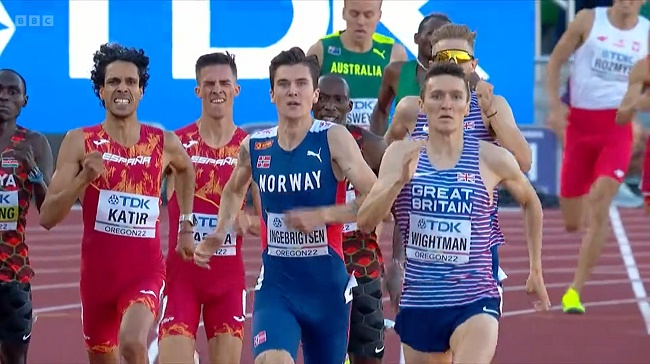
I woke up on Wednesday morning to discover Jake Wightman had won the 1,500m final. Quite a surprise given middle-distance racing has been dominated by Kenyans, Ethiopians and Moroccans for the past two decades or more. It’s only the last couple of years that we have seen the rise of Norway’s Jakob Ingebrigtsen challenging them, which led to him entering this race as the Olympic champion. It’s great to see the African dominance being shaken up as the world catches up on them.
Like Eilish McColgan, Jake has the genetics and support around him to help get the best out of himself. His father, Geoff, was a 2:13 marathoner and ran at the 1990 Commonwealth Games. His mother Susan, nee Tooby, and her twin sister Angela both ran at the 1988 Seoul Olympics. But, even with the family background, you have to have the motivation. Jake himself is a twin, and while brother Sam is still runs as a member of Edinburgh AC, he apparently didn’t continue to take it as seriously after he turned eighteen.
In seeing Jake winning the race in 3:29.23 – a personal best – I wondered how he had ascended to be the champion. He’s just turned 28 and his climb has been slow. Going back only eight years ago to the Commonwealth Games in Glasgow, he was knocked out in the heats in a time of 3:43.87, almost fifteen seconds slower than in Oregon.
It’s instructive to look at his UK Athletics Power of 10 record which lists the majority of his official races and times since he competed in the Scottish Schools championships in 2007 just before he turned 13 years old. At that time he was running 4:45 for 1,500 and it only improved to 4:33 a year later. It took the better part of a decade to knock a minute off that and get down to his current ability. As the graph below shows, he was running close to these times in 2014 and since then has been working to eke out the last improvements from 3:35 to sub-3:30. Even so, it’s a steady progression over the first seven years.
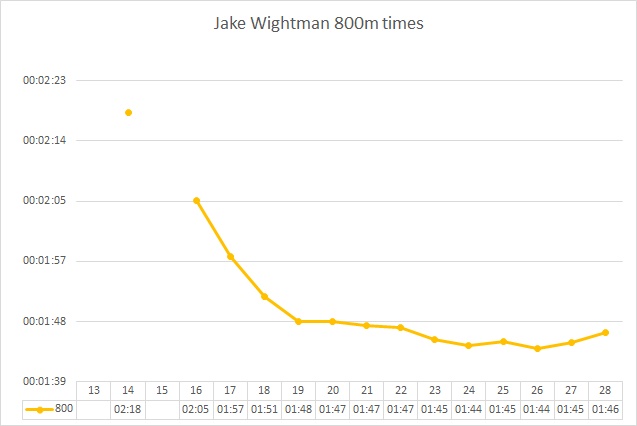
It’s the same story with the 800m. He began as a 2:18 runner in 2008 at age 14 and finally broke two minutes at 17. From there it was another two years to break 1:50 and then it wasn’t until he was ten years into his running career that he became the first British man since Peter Elliott in 1991 to break 1:45 for 800m and 3:35 for 1,500m. That is a lot of running, training and development to get near to his best.
Of course what we don’t know is what his training aims were during these periods. For example, from 2012 – 2016 he ran in some 400m races seeing his times improve from 52.7 to 48.3sec. Again this highlights how it took four years to make a decent improvement from already good times to even better ones – an average of one second per year.
This idea of long term development is one that the average runner doesn’t understand. It takes years to become the best runner you can be. For many runners training consistently for 3-6 months is considered long-term and they’re happy to knock a minute or two off their half marathon time. But as Jake’s record shows with consistent training and a long term approach, you can go much further than you ever expect.
Britain finally seems to have found its summer and a heatwave is predicted over the next few days. This doesn’t bode well for any of us who can’t run early morning or in the evenings when it’s cooler.
There’s no doubt heat, or more importantly humidity can affect your running. While a hot day can be unpleasant, it’s the latter that’s the greater issue because it makes it harder to keep cool. High humidity means there’s high levels of water vapour already in the air and this means the sweat / water on your skin has nowhere to go – it can’t evaporate. So it just sits there and stops you from sweating further which is a key mechanism used by the body for cooling. The heart already works harder, as evidenced by a higher heart-rate, to get more blood flowing to the skin to take away the internal heat which occurs through sweating.
If the body temperature rises too much it can be dangerous. The body usually functions at a temperature of 37-38C but add a couple of degrees to that and it begins to impair muscle function. Get to over 40-41C and you’re in danger of heat exhaustion. Heat exhaustion is problematic and if left untreated it can turn into heaststroke which can be deadly.
I think I suffered heat exhaustion once. I was running at the beach, in the middle of summer, and it was a hot sunny day. The day before I’d done the same route – a ten mile run, five miles out, five miles back and even though it had been hot, I had no issues.
On the second day, I felt fine on the outwards stretch and I seem to recall I had a slight wind in my face which helped me feel cool. Then I turned around and it was hot. Any breeze was now on my back, so I got no benefit and I was running with the sun shining on my front. Where I’d run at 8min/mile on the way out, my 6th mile slowed to 8:30 and I was beginning to feel bad. The 7th slowed further to 9:10 and I took a couple of minutes break, standing in the shade shivering behind a beach hut. My heart-rate wouldn’t drop below 115 even though I was just standing there. I resumed at an easy jog, as I still had three miles to cover to get back to the car, but when the 8th mile came in at a shuffling 9:45 I decided it would be best to walk the rest. I had no further effects that afternoon and the following day I felt fine and was back out running okay.
I’m not quite sure what happened. I’m sure I was a little fatigued from doing the ten mile run the day before although longer sessions were quite common at the time. I may not have eaten or drunk enough before setting out. I find in the hot weather, I am constantly drinking fluids and still underhydrated. One other thing may have been an issue, at one stage of the run I sped up to get past the land train that runs along the prom. This pushed my heart-rate up into the 150s and may have set off a chain of events that I would otherwise have avoided had I just been jogging casually. Whatever caused it, I believe I took the right action by cancelling the session and walking back. Fortunately I’ve never encountered it since.
I’ve always been a big believer in drinking to thirst. Most of the day I have a cup of tea to hand but I don’t force it. When I was more endurance trained and sweated less, I found cups of tea would be half finished. At the moment, with the heat I’m drinking lots of tea and I’m still seeing that I’m underhydrated when I go to the toilet. The colour of your urine is a good indicator – when it’s clear you’re hydrated, when it’s golden or even darker you need to drink more. Even though I don’t noticeably sweat during the day, I’m still losing fluid from the body – water particles will be exhaled in your breathing.
The advice used to be to drink lots before a marathon and to keep drinking throughout. But this became a risk with runners drinking over a litre per hour for 3-4 hours. It could lead to a condition called hyponatremia which can almost ‘drown’ the body’s cells and wash the important minerals out of them. The advice now is to drink to thirst.
Of course if you can do your runs in the early morning or late evening, they’re much more enjoyable. Last Sunday, I did my long run at 5:07am and was home well before 7am. It was cool from start to finish and I still had the rest of the day to enjoy the sunshine.
On other days, I’ve been running in the heat of the day but I don’t mind it. Most of the runs have been for recovery purposes which are deliberately kept slow enough that they don’t cause me to break sweat too much. There is a little but it doesn’t get too uncomfortable. I’ve actually found it’s worse when I arrive home and stop moving. The lack of air circulation causes any sweat to start building up.
The couple of workouts I’ve done in the heat I don’t mind. It’s probably because the intervals aren’t that long and you get a rest afterwards. I believe the real danger of running in the heat comes when you try to hold onto a decent pace for a long time.
If we’re lucky enough to have good weather for the rest of the summer months then it’s worth understanding that it takes around two weeks for the body to get used to the heat. There’s always going to be some degradation in performance because of it until that occurs.
Best advice I can give you is to get out and get used to it. Keep yourself hydrated by drinking to thirst and don’t try to force yourself through anything that feels untoward or out of the ordinary.
With my speed improving over the past month, I took another read of Pete Magill’s Speedrunner book to see what extra I could learn. One of the things I’ve found with learning is that rereading stuff is helpful. The first time you read something it may seem to go in and be understood. If you then begin to apply what you’ve read and grow, a reread brings a different perspective on the same material.
Among the exercises listed in the book are one-legged squats. These are nothing new to me and last November I started doing exercises as I wanted to be able to do a pistol squat which is a full one-legged squat to the ground and back up. I did exercises for about six weeks which were beneficial but when combined with the faster running I was doing, my left glute got sore and I decided to put them on hold rather than get injured.
Reading Speedrunner as I sat in my garden last Monday, it was one of the rare sunny days we’ve enjoyed this summer. The front half of the book is an explanation of the concepts of maximum velocity, acceleration and sprint mechanics while the second half details exercises that will help to improve these.
A variation to the one-legged squat was also detailed. Begin sitting in a chair (as I happened to be doing at that point) and raise yourself up out of it on only one leg. This allows you to go with a smaller range of motion plus the security of not falling backwards or collapsing on the floor. I gave it a try.
My right leg was just about strong enough to do five reps, it was a struggle but I got them done. The left leg was not so easy. Almost immediately on trying the hamstring muscles in the back of my thigh were crying out in pain with the difficulty. I could do it but it was on the edge of a strain. Fortunately I know my body well enough to know when to keep going and when to back off. I did the five reps and that was it.
In the following days, I continued to do five reps each leg, each day. The left leg still strained at the effort but subjectively I knew the pain was reducing, so the muscle must be getting stronger. Plus the exercise itself is also an improver for balance and coordination. It’s worth noting that for all the technology we have, there is nothing that could tell me I was improving beyond a subjective assessment.
By Saturday, after five days of this, I was feeling strong enough to do ten reps on each leg. The left leg was still a little grumbly about this, the right leg strong but actually not quite as good at balancing when up out of the chair.
On Sunday I went for my long run and with the combination of miles and a decent pace (rather than recovery) it’s the sort of run where any new form can begin to be ingrained. I didn’t particularly notice anything different with the left leg starting to strengthen up but in the last mile or so, I found my right shoulder dropped and began to swing a little easier. They may not seem connect but the arms and legs working in opposite pairings, so the right leg / left arm swing together in time as do the left leg / right arm.
Fixing form issues is quite often a case of looking at the whole body as a system, not simply focusing on the body part you thing is an issue. A good example of this is when you have a runner who heel strikes. The instinct is to get them to run on their toes more but quite often I find it is happening because their hips or glutes aren’t working properly. And I reckon this is what happened to me this past week. I got the left glute-hamstring area stronger, it worked better and consequently that led to the counterbalance from the right shoulder correcting itself.
I’ve continued with the one-legged chair squats this week and they are getting easier and easier. The reps of standing up onto the right leg are now beginning to feel as easy as it does when standing up as normal onto two feet. The left leg is still a tad weak but it will strengthen up. I’ve noticed the right shoulder seems to be dropping into place more often when running and during sprints my form felt great.
One of the surprises is that I need to do this strengthening work. While I do press-ups, corework and dumbbell curls to keep my upper body in shape, I had always considered running was enough for my lower body, particularly in recent months where I’ve been doing hills. Apparently it wasn’t and while it is difficult, if not impossible, to find a set of tests to identify any weakness; it certainly highlights the benefit of doing a range of activities outside of pure running.
Last update I mentioned improving top-end speed is the priority this summer even if it comes at the expense of other parts of training. I’ve been doing weekly sprint sessions which alternate between hills and on the flat. The general process has been one of starting with a small amount of sprint work and gradually increasing it. Back in April my first session was 6x8secs – a total of 48 seconds effort. The next week it went to 8x8s (64s), then 10x8s (80s) followed. This morphed into some 60m flat sprints which came in at just under 9-10secs each but only four of them to avoid overloading the body with the new type of effort.
The hills then lengthened to 10secs (x8 reps) that still totalled the same 1min20s of volume before pushing up again to 10x10secs (1min40s). On the alternate weeks, 80m flat sprints were taking around 12s and then a 100m in 15s. Back on the hills, a single 20s effort replaced the final two efforts of the previous 10x10sec and oh my, that was hilariously tough. I was good for the first 15secs but as I entered the new territory of the final 2-3 seconds, my legs became jelly and could barely propel myself. That set the stage for adding a 150m sprint (22+ secs) on the flats and then hills went all-in with 2x25sec. This was my biggest session to date at 2min10 of hills and they won’t get bigger. On the flat, the volume is topping out at 700-800m which fits nicely with trying to be 800m runner.
The latest session was 2x60m, 2x80m, 1x100m, 1x150m, 1x200m as it begins to tip towards speed endurance. The shorter efforts now barely tax me but the 150 and 200 were tough. Ideally I would have taken longer recovery times. A sprinter would usually be taking fifteen minutes recovery before attempting the 200m, I took six minutes. Woefully inadequate and I began to pay for it at the 80m mark as the legs tied up and co-ordination went. My hopes of a first recorded sub-30 sec were dashed.
The setting for these efforts are my local roads. There’s a couple of hills nearby, in fact it’s hard to find a decent straight flat stretch off the main roads. There is one round the corner from where I live which has a slight gradient in the middle so I’ve used that. Unfortunately because it gets busier later in the morning, I’ve been out at 7am doing the sprints which isn’t the best time to go with all-out efforts. With it being mid-June and the longest days, I was up at 5am for breakfast a couple of times to get something in before my sessions. I should add I followed the sprints with some other fast threshold-paced type running.
The results from the speedwork seem to be bleeding through and I certainly feel I’m getting more push in the first steps and technique is improving. While the GPS isn’t accurate on the shorter efforts – it takes around 15-16s to get down to the faster paces – it has recorded me running at 3:35-3:40/mile on a couple of occasions which is scarily only as fast as the world record pace for the mile! But go back a year and I was struggling to run much quicker than 4:45/mile pace, so there is improvement.
The only downside of these sprint sessions is they take 3-5 days to recover from. Quite often my Wednesday sessions were a letdown and off target pace; eventually I ditched the Friday interval session in favour of a Steady run.
Nominally I’m following JackD’s plan and I finished off the 3rd phase of training with one of my favourite sessions … 600m effort in 2:03, 30s standing recovery, 200m in 37secs … three times over with a 7-min jog recovery in between.
When I did this session six weeks ago near the end of May my legs were simply too tired and I couldn’t get below 2:10 / 39s for the 600 / 200 split, I totalled 8min39 for the 2,400m.
This time around my times were 2:02 / 39 … 2:05 / 37 … 2:07 / 36 – 8:06 total time. Unfortunately the scheduled day saw me running into a hefty headwind for over half of the 600m efforts. I think they would have been on target on a calmer day, but it did give me an advantage on the 200s although I think I’d have been hitting those numbers anyway.
All in all, it’s been a good month with fitness improving and the goal of improving speed beginning to take place. I can’t believe I’m already down to the last six weeks of training before I attempt another 800m. It’ll be almost a year since the last one by the time I get around to it. I’m not expecting miracles but I am looking for a decent improvement over last year’s 2:49.
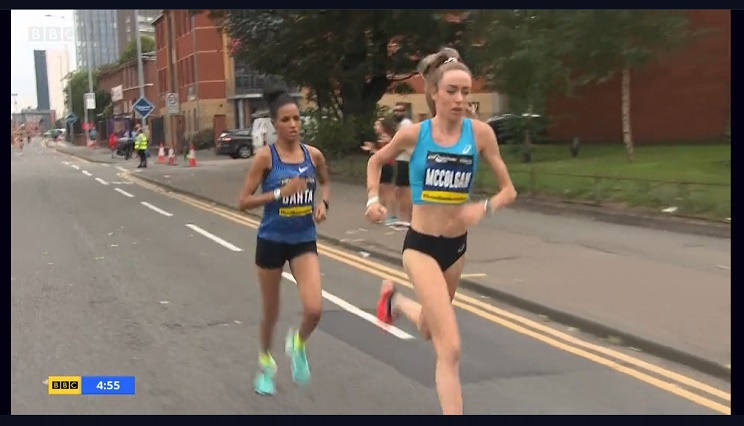
Scotland’s Eilish McColgan is the current golden girl of British Athletics. This year she has set distance records, the first occurred in February when she broke Paula Radcliffe’s British half marathon record by 21 seconds in 1:06:26. Then in May, she ran 30:19 to take Radcliffe’s 10K road record and on Monday (June 6th), she ran this time again on the track in Hengelo, Netherlands to set a Scottish record.
The McColgan name is not unfamiliar to followers of running. Her mother, Liz, was the World Champion in 1991 at the 10,000m having already been Commonwealth Games champion in 1986 and 1990 and silver medal winner at the 1988 Seoul Olympics. When she moved up to the marathon distance she won New York (1991), Tokyo (1992) and London (1996) marathons. Eilish’s father, Peter McColgan, was also a talented distance runner who competed for Northern Ireland in the 3,000m steeplechase and 5,000m at the Edinburgh Commonwealth games as well as for Great Britain in the steeplechase at the 1991 World Championships. What a pedigree for Eilish to have!
Not only does she have the genetic advantage but Eilish is also part of a generation of successful female Scottish distance runners. Laura Muir has been the most successful gaining a silver medal at last year’s Tokyo Olympics where she set a British record for the 1,500m in a time of 3:54.50 In 2012, Lynsey Sharp was European champion and competed at the London Olympics in the 800m. She followed this up four years later setting a Scottish record of 1:57.69 while finishing 6th in the Rio Olympic final.
A recent BBC article detailed that this year’s success is down to Eilish undertaking a reduced training load that Liz had to be persuaded would be in Eilish’s best interest. Liz had been running as much as 140 miles per week in her marathon prime.
But this highlights the event differences. Liz was always a long distance runner doing 10,000m and marathons. Following in her dad’s footsteps, Eilish competed in the 3,000m steeplechase for Great Britain at the London Olympics and then the 5,000m in Rio. It wasn’t until 2018 (when she 28 years old) that she began racing longer distances winning the ten mile Great South Run in 54:43. Roll on three years to the Tokyo Olympics and Eilish competed in both the 5,000 and 10,000m. Looking back at her Personal Bests, her time for 800m is 2:07.8 – over ten seconds slower than Lynsey Sharp and her mile is 4:00.97 which is five seconds slower than Muir. It’s clear that although Eilish competes in middle distance races, she lacks the top-end speed to be winner against the best and like her parents is better suited to the longer distances.
So it’s surprising when she talks in the article about how her training increased from 20, 30, 40, 50 miles per week and has only been operating at 65-70 over the last year and a half to two years. It’s not unusual for a world class 800m runner to operate on as little as forty miles per week but Eilish isn’t one. Typically world class 5,000 – 10,00m runners train between 70-100mpw. Given the recent increase in training mileage, it’s no surprise that when Eilish returned to the Great South run last October she was four minutes quicker than three years ago.
There’s no doubt decent mileage is critical to distance running success and Eilish’s approach of starting on low mileage and building up is a good one to follow but far too many runners simply aren’t doing enough mileage to support longterm improvement. Getting the balance right is important and, as Eilish shows, great results can be achieved off moderate mileage.
While I don’t wish to take anything away from how hard I’m sure she’s working in training, it should be noted many road and track records have been broken over the past couple of years due to the innovation of carbon plates in shoes. I am slightly sceptical Eilish would have been breaking Radcliffe’s records without them (at least in the near future); but many past records have been broken due to now-forgotten reasons outside of better athletic prowess. And in the longer term, unless the IAAF backtracks on the use of carbon plates, these records will become the new standard. All power to her – she’s still the best we’ve seen in a long time.
Whatever the reason, I have no doubt Eilish McColgan is going to go on to greater things as she gets the benefit of higher mileages and moves up to the longer distances permanently. At 31 years old, she has potential for another Olympic cycle in her and maybe more. I’m sure she will be looking to emulate her mother by taking on the London Marathon and other Majors.
Bonus content – Eilish is listed in Wikipedia at 1.80m (5’11). In my article on stride length I observed her cadence averaging 172 steps per minute giving her a stride length of 1.97m. It’s easy to think this is because she is tall and to an extent it is. But, as I also pointed out, Eliud Kipchoge (1.67m – 5’6”) has a stride length of almost two metres – about 15% greater than his height.
A quick look back at Paula Radcliffe running mile 5 of her record-setting 2003 London Marathon shows her running with a stride length of 1.67m (186-88 cadence) when she is 1.73m tall (5’8”). It’s a decent stride but it’s shorter than she is!
Was it the hills? I entered the month feeling positive after some very quick short intervals in April but throughout May my legs have struggled. I started doing hills in April to build speed and they’re certainly feeling stronger but they also tend to take a few days to fully recover.
I’ve never been a decent sprinter but I think I probably should have been. Firstly because I find it easy to put on muscle, and secondly because I’ve never found it easy to be good at distance running. Once I got on Strava I began to see how often quicker runners are able to get better results despite training half as hard as I do. I seem to lack the natural aerobic capacity that many distance runners have.
This is all behind the reason why I decided to give 800m running a try. It’s an event that still needs decent sprint speed backing it up. But when I started following a plan by Jack Daniels eighteen months ago, it didn’t do much for speed recruitment and I made a deliberate decision not to overdo things as I found it easy to run quicker than expected. This again is another reason why I think I’m better suited to short distance racing.
Even so I felt my top-end speed was missing as I could barely get my peak speed below five minute mile. Last February, I started looking at how to improve cadence in the hope this would improve my form for sprinting and top end speed. Six months ago I started doing ten minutes of sprint drills twice per week to clean up my technique. It’s made a huge difference.
So here I am doing Summer Training to build speed and peak for my next 800m attempt. With my aerobic base enabling me to run seven minute miles for an hour in the winter, I decided it was time to introduce hill and flat sprints on a Monday to recruit more running muscle and get faster at the top end. It seems to be working.
Six years ago, I was doing the same set of workouts and my times then for 60m, 80m and 100m approx. were 10½ secs, 12 secs, 16½ secs. Admittedly I tended to do these after another session but this year I’ve recorded times of 8.75s (60m), 11.5s (80m), 14.6s (100m). A definite improvement and fairly good considering I’ve barely done anything like this in the past half-decade and I’m now in my fifties.
I also found on the most recent block of flat sprints I was hitting some high cadences with the two highest values coming in at 262 and 278 on different efforts. I’m slightly wary of whether the cadence monitor is wholly accurate but if it is these are genuine sprint numbers. Again this backs up the belief my form is improving.
The rest of May’s training was something of a slog to hit target paces. Quite often I missed my faster targets but the legs always seemed sluggish after the sprints. This resulted in a decision – I’ve decided though that working on speed over this summer is the priority so if other sessions are a little behind because of that, so be it. Overall my numbers are still an improvement over where they were a year ago.
On into June. This is the hardest block of training. I’ve felt tight and slow on recovery days but hopefully I’ll get through it!
Have you played Wordle – the word-guessing game that went viral at the start of this year?
If you haven’t, don’t worry; there IS a running-related point to this post. The aim of Wordle is to figure out a 5-letter word within six guesses. You enter a word and the app indicates if there are any letters correctly placed, or any correct letters placed wrongly.
Color-blind mode in case you’re wondering!
Most people realise they can improve their chances by starting with a word which has commonly used letters. There’s no point in beginning with a words that has Zs, Xs, Js or Qs for example. While it’s obvious they won’t come up often – it’s perhaps not so obvious that letters like B or G are well down the list of those likely to be used. I learned the most frequent letters are E, T, O, A, N, I, R, S, H, D when I was at middle school, so I start off with words that consist of them.
People also know every word has a vowel (or “Y”) so they think a word like ADIEU is a good starter because it identifies the vowels, but there’s a downside to this. When you take your next guess, you’re reusing those vowels and have less room to figure out the consonants. For example if the A and E are correct in the first guess and you then use LATER on your second word, you’ve only used four of the twenty possible consonants on your first two guesses. You might have the A and E as you enter your third word but still not have found any of the consonants out.
I realised that if I used my first three guesses to get fifteen different letters out on the board, I’d definitely identify the vowels and almost certainly get some consonants while being able to rule out Z, X, Q, J. Worst case scenario, I’ve still got three guesses left for figuring out which of the other seven letters I need to use.
The result of this strategy has been very successful. I’ve only failed once on Wordle in 100+ attempts. That was back on March 11th when the word was WATCH. Why did I fail on WATCH? Because it has multiple possibilities – PATCH, CATCH, HATCH, MATCH, LATCH, BATCH. At least seven different words to slot into a maximum of six guess. And it’s made even harder because CATCH and HATCH involve a double letter. On reflection, I should have then entered a word like BLIMP to eliminate four of the options in one go. That’s good strategy for you.
Playing this way, I found I was able to get the word in under thirty seconds (quick typist), some days as quick as seventeen seconds (slow broadband) but there was a downside to this. You’re never going to get the word in fewer than four guesses (unless you luck in).
This was great while I was playing on my own and my objective was simply to get the word that day. But then I started playing against other people. Always being ‘guaranteed’ a 4th guess was good on the days while others were learning the game but eventually there would always be someone who came up a 3 or better. Now I never won. I had to rethink strategy and go boom-or-bust to try and get it in few than four. Or wait for them to play and see whether a 4 would be good enough!
My original objective when I started playing was to get the Wordle in six tries. Once I realised I could always do this, my objective became to get it done as fast as possible and get on with my day. When I started playing against others I changed strategy again. This is a lesson in life it’s taken me many years to realise. The strategy changes depending on the objective. There is no single perfect strategy or method that will enable you to always meet a variety of objectives.
I once spoke to a runner who found running hills brought her parkrun time down quickly and then, having entered a marathon, continued doing them. It was only when I pointed out over coffee that trying to improve her speed beyond 7:30/mile was fairly pointless as she was hoping to run a sub-4hr marathon at no faster than 9min/mile. Trying to improve speed was the wrong training for her objective.
This isn’t unusual. Runners have a collection of standard workouts and try to apply them to everything – the proverbial “to a man with only a hammer, every problem looks like a nail”. That said, most runners recognise that if they’re going to train for a marathon they’re going to do more mileage and some longer runs but that’s conventional wisdom tilting their training, not understanding the requirements of their objective.
There are certain underlying principles to training that work across all events – training daily is more effective than training a couple of times per week. You’ll always do better at Wordle with a starting guess of CLEAR than you will with VIVID. The high frequency letters enable you to build on later guesses, the low probability ones usually leave you with five guesses and probably no closer to a solve.
Just as high frequency letters like E, T, S are clearly better guesses in Wordle than X, J, Z; it’s obvious that sprinters train differently to marathon runners. But the difference in training between a parkrun, 10K and half marathon is not so obvious to the lay person, just as most Wordlers are unsure whether C, P or G is more prevalent.
It is possible to be good at different events at different times in a career. After all, Eliud Kipchoge was the 5,000m world champion back in 2003 and then when he changed his objective he became the best marathoner in the world. The change of objective necessitated a change in training plan.
You could look back to the 1950s and find Emil Zatopek winning the gold medal in the 5000, 10000 and marathon at the Helsinki Olympics and Lasse Viren trying to replicate the feat in 1976 where he won golds on the track but could only place 5th in the marathon. Training had moved on by then and people had begun to realise you specialise and train for the event rather than simply trying to be a good all-round runner. You certainly won’t find anyone attempting it these days. A local club runner might be able to do it against a sub-elite field just as getting Wordle in four guesses was successful until my competitors figured out how to play better.
It’s been a revealing yet simple reminder from playing Wordle this year that the strategy you use depends on your objective. Likewise with running there is no single way to train for every event and you cannot be world champion at them all on the same day. It’s always a choice between speed or endurance, or finding some combination of them. How you train depends on your objective.





 Big Red Running