Jogging around

When I began running it wasn’t uncommon for it to be known as jogging. Being a jogger or going out for a jog was the standard term. Yet somewhere in the last decade or so, this term has almost become pejorative and insulting. Everyone now wants to think of themselves as a runner.

In his book Better Training for Distance Runners, which was first published in 1991, Peter Coe describes jogging as “very slow running – 7 to 8 min/mi for talented young-adult men (4:21 to 4:58 min/km) and 8 to 9 min/mi for talented young-adult women (4:58 to 5:36 min/km). For runners not so talented, as well as for older runners, these paces would be slower.” (p.177)

It’s always stuck in my mind that he put a number on it yet revisiting the quote I notice he actually defines jogging relative to ability (or expected ability). He doesn’t simply say “anything slower than 7 minute miling is jogging” he qualifies it. He sees jogging as a slower version of running.

I have to say I don’t find moving at 7min/mile pace to be easy or what I think of as a jog but then I am neither talented nor young!


Even so the idea of jogging is one I feel is underrated. My recovery days are all jogs as I define them and which I suspect Peter Coe would agree with. Very easy runs that barely feel like I’m putting in effort. On a good day this is currently around 8:20/mile, on the bad days it is slower and still feels a little struggle due to soreness or tired muscles.

A while back I was working on building my stride length by running sprints on the flat and hills. I did this through May and then my right hip-glute area felt fatigued. I put the sprints on hold and went jogging. After a week or two the hip area felt good enough to resume the sprints. I then upped them to twice per week and felt the creep of fatigue coming back into my right hip area. After five weeks, there came a point when I knew I’d done enough and I went back to jogging. This time the jogging was very slow by my standards – slower than 9 minute miling and on one run averaging 9:50/mile. It doesn’t really matter whether this is objectively fast or slow, it was jogging and felt very easy at my current level.


I am a big proponent of jogging, without looking at your watch for pace or heart-rate, to aid recovery. As I write above, sometimes I think this needs to be for an extended period until the body feels good. One of the extra benefits is you can still go out for a ‘run’ every day and mentally tick off the exercise box.

For some reason, the vast majority of ‘runners’ don’t seem to embrace jogging these days. They always feel they have to be doing some kind of session. They might throw in the occasional easier day but more often they take a rest day instead. When they have an ache or pain they never see it as worthwhile to go with a period of easy running until the body recovers. I think they are missing out.

Built for speed

It was New Year’s Day 2012. I’d returned to the scene of my first parkrun around the University of Southampton playing fields in Eastleigh. Ten months earlier, it had been a cold, frosty February morning and I’d gone haring off the start line slowly fading to get round in 23:38. Now with another thirty-five parkruns under my belt, I’d almost broken twenty minutes.

As we stood listening to the briefings, applauding new runners and visitors; it became apparent we had an Olympian in midst. Standing 6’2” with bleached blonde hair and broad chested it was hard to miss Iwan Thomas, especially as he stood head and shoulders above many of the other runners present. Like me, this would be his second Eastleigh parkrun.

As we set off running, I kept an eye on him but my legs were fatigued. I’d run all-out the day before at Poole so gradually he opened up a lead of fifty metres. It stayed like that for the first two laps then on the final one, the gap extended and he finished in 20:45; I trailed in almost a minute behind in 21:35. Of course he never even knew we were racing!

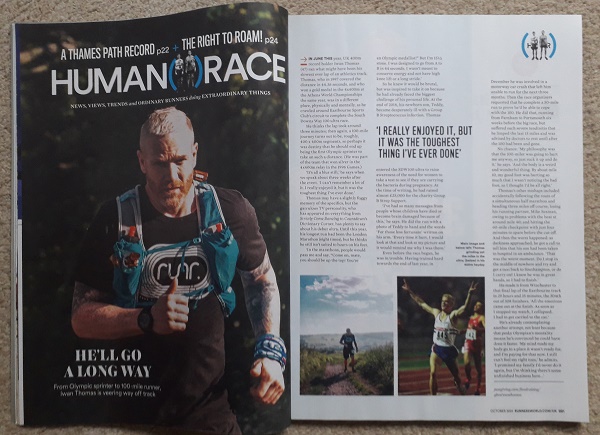
These days Iwan Thomas is often seen on television either as a panellist, contestant or doing roving reports on The One Show. As an international athlete, he was a key part of Great Britain’s 400m success in the 1990s. He won silver in the 4x400m relay at the Atlanta Olympics and gold at the World Championships a year later. He and compatriot Roger Black competed in the Olympic 400m final which was easily won by the legendary Michael Johnson. Roger raced as the 400m British record holder and held it until Iwan broke it in a time of 44.36s. This stood for almost twenty-five years and it was only in May 2022 that Matthew Hudson-Smith finally ran faster than either of these legends.

When his athletics career wound down Iwan began trying longer distances. The London Marathon was an obvious choice where he clocked 3hr58 in 2009 and over the next six years he set personal bests of 40:16 for 10K, 1hr12 for 10 miles and 1hr37 for half marathon. He also took up parkrunning and has racked up over one hundred with a best of 19:18 at Netley Abbey where he usually runs. Currently he’s running around 22-23 minutes there as he approaches fifty.

A couple of years ago in the October 2021 edition of Runners World they detailed his ultrarunning in the South Downs Way 100. That’s one hundred miles from Winchester to Eastbourne. A significant motivator for doing this was to raise money for charity due to difficulties his son suffered after birth. Iwan recognised he’s not built to run ultras saying “I’m 15½ stone. I was designed to go from A to B in 44 seconds. I wasn’t meant to conserve energy and not have high knee lift or a long stride.” When it came to the race, he ended up finishing 304th of 308 finishers in 29hr35. It was a tough race and he was left believing he might have completed it faster as he wasn’t physically ready for it. He’d barely trained in the preceding months due to a tendinitis injury and motorway accident; although race organisers had got him to run a 50-mile ultra as evidence he would capable of the longer event.

Back at Eastleigh parkrun, with only 68 of us having braved any New Year’s Eve hangovers it was easy to find the opportunity to say a brief “Hello”. What struck me wasn’t anything he had to say – it was his size and build. I was looking eye-to-eye with him, standing just as tall and strong.

While Iwan is now 15½ stone, I’d guess he was somewhere around 13-14stone in his prime. Research on other elite 400m runners shows Matthew Hudson-Smith is 6’4” / 12st4lbs, Martin Rooney is 6’6” / 12st 11lbs, Roger Black ran at 6’3” / 12st 6lbs and Michael Johnson at 6’1” / 12st 7lbs.  Those physiques are very comparable to my own. I’m 6’2” and have slimmed down over the past two years to just over 12stone and under 10% body fat. In my younger days, I was usually around 14 stone and more muscular.

I’ve been training and running consistently for the past decade and I’ve come to the conclusion that I’m not particularly suited to distance running. This fits with me being built more like a 400m runner. I’ve always believed everybody is capable of doing everything to a decent standard so it’s a bit galling to have to admit that perhaps you can be genetically limited. My personal bests are all similar to Iwan’s and it’s fair to say they are decent times and many runners would be happy with them. Yet they’re a long way off the best – about 50% worse than the world records and I see many runners around me who naturally run faster off less training.

Does this mean I should give up distance running? Not at all, I’m still determined to get the best out of myself. It just means I’m reconsidering my approach. If speed is where my strengths lie then I need to keep working at that. Looking back to when I started parkrunning, I had good speed but I didn’t understand how to create endurance and stamina or how to convert that speed into better parkrun times. In my pursuit of figuring this out, I got away from speed, allowing it to decay as I spent sessions logging miles and experimenting with different training systems. Now I’m going to dedicating myself to redeveloping my speed.

If you too are interested in improving your speed then contact me to purchase my Get Faster … Speed Training course.

Durations to think about in training

How long can you sprint? Why is the first minute of your parkrun fast? Why do we train differently for a 10K and a marathon?

Each of these questions is determined by what is going on in the body and its capacities. While the exact figure can be a touch higher or lower for you – especially depending on whether you’re well-trained or badly trained – overall they’re numbers that help structure your training. With time and focus you should be able to get a sense of exactly where your numbers are.

8-10secs Sprinting energy

Sprinting is powered by the phosphocreatine energy system, which is sometimes abbreviated to ATP-PC, or called the Anaerobic Alactic energy system. I like to call it the Sprinter’s energy system because that’s more meaningful and tells you what it does.

It produces energy quickly and allows you to move very fast but it doesn’t last long. For a distance runner, it’s useful for getting off the start line or finding a sprint finish or mid-race surge. Surprisingly it’s also the energy system you call upon when you get up off the couch to go make a cup of tea!

This is the system that kicks in when you do interval work – especially if you set off fast.

1min30 Anaerobic limitation

Beyond the sprinter’s energy system detailed above, there is a secondary anaerobic energy system. Its names include Fast Glycolysis, Anaerobic Glycolysis and Lactic Acid energy system. It’s what 400m runners use in their races and is a big contributor to the 800m.

For distance runners, they’re using it when they run intervals at the track which last within this timeframe. Being anaerobic it gets you out of breath and you find yourself puffing. This isn’t to say there isn’t some contribution from the aerobic system but for anyone with good speed, it’s mostly coming anaerobically.

For most parkrunners, you’ll see the first 1-2mins are quick and then their pace drops away. This is because they’ve mostly run on anaerobic energy and then they’re having to rely on the aerobic.

8min Running at VO2max

V02max is a scientific measure of your aerobic capacity. The body takes in oxygen through the lungs, the heart pumps the oxygen around in the bloodstream for the muscles to use. There is a limit to how much oxgyen you can transport and exercise scientists finding this out by doing treadmill tests and collecting the air their subject breathes in and out. I did a VO2max test at college and it is not a pleasant experience. It’s nice enough at the slower speeds but once you get up to speed and are beginning to exceed your VO2max, you quickly begin to accumulate oxygen debt and then you’re hanging on mentally to continue running as the treadmill pushes you. Eventually you have to stop, or I suppose you could collapse and fall off the back of the treadmill if you have the willpower to push on!

In real terms, we have the ability to run at our VO2max pace for up to eight minutes. We can go faster for shorter periods of time, we can go slower for longer. Reigning Olympic 1500m champion, Jakob Ingebrigtsen set the 2-mile world record in June 2023 at 7:54 which means he was running on his VO2max for the race. A world-class woman like Sifan Hassan has run 3,000m in 8:18; so she’s probably thereabouts.

None of this makes a lot of sense from the ordinary runner’s perspective other than to recognise that a high aerobic capacity is very helpful for good distance running. Even when you have talent it takes time to build this aerobic capacity.

12min – steady state reached

Another thing I learned at college was a phrase used by one of the physiology lecturers “it takes twelve minutes to reach steady state”. As I wasn’t a distance runner at the time or interested in physiology/biology lectures, it didn’t mean much to me. It probably doesn’t to you.

What it means in practical terms is that this is how long, on average, it takes for the body to warm-up. If you go running off down the road your legs may feel good but your breathing will struggle. You’ll settle down after a few minutes but it actually takes longer for the body to properly warm-up.

Personally I take a good 15-mins or so to reach a point where my speed has picked up and my breathing can cope. Other runners may take a little less than twelve minutes. Either way there’s two offshoots to this – firstly your quick jog down the path and back for a minute at parkrun isn’t a proper warm-up. Secondly if you’re going out for a run and it only lasts 20 minutes you’re not actually getting lots of training benefit from it. Of course this applies more to regular, committed runners who do significant volumes of training than those who only run once or twice per week.

40min – optimal production of human growth hormone

During exercise the body produces many hormones but let’s focus on human growth hormone. As the name implies this is important for repair, growth and replenishment within the body after a bout of hard exercise.

At the beginning of any run the production of this hormone begins to ramp up and at an hour it has reached its highest level at 600% of where the body started out – a sixfold increase. At forty minutes we’re already at 550% so while the next twenty minutes will raise the level higher, if you’re time pressed or out for a recovery run this is the optimal duration. You’re getting close to the maximum but in only two-thirds of the time.

Combine this with my comments above on warm-up taking twelve minutes and you can see why a run lasting at least thirty minutes is beneficial.

1hr – limit at lactate threshold

The lactate threshold is much talked about. It’s sometimes calculated as the fastest pace which you can run in an hour, something of a self-defining quantity. Once you go past the hour, the pace has to drop and you’ll be into Steady State and closer to marathon pace. While you wouldn’t train at this pace frequently or for this duration, it is worth knowing that when you’re putting together endurance training sessions, it’s good to go out for an hour.

1hr30 – glycogen depletion

If you’re training at a decent pace or you’re aerobically inefficient then you can expect your glycogen stores to run out somewhere around an hour and a half. This is why elite marathoners take on fuel during races. Even though they’re highly efficient, when they’re due to run for over two hours, their glycogen stores won’t quite be able to last them running at marathon pace for that long.

Running out of glycogen is the infamous “hitting the wall”. That usually takes place around twenty miles which fits with elite runners having stores for around 1hr40-45. Often they start a race a little slower and therefore preserve their stores.

With training the body learns to store more glycogen but to achieve that you have to get the body to deplete its stores or close to it in training. If you keep doing long runs taking gels or supping energy drinks the body has no need to learn to store more.

2hr30 to 3 hours – diminishing training returns

In their Hansons’ Marathon Method book, the Hanson discuss why long training runs lasting over three hours are not beneficial to runners. I detailed some of this in the 20-mile myth. Their point is the longer you run for, the more damage the body has to recover from. Slower marathon runners are prone to spending four hours or more on their Long Runs week after week which leaves them struggling for motivation and the body to recover. It’s best not to run too often for longer than 2hr30.


With many of these variables, training improves them. An untrained sprinter may have a ATP-PC system that only lasts a few seconds initially, like their Lactic Acid system. Distance runners can extend the time they spend at VO2max or lactate threshold pace.

The First sub 3:50 woman

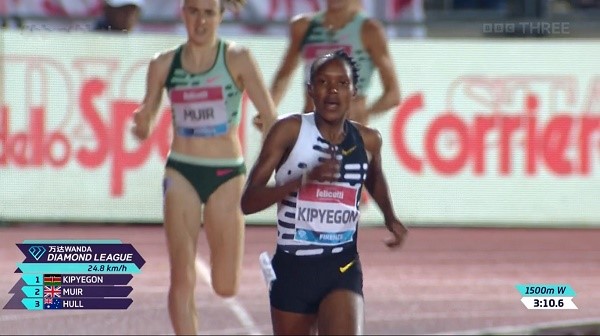
Elite women run fast. We know the sprinters are very fast running under 11seconds for a 100m. On Friday June 2nd at the third Diamond League meeting of 2023, Faith Kipyegon showed she has great speed reaching 25km/hr at times. It was that speed, combined with endurance, which enabled her to become the first woman to run 1,500m in under 3:50 – a pace which would have brought her in for 4:06 for a mile.

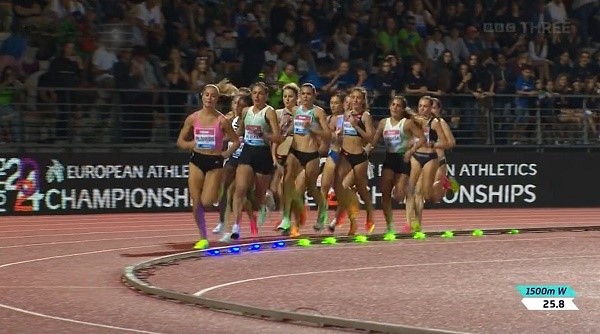
As the reigning Olympic and World Champion, Kenya’s Kipyegon who is approaching thirty years old was heavily favoured to win in Florence, Italy. While pacemakers are still present to lead runners out in the early laps, modern athletics now has a moving set of lights around the edge of the track to help with even pacing. These had been set at 62secs per 400m which equates to a 3:52.5 time.

The blue and yellow lights indicate the required pace

I took a look at the race to see how it was run and find out how the laps broke down. Due to its distance the 1,500 metres is unusual in starting at the beginning of the back straight – which allows athletes to cover 300m followed by three laps of 400m.

The splits as best I could determine them were:

  • 100m – 14.5secs – imagine that. How many of us can even run that from a standing start without blocks even without having to run a further 1,400m?
  • 300m – 46s – first crossing of the finish line
  • 400m – 1:02.37s – first lap of the track
  • 700m – 1:48.2s – second crossing of the finish line. Just before this around the 600m mark the first pacemaker dropped out
  • 800m – 2:04 – second lap of the track taking 61.63s. The other pacemaker drops out at 900m
  • 1100m – 2:50 – third crossing of the finish line – one full lap to go
  • 1200m – 3:05.28 – third lap of the track taking 61.28s. The last 100m has only taken 15-16s
  • 1500m – 3:49.11 – a new WORLD RECORD.  The final lap has taken 58.81s – a pace of 3:57/mile

It’s a truly remarkable performance which saw Britain’s Laura Muir finishing eight seconds behind in a season’s best time of 3:57.09 and Australia’s Jess Hull setting a national record in 3:57.29 as she finished third. Both runners had worked their hardest to keep up with Faith Kipyegon yet they ended up thirty metres behind. No-one in the rest of the field could even crack four minutes which begins to give an indication of the gulf that exists between Kipyegon and the others.

Faith Kipyegon flies down the back straight on her way to a new world record

Watching her run, she has decent compact form and is very balanced. Every stride is powerful and I’d estimate she’s taking around 200 steps per minute. This isn’t unusual for a middle distance runner or for a shorter runner. Faith is listed at 1.57m / 5’2” and weighs 43kg / 93lbs. What’s surprising is when you calculate the distance she’s covering with each step it works out at around 2.08m and that’s over 30% longer than she is tall. And she’s doing it for almost four minutes!

As a coach, these are the things I think about and marvel at. I’ve previously written two articles on stride length (first and second) as well as what elite runners speed is. Developing these can take time but is worthwhile even for distance runners. Consider that on average Faith Kipyegon’s new world record is the equivalent of running fifteen consecutive 100m races in 15.2secs and there are no excuses available about having little legs!

Experiencing Aerobic Limitation

I spent a rainy bank holiday morning sprinting up a nearby hill repeatedly. It’s a key part of getting faster and one that I’ve not done since last summer. Having woken at 6am, I grabbed a bowl of cereal then did the crossword while breakfast digested. About 8:15am, I headed out the door and there was light rain falling. The session I had in mind is not big – a 15 minute warm-up run, 5 mins of drills to help the mobility, the main session of 10 hill sprints and then a ten minute warmdown. But it is time-consuming because each sprint is followed by three minutes of recovery. In the end, it took over an hour to complete. What interested me is what the session told me about how to train for distance running.

Setting off on my warm-up it took three minutes for my body to crank the pace up and reach eight minute miling. My route is a mixture of ups and downs such that, by the end of the first mile, I’d been hitting sub-6 pace on a steeper downhill stretch – 7min38 popped up on my watch. The second mile came in at 7min04 and then I tacked on another thirty seconds back to home. What surprised me was how relatively hard I was finding it. My breathing was beginning to huff and puff like I was running a parkrun and my heart-rate reached 160bpm at the end. All in all, I was glad when I finished my warm-up and could walk back round the corner to do drills.

With the rain falling steadily and knowing I’d be standing around between the hill efforts, I elected to keep the drills short. Just one repetition of each drill taking 15 seconds and then a stride back to my start position with around 30s time to recover before the next. The stride reinforces what I’m programming as well as warming the legs up for the quicker, more violent efforts up the hill. Once again, by the end of these I was puffing and my heart-rate had steadily increased to 155bpm; each subsequent effort building the heart-rate higher than the one before.

Finally I was ready. I walked to the base of the hill and then spent a few minutes chatting with an old chap about goings on. The important thing about hill sprints is to attempt them with fresh legs so I didn’t mind an extra few minutes spent conversing. Hills sprints want to get maximum effort from the muscles which is why they only last seconds and then you get a nice long recovery. The short timeframe allows your ATP-PC energy system to be the key producer of energy while the long recovery ensures it has recharged.

The first effort I sprinted up the hill and my legs were turning over so smoothly. I was barely breathing, it was how I’d feel if I was out for a jog. Then I started to walk back down the hill and the oxygen debt kicked in and within fifteen seconds my heart-rate had reached 139bpm having started down at 90bpm. The second effort felt a little harder on the breathing especially afterwards and my heart-rate reached 143bpm. By the time I’d ambled back downhill to my starting place, it was back to 114bpm and I was feeling okay. After that my heart-rate never got out into the 140s again. Sometimes the oxygen debt after each effort resulted in very quick gasps for breath yet it didn’t take long to be back to normal. As the sprints went on they got a little slower, this is unsurprising because the muscles are beginning to fatigue and they can’t power getting as far up the hill.

After my 10th and final effort, I walked down until one minute had elapsed then began a warmdown run. My legs felt like they were springing along yet the pace was barely quicker than nine minute miling.


What intrigued me about this session was how two such different ways of training – the warm-up and sprints both taxed me in different ways. The warm-up pace picked up gradually to be a little quicker than seven minute miling where I still had room to run faster. Yet it would have been hard to stay running like this for an extended period of time. By contrast the hill sprints which are an absolute blast of maximal energy felt so much easier.

According to the wisdom of heart-rate training I could have done sprints all day long as I maxed out at whereas my warm-up reached 160bpm. Yet I know that wouldn’t be a good idea – no-one would do that, neither a sprinter or distance runner.  It highlights one of the problems of heart-rate training.

What really came home to me from the warm-up is that the thing limiting my distance running is not speed related. This is what I experienced when I first began parkrunning a decade and more ago. Every week I would run and feel there was more available in the tank yet not understand what was stopping me.

The limitation was not one of being able to run very fast for a short time as it is with anaerobic limitation, it was one of being able to run fast for a relatively long time. That’s where aerobic development is required. It took me the next five years to really begin unravelling this conundrum in detail. I read many books which talk about it needing to be done yet it’s not until you viscerally experience it that it becomes clear what is going on.

I meet many runners who haven’t yet had this realisation that being able to run fast 200s, 300s, 400s is not necessarily going to turn them into a faster distance runner. Sometimes it does but more often than not it’s about building speed through good distance training.

Maybe this is something I can help you with? Not everybody wants to be coached for a race, sometimes they simply need a training review. Understanding what they need to do next to get to the next level – is it speed or endurance they should work on. Just head over to the Contact page and give me some basic details and we can arrange a 1 hour consultation.

Update on my 800m training – Apr 2023

April has been a quiet month. Entering it I had high hopes of recording a decent time at Bournemouth Bay 1/2M but those were trashed when I ran three minutes slower than last year. I tapered better this year and my legs felt fresher on the day but, come the run it was a gradual slide with the first 2-3 miles coming in at just under seven minute miles. From mile five onwards the pace dropped to 7:25 and worse. I just had nothing and have easily done better runs in training. I documented last month how I ran six miles in 42-mins in training.

What was strange was how low my heart-rate was throughout the run. It ended up averaging 149bpm which when I consider I do Steady runs in the low 150s was very out of place. What it does go to prove is how little use a heart-rate monitor can be.

I took five days off after the half (no running at all) then went to Poole parkrun and ran 20:57. Both my calves and glutes were sore from it and I had a very slow, dreary Sunday 10-mile run. I ran thirty minutes each day through the following week and returned to Poole parkrun knocking my time down to 20:39. The following week was the same routine, a slightly faster but still drudgy ten mile run then thirty minutes each day. This resulted in a 20:17 parkrun! Three weeks of easy running, no speedwork and my racing simply got faster by forty seconds.

It now seems clear that I’d fatigued my legs too much in training. When I look back I’ve been doing fifty mile weeks since last summer and training hard in the week. The heart-rate monitor numbers were correct but the monitor itself can’t tell you how fatigued you are.


My overall feeling though is one of disillusionment – I’m simply not cut out for distance running. When I compare my training to others, I simply don’t get the results from training that they achieve off much less. I train hard with all sorts of different sessions but ultimately I’m physically not cut out for long distances.

I’ve known this for a while, it’s why I started training for the 800m. Thus far I haven’t really worked on developing my speed to a high level because I’ve been trying to keep the aerobic side in balance. As I’ve written in the Ageing series, the best male sprinters of my age are running under 11 seconds for 100m, 22s for 200m and 50s for 400m. While I’ve not gone all-out at any of these I’d be surprised if I could crack 14s for 100m, 30s for 200m or 1min15 for 400m – that’s just too far down and a gap I need to close up. It’s not because I’m not capable, it’s because I haven’t trained for it in years.

I’m beginning to conclude this has been where I’m going wrong. The first two iterations of training I followed JackD’s plan as he is a proven coach. It didn’t really help me. Last year I began hill training using a progression from Steve Magness’ The Science of Running and I felt this made a difference despite only doing one weekly session for three months.

I’m torn between entirely given up on the distance work until I’m notably nearer to the age-group records or trying to keep the two things in balance. All I know is when I started running seriously a decade ago, I was probably quicker on the speed side. I have little objective proof of this but my legs were much bigger and stronger. I was quickly able to build some of my best times at parkrun, 10K and half marathon on lower mileage than I’ve been doing recently because I had the speed first.


This summer’s plan is to repeat what I did last April / May / June. I combined Steve Magness’ hill sprints on a Monday with Jack Daniels’ 800m training plan on Wednesdays and Fridays. I lasted about nine weeks before I could see I’d peaked and my aerobic fitness was declining.

This year I’m intending to do the same but with some changes. Where I previously followed Jack’s plan for runners covering 30-40mpw, this year I’m downgrading to the 20-30mpw plan with shorter recovery and long runs. Actually Jack’s long run has always lasted only about an hour on these plans but I always did something in the 1hr30-40 range in an attempt to keep my aerobic system up.

The other change I’m going to make, as I’m not doing a time trial prior to starting training, is to be conservative on my numbers. I’m based my training level on my half marathon and fastest parkrun which basically have me running at the level of a 2:36 800m runner. It’s not that fast but I’m aiming to keep my legs fresher this year through less intensity and lower volume of training. Again this 2:36 start point is why I don’t think I’ve got the speedside sorted. It really isn’t that fast given how in shape and athletic I am. I just haven’t trained for speed enough in years.


I resumed faster training in the final week of April. I did 6x8sec hill sprints on Monday which felt great and I loved despite blowing hard at the end of each effort. On Wednesday I did 6x200m with 200m jog recovery aiming for 43s, they avg’ed 40.4sec. On Friday my legs were perking up and I repeated the session, this time with eight efforts, and they avg’ed 39.6sec. My body felt like it was hitting new territory. Or at least territory which it hasn’t been to in a long time. My breathing was gasping in the final efforts. I’ve been there before but this felt different for some inexplicable reason.

Before each of the workouts, I’ve been doing drills and strides to help warm-up and ingrain good form. I began these eighteen months ago and change has been gradual, notably beginning to kick in at the start of the year when I was doing my last block of short intervals. This explains why my glutes and calves hurt after the half marathon. It was the longest sustained effort I’ve done using that running form and therefore being powered by those muscles. My stride seems to be lengthening and when I begin an effort I can hit higher cadences than usual. This all suggests I can get quicker and build my speed up to the levels I desire.

Update on my 800m training – Feb / Mar 2023

Winter training isn’t fun if the weather isn’t amenable to it. And it hasn’t been. We seem to have had windy, cloudy days through Feb and March. Fortunately not much rain although that doesn’t particularly bother me. But when you’re trying to do longer intervals or steady runs and track improvement week-to-week, windy is frustrating.

I came into these months looking to build endurance ready for a half marathon on April 2nd. I’m generally very pleased with how this training block has turned out although, as they say, the proof will be in the pudding. Let’s see how the actual race goes.

I did the race last year scraping under 1hr34 which was my fastest half marathon in almost ten years. While results-wise that is pleasing, I didn’t run my best race, my best running was left in training. On race day my legs had gone. They were heavy and lethargic and I couldn’t push any faster than 6:40/mile at any point. This despite having averaged 6:32/mile for three two-mile efforts on March 15th. The aim was to avoid that this year.

I went with the same training plan as last year but started the long interval build-up two weeks earlier to give myself more time for a longer taper. On Fridays I did my Steady hour run on the flats of the beach promenade whereas last year I ran a hilly local route. The knock-on of this latter point, as I shall explain later, is I ran quicker parkruns immediately the day after.


Below in the tables are the sessions I ran last year and this. You can see on the first week my mile repeats are very similar – both averaging around 6:55/mile with the first mile quick and then a slide as the endurance ebbs away. In the following weeks the body gets better at stamina work – holding a fast pace for longer and the efforts improve.

Last yearEffort 123456TotalPace
15-Feb6x1mile6:496:526:526:546:457:0241:146:53
22-Feb4×1½ mile10:0210:0910:0110:1140:236:44
1-Mar3×2 mile13:1613:1913:2840:036:41
8-Mar2×3 mile19:4220:2440:066:40
15-Mar3×2 mile12:5413:0413:1239:126:32
22-Mar4×1½ mile9:559:599:569:5839:486:38
This yearEffort 123456TotalPace
31-Jan6x1mile6:456:546:556:566:597:0541:366:56
7-Feb4×1½ mile10:0210:1910:2610:3341:206:53
14-Feb3×2 mile13:1113:5014:1641:176:53
21-Feb2×3 mile20:0720:3440:416:47
28-Feb3×2 mile13:3114:5314:3542:597:10
7-Mar4×1½ mile9:449:5610:0610:1640:026:40
14-Mar6x1mile6:256:356:346:426:496:5540:006:40

While the general improvement seen is similar, this year’s numbers were behind last year’s. While the weather wasn’t perfect, I can’t blame that. There was something else at work. What these numbers don’t show is the effort being put in. While I could add heart-rate data, that doesn’t really show it either.  This year my heart-rate has generally been 2-3 beats lower on these efforts which chimes with the slightly slower pace.

What’s not revealed is the effort I was putting in. When I ran last year’s effort, I would overcook them and go anaerobic. Gasping for breath in latter efforts and pushing hard to keep the pace up. I might have expected that effort to show up in higher max heart-rates, if not the average, but it doesn’t which is why I’ve moved away from gadget / data-driven training. This year I deliberately tried to keep my pace under control by focusing on my breathing and not pushing my self too hard. I still pushed hard but not too hard.

As a sidenote, it’s worth explaining what happened in the session on 28th February. The local roads were being dug up to install higher speed broadband cable so I went to the beach. I had hopes this would be quick as it’s on the flat but it was windy. Even so I set it up to have the benefit of the wind on two of my three efforts but my legs had nothing. On reflection, I was suffering a VO2 lull so I just tried to get through it as best I could. Trouble is, I also misprogrammed my watch and instead of having a 0.5mile recovery, the next effort started after 0.05mile which had only taken about thirty seconds to jog! I had to reprogramme the session on the fly and guesstimate the recovery. All in all it was, what we technically call, a balls-up. It would have been easy to get downhearted about the day’s numbers, but after all these years of running I have learned it is just part of the process.

Fridays and parkruns

I consider the hour long Friday sessions to be an important part of building endurance. They highlight where aerobic speed is at. This year’s sessions weren’t as fast as other years but what was incredible was going to parkrun the following day and running decent times. Last year my parkrun was around 24-25 minutes following a Steady run; in 2019 it was more like 27-28mins. That said, I think last year’s hilly route took more out of my legs but perhaps also provided the extra ounce of speed I was seeing in the long intervals.

DistanceRun TimePace per mileFastest mileParkrun
3-Feb8 miles1:02:187:477:0922:53 Upton
10-Feb91:07:007:246:4322:22 Upton
17-Feb91:12:248:007:2921:53 Upton
24-Feb91:06:247:206:5821:19 Poole
1-Mar91:04:227:066:5921:44 Upton
10-Mar91:05:267:136:4021:17 Upton
17-Mar81:00:187:317:11Tapering
24-Mar6 (local)42:007:006:52Tapering
26-Mar7½ (fasted)54:597:236:56Tapering

One reason why I’ve moved away from data-driven training is that some of my endurance days are coming in at relatively low heart-rates yet I’m not racing significantly quicker. My 21:19 at Poole averaged 6:50/mile at a heart-rate of 147bpm – well below the 152HR I consider to be the top of my pure aerobic for a Steady run. I’m hopeful these numbers point to capacity for getting quicker in the summer but I think they actually point to simply having better endurance which is not that important in a shorter distance race especially the 800m which I’m targeting.

Recovery

The notable improvement in my running seems to have come in recovery. While not every session has been as hoped for, my average speed through the week has been improving. Being able to run fast on Tuesday, on Friday, on Saturday and then sub-8 on my long runs is a far cry from where I was a few years back. I could barely run 8-miles at a sub-8 pace once in a week. On top of the effort days, my recoveries have generally been approaching or faster than 8min/mile – a few years ago these would have been well over 9min/mile.

I think this has been the route of the problem. Running easy runs too fast – it is a perennial problem among runners – I can screw it up as well as anyone! Although the runs are manageable and haven’t been causing me any pain, I think they have been creating muscle damage and fatigue. That explains why I can’t run faster in actual workouts. Again, the data isn’t good enough – my heart-rates on runs have been low enough to be classed as recovery but the tech can’t measure muscle damage directly. We can only infer it from how training is going.

In the middle of March I made a decision to go slower on my recovery runs and I think it was the right one. Along with the taper my legs have begun to perk up.

The final workout

I did my final workout on Tuesday. I call it a workout but it wasn’t there for training effect, only to keep the legs reminded of what’s coming up. I did a 30-min Steady run with a half mile effort dropped in after two miles. The two mile warm-up came in at 7:10 pace and then the half mile was unexpectedly quick. It came in at three mins exactly – 6min/mile pace. I did push it a little towards the end but considering I went straight into it off the warmup I was pleased with it. Thinking back to December 2020 and my first 800m time trial that’s essentially what I ran that day – except I had fresh legs and my lungs burned for an hour afterwards. This time I jogged home and got on with life

Half marathon on Sunday April 2nd

The rest of the week has been some easy 30-min jogs and rest days. I’m hoping the 800 wasn’t too much of a shock for the legs. If it was, it’s probably not going to go well and I’ll be left rueing it but at least knowing I’m set up for excellent spring training.

I’m not sure what to expect on Sunday. I believe my stamina is better than last year and therefore I will record a better time. Last year I struggled because of the misjudged taper, this year I’ve hopefully corrected that. The weather forecast is decent – sunny with 7-8mph wind – I probably can’t ask for much more than that. Let’s see what happens.

Coaching a first time marathoner

I opened the Whatsapp message which she’d sent after finishing. “Tbh the whole thing felt easy” it read. It had taken 4hr35 to run the cobbled streets of Rome and not only was it her first marathon, she only started training in November and never ran further than 17½ miles (28km). Yet reaching that distance on race day she opened the jets and picked up her pace, running the final kilometres quicker than a 4hr15 marathoner and throwing in a 5:37 kilometre to the finish line. That is not how most marathoners, especially at the slower end of the field get through their first marathon.

Last September my daughter asked me whether she had enough time to train for Rome marathon. I said “Yes” and wrote her a training plan. She responded by not following it and barely doing any running! After six weeks her biggest week had only covered 12miles and a longest run of 1hr16. It was not a great start. It was the arrival of a new flatmate, with whom she could go running, which kickstarted things; I rewrote the plan and from there on she trained diligently for 4½ months to experience a great marathon and finish in the top half of women finishers.


When she signed up, she was barely running, just thirty miles in the preceding six months. In the past she had done occasional morning runs, pushing all-out to achieve around a 27-min 5K, but this needed a different approach. The training plan I gave her built up to running five times per week and peaking at 35 miles and needing a commitment of up to six hours. Apart from when it was raining, I never heard any complaints or desire for training to be over. All in all, I’m really pleased that my coaching and her hard work resulted in a successful first marathon.

With so little running done prior to starting I knew there were some challenges regarding how to prioritise training. There were a number of things needing to be done.

– Get her used to do high volumes of weekly running – I wanted her to run five days per week and train for 5-6 hours. After all if you can’t run five hours in a week, how can you expect to run it in one race?

– There was the all-important question of how to train a slower runner for the distance on the day? As I wrote in The 20-mile myth beginners are wedded to the idea that because committed runners of the past always trained to reach twenty miles they have to as well. Yet the training benefits are highly questionable and I’ve met many of these slower runners whose marathon training becomes a slog because they spend consecutive cold, wet Sundays in February out for four hours or more. On race day they end up walking anyway and taking five hours.

My decision was I would train her by time and the longest run would be 3hr15. But some of these long runs were to be preceded by a run the day before. This would take the total time spent running on a weekend to four hours and closer to her expected race time. It would have to be enough.

– Ideally I wanted to improve her speed because that would then trickle down to her other paces. It’s obvious if you can run a faster easy pace then the long run will cover more ground.

– The last three weeks of training would be taken up by a taper. By necessity this would cut into the weeks available to make progress through training.

– The final factor to account for was the non-running parts of her life. We had Christmas and New Year coming up and currently being based in Italy she was going to do some travelling as well as university exams. I managed to accommodate these around the training with only a few things moved around.


Once training began properly we built the base in November and December. By New Year I was satisfied she could do 5+ hours running every week without injury or illness coming up. To this point, every run had been at an easy pace of 11 minute miles or slower. She didn’t particularly like it as she prefers going out quickly but did what was asked.

Her first two hour long run was reached at the start of December and we built on from there in small manageable chunks so that by mid-January, she was able to do her first three hour run. This was followed by three more runs of three hours including a 3hr15 run which was the longest at 17½ miles, or two-thirds of the marathon distance.

With the base built, I introduced faster midweek runs lasting up to an hour. Initially at a 10:30/mile pace, as the weeks went by the runs quickened up to be as fast as 9:30/mile. These steady runs continued up until the taper began.

In late January I took her to Christchurch 10K – her first official race. I wanted her to get an idea of what a race is like. How much standing around there is, what it’s like to run with other people. Given her best 5K was around 27 minutes, I expected her to run 57-58 minutes. I was amazed when she finished in under 55 minutes – an 8:45/mile pace which was much faster than anything she’d been training at. It was a great result and informed me of the paces required for the rest of her training. With two months to go to race day it was now all about building stamina and endurance for the big day.

On race day, she was aiming to break 4hr30. To keep it simple, I gave instructions to pace at 6:20/km which is running three kilometres every nineteen minutes – nice simple maths. This would bring her in for a time of 4hr27. From the 10K race I knew this was within her capabilities, probably even faster. She was accompanied by her flatmate and they paced themselves consistently except they used a phone to measure the distance rather than going with the race markers. Consequently they were running 10-15sec/km too slow and went through halfway on pace for a 4hr40 marathon. Soon after her flatmate’s leg began to hurt so they separated at 28km and my daughter sped up running to the end at the pace of a 4hr18 marathoner. Not bad considering she’d never run past 28km in training!! Her flatmate, reportedly a 38-min 10K runner but who hadn’t followed any of my training plan, limped home in over five hours.

Later another Whatsapp said “The whole time I could talk easily and the time went very quickly. At no point did it feel long”.

Not many first time marathoners have as an experience as good as this. It all comes down to well-structured training, putting in the miles and running at the right paces. The postrace Whatsapp stated “Didn’t feel hard. Harder training sessions”. And there’s no doubt she put together some good training sessions. Come marathon day, after the taper, it all came together.

The highest volume of training came in January and February where it was eight consecutive weeks averaging around six hours. The monthly mileage was September 10miles, October 30miles, November 76miles, December 109miles, January 132miles, February 133miles and March 81miles including the marathon. Those figures in the middle may sound big and they are, but when carefully built up to and interspersed with lots of easy miles they accumulate without wearing you down. That was a focus of my coaching to maintain motivation and never let it feel like it was becoming too much.

There is no way to run a decent, comfortable marathon without doing the training. I’ve tried and it didn’t go well. Equally it’s possible to do heaps of training and still run a poor one. What I offer to runners is the knowledge of how to structure training optimally to give them a good shot at success on race day.


If you would like me to coach you, either on an ongoing basis, for a specific race or simply to have a one-off training review where I make recommendations on how you can improve your training then please Contact me for a no obligation look at whether I can help you.

Update on my 800m training – Jan 2023

I feel like I’m in wash-rinse-repeat with my training at the moment. I keep cycling through the right training sessions yet the race results keep coming out the same. I can see some improvement in the stats and speed, yet when I race it is no faster. But this really is the secret to coaching – figuring out where to apply effort.

Coming into January I was working on top-end speed using short intervals lasting around a minute. The pace was intended to be at my calculated 3K-pace broken into sets. The sessions I did were made harder by high winds and I ran my 300s along a section of road which caught the brunt of it along with a gradual hill in the first/last 100 metres depending on which direction I was headed.

Illness strikes …

I had done two sessions at the end of December then my Sunday run went backwards. I wasn’t too concerned as a VO2 lull usually happens at the start of a new training block. But there was a concern – my sister brought a hacking cough to visit over the Christmas period and I fell under its spell. I wasn’t terrible but I was struggling. Yet after a couple of days, I felt slightly better and mistakenly did a 3rd session which, while generally close to target, led me to scale back training as the coughing got worse. I missed the next session of 300s and focused on getting healthy, but was still running each day. By the following Monday it had gone. My mother is still coughing all these weeks later whereas mine was gone in ten days. This is why I believe in keeping fit and healthy especially as you get older. With a good aerobic system your body’s immune system can fight stuff.

Race taper

With only two weeks left to the rescheduled Christchurch Christmas 10K, I knew I needed to taper so I did one more session of 300s and then an even sharper session of 10x100m with 30s standing recovery aiming for 5:30/mile. I found them really easy which probably aligns with why I’m better suited to short distance than long.

A week ahead of the 10K, I went to Poole parkrun on what was an atrocious day. Very high winds and rain. It was absolutely pelting down as I arrived but had eased off by the start. Once again my speed seemed lacking as the first kilometre only came in at 4mins. Along the windiest stretch I ran a 4:20km – at 6’2” and broad I’ve got a large frontal surface area to be blown back. The finishing stretch headed into the wind a second time and having passed them earlier, five men now passed me as my pace dropped to 8min/mile and I felt like I was barely moving. My finish time of 21:02 was good enough to place 19th. I’d guess it’s a long time since Poole parkrun’s 19th finisher ran over twenty-one minutes. While I could make excuses for the wind and rain, the fact is my opening kilometre of 4-mins was fresh-legged and running with the wind; however much others may suggest a sub-20 was on the cards; it wasn’t.

Race

Christchurch 10K itself reinforced this analysis. The run was another cold morning and it was a shame to see the race not as well attended as it would have been before Christmas – less than 200 runners. Many of the others had deferred their places until next December because they’ve started marathon training or other races were taking place on the same day.

I set off quickly not holding back, but again my kilometres were all over four minutes. I reached 5K in 20:38 and then held on for the second half to finish in 42min08. I was somewhat disappointed as it was only fifteen seconds or so faster than last year. All my efforts from a year’s training had added barely anything. However my heart-rate monitor told a different story. Last year my average heart-rate was 159, on this day it was only 152. That’s incredibly low for me on any race. I’d expect it to be up around 161bpm. What it suggests is my fuel source is mostly aerobic but something is blocking me from running faster. When I look at the final miles the pace is consistently 7min/mile.

Finding the problem

On the Tuesday before the race I did a 7-8 mile Steady run averaging 7:17/mile. I felt blocked to run any faster, when I arrived home I realised I had put in more effort than I should have. On the Friday following the race, I did a Steady run at the beach – just letting my body pick up speed and it settled around 7:35-40/mile with heart-rate hitting 150ish. It was a completely comfortable run but slower than I expected.

The day after the Steady run at the beach I went to Upton House parkrun and ran 21:58 averaging only 149bpm. I started slowly and picked up pace as the run went on. But again, it was a big effort to get any much quicker than 7min/mile on tired legs.

A quick look at my old favourite, the Jack Daniels’ tables shows a VDOT of 49 results in a 20:18 5K and 42:04 10K. My Christmas Day parkrun was 20:27 so matches up quite nicely to this. Jack’s tables give a Threshold of 6:55, a Marathon pace of 7:24 and Easy run pace of 8:40. Each of these matches with what I’ve found in training.

Fixing the problem

All these facts – speed of steady runs, not being able to run quicker at parkrun or 10Ks, lower heart-rate when racing, feeling the pace at which I have to put effort in to go faster suggest my aerobic system is clogged and causing the anaerobic system to kick in too early.

In all my years I’ve learned that you have to trust the results from races, especially longer ones where speed counts less. However good things may feel in training or what the heart-rate monitor may suggest, race results are the best guide to what needs to be done.

I could probably just get faster doing Steady runs twice per week with easy runs or recoveries on other days but I want to experiment a little. I want to see whether I can do the same set of Threshold intervals I did this time last year but with more control. I’m going to stay at around 7min/mile as VDOT suggests it’s my Threshold and see if that filters things down.

The block of training I did last year through February and March went well and began with intervals at 6:50 pace and by the end I was closing in on 6:30; but when I arrived at April’s half marathon my legs had nothing. I’d overcooked it. This time I’m going to make sure I don’t exceed Threshold by focusing on my breathing. That will be my guide. Last year, I was pushing efforts to hit a target and it didn’t work.

I did my first session on Tuesday and having warmed up for two easy miles averaging 7:20/mile – not that far off the repeats pace – I began the session.  I accelerated just past 7min/mile and the mile repeats then felt limited at around 6:55 – in line with Jack’s prediction. But, unlike last year, it never felt too taxing and I never had to push harder to hit similar numbers. I’m going to give it three weeks of these and see how things are progressing. If it isn’t going to plan then I’ll drop back to doing the Steady runs instead.

Short term loss for long term gain

Growing up I drank my tea with sugar. It was a lovely sweet taste. Someone asked if I wanted a cuppa, I said “Yes” (being a teenager there was rarely any sign of a Please although there was usually a Thank-you when it was delivered) and it got drank quickly.

When I left education and started work in computing, we had tea and coffee rounds where seemingly every hour someone in the department would be wandering off to the vending machine to get them in for the team. I eventually dropped out of the rounds because I wanted to drink on my own schedule not someone else’s. I got a sense it was frowned upon because it was a rejection of their generosity and I was setting myself up as a non-team player but on reflection, I don’t care. I realise I was listening to my body. I was drinking tea when I felt thirsty not because someone was forcing it on me.

About eighteen months into this I realised I was drinking seven or eight cups per day. They were only small vending cups yet I knew that with each cup I was putting unnecessary sugar into my body. Multiply those eight cups per day across the week, across the year and on through a lifetime and it was probably mounting up for tooth rot and unnecessary calories. These were the days long before anyone worried about an obesity crisis or dangers of too much sugar. I suppose I was ahead of the curve!

I made a rational decision – I would stop drinking tea with sugar to save myself from all those extra lifetime calories. And so I went cold turkey and it was horrible. The tea became tasteless, like chewing on cardboard or paper. And being cheap, 7p per plastic cup tea, it was probably low quality anyway but I persevered. For months, drinking tea became a joyless experience. Then one day, either by accident or on purpose I had a cup with sugar. Ugh. It tasted horrible too. Far too sweet.  So I was now between a rock and a hard place – tea without sugar tasted horrible, tea with it tasted horrible. Either way forward or backward was going through pain. In the end, it was about a year before I started to enjoy drinking tea again but now, looking back from thirty-odd years in the future it was a good decision given how many cups of tea I still drink each day.


Recently I’ve been working on building my shoulder muscles. I noticed last year my left pectoral muscle is beautifully square whereas the right pec has a slight curve to it. A little wiggling of my right shoulder forward and backward identified the underlying root cause of the aesthetic displeasure. There is a slouching, slumping of the right shoulder which when forward causes the pec to sag slightly.

While this is not devastatingly obvious or problematic, like the tea in sugar, I feel it’s worth correcting for when I’m older. Old people often become round shouldered and then hunched which then causes further issues. I already notice sometimes when I am sat typing or driving in the car that the right shoulder is slumping forward and it feels ungainly and may even ache a little. Getting my pec square is a goal not for the aesthetic but because it will indicate the shoulder muscles are working correctly to keep it in position. Of course, unlike the tea drinking, lifting some weights twice per week is hardly painful or something I couldn’t stop.


My training philosophy is that, while everybody is subtly different, each muscle in the body works in a certain way and for a certain purpose. If the shoulder muscles have got used to sagging then, if I can easily correct them with a bit of strength work and conscious repositioning then going to be worth it. In time they will start to hold the joint correctly and strengthen themselves.

It’s easy for muscles to weaken and stop working and the body to compensate with other muscles which aren’t best for the job. A simple example is lifting a heavy object, the best way to do it is by bending the knees and using the leg muscles whereas poor lifting technique has people bending over at the waist and straining their back muscles.

It’s the same with running. We have an array of muscles in our lower bodies which contribute to movement. Some runners power their runs predominantly using their glutes, others use the thighs while some tap into their hamstrings or calves. While my training approach is not interesting in changing form to look good, I do believe it’s worth spending a little time each week to try and improve form through drills and strength work.

My belief is twofold. By using the right muscles for the right job, you get maximum power applied when you are running. If the wrong muscles are doing the job, they aren’t going to be as powerful at it. Secondly, they may already be fatigued when they are asked to do the things they are good at which means you get less out of them and it might even lead to injury. At best using the wrong muscles is a power leak. At worst, you’re unnecessarily fatiguing muscles that aren’t then able to handle what you want them to do. You’re not getting the best out of yourself. Bear in mind, I’m not prescriptive about what is good or bad form, only that we need to get the right muscles firing in the right sequence to maximise our own physiology.

But change takes time and with a complicated action like running, where there are many moving parts, adopting new form doesn’t necessarily come quickly. Small improvements in one area can lead to a change in another area that may or may not be desirable. If change was easy, top class runners would all have amazing form but they don’t.

When we start getting the right muscles to fire correctly they may be too weak to carry the training load we’d previously reached. We may have to run slower or train a little less until they strengthen up enough. It takes conscious effort and a willingness to accept a short-term loss for a long term gain that will hopefully last a lifetime. Just like when I gave up drinking tea with sugar.