A.I. coaching

Let’s play a game …

Here are the times from my last ten 5K parkruns – 23:31 … 23:16 … 23:06 … 23:27 … 22:54 … 23:06 … 23:37 … 23:37 … 22:50 … 23:16.  

What’s your prediction for my next 5K time?

If you said somewhere around 23 minutes – well done. Maybe you went for 22:45 to give me a booost – I wouldn’t be against that.

But would you have said 21:38? I certainly wouldn’t.

Yet Strava does.


Strava recently gave me a month’s free premium membership and they seem to have embraced AI with gusto. Among the features is its willingness to Predict Race Times. Despite having the perfect info available – weekly 5K – Strava is reckoning I can run over a minute faster. Clearly I can’t unless I change my training and then their prediction will probably change.
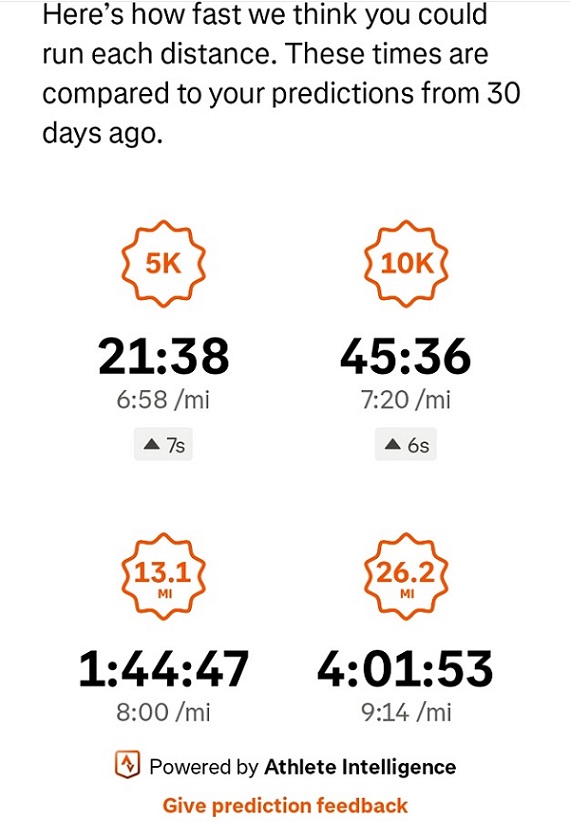
Race predictions

Last month I ran a 6:48 mile to celebrate Banister’s Mile. I know that’s not fast but I’ve been concentrated on building strength in the gym and working on very short distances – I expected my aerobic base to erode and it did. But if I take a look at Jack Daniels’ VDOT tables he estimates a 6:49 mile equates to a 23:09 5K which is relatively close to the 22:54 I ran at parkrun a few days later.  It’s not perfect but it’s not frustrating me into thinking I can run over a minute quicker than I’m capable.

Looking at the other predictions – the 10K of 45:36 is essentially double this Season’s Best for 5K – so that isn’t going to happen. I reckon half marathon at 1hr45 is reasonable and JackD’s VDOT suggests 1hr46 although I wouldn’t be surprised to see myself slip to about 1hr50 given I haven’t run over five miles in almost a year.

VDOT predicts a 3hr40 marathon which is very unlikely and Strava’s 4hr time is probably closer to what I’d achieve. But again, if I entered a marathon tomorrow, I doubt I’d come close to either time because I’d wilt and be walking from fifteen miles. If I trained properly for the distance, I’d feel more confident about VDOT’s prediction; the Strava prediction would then be too slow but it would probably update itself with the training.  But if it has to keep revising times as the training changes then that seems a little disingenuous – rather like the person who tells you “Oh I knew that” after you read out the answer to the trivia question they had just given up on.


With each run you upload there is Athlete Intelligence feedback to tell you about the run or workout you’ve just done. For example, this is what it stated for the run I’d just done at time of writing  …
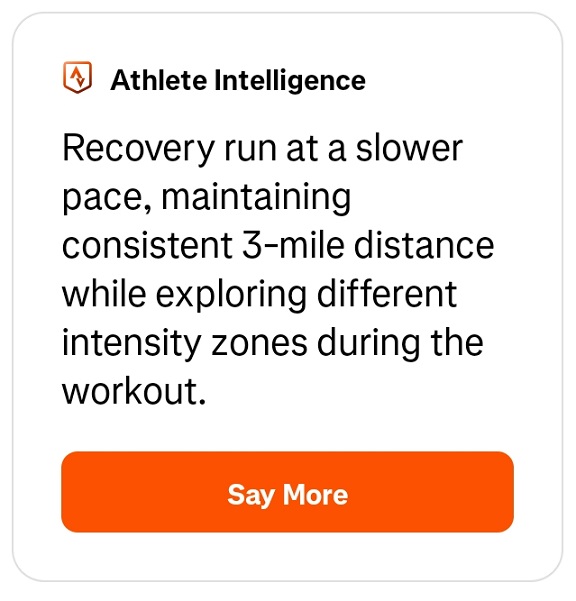
Recovery Run

It’s a bit bland.

And it’s only half correct.

It correctly managed to figure out I do the same route most days (“maintaining consistent 3-mile distance”) and it correctly figured out whether this was faster or slower than usual (“at a slower pace”) but the last sentence (“while exploring different intensity zones”) is complete rubbish. I went out at an easy, recovery pace and maintained the same intensity throughout. What did happen is that I ran up some hills which caused me to run slower (but using the same effort/intensity) and down some hills which caused me to run faster (still using the same effort/intensity) and under some trees which will have messed around with the GPS.

As for the first couple of words (“Recovery run”)  Strava had enough intelligence to take this from the title of my run!  When I changed the title to “Steady” the summary changed likewise. It really wasn’t rocket science to figure that out although when I changed the title back to “Recovered” with a deliberate -ED ending it went back to calling it a “recovery run” and when I tried “Interval session” it ignored that.

I decided to look at what it had to say about previous days. For example here’s an interval session …

This is a pretty good description of what I’d done but what does this final bit (“and a challenging mixed-pace run.”) say or mean? They’re just empty words describing what it thinks I’ve done but not what it really was – warm-up, intervals with rest breaks, warmdown. Technically it’s a mixed-pace run but not like going out and doing a proper fartlek session where you mix the paces up.

I looked back to a speed development session where I sprinted four efforts of 5 seconds followed by further efforts lasting 10seconds, 15seconds and 25 seconds. Between the efforts I walked back to where I started, stood around and had long rests. It ended up taking about 25mins to do seven efforts. Here’s what Strava had to say …
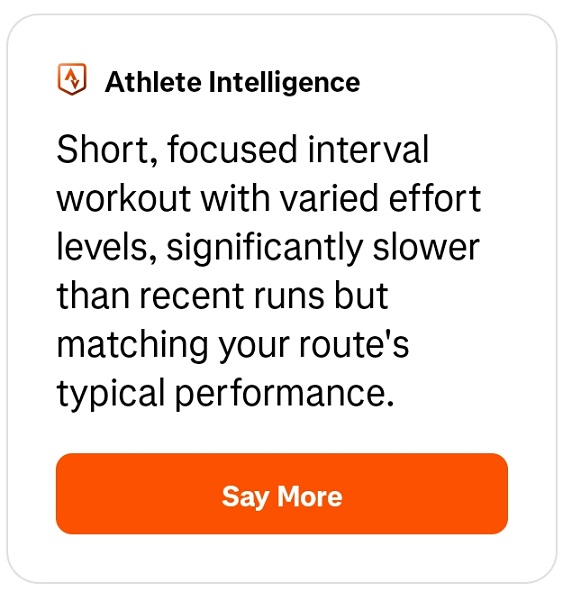
Sprints

It got the first line correct but not much else. There really were no varied effort levels, it was max effort from start to finish on the sprints. And I’m guessing it thinks this was “significantly slower” because the 0.7 mile of total sprinting and walking comes out at 12+ min/mile. Compared to a recovery run then this is significantly slower but of course it is – the aim and structure of the session is totally different.

Here’ s what it said about a 23:16 parkrun …

parkrun

Well that’s strange, I didn’t do any intervals – I ran a 10min warmup, a 5K parkrun, a 5min warmdown. And the parkrun was 25secs slower than my Season’s Best the week before so it can’t have been a “route personal record”.

What can I say? It all sounds like unintelligent garbage to me.


Of course I don’t help Strava much by having an old Garmin watch which doesn’t feature many of the latest variables and I stopped wearing a heart-rate monitor months ago. But I run just about every day and upload my data to Strava – there’s almost ten year’s worth of data about my running for Strava to crunch. And yet I don’t find it’s telling me anything useful.

That said, I haven’t investigated their Runna coaching service – why would I? I coach myself and know how to train others for results. If you need an individual plan then I can help you but equally standard plans have been available in magazines and on the internet for years – and while I’d expect Runna to adapt depending on how your training is going (which is what I do with the runners I coach), I’m not sure how good it is at that. I also question its ability to motivate – I’ve known a few people try to follow coaching plans given to them by their Garmin watches but have yet to hear of anyone who succeeds or even completes the programme.


At the moment AI feels rather like “cut & paste” software. It feels like the gym assessment I used to get where it would state BMI is the relationship between your height and weight, with your value of [Insert value] kg/m2 shown above in Illustration 1. Your value places you in the [Insert rating] category. However, it is worth noting that BMI doesn’t take into account factors such as muscle and lean body mass.  Lots of description with just a couple of personalised bits of information added in.

I remember how these five or six page documents initially impressed me but after retesting, I came to realise that they were just padding out my numbers with waffle. Eventually all I did was look at the graphs and numbers.  I suppose AI has an advantage because it can rephrase the same information in different ways thereby giving the impression for longer that it has something important to say.

I’m sure AI will improve in coming years and when that happens I’ll probably be out of a job. But one of the reasons AI will continue to improve is that it continues to scour the internet. I receive a significant number of hits from AI tools which are reading my blogs and trying to make sense of them.

In the meantime if you want personalised coaching from a real human being – this far I’ve not used AI in my blogs or plans – then click here to Contact me.
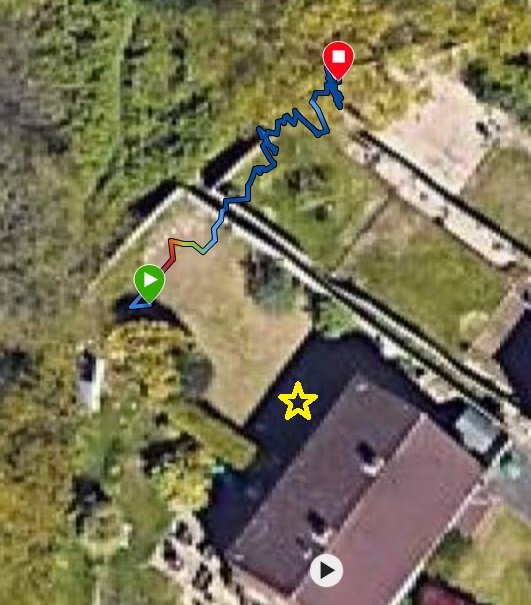
GPS (in)accuracy

This is the GPS map from an activity I recently did. Can you guess what it was? It starts at the green triangle and ends at the red square.

The answer is I was skipping on the same spot for a minute or so. The Yellow star marks where I was yet you’d never know it from what you see. It looks like I’ve started at the top of the garden, gone over the fence and ended up a couple of doors down. It provides a good example of how inaccurate GPS can be. Not only do I appear to move, but the trail never even touches where I was actually skipping.

GPS (or Global Positioning System) was originally set up for the U.S. military and comprises a set of satellites in geostationary orbit that are able to pinpoint a position to within a few metres. In mid-2023 the system comprises 32 satellites with more planned. it was opened up to commercial interests during the 1990s and these days it’s not the only system available. In recent years other groups of satellites have been launched by Russia (GLONASS – GLObal NAviation Satellite System), China, Japan, India and the European Union. Note that the commercial version of GPS is deliberately not as accurate as the military version.

While GPS navigation units were previously available, the earliest GPS wristwatch was released in 1999 by Casio but this was simply a watch that could tell you where you were standing. It wouldn’t be until the early 2000s when companies like Garmin began to sell watches allowing people to track their runs. Initially only used by hardcore runners, the market has expanded with people now tracking their training by phones or smartwatches.


GPS can pinpoint you to within 3 metres which is incredible when you consider the satellites are situated at an altitude of 11,000 miles (eleven thousand!) or 20,000km in metric. And yet it’s often not accurate enough for runners. I’ve frequently heard runners proclaim after races “This course is long” or “this course is short”.

As you can see in that original picture the accuracy of GPS in any one moment is questionable. It’s good enough for your car’s SATNAV to get you from A-to-B when you just need to know what road to drive down, but runners want it to accurately represent where they’ve just run. And for the most part it does this – but only to within a few metres.

The first thing affecting accuracy happens when you turn on your GPS watch. It needs to lock onto the satellites. My old Garmin FR610 claims to remember where I last was and that it’ll be ready within thirty seconds; but I’ve always ended up leaving it out on the recycling bin while I’m putting my shoes on. Even when the “Locating satellites” screen says it has locked in, if I check the Accuracy it can still be 15 metres away. If you set off before the satellites have truly been located, the distance is going to be inaccurate. Now, in the case of my skipping picture, I’d already been out for a run so the satellites were locked in.

When accuracy is at its best of 3m it means you can only be 1.5m to the left or right which is barely more than arm’s length. But if the accuracy drops to 6-7m that’s like being stood in the middle of the road and the watch thinking you could be on either pavement.

This is where GPS can start to read long. While you may be running a straight line, GPS may be zigzagging left, right, left, right either side of you as it tries its best to read exactly where you are. The straight line is always going to be the shortest route, any digression left or right will add distance. While a centimetre added here or there won’t impact matters a lot, on a longer run it adds up.

It’s harder for GPS to read short unless there is some kind of signal dropout. That happens if you run under a bridge, under trees or between tall buildings which all stop the watch receiving the satellites’ signal. On a couple of rare occasions I’ve had my watch lose signal for no explicable reason.

If you’re on a twisty course going round sharp corners or doglegs then there’s a good chance your watch may think you’ve cut the corner. While it checks your location frequently, probably every second, the quicker you’re running the more ground you’re covering and the greater chance of it being off with its moment to moment measurements. This could take distance off.


Generally though GPS is accurate enough. When you go to a race what matters is the distance that has been professionally measured and certified. even if your GPS tells you the course is shorter or longer. Most likely it will read long because road races are measured using the shortest line through twists and turns – usually to within a metre of the curb. Most runners just follow the herd in front or find themselves dodging left and right to pass others.

For some the days of the GPS watch never arrived. They’re happy to use a smartphone app like Strava which is more than capable of recording their runs. And it doesn’t just use GPS it boosts accuracy by using the mobile phone signal.

In the old days, runners stood around waiting for their mates to turn up, maybe bouncing up and down for some stretches before setting off. These days, they’re waiting for the watch to lock on to satellites or scrolling through their phone apps to press start the moment they set off.

Short sprint – Do it for yourself

When I was twenty-two the gym I went to held monthly challenges. These rotated around the cardio equipment with one month being who could run the most miles, the next being to climb the highest on the versa climber, the the stationary bike, the stepper and so on. Typically the same people won the challenges because they were willing to get in the gym every day and train. I’m certain there was one woman who turned up twice a day to ensure she won the stepper challenge. I often didn’t participate because I wasn’t committed enough and I wasn’t into cardio for cardio’s sake.

The October challenge was to row as far as you could over the month. As I enjoyed the rowing machine and felt I was quite good on it, I gave the challenge a go. This was in the days before the Concept2 machine and there was a blocky graphic display showing your avatar rowing but the machines were technical enough to allow you to go head-to-head with someone on the other machine. I’d done this with Gary, who I played volleyball with, and there was something of a rivalry between us; so I went at the challenge full pelt; I wasn’t going to let him beat me. Fortunately the challenge rules limited you to fifteen minutes rowing each day on the six days of the week the gym was open, so it couldn’t get out of hand.

I suppose the aim of the challenges was to give people a reason or motivation to come to the gym. It was early gamification of the sort you see on Strava every month now. Badges for running 5K, 10K, a half marathon, cycling, swimming or whatever every month. These Strava challenges are participatory and while there is a leaderboard it’s about doing it for yourself rather than beating other people.

But back in the day I was interested in beating Gary, if not winning the challenge, so I made sure of going to the gym every day to max out my rowing allowance. All-out, hard effort for fifteen minutes to log as much distance as I could in my quest to be the best and beat Gary. I’d probably then go off and lift some weights and play volleyball or basketball.

I lasted two weeks before I fell sick. It was so bad I went home from work on Thursday lunchtime, took the Friday off work and stayed in bed all weekend to recover. I was back at work on the Monday but I’d learned a lesson about overdoing things. I often say I’m never ill and the Friday was the only day I took off in eight years working there.


The real consequences of that lesson came a couple of weeks later. November rolled around and the gym staff were looking for people to sign up for the next challenge. I declined. I realised I’d made myself ill from a meaningless challenge. My ego took part in the challenges because I wanted to be part of the gym but more so because I wanted to be at, or near, the top of the leaderboard. There was no reward, only bragging rights to be a big fish in a little pond. More so I realised the challenge was the gym staff’s thing not mine. They were signing up people to try and keep people motivated and have as many names as possible taking part to make it an interesting competition but so what? Those were their goals not mine. My goals lay in a different place, in particular on the volleyball court and staying fit and healthy enough to keep training, playing and improving at that.

I never signed up for another challenge again.