I’m trying to improve my sprinting by videoing myself and then comparing it to the theoretical model of the best sprinters in the world. It’s not rocket science but I’d like to feel like I’m running rocket powered. While there are distinct differences between sprinting and distance running, even distance runners need to be able to sprint for the finish line and there should be some common mechanics which will carry over to make me efficient over any distance.
For example, as detailed in part 1, I noticed my foot was landing too far out in front of me causing me to vault over it. When I brought the foot closer, my runs began to feel like I’d taken the brakes off and my glutes were doing the work.
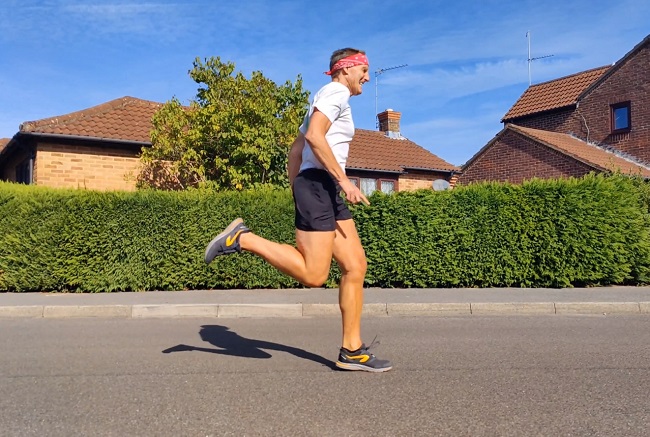
The best sprinters have cadences well over 250 steps per minute, often approaching 300 yet I struggle to even reach the 220s. Watching the video of my sprinting it all seems lumbering and cumbersome. While a still image can look fairly decent, watching actual footage tells a better story. When my foot lands it seems like I’m stuck to the ground for an age as my body passes over it.
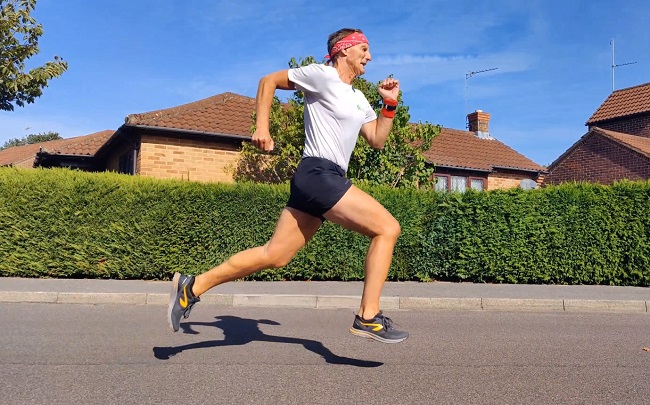
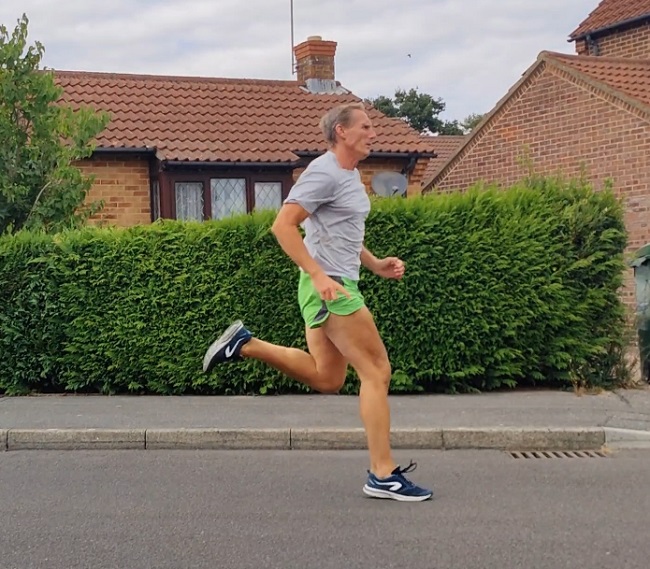
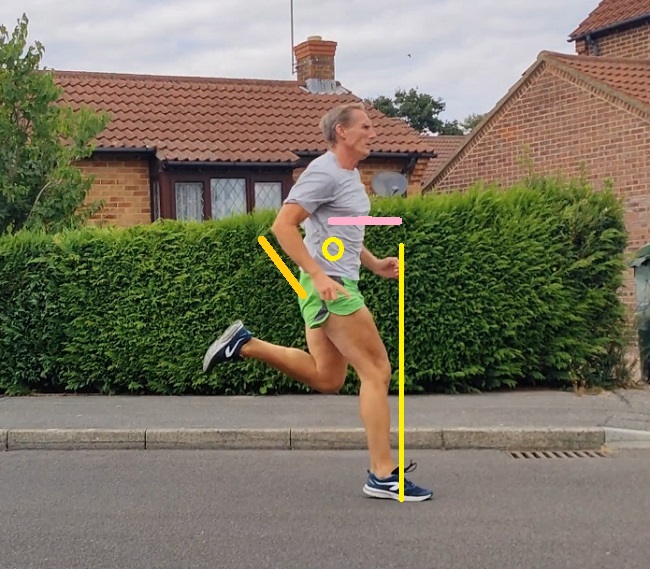
Watching and rewatching footage I began to see my head and shoulders were rising and falling against the background. The next questions was “Why is that happening?”. And from that I began to see both my knee and ankle were collapsing and I was flat footed with each step which produced the illusion of being stuck to the floor for so long.
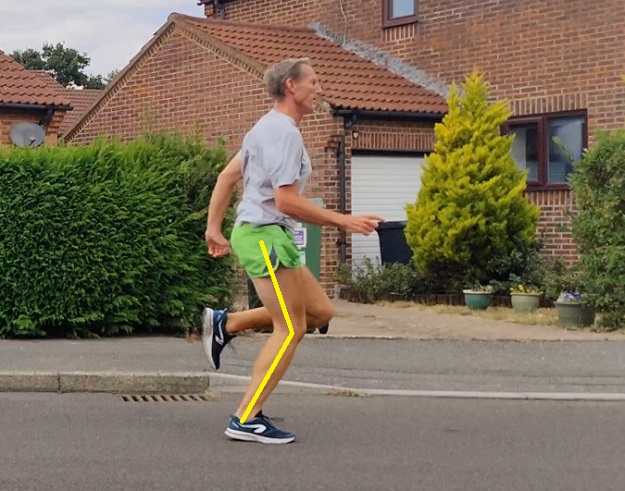
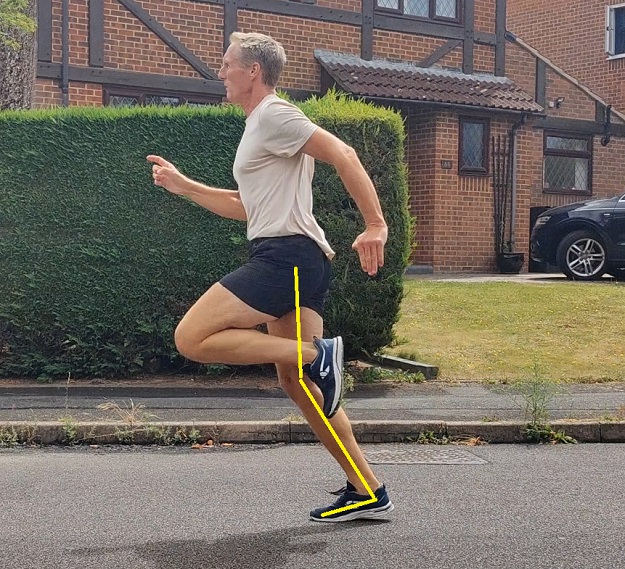
Good sprinters try to maintain leg stiffness (of their support leg) with the knee hardly bending. Their ankles don’t flex much either and they stay up on their toes – the heel never touches the ground. Inevitably there is some flexion in the knee and ankle due to the forces being generated as the weight of the runner lands but the more it can be minimised, the better. Likewise the heel will move towards the floor slightly but never makes contact. This flexing allows the Achilles tendon to load up with elastic energy and then release to help propel them forwards.
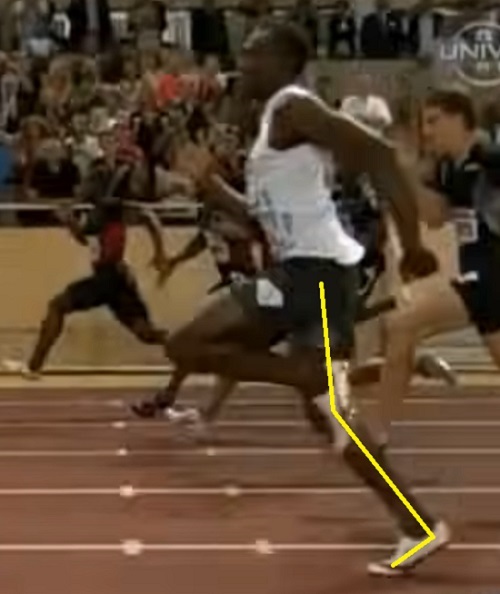
If you compare the pictures you’ll see both myself and Bolt are at the same stage of the stride; the arms match, the knee coming forward matches and the thigh of the support leg is vertical. But the foot is completely different. My ankle has collapsed and flexed and the heel is barely off the the ground; Bolt’s heel is notably raised and the foot is at right angles to the lower leg.
Initially I thought there was too much knee flexion but I’m no longer so sure. But there’s a definite lack of ankle stiffness which is causing an energy leak and it’s that which I’ve been looking at over the past month or so.
How to improve is of course always the harder question to answer when you locate an issue. Trying to resolve this became a matter of trial and error. I tried to focus on keeping the joints stiffer. I felt I had the requisite strength to keep my legs and ankles stiffer – after all when I skip / jump rope they don’t collapse, it was just the sprint technique wasn’t allowing me to get it right.
When I ran my sprints and strides I made an effort to maintain stiffness in the joints. I think it was a little beneficial but it put new stresses through my joints and for a time the tendons in the rear of my left knee were feeling swollen. It didn’t stop me running, it didn’t hurt training; but the knees were certainly unhappy if I was squatting down to say get something out of a cupboard. I made sure to keep the volume of these sprints lower though as I knew there was a danger of trying to do too much and injuring myself.
Note – while leg stiffness is important you don’t want your leg to be locked out at the knee because that has a high chance of leading to an injury. Failure to flex under high forces can lead to bone jarring into bone.
Similarly trying to stay up on the toes can lead to issues with calf muscles and tendons and there’s a good reason for allowing some ankle flexion. When the ankle flexes (i.e. the toes lift up and move closer to the knee) the Achilles tendon stretches and just like an elastic band it stores energy. When this elastic energy releases it provides some of the propulsion for moving forwards. While sprinters’ ankles flex the heel stays off the ground but a distance runner’s heel will come into contact with the ground momentarily and this needs to be allowed to happen for the storage of elastic energy.
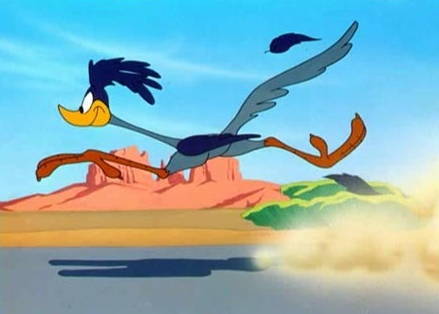
One of the mental models I’ve been using is to think of how skateboarders paw the ground to keep their deck rolling. They time the kickback to add speed as the board begins to slow. It seems to me sprinters are doing the same thing; but where the skateboarders are able to take a foot off the board, paw the ground and then rest the foot back on the deck; sprinters are trying to stay airborne with just their legs extending down to make a short but powerful contact. You could think of the Roadrunner’s legs whirring along at speed..
The other adjustment I made was to try and get my foot down to the ground quicker – what coaches refer to as a hammer action. If I could move the leg down quicker then it would apply force quicker and the foot would go through quicker leaving less time for the joints to flex but still allowing some ankle flex to load the Achilles.
In trying for this quick contact and to stay more airborne, I’ve found my sprinting begin to morph and on occasions I have felt myself springing along as the Achilles does more of the work. There’s still more to do but I think it’s heading in the right direction.
 Big Red Running