Short sprint – “Being fast”

I find the limitations of language frustrating. I often meet runners who say they want to “be fast” but that’s not exactly what they want. They might currently be running a twenty-five minute parkrun and think “being fast” is running twenty-three minutes. Other times when they drop back to twenty-six minutes they say they’re “losing their speed”. But “speed” and “fast”, even “slow” are all relative terms.

Currently I’m reading Chris MacDougall’s latest book, “Running with Sherman” where he talks about his experiences living in Amish country while training a donkey for an ultra race. In one chapter he details running on the Full Moon with the Amish people deciding to only do five miles as they’re running under starry skies without lighting. Meanwhile Ame, one of the first Amish runners, runs the ten mile run “fast” arriving back shortly after MacDougall has finished. That sounds incredible but then MacDougall mentions Ame can run a 2hr54 marathon which suggests he’s running ten miles in about an hour in which case MacDougall must be plodding along at something like ten minutes per mile. Neither of those paces sounds as fast as they come across in his description.

In his more famous book “Born to Run” he writes about how a group of Tarahumara Indians from Mexico competed in the Leadville 100 (mile ultramarathon) easily beating the rest of the field because they capable of running big distances at incredible paces. Except they were running one hundred miles in twenty hours so 12min/mile. While it is incredible to be able to cover that distance, it’s not incredibly fast which is the implication when you read it. Of course, as a writer, he’s trying to make his story appeal rather than go into the details whereas I’m always been interested in the details as much as the story. The danger of reading this vague language is you come away believing you can run incredibly fast at parkrun through ultra training.

The top sprinters in the world have genuine speed and are incredibly fast. Usain Bolt reaches a peak speed of over 27mph running the 100m, averaging 23mph. Meanwhile Eliud Kipchoge runs the marathon at 13mph which is half of Usain Bolt’s top speed. It’s also the equivalent of a fourteen minute parkrun. From there the rest of us are getting slower. Ten mph is scraping under nineteen minutes while that twenty-five minute parkrunner is barely running 7½ mph. When you get down to thirty minutes you’re barely running at a quarter of the speed, Usain Bolt averages.

The point here is not to rag on about people’s levels of ability, it’s about the use of language. Watch out when people say someone else is “fast”, or claim they’re “losing their speed”, are too “slow” or “not fast enough”. They could probably improve all those things easily with a few sessions of sprinting but whether it would do their race times any good is debateable. Specific language like “running at 9min/mile pace” can ensure everybody is on the same page about expectations. From a coaching perspective being specific provides decent insight into what needs to be done to improve.
Short sprint – No-one’s racing anymore

A few years back, I was going through the preliminaries of ascertaining whether I would be the right coach for a potential client. One of his questions to me was whether I could help him with racing. My reply was that it was something I had no experience of, but fortunately despite this, he still went ahead and took me on as his coach.

It later transpired we’d had different definitions of racing. He’d wanted to know if I could help with what to do on the day of his mass participation marathon race (which I absolutely could) whereas I’d been defining racing as what happens when you’re trying to finish ahead of your fellow competitors. For most people, when they talk about attending a race they’re really talking about a time trial – how quick can they run the distance?

Parkrun is not a race. For starters its insurance doesn’t cover it which is one reason why there are no race numbers or race clocks. Parkrun doesn’t even have a winner, it has a First Finisher, although when I first attended it did, until the nomenclature changed. If you look back to its beginnings, parkrun started as Bushy Park Time Trial then, as other events opened, it became UK Time Trials before rebranding as the friendlier sounding parkrun.

Running doesn’t have any true time trial events like say, cycling where riders go off at intervals of a minute or more and the winner is the one covering the distance in the quickest time. Admittedly when I orienteered it was done against the clock with runners having their own start times. This is a logistical necessity to ensure they don’t all reach the check points at the same time and have to wait to punch their card. But orienteering isn’t a pure running sport, it’s also a test of your ability to navigate, runners go off at intervals to avoid being able to follow someone else.

Typically elite runners do time trials to find out what form they’re in. When it comes to races the goal is simply to finish ahead of the person behind you. Often championship medals are won in times slower than heats especially at longer distances.

Of course there are some (many?) who turn up to parkrun and think they’re racing against others but true racing is a tactical art. It’s about letting your opponents take the breeze, it’s about knowing your strengths, their weaknesses and how to gain an advantage. It’s knowing when to go with the pack and when to let leaders go it alone hoping they’ll burn themselves out. This is the tactical stuff I’ve not got any experience of because I’ve never been good enough to need to learn it. I understand some basic theories as I’ve outlined but I’ve never experienced them. Like almost everybody else, I just run as fast as possible trying to get the best time I can.

Charlie Spedding’s success

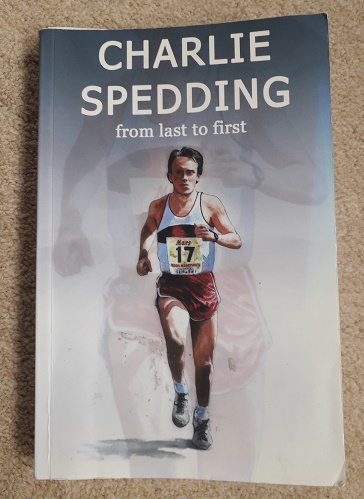
Recently I’ve been reading Charlie Spedding’s autobiography “from last to first”.  He’s a runner I only remember because he was one of the early winners of the London Marathon and being a trivia buff it was the sort of factual list I knew off by heart at one time. The following year he finished second in a time of 2:08:33, which remained the English record until 2014, as he relinquished his title to Welshman Steve Jones.

Published in 2009, “from last to first” looks back to Charlie’s running career which ended twenty years earlier after the Seoul Olympics. Like all autobiographies, it tells of his early life, parents and formative years in running. It details his two major successes, winning the London Marathon and a bronze medal at the Los Angeles Olympic, events which occurred a few months apart in 1984 as well as a copy of his training diary between them. The final chapters of the book give an overview of how he trained and brings us up to date with some of his thoughts on the reasons behind the nation’s lack of health and prospects for future running success.

At just over two hundred pages, the book is well written and often humorous. As a pharmacist, he clearly has an understanding of science yet is able to tell his story without unnecessarily resorting to big words or jargon. I laughed out loud when he recalled his time at Chorister School in Durham where “One of the lads I played with was a boy called Tony Blair. I don’t recall his skill with the ball, but I do remember his ability to make up rules of the game to suit his team’s situation.” Also the tale of how he was invited to do an inspirational talk at a local psychiatric hospital. Introduced to a patient by the doctor as “This is Charlie Spedding. He’s an Olympic bronze medallist in the marathon”, the patient replied “That’s alright, I thought I was Henry the Eighth when I got here.”

About to undergo Achilles surgery in the 1970s, he almost died in hospital due to anaphylactic shock caused by an allergic reaction to a drug. It’s interesting to think that, at the time, surgery was deemed the way to fix these issues. Derek Clayton stated in his autobiography that he’d had nine operations for problems which included his Achilles. Nowadays we understand surgery isn’t necessarily the solution, heel drops can resolve it. My friend, Simon rehabilitated his Achilles simply by doing a month of very easy running after racing twenty-five times in a year. Charlie notes late on that he avoided further Achilles issues when he was in the United States by getting regular massages.

Throughout the book, Charlie impresses how important attitude and mindset were to his succcess. He talks about how he was fortieth or forty-first academically in a class of 42 at junior school but went on to achieve a degree and running his own business. When he first played sport, he wanted to be a footballer but wasn’t good enough; when he ran sprints he was last but then found cross-country and finished second in his first race. Having found what he was good at, he then worked hard at it.

After a decade of high level national running as part of Gateshead Harriers, he sat in a pub and rethought his attitude as to what he needed to do to reach his potential. He realised he needed to be more positive in his vocabulary, to be specific about his goals and to be willing to think differently if he was going to achieve more than the average person. His underlying philosophy was one of getting the best out of himself for whatever talent he had and accepting that as success.

I found many parallels in his writing to how I’ve lived my own life apart, of course, from winning the London marathon or going to the Olympics. The attitude and mindset of always giving your best to fulfil your potential are one that resonate with me. Also his willingness to try new approaches and not giving up when things haven’t worked out. It’s something of a cliché to say “how bad do you want it?” is the determining factor but I’ve met many people who say they want to achieve good times in their running but aren’t then willing to make it a priority or get out of their comfort zone. There’s nothing wrong with not doing those things but I believe it’s best not to talk about your desire for improvement if you’re not willing to do the things that are firmly within your control. It’s like wanting to win the lottery but refusing to buy a ticket.

I enjoyed reading this book for its refreshing honesty and humour. It was a very easy read and, as I was loaned this copy, I’ll probably look to pick up my own one in the future for a reread. As an aside, the hospital in which Charlie Spedding nearly died is the one where I was born!