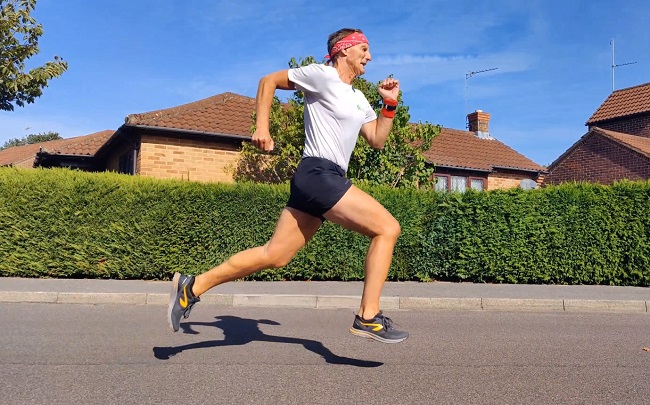
This me in full flow sprinting. Other than the pained expression, to the untrained eye I’d say it looks pretty good but I’m not fast and never have been. Improving my sprinting has been a large part of my summer training while doing 3-5miles each day along with an interval session and weekly 5K parkrun.
I’m very aware elite distance runners have good speed over short distances – a 400m lap in under one minute is normal to them. Yet despite my physical attributes, it something I’m not achieving and I don’t understand why. For sure I’m ageing but even when I was young I was never able to do it and yet my physical attributes suggest it, or something close, should be within my ability. There are men ten years old than me who can so I’m discounting the age problem.
Maybe it’s been down to the wrong training but I had a strong suspicion my form was poor so I bought a tripod off eBay to be able to film my sprints and analyse the technique. Last year I received a copy of Ralph Mann’s The Mechanics of Sprinting and Hurdling for my birthday which explains in great detail every important position the most efficient sprinters achieve. While I don’t expect to be able to replicate or measure them in the detail provided in the book, I hoped to be able to make some comparisons between what I’m doing, what the book states and then to rectify any anomalies.
Unfortunately my phone didn’t have a very good camera on it, or more specifically it could only capture 30 frames per second. At high speed that just doesn’t give enough detail, for example I couldn’t tell whether I was landing on my heel or toes. So I got a new-to-me phone from my nephew which has 4K and 120fps and enabled me to see what was happening.
Landing foot in relation to Centre of Mass
I took some footage and then stepped through frame by frame. I didn’t have any preconceived notions about what I was looking for but the nuances of how I was running began to emerge. Eventually I settled on this frame.
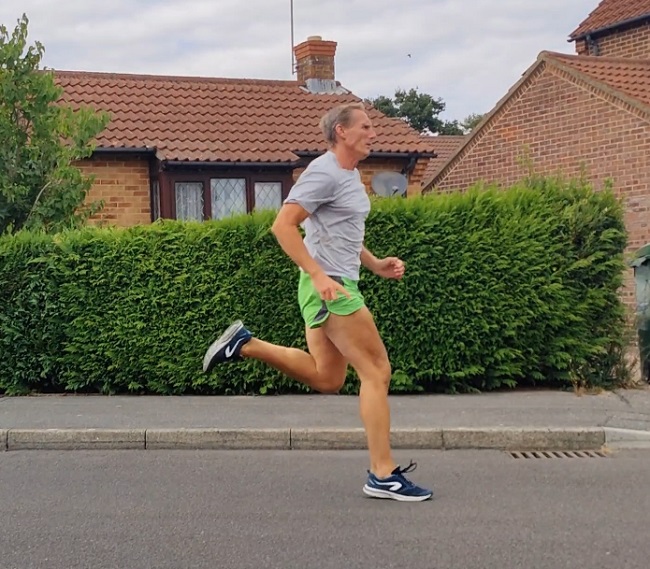
On the surface not that much seems wrong with it because it’s not heel striking – the toes are just touching first and from the knee down to the foot, the lower leg is almost vertical below the knee. Those are the sorts of pearls of modern wisdom that get preached as good technique.
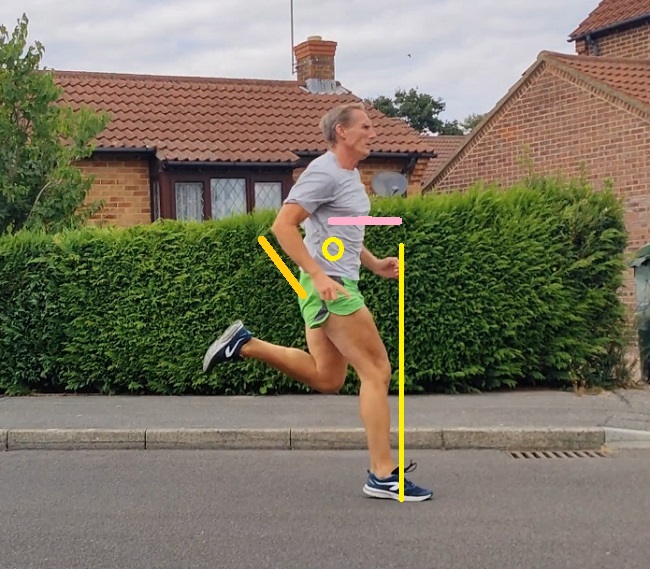
But I could see the foot just seemed too far ahead of the body and when I checked Mann’s book, he states that while world class sprinters are unable to get their feet to land directly below their centre of mass, they can get it to land only 20cm ahead of them. For an average sprinter, it’s 28cm and a poor one it’s 35cm. Think about those numbers for a moment – they’re not particularly big distances so it’s easy to be unaware if they’re wrong.
I’ve drawn some lines on the picture below to explain how it’s calculated. The yellow circle is approximately where my centre of mass is, and the yellow line up from the foot shows where it is landing. The pink line indicates how far ahead it is and I’ve created an orange line of the same length and then measured it from my elbow. Getting out a tape measure it’s a distance of 35cm – poor sprint technique as predicted!
When I ran recovery the next day I worked on getting my foot to land closer to underneath me. The difference was immediate. Every step began to feel like I was being pushed along by my glutes and it became apparent my previous form was creating a braking force out in front – every step needed me to pull my body over the foot. I’ve heard this phenomenon likened to driving a car with square wheels rather than just rolling along. While the new form bedded in quickly, it took a while for the body to adjust to using a different set of muscles, I had a few aches and pains. I backed off training while this was the case.
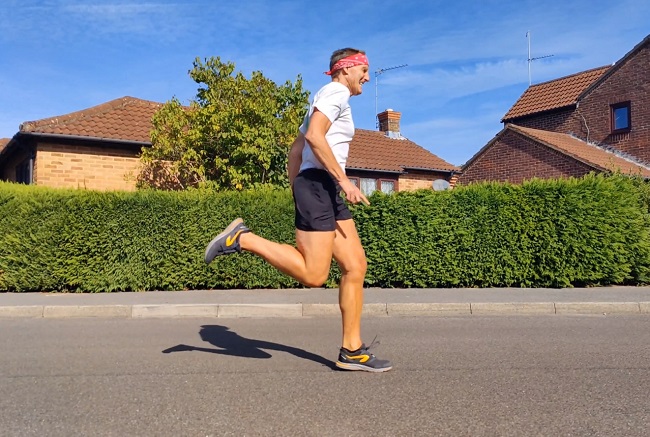
Five weeks later in early September this is how it looks. I’ve picked like-for-like frames based on the the foot placement with toes touching and heel about to touch. It’s clear the foot is now landing closer to my centre line and while there are some slight changes to my upper body posture, the non-landing leg is coiling up in the same position.
I’d say that’s an improvement and I certainly feel it’s easier when I run at any speed, not just sprint. I’m beginning to flow over the ground and I can hear it in a less noisy foot contact. And when I did the measurements again the foot is now landing 25cm out in front of me. Better than average, not quite elite!
Next time I’ll look at a couple of other changes I’ve spotted that might help!
 Big Red Running