Today the internet and AI can tell you almost anything you want to know about how to do something. If there’s an issue it’s that there’s too much info and too many voices telling you conflicting information but it really is easy to find an explanation and view on how to do something. Of course I am one of those many voices.
The first time I used the internet was late in 1997 and I didn’t research how to train until the summer of 2001. Before that we only had what we were being told – mainly books and magazines or the experience of others around us. Whereas today you’d simply pull your phone out of your pocket and search for what you want to know, in those days you had to make the physical effort to go to the shop, peruse the shelves and buy books or magazines; or go out and train with experienced people to get the benefit of their knowledge.
I’m not saying it was better, I can see pros and cons for between what we had and what we have now but what it did mean is I would read a book or magazine from cover to cover. Both the cost of a magazine and the scarcity of knowledge available meant I gave it more attention and thought about it. Of course not everything I read was useful or applicable but I would pick up anecdotes and nuggets of information along the way.
Getting a faster fastball!
One anecdote I recall detailed how baseball pitchers were throwing weighted baseballs to try and improve their pitching speeds. It probably appealed to me because I was interested in trying to hit and serve volleyballs faster. With no way to make a volleyball heavier I even tried serving a basketball once and it almost ripped my arm off at the shoulder. I only tried it once.
Nonetheless the theory made good sense, throwing a heavy ball will strengthen the throwing muscles and then when you go back to throwing a normal ball you’ll surely pitch quicker. Except throwing a heavier ball just gave pitchers a slower arm; the heavier ball was teaching them to throw slower because they weren’t going to be able to throw it as quickly as an ordinary baseball. While there are probably still some times where they throw weighted balls, these days they hit the weights room and build general strength across all the muscles and then use that strength to pitch a baseball faster.
Sprinting faster
In Olympic champion Michael Johnson’s book Gold Rush he mentions that he did some training in weighted shoes and that when he then raced it gave him a mental edge because his feet felt quicker in the normal shoes. But this wasn’t a big day-in, day-out part of his training and the difference between light and heavy was just grams. To have done all of his training in these would have been to make the same mistake as pitchers throwing weighted baseballs; he’d have been teaching his legs to move slower.
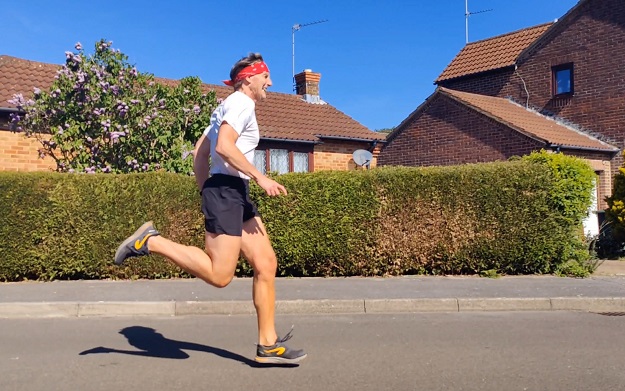
While sprinting is not that important to distance runners, it is useful if they want a finishing kick for the line. To build a stronger sprint we need to do some form of resistance training first. I’ve spent my winter in the gym building strength doing squats and deadlifts but it’s not the only way to create resistance, hills are a great alternative and have been for runners for many decades. They’re also highly specific to using the muscles you need as a runner.
In the gym deadlifts and squats are going to work many of the muscles you need to run but not all muscles get worked appropriately. For example while deadlifts are a great whole body exercise the calves are only working isometrically there is none of the flexion/extension of the foot you get when running. Yet there is a counter argument that at the gym you can use accessory lifts to strengthen any weaknesses. For example, I pulled my right hamstring near to where it attaches to the knee when I first started sprinting. At the gym I was able to use seated leg curls to strengthen them – I went from initally doing reps at 110-120lbs to 150lbs and they’ve been no issue since.
The aim at the gym is to build strength not size. You do this by keeping the number of reps to each set low – I rarely do more than six reps – while going for very heavy weights. At some point you need to convert this new found strength into speed. It’s not enough just to be strong. If you’re running hills you do this by changing to sprinting on the flat to get the legs used to moving quicker. When I’m deadlifting at the gym, I often do low weights as quick as possible. For example during my warm-ups I do sets of 3 at 40, 60, 70, 80kg fast before moving up to lifting heavy weights which peaked at 150kg. By definition it’s impossible to move that very heavy weight quickly. The day I deadlifted 150kg the bar came off the floor slower than ever. When I’ve done my heavy lifts, I might deload the bar do some more quick sets at 90kg and 70kg. These specific weights for doing faster reps were identified based on where I felt I could move quickly and later research suggests 40-65% of max. On occasion when the circumstances allow, I have come home from the gym and run four 10-secs strides to try and transfer the strength into a running action.
In simple terms creating top-end speed is a case of building strength through heavy resistance training and then learning to apply that strength quickly. What you’re essentially creating is power – the ability to move your bodyweight in the shortest time possible.
 Big Red Running