Boardman accurately predicted it would take around 55-mins to cover the course, not too difficult maths when the riders are going at 48km/hr and the course is 44.1km long. At just under an hour it’s an event that’s comparable to elite men’s half marathon running, or in physiological terms it’s being run at Threshold. For lesser runners that might be a 10-mile run or only a 10K – it’s applies to whatever you can cover in an hour.
The nugget of commentary that really struck me was Boardman’s description about riding at Threshold. He stated:
“The first five minutes is free, you don’t feel the pain. That’s the bit where you have to use your head rather than your heart and then it becomes self-regulating, you start to get a feel for the pace, the pain sets in and then you manage it”
What he was describing was how, when you begin a race the legs are free of lactate and waste products that eventually begin to make them feel heavy and the effort to keep them moving gets tougher. With fresh legs it’s easy to go off too fast – build up the lactate quickly and then suffer; the ideal is to ration the build-up evenly over the course of the race. This is true at all race distances and even true during interval training.
After co-commentator Simon Brotherton mentioned that there’s a “fine line between pushing as hard as you can but not going too far into the red” to viewers, Boardman responded with more gold dust:
“There’s a constant calculation going on between …
How far is it to go?
How hard am I trying?
Is this sustainable? And if the answer is yes, you’re not going hard enough. If the answer is no, it’s too late so you’re looking for maybe”
What a fantastic piece of commentary. I must admit the idea of maybe seems quite novel to me. I’ve probably always pushed myself into maybe without realising it and just aimed to hang on, but I’d usually coach people to keep in the comfort zone of yes. We like things to be black-or-white, yes-or-no; Boardman showed that the best in world are risking playing on the edge with maybe!
Next time you’re on the start line at parkrun remember these quotes from Boardman and see how they reflect your experience. The great thing about parkrun is you can test “yes”, “no”, “maybe” over the weeks and begin to learn what each feels like.
Usain Bolt recently ran his first 800m race. As I’m training for this distance, my interest was piqued to see what he achieved. Bolt, of course, is generally seen as the best sprinter of all time winning multiple gold medals in the 100m and 200m at consecutive Olympics and the World Championships from 2008 to 2016. As a junior his coach had wanted him to become a 400m runner, his best time was 45.28s, but he didn’t enjoy the longer training sessions and it became apparent he could be a champion at the short sprints. Running his first 800 race would be a big step up.
Out of athletics for the past four years, he said he’d been training for this race but it turned out to be part of an advert for a used car dealership. Its premise was that you can get an online valuation for your car quicker than Usain Bolt can run 800m. Bolt in lane 1 versus the customer in lane 6 sat in a comfy chair typing her car’s details into her phone. I’ll embed the video at the bottom, if you want to watch it, but Bolt appears to be jogging round on his way to a 2:40 time for 800 metres. The commentary is overlaid and there’s no sound from the track so I’m tempted to believe it’s masking the director telling him to speed up or slow down to ensure he finishes just slower than the customer. After all it wouldn’t be much of an advert if Bolt wins easily. Actually it’s not much of an advert anyway because I thought they were providing insurance quotes, not a price for your used car.
What I could glean from the footage is Bolt is running at a cadence of around 160 steps per minute which equates to a stride length of 1.88m per step. That’s not unbelievable given he’s 6’5” and when he’s in full sprint mode he’s averaging closer to 2.50 metre per step (and his cadence also up at 250 per minute). It’s deceptive watching the video because it really doesn’t seem like he’s covering much ground until you see his strides around the start-finish line. The slow cadence really does make it look like he’s taking it casually.
Even allowing for some play-acting, I doubt Bolt could currently run it that much faster – bear in mind his pace is 5:20/mile, it’s not that slow. He’s not overweight or unfit but of course he has detrained from his peak athleticism. As the best sprinter in the world, his genetics are geared towards speed. He stated in a 2013 interview that he could run the 800m in 2min05 so that gives us a reference for his ability when he was a trained sprinter. There’s also a segment from Superstars in 1986 on Youtube of Carl Lewis, who was the Olympic champion in the same events as Bolt – the 100m, 200m, 4x100m, where he ran 2min15 for the half mile. So I’m inclined to think a detrained Bolt couldn’t have run 800m much quicker than he did in the advert.
A short postrace interview with Bolt shows him lying on the ground having his legs massaged and breathing hard. His splits for this 800 were 35s and 39s for a 1:14 first lap followed by 44s and 42s for a second lap 1:26. That final 200m being faster suggests he did try to pick up the pace. These splits are fairly consistent with what I experienced in my 800m time trials – when I ran 2:53, my splits were 39 / 43 / 45 / 46 secs and I tried to sprint at the end but my legs were tying up with lactate. It’s a fast start and then struggle to hang on.
One difference is that Bolt can run a significantly faster 200m than I can – his world record is 19.19s – yet at 35sec his opening 200 isn’t much quicker than when I time trialled at 39s. His controlled start may have avoided building up the oxygen debt that leads to heavy breathing.
What I’ve found with all my distance races is that it doesn’t matter how hard you train for speed and to handle oxygen debt, there comes a limit to how fast you can go because the by-products seize the muscles up. When your body is trained for speed lactate and waste products are being produced from start to finish. It’s why for in distance running you need to build a good aerobic system to delay their production so they are only produced at higher speeds.
I can remember finishing parkruns when I was speed-trained, saying there was more to come because my legs never felt tired, yet it was only when I did more easy running that my times got quicker. I had to build aerobically through daily easy, steady and long runs to improve at parkrun and longer distances.
Some people are naturally full of slow-twitch muscle and therefore find it easier to build their aerobic capacity – they’ll start with a bigger base. For those with more fast-twitch, either you stick to the sprints as Bolt did or commit to doing the miles that will develop them aerobically.
Usain Bolt’s 800m in 2:40
Skip to 2min43 to see the race won by American footballer James Lofton in 2:03 with Lewis taking 2nd place
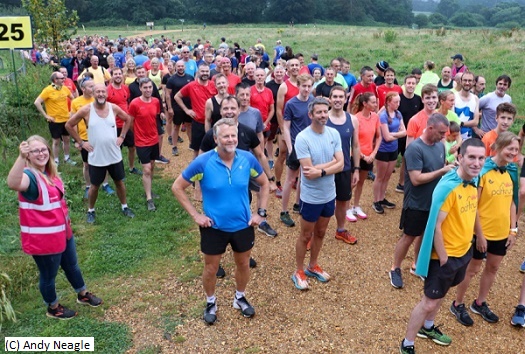
Even overnight rain and thunderstorms couldn’t dampen the enthusiasm for the return of parkrun. I was up at 6:15am for breakfast and headed out to Upton House parkrun a couple of hours later. As I parked the car, just a warm-up jog away, I saw familiar faces who I’d parked by so long ago.
Since I was last at the country park it’s undergone some renovations with bushes around the tea rooms being cleared and the children’s play area refurbished. Consequently the parkrunners have been shoved out through the gate to a new start line and the course revised. I quite like the new route as it’s more open although the uphill finish is going to be taxing when I get up to speed.
The Run Director struggled through the opening speeches because the PA system’s battery wouldn’t recharge after not being used in eighteen months but unusually all the runners stayed quiet so that was good. New parkrun protocols instruct the pre-start speeches to be over quickly and a prompt start at 9am to avoid runners gathering together too long. I was pleased we still had time to clap the one new First Timer who’d turned up, as well as the four runners who were about to complete their 250th run. Imagine being stuck on two hundred and forty-nine all that time. For me, it was number three hundred and twenty-five – but no t-shirts for that!
It’s like Where’s Wally – I’m somewhere in there with the red headband!
With runners expected to seed themselves according to time, I positioned myself just level with the 25-min marker and it didn’t seem like there were too many ahead of me. I ran with Rob for the first 2K and it was nice to run unhindered, able to pass others easily whenever we needed to. At the start of the mini-loop, I left Rob as I took the brakes off and went with the downhill. Despite a light rain, it was all rather enjoyable and I gradually eased past some of the fast starters; always keeping my breathing easy. First mile 7:56, second 7:40, third in 7:26 to finish 49th in a time of 23:57.
Collecting my finish token there was lots of space past the funnel to go and get my token scanned. I then returned to the finish line, chatted to a friend and cheered runners in. The tailwalker came round in just over an hour to complete the field of 295. Elsewhere Poole had 565 and Bournemouth 529 which were the 3rd and 5th biggest attendances in the country, then add in Blandford 133 for a total of over 1,500 local runners out at 9am on a Saturday morning. A successful return for parkrun and I even had my result before midday. Admittedly it was 11:58am but it’s still impressive.
It’s been a long time since I ran a parkrun. Some countries and areas have been reopening sooner than others but finally England is ready to allow them again. Just one week to go and I’m wondering what the response will be.
Parkrun HQ have spent the past year figuring out the logistics to make parkrun Covid safe. Start speeches will be kept brief to avoid people gathering together for too long. A new app has been developed to allow volunteers to do the barcode scanning and timing from their phones rather than using shared equipment. The finish position tokens are to be washed or quarantined every week. Academic research supports the idea that gathering on a start line within close proximity of other runners is safe.
I’m guessing it will all work out as parkrun has been going ahead around the world with (I assume) the same changes in place and things haven’t collapsed there or needed a rethink. But different cultures have different attitudes and that’s the thing I’m wondering about. How will Englanders respond to the return of parkrun? Will we accept the changes? Will we believe the science? Do we care enough to get back out running on a Saturday morning?
My last parkrun was in early January 2020. I stopped going two months before the pandemic put them on pause. This wasn’t some prescient act of foreboding, it was my choice.
With New Year’s weight-loss and fitness resolutions kicking in, attendances swelled. In the weeks leading up to Christmas the average attendance at Upton House parkrun had been about 300; in the New Year it was closer to 500. It’s great to see all those new participants but I was getting trapped among them. I was running heavy mileage on Fridays and could only manage a recovery run on Saturdays. The narrow paths of Upton Country Park allow little room for manoeuvre past runners who’ve started off too quick and who then stop or walk to avoid stepping in the winter puddles. I found it hard to enjoy myself when my rhythm and flow were constantly being broken up.
New Year resolutions never last for everybody but parkrun was always a gamechanger and a high percentage of the newbies continued to come back. But more than a year on, will they? The not-parkrun stopgap that Headquarters tried to promote never took off. For whatever reason, people are only interested in going for a free, timed 5K when it’s part of something bigger. Their own volition and fitness weren’t enough for many people. Maybe it was really the coffee and cake afterwards.
In deciding whether to attend, will people accept the science that says standing on a parkrun startline is safe? My initial instinct, knowing how close we stand to each other, is that they could become super-spreader events. Parkrun’s academic research says it’ll be safe but I have some reservations because it’s modelled on an attendance of 263 participants and March Covid levels that were much lower than they are now. Our parkruns are much bigger than that.
The reality of the situation is with about 2,000 runners attending our local parkruns, the current case rate of 250 per 100,000 suggests five infected people will turn up. My odds on actually standing next to one of the five seem little worse than I could achieve in the aisles of the supermarket.
The parkrun Covid Code asks runners not to attend if they’ve got any signs of it present e.g. positive test, high temperature etc. Generally speaking the parkrun community is good at looking after one another so there’s a good chance they’ll comply. Most people wouldn’t want to run if they’re feeling under the weather anyway.
I know the local parkruns have been doing trial events to familiarise with new processes and these events have been well-attended by members of local running clubs. That’s no surprise, they were invited and they are regular runners but what about the ‘ordinary’ runners who were parkrunning as something to do once a week? My guess is it’ll be a tentative return to action by those who aren’t regular runners.
While about 95% of England’s parkruns are set to return, Moors Valley and Brockenhurst are among those without permission – yet. That will probably push some of their regulars to Bournemouth and maybe further afield to places like Salisbury, Blandford or wherever.
As the restart coincides with the beginnings of the school holidays they may not be the only visitors to other areas. In the past, we usually saw an influx of visitors to our local parkruns either on their way to or from a holiday in the South-west. I assume that will still be the case as more families are choosing to holiday in Britain this year but of course some of our local families will also be going off to visit elsewhere so the net effect is likely the same. Nonetheless with family routines broken up and school out, I don’t think numbers will settle down to their regular levels until September. By then, we’ll know the new processes and have a true picture of whether parkrunning is viable in the new normal.
Ultimately I’m a believer in trusting that life will all work out in the end. Committed parkrunners will be back quickly, the more tentative will take time to return. It will be a while before it settles down but we’ll get there and adapt to whatever challenges come up. It’s quite possible there’ll be more hiatuses along the way.
Finally to say, if you’re not in England or your parkrun hasn’t been given permission to return, then stay strong, it’ll be back eventually. We’ve been through the worst of this and life is gradually returning to old activities.
I was woken early by the tap, tap, tapping of a bird outside my bedroom window. With it being nesting season, the birds have built a nest up in the eaves and are flying in and out of it frequently. Trying to locate exactly what part of the house the bird was tapping, I looked out from behind the curtains and noticed my neighbour working out in his back yard. It was 6:15am. Most of it was stretching and limbering up as he prepared to do pull-ups on a frame he’s bought. I was impressed as I watched him machining up and down, one, two, three; nice square angles at the shoulders and elbows, four, five, six; barely pausing or fatiguing as he went on all the way up to fifteen. A little rest then another set before pulling the tarp over the frame and going in.
I’d love to be good at pull-ups but I’ve always struggled with them. I claim that with my long arms, I’m mechanically disadvantaged. There may be some truth to this. Most people have a reach (measured from fingertip to fingertip across the chest) that is the same as their height. This is one of those anatomical novelties* you can easily test. Lie on the floor feet against the wall and put a marker against your height. Then lie the other way and stretch your arms from the wall to the marker and you should find you can just touch it. Except when I do this I stretch out four inches wider than I’m tall! Of course doing pull-ups isn’t simply about arms, they’re also about lats, shoulders and other body muscles which I’ve never been dedicated to working out. My days of going to the gym didn’t last long, it always seemed so soulless.
My “I’d love to be good at pull-ups” never translated into action. I may say it when I see a parkour runner effortlessly pulling themselves over a wall, or when I try them at the gym but I’ve never really committed to getting good at pull-ups. It’s the same with playing the keyboard, playing the harmonica, being able to do handstand press-ups, dunk a basketball or win the lottery. They’re all things I believe would be cool or, great to be able to do, but I’ve never taken committed action long enough to be able to do them.
This isn’t uncommon. I’ve heard the words “I’d love to break …” followed by a time for parkrun or a marathon leave the mouth of numerous runners who then take very little action to achieve that goal.
I felt somewhat in awe of my neighbour’s commitment at being out there, working out at such an early hour until I realised I was doing the same thing with my own plyometric and hill sprint workouts last summer, my 800m training this past winter and my current Sunday long runs at 5am.
It takes a dedicated, longterm approach to get good at a sport or complex activity, few people are naturals. Before the 800m training, I know there were other things I took action to get good at. I began playing volleyball as an adult and scraped up to playing National League 2nd division. I took golf lessons for three years to be able to break 80 and score a hole-in-one. My running took three months of dedicated training to build a base that took me sub-20 at parkrun and onto other running glories.
I’m not sure why some activities find the power of inspiration to invoke perspiration while others fall by the wayside after a week of trying. But if you ever find yourself saying “I’d love to break 20 minutes for parkrun” or “I’d love to run a marathon in under four hours” ask yourself what’s stopping you. Would you really love to do it or are you in love with the idea of doing it?
If it turns out you do want to improve as a runner (or even just think you do) my weekly sessions can help you improve your speed and fitness, along with oodles of free training advice. If you’re interested in personal coaching to help you reach goals you’d love to achieve then I can help you out with that too. Just drop me a line from the Contact page.
* Another anatomical novelty is your foot should measure the same as the inside of your elbow to the crease of your wrist!
On the last day of the month, I spotted someone on Strava mentioning they’d slogged out a six mile run to keep their streak of 100-mile months going. I’ve got my own experience of streaks, after all I’ve been running every day for over eighteen months now. But I never set out to create a run streak, it just evolved due to Coronavirus and lockdowns.
I learned from parkrunning that a streak can become an albatross around the neck. For the first eighteen months or so of my parkrun life, I attended one wherever I was. It got to the point where the expectations of others to see me, my own desire to be there, plus getting up early on a Saturday morning began to weigh me down. Even the streak itself began to become a relentless pressure. When I picked up an injury in the depths of winter I finally had a reason to break the streak. As soon as I broke the streak all the pressure released and I was no worse off.
I still remained an enthusiastic parkrunner, turning up almost every week, so that by 2015 I’d only missed six parkruns in four years. Among other things I was focused on reaching my 250-club t-shirt and had calculated I’d reach it the following February. Then I changed my mind. Or rather I got my head out of the ego-driven, limitations of my mind that were pushing me on towards the t-shirt as well as the routine that Saturday morning parkrun had become.
What I realised is I’d stopped enjoying parkrun. It was a combination of small things. The journey there and back through heavy traffic. Getting out of bed early for a 6am breakfast. Going to Kings Park in Bournemouth, where an icy wind whips across the fields, and the crowds gather in the shadow of the grandstand while the sun rises behind it. Standing around until the 9am start time to be allowed to go run and then having to weave my way through masses of people who’d gone off too fast. I was no longer running all-out every week but using it as a training session. My love of parkrun had died because it no longer fitted with my needs or what I liked. I wasn’t getting out of it what I had four years earlier.
So I stopped and only attended occasionally.
I began to enjoy my Saturday mornings again. Doing things on my own time and schedule. Getting out of bed when I wanted. Having breakfast when I wanted. Going for the type of run and distance I wanted. Often it was an hour’s easy run closer to midday.
After six months I felt replenished and with a couple of 10K races coming up, I went back knowing some fast parkruns would help my training. Since then this has been the pattern. I go to parkrun when it’s helping me with my training or because I want to see friends or be involved in some way. Streaks should support your training and goals, not be the point of them.
People often notice when a streak is causing them physical issues. They try to run through tightness or tiredness to keep the streak going until their body sends them undeniable signals forcing them to stop.
But streaks can also be detrimental to our mental health. Usually the mental side flags up much earlier as a loss of motivation, bad mood or grumpiness long before any physical problems. We become so focused on how it looks out there to keep our streak going that we don’t take the time to look in here to see how it’s affecting us.
I never thought of myself as a decent runner. I may have mentioned this previously. I certainly never felt I had any natural talent for running. This wasn’t simply a case of low self-esteem or high personal expectations, life fed this back to me in clear, unambiguous terms. When I was at school I was at the back of cross-country. When we did sprints, I was at the back. When I ran around in the playground with friends they were always faster than me. When I went orienteering I was always one of the slowest in my age-category races.
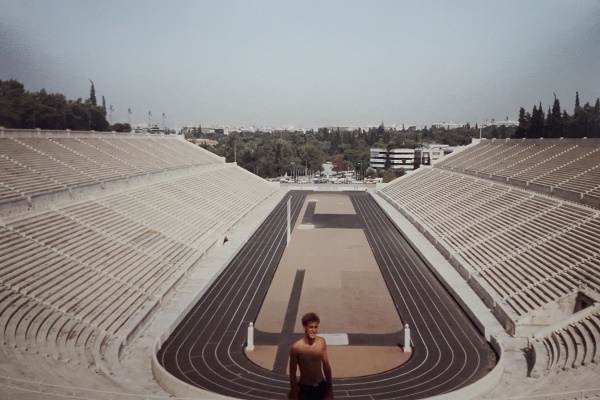
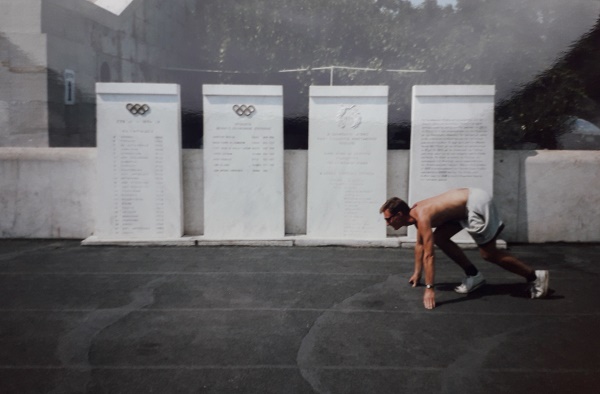
The only time I ever got a hint I might have some ability was when I inter-railed to Greece with my friend, Steve, and we had a sprint race in the original Athens Olympic stadium.
Steve backdropped by the unusually shaped 1896 Olympics stadium
Admittedly I false-started to get a couple of steps lead on him but as the race went on he wasn’t overtaking me and I was holding him off. It might not sound like much except he’d broken our school record for 400m on sports day when we were in Sixth Form, I believe a time of 56 seconds. Our race took place a few years after leaving school and a couple of months before my first ever 10K race.
A young sun-bronzed traveller poses pretending to awaits the gun
October 1992 and if I could remember anything about my first 10K, I’d lovingly regale you with its story. I know it was in Totton, near Southampton, but I’m not even sure where it started or where the course went, only that I took 48-minutes. The race was full of club runners with a few outsiders like myself testing our mettle.
I know these bits because in those simpler, pre-digital times, races used to send out results booklets about a month after the race (as long as you gave them a self-addressed envelope). It contained a list of everyone’s times – often split into male and female races along with team races, course records, past results and it was all very nice laid out. I poured over it to find my name and time, and somewhere past the middle page staples I found, from clear unambiguous feedback, that I wasn’t that good. The fastest people in the field were close to thirty minutes, the slowest just over an hour, so my forty-eight minutes was closer to the back than the front reinforcing the idea I was below average.
It was no different when I ran my first half marathons four years later. I did three in a couple of months and they all came in around 1hr51 – give or take thirty seconds. Wading through the results, I was somewhere down around the 60th percentile. The fastest runners were closing in on 1hr05, the slowest taking 2hr15. Once again I was closer to the back of the field than the front.
My first marathon followed on soon after the halfs and at 4hr23 it was the same back-of-the-pack story. Among my small group of running friends, the talk was always of being good if you could break four hours so clearly I wasn’t. Obviously the sub-3 was vaunted and only for seriously good runners, I remember looking at the London Marathon results of the time printed, over the next five days, in one of the broadsheet newspapers and seeing that only a thousand of the 40,000 strong field had broken three hours. It seemed like a benchmark which only the talented could achieve. It was a pipe dream for a below-average runner like me. I was a long way off the decent times.
Even ten years ago races were still generally organised by clubs. There were more charity runners and non-club runners than before but it was all relatively niche and those latter categories tended to be bucket listers rather than regulars. The majority still belonged to clubs.
By then I’d improved to have run a 1hr38 half and a 3hr41 marathon, both of which began to give me the idea I was better than I realised but I still wasn’t sure of myself. Unfortunately I was mixing with friends who could run sub-3 marathons and break 1hr20 in a half. Nonetheless I began to find myself running paces I’d never thought myself capable of while training with runners who I saw as much better.
My early parkruns were usually placing somewhere in the top 30-40 in a field of 150-200. That’s not bad but it’s not outstanding. But when I got my training together and started going sub-20 each week, I found myself up towards the front and enjoying the open space of few runners around me. There was no longer a need to navigate through the runner traffic and it felt good to be ahead of the pack.
I also discovered RunBritain with its custom handicap system and ranking of your times against the rest of the running population. I began to see my times over 5K, 10K, half marathon were all good enough to rank in the top 10% that year. While I was miles off the times of the elites, it’s obvious top 10% is decent and it gave me a measure of satisfaction, or rather an accurate measure of where I ranked within the running community.
The growth of running during the 2010s took me by surprise. Professional events companies began to organise more of the mass participation races while an influx of Couch25K and parkrunners gve them a market to sell medals to. The composition of modern results looks very different now when compared to what I saw in the nineties.
Half marathons that once had a 2hr30 cut-off now happily extend those numbers out to three hours and beyond. The consequence of this became clear when one of my friends ran the Liverpool Rock ‘n’ Roll half marathon a few years ago. In a field of 7,000 runners she finished in the top half. In fact closer to the 40th percentile. Now, remembering that I used to be down at the 60th percentile with my 1hr51 times, you’d expect she must have been significantly faster than me, wouldn’t you? Except she wasn’t – her time was 2hr07. When I looked deeper into the results of that race, my 1hr51 times of twenty years ago would have put me in the top 15%.
There’s no doubt I improved over the years. But my move up the field was as much about the other people in the field as it was about me. Where my 20-min parkrun in 2011 gave me a RunBritain ranking of 11.4%, when I ran 19:39 six years later it now put me at 4.2%. My time hadn’t improved but the attendance at parkrun had.
Your perception is shaped by reality.
What reality looks like depends on, how much of it ,and how clearly, you can see it.
When only committed runners took part in races, I perceived myself as a poor runner.
When races opened up to the general population, I began to perceive myself as a decent runner.
When parkrun began in Poole the majority were committed runners and my stock dropped again.
When parkrun grew, I once again began to see how far I’d come. Sometimes the evidence of your eyes and senses can fool or mislead you.
In True Speed I wrote about the high speeds at which elite runners run their races; speeds which ordinary runners can barely hit in a sprint. Today we’re going to look at what ordinary speed looks like. Outside of an elite race, most runners are running somewhere between six and ten miles per hour. Even the guys and gals up the front winning the prizes in your local race aren’t running much faster than this. Sometimes it’s even true for elites too, when Gwen Jorgensen was winning her Olympic Gold for triathlon, her 10K was ‘only’ around 11mph, so there’s no shame in not being super fast; only an attempt to better understand what’s going on.
Let’s begin with parkrun. In the table below I’ve listed the times between sixteen and thirty minutes as all but a few parkruns are run in that range. Of course quicker times are available, Andrew Baddeley holds the world record time of 13:48 while Lauren Reid ran 15:45 earlier this year to set a new women’s record.
Parkrun time
Mph
Km/h
Min/mile
Min/km
16
11.7
18.8
5min09
3min12
17
11.0
17.6
5min28
3min24
18
10.4
16.7
5min47
3min36
19
9.8
15.8
6min07
3min48
20
9.3
15.0
6min26
4min00
21
8.9
14.3
6min45
4min12
22
8.5
13.6
7min04
4min24
23
8.1
13.0
7min23
4min36
24
7.8
12.5
7min43
4min48
25
7.5
12.0
8min02
5min00
26
7.2
11.5
8min22
5min12
27
6.9
11.1
8min41
5min24
28
6.7
10.7
9min00
5min36
29
6.4
10.3
9min19
5min48
30
6.2
10.0
9min39
6min00
If you want to train to get faster, it’s a useful table for understanding what speeds and paces you’ll need to be running. Once any initial burst of training sees your times levelling off, you have to start training smart.
You do intervals at paces a little quicker than you’re currently running while keeping the majority of your running at paces for a parkrun that’s 2½ – 3½ minutes slower. That’s 2½ minutes for the runners near sixteen and 3½ for those at thirty If you’re currently running 22-mins at 7min/mile, you’ll want to be training no faster than the pace of a 25-min parkrun (three minutes slower). Even more of your training should be at the pace of a parkrun that’s five minutes slower than you’re currently running.
But we’re not only parkrunners so let’s have a look at what speeds we’re running for different race distances. The vast majority of runners are barely hitting 8mph in any of their races; most are even slower. The top end are the elite values to give you an idea of where there’s capacity for improvement.
4 mph
5
6
7
8
9
10
11
12
13
parkrun
46min39
37min19
31min06
26min40
23min20
20min45
18min40
16min58
15min33
14min21
10K
1hr33
1hr15
1hr02
53min19
46min39
41min29
37min19
33min56
31min06
28min42
1/2M
3hr16
2hr27
2hr11
1hr52
1hr38
1hr27
1hr19
1hr12
1hr06
1hr00
Marathon
6hr33
5hr15
4hr22
3hr45
3hr16
2hr55
2hr37
2hr23
2hr11
2hr01
Of course reaching the highest speeds takes lots of dedicated training but certainly isn’t impossible if you understand what you need to do. Most people can run at 10mph (or 6min/mile pace) if only for twenty or thirty metres. If you can do this, then it’s probable with good endurance training you can improve to run times you wouldn’t have considered possible.
Most runners I see are good at unlocking their natural talent but then spend their training time reinforcing it without notable improvement. They seem happy if they’re knocking a minute or two off their marathon after months of hard training. My 10K went from 48 minutes to sub-40 when I got my training right. My early half marathons all came in at 1hr50 but when I took up running seriously I got them closer to 1hr30. I still believe there is significant room for improvement in all my races when I’m done with 800m training. I won’t settle for less, will you?
Recently the BBC ran an article on Emer McKee, who’s set a 5,000m world record for a twelve year old with a time of 16min40. She’s quoted as saying “Normally I’m just running as fast as I can and just waiting for it to be over,” which is pretty much how any all-out 5K or parkrun should feel.
Emer McKee – world record holder in the 5000m for 12-year-olds
Emer started at parkrun when she was nine and joined a local running club, Willowfield in East Belfast, and has been improving ever since, competing in a range of events from 60 metres up to parkrun but also including long jump and cross-country.
Three points I want to highlight from her story:
As a member of a running club, she is getting decent structured coaching and sessions that enable her to make progress. Although the headline from the article implies she “runs as fast as she can” this refers to her races. It doesn’t necessarily apply to her training. Just going out and running the fastest you can every day in training will bring short term results but eventually you’ll see the gains stop.
It’s taken her three years to reach this stage. She began running parkrun in 2017 and quickly made good progress twenty-nine minutes down to twenty-one by year end. Since then it has taken three years of training to build on that and get down to a sub-17 time.
Being part of a club limits the amount of racing she does and gives time for training to develop. While she’s a regular parkrunner, unlike typical adult runners, the rest of her year is not spent entering 10Ks, half marathons and marathons. The club events she does are all completed within twenty minutes (usually significantly less) and therefore don’t require much recovery. By contrast, adults regularly enter distance races that require more recovery and therefore cut into their ability to train to improve.
The great thing about being twelve years old is she’s got her whole running career ahead of her. She turns up to her club and the coach has already decided what the session is and how it will help her (along with her clubmates) to improve. For the most part, her running priorities are defined by the club’s season.
The coaching of juniors is usually very good because the focus is on developing them, through a structured approach to training, for when they are adults. This approach is one I try to replicate for adults attending my Big Red Running sessions. Sessions build on previous weeks to enable progress in the long-term. If you would like to come to my session then please do. Check the homepage for details and if you have any questions by all means contact me for further info.
A few years back, I was going through the preliminaries of ascertaining whether I would be the right coach for a potential client. One of his questions to me was whether I could help him with racing. My reply was that it was something I had no experience of, but fortunately despite this, he still went ahead and took me on as his coach.
It later transpired we’d had different definitions of racing. He’d wanted to know if I could help with what to do on the day of his mass participation marathon race (which I absolutely could) whereas I’d been defining racing as what happens when you’re trying to finish ahead of your fellow competitors. For most people, when they talk about attending a race they’re really talking about a time trial – how quick can they run the distance?
Parkrun is not a race. For starters its insurance doesn’t cover it which is one reason why there are no race numbers or race clocks. Parkrun doesn’t even have a winner, it has a First Finisher, although when I first attended it did, until the nomenclature changed. If you look back to its beginnings, parkrun started as Bushy Park Time Trial then, as other events opened, it became UK Time Trials before rebranding as the friendlier sounding parkrun.
Running doesn’t have any true time trial events like say, cycling where riders go off at intervals of a minute or more and the winner is the one covering the distance in the quickest time. Admittedly when I orienteered it was done against the clock with runners having their own start times. This is a logistical necessity to ensure they don’t all reach the check points at the same time and have to wait to punch their card. But orienteering isn’t a pure running sport, it’s also a test of your ability to navigate, runners go off at intervals to avoid being able to follow someone else.
Typically elite runners do time trials to find out what form they’re in. When it comes to races the goal is simply to finish ahead of the person behind you. Often championship medals are won in times slower than heats especially at longer distances.
Of course there are some (many?) who turn up to parkrun and think they’re racing against others but true racing is a tactical art. It’s about letting your opponents take the breeze, it’s about knowing your strengths, their weaknesses and how to gain an advantage. It’s knowing when to go with the pack and when to let leaders go it alone hoping they’ll burn themselves out. This is the tactical stuff I’ve not got any experience of because I’ve never been good enough to need to learn it. I understand some basic theories as I’ve outlined but I’ve never experienced them. Like almost everybody else, I just run as fast as possible trying to get the best time I can.

 Big Red Running