A.I. coaching

Let’s play a game …

Here are the times from my last ten 5K parkruns – 23:31 … 23:16 … 23:06 … 23:27 … 22:54 … 23:06 … 23:37 … 23:37 … 22:50 … 23:16.  

What’s your prediction for my next 5K time?

If you said somewhere around 23 minutes – well done. Maybe you went for 22:45 to give me a booost – I wouldn’t be against that.

But would you have said 21:38? I certainly wouldn’t.

Yet Strava does.


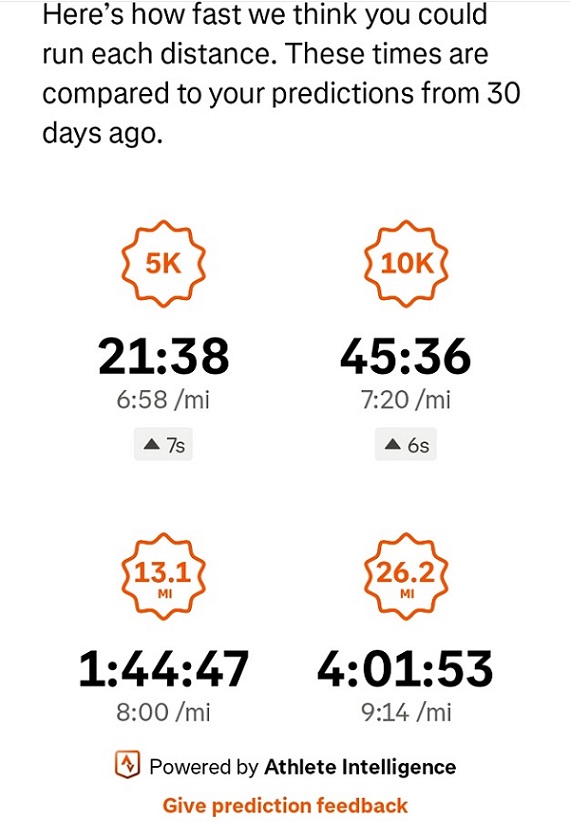
Strava recently gave me a month’s free premium membership and they seem to have embraced AI with gusto. Among the features is its willingness to Predict Race Times. Despite having the perfect info available – weekly 5K – Strava is reckoning I can run over a minute faster. Clearly I can’t unless I change my training and then their prediction will probably change.
Race predictions

Last month I ran a 6:48 mile to celebrate Banister’s Mile. I know that’s not fast but I’ve been concentrated on building strength in the gym and working on very short distances – I expected my aerobic base to erode and it did. But if I take a look at Jack Daniels’ VDOT tables he estimates a 6:49 mile equates to a 23:09 5K which is relatively close to the 22:54 I ran at parkrun a few days later.  It’s not perfect but it’s not frustrating me into thinking I can run over a minute quicker than I’m capable.

Looking at the other predictions – the 10K of 45:36 is essentially double this Season’s Best for 5K – so that isn’t going to happen. I reckon half marathon at 1hr45 is reasonable and JackD’s VDOT suggests 1hr46 although I wouldn’t be surprised to see myself slip to about 1hr50 given I haven’t run over five miles in almost a year.

VDOT predicts a 3hr40 marathon which is very unlikely and Strava’s 4hr time is probably closer to what I’d achieve. But again, if I entered a marathon tomorrow, I doubt I’d come close to either time because I’d wilt and be walking from fifteen miles. If I trained properly for the distance, I’d feel more confident about VDOT’s prediction; the Strava prediction would then be too slow but it would probably update itself with the training.  But if it has to keep revising times as the training changes then that seems a little disingenuous – rather like the person who tells you “Oh I knew that” after you read out the answer to the trivia question they had just given up on.


With each run you upload there is Athlete Intelligence feedback to tell you about the run or workout you’ve just done. For example, this is what it stated for the run I’d just done at time of writing  …

Recovery Run

It’s a bit bland.

And it’s only half correct.

It correctly managed to figure out I do the same route most days (“maintaining consistent 3-mile distance”) and it correctly figured out whether this was faster or slower than usual (“at a slower pace”) but the last sentence (“while exploring different intensity zones”) is complete rubbish. I went out at an easy, recovery pace and maintained the same intensity throughout. What did happen is that I ran up some hills which caused me to run slower (but using the same effort/intensity) and down some hills which caused me to run faster (still using the same effort/intensity) and under some trees which will have messed around with the GPS.

As for the first couple of words (“Recovery run”)  Strava had enough intelligence to take this from the title of my run!  When I changed the title to “Steady” the summary changed likewise. It really wasn’t rocket science to figure that out although when I changed the title back to “Recovered” with a deliberate -ED ending it went back to calling it a “recovery run” and when I tried “Interval session” it ignored that.

I decided to look at what it had to say about previous days. For example here’s an interval session …

This is a pretty good description of what I’d done but what does this final bit (“and a challenging mixed-pace run.”) say or mean? They’re just empty words describing what it thinks I’ve done but not what it really was – warm-up, intervals with rest breaks, warmdown. Technically it’s a mixed-pace run but not like going out and doing a proper fartlek session where you mix the paces up.

I looked back to a speed development session where I sprinted four efforts of 5 seconds followed by further efforts lasting 10seconds, 15seconds and 25 seconds. Between the efforts I walked back to where I started, stood around and had long rests. It ended up taking about 25mins to do seven efforts. Here’s what Strava had to say …

Sprints

It got the first line correct but not much else. There really were no varied effort levels, it was max effort from start to finish on the sprints. And I’m guessing it thinks this was “significantly slower” because the 0.7 mile of total sprinting and walking comes out at 12+ min/mile. Compared to a recovery run then this is significantly slower but of course it is – the aim and structure of the session is totally different.

Here’ s what it said about a 23:16 parkrun …

parkrun

Well that’s strange, I didn’t do any intervals – I ran a 10min warmup, a 5K parkrun, a 5min warmdown. And the parkrun was 25secs slower than my Season’s Best the week before so it can’t have been a “route personal record”.

What can I say? It all sounds like unintelligent garbage to me.


Of course I don’t help Strava much by having an old Garmin watch which doesn’t feature many of the latest variables and I stopped wearing a heart-rate monitor months ago. But I run just about every day and upload my data to Strava – there’s almost ten year’s worth of data about my running for Strava to crunch. And yet I don’t find it’s telling me anything useful.

That said, I haven’t investigated their Runna coaching service – why would I? I coach myself and know how to train others for results. If you need an individual plan then I can help you but equally standard plans have been available in magazines and on the internet for years – and while I’d expect Runna to adapt depending on how your training is going (which is what I do with the runners I coach), I’m not sure how good it is at that. I also question its ability to motivate – I’ve known a few people try to follow coaching plans given to them by their Garmin watches but have yet to hear of anyone who succeeds or even completes the programme.


At the moment AI feels rather like “cut & paste” software. It feels like the gym assessment I used to get where it would state BMI is the relationship between your height and weight, with your value of [Insert value] kg/m2 shown above in Illustration 1. Your value places you in the [Insert rating] category. However, it is worth noting that BMI doesn’t take into account factors such as muscle and lean body mass.  Lots of description with just a couple of personalised bits of information added in.

I remember how these five or six page documents initially impressed me but after retesting, I came to realise that they were just padding out my numbers with waffle. Eventually all I did was look at the graphs and numbers.  I suppose AI has an advantage because it can rephrase the same information in different ways thereby giving the impression for longer that it has something important to say.

I’m sure AI will improve in coming years and when that happens I’ll probably be out of a job. But one of the reasons AI will continue to improve is that it continues to scour the internet. I receive a significant number of hits from AI tools which are reading my blogs and trying to make sense of them.

In the meantime if you want personalised coaching from a real human being – this far I’ve not used AI in my blogs or plans – then click here to Contact me.

Aerobic Training Takes Time

If I offered you the chance to take two mins off your 5K time in a couple of months – I’m sure you’d jump at the chance.  Of course this depends on how fast your current 5K time is, but it’s exactly what I did when I went from a 5K parkrun time of 25:03 on 1st February to 23:11 on 15th March. Speaking accurately that’s not quite two mins improvement but it’s also much less than two months! And I did it through almost pure aerobic training.

That improvement is going from a pace of 8:03/mile to 7:24/mile – which is about 39secs – an average of 6-7secs/mile per week. Think about that if you did this training for three months you might expect to be running a mile per minute quicker than you were. What’s the catch? Why doesn’t everybody do this?

Anyone who’s read about aerobic training and especially a system like MAF training will know the literature says improvement will be slow. They interpret this to mean it will take months. They interpret it to mean that when 2-3months later they’re still doing the same pace for the same heart-rate, they just need to be a little more patient. That’s a wrong interpretation – if they’re months down the line with no change, then it’s clear indication their training is ineffective.

Here’s what aerobic training takes time really means …

Aerobic training log

On Saturday Feb 1st I ran 8:03/mile. On Sunday I did a 3-mile run at 8:05 pace. On Monday I did a 2-mile run at 7:45/mile. On Tuesday I did a 3-mile run at 8:11 pace. On Wednesday I did a 3-mile run at 7:58/mile. On Thursday it was another 2-mile run at 7:38 pace. On Friday it was a 3-mile run at 8min/mile.

On Saturday I returned to parkrun and ran 24:46. On Sunday I ran three miles at 8:37/mile. On Monday it was a three mile run again at 8:36/mile. On Tuesday it was two miles at 8:24/mile. On Wednesday, three miles at 8:26/mile. On Thursday three miles at 8:17/mile. On Friday it was the two mile run at 8:05/mile.

On Saturday I didn’t go to parkrun but ran from home for three miles at 8:31/mile and then did the same three mile run on the Sunday at 8:08/mile. On Monday it was the two mile run at 7:42/mile. On Tuesday it was three miles at 8:25/mile. On Wednesday the three miles came in at 8:01/mile. On Thursday it was the two mile run at 7:46/mile and on Friday a three mile run which was paced at 8:28/mile.

Are you bored yet? Keep on reading there’s still another three weeks of running data to go through.

On Saturday I returned to parkrun and ran 24:21 which is 40+ seconds than three weeks ago. Improvement is already showing up. Sunday I went out and ran three miles at 8:20/mile pace. On Monday I ran two miles at 7:31/mile. Tuesday was three miles at 8:08/mile. Wednesday’s run was the same three mile run, this time at 7:53/mile. Thursday I was back on the two mile run at 7:31/mile. And on Friday I did three miles at 8:23/mile.

On Saturday I was back at parkrun running 23:52. Another surprise thirty second improvement over the previous week. Sunday’s run was three miles at 8:00/mile. On Monday it was the two mile run at 7:26/mile followed by three miles at 8:15/mile on Tuesday. Wednesday was three miles at 7:53/mile and then on Thursday it was the two mile run at 7:36/mile. Friday was clearly a tired leg day as the three miles were run at 8:58/mile.

The tiredness meant I gave parkrun a miss on the Saturday allied to it being a wet and windy morning. Nonetheless I still did three miles from home at 8:37/mile pace. On Sunday it was another three miles at 8:22/mile. Monday was the two mile run at 7:43/mile. Tuesday, three miles at 8:35/mile with Wednesday’s three miles coming in at 7:56/mile. Thursday I did another two mile run at 7:41/mile and Friday was 7:58 pace on a three mile run.

On Saturday March 15th I went to parkrun.  My legs felt great and I ran 23:11.  Almost two minutes quicker than six weeks before.


If you didn’t bother to read all that in detail, I don’t blame you. I could have produced it in a graph or table to give quick visual understanding but I deliberately wrote it longwindedly to make a point. To read it properly requires great patience. And that’s what runners need if they’re going to get aerobic training to work for them.

The training consists of the same thing day-in, day-out with slight variation in pace. Some days are faster; some days are slower. There is no clear pattern of progression other than at the parkruns. Not every runner has the luxury of a local parkrun to measure their progress.

On top of the basic detail I give you, bear in mind this is just the running. Think about what you do with the other twenty-three hours of your day. Getting up. Breakfasting. Work. Lunch. More work. Evening meal. Watching Youtube or television. Sleeping. My week includes going to the gym on Mondays and Thursdays. That’s why Tuesday and Fridays are always notably slower. If you’ve been promised aerobic training will make you faster then you’re eager to see results and those other activities are taking up time before you can go for your next run.

Living through days after day of just doing simple aerobic runs where the pace might be a little faster or slower than the day before can be tough as it doesn’t bring clear results. It’s not like starting a weekly speed session where you will see quick gains. For example last summer when I was running a 440m lap of my road I went from 6:01/mile to 5:01/mile in three weeks.

There’s a temptation for runners – “I now feel better off the bit of aerobic training I’ve done and just jogging around every day surely won’t help forever; perhaps it’s time to drop in some speedwork as I know it’s worked for me in the past”.

They say “a watched pot never boils” but that’s what runners doing aerobic training often do. They keep checking, comparing their times and paces looking for that improvement. If they use a heart-rate monitor they’ll be including that data.

All this is a great example of where you have trust the process. Set the target of doing a block of aerobic work then just get out and do the runs and don’t worry about the results. In a few weeks’ time you’ll see they’re getting faster.

When coaches mean say “aerobic training takes time” I’ve tried to show you what they mean. You should begin to see some kind of improvement in three weeks whether that’s a faster pace, a lower heart-rate or just feeling better on the runs. It might take six weeks to begin to see notable change but if, by 8-10 weeks everything is still in the same place then your training isn’t effective. It’s time to change direction.

Winter Gym is Over

I needed to get stronger if I was ever to run faster. This was my reason for signing up to the gym. At home I have some weighted vests, dumbbells and other equipment for the workouts I’ve been doing the past few years but I realised if I wanted to get stronger, I needed to lift heavier. That presented a choice – either buy more equipment which would take up space in my house and get used relatively infrequently or join the gym.

Ahead of returning to the gym I began to get excited thinking back to the times I’d lifted weights before. There were two primary periods – at the start of the 1990s when I was a teenager and in 2007-08 in my late thirties. I remember being able to bench press multiple reps at 90kg as a teenager and squat reps of 130kg in the Smith machine in my thirties. Now in my fifties would I still be able to achieve these standards?

While these might have been classed as goals, I wasn’t interested in setting specific goals. I had a vague goal – get stronger and stay healthy. Consequently the first few weeks in the gym were spent very carefully setting up for squats, deadlifts and bench press in the free weights area. Partly making sure I understood how to set up the equipment correctly but also prioritisiting technique over lifting heavy weights. I also didn’t want to get sore by trying to lift anything too heavy, too soon.

In the first session I found myself comfortably half-squatting 8 reps of 50kg and bench pressing 5x60kg. Four weeks later I was doing some half squats at 110kg and struggling to bench a couple of reps at 70kg.

My priorities have changed over the months as I identified weaknesses. For example, with the bench press, I attempted to press 80kg at Christmas and failed. I didn’t make the progress I was hoping to make considering I’d been able to do 65kg on my second session. So I moved to using the Chest Press machine to see if that would help. It didn’t and when I attempted 80kg again in my final session I got stuck and had my spotter give me a little bit of help to get it past the sticking point. Maybe next year.

Similarly I went to the gym intending to strengthen glutes and quads using squats and deadlifts. I stopped deadlifting at Christmas because I had a pulled a muscle in my back and need it to recover.

Injuries like that have been a part of this gym training but not while there. Both sides of my back (rhomboids) and both hamstrings have been strained but these injuries occurred while doing sprints. I believe it’s because I’ve strengthed the muscles and am now putting forces through other parts of the body which aren’t used to it. Injuries led me to add exercises to strengthen the adductors, abductors and hamstrings (leg curl) which can only be beneficial.

With squats my initial aim was to push the weight as high as possible over the training period. I reached 149kg just before Christmas in the Smith machine and added another 10kg just after but unracking the bar began to feel like it was squashing my torso even just standing with the weight on my shoulders. At the same time I realised my deep squats, where I could barely do a single effort at 70-80kg, were too low by comparison and since the New Year I focused on upping this. It’s been very successful as I managed to do a 100kg deep paused squat in my final week and felt there was capacity for another rep. I still occasionally worked the top end and managed to do multiple sets and reps of quarter-squats at 160kg in the free weights area.

On my final leg session I repeated my so-called Seb Squat Challenge which I did with half squats at Christmas and this time attempted it with deep squats. I completed it successfully but it might well have been the toughest session I’ve done. The ten reps at 85kg left me gulping for breath, just like when I’ve been sprinting!

Going to the gym twice per week has been enjoyable without feeling like I’m overdoing it. With my sessions on Mondays and Thursdays, it’s allowed me to go to parkrun on a Saturday with relatively fresh legs. While I didn’t have a benchmark run from before the weights I ran 23mins in my first month, the same again at Christmas, slipped to 25mins while injured and then have rebuilt it to 23mins with increased daily runs of 2-3 miles but no speedwork outside of very short sprints.

And this non-movement in parkrun time is while having putting on about 15lbs / 7kg / 1-stone in weight. My legs have grown by 2 inches / 5cm; as has my chest and arms – I look more like a rugby player than a runner. I detailed how my gym shorts ripped last month and when I put my tailored shorts on again a few weeks back they no longer fitted, they were far too tight. It’s been like that with most of my clothes.

It was never my aim to get bigger but I guess it’s inevitable as you add strength. I deliberately did low rep sets which are meant to avoid muscle hypertrophy. I particularly didn’t want to add upper body weight which doesn’t provide much, if any, benefit to running and maybe that’s why my bench press never improved back to my teenage days. But I was never in this to look good, it was always about functional training – providing muscle for power and health.

There is no doubt it has been an excellent investment of my time. As a general estimate I’ve added 20-30% strength in all the exercises I’ve been doing. I notice when I’m running I feel very stable around my core, my legs feel strong and that there is more to come.

While I could continue going to the gym over the summer, my aim is now to focus on turning the strength into power and rebuilding my lacate threshold to run faster over sprints and parkrun. I’m also interested to see how my body reshapes without any gym work, how much of the strength I’ve developed is retained and how quickly I can reaccess it next winter.

Warm up like a pro

My Saturday morning parkrun routine hasn’t changed much over the decade since I started at Poole. I get up early, eat breakfast immediately to give it time to digest and then drink cups of tea. Just after 8am, I pick up my barcode, heart-rate monitor, change of kit and head out the door. Typically I arrive about 8:20am and sit in the car until 8:30am.

I’d love to live close enough to a local parkrun that I don’t need to drive but they’re all 4-5 miles away and so, while I run there on occasion, it’s usually a drive away. As I park I’ve already turned on my GPS watch yet invariably I still have to wait for the satellites to fully lock in. Once I have them I jog to the start line – which is about a kilometre away if I take the shortest route. But I don’t, I go round the lake which measures a bit longer at 2km and depending on how my legs are feeling takes a little longer or shorter than ten minutes to reach. What surprises me is how many people I pass who are just walking to the start. They aren’t jogging, they’re wandering along.

There are many things elite runners can do which the average recreational runner can’t – running at 4 min/mile pace, running 100 miles per week and training twice per day. One thing the recreational runner can do as well as any elite is warming up.


The typical recreational runner warms up by jogging over there then jogging back. It takes about a minute and they’ve done enough when their breathing starts to pick up. I should know because that’s how I used to do them. In my early days of parkrunning, I did the jog over there, jog back warm-up! It’s no wonder that after dashing off the start-line I’d be gasping for breath until things began to settle down around the first mile mark. That’s what happens when you don’t warm-up properly.

A thorough warm-up is not achieved quickly.  Any elite athlete, whether footballer, runner or tennis player will take the better part of thirty minutes to do one. They will do some jogging, dynamic stretching, mobility drills and sport specific movement such as kicking or hitting a ball. I’m not advocating we take it to that level for a weekly parkrun but an easy-to-do, simple running warm-up can be done in 10-15minutes.


At some point, for some forgotten reason, I decided to start doing a longer warm-up. I have no idea why, but it had long lived in my memory what Ian Parker-Dodd, one of my university lecturers, had said “It takes twelve minutes for the body to reach steady state”.  I didn’t know what that meant when he told us but I knew it was something to do with warming up – so twelve minutes became my standard.

Looking back at my records from 2012 I didn’t have a regular time for setting off on warm-up – that evolved later. It probably depended on what time I’d arrived and how quickly I got my gear sorted. Typically I’d amble off at around 8:30am to run a lap of the lake, possibly taking in a toilet stop. It took anywhere between 12-15mins just as Ian Parker-Dodd suggested. The effect was notable – I knocked 45seconds off my parkrun PB. Who knew there was a reason the elites warm-up?!?

This standard warm-up was partly dictated by the features of the park – once I was on the far side of the lake there’s no shortcut back. That said I’d picked the route because I wanted to meet IPD’s time requirement. This ended up totalling just over 1½ miles (2½ km) and is what worked for me. It’s important to think in terms of time – if you tell a slower runner to go do another half of a parkrun before they start, they’ll switch off. Doing 5K is already enough for them. For anyone taking over 30mins for 5K, jogging at the slowest of paces for twelve mins is likely to still be too much but perhaps five minutes is a good compromise.

One mistake I made in my early warm-ups was running them too fast. With my parkruns being run at sub-7 min/mile pace; running my warm-up at 8min/mile was too quick. It left me a little drained before the run. Eventually I slowed them down to 9-10min/mile. These days I start at that pace and let it build up as I warm up, never pushing it. Quite often I’ll be running the latter part of my warm-up around 7:15/mile and that’s okay – it’s doesn’t last too long and I’ve warmed up through the lower paces to get there. When I’m zooming along at the faster pace, barely breathing hard I know my body is warmed throughout.

What occurs during warm-up

While warming up could help you to run faster and breathe easier you may be wondering what’s going on that enables this?

We all know that when we start jogging we soon begin to breathe harder. Typically that’s when we slow down to a more achievable level or, if using the jog over there then jog back warm-up, stop. Muscles use oxygen to create energy and when you start to jog, you activate more muscle so the oxygen demand goes up. Warming up is the body responding to this increased demand.

The first thing is for the heart to start pumping faster – we see this as our pulse increasing. Alongside this, by breathing harder we expel more carbon dioxide out of the lungs allowing more air into them. The sacs of the lungs open up to allow more air in which leads to more oxygen entering the bloodstream which the heart can then pump to the muscles.

When the muscles receive the oxygen from the bloodstream they use it to release energy from glucose and fat stores. The complex breakdown process creates by-products such as carbon dioxide as well as heat and water. While the CO2 is breathed out, the heat and water are sent to the skin to help us cool. To make it easier to sweat, warming up triggers the pores of the skin to open up.

Many runners feel stiff or uncoordinated when they first start running. Warming up helps the muscles, ligaments and tendons get mobile. The tightness and aches may alleviate as a warm-up goes on and you will probably feel your stride lengthen until you are flowing along.

By warming up systematically you can find out if there are any strains or injuries that might need to be taken account of and even that it’s not a good idea to push things today. Sometimes a good warm-up will ease these and then you can run fast.

As well as monitoring the body, a warm-up can be a good time to mentally focus on what you’re intending to do on your run or training session. Will you be going out fast? Holding back? Doing some complicated interval session?

If you run some of the route you’ll be participating on it’s a good opportunity to see if there are any issues. Running around Poole Park, I often find there can be puddles or muddy patches down the back of the lake. They’re not enough for the organisers to cancel the parkrun but I know I will want to position myself on the run to avoid them. On an unfamiliar course, it’s even better to get to know where the tight spots are and maybe just where the course goes. Obviously on a longer race you can’t run the whole course but I’ve always found it useful to get a feel for the run-in to the finish to get an idea of where I might want to start my sprint finish.

How to warm-up

Just start jogging very slowly. Focus on your breathing and if it starts to pick up then don’t panic, just slow down a little. Probably it will settle within a minute or two so just keep jogging while it does. When it’s settled you will naturally find yourself willing to push a little harder. That’s okay as long as you don’t stress your breathing to the point where it doesn’t settle.

Each time your breathing begins to get out of kilter, avoid pushing – just wait and see what happens. Eventually you’ll find yourself jogging along at a particular pace which feels comfortable, isn’t getting faster but isn’t stressing your breathing – you’ve reached the Steady State. While IPD said it takes twelve minutes to reach steady state, it differs by individual. Some will get there quicker, others take a little longer. Personally I’d say it takes 15+ minutes for me to reach it – natural distance runners will likely get there quicker.

Having reached steady state it’s time to warm up the race pace muscles. While my warm-up pace may reach around 7:15/mile; on my parkrun I’m hoping to hit 6:30/mile or quicker. I need to prime the body to know I’m going to do more than I’ve done this far in warm-up. But I also don’t want to exhaust the muscles by doing too much. The compromise is therefore to do some short bursts of quick running known as strides or pickups.

All I do is accelerate for 10-20secs to just beyond race pace then go back to jogging before I do another. Warning – these are not all-out sprints – just an acceleration to a faster speed to get the body used to the quicker pace. Three of these efforts is usually enough to get me breathing harder and the muscles ready for what’s expected from the start-line.

I like to complete this warm-up about ten minutes before the start. This is long enough that if I’ve overdone it the body will recover; but not so long that it will cool down again.


As I say on my arrival at parkrun I often encounter runners walking to the start-line. While I do meet other committed runners warming up the vast majority aren’t. It’s a little bit of a mystery to me why if they have to walk to the start-line from wherever they’ve come, they don’t turn that into a benefit and jog in.  Okay, they may not do the full warm-up but even 5-6 mins is better than nothing.

FIRST Training – 3 runs per week

The marketing sounds great – train less, run faster. The FIRST Training system is one which Runner’s World first promoted in 2005 then followed up with a book. I was lent it in 2012 by a parkrunner who reckoned it was great and I quickly devoured my way through it.

My gut feel after reading was it worked for many of their testimonial runners because it found a mid ground which many runners don’t fall into. You either have dedicated runners who are doing too many workouts and running too fast on their easy days; or recreational runners who simply do all their training at the same pace. With the dedicated runners, FIRST would give them more recovery by getting them to do less. With the recreationals, it would get them running faster instead of jogging around to log miles.

A couple of years on I decided to give FIRST training a try, this followed my unsuccessful months of MAF training. I had ended that when I began to go backwards and became concerned I was somehow overtrained. To try and alleviate the effects I did less and less training during the dark months and things just got worse. With hindsight the idea I was overtrained was a preposterous notion. I’d read the words in Maffetone’s book about anaerobic training, read elsewhere about over-reaching and was prepared to believe my sluggish performance and rising heart-rates were a sign of this. Certainly it’s possible to fit my symptoms to the descriptions of overtraining and this is the danger of reading words in a book rather than talking to some who knows. (This seems a good opportunity to plug my Training Reviews if you think you might want a check-up!)

So with its three runs per week FIRST training seemed like a perfect compromise for getting me back into serious running while allowing decent amounts of recovery.


FIRST training stands for Furman Institute of Running and Scientific Training. It is a method create by two long-time triathletes who were finding it difficult to fit the demands of training for three disciplines into their busy lives. What they found was they could cut their training down to three runs each week and still produce good race times. They then followed this up with a study of twenty-five runners – fifteen of whom recorded marathon PBs.

The three runs in the FIRST system are an interval session, a tempo run and a long run at marathon pace. Looking closely at their programme now, I see how I trained was only an approximation of FIRST training as all their workouts have different distances over the weeks. Their intervals range from 400m to a mile, tempo runs from 3-8 miles, long runs build up to 20 miles for the marathon.  I simply did kilometre reps, a 20min threshold run and a 10 mile long run that grew to 14 as I got fitter.

What’s hidden in the details of the original FIRST promotions, but stated more clearly later, on is that  it’s a 3+2 system. Three runs with two cross-training workouts lasting 40-45mins. This is another reason why I was only doing an approximation of it; I didn’t have the inclination to cross-train.  On the flipside, my coaching commitments meant I often jogged a couple of very easy miles on a Tuesday evening and I was still a keen parkrunner so did a 30-minute 4th run each week at Bournemouth parkrun.

All in it I wouldn’t begin to claim this was a scientific approach to evaluating FIRST training’s effectiveness but I certainly got a flavour of it.


Re-evaluating FIRST training now a decade on with a better understanding of running, I think it has some very strong points. The range of workout distances is great because these implicitly challenge the runner over a variety of paces. Your 400m efforts will naturally be paced quicker than mile efforts. The downside of FIRST’s workouts is a lack of clear progression. The distances seem to jump around and I couldn’t identify a pattern other than for the long runs. When I coach, I like to progress in a logical fashion, You take the runner from point A to Z with points B, C, D etc clear to see.

There is one notable failing if you follow FIRST training accurately and that is the idea of doing two days cross-training each week. Why not just do easy recovery runs at the correct pace on those days? While there may be some benefit carrying over from cross-training, going swimming or cycling isn’t going to produce the same benefit you would get from running. The principle of specificity tells us the best way to build running fitness is by running. Even running on a treadmill isn’t going to provide exactly the same benefits as running outdoors where you will race.


My experience was that I enjoyed the training. I always felt strong and ready to run when I got to the workouts. This is probably the thing which stands out in my memory about it. It was enjoyable and I got myself back up to fitness with it.

The results were decent enough although I didn’t really have a benchmark to test against but I saw the workouts getting quicker and heart-rates getting lower.

For example, my 5K tempo runs began in January at 24:30 with heart-rates in the mid-170s and maxing in the 180s. By the end of March, they were down to 22:30 with heart-rates in the low 160s and maxing in the low 170s.  The route I followed had a long uphill in the 2nd kilometre then after that the remainder was a gradual down. This led to uneven splits and needing to gauge my efforts by breathing but in the early weeks the fastest kilometres were around 5min/km (8min/mile) and by the end they were sub-7, that is about 4:18/km.

Likewise my 5x1K intervals went from totalling around 21:30 (avg 4:18/km) down to 19:45 (3:57).  A decent improvement over three months.

My long runs began on a ten mile route averaging 9:18/mile and by the end they were around 8:30/mile on a longer fourteen mile route.

Those are decent improvements albeit only getting me somewhere closer to where I’d been a year before. Of course, MAF training had taken its toll and, at least I now felt like the days of overtraining had been banished and I could get back on with training.

The one negative for me was I didn’t like running only three days per week. By the time I got to mid-March I was ready to do more running. I had to talk myself into sticking with the programme for a couple more weeks so that I could feel I’d given it a decent shot. Compared to MAF it was night and day. I got tired of MAF because I wasn’t seeing any tangible results and I was forever trudging round holding back on my pace. With FIRST I was holding back on how often I went running but every time I did run I enjoyed it and felt like I was improving. Trouble is, I just wanted more.

Once April came around, I went back to running six days per week. What I noticed is how quickly my heart-rate began to drop on all these workouts and long runs. During FIRST training, my heart-rate was always up at 150 or higher, once I introduced more recovery days It generally stayed a little lower despite me running similar workouts. By the end of the year I was running my fastest ever 10K so while FIRST kickstarted that, it was other training which got me there.

Built for speed

It was New Year’s Day 2012. I’d returned to the scene of my first parkrun around the University of Southampton playing fields in Eastleigh. Ten months earlier, it had been a cold, frosty February morning and I’d gone haring off the start line slowly fading to get round in 23:38. Now with another thirty-five parkruns under my belt, I’d almost broken twenty minutes.

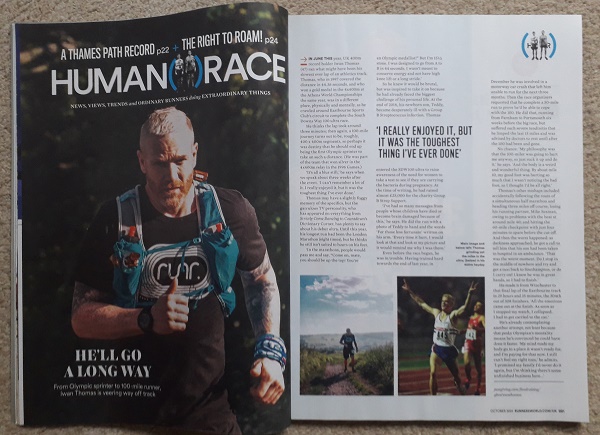
As we stood listening to the briefings, applauding new runners and visitors; it became apparent we had an Olympian in midst. Standing 6’2” with bleached blonde hair and broad chested it was hard to miss Iwan Thomas, especially as he stood head and shoulders above many of the other runners present. Like me, this would be his second Eastleigh parkrun.

As we set off running, I kept an eye on him but my legs were fatigued. I’d run all-out the day before at Poole so gradually he opened up a lead of fifty metres. It stayed like that for the first two laps then on the final one, the gap extended and he finished in 20:45; I trailed in almost a minute behind in 21:35. Of course he never even knew we were racing!

These days Iwan Thomas is often seen on television either as a panellist, contestant or doing roving reports on The One Show. As an international athlete, he was a key part of Great Britain’s 400m success in the 1990s. He won silver in the 4x400m relay at the Atlanta Olympics and gold at the World Championships a year later. He and compatriot Roger Black competed in the Olympic 400m final which was easily won by the legendary Michael Johnson. Roger raced as the 400m British record holder and held it until Iwan broke it in a time of 44.36s. This stood for almost twenty-five years and it was only in May 2022 that Matthew Hudson-Smith finally ran faster than either of these legends.

When his athletics career wound down Iwan began trying longer distances. The London Marathon was an obvious choice where he clocked 3hr58 in 2009 and over the next six years he set personal bests of 40:16 for 10K, 1hr12 for 10 miles and 1hr37 for half marathon. He also took up parkrunning and has racked up over one hundred with a best of 19:18 at Netley Abbey where he usually runs. Currently he’s running around 22-23 minutes there as he approaches fifty.

A couple of years ago in the October 2021 edition of Runners World they detailed his ultrarunning in the South Downs Way 100. That’s one hundred miles from Winchester to Eastbourne. A significant motivator for doing this was to raise money for charity due to difficulties his son suffered after birth. Iwan recognised he’s not built to run ultras saying “I’m 15½ stone. I was designed to go from A to B in 44 seconds. I wasn’t meant to conserve energy and not have high knee lift or a long stride.” When it came to the race, he ended up finishing 304th of 308 finishers in 29hr35. It was a tough race and he was left believing he might have completed it faster as he wasn’t physically ready for it. He’d barely trained in the preceding months due to a tendinitis injury and motorway accident; although race organisers had got him to run a 50-mile ultra as evidence he would capable of the longer event.

Back at Eastleigh parkrun, with only 68 of us having braved any New Year’s Eve hangovers it was easy to find the opportunity to say a brief “Hello”. What struck me wasn’t anything he had to say – it was his size and build. I was looking eye-to-eye with him, standing just as tall and strong.

While Iwan is now 15½ stone, I’d guess he was somewhere around 13-14stone in his prime. Research on other elite 400m runners shows Matthew Hudson-Smith is 6’4” / 12st4lbs, Martin Rooney is 6’6” / 12st 11lbs, Roger Black ran at 6’3” / 12st 6lbs and Michael Johnson at 6’1” / 12st 7lbs.  Those physiques are very comparable to my own. I’m 6’2” and have slimmed down over the past two years to just over 12stone and under 10% body fat. In my younger days, I was usually around 14 stone and more muscular.

I’ve been training and running consistently for the past decade and I’ve come to the conclusion that I’m not particularly suited to distance running. This fits with me being built more like a 400m runner. I’ve always believed everybody is capable of doing everything to a decent standard so it’s a bit galling to have to admit that perhaps you can be genetically limited. My personal bests are all similar to Iwan’s and it’s fair to say they are decent times and many runners would be happy with them. Yet they’re a long way off the best – about 50% worse than the world records and I see many runners around me who naturally run faster off less training.

Does this mean I should give up distance running? Not at all, I’m still determined to get the best out of myself. It just means I’m reconsidering my approach. If speed is where my strengths lie then I need to keep working at that. Looking back to when I started parkrunning, I had good speed but I didn’t understand how to create endurance and stamina or how to convert that speed into better parkrun times. In my pursuit of figuring this out, I got away from speed, allowing it to decay as I spent sessions logging miles and experimenting with different training systems. Now I’m going to dedicating myself to redeveloping my speed.

If you too are interested in improving your speed then contact me to purchase my Get Faster … Speed Training course.

New parkrun world record set

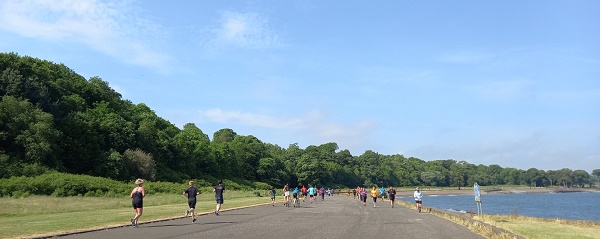
Last Saturday, Andrew Butchart, ran the fastest parkrun of all-time clocking 13:45. Edinburgh parkrun, where he ran, describes itself as a course designed to be enjoyable, rather than for pure ‘PB’ speed!! It’s scenic, flat and run on generally wide footpaths along the promenade on the Firth of Forth. On a tough day, it’s exposed, windy and cold and looking at the photos it’s not hard to imagine how bleak it could be in the depths of winter.

Edinburgh parkrun on a blue sky day

Fortunately Butchart turned up at the height of summer with good running conditions. Putting his time into perspective, if you’re a 23min parkrunner you’re just reaching the 3K point of your parkrun and for those running 27-28mins you’re halfway round. Even a 17 minute parkrunners is still a kilometre behind as Butchart finishes. Running at 2:45/km or 4:26/mile is fast and most of us wouldn’t even beat him off the start line which shouldn’t surprise anyone given he has competed at the Olympics.

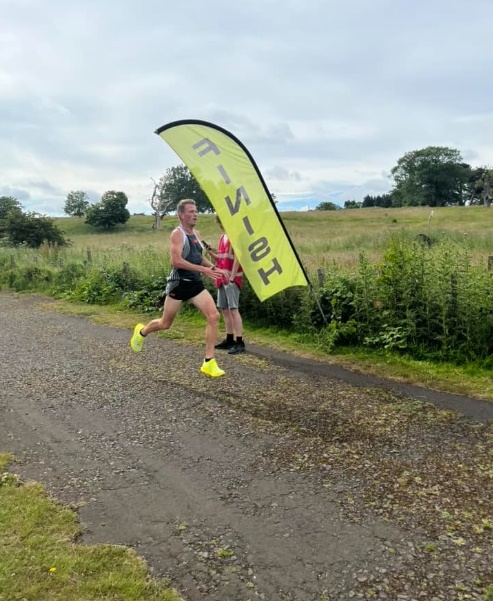
Andrew Butchart sets the record

The previous world record of 13:48 was set by Andrew Baddeley at Bushy Park in August 2012 – the week after competing in the Olympic 1,500 metres. That broke Australian Craig Mottram’s record of 14:00 which had stood since 2006.

The progression of the parkrun world record was fairly easy to track down because when Mottram set the record, Bushy Park was the only parkrun. In setting the world record in Edinburgh, Butchart becomes the first man to do so away from Bushy and the 10th to hold it.

I went back through the results and, of course, the record was initially set at the first event by Chris Owens at 18:47. Over the next year it was broken seven more times until Mottram smashed 39 seconds off to record exactly fourteen minutes in June 2006. Mottram was a world class 5,000m runner who took silver that same year at the Melbourne Commonwealth Games having won a bronze at the World Championships the year before.

In the early days at Bushy Park, where it all started, attendances were often less than 100 people and in setting the world record Mottram only finished ahead of 158 other runners. It wasn’t even a parkrun then – it was Bushy Park Time Trial. It typically attracted club runners whereas these days the bulk of 1,000+ runners turning up won’t be attached to a club. If you pick a random week from the early days you’ll find barely anyone taking longer than thirty minutes and an average time closer to twenty-three minutes. In some ways it was more competitive, especially as First Finishers were still referred to as Winners.

Among those humble beginnings we can find illustrious names such as Mo Farah logging a 15:06 in November 2005, Ireland’s World Champion Sonia O’Sullivan winning regularly as well as reducing the women’s world record twice (16:38 and 16:22). I’ve read there was a contingent of Kenyan internationals who lived near Bushy Park which included Bernard Kiptum (15:04 parkrun WR), Collins Kosgei, Johnson Kiptanui, Simon Arusei, Dennis Ndiso, and another World and Olympic champion in Vivian Cheruyiot – who held the women’s world record briefly at 17:52.

One little quirk of the early records is when David Symons set it at 16:39 in the 3rd ever parkrun event, the women’s world record was also set at 19:57 by Kate Symons. I assume they are married but may just be related.

DateRunnerTimeParkrun location
02-Oct-04Chris OWENS18:47Bushy Park, London
16-Oct-04David SYMONS16:39Bushy Park, London
06-Nov-04David SYMONS16:29Bushy Park, London
27-Nov-04Kevin QUINN16:10Bushy Park, London
05-Mar-05Dermot CUMMINS15:54Bushy Park, London
14-May-05Bernard KIPTUM15:04Bushy Park, London
17-Sep-05Phil SLY14:54Bushy Park, London
01-Oct-05Noel POLLOCK14:39Bushy Park, London
10-Jun-06Craig MOTTRAM14:00Bushy Park, London
11-Aug-12Andrew BADDELEY13:48Bushy Park, London
24-Jun-23Andrew BUTCHART13:45Edinburgh, Scotland

The women’s world record progression is not so easily identified as while it was broken multiple times in the early years, once parkrun began to expand outside of London there was potential for it to be broken elsewhere. I recall Justina Heslop becoming the first woman to run sub-16 in late 2011 and as best as I can find it had always been set at Bushy Park until Hannah Walker recorded 15:55 at St Albans parkrun in July 2013. She has had the longest reign as it was 5½ years before Charlotte Arter took five seconds off at Cardiff in January 2019. She then broke her own record a year later by one second (15:49) just before the COVID-19 pandemic started.

Seasoned parkrunners will remember that events were cancelled due to COVID-19 and, when it came to reopening them, they restarted at different times around the world. Australia was one of the first countries to resume and the women’s parkrun world record went down in early 2021 as Lauren Reid ran 15:45 at Paramatta near Sydney followed seven months later by Caitlan Adams’ 15:38 at Lochiel parkrun near Adelaide.

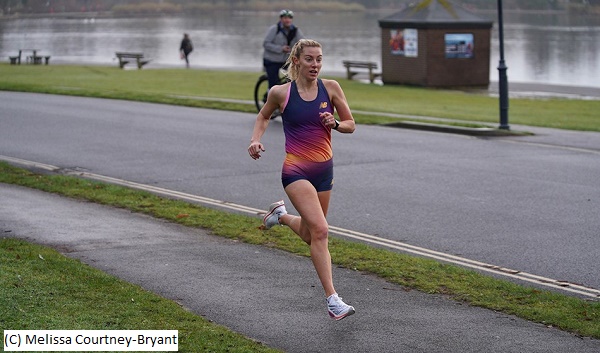
It was quiet for a year until December 2022 produced a flurry of activity. Firstly Samantha Harrison, who finished sixth in the 2022 Commonwealth Games 10,000m final, reduced the world record to 15:37. She was only to hold on to it for three weeks as Melissa Courtney-Bryant ran 15:31 at my local parkrun in Poole on Christmas Eve. Sadly I missed this historic moment but I know it created tremendous excitement to have had a world record set there. Any week I run there I now know I have no excuses about the course.

Melissa Courtney-Bryant on the way to the best Christmas present she could ever hope for!

Yet records are set to be broken and while Melissa is still the UK record holder, the women’s WR almost immediately returned to Australia. A week later on New Year’s Eve, Isobel Batt-Doyle recorded 15:25 at Aldinga Beach near Adelaide. It was the 3rd time in a month it had been broken and she became the 14th woman to hold it.

DateRunnerTimeParkrun location
02-Oct-04Rachel ROWAN21:01Bushy Park, London
16-Oct-04Kate SYMONS19:57Bushy Park, London
11-Dec-04Vivian CHERUIYOT17:52Bushy Park, London
28-May-05Sonia O’SULLIVAN16:38Bushy Park, London
18-Jun-05Sonia O’SULLIVAN16:22Bushy Park, London
03-Jan-09Katrina WOOTTON16:20Bushy Park, London
08-May-10Gladys CHEMWENO16:11Bushy Park, London
24-Nov-11Justina HESLOP15:58Bushy Park, London
27-Jul-13Hannah WALKER15:55St Albans, Hertfordshire
05-Jan-19Charlotte ARTER15:50Cardiff
01-Feb-20Charlotte ARTER15:49Cardiff
23-Jan-21Lauren REID15:45Paramatta, Sydney, Australia
07-Aug-21Caitlan ADAMS15:38Lochiel, Adelaide, Australia
03-Dec-22Samantha HARRISON15:37Long Eaton, Derbyshire
24-Dec-22Melissa COURTNEY-BRYANT15:31Poole, Dorset
31-Dec-22Isobel BATT-DOYLE15:25Aldinga Beach, Adelaide, Australia
23-Dec-23Ciara Mageean15:13Victoria Park, Belfast

Update: In December 2023 Ciara Mageean took another 12 seconds off the women’s world record running in Northern Ireland. It’s the last record we will officially know about as in February 2024, parkrun decided it was no longer going to keep track of male/female/age-group records on its website. With over 2,000 parkruns worldwide it’s an impossible manual task to keep track of them all – we will have to see if updates continue to filter through.

Update on my 800m training – Jan 2023

I feel like I’m in wash-rinse-repeat with my training at the moment. I keep cycling through the right training sessions yet the race results keep coming out the same. I can see some improvement in the stats and speed, yet when I race it is no faster. But this really is the secret to coaching – figuring out where to apply effort.

Coming into January I was working on top-end speed using short intervals lasting around a minute. The pace was intended to be at my calculated 3K-pace broken into sets. The sessions I did were made harder by high winds and I ran my 300s along a section of road which caught the brunt of it along with a gradual hill in the first/last 100 metres depending on which direction I was headed.

Illness strikes …

I had done two sessions at the end of December then my Sunday run went backwards. I wasn’t too concerned as a VO2 lull usually happens at the start of a new training block. But there was a concern – my sister brought a hacking cough to visit over the Christmas period and I fell under its spell. I wasn’t terrible but I was struggling. Yet after a couple of days, I felt slightly better and mistakenly did a 3rd session which, while generally close to target, led me to scale back training as the coughing got worse. I missed the next session of 300s and focused on getting healthy, but was still running each day. By the following Monday it had gone. My mother is still coughing all these weeks later whereas mine was gone in ten days. This is why I believe in keeping fit and healthy especially as you get older. With a good aerobic system your body’s immune system can fight stuff.

Race taper

With only two weeks left to the rescheduled Christchurch Christmas 10K, I knew I needed to taper so I did one more session of 300s and then an even sharper session of 10x100m with 30s standing recovery aiming for 5:30/mile. I found them really easy which probably aligns with why I’m better suited to short distance than long.

A week ahead of the 10K, I went to Poole parkrun on what was an atrocious day. Very high winds and rain. It was absolutely pelting down as I arrived but had eased off by the start. Once again my speed seemed lacking as the first kilometre only came in at 4mins. Along the windiest stretch I ran a 4:20km – at 6’2” and broad I’ve got a large frontal surface area to be blown back. The finishing stretch headed into the wind a second time and having passed them earlier, five men now passed me as my pace dropped to 8min/mile and I felt like I was barely moving. My finish time of 21:02 was good enough to place 19th. I’d guess it’s a long time since Poole parkrun’s 19th finisher ran over twenty-one minutes. While I could make excuses for the wind and rain, the fact is my opening kilometre of 4-mins was fresh-legged and running with the wind; however much others may suggest a sub-20 was on the cards; it wasn’t.

Race

Christchurch 10K itself reinforced this analysis. The run was another cold morning and it was a shame to see the race not as well attended as it would have been before Christmas – less than 200 runners. Many of the others had deferred their places until next December because they’ve started marathon training or other races were taking place on the same day.

I set off quickly not holding back, but again my kilometres were all over four minutes. I reached 5K in 20:38 and then held on for the second half to finish in 42min08. I was somewhat disappointed as it was only fifteen seconds or so faster than last year. All my efforts from a year’s training had added barely anything. However my heart-rate monitor told a different story. Last year my average heart-rate was 159, on this day it was only 152. That’s incredibly low for me on any race. I’d expect it to be up around 161bpm. What it suggests is my fuel source is mostly aerobic but something is blocking me from running faster. When I look at the final miles the pace is consistently 7min/mile.

Finding the problem

On the Tuesday before the race I did a 7-8 mile Steady run averaging 7:17/mile. I felt blocked to run any faster, when I arrived home I realised I had put in more effort than I should have. On the Friday following the race, I did a Steady run at the beach – just letting my body pick up speed and it settled around 7:35-40/mile with heart-rate hitting 150ish. It was a completely comfortable run but slower than I expected.

The day after the Steady run at the beach I went to Upton House parkrun and ran 21:58 averaging only 149bpm. I started slowly and picked up pace as the run went on. But again, it was a big effort to get any much quicker than 7min/mile on tired legs.

A quick look at my old favourite, the Jack Daniels’ tables shows a VDOT of 49 results in a 20:18 5K and 42:04 10K. My Christmas Day parkrun was 20:27 so matches up quite nicely to this. Jack’s tables give a Threshold of 6:55, a Marathon pace of 7:24 and Easy run pace of 8:40. Each of these matches with what I’ve found in training.

Fixing the problem

All these facts – speed of steady runs, not being able to run quicker at parkrun or 10Ks, lower heart-rate when racing, feeling the pace at which I have to put effort in to go faster suggest my aerobic system is clogged and causing the anaerobic system to kick in too early.

In all my years I’ve learned that you have to trust the results from races, especially longer ones where speed counts less. However good things may feel in training or what the heart-rate monitor may suggest, race results are the best guide to what needs to be done.

I could probably just get faster doing Steady runs twice per week with easy runs or recoveries on other days but I want to experiment a little. I want to see whether I can do the same set of Threshold intervals I did this time last year but with more control. I’m going to stay at around 7min/mile as VDOT suggests it’s my Threshold and see if that filters things down.

The block of training I did last year through February and March went well and began with intervals at 6:50 pace and by the end I was closing in on 6:30; but when I arrived at April’s half marathon my legs had nothing. I’d overcooked it. This time I’m going to make sure I don’t exceed Threshold by focusing on my breathing. That will be my guide. Last year, I was pushing efforts to hit a target and it didn’t work.

I did my first session on Tuesday and having warmed up for two easy miles averaging 7:20/mile – not that far off the repeats pace – I began the session.  I accelerated just past 7min/mile and the mile repeats then felt limited at around 6:55 – in line with Jack’s prediction. But, unlike last year, it never felt too taxing and I never had to push harder to hit similar numbers. I’m going to give it three weeks of these and see how things are progressing. If it isn’t going to plan then I’ll drop back to doing the Steady runs instead.

Short term loss for long term gain

Growing up I drank my tea with sugar. It was a lovely sweet taste. Someone asked if I wanted a cuppa, I said “Yes” (being a teenager there was rarely any sign of a Please although there was usually a Thank-you when it was delivered) and it got drank quickly.

When I left education and started work in computing, we had tea and coffee rounds where seemingly every hour someone in the department would be wandering off to the vending machine to get them in for the team. I eventually dropped out of the rounds because I wanted to drink on my own schedule not someone else’s. I got a sense it was frowned upon because it was a rejection of their generosity and I was setting myself up as a non-team player but on reflection, I don’t care. I realise I was listening to my body. I was drinking tea when I felt thirsty not because someone was forcing it on me.

About eighteen months into this I realised I was drinking seven or eight cups per day. They were only small vending cups yet I knew that with each cup I was putting unnecessary sugar into my body. Multiply those eight cups per day across the week, across the year and on through a lifetime and it was probably mounting up for tooth rot and unnecessary calories. These were the days long before anyone worried about an obesity crisis or dangers of too much sugar. I suppose I was ahead of the curve!

I made a rational decision – I would stop drinking tea with sugar to save myself from all those extra lifetime calories. And so I went cold turkey and it was horrible. The tea became tasteless, like chewing on cardboard or paper. And being cheap, 7p per plastic cup tea, it was probably low quality anyway but I persevered. For months, drinking tea became a joyless experience. Then one day, either by accident or on purpose I had a cup with sugar. Ugh. It tasted horrible too. Far too sweet.  So I was now between a rock and a hard place – tea without sugar tasted horrible, tea with it tasted horrible. Either way forward or backward was going through pain. In the end, it was about a year before I started to enjoy drinking tea again but now, looking back from thirty-odd years in the future it was a good decision given how many cups of tea I still drink each day.


Recently I’ve been working on building my shoulder muscles. I noticed last year my left pectoral muscle is beautifully square whereas the right pec has a slight curve to it. A little wiggling of my right shoulder forward and backward identified the underlying root cause of the aesthetic displeasure. There is a slouching, slumping of the right shoulder which when forward causes the pec to sag slightly.

While this is not devastatingly obvious or problematic, like the tea in sugar, I feel it’s worth correcting for when I’m older. Old people often become round shouldered and then hunched which then causes further issues. I already notice sometimes when I am sat typing or driving in the car that the right shoulder is slumping forward and it feels ungainly and may even ache a little. Getting my pec square is a goal not for the aesthetic but because it will indicate the shoulder muscles are working correctly to keep it in position. Of course, unlike the tea drinking, lifting some weights twice per week is hardly painful or something I couldn’t stop.


My training philosophy is that, while everybody is subtly different, each muscle in the body works in a certain way and for a certain purpose. If the shoulder muscles have got used to sagging then, if I can easily correct them with a bit of strength work and conscious repositioning then going to be worth it. In time they will start to hold the joint correctly and strengthen themselves.

It’s easy for muscles to weaken and stop working and the body to compensate with other muscles which aren’t best for the job. A simple example is lifting a heavy object, the best way to do it is by bending the knees and using the leg muscles whereas poor lifting technique has people bending over at the waist and straining their back muscles.

It’s the same with running. We have an array of muscles in our lower bodies which contribute to movement. Some runners power their runs predominantly using their glutes, others use the thighs while some tap into their hamstrings or calves. While my training approach is not interesting in changing form to look good, I do believe it’s worth spending a little time each week to try and improve form through drills and strength work.

My belief is twofold. By using the right muscles for the right job, you get maximum power applied when you are running. If the wrong muscles are doing the job, they aren’t going to be as powerful at it. Secondly, they may already be fatigued when they are asked to do the things they are good at which means you get less out of them and it might even lead to injury. At best using the wrong muscles is a power leak. At worst, you’re unnecessarily fatiguing muscles that aren’t then able to handle what you want them to do. You’re not getting the best out of yourself. Bear in mind, I’m not prescriptive about what is good or bad form, only that we need to get the right muscles firing in the right sequence to maximise our own physiology.

But change takes time and with a complicated action like running, where there are many moving parts, adopting new form doesn’t necessarily come quickly. Small improvements in one area can lead to a change in another area that may or may not be desirable. If change was easy, top class runners would all have amazing form but they don’t.

When we start getting the right muscles to fire correctly they may be too weak to carry the training load we’d previously reached. We may have to run slower or train a little less until they strengthen up enough. It takes conscious effort and a willingness to accept a short-term loss for a long term gain that will hopefully last a lifetime. Just like when I gave up drinking tea with sugar.

MAF Training review – Part 6 When You Need MAF

My previous articles about the MAF Method discourage using the age-related formula for low heartrate training. But in this post I’m taking a more positive angle because there’s a reason people went to Phil Maffetone and he was able to help them. So while, I’m not a fan of the age-related formula, I am a fan of building good endurance which relates to what Maffetone refers to as MAF – Maximum Aerobic Function. While I’m not going to advocate using his formula, I am going to detail and explain the circumstances where a block of endurance training could be useful.

A parkrunner I know is a very capable runner yet, in a decade of running, his progress has been very limited. In fact, he’s barely knocked a minute off his parkrun time. When we first met he’d been running again for perhaps six months. He’d been a talented youngster, quit and now returned to running as he approached forty. It hadn’t taken much training to achieve a twenty minute parkrun yet in all the running since he has barely scraped under nineteen minutes. Despite training five days per week, six at one stage, he really hasn’t made much progress.

His years of running have been blighted by Achilles’ problems. Whenever he starts to train harder with speedwork his Achilles becomes sore and limits his running. He then backs off the pace until long after the Achilles has healed, only to restart the speedwork and go through the same issues. Until recently he was able to run a 19:30 parkrun at full effort but over the last year he’s developed a hamstring injury and is struggling to break twenty minutes. On the tougher local courses, he can’t even break twenty-one minutes!

If he could go to Phil Maffetone, I’m sure MAF would get him back to health and restructure his training to help him improve. I’d still argue against using the age-related MAF formula because he’s over fifty and training at 125 (further five beat reduction for recent injury) isn’t going to produce decent longterm results. Yet, as you’ll see in the next section, he’s clearly not getting the aerobic development Maffetone would encourage and is running around almost every day of the week at heart-rates which are too high.

A typical week’s training when you need MAF

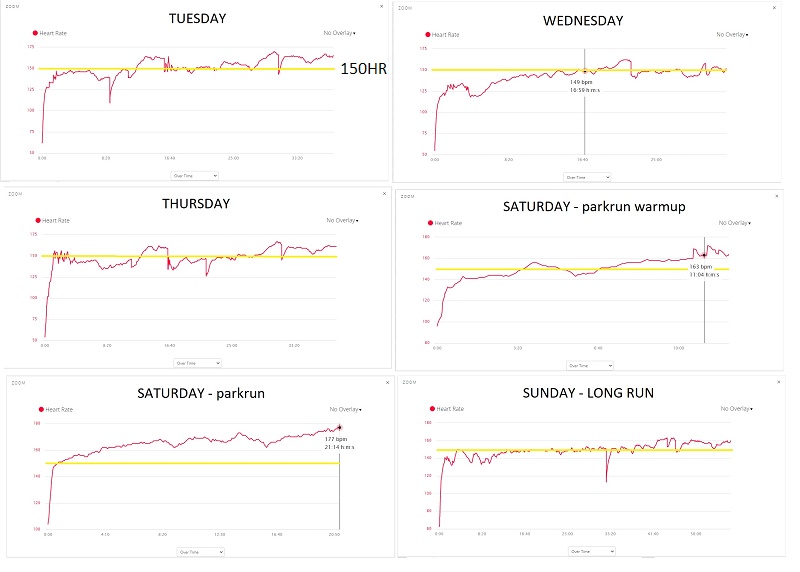
He typically runs five days per week – three midweek, a parkrun on Saturday which is always a faster effort, a Sunday run which is his longest of the week while the Wednesday run tends to be slightly shorter. He gives himself two rest days which, being on Monday and Friday, space the week’s training out nicely. All in it’s not a bad training structure to follow. Here’s the heart-rate graphs from those five days of training.

I’ve put a yellow line to indicate where a heart-rate of 150 occurs and you can see that on every run he is reaching and surpassing it for a decent portion of the time. In fact, at parkrun the heart-rate reaches 170+ and most days he’ll be hitting the 160s at some stage of the running. He’s not just exceeding 150bpm but exceeding it significantly on almost every run.

I consider the overall amount of time spent running each week to be an issue. Totalling about 25 miles per week in 3hr 20mins it’s not enough for a distance runner. Of course everybody leads different lives and has different priorities so I can’t be too critical. Yet at less than an hour the Sunday run isn’t long enough and it should surely be possible to find more time for it. If he was an 800m runner, an hour might be long enough but he isn’t; he describes himself as a 5K / 10K runner. Apart from a couple of ten mile races and a half marathon; 10Ks have been the furthest distance raced in all these years. This overall lack of training volume is part of the problem.

The average pace for the week is 7:45/mile and the Wednesday run is the slowest at 8:11/mile. Given a parkrun time that is just breaking twenty minutes, Jack Daniels’ VDOT tables suggest Easy runs should be somewhere around 8:30/mile pace. So again, alongside the evidence of the high daily heart-rates, we’re getting an indication that there isn’t enough genuinely easy running taking place.

There’s two more problems these stats don’t reveal. On each of the training runs he stops to cross roads which give him one to three minutes recovery on any run. There’s over nine minutes of stops built into these runs. It may seem picky but anyone who has done distance training knows a break is refreshing. If you’re running anaerobically those breaks allow you to recharge the batteries and keep pushing (too) hard. Now you may argue it’s impossible not to stop but, with good timing and route choices it can be avoided. I often go weeks without needing to stop on any of my runs simply by running on roads with low levels of traffic, early in the morning and being flexible about when and where I cross roads. I will happily run an extra fifty paces up a road to let traffic die down before crossing it. But obviously do the safe thing.

The other unseen problem in these graphs is there’s some decent hills on the routes. He’s trying to maintain the same pace up and down them but that pushes the effort up which explain some of the higher heart-rates.

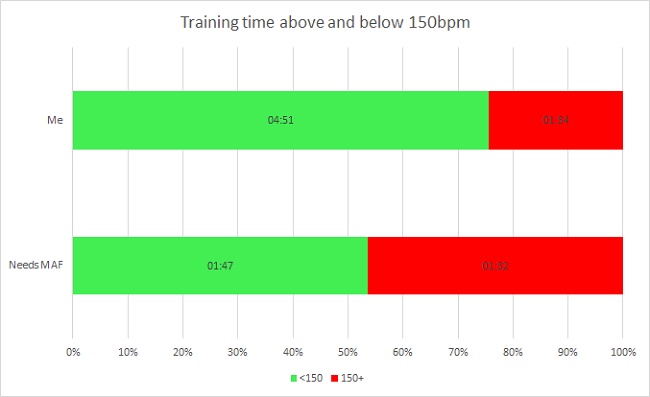
Graphing all those runs differently we can see the time spent in a MAF-HR zone of 130 or less; a middle zone of 131-150 which is usually safe for older runners to train at and a 150+ zone where the training effect is large but also takes time to recover from.

It’s clear he’s running hard five days per week with heart-rates hitting the 150+ mark. You would think the two rest days would be enough but they aren’t. What’s actually happening is the muscles are being trained anaerobically. The days after the rest days (Tuesday and Saturday) are faster runs because the muscles are refreshed but all that allows is for him to go out hard and reinforce the anaerobic training. There is no aerobic development. One of the benefits of day-in, day-out training is it leaves the legs somewhat fatigued to the point where they have to go slower and that helps the aerobic development.

The main consequences of this approach are that he’s getting injured and not improving.

What good training looks like

Injuries were the sort of thing Maffetone was happy to dive in and sort out. As I have stated repeatedly, I’m not a believer in the age-related formula but I am a believer in what Maffetone was trying to get his clients to do which is stay healthy and get faster by building an aerobic base through good endurance training.

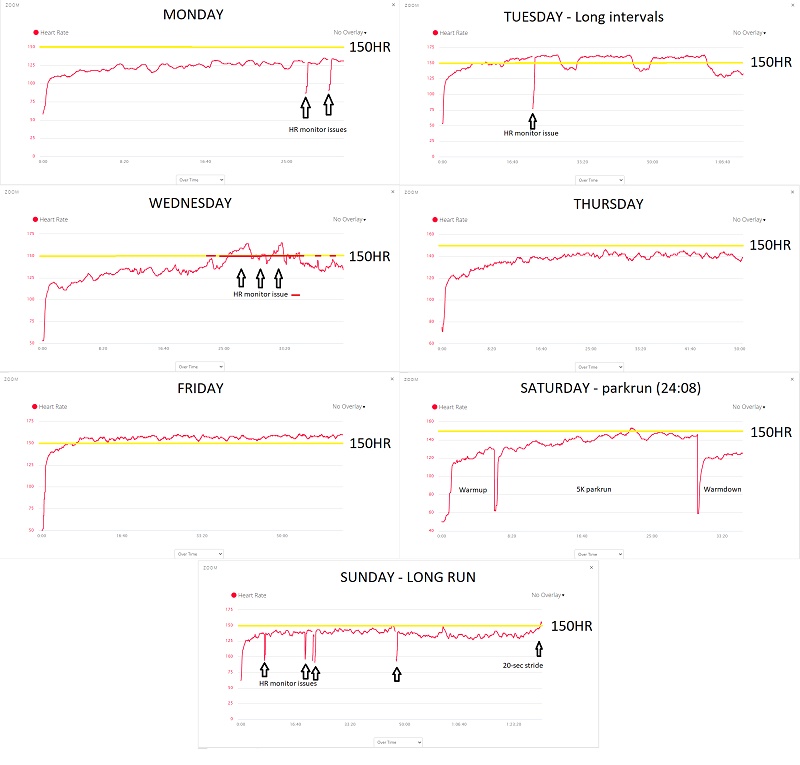
My own training during this period saw me run nearly double the training our Needs MAF runner was managing. I was just shy of fifty miles taking 6hr 24mins yet we had the same average pace for the week at 7:45/mile. Despite all this extra mileage I’d been training every day for almost three years without illness or serious injury. While I picked up a couple of glute strains along the way (which came from trying too hard in speedwork) neither lasted more than a week and I was still able to run. While our parkrun times are similar, my base endurance is improving and I am positioning myself to go faster in the longterm.

You can see I run every day but only push harder on two days (Tuesday and Friday). There’s a few little glitches on my heart-rate monitor particularly Wednesday which highlights the problem of accuracy with heart-rate training but otherwise I’m comfortably well below 150HR on my recovery days. My Sunday long run sometimes scrapes into the red but the training effect I’m interested is in building endurance on those runs. Even a good ninety minute run is still only a hard, aerobic effort. Where the Needs MAF runner has to take two rest days every week, I’m getting out there and running on them too.

Another intriguing detail of our training weeks is that we accumulate the same amount of 150+ ‘red zone’ training time but my extra running accumulates time and fitness in the supporting zones while allowing the body to recover from the harder sessions. If I tried to run hard every day like he does, I’m sure I would be getting injured too.

We’re both fifty years old and Maffetone would like us to be doing all our training to a heart-rate of 130 or below. I don’t believe in that but I do total over an hour of my weekly running at this level and it’s usually in the first couple of miles of the runs while my body warms up. This is important – I’m listening to my body to get an indication of how it feels and whether I can push hard. Maffetone talks about doing warm-ups in his book but the people who think he’s only about low heart-rate training miss this.

On days following a harder effort I find my legs don’t want to do too much and it is a struggle to get the heart-rate up. My legs can be glycogen-depleted so I just jog along to aid recovery. If I tried, I could probably push to higher levels especially if I’d had a day off but I don’t try to push it every day and that was Maffetone’s message.

80-20 training

Much of Maffetone’s work occurred in the 80s and 90s when heart-rate monitors were still new. The science of exercise physiology has progressed a lot in recent years. What we now know, due to the work of Stephen Seiler, is that elite athletes tend to split their training into 80% below lactate threshold and 20% above it.

Throughout this post I’ve referenced a HR of 150bpm. Be careful – 150HR is not THE definitive value to use; it’s the data that was available to me. That the Needs MAF runner trains somewhere around this level most days shows it is probably somewhere around his own.

One hundred and fifty is close to where my lactate threshold heart-rate usually lies and I calculate I have a 76-24% split above and below it. That’s within the bounds of 80-20 training. On the other hand, the Needs MAF runner’s training split comes in at 54-46%. It begins to explain why he’s failing to make progress and getting injured when he starts to do even more intense work!

Arguably it may be wrong to use 150HR to split his training but it’s clear he’s training too hard every day because his body is letting him know through injuries and lack of progress. You can also see when he runs 30secs/mile slower on Wednesdays, he has lower heart-rate so it would be easy for him to include more genuinely easy-paced runs. Doing that, as Maffetone outlined is the key to staying healthy and injury-free.

Although I’ve been explaining all this using data you don’t need a heart-rate monitor to know whether your training is going well. Just a bit of common sense and listening to your body will tell you. When it creaks and groans it’s time to back off.


My six posts on MAF training are among the most detailed and honest articles about it on the internet and well worth reading. I’m trying to help runners get past the idea that training to a single number on a heart-rate monitor is the answer to all their problems. Good training involves scheduling the right mix of sessions at the right times. A block of endurance training like Maf suggests is just one part of what you need. My years of training and coaching allow me to know what to do and when to do it to help runners get fitter, faster and healthier. If you too would like me to help you then please contact me with details of your running and how you think I can help you.