On Mondays, I run a couple of laps of my road all-out. I live on a crescent to which its two ends join back to a connecting road which makes for a nice loop. I begin with a couple of laps from my house to warm-up and in truth it’s not a particularly good one as I often go too fast and it only lasts about four minutes. After this I walk to the far end of my road where I’ll be starting from. This takes 3-4 minutes and gives just enough time for any excess from the warm-up to be gone.
Arriving at the corner I reset my watch then take a look around to check for traffic as I’m intending to run in the road. It’s quietly residential with only the occasional car or delivery van every five minutes or so. I compose myself one final time and then hit the Start button. I’m focusing on a good push off with high cadence and small steps. As the weeks have gone by cadence has been rising. Last week it reached 214-218 in the early going; whereas less than two months ago I could barely hit the 190s. Depending on fatigue it might drop back for a week but the general trend has been one of increase. Somewhere in the dim and distant past I could hit the 220s so I’m hoping I will get back there and then go beyond with dedicated focus and training.
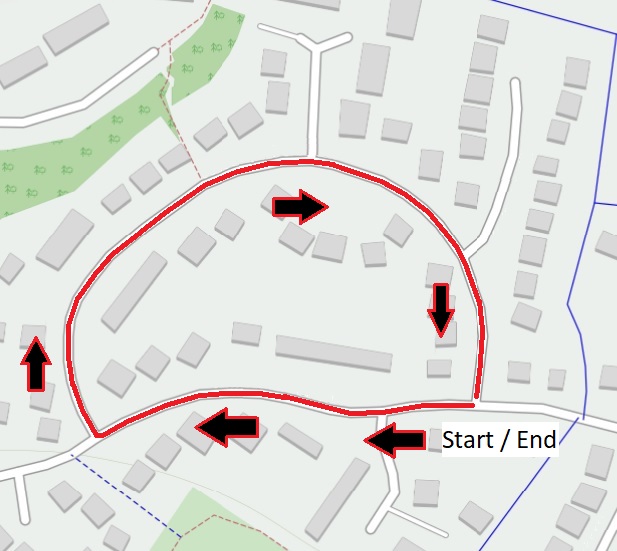
From the corner there is a nice straight taking under thirty seconds to reach a corner where I instinctively slow because it’s almost 90 degrees. Even though I’m running on the road and can take it wide there is always an element of slowing as the initial burst of energy is gone, there’s a very slight uphill and it’s a change of direction. Sometimes there’s also a headwind to make things even tougher. If there’s ever a tailwind I’ve never felt it helping out.
Around the corner and I’m trying to accelerate again. This is helped by a downward stretch and from here onwards it will be the curve of the crescent back to where I began, no more corners to negotiate. I pass my house at about the halfway mark and then it’s fairly flat. As I reach the 45-50s mark I begin to feel what 400m runners always feel as the arms and legs are getting heavy from lactic build up and the coordination is going. Of course, I’m also breathing hard and all my body’s signals are telling me to slow down. There’s often a moment around here where I’m beginning to wish I’d never started and I have to tell myself to “hang on”, “it’s not much further” and “I can’t let myself down now”. Self-coaching at its finest.
My GPS always shows this stretch as the fastest part of the lap after the initial start. As the clock ticks past a minute, the road begins to grade upwards and I’m vigilant for any oncoming traffic as my sight around the bend is hidden by walls and hedges. Drivers often come into the road quicker than they should for a residential road. My ears are listening out too. I’m ready to jump on the pavement if needs must.
The final metres are a short upsection. I have to engage more muscle to finish this. It comes right at the time where my body is begging me to slow. My mind urges me to keep going, no quitting with the end so close. Crossing my imaginary finish line / starting point, I click the Lap button and then begin to walk. It’s already been tough to this point yet in some ways worse is to come.
On finishing my legs are aching a little, my shoulders too sometimes and most notably my breathing is fast and short. In the early season I can usually stay jogging after an effort but, as the weeks go by and fitness improves, I start having to walk. On shorter sprints it becomes a standing recovery.
The peculiar thing is while I’m breathing very hard at the end of the run, about ten seconds after finishing it gets worse. In those first ten seconds, I’ve counted my breathing to be at about 60-65 breaths per minute; but then at the ten second mark it goes haywire. I begin to find myself gulping for air, unable to get it in quick enough. I’ve counted my breathing rate rising to the equivaent of around 150 breaths per minute and this lasts up to about the thirty second mark. It then begins to slow and has normalised by about a minute yet even then I’ll still be panting for the next few minutes.
You’d assume this breathing difficulty is down to lack of oxygen. It’s not. My heart-rate monitor tells me my heart-rate is in the 150s. This is not my max. At a recent parkrun, while running a 23 minute parkrun (i.e. paces slower than 7min/mile) I saw my heart-rate creep up into the 160s and peak at 172 despite not putting in a sprint finish. It’s clear if my heart wanted to circulate more oxygen it could, but it doesn’t. I can only surmise that it’s because sprints are highly anaerobic and therefore the body is trying to reset all the by-products which have built up. Its trying to expel carbon dioxide from the lungs, not supply more oxygen to the muscles.
With my first effort completed I now do a walking recovery. As I wrote, the first minute sees me breathing very hard and my legs hardly have the energy to move. Things begin to ease and by about three mins I’m beginning to get back to normal. I’m still breathing a little harder though.
When the walking lap has been completed (taking over five minutes) it can be tough convincing myself I’ve recovered enough to run another effort fast. The anaerobic energy system half refills in thirty seconds, fully refills in three minutes. The problem is it takes the body significantly longer to clear out all the waste products from these high intensity efforts. Sprinters typically budget a minute’s recovery for every ten metres run. If they run 200m, that means twenty minutes of standing around. Few distance runners will do all-out sprints or hang around that long; particularly in winter.
What I find on the second effort is that once again the first thirty seconds are fine then it begins to bite. And it bites even worse at the halfway point and the legs get heavier and the co-ordination goes. It’s notable when I look at the post run data that I’m able to start the second effort quicker and this in turn builds the lactate up quicker. By the end of the second effort, I feel worse than I did the first. The saving grace is I can just walk home. The knowledge that there is no more to do is wonderful. It’s why I make the session short because it allows me to go hard for two efforts giving them both my best effort.
The ‘oxygen debt’ is tough after this second effort and even when I arrive home five minutes later I can still be panting. I can go upstairs to change and I will still be sweating. On some occasions when I’ve either hit new territory in the session or when my legs are really fresh, I’ve found myself still feeling the effects half an hour after I began. And I definitely sleep well that night!
 Big Red Running