The Truth About Cadence Part 5

The previous parts of this series can be accessed by clicking on the following links where they will open in new windows. Part 1, Part 2, Part 3, Part 4.

I wrote this series of posts because there is an idea out there that 180 steps per minute is the perfect number to run at and I want to investigate. Only this past weekend, I came across an interview with Chris McDougall, author of Born to Run, where he stated “For perfect running form you should be running at 90 strides per minute”  therefore 180 steps.

The idea that there’s a perfect onesize fits all cadence for people of different heights, weights, speeds and abilities has always seemed wrong to me. Maybe it’s because I’m tall and, when I started running I counted my cadence at 150 steps per minute on easy runs rising to mid-150s when I picked up the pace but hardly ever going over 160 in a race. I always assumed it would increase as I got faster, after all I was rarely running any quicker than 7min/mile. On reflection these lower numbers are partly because my form was poor and I was overstriding yet even today with improved technique I’m still running easy runs in the mid-160s. It might reach 180 at 6min/mile and when I pick up my pace to 5min/mile I start to hit the 190s. When I sprint it rises above 200spm. This is the progression we glimpsed for some of the elites.

To recap, the trend for elite cadence data is that very high cadences are only seen over short distances. As the race distance gets longer, cadence drops until for the majority of runners it reaches 180. That gels with the ‘180-rule’ idea and the drop-off makes sense because the shorter races are run at lower speeds and we know speed is created through a combination of steps and stride length. Sprinters have both high cadences and very long strides – neither of which is sustainable for a distance runner. It is only at the end of a distance race where we see endurance athletes raise their cadence and/or stride length to sprint for the line.

Typically we see the 100m sprinters have cadences in the 280-300 range, 400m runners are 220-260, the middle distance runners at 190-210 and long distance is in the 180-190 range.


It’s very clear that if you want to be a sprinter or middle distance runner it’s going to involve high cadences – well over 200spm. Since writing the post on sprinters, I’ve been reading a book on sprint mechanics which began its research in the the early 1980s and now leads to the fastest sprinters training to create high cadences. But its author is very clear to point out this must not occur at the expense of stride length. An adequate stride length is still required. It points out that when some sprinters have pushed their cadence too high (over 300spm) this has been detrimental to their speed.

Whether or not this increase of cadence, which has worked for sprinters, can validly be transferred to long distance running is debateable. For one thing, if it were transferrable then we might expect to already be seeing numerous elite distance runners with cadences well over 200. Whereas the data I covered found only one long distance runner operating at over 200spm. A reason for this may be because sprinters achieve quicker cadence through use of the hip flexors, a relatively weak muscle group, and therefore distance runners would struggle to maintain high cadences for long periods. Even in the 400m we see the cadence of elite sprinters fatiguing and this is in a race lasting 45-50 seconds.


With most recreational runners being interested in races between 5K and marathon in length, the long distance data is most relevant. Thirty-two runners were detailed – eight men and women in their respective 10,000m and marathon races – and we see a different picture to the one presented by Jack Daniels in his book.

At the 1984 Olympics Daniels recorded only one runner having a cadence below 180, out of the fifty he surveyed. His method was very basic and done with the naked eye but, he has also conducted proper scientific research so while observing from the seats is not perfect; his findings are still worthwhile. Ultimately what’s been important throughout these posts has been to get a rough idea of what runners are doing, not coming up with a perfect number.

By contrast the data used in this series of posts, which is taken from the World Athletics reports, has a high standard of scientific rigour to it. High speed digital cameras filming an area which has been carefully measured and calibrated then using computers to analyse the film. This data showed nine of the distance runners (about 25%) had cadences below 180.

For me, the most interesting of these is seeing Mo Farah’s cadence at 173-178 while running at 4:15-30/mile. He is not just a run of the mill athlete, he won multiple Olympic and World titles, which highlights that while 180 may be something to aim for, it is not a prerequisite for success. While his best time in the marathon (2hr05) is not close to the best of the best; he won the 2018 Chicago marathon which is one of the majors.

Recreational paces

What we aren’t seeing from any of this data is what the elites are doing at typical recreational paces which are often 8min/mile or slower. In the marathon, we have data from the men at both the 30 and 40km marks and we see their cadence dropping as they slowed towards 6min/mile. That would suggest that if they run at even slower paces their cadence will drop further. Perhaps.

The marathon data also has three runners who are slower than 6min/mile which is a pace many decent club runners can achieve. The cadences are 175, 185, 186spm – so there is nothing conclusive there.

Rereading a later edition of Daniels’ Running Formula book he mentions that he treadmilled an Olympic marathon gold medallist for their cadence. At 7min/mile it was 184, at 6min/mile 186 and at 5min/mile had reached 190. This is very much in line with what we see in how the cadences drop off in the men’s marathon data reviewed. Yet it is also very different to what Mo Farah is doing in the 10,000m where he is running significantly faster than with lower cadences.

One reason often given for creating a high cadence is to avoid injury. There is some logic, particularly for marathoners, where a higher cadence means a short stride and less vertical displacement i.e. they don’t go as high in the air and therefore don’t hit the ground with as much force. Their effort is used to go more horizontally.  A good example of this is Tirunesh Dibaba in the 10,000m race; where she has a high cadence especially when sprinting in the home straight (228spm) and she must be barely leaving the ground with each step. Some years before this race she had moved up to the marathon and so the lower impact is seen as beneficial when you’re running well over one hundred miles per week.

Final thoughts

Most recreational runners are interested in the distance races – anything from 5K to marathon and maybe beyond. When they go out on easy runs they are doing paces of 8min/mile or slower; some of the decent club runners are closer to 7min/mile.

We have no specific detail on what the elites do at these paces but if your cadence is already in the 180-190 range – when you run faster you will need to increase your stride length to get significantly quicker. It may be possible to increase your cadence towards 200 but the data suggests it won’t go much higher. To improve stride length you are going to have to work on strength and speed making sure you are getting full hip extension.

If your cadence is below 160 at slower paces, it may not be an issue particularly if you are tall or muscular but it may be something to consider looking at.  Often the advice about 180 cadence is intended to stop runners from overstriding which can lead to injuries. Certainly if you have recurring injuries then it may be worth looking at video of yourself running in conjunction with considering whether to increase cadence.

Ultimately though, the cadence data is there to support your running; not be an end goal. Every step you take on a run is a combination of stride length which involves ground contact time, air time, vertical displacement among other things. All these variables interact. Changing one will affect others.

Elite runners run how they feel comfortable. Sometimes it is a high cadence, sometimes it is a low one. Some like Mo Farah have a long stride with low cadence, others like Tirunesh Dibaba are getting their feet to contact the ground as often as possible.

If you enjoyed these articles why not take a look at the ones I wrote about Stride Length – part 1 and part 2.

The Truth About Cadence Part 4

In the Introduction I detailed how, in his Running Formula book, Jack Daniels states that his survey of runners at the 1984 LA Olympics found everyone in events over 3000m had a cadence of 180 or greater – with one exception.

In this post, I’m looking at the 10000m and marathon races from the 2017 World Championships and finding more anomalies than Jack discovered. To read about the cadences of Sprinters and Middle-Distance runners – click the links.

Men’s 10,000m

The race was won by Great Britain’s Mo Farah in 26:49.51s with Uganda’s Joshua Cheptegui and Kenya’s Paul Tanui finishing less than a second behind him. Twenty-two runners had started the 25-lap race and while the early going was slow the race eventually settled down to running laps at around 4:15-30/mile pace. Gradually runners were dropped from the lead pack and at the bell Farah was leading a group of six;  it was here that he kicked and covered the final lap in under 56 seconds.

The technical report on the race covers the first eight finishers and provides their data in the home straight on the 15th lap. We are given the Step Rate when the race has settled down and the runners are running at around 4:30/mile.

Table 1 – Step Rate (Hz) and Cadence (SPM) data for top 8 finishers in Men’s 10,000m

I’ve done the conversion from Step Rate to cadence and we can see there is a huge range from 171 up to 206spm. Mo Farah is just a couple of steps higher at 173 than Canada’s Mohammed Ahmed (171). It’s clear a sub-180 cadence was no hindrance to Farah because he won the gold and Ahmed finished 8th in 27min02 only fifteen seconds behind.

Many of the athletes are running at Jack Daniels’ predicted 180 cadence with Kenya’s Jemal Yimer (194) and Ethiopia’s Bedan Muchiri (206) being the notable exceptions. While the focus of these posts has been to ignore stride length; I think it is useful to recognise Muchiri’s is 1.75m here.

The technical report also provides greater detail (table 2) for the three medallists with their cadence from five points in the race including the home straight as they battle for gold at top speed.

Table 2 – Step Rate (Hz) and Cadence (SPM) data for Men’s 10,000m medallists

What we see is that, for much of the race, Mo Farah is operating at sub-180 cadence while Cheptegui and Tanui are operating at 180-190. It’s when they reach the final lap of the race that they put the afterburners on and here we see all three runners increase their cadence. Mo Farah continues to have the lowest of the three albeit he is achieving a cadence of 200 at this point.

Women’s 10,000m

The women’s race was run differently to the men’s 10000m. While initially both races began slowly with a pack of runners bunched together; it was about twelve minutes into the women’s race on the 9th lap that eventual winner Almaz Ayana took charge.

While the 8th lap had been completed in 1:15 (5min/mile) she now moved to the front and upped the pace with the next two laps coming in 1:08 and 1:07 (4:35-40/mile). Gradually she pulled away from the the rest of the field, lapping back markers and went on to win gold finishing almost a minute ahead of the other medallists. There was a tussle between Tirunesh Dibaba (silver) and Agnes Tirop (bronze) over the last lap with Alice Nanowuna following in fifty metres behind them.

The cadence data (table 3) is a little more conventional for the women with all the runners between 180-192 yet there is one exception – Kenya’s Alice Nawowuna who is down at 173. The race commentators mention Nawowuna is the tallest of the three Kenyans which could explain a longer stride.

Table 3 – Step Rate (Hz) and Cadence (SPM) data for top 8 finishers in Women’s 10,000m

As with the men’s data, the sample is from midrace approaching 6000m where they are running at about 4:50-55/mile with the exception of leader Ayana who is at 4:35 and Molly Huddle at 5:03.

Below in table 4 we see the race breakdown for the medallists and cadence increases in the final lap on the home straight. Ayana is unchallenged so never has to hit her highest gear. The battle between Dibaba and Tirop is close and we can see their cadences are very different. At this stage of her career, Dibaba had been running marathons for three years and it is notable how smooth her stride is sprinting against Tirop. At 228, Dibaba’s turnover in this finishing straight is as good as, or better, than many middle distance runners while throughout the rest of the race she is above average by hitting the low 190s.

Table 4 – Step Rate (Hz) and Cadence (SPM) data for Women’s 10,000m medallists

Marathon

The 2017 World Championship marathons were held on a four lap street circuit around London with each lap measuring about 10km.  While there were some long straights on the course, it also had a number of corners to be negotiated which either required runners to run wider or adapt their pace. It was a true head-to-head race in the sense of trying to beat other runners rather than going for a time.

The marathon data is possibly the most interesting data in this whole study because we have two sets of data for the men recorded at around 30km and 40km and, with runners tiring in both men’s and women’s races, we get a glimpse of them running at paces we might expect from above average recreational runners.

The men’s race was won by Geoffrey Kirui of Ethiopia in 2:08:27. Table 5 shows his cadence on lap 3 is 191spm where he is recorded running at 4:50/mile. Having taken the lead at 35km and opened up a lead over silver medallist Tamirat Tola, he had slowed by the 40km mark. By this point he was running at 5:25/mile and his cadence had dropped to 186spm.

Table 5 – Men’s marathon data at roughly 30 and 40km

Of the other six runners who data was recorded for, only Callum Hawkins increased his pace in the last 10km – this was consistent with him moving up in the race from 8th place to finish 4th. To run 10secs/mile quicker his cadence increased from 187 to 194.

Meanwhile Tola, who slowed by almost a minute per mile, dropped his cadence from 183 to 180; similarly Wanjiru who slowed to over 6mins/mile had his cadence drop from 192 to 185.  The other three runners see a small drop in pace – Simbu slows by 5secs/mile – a relatively low cadence of 175 drops further to 173; Kipketer’s cadence remains the same as he slows by 13secs/mile and the one anomaly is Ghebregergis who fractionally increases Step Rate while slowing by 12secs/mile. I’d be inclined to see this as remaining the same with the 0.01Hz change attributable to the normal variations which occur while running.


The women’s marathon was won by Rose Chelimo in 2:27:11 – not a particularly fast time by modern standards – equating to an average pace of 5:37/mile (35min per 10K). But it was closely contested with the top four runners finishing within ten seconds of each other.

Unlike the men’s race, there is only data provided from the 4th lap – the 40km mark – and at this late stage of the race we see in table 6 a variety of paces from the 5:28/mile of USA’s Amy Cragg who is almost a minute per mile quicker than Kirwa and Dibaba at 6:17 (barely quicker then a 20min 5K parkrun).

Table 6 – Women’s marathon data at roughly 40km

We see a significant range of cadences despite all eight finishers running 2hr27-28. Gold and bronze medallists, Chelimo and Cragg are hitting the 190s with Kiplagat, Daniel and Kirwa in the mid-180s – all in line with Jack Daniels’ findings.

Yet there are three runners with sub-180 cadences. There are Ethiopia’s Shure Demise and Mare Dibaba (unrelated to Tirunesh) in the mid-170s. And then there is Kenya’s Helah Kiprop running at only 165spm. Finishing seventh, a minute behind Chelimo this was far from her best race which was a Marathon Majors win in Tokyo in a time of 2:21:27. Knowing she can run a marathon around 20secs per mile faster opens up the question of whether she would achieve that pace through a quicker cadence, longer stride rate or a combination of the two. I would expect her to be capable of a quicker cadence as 165 is extremely low compared to all the other runners detailed.


Collating the data into table 7 for all 32 runners across the four races we see a symmetrical range of cadences where the majority are in the 180s – which aligns with the average cadence data being 183-185spm. But it also highlights that over a quarter of these runners can be running at sub-180 cadences.

Table 7 – number of runners for each cadence grouping

While the variety of paces goes from 4:15/mile in the men’s 10,000m down to 6:15+/mile in the women’s marathon – we should remember these are all world class athletes who are training many hours per week and getting excellent coaching. They are running times many of us will only dream of and among these runners having a sub-180 cadence is not holding them back.

We’ve also glimpsed cadence at slower paces – the marathons have three men running at 5:49, 5:51, 6:10 per mile and four women running at 5:56, 5:58, 6:17, 6:17 – these are the paces for a 18-20min 5K.  The cadences for these seven runners are 179, 180, 185 and 177, 165, 175, 186.

This suggests, but is by no means definite that, as elite runners move towards recreational paces their cadence can be lower than 180. It’s also backed up by how when the men slowed in their race, four of six runners had lower cadences, while Callum Hawkins increased his pace by increasing his cadence as did each of the 10000m medallists.

In the final post in this series I will summarise what the cadence data can tell us about running and what it might mean for you as a recreational runner. Click here to go to it.

New parkrun world record set

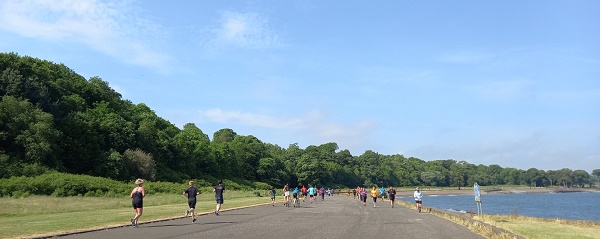
Last Saturday, Andrew Butchart, ran the fastest parkrun of all-time clocking 13:45. Edinburgh parkrun, where he ran, describes itself as a course designed to be enjoyable, rather than for pure ‘PB’ speed!! It’s scenic, flat and run on generally wide footpaths along the promenade on the Firth of Forth. On a tough day, it’s exposed, windy and cold and looking at the photos it’s not hard to imagine how bleak it could be in the depths of winter.

Edinburgh parkrun on a blue sky day

Fortunately Butchart turned up at the height of summer with good running conditions. Putting his time into perspective, if you’re a 23min parkrunner you’re just reaching the 3K point of your parkrun and for those running 27-28mins you’re halfway round. Even a 17 minute parkrunners is still a kilometre behind as Butchart finishes. Running at 2:45/km or 4:26/mile is fast and most of us wouldn’t even beat him off the start line which shouldn’t surprise anyone given he has competed at the Olympics.

Andrew Butchart sets the record

The previous world record of 13:48 was set by Andrew Baddeley at Bushy Park in August 2012 – the week after competing in the Olympic 1,500 metres. That broke Australian Craig Mottram’s record of 14:00 which had stood since 2006.

The progression of the parkrun world record was fairly easy to track down because when Mottram set the record, Bushy Park was the only parkrun. In setting the world record in Edinburgh, Butchart becomes the first man to do so away from Bushy and the 10th to hold it.

I went back through the results and, of course, the record was initially set at the first event by Chris Owens at 18:47. Over the next year it was broken seven more times until Mottram smashed 39 seconds off to record exactly fourteen minutes in June 2006. Mottram was a world class 5,000m runner who took silver that same year at the Melbourne Commonwealth Games having won a bronze at the World Championships the year before.

In the early days at Bushy Park, where it all started, attendances were often less than 100 people and in setting the world record Mottram only finished ahead of 158 other runners. It wasn’t even a parkrun then – it was Bushy Park Time Trial. It typically attracted club runners whereas these days the bulk of 1,000+ runners turning up won’t be attached to a club. If you pick a random week from the early days you’ll find barely anyone taking longer than thirty minutes and an average time closer to twenty-three minutes. In some ways it was more competitive, especially as First Finishers were still referred to as Winners.

Among those humble beginnings we can find illustrious names such as Mo Farah logging a 15:06 in November 2005, Ireland’s World Champion Sonia O’Sullivan winning regularly as well as reducing the women’s world record twice (16:38 and 16:22). I’ve read there was a contingent of Kenyan internationals who lived near Bushy Park which included Bernard Kiptum (15:04 parkrun WR), Collins Kosgei, Johnson Kiptanui, Simon Arusei, Dennis Ndiso, and another World and Olympic champion in Vivian Cheruyiot – who held the women’s world record briefly at 17:52.

One little quirk of the early records is when David Symons set it at 16:39 in the 3rd ever parkrun event, the women’s world record was also set at 19:57 by Kate Symons. I assume they are married but may just be related.

DateRunnerTimeParkrun location
02-Oct-04Chris OWENS18:47Bushy Park, London
16-Oct-04David SYMONS16:39Bushy Park, London
06-Nov-04David SYMONS16:29Bushy Park, London
27-Nov-04Kevin QUINN16:10Bushy Park, London
05-Mar-05Dermot CUMMINS15:54Bushy Park, London
14-May-05Bernard KIPTUM15:04Bushy Park, London
17-Sep-05Phil SLY14:54Bushy Park, London
01-Oct-05Noel POLLOCK14:39Bushy Park, London
10-Jun-06Craig MOTTRAM14:00Bushy Park, London
11-Aug-12Andrew BADDELEY13:48Bushy Park, London
24-Jun-23Andrew BUTCHART13:45Edinburgh, Scotland

The women’s world record progression is not so easily identified as while it was broken multiple times in the early years, once parkrun began to expand outside of London there was potential for it to be broken elsewhere. I recall Justina Heslop becoming the first woman to run sub-16 in late 2011 and as best as I can find it had always been set at Bushy Park until Hannah Walker recorded 15:55 at St Albans parkrun in July 2013. She has had the longest reign as it was 5½ years before Charlotte Arter took five seconds off at Cardiff in January 2019. She then broke her own record a year later by one second (15:49) just before the COVID-19 pandemic started.

Seasoned parkrunners will remember that events were cancelled due to COVID-19 and, when it came to reopening them, they restarted at different times around the world. Australia was one of the first countries to resume and the women’s parkrun world record went down in early 2021 as Lauren Reid ran 15:45 at Paramatta near Sydney followed seven months later by Caitlan Adams’ 15:38 at Lochiel parkrun near Adelaide.

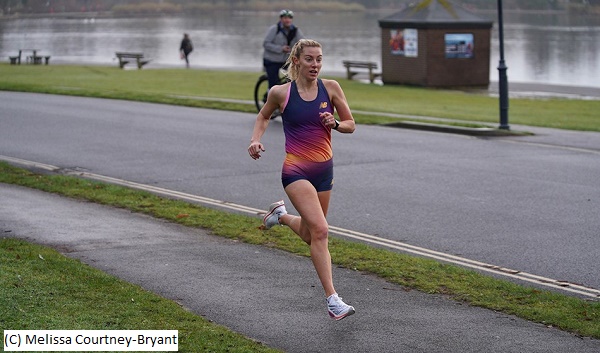
It was quiet for a year until December 2022 produced a flurry of activity. Firstly Samantha Harrison, who finished sixth in the 2022 Commonwealth Games 10,000m final, reduced the world record to 15:37. She was only to hold on to it for three weeks as Melissa Courtney-Bryant ran 15:31 at my local parkrun in Poole on Christmas Eve. Sadly I missed this historic moment but I know it created tremendous excitement to have had a world record set there. Any week I run there I now know I have no excuses about the course.

Melissa Courtney-Bryant on the way to the best Christmas present she could ever hope for!

Yet records are set to be broken and while Melissa is still the UK record holder, the women’s WR almost immediately returned to Australia. A week later on New Year’s Eve, Isobel Batt-Doyle recorded 15:25 at Aldinga Beach near Adelaide. It was the 3rd time in a month it had been broken and she became the 14th woman to hold it.

DateRunnerTimeParkrun location
02-Oct-04Rachel ROWAN21:01Bushy Park, London
16-Oct-04Kate SYMONS19:57Bushy Park, London
11-Dec-04Vivian CHERUIYOT17:52Bushy Park, London
28-May-05Sonia O’SULLIVAN16:38Bushy Park, London
18-Jun-05Sonia O’SULLIVAN16:22Bushy Park, London
03-Jan-09Katrina WOOTTON16:20Bushy Park, London
08-May-10Gladys CHEMWENO16:11Bushy Park, London
24-Nov-11Justina HESLOP15:58Bushy Park, London
27-Jul-13Hannah WALKER15:55St Albans, Hertfordshire
05-Jan-19Charlotte ARTER15:50Cardiff
01-Feb-20Charlotte ARTER15:49Cardiff
23-Jan-21Lauren REID15:45Paramatta, Sydney, Australia
07-Aug-21Caitlan ADAMS15:38Lochiel, Adelaide, Australia
03-Dec-22Samantha HARRISON15:37Long Eaton, Derbyshire
24-Dec-22Melissa COURTNEY-BRYANT15:31Poole, Dorset
31-Dec-22Isobel BATT-DOYLE15:25Aldinga Beach, Adelaide, Australia
23-Dec-23Ciara Mageean15:13Victoria Park, Belfast

Update: In December 2023 Ciara Mageean took another 12 seconds off the women’s world record running in Northern Ireland. It’s the last record we will officially know about as in February 2024, parkrun decided it was no longer going to keep track of male/female/age-group records on its website. With over 2,000 parkruns worldwide it’s an impossible manual task to keep track of them all – we will have to see if updates continue to filter through.