The Hare and the Tortoise

You may recall as a child being told Aesop’s fable about the hare and the tortoise – the story of the speedy hare taking on the slow tortoise in a race. From the start, the hare races off into a lead, certain to win, while the plodding tortoise is left behind. Confident of victory, the hare takes a nap and while he is asleep the tortoise passes him. When the hare awakens he see the tortoise approaching the finish line and, despite his best efforts, the hare is unable to catch him and ends up being beaten. Parents and teachers love to tell this story as a way of saying “don’t rest on your laurels”, “don’t get lazy”, “keep putting in the effort”. The hare doesn’t, the tortoise does.

Now if, like the hare, you’re a runner for whom speed comes naturally – racing 5Ks or 10Ks is never going to be a problem. You might slow a little towards the end but fatigue is rarely enough of an issue that you need to have a lie down and sleep. And as much as the slower runners may plod steadily they’re unlikely to beat the hare.

But step up to a longer distance where fueling plays an important part and it will happen. I got serious about running when I had my own hare/tortoise moment. At the time, I was capable of running a 5:55 mile and 21min 5K parkruns (6:45/mile) and I entered a half marathon. I did some training towards covering the distance in the preceding month or two but it wasn’t extensive. I made the mistake of looking at race calculators which suggested I’d be capable of running around 1hr35 – this didn’t seem out of the question as I’d run 1hr38 the previous year. My running had been sporadic since. Even so I certainly wasn’t that unfit.

Hareing off I ran the first mile in 7:22, the next with the field beginning to spread out in 7:05 followed by 7:31 and 7:20 to take me through four miles in under thirty mins. It was all reasonable so far but miles 5 and 6 came in at 7:45, 7:51. There was a stretch of gradual uphill in there so I wasn’t too concerned. It was after that when the wheels came off.

Mile 7 was 9:00 and mile 8 was 9:38. My legs had gone. My stride was non-existent, I felt terrible. While I didn’t stop for a nap like the hare, I stopped to talk to a couple of running mates. I walked a bit and took 20min30 to cover miles 9 and 10. Then I summoned up the energy to restart and jogged the last three miles averaging 8:40 surrounded by runners who were theoretically much slower than me. I finished in 1hr51. It was a frustrating debacle. If I’d known how bad it would be I could simply have set out at 8:30/mile and got round comfortably.


What it did though was to kickstart me into take running seriously. I spent the next couple of months building a decent aerobic base – a term I didn’t then understand – but which I now teach to runners. Six months later I ran a 1hr31 half marathon.

On that fateful day, I’d finished surrounded by the tortoises who had gone out steadily within their capabilities and knocked off mile by mile. Meanwhile I’d hared off at a pace which was slower than my 5K but without the training to back it up – giving myself no chance of success.

The moral of my running story is twofold:

If you’re interested in my “Build your Base” course or improving your speed please head over to the Contact page and let me know.

A.I. coaching

Let’s play a game …

Here are the times from my last ten 5K parkruns – 23:31 … 23:16 … 23:06 … 23:27 … 22:54 … 23:06 … 23:37 … 23:37 … 22:50 … 23:16.  

What’s your prediction for my next 5K time?

If you said somewhere around 23 minutes – well done. Maybe you went for 22:45 to give me a booost – I wouldn’t be against that.

But would you have said 21:38? I certainly wouldn’t.

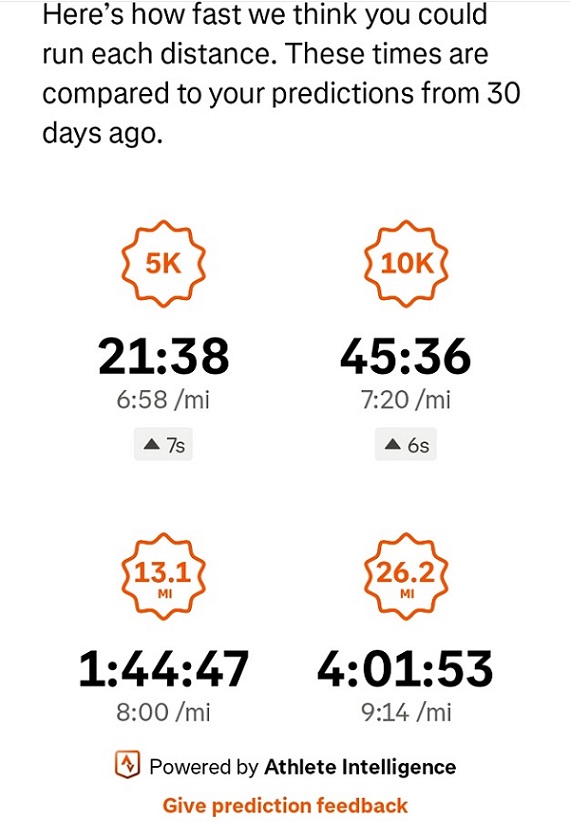
Yet Strava does.


Strava recently gave me a month’s free premium membership and they seem to have embraced AI with gusto. Among the features is its willingness to Predict Race Times. Despite having the perfect info available – weekly 5K – Strava is reckoning I can run over a minute faster. Clearly I can’t unless I change my training and then their prediction will probably change.

Race predictions

Last month I ran a 6:48 mile to celebrate Banister’s Mile. I know that’s not fast but I’ve been concentrated on building strength in the gym and working on very short distances – I expected my aerobic base to erode and it did. But if I take a look at Jack Daniels’ VDOT tables he estimates a 6:49 mile equates to a 23:09 5K which is relatively close to the 22:54 I ran at parkrun a few days later.  It’s not perfect but it’s not frustrating me into thinking I can run over a minute quicker than I’m capable.

Looking at the other predictions – the 10K of 45:36 is essentially double this Season’s Best for 5K – so that isn’t going to happen. I reckon half marathon at 1hr45 is reasonable and JackD’s VDOT suggests 1hr46 although I wouldn’t be surprised to see myself slip to about 1hr50 given I haven’t run over five miles in almost a year.

VDOT predicts a 3hr40 marathon which is very unlikely and Strava’s 4hr time is probably closer to what I’d achieve. But again, if I entered a marathon tomorrow, I doubt I’d come close to either time because I’d wilt and be walking from fifteen miles. If I trained properly for the distance, I’d feel more confident about VDOT’s prediction; the Strava prediction would then be too slow but it would probably update itself with the training.  But if it has to keep revising times as the training changes then that seems a little disingenuous – rather like the person who tells you “Oh I knew that” after you read out the answer to the trivia question they had just given up on.


With each run you upload there is Athlete Intelligence feedback to tell you about the run or workout you’ve just done. For example, this is what it stated for the run I’d just done at time of writing  …

Recovery Run

It’s a bit bland.

And it’s only half correct.

It correctly managed to figure out I do the same route most days (“maintaining consistent 3-mile distance”) and it correctly figured out whether this was faster or slower than usual (“at a slower pace”) but the last sentence (“while exploring different intensity zones”) is complete rubbish. I went out at an easy, recovery pace and maintained the same intensity throughout. What did happen is that I ran up some hills which caused me to run slower (but using the same effort/intensity) and down some hills which caused me to run faster (still using the same effort/intensity) and under some trees which will have messed around with the GPS.

As for the first couple of words (“Recovery run”)  Strava had enough intelligence to take this from the title of my run!  When I changed the title to “Steady” the summary changed likewise. It really wasn’t rocket science to figure that out although when I changed the title back to “Recovered” with a deliberate -ED ending it went back to calling it a “recovery run” and when I tried “Interval session” it ignored that.

I decided to look at what it had to say about previous days. For example here’s an interval session …

This is a pretty good description of what I’d done but what does this final bit (“and a challenging mixed-pace run.”) say or mean? They’re just empty words describing what it thinks I’ve done but not what it really was – warm-up, intervals with rest breaks, warmdown. Technically it’s a mixed-pace run but not like going out and doing a proper fartlek session where you mix the paces up.

I looked back to a speed development session where I sprinted four efforts of 5 seconds followed by further efforts lasting 10seconds, 15seconds and 25 seconds. Between the efforts I walked back to where I started, stood around and had long rests. It ended up taking about 25mins to do seven efforts. Here’s what Strava had to say …

Sprints

It got the first line correct but not much else. There really were no varied effort levels, it was max effort from start to finish on the sprints. And I’m guessing it thinks this was “significantly slower” because the 0.7 mile of total sprinting and walking comes out at 12+ min/mile. Compared to a recovery run then this is significantly slower but of course it is – the aim and structure of the session is totally different.

Here’ s what it said about a 23:16 parkrun …

parkrun

Well that’s strange, I didn’t do any intervals – I ran a 10min warmup, a 5K parkrun, a 5min warmdown. And the parkrun was 25secs slower than my Season’s Best the week before so it can’t have been a “route personal record”.

What can I say? It all sounds like unintelligent garbage to me.


Of course I don’t help Strava much by having an old Garmin watch which doesn’t feature many of the latest variables and I stopped wearing a heart-rate monitor months ago. But I run just about every day and upload my data to Strava – there’s almost ten year’s worth of data about my running for Strava to crunch. And yet I don’t find it’s telling me anything useful.

That said, I haven’t investigated their Runna coaching service – why would I? I coach myself and know how to train others for results. If you need an individual plan then I can help you but equally standard plans have been available in magazines and on the internet for years – and while I’d expect Runna to adapt depending on how your training is going (which is what I do with the runners I coach), I’m not sure how good it is at that. I also question its ability to motivate – I’ve known a few people try to follow coaching plans given to them by their Garmin watches but have yet to hear of anyone who succeeds or even completes the programme.


At the moment AI feels rather like “cut & paste” software. It feels like the gym assessment I used to get where it would state BMI is the relationship between your height and weight, with your value of [Insert value] kg/m2 shown above in Illustration 1. Your value places you in the [Insert rating] category. However, it is worth noting that BMI doesn’t take into account factors such as muscle and lean body mass.  Lots of description with just a couple of personalised bits of information added in.

I remember how these five or six page documents initially impressed me but after retesting, I came to realise that they were just padding out my numbers with waffle. Eventually all I did was look at the graphs and numbers.  I suppose AI has an advantage because it can rephrase the same information in different ways thereby giving the impression for longer that it has something important to say.

I’m sure AI will improve in coming years and when that happens I’ll probably be out of a job. But one of the reasons AI will continue to improve is that it continues to scour the internet. I receive a significant number of hits from AI tools which are reading my blogs and trying to make sense of them.

In the meantime if you want personalised coaching from a real human being – this far I’ve not used AI in my blogs or plans – then click here to Contact me.

Curiousity

Everybody talks about goal setting for success. Setting SMART goals, DUMB goals, setting targets.  I have always been a focused person and goal setting came naturally to me. I never needed to specifically set or write down goals, I always just wanted to achieve excellence. To be the best I could at whatever I was doing. It turns out this was a mistake for me.

The problem is I was always pushing my limits. There’s nothing wrong with that in principle, but it meant I often left myself exhausted. And what I didn’t realise is that physical exhaustion impacts you emotionally.

Eventually I’d reach a state of emotional burnout and give up. Giving up didn’t happen immediately but if I was trying to reach a target and I wasn’t moving closer to it, I’d start to get discouraged. All the effort I was putting in wasn’t reaping any dividends. To an extent I could rationalise this as I know things take time and need patience. It’s the same reason some people will give MAF training a go for far longer than they should without progress.

I’d never get discouraged immediately as I’m resourceful and would look for ways to change things or put in more effort. When I played sports which had a break between seasons, these would allow me to recharge my batteries. But if the lack of progress went on too long, burnout would ensue.

With runners, quite often their change of direction or resourcefulness is to try a new race distance. If all they’ve done is 5Ks, they might move up to the 10K then the half marathon then the marathon. Each of these changes means they change how they train especially for the longer distances where they might be running for two or three hours for the first time; covering distances of up to twenty miles. While they might be nervous come race day, it’s easy to get inspired about doing something different.

This isn’t to say goal setting is a bad thing – it can be really useful for creating motivation to follow training plans and, if or when training stops working it might give impetus to look for alternative ways to kickstart improvement.

But my attitude has changed. I guess it’s partly down to being old and knowing that however hard I try or train I will never achieve the peaks I might have been able to attain when I was younger. Now my driver is curiousity.

I’m simply interested to know how far I can get at something given the constraints of training time and an ageing body’s slower recovery. For example when I went to the gym over the winter, I was curious to know whether I’d still be able to squat 130kg like I was doing 15+ years ago. In fact, within twelve weeks I’d surpassed that.

What I like about not setting targets is that there is no failure. Yet in being curious about the process and what is happening I learn something, and I see that as a success.

The Runner’s Year

It’s January and a whole year of running is ahead. Perhaps you’ve already entered some races and begun training. Elite runners and their coaches certainly have. In fact they won’t only have planned out what to do this year – they’ll know what they will be doing next year and beyond. This year there are World Championships and again in two year’s time then in 2028 it’s the Olympics – probably the high point of runners’ careers.

But those are simply long term plans, there’s a preplanned year of racing in 2025 which they’re expected to take part in.  During the winter they’ll be doing cross country, maybe indoor racing if the facilities are available, and then in the summer it’s the track season and Diamond League with the World Championships being the competition they aim to peak for.

Elite runners and their coaches are always thinking ahead – they have to. How exactly they divide up the training year really depends on what they’re targetting but generally in the autumn they are doing a base of mileage to prepare the body for what comes later. Many modern athletes, particularly the faster track athletes, will be doing some weight training to build strength and stability to support the miles they’re running.

Marathoners who have quit the track will be focused on running two marathons per year – one in spring, another in autumn. The Marathon Majors see Boston and London in April; while Berlin, Chicago and New York take place between the end of September and early November – this neatly allows marathoners to run a Spring and Autumn marathon – six months to train for each. Again those six months will be broken up into phases of base, pre-competition and tapering leading into the race.

Even though their training plans are focused towards major competitions, runners will be participating in other races. Some may be selected for international competitions like the European Championships, Commonwealth Games, World Cross Country championships or World Indoors.  The marathoners, focused on their six month plan, might take part in a half marathon, both as a way to test their fitness and earn some extra appearance money.

But when the best runners take part in other races, their approach is different to that of a recreational runner; they won’t be looking for their fastest possible time they’ll be racing tactically and just looking to be the first across the line. Ideally they’ll want to win with the minimum expenditure of effort and fatigue in their legs. They may even run in a less than ideal state; as training for their goal race may only make minor allowances for a lesser race and certainly won’t see them running at their strongest. In marathons, runners who realise they aren’t going to win often drop out around the 20-mile mark to avoid unnecessarily fatiguing their legs thereby allowing them to recover quicker and potentially even reprioritise an alternative 10K, 10 mile or half marathon coming up just a few weeks later.


My own running followed a fairly standard pattern for many years. I entered half marathons in spring and autumn; 10Ks in the summer and preceding Christmas. That gave me a structure to the year which played out as doing base work after the September half marathon through to the end of October. Then a couple of months specifically training for the 10K. Then in the New Year repeat that cycle with trying to build on what I’d achieved at the 10Ks and preparing for an April half marathon. When the sunshine returned and my legs had recovered from the half marathon I would resume speedwork and prepare for the summer 10Ks before again turning back to do the miles to prepare for the autumn half.

This has all changed with my return to the gym. As I wrote in my previous post, my focus has shifted onto rebuilding leg strength through this winter. Two trips to the gym each week – Monday and Thursday – which allows decent recovery time in between.  On the other days I’ve been working on my sprint speed – small sessions with short intervals and drills to improve form and efficiency. This format partly developed after an injury in July and when I returned I carefully tested the injury with short runs. I found I was enjoying the freedom this gave me. Where once I had always run every day for at least half an hour, currently I don’t even run for that long on any day. A 25min parkrun is currently my long run for the week!

My intention is to start rebuilding my running mileage when my gym membership finishes. Given it rarely gets that hot where I live, I won’t mind doing all the longer runs during the spring and summer. In the meantime it has been lovely not to have to train in the high winds, cold and rainy days of winter as I’ve done for the past decade.  It’s given me a chance to mentally refresh myself after a decade-plus of running almost every day.

From time to time, this refreshed attitude tries to entice me into starting the rebuild now, but I remind myself the priority is the work I’m doing at the gym. It’s impossible to have your maximum speed/strength at the same time as your maximum stamina/endurance. If I start doing significant volumes of running, I may begin to impact my strength gains. When I leave the gym in March, I want to have maximised my strength as best possible with the training time I’ve had available. Once the summer begins I will be looking to convert that strength into power and therefore speed. The running will become the priority again and I will look to maintain whatever strength I’ve gained this winter.


There is no right way to divide up your training but all good athletes divide it up in some way because they recognise they can’t work on all the things they need to do at the same time. Sometimes they need to improve their speed, sometimes it’s their stamina, sometimes it’s their endurance. Having a training plan allows runners to organise all the different sessions they’re going to do so that they arrive at their goal race at their strongest, fittest and ready to race.

If you’re unsure how to develop training plans and set long term goals then maybe I can do that for you. If you’d like Coaching then please click over to Contact Me where we can start discussing how you can become a better runner.

The Biggest Mistake in Modern Running

One of the ways many people have got into running is through the Couch25K programme. Having successfully followed it, they now consider themselves a runner. And rightly so. But it’s the next step where the problem begins.

More often than not, many of today’s runners have busy lives. Running only gets a small look-in and when it does they want to make it a significant run. They prioritise the distance of runs over how often they run. So more often than not, they find themselves running at a pace that feels okay but it’s almost always  for five, six, seven, eight miles. On Sundays they might go out and run ten miles or if they’ve decided to run a marathon go even further.

This all promotes an illusion of fitness. But being able to run for a long time is not necessarily indicative of great fitness. Trudging around as many runners do at 10-12 minutes per miles can be tiring for them which reinforces the illusion of fitness.

But if you watch those runners for the next few years you will find they are still jogging around at the same sort of times and paces.

The biggest mistake in modern running is the idea that just going further will help you get faster.


Now this is a dramatic statement and I need to apply a caveat or two here. While you may race faster, endurance never creates speed.

What I mean by this is that if you can run 5K in 25 minutes then a well trained runner could expect to run a marathon in around four hours. If you are running your marathon in five hours then working on your endurance will definitely help you run a faster marathon.

But once you achieve that, if all you do is go out for distance runs then you’re not going to get significantly faster at any of your race distances. You might do another marathon and record 3hr56 or run 24:50 at parkrun but you’re not going to see any significant progress through just distance running.

At some point you need to do some kind of training that actually builds speed.

Here are some suggestions for getting started:

When you’ve tried these, if you would like a more formalised speed programme then you can Contact me to buy my 3-month plan that will get you fitter and faster. It’s great value and you’ll receive weekly coaching while you’re following it.

Hansons Marathon Method

My run training odyssey which began with Maffetone Method, had tried FIRST training now became interested in “a renegade path to your fastest marathon” – Hansons Marathon Method. Looking back this is a little strange as I wasn’t interested in running a marathon. And the grammarian in me is distraught at the lack of an apostrophe in their title!

Brothers Keith and Kevin Hanson have been developing their eponymous method since Kevin’s first marathon in 1978. As he states in his foreword “What I found were cookie-cutter approaches … always including a long run that was usually 20 miles in American publications and 30 kilometres (18.6 miles) in foreign magazines. I came to find the reasoning behind this prescription was simple: These distances were round, even numbers”.  As he goes on to say there wasn’t any science behind them and he needed to find a better way to train for the marathon.

Not only were the Hansons interested in rethinking how to run marathons they wanted to revitalise American distance running. To do this they decided to replicate what the Greater Boston Track Club had done in the 1970s by taking talented post-collegiate runners and giving them the opportunity to continue their training. The Hanson bought a house in 1999, recruited three athletes and provided them with the essentials to live and train together. When Brooks Sports came onboard as a sponsor they were able to buy a second house and recruit more athletes. Twenty years on, they support twenty athletes in four houses and have seen high level success. The most notable was Desiree Linden winning the Boston Marathon in 2018.


Their coaching isn’t only geared towards elite runners. They’ve helped thousands of novice and recreational runners to complete marathons along the way. Their book, authored by Luke Humphrey one of the their training group, is very well written and packed with information from physiology to nutrition, stretching, strength training and kit. And of course it contains two 18-week training plans – one for beginners and another for advanced runners.

The USP of their plans is the idea that a runner shouldn’t train further than 16 miles on their long run. Instead they go into it with tired legs by running on the preceding day(s). I’ve previously recounted the details of this in “The 20-mile myth” as well as how I used this principle method for my daughter’s first marathon where she never ran longer than 17 miles / 29km in training yet, on race day, was able to speed up from that point and finish strongly.

While regular running, six days per week, to build aerobically is key to their training, it isn’t just a long run and easy runs. There are two SOS workouts each week – Something of Substance. In the first half of the 18-week plans the first SOS workout has you improving your speed while in the second half the focus is on strength. The second SOS workout is a tempo run at your marathon pace which builds from five miles up to ten as the weeks go by.


I picked up my copy of their book at a time when I was just reading how the elite Kenyans approach marathon training differently to westerners. Traditionally western runners building their long run mileage up to twenty miles at relatively easy paces and then look to add speed in the last few weeks. The Kenyans take the approach of running at the pace they want to run their marathon and gradually increasing the distance for which they can hold it. So when I saw the Hansons were doing something similar with their second SOS workout increasing the distance, I decided to give their method a try even though, as I said before I wasn’t going to be running a marathon.

Principally this was the training method I used over the latter half of the year albeit with some hiccups and digressions. The first block ran for six weeks through May-June. I used the basis of their Strength workout progression each Tuesday and the Tempo on a Thursday. Where their Strength workout is a 7-week progression, I only did the first three weeks then repeated them at a faster pace. On the Tempos I increased the distance each week whereas Hansons tend to progress matters more gradually by only increasing it after three weeks.

There’s a reason I didn’t specifically stick with the detail of their plan and it’s that I quickly found myself getting faster by the week. This raised a question I couldn’t quite see how to resolve. When you begin a Hanson training plan, you decide what your target marathon time will be based on a recent race. But when you see yourself getting quicker at the shorter distances and the workouts are becoming easy, it seems pointless to continue training at this. So this is why after three weeks, I went back to the beginning and stepped up the paces. While all the training suggested I was going to be in a better place, race results said otherwise. I had run a 41:43min 10K in early May before I started the training and ran a 41:24 10K at its end on a hillier course. It seemed to me that for all the hard work and miles I’d put in this was a poor return especially given I’d run quicker 10Ks previously.

Consequently, given my disgruntlement at the meagre 20sec improvement, I went back to working on my speed with short intervals. Then I picked up an injury doing something stupid (won’t detail that!) and managed to rebuild my fitness for a 1hr37 half marathon in mid-September.

Coming out of the half marathon, I went with another block of pseudo-Hansons. The first three weeks I did the Strength work intervals at 7:10/mile and the Tempo at 7:25 then moved them up to 6:55/7:10 for a second block. Allied to running fifteen miles on a Sunday, by the end of these six weeks I was beginning to feel fatigued and once again I changed direction as I had another 10K coming up in December. Through November, I peaked and come the 10K I broke 40mins for the first time – 39:57.


My view of the training was it could be a good system to follow for a marathon and certainly it helped in the run up to my best ever 10K. The idea of longer tempo runs lasting up to an hour is now one of the key tenets of all my training plans. I’ve also continued to use the Hansons Strength workout progressions particularly when I’m training for a longer distance race.

My only significant doubt about the Hansons book is their Beginner programme peaks at 57 miles which is perhaps fine if you’ve got a decent running base and its your first marathon after many other races but is too much for anyone who isn’t going to run close to 3hr30 in their marathon. Even then I’d say it may be too much. I reckon 45-50 should easily be enough as a peak for a slower runner and only once they’ve built up to it.

While I was very much into training to pace at the time I’ve gradually moved away from it and now work more often based on feel. There are obvious problems with working to pace if you can’t find a flat course or it’s windy but those weren’t my concern. While training to pace worked well for me then, I found if I misjudged it because I lacked a recent race time, it was either unachievable or at worst could lead me towards overtraining. I don’t want to blame Hansons for that as I think it can be a feature of all pace-based training if you get the volume / intensity wrong.

I also passed on the Hansons ideas to a couple of sub-3 marathoners who tried an Advanced version of the training. This was in the days before I was coaching. This isn’t the Advanced programme in the book but a bought plan which has a little more variety and really doesn’t look much like what is in the book. Being designed for faster runners it doesn’t have the 16-mile limitation on the long run. Both runners profited off the training and were racing quicker as the weeks went by. One of them who had a previous marathon PB of 2hr37, took two minutes off his half marathon time and three minutes off his marathon. If he hadn’t gone into it with an injury he picked up in the last week, he would likely have run close to 2hr30.

What you can learn from Hansons training is good ideas about how often to go out running and what sort of distances to cover. The idea of doing frequent runs at expected marathon pace is a great one as are the demonstrations of how to progress sessions by extending the distance rather than trying to run faster.


While you can buy a copy of the Hanson Marathon Method or their Half Marathon Method for a few pounds or dollars and follow their plan which is designed to apply to millions of runners – if you would like more personalised coaching I’m here to help. I will identify where your strengths and weaknesses lie, what will be achievable and how best to fit training to your lifestyle and circumstances. Sprint over to the Contact page and drop me a line!

Book review – The London Marathon

Ahead of this year’s London Marathon, I happen to be reading a book all about it. This is pure coincidence as I picked it up off the charity bookshelf a couple of months ago for 50p. It’s been sat waiting to be read ever since but I had to finish off the badly written Chris Waddle autobiography first!

Published after the 25th running of the race, “The London Marathon – the History of the Greatest Race on Earth” was written by John Bryant. A marathoner himself by the time of his death in April 2020, he’d run London twenty-nine times, He was an established writer and journalist who’d worked for The Times, Daily Telegraph ad Daily Mail among other newspapers.

Often the people writing these sorts of books aren’t that involved, simply just writing up what they’ve researched on the subject. Bryant cannot be accused of that. He had run a 2hr21 marathon and coached Zola Budd when she was competing for Great Britain in the 1984 Olympics. It’s very clear he understands what he’s writing about and, also how to write it well. It’s a very engaging book split into twenty-two chapters with each detailing a piece of history or what the marathon experience is about.


I’m only about a third of the way through but so far I’ve read about Chris Brasher and John Disley, the founders. About the first race in 1981 and the dark years which followed in the life of its joint winner, Dick Bardsley. It details the British winners (including Charlie Spedding and Steve Jones) in the following years asking them why we no longer have the same success. It tells of Spirodon Louis, the winner of the first Olympic marathon in 1896 and interestingly that his win may have been assisted. How the marathon distance became established at its current distance rather than its differing distance of 22-25 miles. There’s a chapter about Ron Hill, who I previously wrote about, which confirmed my memory that the first 26.2 years of his streak involved running twice per day and once on Sundays.

Upcoming chapters promise a look whether the women’s time will match the men’s, the rise of African runners, what older runners can achieve, the celebrities and ordinary people taking on the marathon challenge. There’s a look at the logistics of organising as well as the demands on the runner’s body. It features the elite runners, the world record holders of the time Khalid Khannouchi and Paula Radcliffe, as well as discussing the potential for when a sub-2hr marathon might be run. Spoiler – it’s been done.

What is fascinating is how much of this info is now common knowledge. It’s easy to forget how far sports science and our understanding of how to train for, pace and prepare for marathons has come. Reading about the early Olympic marathons, the competitors like Dorando Pietri were breakfasting on beefsteak and coffee; gargling with Chianti, drinking wine and taking drugs such as strychnine ad atropine during the race. There’s even a brief look at shoes, barefoot running and the Tarahumara almost five years before Christopher McDougall wrote all about it in Born to Run.

At 260 pages, John Bryant provides an excellent and informative overview of the London marathon through its first twenty-five years. His well-written account is a pleasure to read, striking an excellent balance between story-telling and factual detail. It’s a book packed with looking at London from many different angles and I know it isn’t going to take me long to finish.


The 2023 London marathon takes place this Sunday, April 23, returning to its traditional Spring slot after three years displaced to October due to the pandemic. While it’s now too late for me to coach you for it, there’s always next year. If you think you might like to be coached, please feel free to contact me. I’m sure I can help you become a fitter, faster runner at any distance whether it’s the marathon, parkrun or any other race.

Coaching a first time marathoner

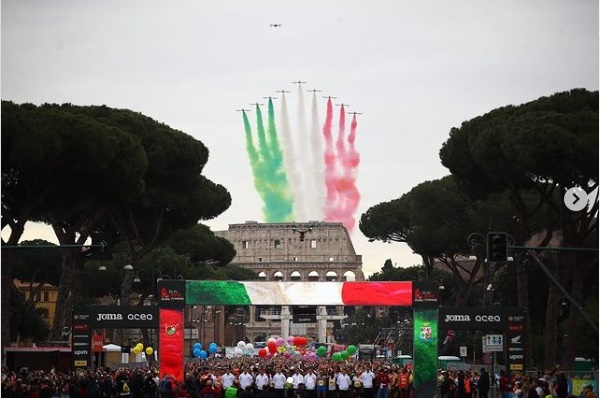
I opened the Whatsapp message which she’d sent after finishing. “Tbh the whole thing felt easy” it read. It had taken 4hr35 to run the cobbled streets of Rome and not only was it her first marathon, she only started training in November and never ran further than 17½ miles (28km). Yet reaching that distance on race day she opened the jets and picked up her pace, running the final kilometres quicker than a 4hr15 marathoner and throwing in a 5:37 kilometre to the finish line. That is not how most marathoners, especially at the slower end of the field get through their first marathon.

Last September my daughter asked me whether she had enough time to train for Rome marathon. I said “Yes” and wrote her a training plan. She responded by not following it and barely doing any running! After six weeks her biggest week had only covered 12miles and a longest run of 1hr16. It was not a great start. It was the arrival of a new flatmate, with whom she could go running, which kickstarted things; I rewrote the plan and from there on she trained diligently for 4½ months to experience a great marathon and finish in the top half of women finishers.


When she signed up, she was barely running, just thirty miles in the preceding six months. In the past she had done occasional morning runs, pushing all-out to achieve around a 27-min 5K, but this needed a different approach. The training plan I gave her built up to running five times per week and peaking at 35 miles and needing a commitment of up to six hours. Apart from when it was raining, I never heard any complaints or desire for training to be over. All in all, I’m really pleased that my coaching and her hard work resulted in a successful first marathon.

With so little running done prior to starting I knew there were some challenges regarding how to prioritise training. There were a number of things needing to be done.

– Get her used to do high volumes of weekly running – I wanted her to run five days per week and train for 5-6 hours. After all if you can’t run five hours in a week, how can you expect to run it in one race?

– There was the all-important question of how to train a slower runner for the distance on the day? As I wrote in The 20-mile myth beginners are wedded to the idea that because committed runners of the past always trained to reach twenty miles they have to as well. Yet the training benefits are highly questionable and I’ve met many of these slower runners whose marathon training becomes a slog because they spend consecutive cold, wet Sundays in February out for four hours or more. On race day they end up walking anyway and taking five hours.

My decision was I would train her by time and the longest run would be 3hr15. But some of these long runs were to be preceded by a run the day before. This would take the total time spent running on a weekend to four hours and closer to her expected race time. It would have to be enough.

– Ideally I wanted to improve her speed because that would then trickle down to her other paces. It’s obvious if you can run a faster easy pace then the long run will cover more ground.

– The last three weeks of training would be taken up by a taper. By necessity this would cut into the weeks available to make progress through training.

– The final factor to account for was the non-running parts of her life. We had Christmas and New Year coming up and currently being based in Italy she was going to do some travelling as well as university exams. I managed to accommodate these around the training with only a few things moved around.


Once training began properly we built the base in November and December. By New Year I was satisfied she could do 5+ hours running every week without injury or illness coming up. To this point, every run had been at an easy pace of 11 minute miles or slower. She didn’t particularly like it as she prefers going out quickly but did what was asked.

Her first two hour long run was reached at the start of December and we built on from there in small manageable chunks so that by mid-January, she was able to do her first three hour run. This was followed by three more runs of three hours including a 3hr15 run which was the longest at 17½ miles, or two-thirds of the marathon distance.

With the base built, I introduced faster midweek runs lasting up to an hour. Initially at a 10:30/mile pace, as the weeks went by the runs quickened up to be as fast as 9:30/mile. These steady runs continued up until the taper began.

In late January I took her to Christchurch 10K – her first official race. I wanted her to get an idea of what a race is like. How much standing around there is, what it’s like to run with other people. Given her best 5K was around 27 minutes, I expected her to run 57-58 minutes. I was amazed when she finished in under 55 minutes – an 8:45/mile pace which was much faster than anything she’d been training at. It was a great result and informed me of the paces required for the rest of her training. With two months to go to race day it was now all about building stamina and endurance for the big day.

On race day, she was aiming to break 4hr30. To keep it simple, I gave instructions to pace at 6:20/km which is running three kilometres every nineteen minutes – nice simple maths. This would bring her in for a time of 4hr27. From the 10K race I knew this was within her capabilities, probably even faster. She was accompanied by her flatmate and they paced themselves consistently except they used a phone to measure the distance rather than going with the race markers. Consequently they were running 10-15sec/km too slow and went through halfway on pace for a 4hr40 marathon. Soon after her flatmate’s leg began to hurt so they separated at 28km and my daughter sped up running to the end at the pace of a 4hr18 marathoner. Not bad considering she’d never run past 28km in training!! Her flatmate, reportedly a 38-min 10K runner but who hadn’t followed any of my training plan, limped home in over five hours.

Later another Whatsapp said “The whole time I could talk easily and the time went very quickly. At no point did it feel long”.

Not many first time marathoners have as an experience as good as this. It all comes down to well-structured training, putting in the miles and running at the right paces. The postrace Whatsapp stated “Didn’t feel hard. Harder training sessions”. And there’s no doubt she put together some good training sessions. Come marathon day, after the taper, it all came together.

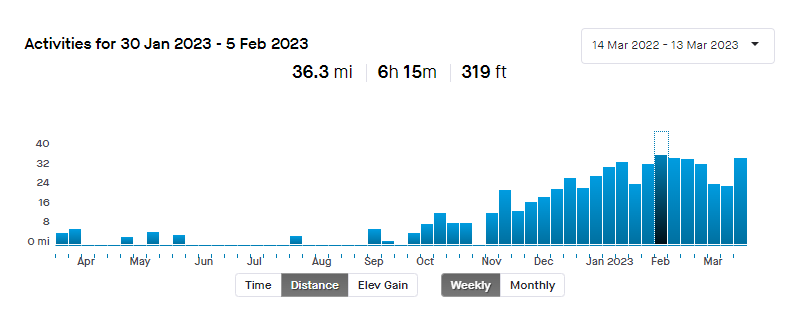
The highest volume of training came in January and February where it was eight consecutive weeks averaging around six hours. The monthly mileage was September 10miles, October 30miles, November 76miles, December 109miles, January 132miles, February 133miles and March 81miles including the marathon. Those figures in the middle may sound big and they are, but when carefully built up to and interspersed with lots of easy miles they accumulate without wearing you down. That was a focus of my coaching to maintain motivation and never let it feel like it was becoming too much.

There is no way to run a decent, comfortable marathon without doing the training. I’ve tried and it didn’t go well. Equally it’s possible to do heaps of training and still run a poor one. What I offer to runners is the knowledge of how to structure training optimally to give them a good shot at success on race day.


If you would like me to coach you, either on an ongoing basis, for a specific race or simply to have a one-off training review where I make recommendations on how you can improve your training then please Contact me for a no obligation look at whether I can help you.

My Last Marathon

I’ve only completed four marathons in my life. All of them were back in the days when I wasn’t a committed runner. It seems I was following, what is now, a familiar box-ticking approach to running. My first distance race was a 10K as parkrun didn’t exist then and 5K races were rare. But the sequence is standard – run a few races at a short distance then move on up to eventually do a full marathon. Now I realise training for, and successfully running, a full marathon is a big commitment if you want to do it well. Although I knew then you should do six months of training beforehand, I was only focused on getting the long run done. Again this is a familiar story of modern runners.

On the New Forest paths

My last marathon was way back in 2010 and, for the first time in my life, I was beginning to train more regularly. I began the year by entering a twenty mile race which, when the train had demoralised me enough, I downgraded to ten miles. I followed it up a few weeks later with the Bournemouth Bay 1/2M in 1hr38+ at the beginning of April. To that date, it was the best race I’d ever done and knocked 12-13 minutes off my old Personal Best.

In the weeks following the half I began to lose interest in running and it was by entering the New Forest marathon, scheduled for late September, that I found motivation to get out and train again. I was in decent shape and with five months training, it should have been easy. In fact by early June I’d completed the twenty-mile run leapfrogging from fourteen to seventeen to twenty. I spoke with an experienced runner and he suggested there was no need to do the twenty miles every week and my records show I only did a fourteen mile run after that before disaster struck and I pulled a calf muscle. I lost the whole of July and it was early August when I could run again.

Suddenly I only had eight weeks until the marathon and I’d gone from having over three months to improve on my twenty mile long run to needing to rebuild entirely. Still believing in the necessity of the twenty mile long run but also recognising I couldn’t do it the week before the marathon I squeezed training into six weeks – 9, 11, 14, 17, 18, 20½, dropped to 9 miles and then ran the marathon the following week. I often say the reason it worked so well for me is because I didn’t have time to overtrain or under-recover!


On the day, two non-running moments stand out in my memory.

Firstly I arrived to collect my number which my racepack said was something like #1600. In the sportshall, I saw two collection desks one with a sign saying “Marathon 1-999” and “Half Marathon 1000-2000”. I was confused as my number suggested I was running the half but I knew this wasn’t the case. What most surprised me is how devastating this was to my psyche. I’d prepared for the longer distance, so if I had to run half the distance it would surely be no trouble. I could see it would be a problem if you’d only trained for a half and then found yourself expected to somehow do double the distance but, not when you knew you’d run over seven miles further in training. Somehow it was devastating.

I talked to the organiser adamant that I’d entered the full marathon while he said I couldn’t have; fortunately he was willing to move me into that race anyway. Once I’d got my sub-1000 number I felt calm about what was ahead.

The second issue was forgetting my new running shoes. Of course I knew you don’t run a marathon in a new pair of shoes, so I’d broken them in before the race. But I forgot to bring them along and ended up running the marathon in the old battered pair which had lasted me all through training. Oh well. I didn’t get any lasting injuries so no harm, no foul. Not good race day preparation though, yet not the first time it happened to me!


The race itself went well. Classic autumn day and decent conditions – sunny, warm and not too humid. I’d borrowed a Garmin from a work colleague and watched the miles tick by. I’m not sure whether I went into it with an intended time – I suspect I did as I’d begun to discover the online race calculators. Whether I did or not I found myself running around 8:15/mile and with the help of the Garmin I was able to keep on track. I don’t remember much of the run other than it was scenic and all around the New Forest. I’d bought five gels, which is the only race I’ve ever used them in and on advice took one every forty-five minutes thereby consuming the 4th at the 3-hour mark. It worked well and when I finished in 3hr40min59, I still had one left.

As with any marathon the running got tough in the final miles. I’d covered the first twenty in 2hr45 and the final 10K in 55mins. It was slippage that cost me perhaps five minutes and had I gone into it better trained maybe I’d have achieved a sub 3hr30 time but I was happy with what I’d achieved. I still am.

Most important to me was I’d done the whole run without stopping or walking – the only one of my four. I started running in the early 1990s when races were still predominantly filled by club runners. The sub-4 marathon was the benchmark for any aspiring runner and while it was accepted you might run out of steam and need to walk at some stage; running all the way was a badge of honour.


Incidentally when I arrived home and checked my emails, I found had entered the half marathon five months before, back in April. I’m not sure how I mixed it up but there’s no doubt from the training that I always intended to do the full 26.2 miles.

The Ageing Runner – Part 4 Long distance

If you missed part 1 you can find it here, part 2 is here, part 3 is here.

When we started Poole parkrun the attendance was well below two hundred runners each week which made it easy to get to know everybody. As the London Marathon rolled around in the April, I was excited to follow runners like Liz Yelling, who was aiming at an Olympic place, and Steve Way, who’d run three consecutive 2hr19s. But it wasn’t just the elites who caught my interest, I’d got to know runners of all abilities and using the online tracking kept an eye on a variety of people who’d be running from over four hours through to those attempting to run sub-3.

One of the success stories was Dave Cartwright, who ran a sub-2hr55 marathon on his way to being the fastest man in the 60-64 age group that day. Footage of him crossing the finish line was doubly amusing as he was shown on BBC TV patting model Nell McAndrew on the shoulder who, despite being over twenty years younger, had finished only just ahead of him. Now in his seventies, Dave is still running round Poole parkrun in under twenty-two minutes and completing Blackmore Vale half marathon in under 1hr40. These times are fantastic to most people and yet, they’re not close to the times of the best in his age group as we shall see.

Recently two V55s, Andrew Ridley and Duncan Cooper came 8th and 9th in a field of over seven hundred runners. Their times were 16:27 and 16:35 respectively. Andrew’s age-graded time equates to 95% but his efforts also give insight into how slow decline can be. He set his Poole parkrun PB of 16:15 having only just turned fifty, yet here he is seven years later running only twelve seconds slower. Barely two seconds decline per year. I know Andrew trains very hard to keep his speed intact for 800m racing.

Age group world records for 5000m

TimeAthleteDateTimeAthleteDate
World Record12:35Joshua Cheptegei14-Aug-20 14:07Letesenbet Gidey07-Oct-20
V3512:54Bernard Lagat22-Jul-11 14:34Edith Masai02-Jun-06
V4013:07Bernard Lagat20-Aug-16 15:05Joanne Pavey05-Jun-14
V4514:24Lucien Rault19-Jun-82 15:56Nicole Leveque01-Jun-96
V5014:53Sean Wade25-Mar-16 16:51Gitte Karlshøj23-Jun-09
V5515:30Keith Bateman05-Jan-11 17:29Silke Schmidt27-Jun-15
V6015:56Yoshitsugu Iwanaga14-Nov-20 17:59Silke Schmidt20-Sep-19
V6516:39Derek Turnbull13-Mar-92 20:08Kathryn Martin28-Oct-16
V7018:16Ron Robertson09-Jul-11 20:56Angela Copson25-Jun-17
V7519:07Ed Whitlock23-Jul-06 23:31Lavinia Petrie28-Apr-19
V8020:20Jose Vicente
Rioseco Lopez
04-Sep-21 25:40Yoko Nakano12-Sep-18
V8524:04Ed Whitlock30-Jul-16 27:38Yoko Nakano23-Nov-21
V9030:00Yoshimitsu Miyauchi20-Sep-14 
V9539:43Antonio Nacca04-May-19 

Age group world records for the 10,000m

TimeAthleteDateTimeAthleteDate
World Record26:11Joshua Cheptegei07-Oct-20 29:01Letesenbet Gidey08-Jun-21
V3526:51Haile Gebrselassie24-May-08 30:53Joanne Pavey03-Aug-12
V4027:49Bernard Lagat01-May-16 31:25Sinead Diver28-Sep-19
V4529:44Kevin Castille17-Mar-17 32:34Evy Palm04-Sep-88
V5030:49Sean Wade01-Apr-16 35:06Fiona Matheson16-Oct-11
V5531:52Keith Bateman26-Mar-11 36:47Sally Gibbs11-Nov-19
V6033:40Yoshitsugu Iwanaga28-Nov-20 37:58Mariko Yugeta14-Nov-20
V6534:42Derek Turnbull15-Mar-92 41:40Angela Copson05-Aug-12
V7038:04Ed Whitlock09-Jul-01 44:25Angela Copson28-Jul-17
V7539:25Ed Whitlock21-Jul-06 50:01Melitta
Czerwenka-Nagel
28-Aug-05
V8042:40Ed Whitlock09-Jul-11 51:47Yoko Nakano06-May-18
V8551:08Ed Whitlock12-Aug-16 1:26:15Vladylena Kokina21-Sep-14
V901:09:28Gordon Porteous17-Oct-04 

Age group world records for the marathon

TimeAthleteDateTimeAthleteDate
World Record2:01:39Eliud Kipchoge16-Sep-18 2:14:04Brigid Kosgei13-Oct-19
V352:03:59Haile Gebrselassie28-Sep-08 2:19:19Irina Mikitenko28-Sep-08
V402:06:25Ayad Lamdassem24-Feb-22 2:19:52Helalia Johannes06-Dec-20
V452:14:23Bernard Lagat29-Feb-20 2:28:34Catherine Bertone23-Sep-17
V502:19:29Titus Mamabolo20-Jul-91 2:31:05Tatyana Pozdnyakova06-Mar-05
V552:25:56Piet van Alphen19-Apr-86 2:50:40Jenny Hitchings03-Nov-19
V602:30:02Tommy Hughes25-Oct-20 2:52:13Mariko Yugeta31-Jan-21
V652:41:57Derek Turnbull12-Apr-92 3:07:51Kimi Ushiroda15-Dec-19
V702:54:48Ed Whitlock26-Sep-04 3:24:48Jeannie Rice29-Sep-19
V753:04:54Ed Whitlock15-Apr-07 3:53:42Yoko Nakano23-Nov-12
V803:15:54Ed Whitlock16-Oct-11 4:11:45Yoko Nakano26-Feb-17
V853:56:38Ed Whitlock16-Oct-16 5:14:26Betty Jean McHugh09-Dec-12
V906:46:34Ernest Van Leeuwen06-Mar-05 8:53:08Mavis Lindgren28-Sep-97

Notes on Masters world records

All data was updated from Wikipedia in mid-June 2022. The aim is not to create a comprehensive set of records but to give readers an indication of what is possible. I will periodically update these when I can.