The First sub 3:50 woman

Elite women run fast. We know the sprinters are very fast running under 11seconds for a 100m. On Friday June 2nd at the third Diamond League meeting of 2023, Faith Kipyegon showed she has great speed reaching 25km/hr at times. It was that speed, combined with endurance, which enabled her to become the first woman to run 1,500m in under 3:50 – a pace which would have brought her in for 4:06 for a mile.

As the reigning Olympic and World Champion, Kenya’s Kipyegon who is approaching thirty years old was heavily favoured to win in Florence, Italy. While pacemakers are still present to lead runners out in the early laps, modern athletics now has a moving set of lights around the edge of the track to help with even pacing. These had been set at 62secs per 400m which equates to a 3:52.5 time.
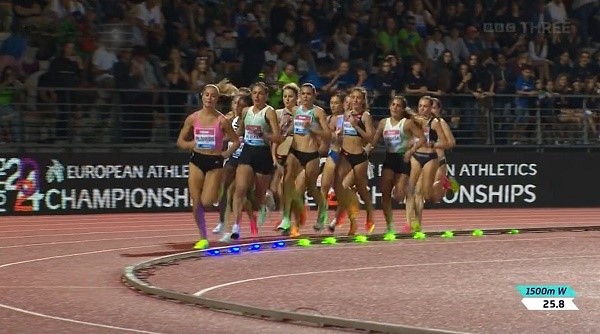
The blue and yellow lights indicate the required pace

I took a look at the race to see how it was run and find out how the laps broke down. Due to its distance the 1,500 metres is unusual in starting at the beginning of the back straight – which allows athletes to cover 300m followed by three laps of 400m.

The splits as best I could determine them were:

  • 100m – 14.5secs – imagine that. How many of us can even run that from a standing start without blocks even without having to run a further 1,400m?
  • 300m – 46s – first crossing of the finish line
  • 400m – 1:02.37s – first lap of the track
  • 700m – 1:48.2s – second crossing of the finish line. Just before this around the 600m mark the first pacemaker dropped out
  • 800m – 2:04 – second lap of the track taking 61.63s. The other pacemaker drops out at 900m
  • 1100m – 2:50 – third crossing of the finish line – one full lap to go
  • 1200m – 3:05.28 – third lap of the track taking 61.28s. The last 100m has only taken 15-16s
  • 1500m – 3:49.11 – a new WORLD RECORD.  The final lap has taken 58.81s – a pace of 3:57/mile

It’s a truly remarkable performance which saw Britain’s Laura Muir finishing eight seconds behind in a season’s best time of 3:57.09 and Australia’s Jess Hull setting a national record in 3:57.29 as she finished third. Both runners had worked their hardest to keep up with Faith Kipyegon yet they ended up thirty metres behind. No-one in the rest of the field could even crack four minutes which begins to give an indication of the gulf that exists between Kipyegon and the others.
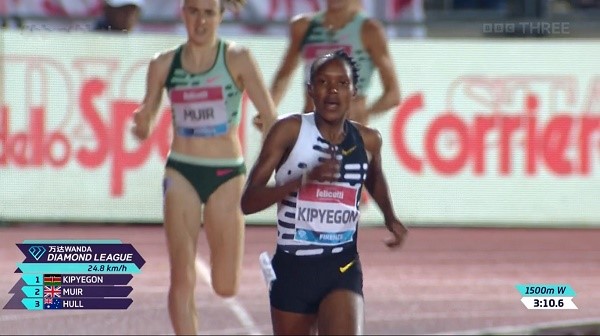
Faith Kipyegon flies down the back straight on her way to a new world record

Watching her run, she has decent compact form and is very balanced. Every stride is powerful and I’d estimate she’s taking around 200 steps per minute. This isn’t unusual for a middle distance runner or for a shorter runner. Faith is listed at 1.57m / 5’2” and weighs 43kg / 93lbs. What’s surprising is when you calculate the distance she’s covering with each step it works out at around 2.08m and that’s over 30% longer than she is tall. And she’s doing it for almost four minutes!

As a coach, these are the things I think about and marvel at. I’ve previously written two articles on stride length (first and second) as well as what elite runners speed is. Developing these can take time but is worthwhile even for distance runners. Consider that on average Faith Kipyegon’s new world record is the equivalent of running fifteen consecutive 100m races in 15.2secs and there are no excuses available about having little legs!
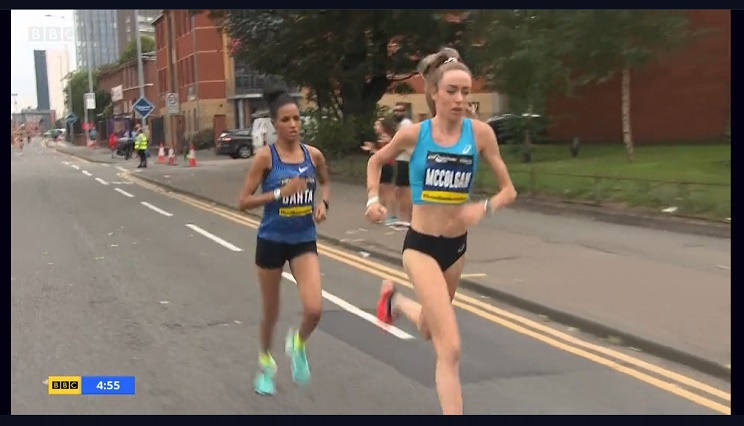
Eilish’s low mileage

Scotland’s Eilish McColgan is the current golden girl of British Athletics. This year she has set distance records, the first occurred in February when she broke Paula Radcliffe’s British half marathon record by 21 seconds in 1:06:26. Then in May, she ran 30:19 to take Radcliffe’s 10K road record and on Monday (June 6th), she ran this time again on the track in Hengelo, Netherlands to set a Scottish record.

The McColgan name is not unfamiliar to followers of running. Her mother, Liz, was the World Champion in 1991 at the 10,000m having already been Commonwealth Games champion in 1986 and 1990 and silver medal winner at the 1988 Seoul Olympics. When she moved up to the marathon distance she won New York (1991), Tokyo (1992) and London (1996) marathons. Eilish’s father, Peter McColgan, was also a talented distance runner who competed for Northern Ireland in the 3,000m steeplechase and 5,000m at the Edinburgh Commonwealth games as well as for Great Britain in the steeplechase at the 1991 World Championships. What a pedigree for Eilish to have!

Not only does she have the genetic advantage but Eilish is also part of a generation of successful female Scottish distance runners. Laura Muir has been the most successful gaining a silver medal at last year’s Tokyo Olympics where she set a British record for the 1,500m in a time of 3:54.50  In 2012, Lynsey Sharp was European champion and competed at the London Olympics in the 800m. She followed this up four years later setting a Scottish record of 1:57.69 while finishing 6th in the Rio Olympic final.


A recent BBC article detailed that this year’s success is down to Eilish undertaking a reduced training load that Liz had to be persuaded would be in Eilish’s best interest. Liz had been running as much as 140 miles per week in her marathon prime.

But this highlights the event differences. Liz was always a long distance runner doing 10,000m and marathons. Following in her dad’s footsteps, Eilish competed in the 3,000m steeplechase for Great Britain at the London Olympics and then the 5,000m in Rio. It wasn’t until 2018 (when she 28 years old) that she began racing longer distances winning the ten mile Great South Run in 54:43. Roll on three years to the Tokyo Olympics and Eilish competed in both the 5,000 and 10,000m. Looking back at her Personal Bests, her time for 800m is 2:07.8 – over ten seconds slower than Lynsey Sharp and her mile is 4:00.97 which is five seconds slower than Muir. It’s clear that although Eilish competes in middle distance races, she lacks the top-end speed to be winner against the best and like her parents is better suited to the longer distances.

So it’s surprising when she talks in the article about how her training increased from 20, 30, 40, 50 miles per week and has only been operating at 65-70 over the last year and a half to two years. It’s not unusual for a world class 800m runner to operate on as little as forty miles per week but Eilish isn’t one. Typically world class 5,000 – 10,00m runners train between 70-100mpw. Given the recent increase in training mileage, it’s no surprise that when Eilish returned to the Great South run last October she was four minutes quicker than three years ago.

There’s no doubt decent mileage is critical to distance running success and Eilish’s approach of starting on low mileage and building up is a good one to follow but far too many runners simply aren’t doing enough mileage to support longterm improvement. Getting the balance right is important and, as Eilish shows, great results can be achieved off moderate mileage.

While I don’t wish to take anything away from how hard I’m sure she’s working in training, it should be noted many road and track records have been broken over the past couple of years due to the innovation of carbon plates in shoes. I am slightly sceptical Eilish would have been breaking Radcliffe’s records without them (at least in the near future); but many past records have been broken due to now-forgotten reasons outside of better athletic prowess. And in the longer term, unless the IAAF backtracks on the use of carbon plates, these records will become the new standard. All power to her – she’s still the best we’ve seen in a long time.

Whatever the reason, I have no doubt Eilish McColgan is going to go on to greater things as she gets the benefit of higher mileages and moves up to the longer distances permanently. At 31 years old, she has potential for another Olympic cycle in her and maybe more. I’m sure she will be looking to emulate her mother by taking on the London Marathon and other Majors.


Bonus content – Eilish is listed in Wikipedia at 1.80m (5’11). In my article on stride length I observed her cadence averaging 172 steps per minute giving her a stride length of 1.97m. It’s easy to think this is because she is tall and to an extent it is. But, as I also pointed out, Eliud Kipchoge (1.67m – 5’6”) has a stride length of almost two metres – about 15% greater than his height.

A quick look back at Paula Radcliffe running mile 5 of her record-setting 2003 London Marathon shows her running with a stride length of 1.67m (186-88 cadence) when she is 1.73m tall (5’8”). It’s a decent stride but it’s shorter than she is!