At some stage, every runner picks up an injury or illness or even just stops running for a few months. Typically when they restart they try to get back up to their old mileage and paces quickly. Particularly with an injury this isn’t smart. You have to rebuild carefully from small beginnings and extend the runs as the fitness returns. The last thing you add back is intensity.
To give an example of how it should look, I’m going to rewind to when I last had a notable break. It was 2018 – over five years ago and as I documented in my running streak I’ve barely taken any time off since then. The only notable breaks were taking a few days off to taper into and recover from a half marathon.
At the start of year I was running really well. I’d cracked the endurance conundrum and found myself comfortably running for 8-9 hours each week and covering 60-65 miles. I had organically built this mileage up and it all felt very comfortable. In fact, in late 2017 I’d been trying to limit myself to 8hrs per week but I began to feel like I wasn’t getting any benefit and needed to do more.
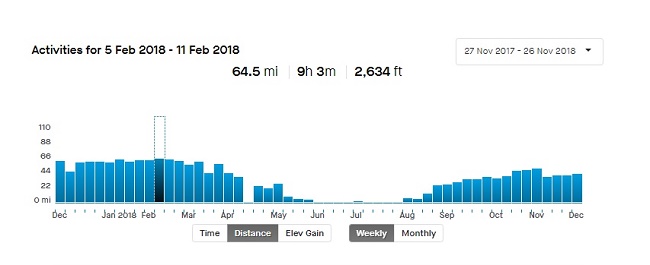
You can see from the Strava data that my mileage was consistently high through Jan-Feb as I prepared for an April half marathon. March began to taper down and then I had a minor accident slipping on some ice. I believe this was the beginning of the injury I had that summer. The half marathon went badly and when I returned to running afterwards I had some pains and while I hoped to be able to run through these, by the end of May I had to admit defeat and accept I needed to let the injury recover.
I had some kind of core injury which stopped me from doing any kind of sporting activity. I don’t believe there’s been a longer phase in my life where I was inactive than the following two months through June and July. With the core being literally the core, there was nothing I could do, I couldn’t go swing a golf club, I could barely do garden work. I just rested.
People I spoke to wonder how I was surviving without being able to go exercise. They know how it dominates my life yet I was quite comfortable sitting in a chair and reading, waiting for it to heal. Despite barely eating over the next two months I put on almost twenty pounds with the activity and my waistline went up a couple of inches. No-one would have accused me of being fat but I was bigger.
My one deference to the inactivity was a weekly lap of the road I live on. Being a crescent, it’s a very convenient loop so I would run a single lap each Sunday to see if the injury was still affecting me. Each week, I would discover it was still painful despite running for less than three minutes at a slow pace.
Eventually though, one day I sensed a difference and felt ready to return. Here’s what my training return looked like:
| Week 1 | |
| Mon | |
| Tues | 2min test – the green light to restart |
| Weds | 15 min run |
| Thurs | |
| Fri | 14 mins30 |
| Sat | 16 mins30 |
| Sun | |
| Total | 4 runs totalling 48mins |
Having felt good on the Tuesday test I was excited to restart. So I began with a single fifteen minute run. On reflection, possibly even this was too long and it should only have been 5-10minutes but it didn’t present issues. To be on the safe side, I took a rest day on Thursday and then ran again on Friday. I ran the same route and came in thirty seconds faster. I then ran again the next day and as I was a little quicker again, I tacked on an extra 400m loop of my road to take it past fifteen minutes. That was it for the week. Three main runs of fifteen minutes and lots of recovery time.
Remember I had been running an hour every day for weeks on end less than six months previously so it’s a huge cutdown.
| Week 2 | |
| Mon | 15 mins |
| Tues | 30 mins |
| Weds | |
| Thurs | 35 mins |
| Fri | 15 mins |
| Sat | 33 mins – hilly parkrun |
| Sun | |
| Total | 5 runs totalling 2hr04 |
I had some coaching working to do on Monday so I ran the warm-up and had some aches and pains until I got going. Given that’s the case, I now question why I did a thirty minute run the next day but this is the curse of the returning runner. Wanting to pick back up sooner than they should. Sensibly I then took a rest day.
On the Thursday, I ran a fairly flat route and still had some pains but usually only at the beginning of runs. The Friday was a short recovery run.
On Saturday I went back to parkrun. I ran 33mins which is about 10min30/mile and my notes states “hardly an ache at this pace”. That’s the key with all injury recovery – you have to stay ‘below’ the injury. Certainly in terms of pace but also duration. If the injury starts to flare at a particular pace or after a certain distance, you back off to build the fitness you can without worsening matters.
Anyway I was very pleased to have now achieved two weeks of training without relapse.
| Week 3 | |
| Mon | 45 mins on the flat – dedicated 4.5 mile route |
| Tues | 20 mins recovery |
| Weds | 45 mins on the flat – dedicated 4.5 mile route |
| Thurs | 30 mins on the flat |
| Fri | |
| Sat | 29 min parkrun – 4 mins quicker than last week |
| Sun | 1hr22 long run – dedicated 7.5 mile route |
| Total | 6 runs totalling 4hr14 |
Following the Sunday rest day, I went for a run on the prom at the beach. It was a forty-five minute effort and my notes state it wasn’t enjoyable. I guess because I’d managed to run for two weeks without injury returning I felt I now had to just rebuild. Running is always tough when your fitness is lacking so I just felt I had to go through it. Note I still did a short recovery run the next day and generally ran in the flattest places possible to keep intensity to a minimum.
After another Friday rest day, I knocked 4-mins off my parkrun despite trying no harder and then on the Sunday went for a long run. It was tough. It started out quite slow and the ‘new territory’ of the last three miles had me running at 11min30/mile pace – for some that may not seem that slow but consider I was capable of running close to 6min/mile at the start of the year.
| Week 4 | |
| Mon | 20mins Recovery |
| Tues | 40mins Steady |
| 30mins including 10mins faster (coaching) | |
| Weds | 20mins – Recovery AM |
| 20mins – Recovery PM | |
| Thurs | 40min Recovery |
| Fri | |
| Sat | 30mins at Chichester parkrun |
| Sun | 40min recovery |
| Total | 6 runs totalling 4hr23 |
The following week I continued running and managed to do six days on the road. I even did a couple of small double sessions on the Tuesday and Wednesday. After a Friday rest, I went to Chichester parkrun as I was visiting friends and ran it in 27mins but on the Sunday morning, after a late night out I had nothing in the tank so only managed a 40-min run.

By this point I’d completed four weeks and felt confident the injury wasn’t returning. Within a month I was running 23mins at Hasting parkrun and training continued on from there. I slowly rebuilt my running and it was almost six months before I was regularly running eight hours per week again. There simply wasn’t the need until I’d rebuilt my fitness.
I often say to runners who are coming back from injury that it’s better to take a little longer and avoid relapse than to get into a depressing cycle of restart, relapse, sit and wait then restart, relapse, sit and wait …
Of course many don’t want to hear that. They finally feel fit, they have goals, they feel they’re getting older and will lose their speed. Having been patient and unable to run for some time they want to get going again. What they don’t consider is that it doesn’t have to be an all-or-nothing approach. The swing between the two extremes of thinking they are either ready to run or still injured. Consequently when they restart, they dive back in rather than testing their fitness step by step.
My advice to any running returning from injury is :
- Restart with very short runs to test how the affected area responds – run for only 5-15mins.
- Rest the day after each run to give extra recovery time. If you run the very next day it might be too soon.
- Don’t be too quick to add on mileage and every time you do, let it consolidate.
- The last thing you add is intensity – wait until you’ve rebuilt a solid base of running.
In fact, much of the mileage you may have been doing before will have been because of aerobic efficiency. That will naturally return as your fitness rebuilds.
One final thought – when you restart after an injury, invariably you will encounter some pain. Sometimes it is hard to be sure of why this is happening. It could be the injury hasn’t fully healed in which case you have to give it more time. But it could be some scar tissue from the injury healing and this needs to be broken down. How do you know which is which? You can never be sure, so err on the side of caution, take the rehab slowly and see how it proceeds.
 Big Red Running