The Joy of Deadlifts

Another winter of gymwork comes to an end and I have to say I’ve really enjoyed it. And here’s the bonus – I feel physically really good from it. This year my deadlifting has gone through the roof and it feels like it’s made a massive difference to my running.
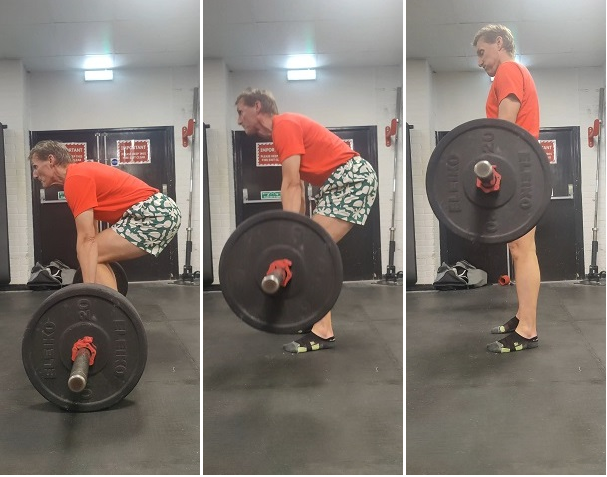
Pulling 90kg deadlift

My rationale for joining the gym was established over the summer of 2024 when I’d exhausted my training options at home. I own a few bits of kit; weighted vests and dumb bells but at most I could only add 30kg to my bodyweight if I was doing squats or step-ups. If I wanted to get stronger I either needed to buy more weights or join a gym to use theirs. While the former may be cheaper in the long run (assuming you use it); the latter is better for not cluttering up your home as the gym will always have more weights and equipment than I can ever store.

I got a six month membership at the end of September 2024 to take me through the winter but set myself no specific targets. There were some questions at the back of my mind. Would I be able to bench press more than when I lifted weights at twenty years old? Would I be able to half squat the 130kg I could manage in my late thirties? The answer to the latter was a resounding “Yes” as I was doing 1/4 squats at 150kg within twelve weeks. Unfortunately the answer to the bench question was a disappointing “No” as I only managed a 75kg bench press and failed when I attempted 80kg. Across the six months I didn’t make much progress as I was able to do 70kg within a month of starting.

Training Goals

As someone who is usually striving to improve, I don’t feel a need to set goals other than for a direction to work in. As I’ve got older and my personality has become more rounded, I find there is an overlapping bunch of things I want to achieve and at the gym the main ones were:

One day I bumped into Caroline, a lady from Human Resources where we both used to work. Despite my protestations that my goals weren’t SMART, she reckoned they are because what I’m doing is specific, its  measurable, attainable, recorded and there is a timeframe involved – I wanted to get all this done before my membership expired and I headed back outdoors for the summer. Technically she’s right as I keep a record of each session and weights are easy to measure but my goals are what I’m calling hesitant goals – they end in ER – I want to be stronger, fitter and better than when I started. There’s not much specificity in what the actual targets are.

Ultimately though my goals are wrapped up in an overarching desire to be as healthy as reasonably possible. This is probably the most important thing for me; I’m not going to push my body to such extremes that it becomes unhealthy just to be able to lift an extra 10kg. Now in my mid-fifties I recognise some things are getting weaker or beginning to ail and I want to stave off that age-process as best I can.

Squats

Last year squats were my focus and I completed a 100kg deep squat before I left. This year on the advice of Alex, one of the powerlifters, I changed my form and this allowed me to get deeper. Unfortunately soon after this change my adductor tightened up on a run and made squatting heavy loads difficult, maybe even painful. Running wise it never affected me but I did have a similar injury back in 2012 which took three months to recover from and I couldn’t run. So I’m not sure whether it was running or weights or an interaction of them which caused the problem but it stopped me improving my squat from November to early February.

When I was able to squat again, I was only doing sets of 75kg but with smarter training managed to eke out a 100kg deep squat on my last session. It was touch and go whether I’d complete it whereas last year it went up easily and I could probably have added another 2.5 – 5kg. Nonetheless I felt pleased to match last year despite only doing three decent months of squatting and with better form.

Deadlifts

Where squats were problematic, deadlifts were a resounding success. I started at 80-90kg, the latter of which is bodyweight and on week three was just able to do 105kg but I felt like Quasimodo, the hunchback of Notre Dame, as my back was rounding and my grip was screaming out to drop the bar before it slipped out of my fingers.

Staying healthy is an overarching goal and the one thing I didn’t want to do is mess up my spine. A slipped disc or similar will never properly heal. For that reason, I backed off the heavy weight and built up from 90kg focusing on form and from there it was a straight line of improvement. Every session I seemed to add 2.5kg to the bar and complete 3 sets of 6 reps.

By Christmas I was at 122.5kg and while I had no particularly goals when I started, I had read a runner should be able to deadlift 3 sets of 8 at 1.5 – 1.8 times their bodyweight. That equates to 135 – 162kg for me and it seemed unthinkable that I wouldn’t be able to achieve this with so much success behind me and another three months to train.
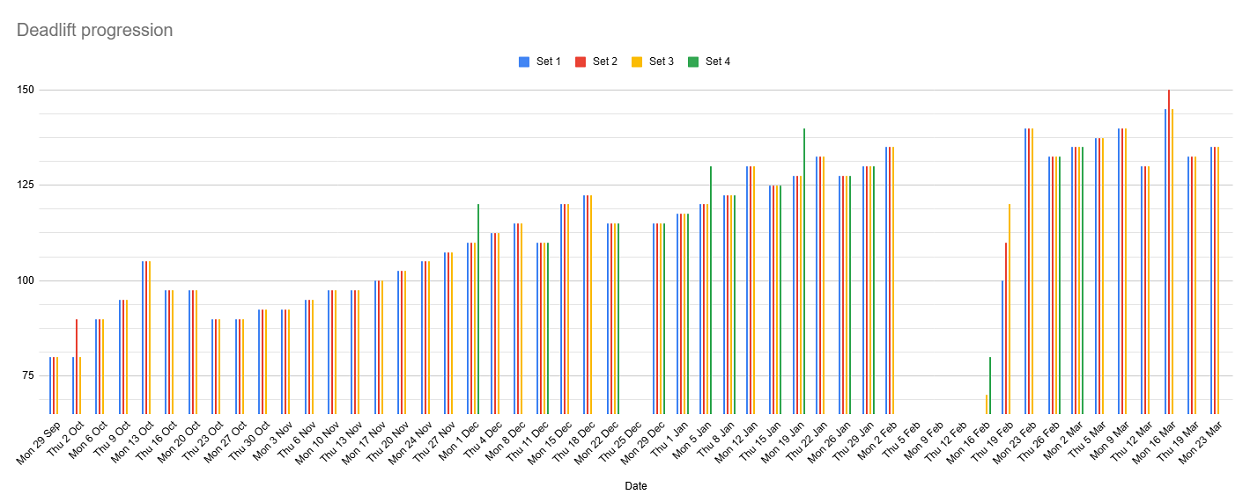
Deadlift progression over winter 2025-26

I needed the Christmas break though as I was beginning to feel beat up with all that improvement and I started doing four sets at lower weights to increase the overall lifting volume while giving my top end muscle a chance to recover.

I continued improving until I reached 132.5kg where I experienced my first failure to complete 3 sets of 6 and from here onwards, my progress became notably slower. With hindsight it seems like this was a threshold weight where things changed.

I managed some sets/reps at 140kg and while my legs were strong enough it was my top half which was beginning to fail me. Completing the hip hinge could be tough, my grip would slip and worst of all I strained my right lat when lifting at 135kg. Just a slightly  rounding of the upper back was enough to keep me out for a couple of weeks although I could still train squats and everything else in my programme.

The final month or so was tough but rewarding. I started using chalk to stop my sweaty palms from slipping and I progressed my 3 sets of 6 to 140kg. I realised I’d struggle to do this at 145kg with the limited time I had availalble and so opted to do 4 reps at 145kg and then attempt a 150kg lift. In all the deadlifting I’d done the bar never moved so slowly but I managed it. And then I did another set of 4 reps at 145kg. Hitting that 150kg / 330lb deadlift felt like a satisfying winter’s training and allowed me to achieve 3 sets of 8 at 135kg to just make it to the 1.5x bodyweight criteria.

Bench Press

My bench press has been a disappointment again. Despite trying to use the same methodology of doing 3 sets of 6 at each weight, I simply struggled to make gains. I tried all sorts of things from drop sets to increased volume, to emphasising sets of 10 reps to trying sessions with singles, doubles and quad reps.

Arriving back in the weights room six months ago I could bench 60kg and when I left six months later I failed attempting to lift 82.5kg.  Some weeks before I had managed a session of six single reps at 80kg so it was a bit frustrating not to at least manage 85kg and I’m going to rethink my work/recovery balance before next year.

Overall my chest is stronger and better sculpted which I think is also in part due to deadlifts but I haven’t managed to unlock what I need to do for improving my bench press. Maybe this is as far as I will ever get but it seems a little weird that I could only add 33% to my bench press when my deadlift was able to increase almost weekly – adding 65+%.

Pull-ups, deadhangs and six packs

My attempt to do pull-ups has had a modicum of success. On three occasions I’ve managed a single pull-up. I actually did two pull ups about ten minutes apart on one of those days. As I weigh 90kg performing pull-ups has always been something of a struggle. The gym has a machine where you can set the weight it provides to assist you so I began by using 30kg / 66lbs – essentially I was only pulling up 60kg of me. As the weeks went by I decrease the weight until on my final session I used less than 4kg / 8lbs.

Given I’d already done some individual reps perhaps I could have switched over but pull-ups were a low priority exercise and I often did them when I was fatigued after other exercises. I need every bit of help I could reasonably get.

Another low priority exercise were deadhangs which I did from time to time. I built up from 35secs on my first attempt to doing 1min20 which is reasonably decent. I’m now intending to deadhang every day for a minute through the summer, often using a weighted vest to make me heavier and therefore make it more of a challenge.

As for my abs sixpack it’s grown. It’s mostly a vanity thing as while a strong core is important for running, your  core is more than a sixpack. Nonetheless there are definitely abs showing.

Setbacks

As great as it’s all been, I have to say I’m ready for the summer break from the gym. Most mornings when I wake up I’d have some aches or pains based on what I’d worked out the previous day. Usually these would be gone in a few minutes but it’s going to be nice to wake up without them.

There were some small sprains and strains. Firstly there was the adductor as I wrote above. Then in January I strained a rear shoulder muscle doing flies – that made things painful for about a week. I also picked up some golfers elbow which I’ve attributed to the flies – so I stopped doing them – but is also related to grip strength which seemed to know when I’d done deadlifts, bench press, pull-ups and one or two other exercises. There was also a bit of tendinitis in my left bicep which is probably related to these.

Finally there were my lats. The lower portion of these was really tested when I deadlifted. I would usually feel that area after the heaviest deadlifts and sometimes into the next morning. On the positive side it never affected my running.

Overall these were all just minor issues which I was able to manage and while I wanted to achieve goals, they informed me of when to back off training.

Running rewards

By keeping my rep counts low I’ve managed to avoid putting on a significant amount of weight, only 4lbs / under 2kg. With all the leg strength I’ve gained that suggests my weight-to-power ratio will have improved. I’m looking forward to getting back to some sprints.

The real reward from the deadlifts (as well as the better squat form) is the effect they had on firing up my glutes. When I run I’m glute-dominant and skimming along just above the ground. Unfortunately it’s not yet coming through into my running times. It will but all the fast-twitch recruitment has increased my anaerobic capacity andnow needs to be made more aerobic before I get the benefits.

The hidden benefit of deadlifts has been that, as it’s a whole body exercise I’ve strengthened many accessory muscles which don’t get a workout when running. That’s got to reduce the chances of incurring an injury. I feel much more balanced and stable when I’m out running. While it’s great to be able to deadlift a heavy weight, for the purposes of running you need to convert that to power and that’s essentially what I began to implement in the last month or so. I’ll explain what I’ve been up to in my April blog post.

Running Locomotion 101

Running seems easy. It’s the act of putting one foot in front of the other quickly. One of your legs swings out in front of you and you move onto it. Then the other leg moves out in front of you and you do it again.

This much everybody agrees on.

Yet the mechanics of running aren’t taught at school, it’s something we pick up from watching others. Some people seem to intuitively understand what to do to run fast while others seem to lumber along.

If you start to think about it, or look for guidance from the internet, it quickly becomes a morass of information. Is running the same as falling with gravity, repositioning your legs quick enough to avoid landing on your face? Or are you almost jumping or hopping forwards with each step and lifting your knees high to extend the stride? Which muscles do you use when?


Consider that the only thing which moves you forward is pushing the ground away behind you. Powerful muscular contractions of the glutes and hip muscles ‘out the back’ allow you to skim forward over the ground.  Then when the step is complete, you do the same with the other leg. You don’t waste muscular effort repositioning the foot in front of you, you let the body’s natural stretch mechanisms do it.

It’s just like using a slingshot or catapult. You use all your effort to pull the elastic back to its maximum stretch and then, when you let go, it fires forward.  You can’t make a catapult go forwards faster by doing anything other than letting go.

Just like the elastic on the catapult fires past the Y-mechanism eventually it slows down as it runs out of energy. Likewise the leg and foot shoot past the body and end up in front. That’s when you, as a runner, go back to putting the effort in to getting the foot and leg moving backwards to power the next step.


These are the first principles:

These simple principles will help you begin to sort through the advice you read. It won’t cover everything but it’s a good starting place.

On form – excessive rotation

Sprinting into the finish of Lordshill 10K, I was overtaking other runners and feeling strong. Yet my Garmin only recorded a Best Pace of 4:45/mile, which while useful, is slower than Kipchoge runs a whole marathon. Looking at the races photos of my sprint finish, I began to see why and started to think about some form changes. Sadly I never got a copy of the photo so I can’t reveal its horrors but this one from the 2010 New Forest Marathon begins to hint at my lack of form. Here, I was only running at eight minute mile pace, not even trying to sprint.  If I hadn’t mentioned it you might not see much wrong. But there’s issues, notice the heelstrike of the right foot.

At least I look as if I’m enjoying it!

Below is another picture I came across as I was reading through my backlog of Runner’s Worlds. It’s a happy photo, you can see the joy of the runners. I’m guessing they’re approaching the finish as they’re spaced out and smiling, not overwhelmed by already having run for two hours with many more miles left to do. But my eye wasn’t drawn to the runner’s joy, it’s another photo where heelstriking is visible. (This isn’t criticism of the ladies in the image, they’re simply demonstrating something which is common among runners, myself included, that can even be seen at the elite level).

But heel-striking isn’t the focus of this article. That’s because it isn’t caused by, or easily corrected by adjusting, how the foot lands. Heel-striking is simply a reaction to a chain of events. The foot is connected to the ankle, which connects to the shin, to the knee, to the thigh and on up to the hip and pelvis. This is where the problem is really occurring. The pelvis is rotating forward, thereby flinging the leg forward, so the only place the runners can land is on the heel.

It’s hard to see pelvic rotation because the hip and thigh muscles obscure it but there’s another way to identify it. Here’s a close up of the same picture with some lines added. You’ll see I’ve highlighted the shoulders because this is where the issue is obvious. Shoulders also rotate around the spine, which is the centre axis connecting the upper and lower bodies. Whatever happens in the lower half is mirrored in the top half, for example as you walk or run, your arms and legs swing in opposite time. Unless you consciously block it, or have your hands in your pockets, your arms always swing back and forth when moving.

Lower half travelling forwards, top half turning

When there’s excessive pelvic rotation you get excessive shoulder rotation. In the RW photo, the runners’ arms aren’t so much swinging as being turned. If you look back to my photo, you’ll see the opposite shoulder is coming around, emphasised by the arm moving towards the middle of the body. The disaster photo from 2017 of me sprinting, shows an even more pronounced rotation of the shoulders and hips. I would hazard to say my shoulders were 45 degrees to the square – but I’m trying to mask this by swinging my arms straight forward and back despite the turning! I really wish I had the photo to show you how bad it was.

A good way to see why this is a problem is to imagine yourself riding a bike along the road. If you begin to wobble the handlebars then the front wheel wobbles. You end up zigzagging in danger of falling off, continuously understeering and oversteering to try and keep stable. When you keep the handlebars steady your bike travels effortlessly straight. It’s the same issue for the runner. Keep over-rotating the pelvis and you’re constantly fighting to run in a straight line. No longer do the muscles which are most efficient do the work, but lots of auxiliary muscles have to compensate which is both energy costly and puts you at risk of injury.

Sprinters

If you compare this to any world-class sprinter you’ll see their shoulders and hips stay relatively square. Of course some rotation has to happen, we’re simply interested in avoiding excessive rotation. Here’s a video of a sprinter doing 26+ mph on a treadmill. Helpfully, the university researchers have put reflective dots on the sprinter’s body which allow us to see the rotation of the upper and lower bodies. Or rather the lack of it.

We can see there isn’t much rotation occurring in the hips. I’d estimate one hands width, so maybe 3-4 inches. The dot under the armpit is moving more but we never see the shoulder on the far side coming into view. The stability of the hips is reflected in minimal shoulder turn. And if you look at the footstrike while the leg comes out in front, as the foot strikes the treadmill it’s flat – no heelstrike in sight.

If you see sprinters head on, you’ll see their arms and legs are moving straight backwards and forwards. Coaches actually teach sprinters not to let their arms cross the centreline of the body which happens when the shoulders turn.

Improving your form

I don’t focus very much on running technique, certainly not like when I played other sports.  But I have been working on reducing my hip and shoulder rotation because it’s a cure-all for a bunch of problems. If you reduce rotation you raise cadence, reduce heelstrike, power your running with your glutes and reduce quad involvement which can lead to lower back pain.

Here are some ideas and things to try that I’ve found helpful over the years.

Exercise

Try running with one hand on your hip and feel how it affects you. The hand on hip forces the shoulders to stop rotating and the other arm then has to swing. Do it for thirty seconds then change over. This exercise isn’t intended to be used to rework your form i.e. don’t go run for an hour with one hand on a hip (for one thing you’ll look silly); it’s to give you an understanding of what the proper form feels like and which muscles should be working.

Strengthening

The problem of excessive rotation is often down to not stabilising the core and not using the glute muscles to power the running. I get runners doing exercises at my sessions in Poole Park when time allows. I recommend Planks and especially Side Planks for core stability. For glutes, try Glute Bridges progressing to the Single Leg version. Also Single Leg Deadlifts. You can find examples of these exercises on the web and Youtube if you can’t make my session.

Glute Activation

Once strengthened you need to ensure the glutes are being activated when you run. Here are simple exercises to do before running, perhaps while waiting for your GPS watch to lock in or a friend to arrive:

  • Stand with one foot out in front, the other underneath you. Then push up on to the toes of the rear foot to rock forward onto the front foot. Relax back down before doing it again four times then switch legs.
  • Imagine pushing a shopping trolley in front of you which doesn’t allow your legs to swing forward while walking. Forward motion has to be powered by pushing away behind. Walk twenty yards then break into a jog and try to keep the same feeling.
  • Standing against a wall, walk away from it by pushing against it with the back of your leg and heel. Do five push offs with each leg..
  • Walking up the stairs at the office or home, push up off the lower foot to fully straighten the leg. Barely lift the other leg onto the next step. Practice every time you use stairs.

In all these exercises the leg that is behind the body does the work, the one in front remains ‘quiet’. Your aim is avoid using the quads to power the exercise. Again, I incorporate this activation work into coached sessions during warm-ups.

Integrating the two – my journey

Last Easter I started an exercise program to rebuild the strength and power I’d lost while focused on building endurance. One of the exercises I did was “Bounding”. Very long loping strides where you hang in the air (like a triple jumper) aiming to cover distance rather than go quickly. Pushing off with each bound, it became obvious if there’s over-rotation going on because you start to zigzag down the road. I started to find myself pushing with the glutes and maintaining hip stability.

In the summer, I started a new core stability programme and the work I did on side planks helped with minimising rotation. I’d always been strong in the core but when combined with improved running form the two things began to work together. I came home from one of my Sunday long runs and found the oblique muscles either side of my core were aching because they’d been stabilising me for the first time ever. You can run for years with bad form and never know it!

But still I wasn’t sorted. As I’ve moved in to 800m training with its emphasis on shorter 200m efforts, I began to notice my right hip was rotating forwards.  I had to work on keeping my hips squared and getting the glutes to fire.

I know I’ve still work to do on this.  It’s slowly coming together. Form change is difficult and tends to be a series of plateaus then improvements as you find something that helps you move to the next level. I started trying to improve my cadence back in 2013 and I’m still working on it. The recent form changes for getting glutes to fire have been a stepping stone for that. No doubt I will be looking again at photos in five years’ time and still finding fault.

A Final Thought

You often see people carrying drinks bottles. I believe it’s something that causes runners to engage in shoulder rotation. After all, if you carry a cup of tea or glass of wine through to the living room, you try to keep it as level as possible, you don’t want to spill any. A correct armswing will cause the bottle to shake up and down and the liquid in it to slosh around putting strain on the arm and shoulder muscles. I don’t know what the answer is for those who want to carry a drinks bottle, personally I’ve never found a need for them even on the longest of runs. My encouragement would be to learn to trust your body can handle running without needing to take a drink. Obviously in hotter, more humid condition this may be unavoidable.