I have to admit running all those miles didn’t happen last year. It was almost a decade ago and came a few years after I’d started running seriously. The mileage was never something I specifically set out to achieve, it came as a result of how I decided to approach my training. It was the result of a Process Goal.
These days I believe the mileage you run should support your race goals but this happened at a time when I thought more miles were better and couldn’t understand why I wasn’t getting faster. I had speed, I just didn’t seem able to apply it effectively.
When I first took up running seriously, by which I mean going out to run six days per week and building a decent aerobic base; my mileage went from a few hundred miles each year to around 1,800 miles. In that circumstance increased mileage certainly helped. Over the next few years my mileage always hovered around this mark. Sometimes 1,700; sometimes 2,000 but never significantly different.
Each year had the same problem. I would have some months where I easily racked up well over 200 miles putting me on track for 2,500 for the year but then an injury, a virus or illness would strike for a month or two and, at year end, I’d end up back around 1,800 for the year.
The lower mileage isn’t specifically the concern, it’s that inconsistent training is always undoing the gains. Imagine picking up an injury, perhaps it’s a strain or tear in the hamstring and you think “I can run through this” so you take the next couple of weeks a bit easier, no workouts but eventually realise it’s not improving and you’re going to have to rest. You rest for the next month until it’s recovered, fretting in the meantime that you’re losing fitness and then begin to rebuild. First you have to do a couple of weeks just to be sure you can resume training without reinjuring yourself and then you have to rebuild the lost fitness. By now it’s two months since the injury occurred and at best, your fitness is still at the same level as before the injury. Realisitically it might take another month or two before you start to feel you’re back where you were. One injury has struck off three months, maybe more, without making any progress. If you start the rehab process too soon, you might set yourself back and have to start over again.
My solution for my lack of consistency was to think about what I could do rather than what I wanted to do.
Looking at my training logs, it was fairly clear I could run for up to 7 hours per week without any issue. But if I put in a string of weeks where I was doing over 8 hours that was when the issues began to occur.
My aim for the year simply became to do 7-8 hours training per week – no more, no less. Less than seven hours left me feeling like I wasn’t doing enough; more than eight was a potential recipe for setback. It meant holding back on the weeks where I felt able to do more and saying “I’ve done enough”. The result was 2,840 miles for the year! Mission accomplished.
I wasn’t perfect. There were still some weeks where I exceeded eight hours but the time goal focused me in. I knew that if I’d done too much one week I couldn’t afford to do it again the following week and needed to rejig my upcoming schedule. On the flipside there were weeks when I didn’t quite reach the seven hours and this was fine – workouts are often completed in a shorter time than steady endurance runs. And certainly if I had a race coming up, I’d taper and might only end up doing 4-6hrs.
The most fascinating part occurred towards the end of the year as I got fitter and my endurance built up – I began to feel doing eight hours per week wasn’t enough. When I say feel I literally mean the signals my body were sending to my brain were that I would arrive home from training runs feeling fresh. In the past my bigger weeks didn’t feel that draining but now there was a notable difference – I felt ready to do more.
You probably aren’t doing 7-8 hours running per week but process goals are a good way of getting into a pattern of consistency. It might be to …
run five days per week
run for fifteen minutes every day
run six days per week including a workout and a long run.
Notice that, for the most part these are just specifying the process, not the outcome. When I used to think “I want to run 200miles every month” that’s an outcome goal, it made no allowance for tapering into races or low-volume speed sessions. It didn’t care that February only has 28 days while August has 31; or that running in winter might not be possible if it gets icy; it just becomes a goal to fixate on. Sometimes that is good – it creates a get it done however you need to mentality but it can also lead to burnout, injury or overtraining if it’s pitched wrongly.
If you need help setting goals or deciding how to structure your training – please consider Contacting Me and I will help you get the best out of yourself. We can do a 1-hr training review or even look at working together for longer term.
I’m trying to improve my sprinting by videoing myself and then comparing it to the theoretical model of the best sprinters in the world. It’s not rocket science but I’d like to feel like I’m running rocket powered. While there are distinct differences between sprinting and distance running, even distance runners need to be able to sprint for the finish line and there should be some common mechanics which will carry over to make me efficient over any distance.
For example, as detailed in part 1, I noticed my foot was landing too far out in front of me causing me to vault over it. When I brought the foot closer, my runs began to feel like I’d taken the brakes off and my glutes were doing the work.
The best sprinters have cadences well over 250 steps per minute, often approaching 300 yet I struggle to even reach the 220s. Watching the video of my sprinting it all seems lumbering and cumbersome. While a still image can look fairly decent, watching actual footage tells a better story. When my foot lands it seems like I’m stuck to the ground for an age as my body passes over it.
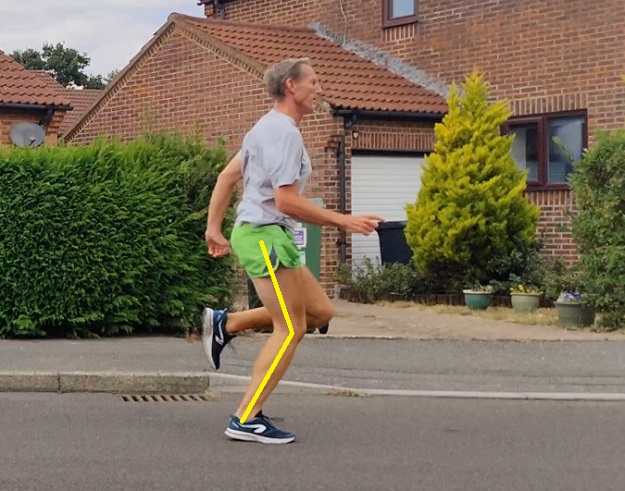
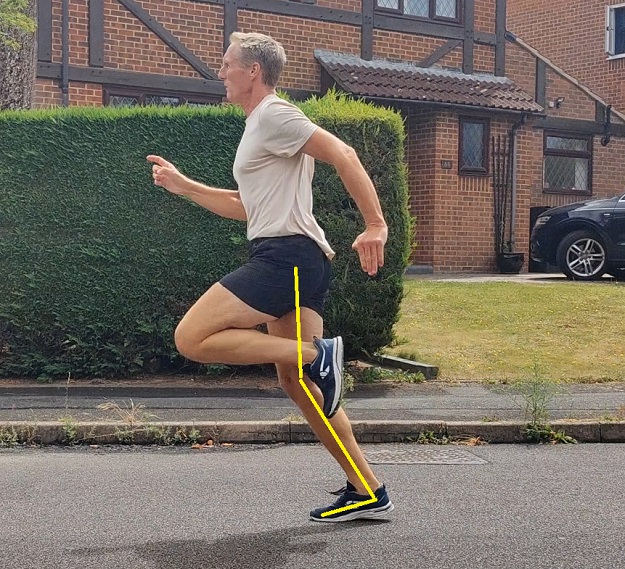
Watching and rewatching footage I began to see my head and shoulders were rising and falling against the background. The next questions was “Why is that happening?”. And from that I began to see both my knee and ankle were collapsing and I was flat footed with each step which produced the illusion of being stuck to the floor for so long.
Knee bend just after landing (thigh yet to reach vertical)
Ankle bend
Good sprinters try to maintain leg stiffness (of their support leg) with the knee hardly bending. Their ankles don’t flex much either and they stay up on their toes – the heel never touches the ground. Inevitably there is some flexion in the knee and ankle due to the forces being generated as the weight of the runner lands but the more it can be minimised, the better. Likewise the heel will move towards the floor slightly but never makes contact. This flexing allows the Achilles tendon to load up with elastic energy and then release to help propel them forwards.
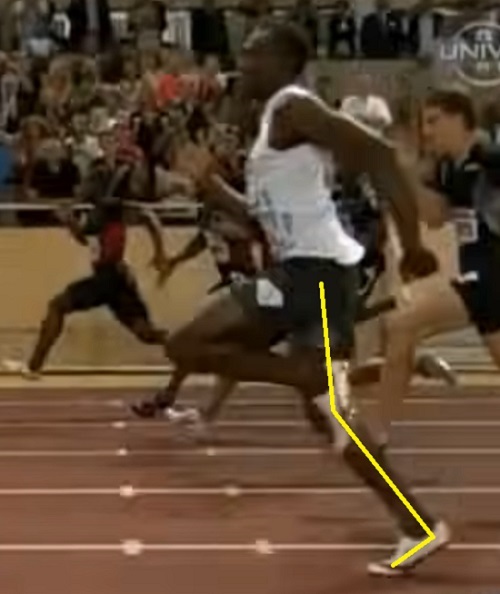
Usain Bolt – knee and ankle flexion
If you compare the pictures you’ll see both myself and Bolt are at the same stage of the stride; the arms match, the knee coming forward matches and the thigh of the support leg is vertical. But the foot is completely different. My ankle has collapsed and flexed and the heel is barely off the the ground; Bolt’s heel is notably raised and the foot is at right angles to the lower leg.
Initially I thought there was too much knee flexion but I’m no longer so sure. But there’s a definite lack of ankle stiffness which is causing an energy leak and it’s that which I’ve been looking at over the past month or so.
How to improve is of course always the harder question to answer when you locate an issue. Trying to resolve this became a matter of trial and error. I tried to focus on keeping the joints stiffer. I felt I had the requisite strength to keep my legs and ankles stiffer – after all when I skip / jump rope they don’t collapse, it was just the sprint technique wasn’t allowing me to get it right.
When I ran my sprints and strides I made an effort to maintain stiffness in the joints. I think it was a little beneficial but it put new stresses through my joints and for a time the tendons in the rear of my left knee were feeling swollen. It didn’t stop me running, it didn’t hurt training; but the knees were certainly unhappy if I was squatting down to say get something out of a cupboard. I made sure to keep the volume of these sprints lower though as I knew there was a danger of trying to do too much and injuring myself.
Note – while leg stiffness is important you don’t want your leg to be locked out at the knee because that has a high chance of leading to an injury. Failure to flex under high forces can lead to bone jarring into bone.
Similarly trying to stay up on the toes can lead to issues with calf muscles and tendons and there’s a good reason for allowing some ankle flexion. When the ankle flexes (i.e. the toes lift up and move closer to the knee) the Achilles tendon stretches and just like an elastic band it stores energy. When this elastic energy releases it provides some of the propulsion for moving forwards. While sprinters’ ankles flex the heel stays off the ground but a distance runner’s heel will come into contact with the ground momentarily and this needs to be allowed to happen for the storage of elastic energy.
One of the mental models I’ve been using is to think of how skateboarders paw the ground to keep their deck rolling. They time the kickback to add speed as the board begins to slow. It seems to me sprinters are doing the same thing; but where the skateboarders are able to take a foot off the board, paw the ground and then rest the foot back on the deck; sprinters are trying to stay airborne with just their legs extending down to make a short but powerful contact. You could think of the Roadrunner’s legs whirring along at speed..
The other adjustment I made was to try and get my foot down to the ground quicker – what coaches refer to as a hammer action. If I could move the leg down quicker then it would apply force quicker and the foot would go through quicker leaving less time for the joints to flex but still allowing some ankle flex to load the Achilles.
In trying for this quick contact and to stay more airborne, I’ve found my sprinting begin to morph and on occasions I have felt myself springing along as the Achilles does more of the work. There’s still more to do but I think it’s heading in the right direction.
You may recall as a child being told Aesop’s fable about the hare and the tortoise – the story of the speedy hare taking on the slow tortoise in a race. From the start, the hare races off into a lead, certain to win, while the plodding tortoise is left behind. Confident of victory, the hare takes a nap and while he is asleep the tortoise passes him. When the hare awakens he see the tortoise approaching the finish line and, despite his best efforts, the hare is unable to catch him and ends up being beaten. Parents and teachers love to tell this story as a way of saying “don’t rest on your laurels”, “don’t get lazy”, “keep putting in the effort”. The hare doesn’t, the tortoise does.
Now if, like the hare, you’re a runner for whom speed comes naturally – racing 5Ks or 10Ks is never going to be a problem. You might slow a little towards the end but fatigue is rarely enough of an issue that you need to have a lie down and sleep. And as much as the slower runners may plod steadily they’re unlikely to beat the hare.
But step up to a longer distance where fueling plays an important part and it will happen. I got serious about running when I had my own hare/tortoise moment. At the time, I was capable of running a 5:55 mile and 21min 5K parkruns (6:45/mile) and I entered a half marathon. I did some training towards covering the distance in the preceding month or two but it wasn’t extensive. I made the mistake of looking at race calculators which suggested I’d be capable of running around 1hr35 – this didn’t seem out of the question as I’d run 1hr38 the previous year. My running had been sporadic since. Even so I certainly wasn’t that unfit.
Hareing off I ran the first mile in 7:22, the next with the field beginning to spread out in 7:05 followed by 7:31 and 7:20 to take me through four miles in under thirty mins. It was all reasonable so far but miles 5 and 6 came in at 7:45, 7:51. There was a stretch of gradual uphill in there so I wasn’t too concerned. It was after that when the wheels came off.
Mile 7 was 9:00 and mile 8 was 9:38. My legs had gone. My stride was non-existent, I felt terrible. While I didn’t stop for a nap like the hare, I stopped to talk to a couple of running mates. I walked a bit and took 20min30 to cover miles 9 and 10. Then I summoned up the energy to restart and jogged the last three miles averaging 8:40 surrounded by runners who were theoretically much slower than me. I finished in 1hr51. It was a frustrating debacle. If I’d known how bad it would be I could simply have set out at 8:30/mile and got round comfortably.
What it did though was to kickstart me into take running seriously. I spent the next couple of months building a decent aerobic base – a term I didn’t then understand – but which I now teach to runners. Six months later I ran a 1hr31 half marathon.
On that fateful day, I’d finished surrounded by the tortoises who had gone out steadily within their capabilities and knocked off mile by mile. Meanwhile I’d hared off at a pace which was slower than my 5K but without the training to back it up – giving myself no chance of success.
The moral of my running story is twofold:
For the hares – if you enter a long distance race make sure you have done the training to back up the pace you’re intending to run. If you haven’t then you need to take it a little easier.
For the tortoises – if you can plod along and finish the race comfortably, it’s time to dig out some speed and challenge yourself to leave your comfort zone.
If you’re interested in my “Build your Base” course or improving your speed please head over to the Contact page and let me know.
Everybody talks about goal setting for success. Setting SMART goals, DUMB goals, setting targets. I have always been a focused person and goal setting came naturally to me. I never needed to specifically set or write down goals, I always just wanted to achieve excellence. To be the best I could at whatever I was doing. It turns out this was a mistake for me.
The problem is I was always pushing my limits. There’s nothing wrong with that in principle, but it meant I often left myself exhausted. And what I didn’t realise is that physical exhaustion impacts you emotionally.
Eventually I’d reach a state of emotional burnout and give up. Giving up didn’t happen immediately but if I was trying to reach a target and I wasn’t moving closer to it, I’d start to get discouraged. All the effort I was putting in wasn’t reaping any dividends. To an extent I could rationalise this as I know things take time and need patience. It’s the same reason some people will give MAF training a go for far longer than they should without progress.
I’d never get discouraged immediately as I’m resourceful and would look for ways to change things or put in more effort. When I played sports which had a break between seasons, these would allow me to recharge my batteries. But if the lack of progress went on too long, burnout would ensue.
With runners, quite often their change of direction or resourcefulness is to try a new race distance. If all they’ve done is 5Ks, they might move up to the 10K then the half marathon then the marathon. Each of these changes means they change how they train especially for the longer distances where they might be running for two or three hours for the first time; covering distances of up to twenty miles. While they might be nervous come race day, it’s easy to get inspired about doing something different.
This isn’t to say goal setting is a bad thing – it can be really useful for creating motivation to follow training plans and, if or when training stops working it might give impetus to look for alternative ways to kickstart improvement.
But my attitude has changed. I guess it’s partly down to being old and knowing that however hard I try or train I will never achieve the peaks I might have been able to attain when I was younger. Now my driver is curiousity.
I’m simply interested to know how far I can get at something given the constraints of training time and an ageing body’s slower recovery. For example when I went to the gym over the winter, I was curious to know whether I’d still be able to squat 130kg like I was doing 15+ years ago. In fact, within twelve weeks I’d surpassed that.
What I like about not setting targets is that there is no failure. Yet in being curious about the process and what is happening I learn something, and I see that as a success.
If there was any doubt my glutes and thighs have grown in size since going to the gym, it was proved when I split my shorts doing deep squats the other day! Fortunately I had a spare pair with me and was able to see out the session.
Deep squats, which are a staple of power lifters and gym goers, where you go ass-to-grass and your bum is lower than parallel, thereby putting you in ‘the hole’, aren’t found to serve much purpose for runners.
Yet having pushed my squat up to 160kg in the Smith machine in early January, I found my deep squat was barely half of this. I was straining to do even 1 rep at 70kg despite the Smith machine channelling all my force into the lift rather than having to worry about stability or balance.
The disparity between my 1/4 squat and deep squat seemed too much and after Christmas I decided to focus on improving my depth. For one thing, everything you can do from a deep squat means you can do that weight at 1/2 and 1/4 squat too. I also suspect the disparity is because there is some underdeveloped muscle somewhere in my legs/hips which would benefit from strengthening by getting lower.
I know when I unracked 160kg it was the first time I’d felt like my back might not like the squats. I felt a little bit of strain there and as I lowered the bar, I was really conscious I couldn’t go deeper than about 8-10”. Pushing back up to standing was less of an issue than the lowering phase. I was never in any danger because I always set the safety bars on the equipment, and while they have tested twice with crashing out, I don’t want to attempt any lift with a gung-ho mindset.
While the focus has been on improving my deep squat, every three weeks or so I slot in a heavy session to remind the body it’s still needed. In February that saw me do four sets of 6x150kg in the free squat area which suggests with the right training I’d be able to do 1 rep of 180kg. While these heavy lifts might only be a 1/4 squat at best – perhaps getting 30cm or so of depth – I’m still very pleased with them and what it might contribute to max velocity.
There is a suggestion that a 1/4 squat should be able to lift 30-45% more than a deep squat which works out as at between 124-138kg. Yet my latest deep squats see me only just able to do 3 reps at 90kg and I’m struggling with poor form such as hips lifting first.
This is why I’m working on the deep squat at the moment. The disparity is still too wide. I’m barely able to deep squat my body weight and from what I’ve read, focusing on 1/4 and 1/2 squats doesn’t become effective until you can deep squat at least 1.5x bodyweight which would be the upper end of the 124-138kg range.
Realistically I know I’m not going to get there in the month I have left at the gym during my winter membership but I’m certainly feeling the benefits of strength training and setting myself up to run faster through the summer and then get back to the gym to further improve next winter.
It’s January and a whole year of running is ahead. Perhaps you’ve already entered some races and begun training. Elite runners and their coaches certainly have. In fact they won’t only have planned out what to do this year – they’ll know what they will be doing next year and beyond. This year there are World Championships and again in two year’s time then in 2028 it’s the Olympics – probably the high point of runners’ careers.
But those are simply long term plans, there’s a preplanned year of racing in 2025 which they’re expected to take part in. During the winter they’ll be doing cross country, maybe indoor racing if the facilities are available, and then in the summer it’s the track season and Diamond League with the World Championships being the competition they aim to peak for.
Elite runners and their coaches are always thinking ahead – they have to. How exactly they divide up the training year really depends on what they’re targetting but generally in the autumn they are doing a base of mileage to prepare the body for what comes later. Many modern athletes, particularly the faster track athletes, will be doing some weight training to build strength and stability to support the miles they’re running.
Marathoners who have quit the track will be focused on running two marathons per year – one in spring, another in autumn. The Marathon Majors see Boston and London in April; while Berlin, Chicago and New York take place between the end of September and early November – this neatly allows marathoners to run a Spring and Autumn marathon – six months to train for each. Again those six months will be broken up into phases of base, pre-competition and tapering leading into the race.
Even though their training plans are focused towards major competitions, runners will be participating in other races. Some may be selected for international competitions like the European Championships, Commonwealth Games, World Cross Country championships or World Indoors. The marathoners, focused on their six month plan, might take part in a half marathon, both as a way to test their fitness and earn some extra appearance money.
But when the best runners take part in other races, their approach is different to that of a recreational runner; they won’t be looking for their fastest possible time they’ll be racing tactically and just looking to be the first across the line. Ideally they’ll want to win with the minimum expenditure of effort and fatigue in their legs. They may even run in a less than ideal state; as training for their goal race may only make minor allowances for a lesser race and certainly won’t see them running at their strongest. In marathons, runners who realise they aren’t going to win often drop out around the 20-mile mark to avoid unnecessarily fatiguing their legs thereby allowing them to recover quicker and potentially even reprioritise an alternative 10K, 10 mile or half marathon coming up just a few weeks later.
My own running followed a fairly standard pattern for many years. I entered half marathons in spring and autumn; 10Ks in the summer and preceding Christmas. That gave me a structure to the year which played out as doing base work after the September half marathon through to the end of October. Then a couple of months specifically training for the 10K. Then in the New Year repeat that cycle with trying to build on what I’d achieved at the 10Ks and preparing for an April half marathon. When the sunshine returned and my legs had recovered from the half marathon I would resume speedwork and prepare for the summer 10Ks before again turning back to do the miles to prepare for the autumn half.
This has all changed with my return to the gym. As I wrote in my previous post, my focus has shifted onto rebuilding leg strength through this winter. Two trips to the gym each week – Monday and Thursday – which allows decent recovery time in between. On the other days I’ve been working on my sprint speed – small sessions with short intervals and drills to improve form and efficiency. This format partly developed after an injury in July and when I returned I carefully tested the injury with short runs. I found I was enjoying the freedom this gave me. Where once I had always run every day for at least half an hour, currently I don’t even run for that long on any day. A 25min parkrun is currently my long run for the week!
My intention is to start rebuilding my running mileage when my gym membership finishes. Given it rarely gets that hot where I live, I won’t mind doing all the longer runs during the spring and summer. In the meantime it has been lovely not to have to train in the high winds, cold and rainy days of winter as I’ve done for the past decade. It’s given me a chance to mentally refresh myself after a decade-plus of running almost every day.
From time to time, this refreshed attitude tries to entice me into starting the rebuild now, but I remind myself the priority is the work I’m doing at the gym. It’s impossible to have your maximum speed/strength at the same time as your maximum stamina/endurance. If I start doing significant volumes of running, I may begin to impact my strength gains. When I leave the gym in March, I want to have maximised my strength as best possible with the training time I’ve had available. Once the summer begins I will be looking to convert that strength into power and therefore speed. The running will become the priority again and I will look to maintain whatever strength I’ve gained this winter.
There is no right way to divide up your training but all good athletes divide it up in some way because they recognise they can’t work on all the things they need to do at the same time. Sometimes they need to improve their speed, sometimes it’s their stamina, sometimes it’s their endurance. Having a training plan allows runners to organise all the different sessions they’re going to do so that they arrive at their goal race at their strongest, fittest and ready to race.
If you’re unsure how to develop training plans and set long term goals then maybe I can do that for you. If you’d like Coaching then please click over to Contact Mewhere we can start discussing how you can become a better runner.
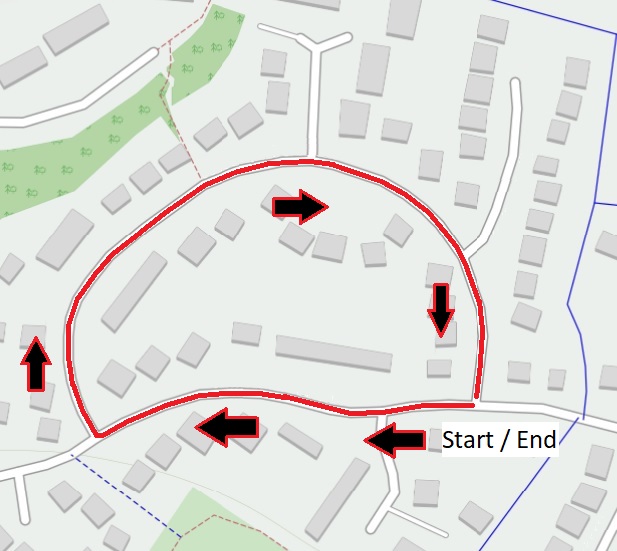
On Mondays, I run a couple of laps of my road all-out. I live on a crescent to which its two ends join back to a connecting road which makes for a nice loop. I begin with a couple of laps from my house to warm-up and in truth it’s not a particularly good one as I often go too fast and it only lasts about four minutes. After this I walk to the far end of my road where I’ll be starting from. This takes 3-4 minutes and gives just enough time for any excess from the warm-up to be gone.
Arriving at the corner I reset my watch then take a look around to check for traffic as I’m intending to run in the road. It’s quietly residential with only the occasional car or delivery van every five minutes or so. I compose myself one final time and then hit the Start button. I’m focusing on a good push off with high cadence and small steps. As the weeks have gone by cadence has been rising. Last week it reached 214-218 in the early going; whereas less than two months ago I could barely hit the 190s. Depending on fatigue it might drop back for a week but the general trend has been one of increase. Somewhere in the dim and distant past I could hit the 220s so I’m hoping I will get back there and then go beyond with dedicated focus and training.
From the corner there is a nice straight taking under thirty seconds to reach a corner where I instinctively slow because it’s almost 90 degrees. Even though I’m running on the road and can take it wide there is always an element of slowing as the initial burst of energy is gone, there’s a very slight uphill and it’s a change of direction. Sometimes there’s also a headwind to make things even tougher. If there’s ever a tailwind I’ve never felt it helping out.
Around the corner and I’m trying to accelerate again. This is helped by a downward stretch and from here onwards it will be the curve of the crescent back to where I began, no more corners to negotiate. I pass my house at about the halfway mark and then it’s fairly flat. As I reach the 45-50s mark I begin to feel what 400m runners always feel as the arms and legs are getting heavy from lactic build up and the coordination is going. Of course, I’m also breathing hard and all my body’s signals are telling me to slow down. There’s often a moment around here where I’m beginning to wish I’d never started and I have to tell myself to “hang on”, “it’s not much further” and “I can’t let myself down now”. Self-coaching at its finest.
My GPS always shows this stretch as the fastest part of the lap after the initial start. As the clock ticks past a minute, the road begins to grade upwards and I’m vigilant for any oncoming traffic as my sight around the bend is hidden by walls and hedges. Drivers often come into the road quicker than they should for a residential road. My ears are listening out too. I’m ready to jump on the pavement if needs must.
The final metres are a short upsection. I have to engage more muscle to finish this. It comes right at the time where my body is begging me to slow. My mind urges me to keep going, no quitting with the end so close. Crossing my imaginary finish line / starting point, I click the Lap button and then begin to walk. It’s already been tough to this point yet in some ways worse is to come.
On finishing my legs are aching a little, my shoulders too sometimes and most notably my breathing is fast and short. In the early season I can usually stay jogging after an effort but, as the weeks go by and fitness improves, I start having to walk. On shorter sprints it becomes a standing recovery.
The peculiar thing is while I’m breathing very hard at the end of the run, about ten seconds after finishing it gets worse. In those first ten seconds, I’ve counted my breathing to be at about 60-65 breaths per minute; but then at the ten second mark it goes haywire. I begin to find myself gulping for air, unable to get it in quick enough. I’ve counted my breathing rate rising to the equivaent of around 150 breaths per minute and this lasts up to about the thirty second mark. It then begins to slow and has normalised by about a minute yet even then I’ll still be panting for the next few minutes.
You’d assume this breathing difficulty is down to lack of oxygen. It’s not. My heart-rate monitor tells me my heart-rate is in the 150s. This is not my max. At a recent parkrun, while running a 23 minute parkrun (i.e. paces slower than 7min/mile) I saw my heart-rate creep up into the 160s and peak at 172 despite not putting in a sprint finish. It’s clear if my heart wanted to circulate more oxygen it could, but it doesn’t. I can only surmise that it’s because sprints are highly anaerobic and therefore the body is trying to reset all the by-products which have built up. Its trying to expel carbon dioxide from the lungs, not supply more oxygen to the muscles.
With my first effort completed I now do a walking recovery. As I wrote, the first minute sees me breathing very hard and my legs hardly have the energy to move. Things begin to ease and by about three mins I’m beginning to get back to normal. I’m still breathing a little harder though.
When the walking lap has been completed (taking over five minutes) it can be tough convincing myself I’ve recovered enough to run another effort fast. The anaerobic energy system half refills in thirty seconds, fully refills in three minutes. The problem is it takes the body significantly longer to clear out all the waste products from these high intensity efforts. Sprinters typically budget a minute’s recovery for every ten metres run. If they run 200m, that means twenty minutes of standing around. Few distance runners will do all-out sprints or hang around that long; particularly in winter.
What I find on the second effort is that once again the first thirty seconds are fine then it begins to bite. And it bites even worse at the halfway point and the legs get heavier and the co-ordination goes. It’s notable when I look at the post run data that I’m able to start the second effort quicker and this in turn builds the lactate up quicker. By the end of the second effort, I feel worse than I did the first. The saving grace is I can just walk home. The knowledge that there is no more to do is wonderful. It’s why I make the session short because it allows me to go hard for two efforts giving them both my best effort.
The ‘oxygen debt’ is tough after this second effort and even when I arrive home five minutes later I can still be panting. I can go upstairs to change and I will still be sweating. On some occasions when I’ve either hit new territory in the session or when my legs are really fresh, I’ve found myself still feeling the effects half an hour after I began. And I definitely sleep well that night!
One of the ways many people have got into running is through the Couch25K programme. Having successfully followed it, they now consider themselves a runner. And rightly so. But it’s the next step where the problem begins.
More often than not, many of today’s runners have busy lives. Running only gets a small look-in and when it does they want to make it a significant run. They prioritise the distance of runs over how often they run. So more often than not, they find themselves running at a pace that feels okay but it’s almost always for five, six, seven, eight miles. On Sundays they might go out and run ten miles or if they’ve decided to run a marathon go even further.
This all promotes an illusion of fitness. But being able to run for a long time is not necessarily indicative of great fitness. Trudging around as many runners do at 10-12 minutes per miles can be tiring for them which reinforces the illusion of fitness.
But if you watch those runners for the next few years you will find they are still jogging around at the same sort of times and paces.
The biggest mistake in modern running is the idea that just going further will help you get faster.
Now this is a dramatic statement and I need to apply a caveat or two here. While you may race faster, endurance never creates speed.
What I mean by this is that if you can run 5K in 25 minutes then a well trained runner could expect to run a marathon in around four hours. If you are running your marathon in five hours then working on your endurance will definitely help you run a faster marathon.
But once you achieve that, if all you do is go out for distance runs then you’re not going to get significantly faster at any of your race distances. You might do another marathon and record 3hr56 or run 24:50 at parkrun but you’re not going to see any significant progress through just distance running.
At some point you need to do some kind of training that actually builds speed.
Here are some suggestions for getting started:
Add pickups to your runs once or twice each week. Simply pick the pace up for 10 seconds before returning to your original speed. Some runners like to finish with a fast stretch home.
Try a fartlek run. A variation on pick-ups is to do a variety of paces for different durations throughout the entire run. This is particularly good for groups of runners where different runners can lead the pace determining how long it will last before dropping back to an easy pace before someone else takes the lead. The variations can range for ten seconds going very fast to a few minutes getting out of breath.
After an easy run do a set of five strides. Run 95% top speed for just ten seconds then walk back to recover. It’s five minutes extra but will get your legs moving quicker.
Run to a local hill and run up it for thirty seconds then jog back down. When you’ve done four efforts run home for warmdown.
When you’ve tried these, if you would like a more formalised speed programme then you can Contact me to buy my 3-month plan that will get you fitter and faster. It’s great value and you’ll receive weekly coaching while you’re following it.
Things are coming together at last. I’m in the final two weeks of the plan and tapering towards a couple of 800m time trials in April to see whether the training has paid off. I already know it has and it’ll be good to see it quantified in my time trial, but that’s for next month’s update!!
Although I began following Jack Daniels’ 800m training plan at the start of December, I actually consider training started back on 21st September when I went back to a steady diet of gentle runs at ten minute mile pace, subsequently introducing strides and a faster session midweek.
So really this has been six months of consistent training. I wanted to write “hard work” but apart from putting in big efforts during the twice weekly workouts, and a difficult spell around the start of February when my body was struggling to adapt, compounded by atrocious weather, I don’t believe it’s been hard work. I’ve looked forward to the training, enjoyed it and it’s not felt like a burden at all.
I realised over this past month my body has begun to feel fit and strong again. I hadn’t appreciated a lack of regular fast running over the past 3-4 years has allowed muscles to weaken. That translated in my day-to-day living as minor aches or pains walking up the stairs, or pushing with my hands to get up off the sofa. Nothing drastic, just minor little things that most people put down to the effects of ageing. In some ways they are the effects of ageing but not irreversibly as those people would have you believe. The takeaway is if you stop using it, you lose it. I actually now feel as strong and fit as I did ten years ago, and would like to believe I’m as fit as I was in my twenties although I know that’s not quantifiably true. My running still isn’t as fast it was when I started parkrunning at forty but I can see it’s getting back there and I believe it’s going to surpass that because of what I’ve learned since then.
March’s training has been focusing on what Jack calls T- and FR- pace running which stand for Tempo and Fast Rep. After adjusting for the expected improvement in fitness, these have been mile repeats at 7:12/mile and short intervals (200-600m) at 5:38/mile respectively. To put this into perspective when I began in December the Fast Reps were 44½ secs per 200m, now they’re at 42secs. Training has been going well enough that I’ve been overcooking these with some coming in at sub-40! I even managed a 37.45s effort (5:01/mile).
One of the problems I faced for T-paced sessions is ideally needing somewhere flat where I could keep pace and effort consistent. In other years, I would have gone to the beach or Poole Park, but with lockdown ongoing, as well as the possibility of sand on the prom or people out for a walk; I decided to look closer to home. The roads right outside my front door are fairly flat and quiet, but I’ve always resisted doing intervals on them for no explicable reason other than I always think of warm-up as taking me away from home. Circumstances led me to conclude this would be the best place for the training. Maximising the area available to me, I created a loop measuring 900m which had no sharp turns and only minor ups and downs. On some sessions, it meant I ended up doing a good 10+ laps of the same roads which, I suspect many people would find boring, but I hardly noticed as I was focused on my breathing, pace and sometimes trying to reach the end without completely falling apart! This ‘track’ worked well apart from, where I run in the road my early morning sessions brought me into conflict with people driving off to work.
Around mid-month, my legs began to feel strong and, the walking up the stairs with ease I talked about, came into my awareness. I could tell a step change in my fitness was about to come through and when it arrived my easy running pace improved by 20 secs/mile. It felt wonderful and that improvement then fed into the next session of T-pace running coming in at sub-7 min/mile rather than 7:10. In turn it made the fastest intervals feel a lot easier although not necessarily faster!
I’m not going to do my usual breakdown of successful / failed repeats until next month’s post but my attention was drawn to a bizarre set of times on last week’s 200s. I run these back and forth along a road which I’ve come to realise, has slight undulations to it, and these result in one direction being marginally faster than the other. The four efforts in the slower direction were 41.66 / 41.66 / 42.20 / 41.66 secs. I’m sure you can see the bizarreness of the fastest three being exactly the same time to one-hundredth of a second, it simply cannot be a coincidence. And if I then tell you the first effort on the previous session was … yes, you’ve guessed it … 41.66secs; there’s some kind of limitation going on somewhere in all of this! I’m not sure what it is, my legs were fatigued that day but in the other direction I ran 41.77 / 40.05 / 39.33 / 37.45 secs so it was possible to go faster under the right conditions. Bizarre numbers aside, it’s been a good month’s training.
I’ve got two more workouts to do in April, then the time trials begin. I’m only intending to do two mid-month but this will be weather dependent. If I feel I’ve underperformed I may slot in a third. Analysing my training times, I’m hopeful I can break 2min40 but I’ll report back whatever the fruits of my harvest are!
Something different today. Usually I write about running but I’m going to looking back to one of the first sports I played seriously – thirty years ago in 1991 – it was squash. I have no recollection of the specific moment I decided to try it or why. Working at Chase Manhattan Bank, squash was a popular sport and there were two courts onsite with a competitive league and an annual knockout cup. My boss, Jon, was one of the best players in the bank. Nigel, his boss, was also very good. As I recall, Matt, Rick, Gareth and Alan all played, as did Pete and Greg, two Aussie contractors. I think JohnnyG may have played but Benardette didn’t and neither did SteveS. I can’t imagine Bernard, Charles or SteveT playing and certainly myself and Danny, the new kids on the block, didn’t. Quiet Nigel may have played but he was so quiet, he never uttered a word in his six months of being in our department so I never found out! But when you look at it, half our department did and I suspect it’s that which led me to start playing.
If you’ve never played squash, or quite possibly in this day and age even seen it being played; I’ll give a recap. During the 70s and 80s it was very popular with every sports centre having courts and leagues. It was something of a corporate sport, played by middle class office workers, yet by the late 1990s it was dying out. Certainly that’s what happened at Chase. The league had been very popular when the bank first came to Bournemouth in 1986, but was all but gone by 1994-95ish. When I started there, you’d always hear a ball echoing around the court as you walked over to lunch, or to the onsite bar at 5:15pm. But slowly the distinctive sounds faded away and often the courts would stand empty in darkness.
Eventually as the bank’s workforce expanded, office space became a premium and the courts were converted. That’s similar to what happened to many of the local courts – Littledown Sports Centre turned their courts into part of the fitness studio, the Lanz Club in Boscombe got knocked down and rebuilt as flats, the South Dorset Squash Club on Ringwood Road is now a Co-op supermarket. When I worked at Broadstone Sports Centre there were two courts but these were converted into additional changing rooms and a soft play area when the swimming pool was built circa 2000. There are still courts around – Haymoor in Canford Heath, Ferndown Sports Centre, Two Riversmeet in Christchurch but they are few and far between. Apparently there’s a decent size league in Dorset of 400+ players but that’s next-to-nothing when you consider our local parkruns attract that many runners every Saturday.
Walking onto a squash court always had a special feel. You walked through the doorway into a cavernous white room with high, white-washed walls. At least they were originally white but now covered by hundreds of marks from squash balls. The room would echo, the lights needed to be bright and on closing the door, the handle dropped flat making for a smooth surface. If you turned round and looked up there was a balcony for spectators to look down on you. Above and behind you, people could sneak a look over and you’d never know they were watching. The cold, echoing, emptiness with just the two of you made it feel like a gladiatorial contest. The only noises were the grunt of long rallies, the squelching and braking of feet in motion and the ball ricocheting off the walls.
The ball was a small, black sphere of hollow rubber. Flexible once warm, it could reach speeds of well over 100km/hour. Some balls had a yellow dot, others a red one, each of which indicated a different speed. You’d have to agree with your opponent which ball to use – a slower one being more advanced because it didn’t bounce as much. I quickly found any decent opponent would snort contemptuously if I even considered offering up the lesser ball. Once agreed you then had to warm the damn thing up. Usually that involved hammering it repeatedly against the front wall, which was easy for people like Jon or Nigel who had the skills, but for a beginner like myself it simply displayed my ineptitude. Two or three hits then the ball would skew out of control and I’d have to scramble over and pick it up. A feeling of embarrassment towards my opponent and a shame that I was irritating or holding them when they wanted to get warm. In winter the courts would be chillingly cold which made warming the ball up even harder. There was a shortcut available though, rolling it vigorously back and forth under your shoe. Occasionally in matches the ball would split or, more likely, get lost in the rafters. When that happened you had to suspend play and warm up another ball. Another opportunity to display ineptitude.
Being the first individual sport I’d played, I now realise I felt a sense of responsibility not to show myself up with the wrong etiquette, so I’d go through the motions of warmups that I didn’t know or understand. All my routines were copied from the players I met over the following months. If someone jogged around the edges of court or up and down in the corridor then I did that. If they swished their racket and did some hip looseners or shoulder swings then I did them too. Mostly I stood there thinking “Can we just get on and play?”.
Games were, of course, preceded by the need to decide who would serve first. No flip of a coin, play for service or “Which hand is the ball in?” deciders as some sports do. The tradition of squash was to spin a racket on its head having identified a logo on each side of the racket to represent each player. One of my few moments of one-upmanship was having a racket that had “My Serve”, “Your Serve” printed on it precisely for this situation. Opponents would begin to ask whether I wanted the Slazenger logo or blank side of their racket, and I’d proudly interject and show them the “My Serve” / “Your Serve” markings. Of course there’s always one person who doesn’t get it and I recall showing this to an opponent who then said he wanted to take the “My Serve”! Didn’t seem to understand the implied ownership of my racket, my serve.
A difficulty of squash is that it’s not a sport where the ball easily goes out of bounds, it usually stays in court until it can’t be returned. Out of bounds happens if you hit it upwards enough, or aim too low at the front wall thereby hitting the bottom 18-inches of the metal “tin”, but most of the time you’re playing until one of you is unable to return the ball before it’s bounced twice. The front wall is theoretically unmissable, it’s 20 feet wide stretching up to 15 feet. You can play the ball off the side walls before or after hitting the front wall. It can rebound off the back wall if it goes deep enough. This is what begins to make squash so difficult for a beginner, it’s a game of angles and you have to be able to read the flight of the ball, predict where it’s going and get into position for your next shot.
Skilled players have an ability to keep rallies going for an average of 15-20 seconds, but as a beginner mine were often over before I’d even started. My opponent would serve, I’d lunge to volley the ball in mid-flight and misjudge it. Even then, I still had the chance to scrabble around and try to play it before the second bounce. But I rarely had the technical skill to play a good shot. Good players knew how to exploit my weaknesses. They’d play the ball off the front wall to die in the back corner. They’d play every shot in a rally to my backhand which was technically harder to co-ordinate returns from. They’d play drop shots after pushing me deeper and deeper to the back of court.
I dived in enthusiastically, playing lunchtimes and evenings – whenever I could get a court booking and find an opponent. With the games popularity, that might mean arriving at 7am for a pre-breakfast game or waiting until 2pm for a late lunch – the courts were well-used at peak times. With regular play, my understanding of the game grew gradually. I no longer lunged wildly at serves which I should have waited to bounce. I began to learn the footwork and technique for a backhand. Jon taught me how to face into the back corner so that, with a flick of the wrist I could simply sweep a shot back down the line to hit the front wall, then watch it loop back to land in the same corner where my opponent had just tried to put me under pressure. What happens as you learn to play a sport is you develop technically, tactically and mentally. Being a bad player means you physically develop your speed and strength only as quickly as you can learn to play the game well.
One of the key tactics is to control the “T” – the centre of the court – from there you can reach the rest of court easily. Every shot you play is trying to force your opponent off the “T” so you can take it over. Of course they have the same aim. If you watch good players, you’ll see there’s a dance going on as one waltzes off the “T”, the other moves onto it only to vacate it moments later and be replaced by their opponent again. As a beginner there was no such dance going on. My opponent would stand on the “T” and I would constantly be scrambling around them to reach balls at full stretch, just about able to return them. My opponent would take two or three strides from the “T” and play the ball to some corner of court where I wasn’t, leaving me to take five or six desperate lunging steps to try to get the ball while my opponent would waltz back onto the “T” comfortable in the knowledge they had the game firmly under control.
So in my early days, I wasn’t very good. I’d take a couple of steps to return a serve, I’d take a few lunging steps across court to reach a ball, my opponent would kill the rally and score a point. I only needed enough fitness for a few seconds of play. That was the way it was for the first few months.
As I improved I began to make rallies last longer. I began to win more points which made games last longer and, consequently I got fitter, which in turn helped rallies to last longer. I began to understand the angles involved. Experience told me that when a ball hit this point on the front wall, it would go over there. When it hit that particular spot, it went there. I began to be able to position myself earlier for return shots and gradually my technique improved. Mentally, my shot selection improved as I learned when to play a drop shot, when to play it deep and when it was inadvisable to play them. I started playing better opponents who in turn pushed me for longer rallies, better shots, and fewer mistakes and so on. That’s the nature of the improvement, there’s nothing radical in this if you apply yourself.
The highlight moment of my squash years was taking part in the annual tournament. Maybe I played in two, but I only remember the game where I was knocked out by Mack. An experienced player, I’d guess he was around fifty; he was lean, wily, whitehaired, a talker and he was full of gamesmanship. He’d take any ‘let’ he could, slow the game down when he was losing and find ways to take breathers after long rallies. Fitness was my greatest asset, so of course I tried to run him ragged but he’d take every second he could and every break between sets to recover. Looking back, I can’t blame him.
With my boss Jon being a good player, I’d already seen and heard about the tournament before I played in it, I probably supported him in the previous years. I reckon the tournament was played over two weeks of February, in the evenings with a straight knockout. What I remember distinctly is the hubbub associated with it. The balconies overlooking the courts would be crowded with supporters and players who’d entered, especially those still in the tournament or due to play later. And like Wimbledon fortnight or the FA Cup, as you got closer to the final, the interest level increased. If you arrived late you’d be watching over the shoulder of others or trying to squeezing into the gap at the end of the row by the wall. The support generated oohs, aahs, and rounds of applause for exciting rallies. It was nothing like playing on a lunchtime when a couple of friends might watch for five minutes to fill time before they had to return to the office.
I played Mack in, what I think would have been, the third round of the tournament. The winner of the game would then play Paul who I’d become good friends with. We often played matches and he always beat me. Always. But I was fast-improving whereas he’d been playing for some years; I felt I held something back in our friendly games and that the do-or-die nature of the knockout would give me a sharper edge. I was sure I’d beat him if I could get past Mack. And if I beat Paul then I’d probably have been in the quarterfinals.
But I had to get past Mack first. And initially that didn’t seem too hard. The matches were best of five games and I easily went two-nil up running him round court with repetitive whipping forehand shots, gradually pulling him off the ‘T’ until, I’d drive an unreturnable cross-court shot to his backhand to win the rally. It was all going to plan and then as victory closed in during the third game, I tensed up and began to make mistake after mistake.
It was a classic case of choking and Mack was wily enough to just keep popping the ball up for me to smash it into the tin or mishit. It was terrible. Not just because I was losing but because I knew the whole balcony were watching me throw the match away. I’d shown them how well I could play for two games, now I was showing them how badly I handled pressure. I could hear gasps and mutterings whenever I played a bad shot. It became obvious I was going to lose the third game and then the fourth. A friend or colleague would shout down a word of encouragement but all it did was remind me that I was playing badly and now needed some kind of external support that I hadn’t needed when I was playing well. I don’t recall the details of how I came to lose the deciding fifth game, only that I went from two-nil up to losing three-two. I think Mack went on to beat Paul in the next round, it’s not etched in my memory, as it wasn’t something I wanted to be reminded of or talk about.
I don’t recall exactly when or why I stopped playing. I first touched a volleyball in the summer of 1992 and decided I wanted to get good at it. The bank also opened an onsite gym which was a bargain at £6 per month and it began to take up my lunch times and evenings. I believe that’s how I got into running and entered my first 10K. Either there were some entry forms on the reception desk when I walked in, or someone at the gym talked me into it. It was also the winter I moved out of my parents’ home and began growing up and looking after myself. Extra time from living closer to work and a need to recreate my routines saw me move away from old friends and habits.
I’d guess the gym hastened the demise of the squash league. The guys who’d enthusiastically competed five years before were getting older and gaining more family responsibilities. Hitting their thirties and forties their knees were creaking and they knew their place in the pecking order of the league. The competitive fires were probably beginning to die down as they knew who they could beat and who they couldn’t. The gym presented an exciting new, alternative for keeping fit with no dependency on finding opponents or booking courts. It could easily be fitted in around the rest of their lives.
I’m sure I played the occasional game of squash in 1993 and 1994 but volleyball became my new all-consuming passion. I started playing basketball, going to the gym, there was circuit training in the sportshall on Wednesday lunchtime and tennis lessons on Thursdays. With so many options available, squash fell by the wayside. Just the occasional game now and then.
I’ve only played three or four times since I left Chase in 1997. Each time I played I was in a terrible state the next day. I could still read the game well enough to know where the ball was going. I had the fitness to get into position to play those shots. I didn’t have the fine motor skills to play winning shots so rallies lasted much longer than when I first played. As a beginner, my fitness built up as I got better at the game, now I’d play hard for forty minutes using squash-specific muscles that weren’t used to being used. Deep lunging stretches to reach the ball in all corners of the court. I’d walk off court dripping in sweat feeling like I’d had a good workout. The next day, I’d suffer from muscle soreness that lasted two or three days. I couldn’t take those matches easy but, with decent fitness, I paid for it in the following days.
Nowadays I see the same thing happen with runners returning from injury. Having been used to running regularly for an hour or more they jump back in with a half hour test run. Invariably it’s at a decent pace because their legs are feeling fresh. What they don’t do is go for a gentle easy run to ease back in and be sure the injury has fully healed. If they were running thirty miles per week before they get injured they come straight back running five days per week and quickly back up to that sort of mileage. Then they wonder why the get injured again.
When you come back to running after an injury, you should begin with short gentle runs – possibly as short as five minutes and ideally no more than fifteen minutes. If that’s ok you might do it again the next day but you might take a rest day for extra assurance. If nothing’s causing problems you build slowly back up from there, adding five or ten minutes until you’re sure you’re injury-free. Of course it depends on how big the injury was but for anything major, I’d aim for the better part of a month to rebuild.
Likewise when I went to circuit training after a break, I never pushed it. I took the session easy knowing I’d get a decent workout and consequently I avoided the next day soreness. But I never figured out how to achieve that graduated approach when getting back into playing squash. I don’t think it’s possible. You book a court for forty minutes, you’ve got to use the time up. And you have to give your best efforts for your opponent. All you can hope is to walk away unscathed and maybe to accept you’re going to be sore for a while.
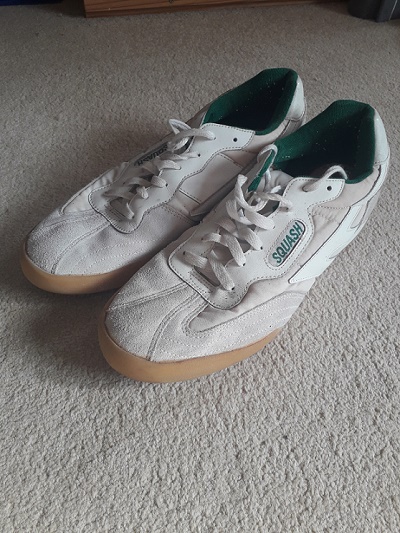
As the pictures attest I still have my squash racket and the Hi-Tec shoes I bought all those years ago. They’ve been up in the loft ever since. I thought I’d barely used the shoes as they look so clean and the soles are hardly worn. But when I looked inside, I could see the insoles had been worn around the ball of my big toe. I spent a lot of time on my toes and driving off the forefoot to get to balls quickly. The cleanliness of the shoes is no surprise because squash courts are clean and shoes don’t get dirty like running shoes would. I was obviously into Hi-Tec as my first pair of running shoes were Hi-Tec Silver Shadows which I think I bought for £25.
Picking up my racket I’d forgotten how light it is. I cocked my wrist and gave it a couple of swishes – the old three finger hold with thumb and forefinger loose came automatically. I regripped the racket a few times myself. It was one of those tasks I’d do periodically, more because I enjoyed doing it than out of necessity. I remember Jon used to have about three grips on his racket so that it was big and fat to nestle in his hand. I also remember if you ever saw him running around a football pitch he ran with one hand open and the other as if he was holding a squash racket!
My racket was made by a company called Unsquashable and the headcover has a stylish mix of fluorescent pink and black. I rarely buy things based on looks but graphite rackets were becoming more attractive than the wooden and steel ones that preceded them and I think I bought this one because it had a larger sweet spot. Unsquashable still seem to be in existence, making rackets and I recall they were connected to Jahangir Khan, who was the best player of the 1980s.
I was definitely not the best player of the 1990s and when I look back squash was simply a sport I played regularly for a couple of years before relegating it to “once in a while” as a way to connect with new acquaintances. There’s a part of me that would love to play again just to experience hitting the forehands and backhands down the line. To stand waiting for the serve and the frustration of trying to dig a ball out of the back corner. Maybe one day the opportunity will present itself and I’ll be ready to give it another go but I’m also content to leave it in the past. Squash was what I did then and life moves on. For now, I’m far too focused on my running and coaching others to become better runners.





 Big Red Running