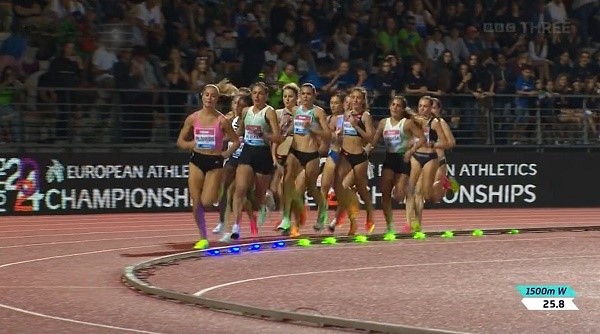
It was early June when Faith Kipyegon became the first woman to run 1,500m in under 3:50; last night she shattered the mile record. Running 4:07.64 it was almost five seconds quicker than Sifan Hassan ran in 2019.

There’s no doubt Kipyegon is in form, having also broken the 5,000m world record in Paris in June. She’s obviously training well but it’s not just her. While Kipyegon finished seven seconds clear, every other runner in the race recorded a Personal Best and there were three continental records and six national records. Five of the women taking part are now among the top-8 fastest milers of all-time. This is unprecedented and you have to wonder why.
The first and simplest explanation is that the mile isn’t raced often. It’s an old Imperial race distance which is still popular in the U.S.A. and holds significance for men with the four-minute mile. But the Olympics and World Championships race the metric distance of 1,500m.
An immediate assumption might be to point to performance-enhancing drugs. The spectre of doping is always a cloud hanging over athletics and while it’s possible, perhaps even probable, someone in the race is using, you can’t have a race full of dopers and somehow avoiding any one of them getting caught. There has to be something else going on.
Perhaps it’s the track as Monaco was also where Hassan set the previous record and it has a reputation for fast middle distance races in recent years. It wasn’t just the women’s 1,500 where fast times were recorded last night, there were three men running 12:42 in the 5,000m and eight men under 1:44 in the 800m. For comparison, Mo Farah’s personal best over 5,000m was 12:53 and at last year’s Oregon World Championships only one man ran under 1:44 in the 800m final.
Perhaps Monaco itself isn’t faster, it’s simply that its Diamond League meeting is usually held at this time of year and that coincides with athletes getting close to their best. Everyone will be looking to hit their peak in a month’s time at the World Championships in Budapest. For some there’s a little extra to come, some may have peaked too early and others will just be holding on.
It’s the shoes
Anyone who has been following athletics in recent years cannot have missed how many records have been shattered in the long distance races from 5,000m on up to marathon. It’s not just world records but national records as well as personal bests for many athletes. While there may be some improvement due to refined coaching and training methods, it’s impossible not to have heard about the shoes.
Nike introduced the Vaporfly shoes in 2017 and claim they can improve a runner’s performance by up to 4.2%. This occurs through a combination of a carbon-fibre plate in the sole and lighter, bouncier foam which results in the runner using lesser effort and saving energy. As the results show this has been massively beneficial to the point where they are standard for all elite distance runners now.
It’s also understood however that that the benefits of the Vaporflys and similar models only apply to long distance races. For sprinters and middle distance runners on the track they find the Vaporflys feel squishy whereas the spikes they use give better traction. This is why the shoe companies developed a superspike with prototypes beginning to appear in 2019. Again these spikes have a carbon-fibre plate and more efficient foam but with different shaping and geometry.
Although the exact reasons why superspikes help isn’t understood, we’re seeing it benefit track athletes. There have been world records set in the men’s and women’s 400m hurdles by Karsten Warholm and Sydney McLaughlin-Levrone respectively and by Tobi Amusan in the women’s 100m hurdles. It should be noted that, at the time of writing which is a year after she broke the record, Amusan has been provisionally suspended for missing drugs tests. In her case, it may not be the shoes! Undoubtedly though many athletes, especially women, in the short sprints have been setting Personal Bests and National Records, just as happened in the mile race.
Why allow the advantage?
Track and field athletics is no longer the crowd draw it once was. It’s fighting with other sports for television and media coverage and for the money and revenues those attract. Athletics will always be the centrepiece of the Olympics but outside of that, it often holds little interest to most people. Athletics stadia are not packed like football grounds, it is not a sport people regularly turn out to watch. In Britain, the TV coverage is hidden away on BBC3 which is only available online or by Red Button.
Keeping partners, whether official or not, happy is something World Athletics have to consider in a world where it is a business as much as a sport. For the shoe companies who introduce expensive new shoes promising to make every runner faster it is an important way to grow their profits. While it would have been an easy decision for World Athletics to ban the shoes it would likely lead to shoe companies cutting their budgets for research and development and focusing on the fashion trainer market and other sports. Many athletes have shoe deals with the shoe companies and therefore a ban could have impacted them. World Athletics did eventually introduce restrictions to the dimensions of the road shoes in 2020 but it didn’t ban them outright and consequently we have seen records being smashed time and time again.
All of this is a reminder of what happened in swimming in 2008 when new bodysuits were introduced and over 200 world records were broken. Eventually the governing body intervened, wiped those records and banned the suits. But this was different, your average person who goes swimming at the local pool wasn’t going to go out and buy a go-faster body suit so the commercial impact to the apparel companies was small.
Yet the same argument can be made about track superspikes. The market for them is small and if World Athletics were to ban them it wouldn’t impact the revenues of the shoe companies significantly.
Wiping the record books
It puzzled me why the super shoes have been allowed until I considered that perhaps Lord Coe, as head of World Athletics, is happy for the world records to be broken. Obviously it generates clicks and headlines for World Athletics which can never be a bad thing.
More importantly though, many of the women’s world records are disputed as they were set in an era before out of competition drug testing took place. Florence Griffith-Joyner set the 100 and 200m world records in the summer of 1988, East German Marita Koch’s 400m time was set in 1985 and Czechoslovakian Jarmila Kratochvilova’s 800m was set way back in 1983. We know the East Germans systematically doped and it’s highly likely the same applies to anyone else from the Eastern Bloc. There will always be suspicions about Flo-Jo’s times and certainly there is evidence her 100m was set with an unmeasured tailwind even if doping wasn’t involved. These times were thought beyond reach with other runners barely able to get close and yet, in recent years, it’s begun to look a possibility.
Even after out of competition testing was introduced in 1989 there was another notable set of suspect world records a few years later. These were in the women’s 1500, 3000, 5000 and 10,000m by Chinese athletes who were known as “Ma’s Army” after their coach Ma Junren. While the 1500, 5000 and 10,000m records have since been broken, Wang Junxia’s 3,000m time of 8:06 is still on the books. It came to light in 2015 that Wang and her teammates had written a letter in 1995 accusing their coach of forcing them to take drugs. It is hard, given the lack of subsequent success by Chinese athletes, to believe that their record setting success was simply down to hard work of running a daily marathon at altitude and eating turtle blood soup as Junren claimed.
Getting those records off the books is a desirable thing to World Athletics and if doing that happens to coincide with keeping the shoe companies happy then so be it. I think there is a good chance we will see an attempt at the women’s 3,000m world record at some stage if Faith Kipyegon continues to run well. She is the new 1,500m world record holder with a time which is a second quicker than Wang Junxia’s Personal Best. Like the mile, the women’s 3000m is not a distance which is raced often. It was contested at championships up until 1993 and then replaced with the 5,000m. It will require a special staging of the race, probably at a Diamond League meeting to achieve it. This isn’t out of the question as Jakob Ingebrigtsen of Norway ran a “World Best” in a two-mile race in June. It was the same Diamond League meeting in Paris where Kipyegon broke the women’s 5,000m world record.

 Big Red Running