Watch any elite runner and you’ll see their heel kicking up to their buttocks as the leg moves forwards. I have a whole bunch of terms for this – butt kick, heel lift, back lift which I am going to use interchangeably through this article.
From an efficiency perspective it is very important. The days of people owning mechanical clocks are now all but gone, so the majority of people probably have little idea about how the length of a pendulum affects its movement. Basically a long pendulum swings slower than a short one and vice versa. You can test this by grabbing a piece of string, tying an object to the bottom and swinging it at different lengths.
Applying this concept to running – a short leg will swing quicker than a long one. Tall people tend to have slightly slower cadences than shorter people and it is why, when small children run their legs appear to go like the clappers. Of course, once you’re fully grown you can’t change the leg of your legs, you’re stuck with your genetics, unless a disaster happens.
Yet shortening one’s leg is effectively what an elite runner does when they kick their heel up to their backside. As the foot passes closer to the body and above knee height they have essentially halved the length of their leg. It is now only as long as their femur measures from hip to knee. This is sometimes referred to as shortening the lever. A shorter leg comes forwards quicker than a straighter leg helping to reposition it ready for the next step.
With recreational runners we rarely see this butt kick taking place. With some runners it is like they are walking fast, keeping their legs straight – moving them back and forth with a high cadence and barely leaving the ground. To varying degrees, other runners will lift their trailing foot off the ground – some lift it just a few inches whereas others may have it passing the support leg at calf or even knee height. Once in a while you see recreational runners who have an exaggerated back lift even if they are only moving at a moderate pace, such as eight minute miles. It is almost certainly something they have been taught to do and there are certainly many coaches / Youtubers who advocate doing this. The trouble is while deliberately lifting the heel to the backside seems desirable for the efficiency reasons previously mentioned, it is not.
Don’t initiate ‘the pull’
It’s likely ‘shortening the lever’ will help you run faster, at least in the short-term. To do it you just pull your heel to your butt – to do this you engage the hamstrings. The problem is, this isn’t how it should occur or what the hamstrings are best used for. What they should do is control how quickly the lower leg unfurls once your leg is out in front of the body. This isn’t a conscious process, it just happens with every step you take. Like any muscle they will eventually become tired and fatigued so if you are mistakenly using your hamstrings to actively pull your heel, you’re going to tire them out needlessly.
How to butt kick
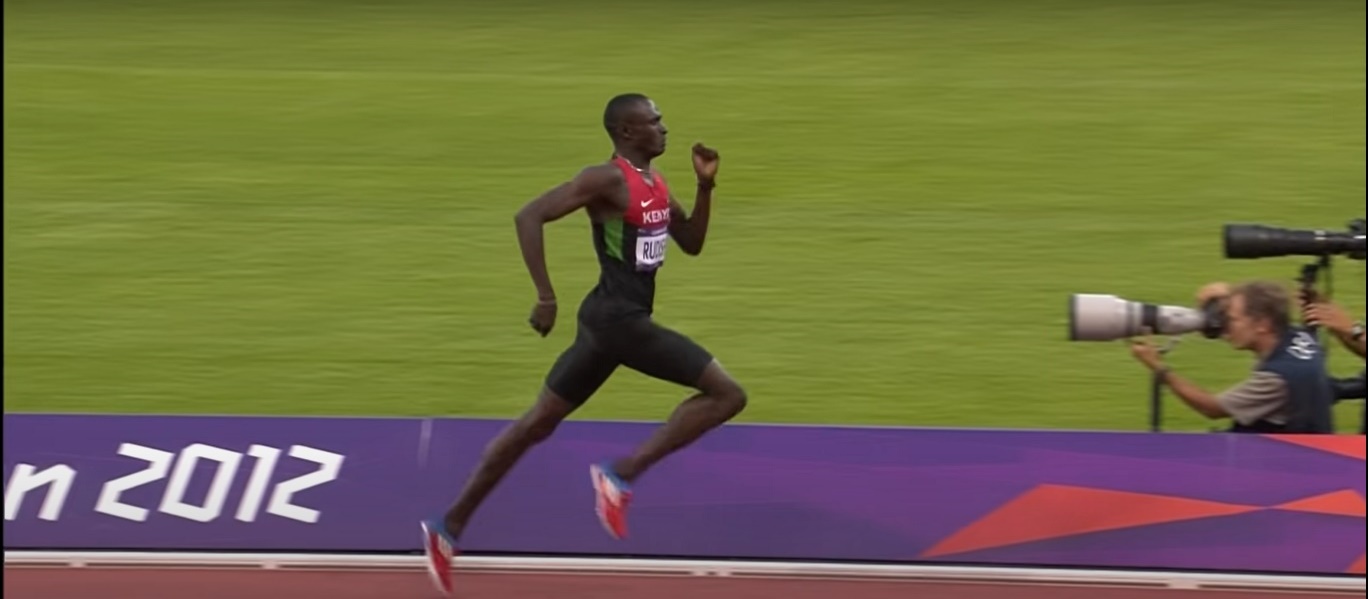
The reason you don’t need to actively lift your heel is because when you run correctly it naturally happens. In my look at glute-powered running, In a previous post, I discussed how an elite runner like David Rudisha uses his glutes to swing his leg from in front of him to behind. At some point the thigh physically cannot go any further back and he tips up into a toe-off.
Looking at a snapshot of what happens a few frames later we see his thigh has barely moved but the lower leg has begun to lift. This is momentum transferring down the leg through what is referred to as the kinetic chain. It generates power in many sporting actions from kicking a football, throwing a javelin, swinging a golf club to delivering a knockout punch. Energy is generated by big powerful muscles and then transferred to the smaller extremities to achieve a higher speed. It’s the same process that allows Indiana Jones to to crack his whip – his arm and body begin the movement and then the energy transfers through the handle and down the whip to create the cracking sound.
For Rudisha, after the leg appears to momentarily pause, it then begins to move forward. This is powered by the elastic energy that has been stored in the muscles on the front of the hip and thigh. When the leg was moving backwards these muscles were being stretched like an elastic band and now, just like when the elastic band is let go they ping back to their normal length. This pulls the thigh forward, but it doesn’t affect the lower leg so that continues its journey towards the runner’s butt.
Eventually the lower leg either runs out of momentum or reaches its closest point to the butt. If everything is timed well, it is enough to carry it under the runner’s body as a shortened lever.
Composite image of David Rudisha’s stride showing the heel lift and pass under the body
Not everybody butt kicks
Given that I’m describing this as a natural sequence of events, you might expect everybody to lift their heel to their backside and kick butt yet this isn’t what we see. The main reason is you have to be running at high speed for it to happen. You won’t see any sprinter who doesn’t butt kick and this isn’t taught to them except by bad coaches – it just happens.
Your legs have to be moving back and forth quickly to create the momentum in the lower leg. Quite how fast you need to be is some undefined combination of factors such as pace, leg length, foot weight and stride rate.
All elite distance runners back kick because they are rarely run slower than five minute miles. The women’s marathon is the slowest elite distance race and Tigist Assefa can be seen butt kicking on the way to her marathon world record.
Tigist Assefa running behind two pacers demonstrating a high heel lift at 5min/mile
Yet if you see an elite distance runner out for a jog, at say nine minute mile pace, their heel doesn’t kick their butt. The foot will come off the ground but it is not the efficient shortened lever. At slower speed the leg just doesn’t have the momentum to carry the foot up to recover close to the backside.
There is another reason why we often don’t see any backlift in recreational runners and this is because many over-rotate their hips which I discussed in this post. Instead of the leg swinging straight backwards and forwards with a long range of motion to create power and momentum, a shorter stride length is creating by turning the hips. Arguably this may simply be a factor explaining why they’re slower at running but I noticed in the footage of Tigist Asseffa breaking the world marathon record, she appears to have one foot lift higher than the other. I suspect this is due to over-rotation of the hips as it is reflected in one shoulder rolling more than the other. She is not the only long distance runner who seems to have some inefficiency in this area.
Final thoughts
Kicking the heel to butt for more efficient recovery is something which occurs with good running form and mechanics. Attempting to force it by pulling your heel up is unnecessary and will tire the hamstrings. Arguably it could be beneficial to slower runners but the counterargument is that spending the time learning to pull the foot up is training time that could be used to improve speed so it happens naturally. Ingraining bad form is unlikely to be a good idea because it is harder to undo later on. To get the natural heel lift, you need to get the glutes firing and the leg swinging through to an extended toe-off.
The information detailed here is based on personal experience and that contained in Steve Magness’ The Science of Running Book. Magness was the Cross Country coach at the University of Houston where he was able to speak with Tom Tellez, the track coach who coached many athletes including Carl Lewis who was the 100m world record holder during the 1980s and 1990s.
I used to coach a triathlete who had decided to run a marathon. In our discussions he told me that one of the tough parts of a triathlon is the transition from cycling to running. You get off the bike and then when you start to run, the legs feel like rubber and they take a couple of minutes to adjust. I later heard people say cycling is quad-dominant whereas running is glute-dominant. While nice descriptors it didn’t really explain what was going on.
The glutes are the muscles in your backside or rear, the quads are in your thighs. You can find many articles written about runners who have lazy glutes due to sitting at a desk all day and suggesting exercises to activate them. Along the way I’ve tried many of these, both for strengthening and activation without much success. As a kid, I cycled everywhere so my thighs grew big and muscular and no doubt that led me to be quad-dominant in powering all the exercise I did.
If you’re a cyclist, or like me were one, this post is going to help you understand how it could be holding you back from achieving your running potential. If you’re a runner, like I’ve been for over a decade, you’ll probably benefit from understanding how using your glutes to their full extent might help your running. I’ll explain the difference between quad and glute dominant exercising; showing why runners should be aiming to get their glutes active and providing some ideas on how to do this.
Cycling is quad-dominant
Here is a cyclist sitting in a recommended position for setting up the saddle. Opinions vary as to the correct method but they are all small variations of what you can see – the leg almost, but not quite, straight when the pedal crank is at the bottom. The yellow lines indicate parts of the bike – the saddle position and the pedal cranks. When they’re vertical the cyclist will have one foot at the highest and the other at the lowest point of the pedal stroke. We’re particularly interested in the lower point because that is the furthest the foot gets away.
Most of us have been on a bike and we know that each stroke is powered by pushing down on the pedal. When the foot reaches the bottom, the other foot has reached the top and it then takes over pushing down to keep the pedals turning. In essence the cyclist is always pushing down on the pedal to power the bike forward. There is also some debate as to whether cyclists should pull on the upstroke to assist. Even so, all this pushing down, and any pulling up, is due to the quad muscles in the thighs – along with some assistance from the hamstrings and calves.
What doesn’t contribute to the stroke (very much) are the glute muscles sitting on the saddle. There may be a contribution but it’s minimal because the pedals limit how high and low the thighs can move and therefore how much effect the glutes have. You can see the thighs are about 45 degrees apart and as you will see the glutes don’t move much.
Running is glute-dominant
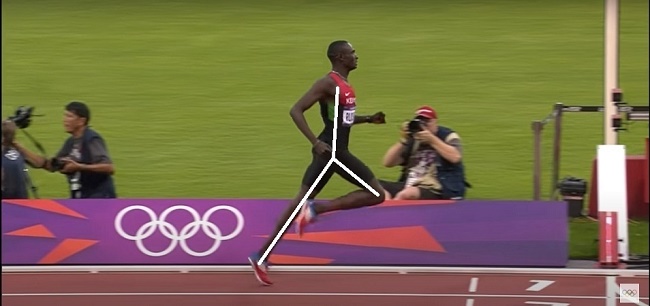
Now let’s look at a world class runner – David Rudisha. I examined his stride length in a previous article where I estimated it to be 2.45m. You can see in the picture below his legs are about 90 degrees apart. So already his glutes are moving through a greater range of motion than the cyclist’s.
His knees don’t come up as high as the cyclist when they come forward. A runner with good form allows the knee lift to occur naturally through elastic energy rather than a conscious lifting of the thighs. This elastic energy is created by the hip flexors on the front side stretching as the leg goes backwards. When the ‘backside’ work has been done, just like an elastic band snapping tight, the hip flexors pull the leg forward.
We also see David Rudisha is extending his leg behind him to the point where only his toes are still in contact with the ground. His back leg is straight from hip to ankle as it transfers force to the ground. His ankle is still a little flexed but having looked at multiple pictures and video, it doesn’t appear Rudisha can fully straighten at the ankle which would be better. The key point to notice is that his leg is extending behind his body which is due to a powerful hip extension. To run forward, he has pushed the ground away behind him.
Running and cycling side by side
If we now compare Rudisha to the cyclist, but rotate the latter so his torso is upright, we see a massive difference between them.
It’s clear from this picture that the legs of the cyclist are always in front of him. There may be some pelvic tilt in his seating to achieve a better aerodynamic position but it’s not enough to be relevant. The position of the saddle, the pedals and cranks ensure his thighs and feet only move in a limited range – the equivalent of 2 – 3:30pm on a clock face. By comparison, Rudisha’s legs are working from about 4:30 – 7pm. The ranges of motion don’t even overlap.
In the cyclist’s rotated position, it’s easier to see how their thighs and knees will piston up and down in front of them. In the normal orientation we see the pedal being pushed down, here perhaps we can think of it being pushed away from the body. This push is achieved by the thigh muscles straightening the knee until it almost locks out. It’s similar to how rowers power each stroke by straightening their legs. This is why cycling is considered a thigh-dominant activity. Of course, dominant doesn’t mean only; so there can be contribution from other muscle groups – just not as much.
Glutes power the stride
Let’s now see why running is glute-dominant with another look at David Rudisha. In this picture he is still airborne with his leg having come forward as far as it will during this stride. Although it’s not easy to see – his lead foot hasn’t even touched the ground yet. He is about to start using his glutes to continue running fast!
As the yellow arrows show his leg will swing backwards with the foot hitting the ground just ahead of his body. He will continue to propel his leg backwards and his foot will momentarily be stationary on the ground as his body passes over it, just like a pole vaulter arcs over the planted pole. As best possible, his leg will remain straight all the way through to the toe-off. Typically the quicker the running speed, the stiffer the landing leg tends to be.
He will attempt to maximise pushing the ground away behind him by fully extending his rear leg until only his toes are in contact with the ground as we saw in the earlier photo. When that point is reached the leg will naturally fold up behind him and pass forward under the body due to the elastic energy created by the stretched hip flexors. The runner doesn’t need to trying to do anything to bring the leg forward or lift the knee.
The glutes
Swinging the leg backwards is powered by the glute muscles which are a group of three muscles in the buttock area. In recent years the Kim Kardashians of the influencer world have attracted attention to them by getting implants and doing exercises specifically intended to make them larger.
Gluteus minimus not shown
In running we’re interested in using the glutes to extend the hip. Again this is the sort of phrase that doesn’t mean much without thought, and it’s possibly easier to understand it by thinking about what happens when you stand up. The legs move from being at 90 degrees in front of you to straightened below you. Extension of a joint is straightening it. Hip extension is straightening at the hip – it increases the angle on the front side.
In this picture of a glute muscle we can see them crossing the back of the hip and pelvis. If the person were now to stand we can imagine that the glute muscles would ball up to give the Kardashian look – just as a biceps muscle gets bigger when it is flexed. This is why runners, especially sprinters want big, strong glute muscles.
When runners flex the glute muscles the leg moves backwards and the front of their hip straightens. When the foot hits the ground, the continued action of contracting the glutes causes the leg to pass below the torso and then behind. Of course we rarely feel this as contracting our glutes, it feels more like pushing the ground behind.
The issue is people usually have no reason to flex the glutes that far back and if we’re not practiced on it, we don’t do it as runners. When we stand we only contract the glute as much as necessary to bring ourselves to an upright position. We only need our knees and feet to be directly below us. When we walk we move the leg a little behind us but do it slowly and not too far. Then we often take our next step by falling forward and rolling onto the heel of the lead foot.
As Rudisha shows there is a range of motion where using the glutes deliberately will create a full and powerful hip extension so that the leg and foot move further behind. Unfortunately this is not what quad-dominant runners or cyclists with their strong thighs and poor glute activation do when they run.
How cyclists often run
We saw in previous pictures, the typical cycling position doesn’t even bring the cyclist’s feet to the ground if they are turned upright. Obviously this isn’t what happens in real life when a cyclist tries to run.
While cyclists are very good at pushing the foot to the ground using the thighs and exerting push, they often don’t learn to extend the leg back past the vertical. Instead almost as soon as the foot has landed they feel the stride is complete and pick the knee back up. Where the runner’s leg comes forward using elastic energy, the cyclist uses their strong thigh muscles and hip flexors to lift the knee ready for the next stride.
Statistically this gives them the sort of measures their sportswatch likes – high cadence and short ground contact time – so they think they’re doing the right thing. What they lose though is stride length as the foot doesn’t push them as far forwards as it could with a longer range of motion. As Steve Magness writes in The Science of Running “Often, the mistake is made in trying to get the foot off the ground as quickly as possible, but remember it is only when the foot is on the ground that force is transferred to the ground. While having a short ground contact time is beneficial, it should be a result of transferring force faster and not of getting quicker with the foot.” (p.307)
Strengthening glutes
I’m a big believer that once you start using the correct muscles to do the job they quickly strengthen themselves up with regular running. Even so there are a variety of initial strengthening exercises you can try which may help. These include step-ups, one-legged deadlifts, hip thrusts or frog-legged bridges. As starter exercises for getting more strength into the glutes and supporting muscles they are good options but they don’t take you past straight hips and therefore don’t mimic that extra bit of power we’re looking for.
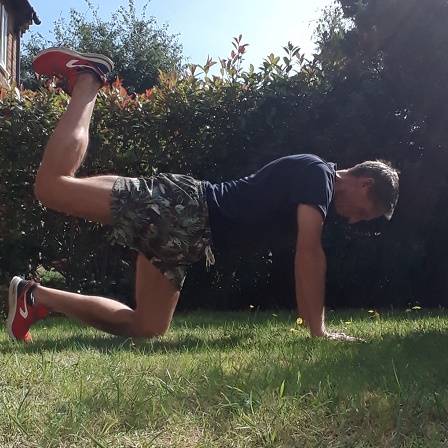
Donkey kick demo in the garden
Donkey kicks may be the best exercise for really squeezing the glutes but other than by adding ankle weights it’s not possible to create resistance for adding strength and power. If you lie on your back and do hip thrusts you can add resistance especially if you progress to doing them on a one-legged, on a step or with a weight across your hips.
But having strong muscles doesn’t guarantee using them during runs. If your movement patterns are wrong, it doesn’t matter how strong the muscle is they won’t help out. A simple example of this principle is when people try to pick up a heavy object. Health and safety advises them to bend their knees and use their legs. More often than not people simply bend over at the waist and strain their back. It doesn’t matter how strong their legs are if they don’t use the correct technique.
I haven’t described these exercises in detail but a quick internet search will turn up a myriad of articles or Youtube videos demonstrating them.
Activating glutes
To begin to get the movement correct you need activation exercises. A simple one is to imagine pushing a shopping trolley or pushchair. Basically to imagine there is something that will block your legs from swinging ahead of you which forces you to push the foot or leg backwards to create the propulsion to go forwards.
You can also try standing with your back against a wall and then stepping away from it. Feel the back of the leg and heel push off the wall using the muscles around the hips.
Walking lunges can be a good exercise for creating the hip flexor stretch and getting the glutes to work. They also work as a good balance and coordination exercise. You really have to focus on getting the glutes to work.
These sort of activation exercises may work at giving you the feeling you’re looking for but personally I never managed to carry them over into my running.
Toeing off
While David Rudisha doesn’t appear able to full point his toes he is certainly pushing his foot and toes as far back as possible. The following compilation of pictures of Seb Coe show how great his form was in this area.
Practicing toeing off has been the exercise I found most useful. When your foot hits the ground put pressure through your big toe and push your foot all the backwards until the leg is fully extended behind you and you are up on your toes. NB This is not running on your toes but pivoting up onto them when the leg is at its furthest point back.
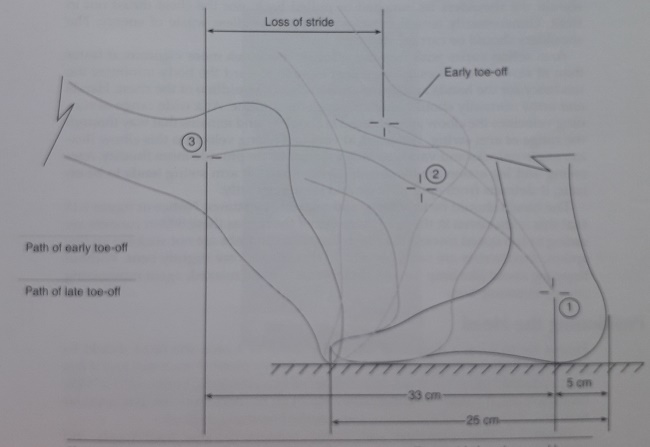
Peter Coe, coach and father of Seb, highlights in Better Training for Distance Runners” that a fully straightened ankle which has pivoted over will leave the ground late and create extra stride length over that of a runner who either keeps their foot flat on the floor or with the heel barely lifted off. This pivoting can adds over the length of the runner’s foot to each stride.
To achieve strong ankles and good rear leg extension, Arthur Lydiard the great running coach of the 1960s, had three strengthening exercises – steep hill running, hill bounding and hill springing – which he scheduled as a four week phase prior to speedwork. He is quoted in Healthy Intelligent Training as saying “Increase in speed comes from flicking of the ankles. If you want speed, you don’t need to be built like a body-builder. You need to be like a ballet dancer, with springy and bouncy ankles” (p.118). However Steve Magness writes “Unlike what many suggest, do not try to get any extra propulsion out of pushing off with the toes consciously.” (p. 307)
There’s clearly a contradiction between what these two coaches are proposing but there is no doubt a fully extended leg with pointed toes is critical to achieving speed and stride length. My own interpretation is that by pushing the foot through for the full stride, you naturally lever up onto the tip of the shoe and your toes. Knowing that Lydiard’s hill strengthening came at the end of months of aerobic distance training, his exercises were there to help runners get used to this action again. Once you’ve got strong ankles and good technique you probably won’t even notice it happening and there will be no flick. I think the key to Magness’ statement is about not consciously flicking the ankle, as there runners who try to get a bit extra by doing this but are actually creating inefficiency in the mechanics.
Whether Lydiard or Magness is right about ‘the flick’ doesn’t matter for most runners as it’s a “1% improvement” whereas many runners haven’t mastered the gross movement of pushing with their glutes to end up toeing off which is where the big gains will be made. Initially if you aren’t pivoting up to toe-off, you aren’t getting the most out of your glutes and will need to go through a conscious phase of deliberately toeing off to achieve this.
Lydiard’s hill exercises also work on getting that rear leg extension we’re seeing in Coe and Rudisha. I’ve found this is best achieved by ensuring the back of the knee straightens, that it feels almost as if it’s being pushed back beyond what is physically possible.
Ultimately even your running shoes are built to enable you to toe-off. Every pair has the sole extending forward, up over the front of the shoe yet few runners actually wear this down. When you look at how far it turns up you realise how much encouragement you have to do this.
Summing up
The best runners in the world power their running by using their glutes. The glute muscles swing the leg backwards from its further point out in front of the body to the furthest point behind. Elite runners push the ground away behind them and then allow elastic energy to bring the leg forward again for the next step. Each time their foot hits the ground they are pushing themselves on to maintain speed or accelerate just as a skateboarder keeps the deck rolling by occasionally pawing the ground with their foot.
This contrasts to the average runner, or those who are thigh-dominant, who stopping pushing with their glutes when their foot hits the ground, allowing their momentum to carry them over it as they pick the knee back up. In doing this they decelerate while the foot is on the ground, miss out on stride length and the free elastic energy available for bringing the leg forwards. As Matt Fitzgerald states in The Cutting Edge Runner “when you retract your leg properly, your foot feels as though it grips the ground rather than lands on it. From this point all you have to do is keep thrusting backwards, and you will have effectively minimised any stance phase and the deceleration that comes with it.” (p.152)
Making changes is never easy and if you start using muscles that have never been engaged before, they will have some catching up to do. Like a slower runner trying to keep up with a faster pack, they’ll be left fatigued and sore until they have gained the fitness to be part of the group. If necessary back off the pace and distance of your runs, take extra days rest until you begin to feel adapted. Once the correct muscles are active they will start to work for you, the new form will increasingly become second nature and the muscles and tendons will strengthen for themselves as you get faster or try more demanding sessions.
References
Coe, P. & Martin, D. (1997) Better Training for Distance Runners.
Fitzgerald, M. (2005) Runner’s World The Cutting Edge Runner.
Livingstone, K. (2009) Healthy Intelligent Training.
Like all runners I want to get faster. How you do this is, of course, the difficult part. Having a coach or following a plan takes you through the workouts you need to do to improve speed, stamina and endurance appropriately to your event.
There are certain guidelines for what you’re trying to do; for example, 100m sprinters are working on top-end speed and trying to be as efficient with their running form as possible. Marathon runners are training to improve their aerobic efficiency and top-end speed isn’t too important to them. Everybody in between is working on some variation between these.
Paula Radcliffe still getting air time at mile 25 of 2002 Chicago marathon
But even when you think the marathon is more about endurance than speed, you discover world class marathoners are fast. Take Paula Radcliffe, she can run 4min25 for a single mile where most parkrunners can’t even run 200 metres at this pace.
The Formula
The simple mechanical explanation of speed is that it’s the amalgamation of how quickly you move your legs and how far you travel with each step. More commonly this is quoted as a formula of Speed = Stride Length x Stride Frequency. I first learned about this in the mid-1990s but never really thought about what to do with it.
On the stride frequency (cadence) side there’s a lot of talk about how the magic number of steps to take is 180 per minute. I’m not going to dig into that here today as it’s much discussed around the internet, only to say there is no magic number to achieve. It’s the Stride Length side I’m currently interested in. [Note: I have now written a series of articles on Cadence which begin here and provide some interesting data – clicking on the link will cause it to open in a new browser tab].
What is Stride Length?
Around the time I learned the formula, I started to hear about how the great 400m hurdler Ed Moses had a stride length of 2.70 metres which enabled him to take thirteen steps between each hurdle.
When I looked up what a stride was, it was defined as two steps e.g. right foot then left foot or vice versa. So by that definition your stride length would be how far you cover from when your left foot hits the ground to when it hits the ground again. That would suggest each single step by Moses was only covering 1.35 metres yet when I did the calculations that didn’t seem right.
It turns out when runners, coaches or commentators talk about stride length they’re using the term interchangeably with step length. For runners, stride length is the distance you cover with one step. If you stand with both feet together and step onto the right foot, it is the distance you’ve covered in this step.
If you’re going to try measuring it, remember to measure consistently from the heel-to-heel or toe-to-toe. Often though you can find out from the stats produced by GPS watches – if they’re capable of measuring cadence.
Garmin stats from a run – avg stride length highlighted
Elite stride length
400m hurdlers
I said that Ed Moses is famous for his 2.70 metre stride but it’s not just him. When I was watching the Tokyo Olympics over the summer, I switched onto the final of the women’s 400m hurdles. The commentators were discussing how Sydney McLaughlin – the world record holder – runs 14 steps between the hurdles until the final one when she increases to 15 steps because of fatigue shortening her stride. I found out the distance between the hurdles is thirty-five meters making her long stride to be 2.50 metres and dropping down to 2.35 metres when she tires. That’s big and it’s stunning.
Measure out 2.50 metres and you’ll realise why I still harboured some doubt about whether I was understanding what stride length is. Were elite runners really covering the length of a small car in one step? Or was their stride the technical ‘two step’ definition? I went looking for direct evidence.
David Rudisha – 800m
I found some decent Youtube footage of David Rudisha running the 800m at the London Olympics. It’s the race where he set a new world record. As he crossed the line he was well ahead of the rest of the field and there was a good angle on it.
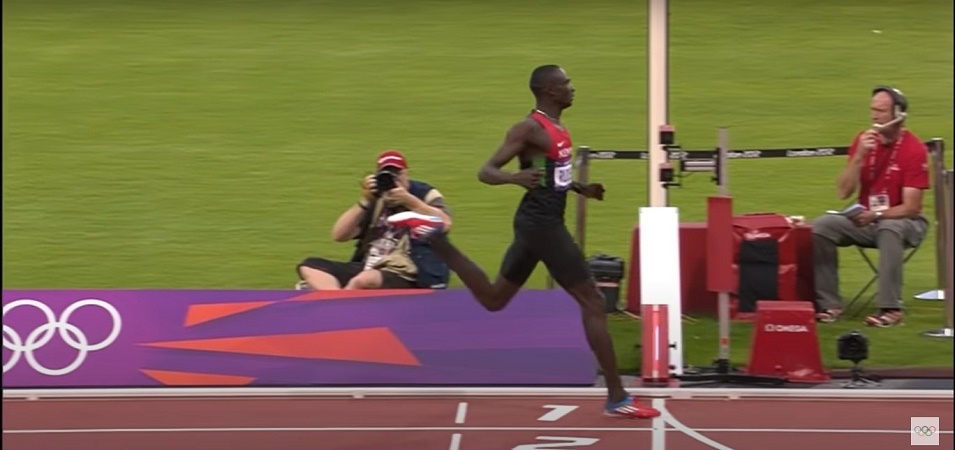
And below he is one step before! It seems unimaginable how he will go from toeing off at the red triangle next to the Olympic logo and ending up on the finish line but he does.
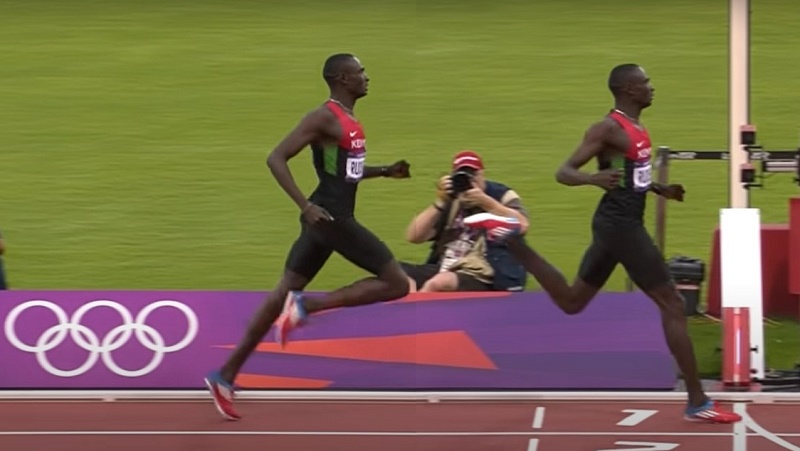
Here’s a combined picture to make things simpler. We can see it’s quite some distance.
Rudisha is recorded as being 1.88m tall so let’s put some lines on the photo and estimate how long his stride is.
He’s not standing fully upright so the yellow line is around 1.75m. The red line is just above his knee and, fortunately as I’m the same height, I can estimate it to be around 70cm. That’s a total of 2.45m.
The exact measurement doesn’t really matter, what’s important is we now have visual proof that a world class runner takes well over two metres with a single step.
Finally here’s a look at his last two steps, he’s easily covering the better part of five metres. His black shorts make it harder to identify which leg is forward or backwards but if you look at his shoulders there’s no doubt about it. And you can also see how far his body moves over the top of his support leg as he pivots from landing up to toe-off.
Women’s 10K
So far I’ve talked about the stride length of the 400m hurdler and 800m runners. These shorter distance track athletes always have a longer stride than distance runners because the speeds they run (around 3 – 3min30/mile) are that much quicker.
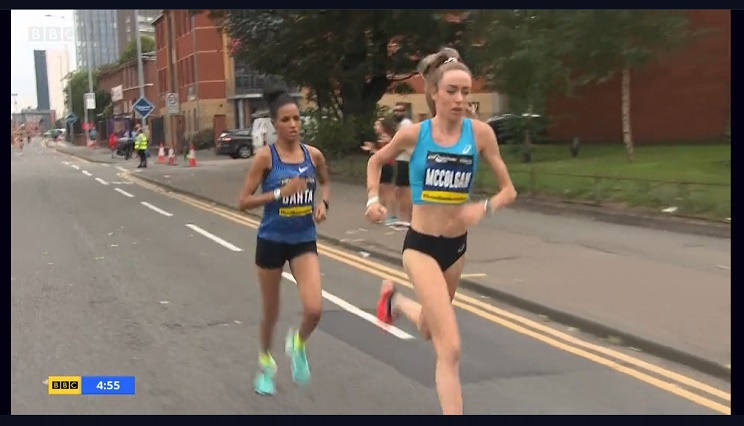
Last weekend the BBC were showing the Great Manchester Runs. A friend who was watching the women’s 10K race messaged to point out the difference in running styles of the two lead ladies – Eilish McColgan and Meraf Bahta.
It was clear McColgan has a long, bouncy stride with a high back kick – probably because she’s still doing shorter track races – whereas Bahta’s stride was shorter and flatter. By flatter I mean she’s staying more level with the ground, less bounce.
Rewatching footage from the second kilometre I counted their respective cadences. McColgan was running at 172 steps per minute, Bahta up at 200. It’s a notable difference and knowing that they were running together slightly faster than 3min/km (4:45/mile) you get an indication of their stride lengths – McColgan’s is 1.97m and Bahta’s 1.70m.
Ordinary runners
McColgan is impressive but it’s Bahta who really makes the point. Even for a high cadence runner, she still has a stride length far above that of most runners. Most of the ordinary runners I know have short stride lengths according to their Garmins. If it’s much over a metre on a general run that’s unusual. Of course you can’t big stride all the time but I doubt many have the strength and technique to extend their stride out when required.
My 10K races have an upper end value of something like 1.4m when I’m fresh and usually drop into the 1.30s by the end. I’m sure I’m not unusual in this respect and of course I’m not running world class pace so it’s naturally going to be shorter at my slower race paces.
Most ordinary runners work on their cadence with no thought for improving their mechanics or top-end speed to create a longer stride length. This is a mistake because as we’re seeing with someone like Bahta, that longer stride length is still beneficial when you have a high cadence.
The way you develop a decent stride length is by pushing off more powerfully. You don’t reach out in front of you, you launch yourself forwards through the air with each step. Think of it like being on a pogo stick using the spring to load up and travel forwards for as much distance as possible. As a runner when your leg is behind you, you extend your hip, your knee, your ankle to push forwards. Learning this technique is best done during strides or hill sprints. Short efforts where you’re not concerned about running out of energy or fatiguing.
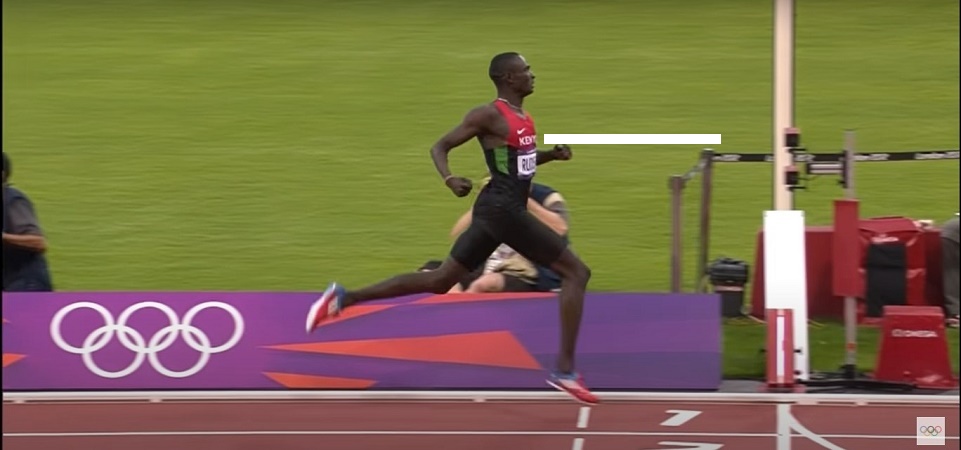
One last picture of David Rudisha to marvel at. It’s during the flight phase of the last step. His foot is a good half metre or more before the line and looks like he will land there yet somehow he travels on., His effort at toe-off propels him forwards the extra distance before his foot hits the ground. It happens quickly and horizontally. There is very little drop which is what the white line is there to help see.
The white line is lined up with the word “Kenya” on his vest and level just above the black tape by the finish. Take another look below at the finish line photo and you can see he’s only dropped a matter of inches to now be level with it.
When he was in the air, he wasn’t actually high off the ground. His effort goes towards pushing him forwards not up into the air. If you watch slow runners they use a lot of energy bouncing up and down rather than going forwards – this is bad.
If you want to marvel at Rudisha’s running, here’s the video of his 2012 Olympic run. There’s a good, slow motion close-up at the 7min10 mark.
I wrote another article looking at Eliud’s Kipchoge’s stride length and detailing how I calculated it here.











 Big Red Running