Aerobic Training Takes Time

If I offered you the chance to take two mins off your 5K time in a couple of months – I’m sure you’d jump at the chance.  Of course this depends on how fast your current 5K time is, but it’s exactly what I did when I went from a 5K parkrun time of 25:03 on 1st February to 23:11 on 15th March. Speaking accurately that’s not quite two mins improvement but it’s also much less than two months! And I did it through almost pure aerobic training.

That improvement is going from a pace of 8:03/mile to 7:24/mile – which is about 39secs – an average of 6-7secs/mile per week. Think about that if you did this training for three months you might expect to be running a mile per minute quicker than you were. What’s the catch? Why doesn’t everybody do this?

Anyone who’s read about aerobic training and especially a system like MAF training will know the literature says improvement will be slow. They interpret this to mean it will take months. They interpret it to mean that when 2-3months later they’re still doing the same pace for the same heart-rate, they just need to be a little more patient. That’s a wrong interpretation – if they’re months down the line with no change, then it’s clear indication their training is ineffective.

Here’s what aerobic training takes time really means …

Aerobic training log

On Saturday Feb 1st I ran 8:03/mile. On Sunday I did a 3-mile run at 8:05 pace. On Monday I did a 2-mile run at 7:45/mile. On Tuesday I did a 3-mile run at 8:11 pace. On Wednesday I did a 3-mile run at 7:58/mile. On Thursday it was another 2-mile run at 7:38 pace. On Friday it was a 3-mile run at 8min/mile.

On Saturday I returned to parkrun and ran 24:46. On Sunday I ran three miles at 8:37/mile. On Monday it was a three mile run again at 8:36/mile. On Tuesday it was two miles at 8:24/mile. On Wednesday, three miles at 8:26/mile. On Thursday three miles at 8:17/mile. On Friday it was the two mile run at 8:05/mile.

On Saturday I didn’t go to parkrun but ran from home for three miles at 8:31/mile and then did the same three mile run on the Sunday at 8:08/mile. On Monday it was the two mile run at 7:42/mile. On Tuesday it was three miles at 8:25/mile. On Wednesday the three miles came in at 8:01/mile. On Thursday it was the two mile run at 7:46/mile and on Friday a three mile run which was paced at 8:28/mile.

Are you bored yet? Keep on reading there’s still another three weeks of running data to go through.

On Saturday I returned to parkrun and ran 24:21 which is 40+ seconds than three weeks ago. Improvement is already showing up. Sunday I went out and ran three miles at 8:20/mile pace. On Monday I ran two miles at 7:31/mile. Tuesday was three miles at 8:08/mile. Wednesday’s run was the same three mile run, this time at 7:53/mile. Thursday I was back on the two mile run at 7:31/mile. And on Friday I did three miles at 8:23/mile.

On Saturday I was back at parkrun running 23:52. Another surprise thirty second improvement over the previous week. Sunday’s run was three miles at 8:00/mile. On Monday it was the two mile run at 7:26/mile followed by three miles at 8:15/mile on Tuesday. Wednesday was three miles at 7:53/mile and then on Thursday it was the two mile run at 7:36/mile. Friday was clearly a tired leg day as the three miles were run at 8:58/mile.

The tiredness meant I gave parkrun a miss on the Saturday allied to it being a wet and windy morning. Nonetheless I still did three miles from home at 8:37/mile pace. On Sunday it was another three miles at 8:22/mile. Monday was the two mile run at 7:43/mile. Tuesday, three miles at 8:35/mile with Wednesday’s three miles coming in at 7:56/mile. Thursday I did another two mile run at 7:41/mile and Friday was 7:58 pace on a three mile run.

On Saturday March 15th I went to parkrun.  My legs felt great and I ran 23:11.  Almost two minutes quicker than six weeks before.


If you didn’t bother to read all that in detail, I don’t blame you. I could have produced it in a graph or table to give quick visual understanding but I deliberately wrote it longwindedly to make a point. To read it properly requires great patience. And that’s what runners need if they’re going to get aerobic training to work for them.

The training consists of the same thing day-in, day-out with slight variation in pace. Some days are faster; some days are slower. There is no clear pattern of progression other than at the parkruns. Not every runner has the luxury of a local parkrun to measure their progress.

On top of the basic detail I give you, bear in mind this is just the running. Think about what you do with the other twenty-three hours of your day. Getting up. Breakfasting. Work. Lunch. More work. Evening meal. Watching Youtube or television. Sleeping. My week includes going to the gym on Mondays and Thursdays. That’s why Tuesday and Fridays are always notably slower. If you’ve been promised aerobic training will make you faster then you’re eager to see results and those other activities are taking up time before you can go for your next run.

Living through days after day of just doing simple aerobic runs where the pace might be a little faster or slower than the day before can be tough as it doesn’t bring clear results. It’s not like starting a weekly speed session where you will see quick gains. For example last summer when I was running a 440m lap of my road I went from 6:01/mile to 5:01/mile in three weeks.

There’s a temptation for runners – “I now feel better off the bit of aerobic training I’ve done and just jogging around every day surely won’t help forever; perhaps it’s time to drop in some speedwork as I know it’s worked for me in the past”.

They say “a watched pot never boils” but that’s what runners doing aerobic training often do. They keep checking, comparing their times and paces looking for that improvement. If they use a heart-rate monitor they’ll be including that data.

All this is a great example of where you have trust the process. Set the target of doing a block of aerobic work then just get out and do the runs and don’t worry about the results. In a few weeks’ time you’ll see they’re getting faster.

When coaches mean say “aerobic training takes time” I’ve tried to show you what they mean. You should begin to see some kind of improvement in three weeks whether that’s a faster pace, a lower heart-rate or just feeling better on the runs. It might take six weeks to begin to see notable change but if, by 8-10 weeks everything is still in the same place then your training isn’t effective. It’s time to change direction.
Durations to think about in training

How long can you sprint? Why is the first minute of your parkrun fast? Why do we train differently for a 10K and a marathon?

Each of these questions is determined by what is going on in the body and its capacities. While the exact figure can be a touch higher or lower for you – especially depending on whether you’re well-trained or badly trained – overall they’re numbers that help structure your training. With time and focus you should be able to get a sense of exactly where your numbers are.

8-10secs Sprinting energy

Sprinting is powered by the phosphocreatine energy system, which is sometimes abbreviated to ATP-PC, or called the Anaerobic Alactic energy system. I like to call it the Sprinter’s energy system because that’s more meaningful and tells you what it does.

It produces energy quickly and allows you to move very fast but it doesn’t last long. For a distance runner, it’s useful for getting off the start line or finding a sprint finish or mid-race surge. Surprisingly it’s also the energy system you call upon when you get up off the couch to go make a cup of tea!

This is the system that kicks in when you do interval work – especially if you set off fast.

1min30 Anaerobic limitation

Beyond the sprinter’s energy system detailed above, there is a secondary anaerobic energy system. Its names include Fast Glycolysis, Anaerobic Glycolysis and Lactic Acid energy system. It’s what 400m runners use in their races and is a big contributor to the 800m.

For distance runners, they’re using it when they run intervals at the track which last within this timeframe. Being anaerobic it gets you out of breath and you find yourself puffing. This isn’t to say there isn’t some contribution from the aerobic system but for anyone with good speed, it’s mostly coming anaerobically.

For most parkrunners, you’ll see the first 1-2mins are quick and then their pace drops away. This is because they’ve mostly run on anaerobic energy and then they’re having to rely on the aerobic.

8min Running at VO2max

V02max is a scientific measure of your aerobic capacity. The body takes in oxygen through the lungs, the heart pumps the oxygen around in the bloodstream for the muscles to use. There is a limit to how much oxgyen you can transport and exercise scientists finding this out by doing treadmill tests and collecting the air their subject breathes in and out. I did a VO2max test at college and it is not a pleasant experience. It’s nice enough at the slower speeds but once you get up to speed and are beginning to exceed your VO2max, you quickly begin to accumulate oxygen debt and then you’re hanging on mentally to continue running as the treadmill pushes you. Eventually you have to stop, or I suppose you could collapse and fall off the back of the treadmill if you have the willpower to push on!

In real terms, we have the ability to run at our VO2max pace for up to eight minutes. We can go faster for shorter periods of time, we can go slower for longer. Reigning Olympic 1500m champion, Jakob Ingebrigtsen set the 2-mile world record in June 2023 at 7:54 which means he was running on his VO2max for the race. A world-class woman like Sifan Hassan has run 3,000m in 8:18; so she’s probably thereabouts.

None of this makes a lot of sense from the ordinary runner’s perspective other than to recognise that a high aerobic capacity is very helpful for good distance running. Even when you have talent it takes time to build this aerobic capacity.

12min – steady state reached

Another thing I learned at college was a phrase used by one of the physiology lecturers “it takes twelve minutes to reach steady state”. As I wasn’t a distance runner at the time or interested in physiology/biology lectures, it didn’t mean much to me. It probably doesn’t to you.

What it means in practical terms is that this is how long, on average, it takes for the body to warm-up. If you go running off down the road your legs may feel good but your breathing will struggle. You’ll settle down after a few minutes but it actually takes longer for the body to properly warm-up.

Personally I take a good 15-mins or so to reach a point where my speed has picked up and my breathing can cope. Other runners may take a little less than twelve minutes. Either way there’s two offshoots to this – firstly your quick jog down the path and back for a minute at parkrun isn’t a proper warm-up. Secondly if you’re going out for a run and it only lasts 20 minutes you’re not actually getting lots of training benefit from it. Of course this applies more to regular, committed runners who do significant volumes of training than those who only run once or twice per week.

40min – optimal production of human growth hormone

During exercise the body produces many hormones but let’s focus on human growth hormone. As the name implies this is important for repair, growth and replenishment within the body after a bout of hard exercise.

At the beginning of any run the production of this hormone begins to ramp up and at an hour it has reached its highest level at 600% of where the body started out – a sixfold increase. At forty minutes we’re already at 550% so while the next twenty minutes will raise the level higher, if you’re time pressed or out for a recovery run this is the optimal duration. You’re getting close to the maximum but in only two-thirds of the time.

Combine this with my comments above on warm-up taking twelve minutes and you can see why a run lasting at least thirty minutes is beneficial.

1hr – limit at lactate threshold

The lactate threshold is much talked about. It’s sometimes calculated as the fastest pace which you can run in an hour, something of a self-defining quantity. Once you go past the hour, the pace has to drop and you’ll be into Steady State and closer to marathon pace. While you wouldn’t train at this pace frequently or for this duration, it is worth knowing that when you’re putting together endurance training sessions, it’s good to go out for an hour.

1hr30 – glycogen depletion

If you’re training at a decent pace or you’re aerobically inefficient then you can expect your glycogen stores to run out somewhere around an hour and a half. This is why elite marathoners take on fuel during races. Even though they’re highly efficient, when they’re due to run for over two hours, their glycogen stores won’t quite be able to last them running at marathon pace for that long.

Running out of glycogen is the infamous “hitting the wall”. That usually takes place around twenty miles which fits with elite runners having stores for around 1hr40-45. Often they start a race a little slower and therefore preserve their stores.

With training the body learns to store more glycogen but to achieve that you have to get the body to deplete its stores or close to it in training. If you keep doing long runs taking gels or supping energy drinks the body has no need to learn to store more.

2hr30 to 3 hours – diminishing training returns

In their Hansons’ Marathon Method book, the Hanson discuss why long training runs lasting over three hours are not beneficial to runners. I detailed some of this in the 20-mile myth. Their point is the longer you run for, the more damage the body has to recover from. Slower marathon runners are prone to spending four hours or more on their Long Runs week after week which leaves them struggling for motivation and the body to recover. It’s best not to run too often for longer than 2hr30.


With many of these variables, training improves them. An untrained sprinter may have a ATP-PC system that only lasts a few seconds initially, like their Lactic Acid system. Distance runners can extend the time they spend at VO2max or lactate threshold pace.

MAF, Hof and Cerutty

Percy Cerutty is one of the forgotten coaches of the 20th century. His most notable protégé was Herb Elliott who won the 1,500m gold at the 1960 Rome Olympics and knocked six seconds off the world record for a mile, that’s pretty good to have on your resume. Cerutty’s methods were consider eccentric and bizarre yet I found some commonality between what he coached and the work of Wim Hof and Phil Maffetone. It’s useful to understand their common ground as, while Hof and Maf aren’t specifically coaching runners, the underlying principle is important to all distance runners and building health. Let’s begin by recapping Maf and Hof!

Phil Maffetone

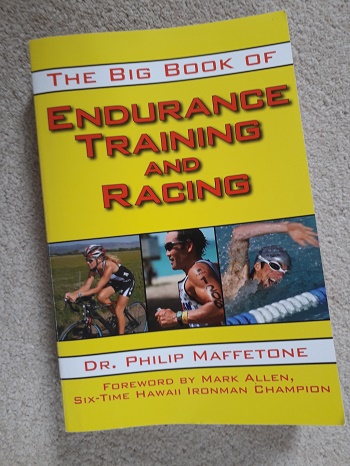
I’ve discussed Maffetone’s work at length previously. While he wasn’t a running coach, his work as a chiropractor helped many long distance athletes improve their times. His main concept is to build the aerobic system so exercise becomes fuelled by burning fat. Athletes do this by training to a heart-rate calculated using their age, muscle-testing for weakness and changing the diet to eat fewer processed foods, grains, dairy products and animal fats while eating more vegetables, fruits, nuts and seeds.

Coming up with a definition of health is an interesting conundrum, because when you when try, it ends up being defined by a negative. The negative being the absence of illness, injury or any other way the body may be malfunctioning. Just saying health is the perfect functioning of the body doesn’t say much.

Maffetone’s method is about eliminating or reducing, to an allowable level, those things which cause ill-health. When many athletes train they often do so with too much intensity which causes the parasympathetic nervous system to rev up, create adrenaline and generally cause the body to become unhealthy due to the waste products caused by anaerobic metabolism. Maf focuses them on improving the aerobic system to delay the anaerobic system from kicking in and lower its overall use.

While he never specifically coached athletes, he helped them get healthy by improving their aerobic base. His best known success is Mark Allen, who went from runner-up in multiple Hawaii Ironman races to being a five-time winner.

Wim Hof

I recently read and wrote about Hof’s book “The Wim Hof Method” and the three core tenets of his system. Improving the aerobic system by taking cold showers, breathing deeply and mentally focusing to achieve goals. Like any good system of improvement, his method starts off with small challenges and gradually increases so you can contend with more.

Hof is not a running coach either and while he has run a marathon barefoot up Mount Everest and swum 200m under sea ice; I consider his most impressive achievement to be the story of how researchers injected him with E-coli virus. In 16,000+ previous trials participants always developed mild flu-like symptoms from the injection – yet Hof didn’t. A subsequent experiment then saw him train twelve people in his method who also remained healthy despite the E-coli injection. The scientists were amazed yet it seemed natural to Hof.

Like Maffetone, Wim Hof explains the benefits of his method as coming from building the aerobic system up. He talks about how an improved aerobic system keeps the body functioning in its naturally alkaline state whereas anaerobic metabolism pushes it into an acidic state. He explains how deep breathing suppresses inflammation and cleans out waste products in the lymphatic system.

While their descriptions of the specifics may differ, the underlying principle is the same of improving the aerobic system to maintain health and create a strong immune system.

Percy Cerutty

So that’s an outline of Phil Maffetone and Wim Hof’s methods and rationales towards keeping your body healthy. Now we look at Percy Cerutty and how through his own experiences he discovered similar principles and put them into action to turn Herb Elliott into the world record holder for the mile and 1,500m as well as remaining undefeated in thirty-six mile races.

Herb Elliot and Percy Cerutty running barefoot strides

In Beyond Winning, Gary M. Walton writes “Born in 1895, Cerutty grew up in a working-class suburb of Melbourne. He was a weak, sickly, and underprivileged child. When he was six years old, he contracted a case of double pneumonia that caused partial paralysis of his left lung. For years, heavy exercise and especially running caused sever discomfort. He suffered from chronic migraine headaches and was usually sick after races. [Cerutty entered mile races, winning ten – one in 4:32] When he quit running in his early twenties, his health continued to slide. By the time he was 43, he had suffered from a nervous and physical breakdown requiring a six-month leave from his job as a telephone technician.”

This is a man who was clearly struggling with his health but during his six-months off, Cerutty decided to challenge his mind and body. It was do-or-die. He rebuilt his confidence by building up to diving off the high tower at St Kilda Baths, took up weightlifting, hiking and swam in the icy Yarra River near his home. He was beginning to develop his back-to-basics, no comfort Stotan philosophy – a mixture of Spartanism and Stoicism.

He created a weekend training camp at Portsea where runners would come to live in bunkhouses, run up sand dunes and eat raw foods. Walton states breakfast was “rolled oats, nuts, dried fruits, bananas, raw cabbage, brown bread and cheese”. But it wasn’t just about physical exercise, in the evenings they would talk and read books of philosophy and poetry, a purification of the mind.

A typical day at the camp:

  • 7am – 5 mile run before breakfast wherever they wanted to go
  • 8am – breakfast (as detailed above)
  • 9am – swimming, surfing or outdoor chores like chopping wooding, painting, carpentry
  • Noon – training and lectures followed by another swim
  • 2pm – lunch – fish and fresh fruit
  • 3pm – siesta
  • 4pm – weight training (a new concept in the 1950s)
  • 5pm – 10 mile run along dirt roads ending at the sea
  • 7pm – tea and general discussion on a variety of topics led by Percy
  • 11pm – lights out

One of the features of the Portsea half-acre training camp was a 60⁰ sand dune rising 80ft which the record to run up was 11 seconds and which Elliott had run up and down forty-two times on a another occasion. There was the Hall Circuit – 1mile 285yds – which Elliot had covered in 5min21 – as well as a ¼ mile Stewart Circuit which ended up a steep hill. Training wasn’t solely around the camp but also took in the local dirt roads, parks and golf course.

While Cerutty trained Elliot and other runners to world records, his aim was not specifically to win titles or run times. It was about getting the absolute maximum out of oneself. His Stotan creed was about removing the crutches and supports that people of the era were beginning to let creep into their lives. When he toured America, Cerutty was appalled at how Americans were flabby, drinking and smoking too much. While this may have been judgemental and critical we should remember he believed in what he preached and went from constant ill health in his younger years to being able to run a sub-3 marathon at age 50 which set the Victoria state record at a time when the world record was 2hr26.

All information on Cerutty taken from Walton’s “Beyond Winning” published in 1992.


It’s clear there is a similarity between Wim Hof Method and Cerutty’s training camp using nature to harden the mind and body. Swimming in cold water is used by both as a way to strengthen the will; but Cerutty probably never realised, unlike Hof, that it is strengthening the aerobic system as well. Even so, running on sand, up and down dunes would have had Cerutty’s runners breathing deeply just as Hof recommends. The overlap between their methods seems notable.

While there is less immediate commonality between Cerutty and Maffetone, both recommend a careful diet which involves natural foods and avoids processed ones. Cerutty’s diet though tended to be more carbohydrate-based whereas Maffetone’s doesn’t. But Cerutty was training runners like Herb Elliott for middle distance events where carbohydrates are the primary source of energy whereas the Ironman triathlons Mark Allen took part in need fat to be a key fuel source.

What Cerutty was discovering in his training camps was how to build the aerobic system through a combination of daily distance running at a time when these things were rarely understood. The daily regimen of running for half an hour in the morning, another hour in the evening as well as cross-training with sea swims or surfing would certainly have left athletes tired but improving their aerobic system. The overlap with Wim Hof’s Method is clear and Hof’s method has clear overlap with Phil Maffetone.

All distance runners will improve their times and capabilities by building their aerobic capacity and endurance. While the Stotan approach of Percy Cerutty is no longer necessary, it is easily achieved with a committed approach to modern training methods. If you’d like to me to help you become a healthier, better runner – please contact me to discuss online coaching, training reviews and plans.

Dealing with going anaerobic

In the last post I talked briefly about going anaerobic. The word anaerobic means to be without air and, at its simplest, it’s when the body cannot get enough oxygen for the work being done. More accurately, anaerobic metabolism occurs independently of oxygen – the distinction being there can be oxygen present but for whatever reason it’s not being used. I’ve experienced this on occasions when my heart-rate has been lower than 130 bpm but I can feel the signs of working anaerobically. If I were training by my heart-rate monitor I’d shoot on past this and for many years I never realised it was holding back my running.

Going anaerobic is quite normal. As I said in the last post we do it the moment we begin an exercise as simple as getting up off the sofa. The problem with going anaerobic is that we can only handle a limited amount of it. While that’s not an issue for daily tasks like going upstairs, it quite often turns out to be the limiter for runners exerting themselves for significant periods of time.

Going anaerobic produces all sorts of by-products that feel uncomfortable, as well as using up fuel stores much quicker than aerobic metabolism. While fuel isn’t an issue in shorter races, some of the by-products are. For example, carbon-dioxide is a by-product which results in you breathing heavier. The faster you run, the quicker by-products build up which is why you get out of breath very quickly when you sprint.

Not all by-products are bad. One which you may have heard of is lactate, also incorrectly referred to as “lactic acid”. Historically because it’s easy to measure it was originally thought to be the root of all the problems and most people still associate it with bad things e.g. runners saying “my legs were full of lactic acid”. So while it’s technically wrong to say it causes bad things, the real world uses it in this sense because it’s become the norm and coaches use it because it correlates to the waste products which are bad. I’m not going to buck the trend!

Three ways your body handles going anaerobic

Lactate Clearance – any time lactate is being produced, the body shuttles it out of the muscles to other areas of the body where it can be broken down or used as fuel. This is done by monocarboxylate transporters (MCTs). While you don’t need to remember the name of these, it is worth understanding the body can only build a finite number of them. This means only a certain amount of lactate can be cleared. Typically this is an hour’s worth while running at Threshold. In fact it’s the other way around in reality, your Threshold is defined by the MCTs. When you’re doing a run of less than an hour, you can run proportionately faster than your Threshold.

When the level of lactate production is equal to the level of lactate clearance, the body is referred to as being in a Steady State. The lactate neither increases nor decreases. Most people train here because the steady state doesn’t feel bad. It’s a combination of aerobic and anaerobic energy.

Lactate Tolerance – if the rate of lactate production exceeds the rate at which it can be cleared out then all the body can do is tolerate it by buffering the acids. Just as there is a limit to how many MCTs can be built, there is a limit to how much lactate tolerance can be built through training.

Slowing down – the third way the body responds to a build-up of lactate is the one most of us have experienced – it slows us down.

If we go out very fast, we use up lactate tolerance quickly and can then only run in a steady state at best. When the anaerobic energy production or MCTs run out, all we have left is aerobic energy to fuel us and drop down to the aerobic level. This is something most have experienced in half and full marathons.

The slow down can be voluntarily reset at any time by dropping back to aerobic mechanism. After a period of this, the lactate has cleared out and we’re able to pick up the speed again. Most runners unconsciously know this as they push themselves to the point of getting out of breath, slow down and then later find the energy to give it another effort.

Implications for training

Anaerobic training, such as speedwork and intervals, has its benefits but they are limited, less than 10% of your parkrun is anaerobic ! There is only so much clearance and tolerance that can be built by the body. Spending your time training anaerobically only provides so much benefit. All those rest periods keep resetting the anaerobic systems.

These limitations don’t change for the best runners, they are just as limited in the anaerobic department as the rest of us. The difference is they have better aerobic systems. Quite often they have a naturally large aerobic system but they’ve also improved it through training and that’s where all of us should be spending the majority of our training time.

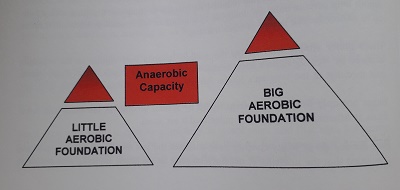
This is best encapsulated in a picture from Keith Livingstone’s Healthy Intelligent Training book. The Anaerobic contribution is the same in both but, the bigger the aerobic contribution, the more that can be achieved i.e. running faster.

Going anaerobic

I remember when I was in my twenties, and I knew absolutely nothing about how to train for running. I just thought you ran as fast as you could for 10-20 mins and assumed you’d get faster. Compared to now, there was a dearth of information on how to train although there were books on it; but anyone who was decent learned how to run by the osmosis of running with others at a club.

These days there’s more information, jargon and approaches to getting better than ever before. Although it wasn’t running, I remember meeting some rowers – which as another endurance sport mirrors running – and one of them talking about “going anaerobic” and “oxygen debt”. These phrases were about as technical as people got in those days and while “anaerobic” still gets bandied around; the concept of oxygen debt is one that’s rarely mentioned these days.

My understanding of going anaerobic back then was based on the idea that sprinters use anaerobic energy while distance runners use the aerobic system. It was one-or-another in my head and anaerobic equalled the breathlessness of sprinting. The truth is more complicated as both groups use varying degrees of aerobic and anaerobic energy in their events. This post isn’t going to break that down but it’s taken me some years to get closer to the truth about when we go anaerobic. The fact is any breathlessness, which can happen for an untrained runner at paces as slow as nine or ten minute miles involves anaerobic metabolism. You don’t have to be running at high speeds to go anaerobic.

When you read running books that mention anaerobic training there is much confusion as different authors define it differently. Again, I’m not going to dive too far into that debate other than to say some authors see it as what happens when you exceed V̇O2max. Others believe it is what happens when you exceed Lactate Threshold / Anaerobic Threshold (or whatever term they use to name the point where you begin to exhale harder and faster). Whereas I believe it starts much earlier than that, back at what may be called the Aerobic Threshold, but is confusingly also called the Lactate Threshold by some groups, and consequently I refer to as the First Threshold to try and avoid confusion. Even then I’m not entirely correct about when it happens – it’s simply a nice approximation.

What I can say with confidence is that going anaerobic happens any time your aerobic system is overwhelmed. If you’ve been sitting quietly on the sofa and suddenly jump up and run upstairs; your heart doesn’t have time to speed up to supply more oxygen so you have to go anaerobic to meet the demand. For a while you go into “oxygen debt” until the body is able to handle the exertion – which is partly about getting to the top of the stairs and stop the high intensity work; and partly because the heart races and you breath hard in response. Another example is the start of a run, you’ll be using anaerobic energy until the body can meet the demand; once you’re settled in every thing steadies up but if you come to a hill and start to get out of breath going up it – yep, you’ve gone anaerobic again.

All of this is simply background information setting up my next post on how the body responds to going anaerobic. It’s very easy to get bogged down in the detail, I’m trying to keep it simple but if you have questions please do ask in the Comments.