Update on my 800m training – January 2022

January has been a revealing month for training. It has really ebbed and flowed, showing the typical pattern of ups and downs that every runner can expect. While the intricate details of my training may not be of interest to everybody, the pattern should be.

In mid-December, I concluded I was struggling for aerobic speed. While my top-end speed hasn’t been fantastic I have been able to run 200s at 5min/mile pace but, at all the parkruns I ran through Oct-Nov-Dec, I’d struggled to run any kilometre quicker than 3:55. Compare this to my past and I could run one in 3:45 in 2019 and much faster in the years before that.

I embarked on running kilometre intervals with three minutes standing recovery which had always been an old session favourite. The route I use is undulating with definite up and downhill legs. The recent sessions were slightly complicated by workmen creating a cycle path on the other side of the road and parking their vehicles along the verge. But only on one occasion did this impact me.

I began these efforts on Dec 23rd and did them once per week. The first three weeks showed little to no change but during this time I struggled with my general running. This probably wasn’t helped by running a Christmas Day parkrun (20:11) between the first two sessions and seemed to send me into a running spiral.

Intervals – 5x1K with 3-min standing recovery

Below are the results of the 5x1K with 3-min standing recovery, plus I’ve included Christmas Day parkrun to illustrate how my running looked without the recoveries and what I was trying to improve upon. It’s noticeable that my first intervals weren’t much faster than the parkrun.

 Effort 12 (uphill)34 (uphill)5
23-Dec3:553:583:534:013:56
25-Dec (flat parkrun 20:11)4:014:014:014:084:00
30-Dec3:563:563:543:583:54
5-Jan3:543:594:003:573:59
11-Jan3:444:003:574:114:02
18-Jan3:424:013:504:063:49
25-Jan3:433:543:493:593:50

You can see for the first three weeks, the first kilometre was still only capable of being run in around 3:55 and then on 11-Jan, I clocked 3:44 and went faster the following weeks. What’s noticeable is how slow the other intervals were on the 11th and I think this is because my legs had dug out more fast-twitch muscle which was producing more lactate and this then made it harder to run the following intervals especially the uphills. Over the next couple of weeks, the body began to adapt so either less lactate was produced or it was cleared / tolerated by the body allowing the later efforts to speed up.

The highlight of running a kilometre in 3:42 is it’s the same pace as my 800m a year ago. Not only did I run 200m further on this training effort but I was then able to do further efforts three minutes later. Remembering back to my original time trial, I did jog immediately after but my breathing was rasping away and my lungs burning for the next fifteen minutes and beyond.

Long runs – 11.7 miles every Sunday

I have a standard long run to Broadstone which I’ve been running fasted (no breakfast) at about 7am. In late November, I clocked my quickest ever time of 1:29:06 (7:38/mile) with an average heart-rate of 151.  The following weeks I prepared for Christchurch 10K so didn’t run it again until December 19. This came in at 1hr32 and set a baseline for where training was about to go. The start of January saw my body absolutely crash with heavy legs after Christmas Day parkrun and two sessions of intervals. Just too much and I needed recovery hence a 1hr45 run where heart-rate barely got out of the fat-burning zone. As the weeks passed, the long run quickened up until I ran a course PB on January 30. The variability of the long run highlights how when you move the body towards faster work, the endurance drops off.

 Run timePace per mileAvg HR
19-Dec (before ints)1:31:537:53149
26-Dec1:36:438:14139
2-Jan1:45:069:00127
9-Jan1:37:088:20143
16-Jan1:35:238:09140
23-Jan1:33:117:58145
30-Jan1:28:287:35147

Steady run – 7.4 miles

My second workout of the week has been a Steady run usually on a Thursday. I hadn’t run this route in a while but my previous best ever was 56:25 set years ago. Often it takes over an hour if I’m doing an easy run.

For the Steady I would head out and push up to an upper aerobic feel – what I feel is marathon pace intensity and just hang on, never pushing it. It’s a route with a long uphill at mile 3, heads back down for faster miles at 4 & 5 before a gradual uphill to home.

I was pleased when I ran a course PB two days after the first set of intervals but when I overloaded in the next few days, I took it easy the following week. Once my legs were back, I began to see the same improvement and benefits that I’ve experienced on my long runs.

Run TimePace per mileFastest mile
23-Dec55:597:337:04
30-Dec60:398:107:34
6-JanNo steady run
13-Jan56:237:347:11
20-Jan54:457:217:04
27-Jan53:397:136:51

The run on January 27 was done with an extra day of recovery, on the Friday rather than the usual Thursday. I’m sure it helped and I was really pleased to achieve three sub-7 miles during the run – admittedly on downhill miles! It’s a long time, if ever, that I’ve run those sorts of splits on a local route outside of a race or workout.

Drills and strides

These have continued twice weekly and, as I’ve said before, they seem to have made a massive improvement to my running form. I feel I’m beginning to skim over the ground with all my effort applying horizontally rather than a bouncy, up and down stride which you see in many runners.

I added in a C-skip at the start of January as the B-skips had become coordinated and I was no longer having to break them down into smaller parts. C-skips are what most people would think of as “butt kicks” (heel flicking up to kick the backside) and they unlocked some of the tightness in the quads. But there was a small downside as the increased efficiency began to put a strain on previously unused muscles and I’ve been struggling with a painful left glute which then began to extend down into the left ankle area. Nothing terrible and never a problem when I’ve been running but flaring up during long periods of sitting.

On the week of 6-Jan when I didn’t do the Steady run, it was because I ran the intervals on the Wednesday to give myself extra recovery. The following day, after doing drills, I ran one 200m to get an idea of where I was at and it came in at 35.81secs. The fastest since I began 800m training and close to my best recorded ever. The cadence was consistent, starting up at 206 before dropping slightly to 204 then 202 – but it was very smooth. I was pleased with it considering I’d run hard intervals the day before.

January over, looking forward to February

So that’s how January’s training has gone. The only negative is I only attempted one fast parkrun on 22 January and that came in at a disappointing 21:19 at Upton House, over twenty seconds slower than my PB there. But I know I’d been training hard and my legs were recovering from it. The fastest kilometre was only 4:05 which is notably slower than the sub 3:45 I was running in training.

While I’d like to have continued with the 5x1K to see how they evolve, I’ve decided to take training in a slightly different direction for February and March as I’m intending to run the Bournemouth Bay Half marathon on April 3. So I’m going to fill in the gaps with some 10K-paced work on the next 2-3 Tuesdays then switch those workouts to half-marathon paced work and looking to build the endurance to support it for the longer distance race. That will round off my winter training and set me up for getting back to 800m work in the spring.

Efficiency and my postman

I often say “Hello” to my postman, if he doesn’t look too busy I’ll engage him in conversation or give him a wave as I zoom by in the car. Before Christmas there were a couple of days where I received post at around 4pm. This being later than usual, I chased after him with a couple of mince pies and commiserated about the long hours he was doing and asked what time he’d started and finished. He said he was arriving at the sorting office just after 6am; doing a couple of trips back there pushing his trolley up the hill and on the longest day had delivered his last letter at 4:45pm, arriving back in the office at 5:07pm. He delivers six days per week.

I once did a spot of leaflet delivering to local houses and was tired after two hours of it. On paper, it doesn’t seem much, walking around, occasionally climbing two or three steps to a door, and sometimes bending down to a low letterbox. By the time I finished I was tired and hungry and I’d only done my local roads. I’d estimate my postman’s route is three times bigger than what I’d done.

So you’d think he’s superfit from all that walking and to an extent, he is. You rarely see an overweight postman or woman. It’s an active job. Yet when I looking at that fitness from a running perspective, he’s not going to go out and run a sub-3 marathon without some other training. What’s he’s got is functional fitness for a specific task – walking at low speeds, pushing a trolley with letters and parcels and the ability to do some step-ups. He could probably go out and do a charity walk or ultra with ease.

This is the mistake many people make as they get older. They think that if they do lots of walking or playing golf, it’s keeping them fit but it’s really not doing that much because there’s very little exertion taking place. Same with people cycling bikes along the promenade or cycle paths. If you don’t push yourself, the body becomes efficient at what it does.


We can begin to get an idea of how efficiency works by looking at things through a biological / chemical perspective. For muscles to contract they need to be fuelled by a substance called ATP which the body sources or creates from its fuel stores using one of four energy pathways. I’ll give an overview of the four here but if you want to jump past the details, the info relevant to the remainder of this post is in the summary lower down.

ATP-PC or Alactic Anaerobic energy system

A small amount of ATP is stored and readily available for fuelling high intensity activity. Energy is created very fast, so the muscles are able to work fast. But there’s a limited quantity of the substances used in the ATP breakdown and rebuilding process so it’s exhausted after around ten seconds. This is why it’s sometimes referred to as the sprinter’s system. Those guys and gals are quick but they can’t last even one lap of the track. For distance runners, this energy pathway isn’t very useful other than for a quick start off the line, or a kick at the end of a race.

Anaerobic Glycolysis or Fast Glycolysis

Carbohydrates stored (as glycogen) in the muscles and liver can be broken down to release glucose. Each molecule of glucose, when broken down by Anaerobic or Fast Glycolysis, creates 2 ATP. When we talk of anaerobic exercise, it’s usually this system we’re talking about (although the ATP-PC system is also covered, but as I wrote it’s mostly irrelevant to distance runners).

Aerobic Glycolysis or Slow Glycolysis

Usually referred to as the aerobic system, this takes a molecule of glucose and breaks it down to create 36-38 ATP. To create this quantity (much higher than the Anaerobic version) it uses oxygen in the breakdown and goes through more steps hence it powers muscles slightly slower. This is why a marathon, which is run almost purely using this pathway, is never going to be as fast as the runner’s 5K.

Lipolysis or fat-burning

The other part of the aerobic system is fat-burning. Depending on the type of fat and how long its molecular chain is, a molecule of fat breaks down to produce 120-140 ATP. Again it needs oxygen but the reason why it produces so much ATP is because it goes through even more steps and chemical reactions to achieve it. This is why ultra-running is even slow than marathon running!

Summary

ATP-PCInstant energy for 10 seconds
Anaerobic / fast glycolysis2 ATP
Aerobic / slow glycolysis36 – 38 ATP
Lipolysis / fat-burning120 – 140 ATP

Enough jargon, let’s get back to postal deliveries …

What I’m about to describe is more of an analogy than physically possible. Firstly the numbers are wrong in magnitude – there are billions of ATP being processed in each muscle cell to keep the body alive. Secondly the body doesn’t use one energy system exclusively at any one moment, it’s often a mixture of them all. Putting the technicalities aside, let’s use those ATP numbers to begin to get an idea about efficiency.

When I went delivering leaflets as an untrained delivery worker, let’s say I was only using the Anaerobic / Fast glycolysis system. After two minutes I’d used up the fuel I’d created and was having to break down more. It’s no wonder then that, after two hours of delivering leaflets, I arrived home feeling tired and hungry – I’d used up my fuel stores and exhausted the muscles sixty times over. Such a big effort probably triggered a stimulus to adapt to a more efficient, aerobic pathway.

If I’d stuck at the delivering for a few weeks, my body would have adapted aerobically and I’d have found myself able to last over thirty-five minutes, almost forty minutes, using the same quantity of fuel I’d previously used anaerobically in two minutes. So now if I was out for two hours – what had previously required sixty refills would only need three to fourr. The job would feel much easier and I’d likely arrive home feeling less hungry.

If like my postman, I was doing this job six times per week for months on end my body would go a step further and begin to get efficient at fat-burning. Suddenly all the energy which had been used up in two minutes on my first day out would now be more than enough to last for over two hours (120 – 140 minutes). Or to put it the other way around. When my postman was delivering for over ten hours at Christmas time, he was able to fuel it with the same level of food that I would use up in ten minutes of delivering leaflets.

And in a nutshell that is efficiency and why, as runners we get faster at running if we train effectively. We go from sweating, gasping and wanting to stop while running at ten minute mile pace to being able to jog aerobically at that pace.  We arrive home feeling fresher, less tired and without so much hunger. Suddenly on our runs we have more energy available to run further and push harder. But if, like my postman, all you ever do is go at one speed then you won’t get any faster, only more efficient. It’s why once the body has adapted from running anaerobically at one pace to running it aerobically, doing some speedwork recruits the next level and begins the process all over again.

Positive and wishful thinking

At Christmas Day parkrun in Poole, I arrived unsure of what to expect. I’d run 20:26 at The Great Field a month before and 21:01 at Upton House more recently. With Poole being notably faster there was a glimmer of hope I might squeeze under twenty minutes. But I knew I’d run 5x1K intervals earlier in the week so my legs could still be tired. I was happy when I recorded 20:11.

What’s always intrigued me are the runners who can’t be happy with the time they get. My 20:11 on Christmas Day was my fastest parkrun in four years. Yet I know some runners who wouldn’t be happy with that. In response to a time of 20:11 they’d say something like “I wish I could have got under twenty minutes”. Instead of being happy with their fastest time in years they manage to diminish the achievement.

This is wishful thinking in all its glory. Their minds are off somewhere else wishing for what they want, not what’s actually happened. If they could live in the moment they’d savour that time.

– If they ran hard from start to end, giving their absolute best, then there is nothing more they could have done. So what’s to be unhappy about?

– If for some reason, they know didn’t put in full effort then they got the result they deserved. They can’t be unhappy with the time, they need to be unhappy with themselves and their approach. They need to hold themselves accountable, learn the lesson and adjust in the future. With running times, you get out whatever you put in.


People often talk about needing to develop positive thinking or optimism, this is different to wishful thinking. When I run a time of 20:11, it gives me confidence that I will be able to break twenty minutes. I think of all the things I haven’t yet worked on in training. All the sessions of speedwork, tempo running, base-building and pace development that are there to be worked on. On top of that there’s all the potential supplemental stuff like shoes, nutrition, compression socks that might shave seconds off. That’s my version of positive thinking. The only time I ever got downhearted and lost my optimism was a period when I couldn’t see any new openings to try. Even when I’m running badly – it is what it is. Having a plan for how I’m going to work my way out of the slump keeps me positive.

The interesting thing about the wishful thinkers is they call themselves realists yet they don’t live in reality. The truth is they’re pessimists – they can’t even be honest with themselves about what to call themselves. They never dare to dream big or set challenging goals, trying everything they can in pursuit of achieving them. They don’t take responsibility for their training, they don’t try new things or different approaches they keep it as safe as possible. When they run out of their limited array of options, all they can do is wish they could have been faster.

Review of the year – 2021

I’m not sure what to make of 2021 as a running year. My goal at the start of the year was to train for the 800m and improve on the 2:58 time I recorded in December 2020. I’m under no illusions that this is not a particularly good time even for a fifty year old. I religiously followed Jack Daniels’ training plan and when I next time trialled in April, I’d only improved to 2:55. Another time trial in early June was 2:53 and after another round of following the training plan I was only down to 2:49 in October. It really hasn’t been very satisfying progress from a results perspective.

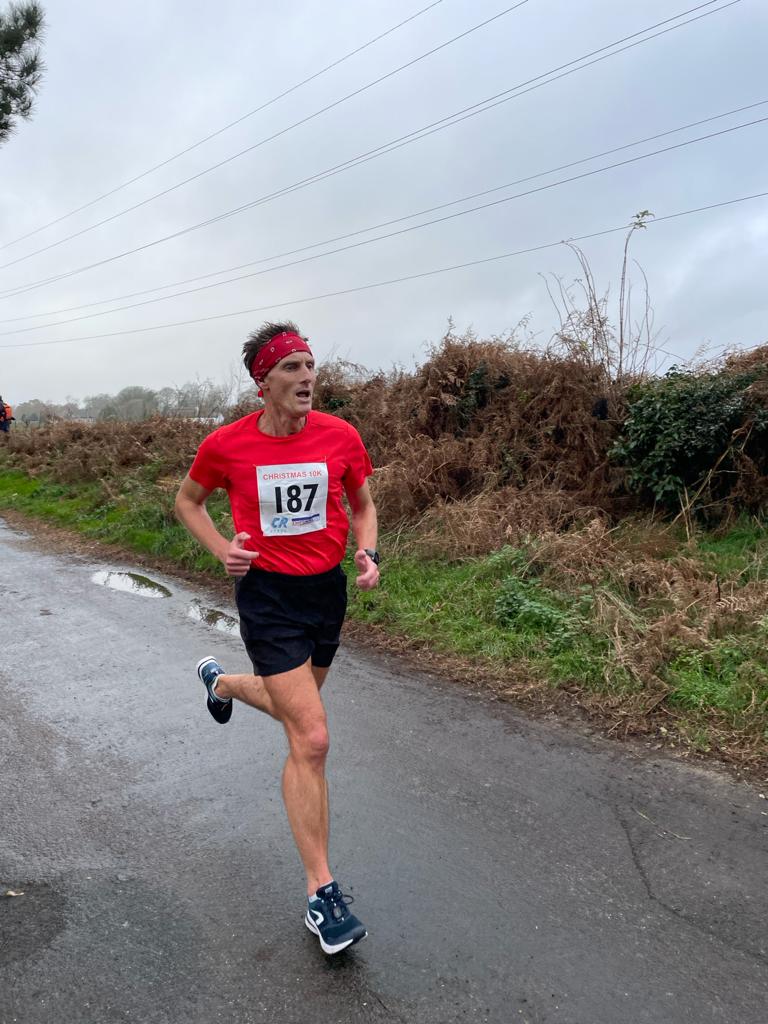
Final sprint to the line at Christchurch 10K in 2021

From a process perspective, much seems to have happened. I’ve generally got fitter. At start of year I was running some of my recovery miles as slow as ten minutes; by year end I was feeling comfortable at eight minute miles. My general training speed has improved and there was a notable difference in how I felt on my 800 time trial. Last December I was absolutely gasping by the end of it with the lactate build-up leaving me coughing for the next hour. Each of this year’s time trials has felt progressively better, less hard breathing, even if I’ve not been significantly faster. All of this summarises to having built a better aerobic system.

Over the year, I’ve lost a stone in weight. I started the year at 188lbs (13st 6lbs) and am now below 175lbs. I’ve never been this light or chiselled in my life. Half the weight loss happened in the early months when I geared up and did the tough interval training; the other half when I started doing a low volume of press-ups and bicep curls daily. On that front, I’ve at least doubled my capacity for doing press-ups in six months.


While endurance has improved. I’ve been wondering about my top-end speed. At year start, I knew I was struggling there as I couldn’t even hit a peak speed of five minute per mile pace running flat out. Now, I will say this is to be treated with a little scepticism because the accuracy of my GPS watch is not quick to lock in. It takes fifteen seconds but even so, by year end I’ve seen myself hit 4:13/mile on it. Again I’m aware this is not a great top end speed, given that Olympic distance runners do whole races at this pace.

Digging back through my records, I found myself hitting 3:38/mile when I was younger at the end of parkruns. Again I treat this with some scepticism as GPS can be wonky but I also suspect it’s relatively accurate. Ultimately the best 800m runners in the world are averaging a 3:20/mile pace for the men and 3:50/mile for the women. They can run fast over short distances – I can’t even hit these paces yet.

Throughout 2021 I’ve been exploring ways to improve my top end speed. This has ranged from looking at cadence and trying step-over drills; thinking about form generally; to doing twice-weekly sessions of sprint drills which really seem to be making a difference. As I exited 2021, my running form had begun to feel different in a positive way. I finally feel like I’ve got a back kick and the trail leg is shortening when I try to run quickly. I’m becoming glute-powered rather than quad-powered.

What I haven’t done to improve my speed, for deliberate reasons, is any hill work. I tried that in 2020 and within two weeks, I’d blown my aerobic base as the fast-twitch muscle began to overpower it. While it would be useful to get the fast-twitch speed back, I need to do it in a controlled manner, waiting until base is bigger and capable of handling high levels of anaerobic work.


From a racing perspective there hasn’t been much. The big positive was the return of parkrun in July. At my fiftieth birthday, I managed a 21:20 Upton House Personal Best. Then over the last few months I’ve been reducing that with runs of 20:55 there again, 20:26 at The Great Field parkrun and a touching distance of sub-twenty – 20:11 at Poole on Christmas Day.

The great thing about running 20:11 on Christmas Day is it’s not notably worse than ten years ago when I was forty and running 20:00 on Christmas Eve 2011. This is also true of my 10K.  At Christchurch in 2011 I ran 42:23; this year I was one second slower at 42:24 !!

Ten years ago, I was on my way up with my run training and I didn’t have any understanding of the interaction of speed, endurance and recovery; and how to bring them together to perform at your best. I had much more speed then because it’s all I tried to do, whereas now I’m coming at running from the endurance end. I’m hopeful I’ll be adding aerobic speed this winter that will see me surpassing all previous bests. I don’t like to rely on luck or hope but … fingers crossed!

This reflects the negative about Jack’s plan. I don’t feel it’s helped me improve at the top-end speed as there’s nothing in the schedule dedicated to building it in the first place. The best 800m runners are often coming to the event capable of running 400m in less than fifty seconds (as young adults) and then building the endurance to hang on. For this reason, I’m going to reintroduce my own ideas about the things that helped me to get fast when I was young – which mostly involve more standing recoveries and interval work done in sets to allow lactate to clear. I just need to make sure I don’t undermine the aerobic base by doing too much.

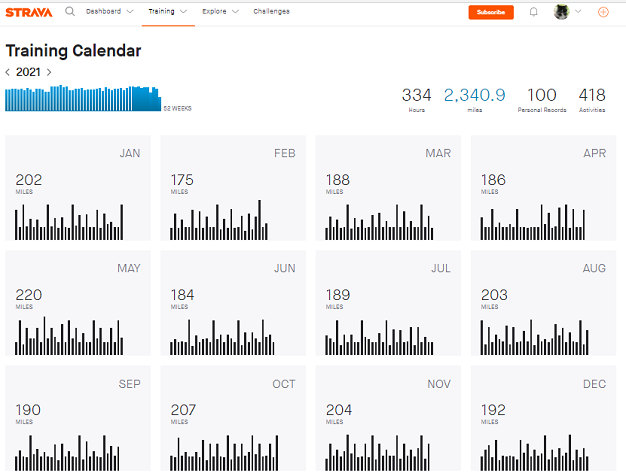
So that’s been my 2021. I’ve enjoyed the year’s running – there’s no way I could have got out every day if I didn’t. I covered about 100 miles more than in 2020 and that has been down to a consistent schedule. I usually run around six hours per week training and that’s led to more miles as I’ve speeded up. Of course the schedule flexed through the year depending on where I was at with Jack’s plan but generally speaking it’s been a consistent outlay of six to six-and-a-half hours each week resulting in 40-50 miles.

Dealing with going anaerobic

In the last post I talked briefly about going anaerobic. The word anaerobic means to be without air and, at its simplest, it’s when the body cannot get enough oxygen for the work being done. More accurately, anaerobic metabolism occurs independently of oxygen – the distinction being there can be oxygen present but for whatever reason it’s not being used. I’ve experienced this on occasions when my heart-rate has been lower than 130 bpm but I can feel the signs of working anaerobically. If I were training by my heart-rate monitor I’d shoot on past this and for many years I never realised it was holding back my running.

Going anaerobic is quite normal. As I said in the last post we do it the moment we begin an exercise as simple as getting up off the sofa. The problem with going anaerobic is that we can only handle a limited amount of it. While that’s not an issue for daily tasks like going upstairs, it quite often turns out to be the limiter for runners exerting themselves for significant periods of time.

Going anaerobic produces all sorts of by-products that feel uncomfortable, as well as using up fuel stores much quicker than aerobic metabolism. While fuel isn’t an issue in shorter races, some of the by-products are. For example, carbon-dioxide is a by-product which results in you breathing heavier. The faster you run, the quicker by-products build up which is why you get out of breath very quickly when you sprint.

Not all by-products are bad. One which you may have heard of is lactate, also incorrectly referred to as “lactic acid”. Historically because it’s easy to measure it was originally thought to be the root of all the problems and most people still associate it with bad things e.g. runners saying “my legs were full of lactic acid”. So while it’s technically wrong to say it causes bad things, the real world uses it in this sense because it’s become the norm and coaches use it because it correlates to the waste products which are bad. I’m not going to buck the trend!

Three ways your body handles going anaerobic

Lactate Clearance – any time lactate is being produced, the body shuttles it out of the muscles to other areas of the body where it can be broken down or used as fuel. This is done by monocarboxylate transporters (MCTs). While you don’t need to remember the name of these, it is worth understanding the body can only build a finite number of them. This means only a certain amount of lactate can be cleared. Typically this is an hour’s worth while running at Threshold. In fact it’s the other way around in reality, your Threshold is defined by the MCTs. When you’re doing a run of less than an hour, you can run proportionately faster than your Threshold.

When the level of lactate production is equal to the level of lactate clearance, the body is referred to as being in a Steady State. The lactate neither increases nor decreases. Most people train here because the steady state doesn’t feel bad. It’s a combination of aerobic and anaerobic energy.

Lactate Tolerance – if the rate of lactate production exceeds the rate at which it can be cleared out then all the body can do is tolerate it by buffering the acids. Just as there is a limit to how many MCTs can be built, there is a limit to how much lactate tolerance can be built through training.

Slowing down – the third way the body responds to a build-up of lactate is the one most of us have experienced – it slows us down.

If we go out very fast, we use up lactate tolerance quickly and can then only run in a steady state at best. When the anaerobic energy production or MCTs run out, all we have left is aerobic energy to fuel us and drop down to the aerobic level. This is something most have experienced in half and full marathons.

The slow down can be voluntarily reset at any time by dropping back to aerobic mechanism. After a period of this, the lactate has cleared out and we’re able to pick up the speed again. Most runners unconsciously know this as they push themselves to the point of getting out of breath, slow down and then later find the energy to give it another effort.

Implications for training

Anaerobic training, such as speedwork and intervals, has its benefits but they are limited, less than 10% of your parkrun is anaerobic ! There is only so much clearance and tolerance that can be built by the body. Spending your time training anaerobically only provides so much benefit. All those rest periods keep resetting the anaerobic systems.

These limitations don’t change for the best runners, they are just as limited in the anaerobic department as the rest of us. The difference is they have better aerobic systems. Quite often they have a naturally large aerobic system but they’ve also improved it through training and that’s where all of us should be spending the majority of our training time.

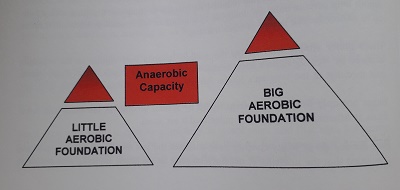
This is best encapsulated in a picture from Keith Livingstone’s Healthy Intelligent Training book. The Anaerobic contribution is the same in both but, the bigger the aerobic contribution, the more that can be achieved i.e. running faster.

Going anaerobic

I remember when I was in my twenties, and I knew absolutely nothing about how to train for running. I just thought you ran as fast as you could for 10-20 mins and assumed you’d get faster. Compared to now, there was a dearth of information on how to train although there were books on it; but anyone who was decent learned how to run by the osmosis of running with others at a club.

These days there’s more information, jargon and approaches to getting better than ever before. Although it wasn’t running, I remember meeting some rowers – which as another endurance sport mirrors running – and one of them talking about “going anaerobic” and “oxygen debt”. These phrases were about as technical as people got in those days and while “anaerobic” still gets bandied around; the concept of oxygen debt is one that’s rarely mentioned these days.

My understanding of going anaerobic back then was based on the idea that sprinters use anaerobic energy while distance runners use the aerobic system. It was one-or-another in my head and anaerobic equalled the breathlessness of sprinting. The truth is more complicated as both groups use varying degrees of aerobic and anaerobic energy in their events. This post isn’t going to break that down but it’s taken me some years to get closer to the truth about when we go anaerobic. The fact is any breathlessness, which can happen for an untrained runner at paces as slow as nine or ten minute miles involves anaerobic metabolism. You don’t have to be running at high speeds to go anaerobic.

When you read running books that mention anaerobic training there is much confusion as different authors define it differently. Again, I’m not going to dive too far into that debate other than to say some authors see it as what happens when you exceed V̇O2max. Others believe it is what happens when you exceed Lactate Threshold / Anaerobic Threshold (or whatever term they use to name the point where you begin to exhale harder and faster). Whereas I believe it starts much earlier than that, back at what may be called the Aerobic Threshold, but is confusingly also called the Lactate Threshold by some groups, and consequently I refer to as the First Threshold to try and avoid confusion. Even then I’m not entirely correct about when it happens – it’s simply a nice approximation.

What I can say with confidence is that going anaerobic happens any time your aerobic system is overwhelmed. If you’ve been sitting quietly on the sofa and suddenly jump up and run upstairs; your heart doesn’t have time to speed up to supply more oxygen so you have to go anaerobic to meet the demand. For a while you go into “oxygen debt” until the body is able to handle the exertion – which is partly about getting to the top of the stairs and stop the high intensity work; and partly because the heart races and you breath hard in response. Another example is the start of a run, you’ll be using anaerobic energy until the body can meet the demand; once you’re settled in every thing steadies up but if you come to a hill and start to get out of breath going up it – yep, you’ve gone anaerobic again.

All of this is simply background information setting up my next post on how the body responds to going anaerobic. It’s very easy to get bogged down in the detail, I’m trying to keep it simple but if you have questions please do ask in the Comments.

731 days and counting …

Somehow my Run Every Day streak has hit two years. There was never any intent to start a streak but it began back on December 8th 2019 at Christchurch 10K following a rest day. Post-race I began rebuilding my aerobic base with the aim of running a spring half marathon. Then the pandemic hit and we were all thrown into lockdown – only being allowed out for exercise and essential shopping. Having already clocked up one hundred consecutive days I thought I’d see how long the streak could go, fully expecting it to finish sometime in the summer once the pandemic was over(!), but if I went past that, aiming to do the whole of the calendar year as a challenge. And since then it’s just gone on. I’ve found no particular need for a rest day this year and as I haven’t entered any races other than this year’s edition of Christchurch 10K, I’ve kept running.

How did I motivate myself?

The streak has been incidental to my running. Running is something I love doing. When you do things for love, there is no concept of motivation. People who like fine food, don’t have to motivate themselves to go out to eat!

The sort of reasons why I love running are that it keeps me fit and provides a challenge to be better than I ever have. There are different event distances to get better at, as well as the technical challenge of trying to improve my running form and adding on strength and conditioning for an overall healthy, longer life. Looking after my future health by taking care of myself now is an easy motivation for me.

I guess it would also be fair to say there is hidden motivation coming from being a natural goalsetter. In the early days of the streak I was focused on getting fit for my spring half marathon, then it was extending the streak through lockdown, then the calendar year and now it’s daily running to support my 800m training. As I saw each milestone ticked off, a new one just a few months ahead naturally presented itself. So it just kept going.

How did I make time to run?

I have a routine. I often run at the same times each day.  By having that routine it becomes a priority to my life. In turn that buffers my own mental health and wellbeing because I’m putting myself first regularly in some part of my day. It sends an underlying message to my subconscious that what I want matters.  It’s not that I won’t be flexible when the occasion demands, but having the time blocked out “for me” makes it easier to be flexible when other demands arise.

How did I get out for runs when the legs were tired?

First and foremost, I let my body dictate how it wants to run. I generally schedule four easy/recovery runs each week lasting around forty minutes. I’ll run these as slow as my body wants, or more specifically only as fast as it lets me. I make sure I set off slowly (aka warming up) and I listen to how fast my body wants to go. I don’t push to go faster on these days, I just accept whatever pace my body lets me have.

There’s always a Sunday long run each week. In the early days of the streak I aimed for this to last two hours, but when I took up 800m training I reduced it 1hr30 and found a 11½ mile route which facilitated it.

The other two days of the week tend to be some kind of effort session. Whether that’s a one-hour Steady run, an interval session or parkrun; it’s more likely I push things and won’t be listening to my body. That’s fine because I have all the other days to recover.

But throughout I’ve always been monitoring how I feel, looking for signs of overtraining and ready to drop back and slot in a recovery week.

What have been the benefits?

Obviously I’ve been staying fit and healthy and hopefully getting faster, but there’s also a hidden benefit that only showed itself through daily running. I began to learn about the day-to-day fluctuations in how my body feels and wants to run. I started to understand what soreness meant, able to predict up or down days and be able to accept that sometimes the body can’t do too much.

Many amateur runners only run two or three times per week. If they’re marathon training they start to struggle to follow their plan because they feel lousy or tired. They don’t think they can do those runs slower or reduce the length while still doing something; they simply go all-or-nothing. Running every day ‘forced’ me to go out on the days when I didn’t want to and, by doing that, it’s helped me understand my running body better and figure out how to train to be able to do that without getting injured.

When will it end?

I never intended to have a run streak and despite ensuring I slot in recovery runs, I think there has been a build-up of residual muscle damage that would benefit from a rest day. If I get back to 10K or half marathons in 2022, I’ll be taking rest days in the lead up as part of the final taper. If the winter months in early 2022 are icy and cold, I’m certain I’ll take a rest day. It’s quite possible though I’ll get to the end of 2022 and be writing about my three year run streak!


Over the two years I’ve run over 4,500 miles and it’s consistently been thirty-five to fifty miles each weeks depending where I’m at in my training schedule. Every run streak has to have parameters, Ron Hill’s famous fifty-two year streak involved one mile every day; mine has turned out to be at least 5K every day. There was one day back near the beginning where I only did 4K but, as I said, there was no intention to create a run streak and it’s all arbitrary anyway. It’s not like I’m doing this for a world record, charity or at the expense of anyone else. It’s a nice, little story to tell but not much more than that in my book. The run streak has been something building in the background while I train.

Some Benefits of Easy Runs

I see Andy regularly at parkrun. He managed a PB of close to 23-mins a couple of years ago and wants to get back there. A few weeks ago I did a recovery parkrun and he finished just behind me at twenty-five minutes but was lying on the floor gasping for breath from the effort he’d put in.

He entered a half marathon in mid-October and achieved a creditable 1hr55 despite a lack of longer distance training. The following week after parkrun, as we talked about how well he’d done, I suggested that, rather than let this fitness go to waste, he should try to get out for an hour’s run each week. That way when he decides to do his next event, he doesn’t have to build up from a base of only 5K.

A few days later he pinged me a message saying he’d taken my advice and done a 10K in about fifty-five minutes. He’d run it at a pace not much slower than his half marathon and I suggested slowing it down further and enjoying the scenery. The following week he did this, slowing it by 30-secs per mile which means the run is only 3-4 mins slower overall but feels much less exertional.

He ran it again the next two weeks and then something weird happened … three days later he did the 10K again – a second time that week. The easy running was clearly having an effect. When I saw him at parkrun he nodded as I mentioned it and then ran his parkrun as fast as he could. His time a little over 24-minutes was an improvement on the last one.


What I want to draw out of this are the benefits he’s getting from easy running.

First and foremost, he’s getting fitter. His parkrun time has got 30+ seconds quicker in a matter of weeks. And postrun he wasn’t rolling around on the floor gasping for breath this time.

Secondly, the easy 10K runs leave him arriving home feeling good but not exhausted. They set him up for the day rather than tearing him down.

In turn that is leading him to feel more motivated. He’s enjoying the easy runs so much that he’s happy to do more than one 10K in a week! It wasn’t what I set out to get him to do but all credit to him for doing the extra.

Finally, the easy runs are giving his body more time to recover from the harder efforts. When he only ran fast his body never had time to recover. Every subsequent effort became more stressful until he took days off. Invariably he was never in peak form at parkrun because his fast-twitch muscles were always recovering. Now when he arrives at parkrun they’re rested and ready for a harder run if he wants it.

These aren’t the only benefits to easy running but they are some of the most easily noticeable.

What to do when Storm Arwen hit

Storm Arwen, the first storm of this winter hit the British Isles on Friday night. While the North was battered by 100mph winds, the South coast got off lighter with winds of only 30mph and gusts of 44mph. I wasn’t surprised to hear that three of the local parkruns cancelled including Upton House. Poole parkrun went ahead and the turnout was down on recent weeks. Again no surprises there.

It had been my intention to do one more fast parkrun in the lead-up to Christchurch 10K (two weeks away) but I didn’t fancy dragging to Poole on a cold, windy day, just like many others didn’t. So I ran from home and did an interval session – 6x1km with 200m jog recovery aiming for 10K intensity. This is one of my favourite sessions for preparing for a 10K so I’d had it in mind to do this week.

I wasn’t sure how it would go with the conditions. I ummed and ahhed about routes but went for the one where I usually do this session to give me consistency for comparing where I’m at with my training and also I know all my waypoints for the interval lengths. The only doubt I had was whether there’d be trees down on route as there have been in the past. As it turned out there weren’t any other than a few small branches / twigs that I was able to high step over without issue.

The wind, on the other hand, was quite brutal. I resorted to leggings, long sleeve top, gloves and hat for the first time this year. It kept me warm and because I wasn’t aiming for top speed, only 10K intensity, the headwind was rarely problematic.

A good session and I jogged home at a decent warmdown pace to complete an hour’s running. No parkrun this week but so what? There are multiple ways to achieve your running goals and there’s no rule which says you can’t do an interval or speedwork session on a Saturday morning.

I Discovered a Muscle

Full disclosure – I didn’t make a ground-breaking medical discovery; I simply found a new muscle .I’d never heard of. Running along the prom last Tuesday, with my legs pepped up, I found myself springing forwards almost effortlessly. As the run progressed, I began to feel an ache in my buttocks in a place which had never ached before. There’s nothing untoward in this, muscles fatigue and this leads to aching. But late in the run, when I focused on readopting my early run form, the muscle ached more, my stride improved and the springing returned. I’d discovered a new muscle!

This isn’t the first time this has happened to me in recent weeks. When I began doing squat workouts in October with the goal of being able to do pistol squats, I found a weakness on the outside of my hip. I took a look at the medical dictionary i.e. Googled “buttock muscles” and concluded it was probably the Gluteus Medius or Gluteus Minimus being activated. While I already knew of the three Glute muscles (the other being the Gluteus Maximus) and the Piriformis, I failed to notice the Obturator Internus hereby referred to as the OI (or its companion the Obturator Externus, the OE). My self-diagnosis of where the ache was leads me to believe it was the OI I’d discovered but it might be the OE.

Posterior Hip Muscles 1
Courtesy of Beth ohara~commonswiki, CC BY-SA 3.0, via Wikimedia Commons

Reading up on the OI and OE muscles, it seems they’re used in hip extension and rotation. That explains why I began to feel an ache as my stride lengthened out. Over the past month I’ve been doing sprint drills twice per week for just ten minutes and these have been helping me to learn how not to (excessively) rotate my hips when running. Running along the prom I could actually feel my core holding the hips square as I pushed off with each step. The sprint drills have helped correct the motion and along with the strengthening effect of the squats the consequence is the OI/OE muscles starting to ache. On Wednesday’s drills and strides, I found myself powering along like I’ve rarely done before. I remember perhaps two occasions, in my whole lifetime, when I felt like a sprinter – running on air.