What a block of training this has been! You’ll recall from my previous update that I’ve been following an 800m plan written by Jack Daniels and in his notes he said this phase would be the most demanding. He didn’t lie. In the previous update, most of my workouts were short intervals at paces between 5:30 – 6:30/mile to get the legs used to running faster. The rest of my week was easy running to recover. It never felt too bad as my legs have always liked faster running and coped very well with it.
What I hadn’t appreciated about my fitness was … the huge gap in it. Before starting this training I did three months of easy running where the majority of it was 8-10 min/mile. My long runs for example were averaging 8:30/mile in November. Along the way I clocked a few miles close to 7:30 (but only a few) and this is where the gap opened up. I had nothing to connect me between those autumn runs, at 7:30 or slower, to the 800m speedwork at 6:30 or quicker. Bridging the gap is what this phase aimed to do as you’ll see when I explain JackD’s T-pace and I-paced running.
To begin the recap let’s rewind to mid-January and the start of this phase. The first thing was to up the paces to account for (hopefully) improved fitness coming off of the previous block of training. This meant where I’d been running 200s at 48secs they were now expected to be run in 47 secs. Faster 200m repetitions quickened up from 44 to 43s and the other short interval distances were all increased using equivalent paces to these.
The sessions focused on what JackD terms I-pace training which are longer intervals at your predicted 5K pace. These began at three mins (where I managed 700 metres) and incrementally stretched out to five minutes (1,200m). I like what he says on p.108 of his 3rd edition book about how this “adds an aerobic stress but not any faster running speeds, which would be an additional new stress for the body to deal with.” i.e. you only add one stress, not two. My I-pace has been 6:50/mile (4:15/km).
The T-pace (Threshold) running should have been around 7:20/mile but I’ve found myself running them at 7:10-15 fairly comfortably. I think my recent years of endurance training probably made this easier to achieve than expected. There was also one 40-minute run at M-pace (Marathon) which I ran at 7:45/mile but could feel myself flagging in the last 5-10 minutes. Another gap filler.
There were still lots of 200s, 300s, 400s and 600s being run at fast paces but not the 100+ efforts of last time. Once again I’ve summarised it all in a table below and you can see, while the shorter efforts were generally successful, I struggled on the longer 400s and 600s. I think this is because my legs were often still recovering from the I- and T-paced sessions which totalled well over 45km.
Target time
On target
Missed
Efforts
Fastest
200m
47s
10
–
10
(2km)
38.44s
(5:10/mile)
43s
12
2
14
(2.8km)
300m
1min05
9
–
9
(2.7km)
59.77s
(5:21/mile)
400m
1min34
6
4
10
(4km)
1:24.9
(5:42/mile)
1min26
1
4
5
(2km)
500m
1min57
1
–
1
(0.5km)
1:53.54
(6:06/mile)
600m
2min23
4
6
10
(6km)
2:17.2
(6:08/mile)
I-Pace
6min50
33
1
34
(27.7km)
T-Pace
7min20
7
–
7
(11.2km)
M-Pace
7min45
4
1
5
(8km)
Total
87
18
105
(66.9km)
Stats for those who love them!
What’s been most interesting is Sundays have alternated between doing a Long Run one week, and a workout the next. By the time I’d run warm-up, efforts, jogged recoveries and warmed down home; the Sunday workouts were close to ten miles – not far off my standard 11-12 mile Long Run. Some of the midweek workouts have also been in the 8-10 mile range.
The first couple of weeks had their usual slump as the legs got used to the new regime. There were some aches and pains occurring especially in my left knee and right calf but these disappeared about three weeks in. My body began to feel comfortable with the training but I fatigued after a heavy fourth week. I found myself sleeping more and the fifth week of training was the toughest I’ve encountered so far. Thursday of week 5 was the workout where I physically couldn’t run fast enough on a set of fast 400m efforts missing target by 2-3 seconds. Fortunately in week 6, my legs perked up and I reaped the benefits of all the training so far. In the final workout I recorded my three fastest 200m times since I started – hurrah! Arriving home my Garmin promptly corrupted the workout so it wouldn’t upload. Fortunately I’d done a cursory review of the numbers in the kitchen. Frustrating but not the end of the world.
My overall mileage stayed about the same as previously and the six weeks resulted in 45 / 45 / 42 / 45 / 41 / 46 miles. These have been achieved with 6hr10 – 40 mins running each week depending on how my other commitments allow.
Weatherwise the training was a nightmare. As a golfer I’ve always found the end of January / start of February to be the worst conditions and I usually took a month off to stay warm at home. But, as a runner, you need to be getting out as often as possible so it’s a case of wrapping up warm, wearing the right gear. This year’s weather was rather diabolical – a combination of high winds, minus-figures temperatures, almost some snow, and two weeks of heavy rain. It seemed to dominate the forecast for every scheduled workout but there were one or two nice sunny days jumping out from nowhere to give surprise relief. Even so, when you’re struggling with fatigue, it’s not encouraging to go into a session knowing high winds will be suppressing your pace. But it’s already beginning to feel like “Spring is here” with mornings getting brighter and even birds tweeting!
The next six weeks focus on T-paced work which so far I’ve found fairly easy, but it includes fast repeats out to 600m which are going to need to be run in 2:06 – the fastest I’ve run so far is 2:13. I’m not looking forward to those but let’s see what happens ..
The Hansons’ Marathon Method contains an interesting approach to training for the marathon. The idea of the traditional “20-mile run” is abandoned with the longest run being only sixteen miles in their plans. Within the book they explore and compare the recommendations of other coaches and plans.
The idea of the 20-22 mile run comes from the days of Arthur Lydiard in the 1960s when he had his middle-distance runners doing this distance every Sunday! It might sound hard but remember these were runners with the capability of racing four minute miles. They’d begin the season taking 2hr35 and slowly work down to completing the runs in little more than two hours – quicker than 6min/mile, but that’s typically the easy pace of a world class runner. I don’t know if it was deliberate to create a course this long or down to the natural geography of Auckland, running in the Waitakere mountain range where Lydiard lived.
Derek Clayton, the world record holder for the marathon through the 1970s ran 150-160 miles every week. It was his belief, and he put it into practice, that he needed to run a 25-mile run every Saturday to be ready for his marathons. It’s hard to argue with a man whose record stood for so long yet Clayton suffered injuries and needed surgery eight times. Very few, if any, modern elites would do this level of mileage regularly now. Although there’s no record of how long these runs took him, given his toughness and general mileage, it’s hard to believe they would have been run any slower than 6-min/mile therefore being completed in 2½ hours.
In Jack Daniels’ Running Formula book he states a Long Run should never be more than 25% of the weekly mileage. The problem with this statement is it suggests you have to be running eighty miles per week to train for a marathon which is unnecessary for all but the best runners. This 25% limit is better applied to his training plans for shorter race distances but even with the marathon he says don’t go over 2½ hours. He makes the point that for someone only running four times per week, the runs are automatically 25% of the weekly mileage!
The 20-mile run is actually an arbitrary distance, there’s no science to this number. In Europe where they work in kilometres the Long Run is often 30K or 35K which are 18.6 miles and 21.7 respectively. People love round numbers! Of course, it’s true that runners used to say “Twenty miles is the halfway point of the marathon” as a reference to when the body starts to hit the wall and you have to dig deeper, but it’s also because they rarely trained much past it so the body wasn’t used to longer runs.
The most interesting approach to the marathon long run is the one detailed in Steve Magness’ The Science of Running. Magness coached at the Nike Oregon Project under Alberto Salazaar, himself once a world-class marathoner. The training knowledge at NOP was of the highest calibre so this method is one used by some of the best runners in the world. The first two months of a training programme are used to build up the Long Run to the twenty mile mark but then after this, there’s rarely specific Long Runs scheduled. They’re replaced by workouts that typically total the mileage. A world-class marathoner running at 5min/mile might do a Tempo run of 15-miles taking 1hr15 and when you add in a 4-mile warm-up and warmdown the session totals twenty miles. US Marathoner Josh Cox demonstrates this workout in the Training Day video.
The Hansons believe your marathon should be based on good physiological principles. They conclude that running for significantly longer than 2½ – 3 hours doesn’t provide those benefits to runners. Certainly in my own limited marathon training, I used to find that a three hour run left me feeling dehydrated whereas I happily run between 2 – 2hr15 every Sunday without taking food or drinks and arrive home feeling fine.
Hansons may limit the Long Run to sixteen miles but they include a run of eight miles the day before which results in a total of twenty-four miles over the two days. As they describe it, those sixteen miles then become the “last sixteen miles of your marathon” rather than the “first sixteen” which runners who set off fresh legged typically do. This is a method called cumulative fatigue and is used by ultrarunners to train for their races which can be in excess of one hundred miles. On a training weekend they might run for 5-6 hours each day to enable them to compile a total closer to their race distance.
When I was marathon training because I was capable of a 22-min parkrun I could reach twenty miles in three hours, it happily coincided with my 9-minutes per mile easy pace. For a slower runner, I would look for them to improve their pace and to use the principles of cumulative fatigue to help them prepare for a marathon. I’ve met far too many 5-hour marathoners focused on reaching the mythical 20-mile run in training because that’s what the guys who were capable of running four minute miles in the Sixties did. The problem is, as they build up through fourteen, sixteen, eighteen, twenty miles they start tearing themselves down Sunday after Sunday with demoralising trudges lasting four hours or more, often in unpleasant winter conditions. Motivation sags, they can’t wait for the taper and end up walking large chunks of the marathon anyway. If you must build up to twenty miles get it done early interspersing the progression with less-taxing two hour runs on alternate weeks to give the body a chance to recover.
This far I’ve focused on the marathon distance but I find many runners don’t believe a Long Run is necessary for anything other than half or full marathons. This is a mistake and maintaining a weekly Long Run is an important part of building your aerobic base. By running further once a week you dig out muscle fibres that would otherwise lie dormant. Does it need to be 20-miles? Definitely not unless you’ve reached the capabilities of the Lydiard crowd.
Middle distance runners typically do a run of 10-12 miles and it goes up from there depending on the distance being raced and the runner’s capabilities. But it’s equally important to think in terms of time. I always aim for a minimum duration of 1½ hours for my weekly Long Runs and a maximum of 2½ hours. Of course, this distance needs to be in proportion to my other running, I wouldn’t do that if I were rebuilding after a layoff and only doing thirty minute runs the rest of the week.
Whatever your event, whether it’s parkrun, 10K or longer don’t neglect a weekly long run. It’ll keep you positioned to pick up on a half or full marathon at short notice while helping you get fitter and faster for your chosen distance.
Just before Christmas, I was lent a copy of Ron Hill’s two-part autobiography “The Long Hard Road” which is packed with detail on his life and running up to when he wrote them at the start of the 1980s. I talked briefly about it in my Marathon Speed post. Coincidentally the latest issue of Runner’s World (February 2021) contains a feature on Ron which, of course, goes nowhere into the same level of detail but does give an outsider’s view of what he was like.
The legendary Ron Hill adorns the cover of Runner’s World – Feb 2021 issue
Ron’s famous for his fifty-two year run streak and I’ve read analysis elsewhere suggesting he overtrained prior to big races. But let’s rewind, as I’m two hundred or so pages into part one and still learning about his early training and racing. On page 91 he details a week’s training which was the general schedule he began to follow from August 1961 and on through the next couple of years.
Details of a week’s training from Ron Hill’s book “The Long Hard Road” Pt. 1
About two weeks after formalising the schedule he won his first marathon, Liverpool, in 2:24:22 which gives us an indication of his level of fitness. Up to this point his training had been irregular with weekly mileage varying between 50-80 miles. He even took days off at that stage!
The training week I’m analysing follows the format he used throughout 1962-64, averaging 85-90mpw. His diary begins on a Saturday before Christmas …
The first thing to note is while 91½ miles of training sounds daunting, he’s actually only doing about 1hr – 1hr15 of training each day. The morning sessions are 25-30 mins; and the evening sessions tend to be eight miles of faster training which I’d estimate took 40-45 mins. The Sunday ‘long run’ of 11 miles will be just over the hour. What makes the 91½ miles achievable is being a fast runner – the majority of his running is done between 5-6 min/mile so he’s covering 10-12 miles per hour.
Saturday Dec. 16th
Morning – 4 mile course – 24:27 (6min05/mile)
Evening – 12 miles total.Ten mile race – 1st in 49min59 (5min/mile)
My thoughts – the 10-mile race is 5min/mile. According to Jack Daniels this gives Ron a marathon pace of 5:20/mile – which fits with his first marathon being run at 5:30/mile.
This 5:20/mile gives us a boundary for the 80-20 rule modern elites follow – 80% of their training will be slower than this. This 10-mile race is definitely in the 20% category.
Meanwhile the morning run is in the 80% category. JackD suggests an easy pace of 5:55 – 6:40/mile for someone at Ron’s level of development, so at 6:05/mile it looks about right.
Sunday Dec. 17th
11-mile long run. No time given but run with two others at a “very gentle” pace
My thoughts – at over an hour, it’s slightly longer than an ideal recovery run from yesterday’s race but it certainly falls into the 80% category.
I find it interesting Ron had now been running over four years and his long run was only 11 miles. He managed to win Liverpool marathon without any specific build-up – there was no 20-mile run. It suggests he had natural talent for distance running but, as you’ll see, he ran hard almost every day and in doing so he used the same principle of ‘cumulative fatigue’ that ultra runners use to train for their big races.
Monday Dec. 18th
Morning – 4 ½ mile course – 26:51 (6min/mile). Says he “pushed it a bit”
Evening – 8½ miles – 6 laps of fartlek including fast lap (4:49)
My thoughts – the morning run is slightly longer and faster than on Saturday but Ron’s Sunday was easy by his standards. Falls into an 80% run.
We have few specifics on the how long the fartlek efforts lasted but due to the fast lap, I’d classify this as a 20% run.
Tuesday Dec. 19th
Morning – 4½ mile course – 28:36 (6min20/mile) – “fartlek” “pushed intervals along a bit towards the end”
Evening – 8½ miles – at Firs – 4 laps at race pace (19:35 – 4:54/mile) + 2 laps fartlek
My thoughts – once again, while the average pace suggests it falls within the 80%, by doing a fartlek and pushing along the intervals, this begins to get into the 20% zone.
The evening session is definitely a 20% run, in modern terminology you’d call this a 20-min Threshold or Tempo run.
Wednesday Dec. 20th
Morning – 4½ mile course – 28:08 (6min15/mile) “pushed it where I could”
Evening – 10 miles – 20x440s in 1min10 with 220yd recovery
My thoughts – once again the pace of the morning run is under 80% but Ron isn’t allowing his legs the recovery they need from the race (80% session).
The evening session is the 6th consecutive session where he’s putting in effort rather than simply running easily (20% session).
Thursday Dec. 21st
Morning – 4½ mile course – no time given – “fartlek” “legs tired and leaden at the end”
Evening – 8 miles – “number stride fartlek” up to 60 and back down twice over
My thoughts – finally we see the results of hard racing on Saturday followed by trying to push things on Monday to Wednesday. I’m guessing the legs felt particularly tired because the previous evening was five miles worth of interval work. Yet Ron wanted to do a fartlek that morning. It would probably qualify as an 80% session on average pace but it’s another hard one in my book.
In the evening he did the “number stride fartlek” workout he invented:
“I ran 10 double strides hard effort, counting each time my left leg pushed off then jogged 10 double paces, then 15 double strides with the same number of paces jogged, 20, 25, 30, and so on, up to 55 or 60, then back down again to 10. Half mile jog, then repeat the sequence again. The bursts were relatively short, but it meant a lot of hard work in the acceleration phase each time, and I found it very tiring.”
Ron describes his “number stride fartlek” session (p.73)
I calculate this to be over twelve minutes of all-out hard running. First effort of 10 double strides only takes around 5 seconds, the second effort about 8 seconds. By the time he’s on the 60 double strides it’s taking over 30-seconds for each effort and he’s still got to come back down the ladder again. In total there are 21 efforts ranging from 5 – 30+ seconds. He’s packing in a lot of acceleration and hard running here. When you add it all up he’s totalling over 6-mins of all-out hard running on one of these efforts. That’s a session in itself for sprinters and he did it twice over.
Now compare that to the recommendations of Jack Daniels who would suggest doing eight strides after an easy run and describes them as “light, quick 10- to 20-second runs (not sprints) with 40 to 50 seconds of recovery between” (Daniels’ Running Formula 3rd ed. P.152). That’s around 2-3 minutes worth and not all-out. I begin to wonder how Ron ever survived running all those years – definitely a 20% session.
Evening – 7 miles – ran to Firs and back for six laps of field
My thoughts – at last we see a day of easy running. After the “number stride fartlek” his legs probably weren’t able to do anything else in the morning (80% session).
No time is given for the evening session but it was probably an easier run (80% session).
To summarise, what I’m seeing here is almost constant pushing to run fast. The only days where this doesn’t happen are Friday and Sunday. He raced every Saturday so probably took things easier on Friday to give himself fresher legs and recovered on Sunday.
In terms of the 80-20 rule, it’s hard to know for sure which category sessions fell into I’d estimate he was closer to 50-50. The rule relates to doing training 80% of the training at an intensity where no waste products from anaerobic metabolism are being produced. Their presence upsets the body’s chemistry, uses fuel stores quicker and fatigues muscles thereby leaving the body less able to perform effectively in the next workout.
But beyond the anaerobic metabolites, there’s a question of muscular recovery. When racing or running at high speeds, the muscle fibres get micro tears that have to rebuild stronger. Without adequate recovery this mending doesn’t occur. Ron has it going in his favour that he’s in his early 20s so he’ll still be recovering quickly, but even a young person is only capable of doing three workouts per week – maybe more occasionally. If I’m sounding critical I’m happy to admit when I was Ron’s age, I had no respect for the recovery process either. I used to play sport hard almost every day. It wasn’t unheard of for me to play an hour of competitive basketball then go to volleyball training for another hour. Or play a game of squash at lunchtime and another in the evening.
On p. 108 Ron provides the bare bones of his schedule … (“It was hard training, but as I was seeing improvement and success, I didn’t mind it. Morning sessions rotated on a weekly basis. Evening sessions on a fortnightly basis. I had a card in my training log and I ticked off each session as it was done.“) … it’s a lot easier to see the pattern and intensity of sessions:
MORNING
(4½ mile runs)
EVENING
Mon
Fartlek
Week 1
Mon
Fartlek with bursts
Tues
Fast
Tues
Four laps of the Firs (3½ miles) at racing speed
Weds
Fartlek
Weds
20 x 440 (usually around 68sec)
Thurs
Fast
Thurs
“number stride” fartlek
Fri
Easy
Fri
7 miles easy
Sat
Easy
Week 2
Mon
20 x 440
Tues
4 laps at racing speed
Weds
20 x 440
Thurs
4x repetition laps at the Firs
Fri
7 miles easy
Saturday would have been a race later in the day and Sunday only one longer run
Ron is doing four specific workouts plus a race each week. He ran 64 races in 1962! And he’s pushing it on four mornings. His body is under a huge amount of stress and it’s no wonder that, after a year of it, he was eventually forced to back off and take three easy weeks (30-40 miles) in December 1962. As he recounts his year, he’s usually trying to run through some kind of nagging Achilles, foot or quad injury.
I’m certain if he had simply jogged the morning runs each day he would have been in a much better position (but still not an optimal one). Some people can handle more intensity and training than others and it’s clear Ron could. But it’s also clear from how his body reacted that his training was too much even though it helped him get faster over the next couple of years. More recovery sessions would almost certainly have allowed him to do stronger workouts to make the same gains and possibly even run faster.
But enough of the analysis, Ron says he was seeing improvement and it’s certainly the case. As he started this training he won the Liverpool marathon in 2:24:22 in August 1961. A year later he won the Polytechnic Marathon in 2:21:59. It led to him representing Great Britain and Northern Ireland at the European Championships in Belgrade. He didn’t finish the race pulling out at 30km five minutes down on the leaders. In 1963, he tried to defend his Polytechnic title and, while running faster (2:18:06), he came 2nd to Buddy Edelen. In 1964, Ron ran his fastest time yet with 2:14:12 at the Polytechnic which would have been a World Record had Basil Heatley not been beaten him. It gave them both a place at the Tokyo Olympics but Ron could only finish 19th in the marathon (2:25:34) and 18th in the 10,000 metres – a distance he’d been ranked at 3rd in the world in 1963. Nonetheless in three years he took ten minutes off his marathon time with his training regime. At other race distances he also saw improvements – his 2-mile time going from 9:12 to 8:50; his 3-mile time from 14:08 to 13:29; and his mile time down to 4min 12.5sec.
This is the question mark against Ron’s training methods. He was capable of winning one week, struggling the next. He won the Boston Marathon and Commonwealth Games in 1970 but then failed to even secure a medal at the Munich Olympics when he was the favourite.
I believe more recovery runs each week and fewer workouts would have allowed him to find the consistency to be a winner more frequently. Maybe I’m being unfair to him and as I get into the later parts of his autobiography, I’ll find he did what I suggest but his hard-working reputation leads me to doubt it. It’s instructive that as he prepared for the AAA Championship 6-mile race, key to selection for the Olympics, he was still running in local races. Modern runners are more selective about when they race. Constantly pushing his body meant it had to give out at some stage, so it often happened when everybody else was rested, at the top of their game and able to push harder.
Regardless of the results, I believe Ron got the best out of his talent and had a career to be proud of. His best marathon time was 2:09:28, only a minute or so behind the world record in place a decade and a half later. As a coach, you love people who are committed to their training and willing to work hard so there’s no complaints there.
Part two of Ron Hill’s “The Long Hard Road” – 400 pages each
The standard approach to marathon training has always been to build up the distance to the “20-mile run” three weeks before race day and then taper. Runners of the 1980s talked about doing the 20-mile run six times before a marathon to get the legs used to the distance but it was always about building up to the distance.
But a few years ago, I came across the idea that the Kenyans start out with running short distances at the pace they want to run their marathon and then extend the distance. I discovered this around the same time I was reading the Hansons Marathon Method which sets out ever-longer “Tempo runs” at marathon pace. These two approaches of the traditional Western build-up vs the Kenyan build-long have names in the sprint world – Long-to-short and Short-to-long respectively.
When I began running, I started out with a sort of Short-to-long approach. I went out the door at high speed and tried to hold onto it for as long as possible. Of course fatigue quickly kicked in and I gradually slowed down. This is the Short-to-long approach at its simplest – start at a particular speed and build up the distance for which you can hold it. I’m currently using this approach with my 800m training – I began with strides of 10-20secs to get my legs used to running at speed. Then it was 200m efforts at a particular pace, subsequently progressing onto 400m then 600m efforts at the same pace.
The alternative approach of Long-to-short is one where you get used to running longer intervals at a slow speed and then gradually quicken them up. As I documented in my post about Roger Bannister, in the six months preceding his iconic moment he began running 440yd intervals at 1min06 then reduced the time by a second per month until he could run them at 56 seconds e.g. 1:06, 1:05, 1:04.
In his “The Science of Running” book, Steve Magness refers to “Top down” and “Bottom up” approaches which are the distance running equivalents of Long-to-short and Short-to-long. Below are his suggested set of workouts for the 5K parkrun distance. On the left you can see the distance is long intervals of a mile or 1km which begin at threshold pace and quicken to 10K and 5K pace as the weeks go by. On the right, everything is run at 5K pace from the beginning but starts with short intervals of 400m and lengthens out.
Top Down (Long-to-short)
Bottom Up (Short-to-long)
6 x 1-mile at threshold with 1-2 min rest
3 sets of (4x400m) at 5K pace with 30sec rest, 5-mins between sets
5 x 1-mile at 10K pace with 2-3 min rest
3 sets of (3x600m) at 5K pace with 40sec rest, 5-mins between sets
3 x 1-mile at 10K pace 2 x 1000m at 5K with 3 min rest
2 sets of (3x800m) at 5K pace with 45sec rest, 5-mins between sets
1 x 1-mile at 10K pace 1 x 1-mile at 5K 2 x 1000m at 5K with 3 min rest
2 sets of (1000, 800, 700m) at 5K pace with 45sec rest, 5-min between sets
3 x 1-mile at 5K pace with 3 min rest
5x1000m at 5K pace with 60-75sec rest
Of course these are general outlines of the approach. The truth is you still do a bit of each as you progress through your running career. Eliud Kipchoge didn’t start out sprinting as a small boy at his marathon pace of 4:40/mile and keeping lengthening it out until he could run a sub-2 marathon. He did some faster running in shorter races (his mile time is 3:50) and he did lots of general runs at slower paces to build support for what he eventually achieved.
The second truth is that neither approach is “The Way” to train. Some runners will adapt better using a Short-to-Long approach, others using a Long-to-Short. I’ve met a number of guys who were natural marathoners and benefitted hugely from the traditional Western approach to marathon training. They went out each week, covered big distances and pushed a little harder. I, myself, on the other hand have always struggled to run big distances but find the shorter stuff easier and so tag on distance when I have a longer race coming up.
Whichever way you currently approach your training, think about your preferred style and then have a think about the alternative and whether applying it might get you better results.
I noticed during the 2020 lockdown my speed and strength have been declining and, as I’m not getting any younger, I thought it would be good to try something different while I’ve still got the opportunity to maximise whatever talent is left.
I’ve been toying over the years with trying my hand at middle distance running – 800m or mile. Having always struggled at 10K and half marathons more than my training suggested I should, it’s been a slow realisation that maybe I’m built more towards middle-distance or even shorter. I met Iwan Thomas, the British 400m record holder at Eastleigh parkrun once, and noticed we’re of similar size and build at 6’2” and 13+ stone. (Obviously this isn’t to begin to suggest I could ever have challenged him). But I have all the hallmarks of being packed with speed-generating fast-twitch muscle – I build muscle easily, I sweat profusely, have high heart-rates when running at easy paces, start off too fast and love doing interval work. The only trouble is I was never fast at sprinting!
While I understand the principles behind training for 800m, I’ve never actually done it so I decided to use one of the plans from Jack Daniels’ Running Formula book. I wanted to get a sense of how he structures workouts and what volumes he uses. I’d been running forty miles per week through the autumn so went with the plan based on that mileage. I ran an 800m time trial on Dec 2nd to baseline where I was at and ran a lung-busting 2min58. Not great but a starting place.
The plan has been to run two workouts each week, on Tuesday and Thursday, and a long run on Sunday. While I’ve trained to the workouts scheduled, I’ve continued with a long run of 1hr30+ that I was doing through the autumn rather than Jack’s recommended one hour. He also recommends doing six to eight strides on two of the recovery days but again I haven’t done these. This is because I’ve found in the past it’s easy to develop my speed but, in doing so, I wipe out my endurance. I wanted to try and keep the aerobic side propped up with the long run. The six weeks of training I’ve done so far have resulted in 45 / 41 / 48 / 47 / 43 / 44 miles.
The first workout began with a total of 1,600m training (8x200m) progressing to 2,400 – 3,000m in most sessions with a peak of 3,200m. It’s been exclusively a mixture of 200m – 600m efforts with equal jog recoveries. I’m surprised at how low volume this is compared to what many runners do when training themselves.
Target time
On target
Missed
Efforts
Fastest
200m
48s
67
9
76
(15.2km)
40.6s
(5:27/mile)
300m
1min13
6
–
6
(1.8km)
1:05.79
(5:53/mile)
400m
1min37
26
1
27
(10.8km)
1:29.01
(5:58/mile)
600m
2min26
4
–
4
(2.4km)
2:13.87
(5:59/mile)
Total
103
10
113
(30.2km)
Some interval stats for those who love them!
The first few weeks created an overload and the pace of my Sunday and other runs went backwards. This was to be expected as it takes 10-14 days to recover from a new stimulus. I found myself sleeping 8-10 hours the night after big workouts and experiencing more muscular tightness than in the past. As my running form has (hopefully) improved, I’ve found myself landing more on the fore and midfoot and my calves have been taking more load. I’ve had a few aches and pains in random muscles – the inside of the right thigh, below the knee, my left glute but none of them lasted long and the slower, paced recovery days allowed them to heal. I’ve been stretching more to keep everything loose.
Once or twice, I looked at the upcoming session with dread – not because of whether it’ll hurt, but whether I can be on-target for some of the bigger efforts. That’s a real ego thing and something that isn’t good to get too judgemental about. Ultimately there was only one interval I missed by a big margin and that was in the first session of the 400s. It started on an uphill section and I took it too casual – so I learned from it. When I was younger, I’d have beaten myself up about it but now I see a missed target as feedback to whether I’m on track for training. If you start missing targets regularly then there you’re trying to do something you’re not ready for. But once I got into the training I rarely missed target and was more likely to run them too fast. The silly thing is while you can feel you’ve failed for running 48.2s and only marginally missing, you think nothing of it when you run 45 or 46s. Certainly that’s how I would have looked at it when I was younger. But with a wiser head on my shoulders, I tried to ensure efforts weren’t too fast either, there’s no use in adding extra stress when the plan is calculated to give you an optimum loading to recover from.
One of the side-effects of training with all these short intervals – especially the 200s – has been that it’s given me a chance to practice my running form, or rather to play around with it. I noticed I run faster with lower knee lift, that my left leg wasn’t straightening ‘out the back’ and my right hip was coming forward and therefore dragging the trail leg. I noticed over the past week that my left knee was tracking from side-to-side but the lower knee lift gave it more power to push down and straight through. All little things I could only figure out and experiment with by training at faster speeds than a jog. Jack Daniels says in his book that Repetition training is good for improving efficiency but I’d never experienced it to be true until this block of training.
Overall I’ve really enjoyed this training. I’ve been lucky with the weather. It was icy around New Year but I ran at lunchtime when it was warmer and lighter. Some of the sessions have been 15-20mph wind but nothing gale force. Getting out and running fast is fun even when it leads to heavy legs and gasping for breath. It leaves you feeling stronger and better able to cope with running on other days. The next phase of the plan is geared towards supporting this with longer intervals but run at a slightly, slower pace.
Recently I’ve been loaned biographies about Bill Adcocks, Derek Clayton and Ron Hill. These are names from a long-forgotten past but, in the late 1960s, they were three of the best, if not the best, marathoners in the world.
Derek Clayton was the marathon world record holder for fourteen years including the whole of the 1970s. Born in Northern Ireland, he emigrated to Australia in his early twenties and set his mind on becoming the world record holder. His training regime consisted of 150-160 miles each week which enabled him to set the record, first in 1967 with a time of 2hr09min36 in Fukuoka (Japan) then improve it two years later to 2hr08min34 in Antwerp (Belgium). There was however controversy over this latter record as the course was thought to be short. Nonetheless it stood until 1981 when it was broken by Rob de Castella.
Derek Clayton looks out from the cover of “Running to the Top”. Part autobiography / part advice
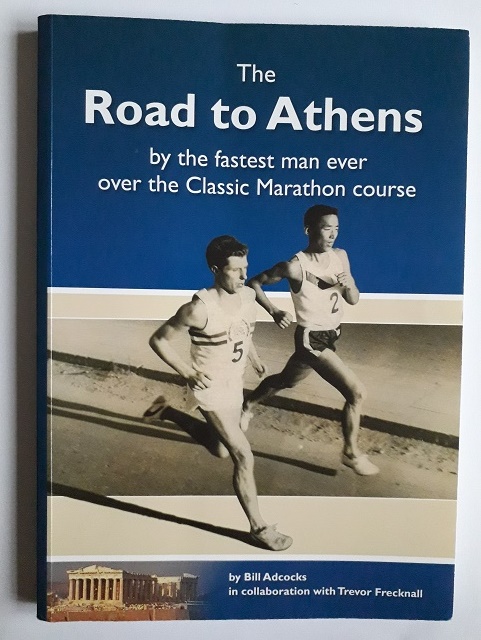
Bill Adcocks was another great marathoner and, the year after Clayton’s recordsetter, he became the sole Briton ever to win Fukuoka marathon in 2hr10min48. He was only a minute slower than Clayton and, while he never held the world record, until 2004 he held the course record for the original Marathon route in Greece with a time of 2hr11min07. Among his other accomplishments were to place 5th in the heat and altitude of the 1968 Mexico Olympic marathon and win silver at the Empire (Commonwealth) Games in 1966.
Bill Adocks running on the left. The cover ofhis autobiography “The Road To Athens”
Ron Hill is better known these days as he’s continued running into the 21st century and is famed for his daily run streak that stretched from 1964 to 2017. Arguably he was slightly better than Bill Adcock at the marathon but it’s a close contest. Ron competed for Great Britain at the 1964, ‘68 and ‘72 Olympics. In 1970, he set a course record in Boston in 2hr10min30 then followed it up by winning the Commonwealth Games gold in 2hr09min28. He claimed this was the world record as it was faster than Clayton’s Fukuoka time and the Antwerp course had never been successfully remeasured.
Part two of Ron Hill’s “The Long Hard Road” – both parts are 400 pages
Having graduated with a PhD in textile chemistry, Ron began his own clothing line. I remember when I was a sixteen year old attendant at Broadstone Sports Centre, the other lads (Warren, Justin, Eddie, Tim) all wore RonHill Tracksters – navy blue leggings with a thin red stripe down the side and stirrup loops at the bottom. While they were tighter than the woollen tracksuits of the day, they were still looser compared to the lycra of today. Of course I had to get a pair to try and fit in with the cooler, older lads!
The legendary RonHill Tracksters. A favourite of the lads at Broadstone Sports Centre in the ’80s
What I found revealing from these books was that each of them began at clubs where they did regular intervals sessions to develop their speed. Mileage was secondary and a big week in their early years was 30-40 miles. Their best times for 400m and the mile were as follows:
400m / 440yd time
Mile time
Derek Clayton
52 secs
4:07
Ron Hill
55 secs
4:10
Bill Adcock
57 secs
4:12
1960s world record
45 secs
3:51
My big takeaway is that even the best marathoners in the world, who are the most naturally talented towards endurance, could run a 400m or 440yds in under sixty seconds. Yet I know few runners entering parkruns, 10Ks or other distance events who can do this. Do you have to be freakishly endowed with speed to achieve this? I don’t believe so – simply committed to a good training programme. Of course there will be some who aren’t capable but I suspect many more could if they tried.
The related takeaway is that in being able to run 2hr10 marathons, Clayton, Hill and Adcocks were running at 5-minutes per mile. It’s an obvious statement yet most people approaching the marathon are more concerned about training for the distance than being able to run a single mile faster. To an extent, you can build decent times off general runs and progressively pushing harder but often this only leads to being a decent runner at the front of local races with times that are far off those of the best club runners.
When you think about it, it’s obvious – “if you want to run a fast distance race, you have to be fast over a shorter distance”. I know lots of people who do speedwork with the intention of getting fast for their current races but no-one who’s taken a dedicated approach to improving their speed at shorter distances before working on the distance of longer races.
“Who is the only neurologist who will still be remembered one hundred years from now?”
In his 1996 book “Why Michael Couldn’t Hit”, Harold L Klawans states he often asked a sports trivia question to spark up discussion in what otherwise promised to be uninspiring lectures. Klawans was the professor of neurology and pharmacology at Rush Medical College in Chicago and his book discussed sports topics such as why basketball’s Michael Jordan failed to be successful at baseball; why Muhammad Ali was one of the few boxers to contract Parkinson’s Disease among his peers and how conditions like acromegaly, Tourette’s and ALS affected other sports stars.
The answer to his question is a trick one – it’s Sir Roger Bannister who will most certainly be remembered for many years to come, not specifically for his career in neurology, but for becoming the first man to break the four-minute mile barrier. Sadly he died in 2018, aged 88 after a long and successful life in both sport and medicine.
When Bannister ran the first sub-4 minute mile in May 1954, it was based on a low-volume, high intensity approach. In 1949 he’d run 4:11; in 1950 it was 4:09.9; in 1951 it was 4:07.8; while in 1952 he only raced the mile once as he focused on the Olympics in Helsinki where he finished 4th in the 1,500m. In 1953 he ran 4:02 and would certainly have broken the 4-min barrier under modern conditions. The tracks in those days were cinder and runners’ spikes accumulated the ash as a race went on, costing one second per lap.
Bannister’s training schedule during the winter months reached a maximum of twenty-eight miles per week but, when he was training hardest in the spring, prior to the sub-4 he was down to as little as fifteen miles per week. His sessions never exceeded 48-minutes and many were fitted into the lunch hour during his medical studies.
Once out of winter training, two of his key sessions were as follows:
Run 3 x 1½ miles at 4:50/mile pace which would have equated to 7-minutes of running at Threshold pace.
Hard intervals of 10 x 440yd in 1min06 with a 440yd jog recovery in two minutes. Twenty laps of the track taking half an hour and totalling five miles of training. Bannister stated there was no warm-up or cooldown. This training started in the October of 1953 and the time for the ten efforts was reduced by a second each month so that by the time of the record-setting mile he was running them in sub-60, sometimes as quick as 56 seconds.
So, this all leads to the question, if Bannister was able to train this successfully with intervals why don’t more runners train like this? I believe there are two reasons.
Firstly it’s my opinion that Bannister had decent levels of natural endurance due to his genetics. He was 6’2” and weighed 11-stone. Compare this to Britain’s 400m record holder Iwan Thomas who is as tall yet weighs 2½-stone heavier. That extra muscle is a suggestion of larger, fast-twitch muscle fibres that lack endurance. Even though we consider Bannister fast, he doesn’t have the blazing speed of Thomas whose record is under 45 seconds. Another indication of Bannister’s natural endurance is his ability to do these sessions without warmups. It’s something only a natural could do.
Secondly Bannister was exclusively a middle distance runner in the 800m / 1,500m / mile events. His five mile training sessions were the longest runs he did. Most of the runners I meet are interested in parkruns and longer. Even a parkrun is over three miles long and therefore requires significantly more endurance than a four minute run.
This is the real meat of this story. The problem with low-volume training is it doesn’t stretch the demands of the race for most runners. Even though Bannister was training low-volume he was still doing 15-30x as much training each week as his mile race. Each session was 5x as long as he was racing. Obviously the longer your race, the harder it becomes to scale up like this (a marathon runner would have to run the impossible 400 miles each week to train 15x their race distance) but more miles is generally beneficial to improving endurance for your distance races. Now compare this to the average runner entering 10K races who are running twenty miles per week and barely doing 3x the distance. As I wrote in the How to Improve series, successful training requires runners to get out there frequently to build up a base of miles.
BONUS STORY – Klawans’ book also tells the story of Wilma Rudolph who was the Olympic champion in Rome 1960 in the 100m, 200m and 4x100m relay events. She was the fastest woman in the world and yet had suffered from polio as child. This entailed walking with a heavy leg brace for much of her childhood and intensive physiotherapy, massage and heat treatments for four years up to the age of ten. Once the polio had gone and her body had regrown the nerves, which can take one to two years for the muscles of the feet, she went onto become a basketball and track star.
Given our current circumstances with Covid-19, I found it thought-provoking to read how polio is also caused by a virus. Klawans states “When I was growing up it seemed as if one day you could be playing baseball with your friends and the next day you could be paralysed for life. In Chicago, every summer, you had to stay away from crowds, especially the crowds at the beach. Otherwise polio might get you.”
He explains polio existed from the time of the Egyptians but in those days was endemic, by which we mean it was always around. It was present in the water supply because there was no separation of faecal waste from drinking water. With people being exposed to the virus early on they built a resistance to it without ever knowing they’d had it. However once sanitation became the norm, it became an epidemic because people no longer grew up being exposed to it and gaining the immunity it would have brought. Of course, this is not to rally against sanitation, only to highlight how herd immunity was the endemic route to avoiding polio while the development of a vaccine was the thing that eventually wiped out the polio virus and its associated epidemics.
With 2020 now done and dusted, it’s an understatement to say it was a difficult year for everybody. From a running perspective, the lack of races, parkruns and even club sessions left many runners questioning why they run. Personally I run because I enjoy it, the races and parkruns are side attractions where I like to test my mettle. While my year started with a rebuild of my fitness, it ended with me having run every day, failing to get faster over 5K and heading in a new direction with 800m training.
The rebuild of fitness began after I suffered a four day illness in late November 2019. It was probably a standard winter flu virus although it’s tempting to claim it was an early version of Covid-19 but realistically the timing is wrong even though some of the symptoms, like loss of taste, were the same. Anyway whatever it was, this all took place the week before the Christchurch 10K and with my aerobic fitness wiped out, I struggled round to receive the annual reward of a Christmas pudding! After that I focused on the rebuild which I knew would take about six weeks and got out running every day. I attended Christmas Day parkrun at Poole with its record attendance of over 1,300 then went to visit friends and ran Rushmoor and Frimley Lodge parkruns on New Year’s Day. By February, the legs were perking up; I was running ten miles on a Sunday at a good clip and ready to up my training.
It was my intention to run Bournemouth Bay 1/2M at the start of April and take a few days rest going into it. But with the onset of Covid-19, I delayed my entry and we ended up entering lockdown in the last week of March. As leaving the house was limited, I continued to run every day and it was a fantastic time to be out running. The roads were traffic free, almost deserted and I remember running at 10am one morning barely seeing anyone for the first mile. It was eerie and quiet like a scene from “28 Days Later”, the 2002 film where the protagonist awakes from a coma to find London deserted. But then, if you’ve seen “28 Days Later”, you’ll know 2020 wasn’t far off a real life version of it.
By the end of March I’d been running for 115 days straight and there was no sign of stopping. I decided that with lockdown in place, no races in sight and uncertainty about when the world would be back to normal, this would be my chance to create the longest run streak of my lifetime. And I mean lifetime. All being well, I’ve got a few decades ahead but I always take rest days before and often after races. If I’m still running in my 70s and 80s, I’ll still be entering races. I don’t usually go more than three months without a race.
Streakwise I’d already surpassed my previous best of 76 days so the question was how long could this one go? I figured if I reached September I’d try to see out the whole of 2020. But that was still a long way off so I focused on now.
My standard running year is to build stamina in the winter then work on speed for 5K and 10K races in the summer. There weren’t going to be any of those coming up but I pressed on with the plan hoping, as we all did, that racing and parkrun would be back in a few months. I’d also noticed my vertical jump had dropped over the years. When I played basketball I was able to touch the ring and my jump was about 70cms, now it was 42cms at best and I felt little spring in my legs. This shouldn’t have been a surprise because I hadn’t done any dedicated running speedwork in over three years and it was over a decade since I’d been playing the sports that had built big thigh muscles for jumping. So while everybody else was following Joe Wicks’ classes on Youtube, I started my own fitness regime of hill sprints, skipping, side jumps, step-ups and depth jumps. I also started bounding, like a triple jumper, which was great fun and began to highlight some changes I needed to make to my running action.
I continued to run daily and began 5K training with a time trial at Poole Park benchmarking in at 22:05. I was twenty-five seconds slower than I’d been on New Year’s Day. My fastest kilometre had only been 4:14 and I found myself struggling to even hit 4:30 towards the end. But a benchmark is there to find out where you’re starting from and over the next six weeks I ran kilometre intervals twice per week and saw my speed pick up to reach a best time of 3:50. A second time trial at the beginning of July came in at 21:32. A 30+ second improvement isn’t to be sneezed at, but I’d also expected better from six weeks of training so there was something missing. What I didn’t immediately realise was that another rebuild was looming.
The day after the second time trial, it was obvious my body had switched over to speed mode rather than the endurance mode needed for distance running. I could feel it in my long runs where I felt like I was running fast, yet each week’s run came in within seconds of the previous weeks’. Nonetheless I thought I could train myself out of it with a more restrained approach to my interval work but I was wrong. By mid-August I had to admit defeat and think about another rebuild. There was another problem. I was struggling with many aches and pains in my ankles and feet, as well as my lower back. This is always a sign I’ve done too much fast running and need to do recovery work.
On top of all this I started a core stability programme in mid-August. I’d always thought my core was reasonably strong. Certainly whenever I planked against other people they’d struggle to hold it for as long as me and I could hold for 1-2 minutes. But I was wondering how on earth the guy who holds the record at over five hours for a plank could manage that. The longest I’d ever managed was three minutes which is a long way off. Researching I came across a statement that once you go over a minute there’s no benefit to planking for longer, and then I discovered the Big3 programme of Stuart McGill which he’d developed from working with spinal rehab patients.
I began doing the Big3 programme nightly but after a week it was too much, too soon so I backed off and let things settle down. A week later, after my Sunday long run, I bent down to untie my shoelace and felt an ache in my side that took two hours to subside. It wasn’t a bad pain just one that indicated I’d been working the core throughout my two hour run. I realised that while I may always have had a strong core, it had never been integrated into my running and was allowing me to twist and turn my shoulders and hips too much. I continued with the core stability and found an additional benefit was my golf swing became more connected.
Going into September the aches and pains in ankles and feet were becoming too much to bear. My streak was intact but I knew I wouldn’t get through four more months of daily running. I had to be honest with myself about this. It was tempting to think I could take it one day at a time but deep down I knew realistically it would be too many days. If this had been mid-November, with a month or so to go, it would have been different but not four months. I didn’t want to give up without trying to fix things before I took a rest day, so I made a deal with myself – I’d give it until October and if there was no respite from the pain by then, I’d end the streak.
Knowing the pains were a sign I was doing too much, I scaled back my daily one hour runs to forty minutes and shortened my Sunday long run to give less training to recover from. Over the first couple of weeks, the pain eased and I found myself sleeping up to nine hours each night. But despite running at over 9min/mile I returned from each run sweating. I knew from the sweat I was overcooked on the speed side. If I was to get out of this hole, I had to drop back and run even slower.
The week beginning September 21st, I dropped back to running at ten minutes per mile. The average pace of that week’s runs were 10:02/mile, 10:05, 9:48, 9:11, 9:27, 9:53, 9:25. It was a big step back when you consider my kilometre intervals had been easily faster than seven minute per mile. The following week wasn’t much faster but I was arriving home barely sweating and the aches and pains soon eased up. It was beginning to feel relaxing.
After three weeks I began to throw in a faster mid-week run at 8:30/mile and then a couple of strides into my Sunday long runs. By mid-November the midweek run was sub-8 pace and the aches and pains that had plagued me just a few months before were forgotten. Easing up the pace had allowed the muscles to recover, switch to building endurance and the pace to pick up. There was still a variance between the pace of all my runs – days of faster running needed to be followed by a day or two of slower but I was sleeping less and the general pace was improving. All the while I continued the core stability programme on Mondays and Thursdays and found my running form was transforming. Less rotation of the shoulders and hips, more glutes driving me forward.
Finally December of this difficult year rolled around. The streak was still on. I’d always had in mind to get to the 8th to achieve a year’s worth of running and that would then leave a few weeks to complete the whole calendar year. With the quiet of lockdown, I’d had time to think about my own running and why I’d struggled to run the sort of times that my training should have brought. Some years ago I half-joked that I would have been better suited to middle-distance running, or even the sprints, and now I decided to test this by trying my hand at 800-metre training.
To start off December I ran a 800m time trial in 2min58. Considering the world record is under 1min42, that’s a long way from being decent but considering I’d done no dedicated speedwork in years I figured this wasn’t terrible. The following week I began running two intervals sessions each week geared towards building speed over shorter distances. Now as we begin 2021, four weeks have been done and so far so good. My general runs are getting faster and I’m loving the interval work. I like the daily jogs but interval work has always been something I enjoyed much more than any distance run. Often what you enjoy doing is an indicator to what you’re best suited.
So that was the rollercoaster of my 2020 running. Three months spent rebuilding fitness. The following months working on strength and speed. Then back to rebuilding. The underlying positive has been one of a gradual improvement in running form through sprints, bounding and core stability work. I’ve wondered whether the need for the second rebuild was down to the revised form, the body discovering a need to rewrite all its motor programmes as lesser-used muscles began to take precedence over those that have turned out to be inefficient and overdeveloped. Could it be I’m like a beginner starting out and building up for the first time?
In the background there’s been the aim to complete a year of running every day. It never started off that way but became a goal as our circumstances change. The streak itself was never there to be a social media boast, it was a bucket list tick off so one day I’d be able to say I did it. But I also wanted to experience it and pass on what I learnt. While the early days of my streak never felt difficult, as the year wore on I began to feel jaded. Even when I reset things in September and lowered both the pace and volume of my running I began to lose my enjoyment of running. Completing the streak began to hang over me like a dark mist. With December’s nights drawing in, shorter days, colder and wetter weather I began to struggle to feel enthusiasm to get out on my runs. The introduction of 800m training added an extra stimulus to recover from and most likely contributed to that mood.
Yet as soon as I had streaked the year, the mist lifted and I felt happier in the knowledge that I didn’t haveto run if I didn’t want to. Where before I’d been thinking ahead, planning each day’s run with an eye on the run that followed, now I’m able to run in the moment. If I overdo things at any time, having a rest day is back on the table as an option. I realise run streaks are a good thing when they support your training but not when they stop you from listening to your body.
A year of running – 365 days with bonus Feb 29th for free
With Christmas past and 2021 around the corner, it’s a time when New Year’s Resolutions are being mulled over and decided upon then invariably they’re broken before January is out. In the sporting world we talk about goal-setting which is the same thing, it just isn’t confined to 1st January.
A typical New Year’s Resolution is to “Get fit”. The SMART acronym has been around long enough that most people know “Get fit” fails to be Specific, Measurable, Achievable, Realistic, Timed. It’s certainly not any SMARTER because it’s not Exciting and probably not Recorded (or wRitten down).
Personally I’m a fan of DUMB goals – these are “Doable, Understandable, Manageable, Believable”. Alternatively they can be “Dreamy, Uplifting, Methodical, Behaviour-driven” or even “Dangerously Unattainable, Monstrously Big” goals.
The difference between SMART and DUMB goals is inspiration. SMART goals are simply a project plan – a typical SMART goal could be to “Run three times every week in 2021”. You’ve specified what you’re going to do, how it’s measured, when it’s done by, it’s realistic and achievable. But oh my, how boring. For sure, you’ll be into that goal for January and even for February but by springtime what’s going to keep you going? Running three times each week has become part of your standard routine. And if you start to miss runs, what’s going to get you going again? The excitement of setting that goal back at New Year is gone, down the road you’ll be looking for new goals to liven up your life.
Now let’s look at the DUMB approach – it looks something like “Run a marathon in under 3 hours” or “Run sub-18 at parkrun” or even “Finish in the top ten of my local 10K race”. Ouch – those are seriously tough goals but they’re also goals which would put you in the upper echelon of runners and bring lots of spoils and glory. (I’m assuming you’re not someone who has run 3hr01, 18:05 or finished 11th! But if you are then start thinking sub-2hr30, sub-15 and winning) For the average person these goals look difficult and that’s the point.
What sort of commitment would you have to make to achieve them? A big one.
How much effort would you have to put in? Lots.
Would you be guaranteed to achieve it? Certainly not.
The uncertainty of success and risk of failure avoids complacency (providing the stick) for achieving something special (the carrot). But notice also these DUMB goals aren’t impossible, I’m not suggesting you try to set a world record or win the Olympics, only that you embark on achieving something special. It’s a special that has to be something you consider special – not something you hope will impress others on social media, at work or at home. It has to be a special that impresses you and would make you happy or glow with pride to achieve. The more personal and special you make it to you, the more driven you‘ll be to complete it.
When you set big goals – you have to commit and work hard. Setting goals that are out of your comfort zone, forces you to get out of your comfort zone. You can’t continue to simply do what you’ve done before. You have to get creative, maybe investigate hiring a coach, following a training plan, joining a running club and getting out on the cold, winter’s nights. But notice that it also means you have to run three times every week to have a chance of achieving it – you’ve automatically integrated what was a SMART goal to help on the journey to achieving the DUMB goal.
I used to say “Plans have to be realistic, dreams don’t”. You allow yourself to dream then create a realistic plan to get you there. Like any journey to a far off place, you keep checking the roadmap to ensure you’re on course. If things are going awry you take stock of where you are, reset your plan and then go onwards again. Of course your dream may be something you know will take many years to achieve but it’ll always be there in the background inspiring you; the thought of achieving it keeps energising you to take action. But you do have to buy-in and commit to it, it’s no use saying “I’d love to run a sub-4 marathon” and forget about it by the next day. That’s unproductive day-dreaming – it’s good to spend some quiet time thinking about what truly matters to you and evaluating how committed you’re really willing and able to be.
“Plans have to be realistic, dreams don’t”
A word of warning though. When you allow yourself to dream big and begin to get excited about what you might achieve, don’t go telling other people about it. If you’re a thirty minute parkrunner, who decides to run a three hour marathon; other people will want to be your voice of realism. All but a few will be quick to point out the flaw in your plan –you can barely run a parkrun at ten minutes per mile, let alone complete a marathon over three minutes per mile quicker. Limit conversations to telling people about your easily achieved SMART stepping stones such as “to go running three times per week” or “to join a running club” because their realism can handle that. Only start to tell other people about your big goals when they’re incredulous about how well you’re progressing and wondering why your parkrun times are tumbling. But even then, exercise caution in who you tell – keep it to people you know who will be supportive rather than crushing.
So dream big, find something that inspires YOU, but also something you’d be proud and excited one day to tell your friends and family you attempted. Ultimately it’s not about whether you achieve the goal, it’s about the journey and process of committing to something meaningful to YOU. When you find a goal that excites YOU, you’ll find yourself feeling alive and vibrant. Once you’ve got that big DUMB goal, figure out the specific, measurable, achievable, realistic, timed steps you can take on your way to achieving it. You’ll find the success or failure of the SMART goals doesn’t matter any longer because they’re simply steps along the way as you try to achieve your something special.
Today I’m going to tell you about my short-lived indoor rowing career. I used to spend my lunchtimes at the gym, warming up on the Concept2 rowing machine before I lifted weights. One day someone pointed out there was a leaderboard for how fast people could row 2,000m and, being my typical competitive self, I decided to give it a try and clocked something like 7min11 (the exact time is lost in the dusty corners of my memory).
I was informed by a friend, Gary, who happened to be a member of a rowing club, that getting under seven minutes is considered a good time. I don’t know whether that’s true because the world record is 5min35 and there was a tall, thin guy called Pete at the top of the leaderboard who’d rowed 6min30ish, but I was motivated to see if I could knock those eleven seconds off.
Now given this occurred around the turn of the millennium and the internet was still a new thing, I was very lucky to have access at my desk to the World Wide Web (as we called it then) and was able to research rowing training. After all it was more compelling than doing actual work!
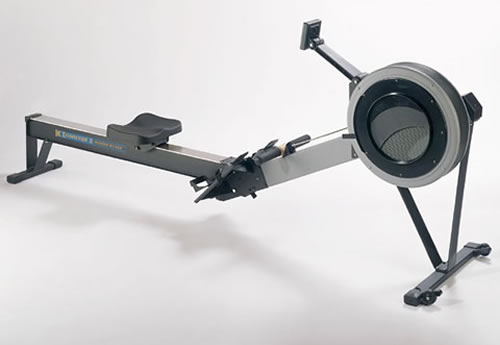
The Concept2 Model C ergometer – an indoor rowinng mahine
I came across a website called Masters Athlete Physiology and Performance (MAPP) created by Dr Stephen Seiler which was fantastic in its detail on the effects of exercise on human anatomy and how rowers trained. Seiler was a Masters rower and a university academic who studied endurance sports. Although he had sections on cross-country skiing, running, cycling and swimming it was the Human Physiology and Rowing sections that I was most interested by. In particular he put forward a theory called “The Waves of Change” where he proposed how to develop as an endurance athlete.
First Wave is spent building VO2max – the ability of the heart to supply oxygen to the working muscles. VO2max can be fully developed in a year and is achieved through hard intervals and speedwork.
Second Wave is spent building Lactate Threshold – the ability of the muscles and surrounding tissues to extract and utilise the oxygen. This takes three to four years to completely develop and is achieved by running at a pace just below the LT to push it up.
Third Wave is spent improving Efficiency (aka Economy) and can carry on for years. Unfortunately no-one knew what training did this other than it appears to happen through repeated high volumes of training.
Having just completed my degree in Sports and Exercise Science this was fascinating stuff to me. I’d heard of VO2max before and even measured mine on a treadmill test during my second year studies but at that time, I wasn’t at all interested in the physiology. I was more interested in knowing my numbers.
With a concrete goal of breaking seven minutes, I lapped up the pages of Seiler’s website and I’d say it was the first time I ever tried to train systematically. I set myself up with a weekly programme of two hard interval sessions, two days where I rowed easy for recovery and then on a Friday evening an hour’s row at a significantly slower pace. I can tell you all the sitting led to a very numb bum!
It’s worth explaining at this point that 2,000m is the typical race distance for rowing at the Olympics and World Championships. Where runners tend to think in terms of 400m laps of the track, rowers work in 500m efforts and the Concept2 rowing machine displays paces and lap times against this distance. I calculated that if I wanted to break seven minutes for 2,000m then I needed to row 1:45/500m and this is what I set out to do on my intervals.
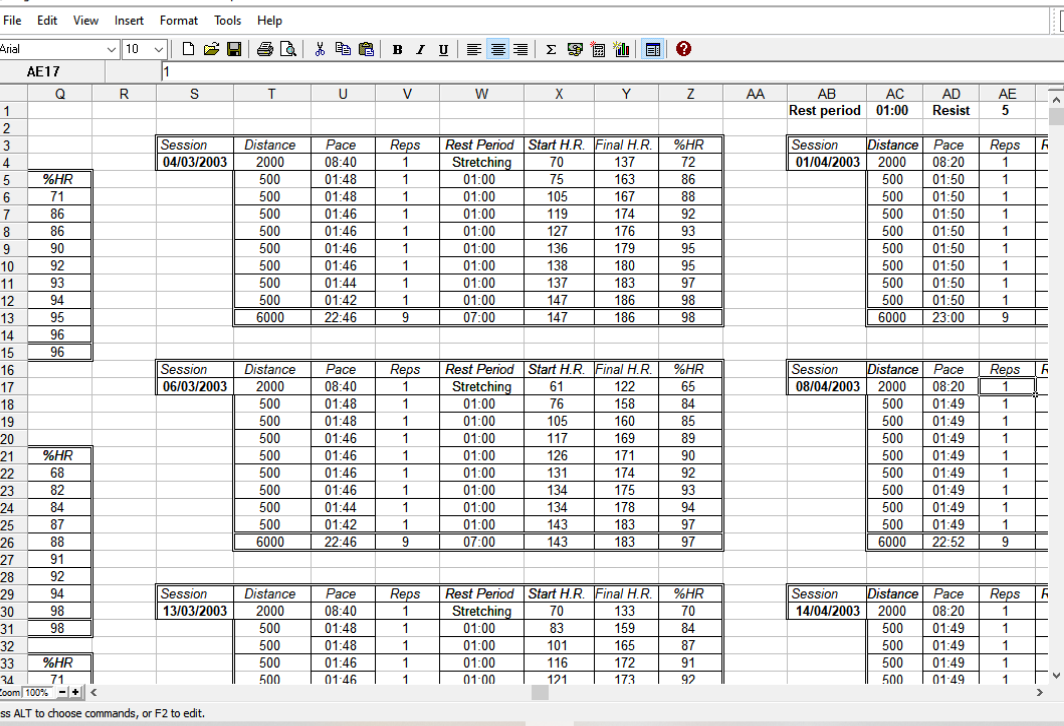
I began my hard intervals with eight efforts of 500m with 1-min recovery aiming for 1min45. I don’t know why I decided to do eight but the distance, recovery and pacing are all fairly explanatory. The other joy of the Concept2 was being able to programme this workout into it and having it show heart-rates alongside all the time, distance, pace, stroke-rate type information. I got into a habit of taking a pre-printed form with me to each session where, during the recovery, I would scrabble to pick up my pen and note down how long the effort had taken me and the starting and ending heart-rates. Looking back it was all rather nerdy and yet, these days a good GPS watch will do this for you and upload the data straight to Strava.
To begin with, I found my heart-rate would gradually creep higher and higher with each successive effort ending up somewhere in the high 180s. Meanwhile during the one minute recovery phase it would drop back to the 120-130s. So I’d row my 500m gasping for breath, watching heart-rate quickly ratchet up from 120 to 180 and then drop back to say 125 during the recovery. The next effort and recovery would see the same pattern. After seven intervals I’d be gasping for breath but go all-out on the last effort to simulate a final surge to the finishing line.
After a few weeks of this I began to find it getting easier so of course, I did what any competitive person would do and turned the screw. I changed from eight at 1:45 to four at 1:45 followed by 1:44, 1:43, 1:42 finishing all-out. A few weeks later I started doing four at 1:45, three at 1:40 then all-out. Next I started to reduce the recovery period as a minute seemed too long so I brought it down to 45 seconds and then, a few weeks later to 35-seconds.
I was certainly getting fitter. My stats showed I was covering the entire session in a shorter time both during the efforts and when you added in recovery time. I watched as the numbers on my spreadsheet gradually reduced.
Sample of my rowing spreadsheet from 2003. Not the original one from my sub-7 training schedule but equally nerdy!
But there was also a peculiarity I noticed. Where in the early days I’d been getting heart-rates up into the high 180s, by the final weeks it was impossible to reach this and I was only peaking in the high 170s. This occurred even though I was rowing faster with less time to recover. Even though I’d dropped the recovery time to only thirty-five seconds and my heart-rate only dipped below 160bpm, even on the hardest efforts it wouldn’t go up by much more than 15-20 beats. I was finding I could no longer work hard enough to get my heart-rate up to its max.
After two or three months of training I decided to have another go at the 2,000m time. I rested for a day or two and then went to the gym on a quiet evening intending to settle in for rowing at 1:45 with a fast finish to break the seven-minute barrier. The moment of truth had arrived. I began rowing. Immediately the pace was down to 1:40 and it felt easy. Far too easy but I couldn’t find a way to slow myself. I just hung in there as my breathing began to ratchet up while watching the distance count down. With about six hundred metres to go disaster struck. My right leg began to shake violently. I could barely push off for each stroke but I continued. The pace slowed and where I’d been on for a time of around 6min40, I limped through the final metres to a time of 6min51 and my goal achieved.
And that was it. For one reason and another I never had the dedication to indoor rowing again. But there was a side benefit. A couple of months afterwards I took part in a local 10K run. As always I started slowly clocking 8min15 for the first mile (for some reason the organisers used mile markers) and every mile afterwards came in at 7min15. An all-out surge to the finish line, gasping as I had done on the rower, and I’d set a new 10K PB of 45min50. Two minutes faster than I’d ever run before. I suspect had I warmed up and gone out hard from the beginning I would have run sub-45.
After this brief flirtation with indoor rowing, I returned to playing and coaching volleyball, took up golf and occasionally entered running races. Stephen Seiler’s Waves of Change theory stuck with me for the decade and I’d occasionally jump on the Concept2 and row hard intervals as a way to build VO2max as per his First Wave of Change. Then I’d run on the treadmill using an estimated Lactate Threshold pace to try and effect the Second Wave. Looking back it was never very successful because I wasn’t committed enough to running, but it did get me thinking about how to train systematically.
I occasionally revisited Stephen Seiler’s website until it went offline but his academic studies have since gone in a new direction and become highly important in the world of endurance training. It is his work with Norwegian cross-country skiers and cyclists that uncovered they train to the 80-20 rule with a Polarised training method.






 Big Red Running