My sprint practice has taken a backseat over the last month because I’ve been feeling some fatigue around the lower core and to the right of my groin. Back in 2012 I strained something in there and I had to stop running for three months; so I’m very wary of that happening again especially as I’m now over a decade older. I have thrown a couple of sessions in but not been able to video them, so no piccies to show!
Nonetheless I’m still training every day and running longer intervals of 400m to a mile but not as all-out sprints. One day I was out on a typical training session and I’d planned to run 10x400m intervals. Somewhere around the 7th or 8th I became aware of how I was applying force. My leg would swing backwards from its high knee, my foot would hit the ground and then I’d stopped putting in effort and coast over the stationary foot. I immediately knew what I was doing wrong.
Last month I wrote about the mental image of how skateboarders paw the ground to push themselves forward. While I was referring to that in terms of sprint technique and, while on these 400s I wasn’t flat out sprinting, I realised I was doing the equivalent of the skateboarder bringing their foot down to the ground and then half-heartedly pushing through. In effect, creating friction and drag rather than adding energy to the stride.
I’ve written previously about hip extension and how elite runners push their foot back using the glutes until the leg is behind them. Yet it was only in this moment that I actually felt myself not doing this. A moment where I gained the awareness that as soon as my foot hit the ground, I let the ground slow me rather than put in effort to push through with the glute and attack back at the tarmac.
A few days later, on an easy jog, I noticed I was deliberately trying not to put in too much effort. My foot barely left the ground and to push all the way through with the glute felt like I was putting in more effort than I wanted for an easy run. It seems this had become a bad habit that had carried through to faster running.
While I haven’t been able to work on my sprinting, I have been able to focus on this during long intervals by being aware that I’m getting full hip extension and driving the leg through forcefully. It doesn’t always happen because tiredness sets in and those muscles aren’t necessarily used to applying effort all the time for longer periods but it does seem to be happening more regularly.
What I’m finding is that I’m naturally staying up on my toes more and and my glutes are beginning to burn. That’s a surefire sign that the correct muscles are firing.
When I arrived home and uploaded my run, I noticed my cadence graph is looking much smoother. There’s a couple of aberrations in there which happens as I navigate corners and slopes but otherwise it looks unusually smooth.
I went back to the start of October and compared it to what the graph looked liked then. Notably less smooth.
Overall I’m sure this is a good sign for my running. I suspect it may be the first time in my life where I’ve run with a mechanically advantageous stride. And lately I’ve noticed my running is getting quieter. I’m skimming over the ground more than pounding into it which is indicated by what the improved cadence smoothness shows.
I’m trying to improve my sprinting by videoing myself and then comparing it to the theoretical model of the best sprinters in the world. It’s not rocket science but I’d like to feel like I’m running rocket powered. While there are distinct differences between sprinting and distance running, even distance runners need to be able to sprint for the finish line and there should be some common mechanics which will carry over to make me efficient over any distance.
For example, as detailed in part 1, I noticed my foot was landing too far out in front of me causing me to vault over it. When I brought the foot closer, my runs began to feel like I’d taken the brakes off and my glutes were doing the work.
The best sprinters have cadences well over 250 steps per minute, often approaching 300 yet I struggle to even reach the 220s. Watching the video of my sprinting it all seems lumbering and cumbersome. While a still image can look fairly decent, watching actual footage tells a better story. When my foot lands it seems like I’m stuck to the ground for an age as my body passes over it.
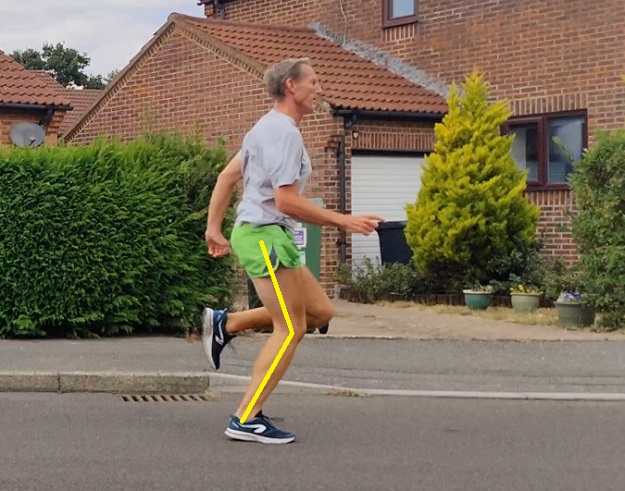
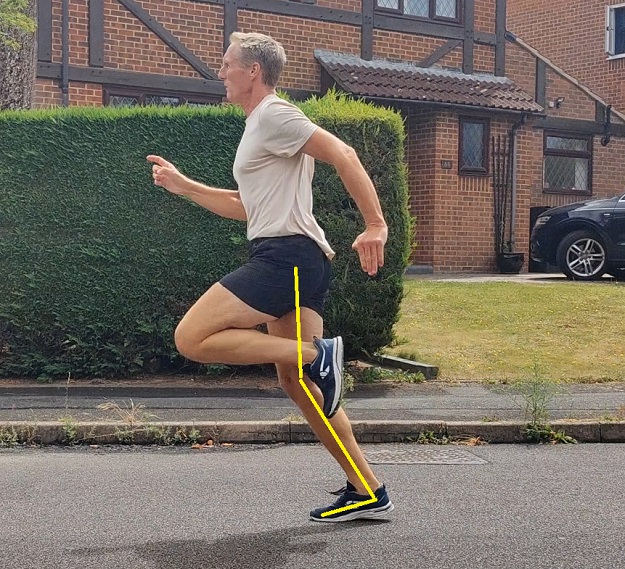
Watching and rewatching footage I began to see my head and shoulders were rising and falling against the background. The next questions was “Why is that happening?”. And from that I began to see both my knee and ankle were collapsing and I was flat footed with each step which produced the illusion of being stuck to the floor for so long.
Knee bend just after landing (thigh yet to reach vertical)
Ankle bend
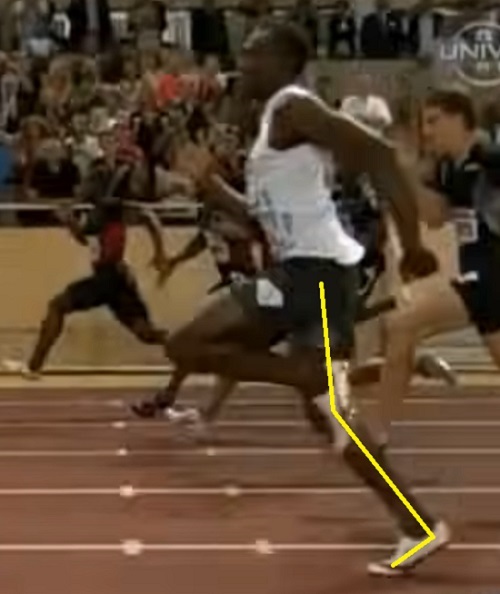
Good sprinters try to maintain leg stiffness (of their support leg) with the knee hardly bending. Their ankles don’t flex much either and they stay up on their toes – the heel never touches the ground. Inevitably there is some flexion in the knee and ankle due to the forces being generated as the weight of the runner lands but the more it can be minimised, the better. Likewise the heel will move towards the floor slightly but never makes contact. This flexing allows the Achilles tendon to load up with elastic energy and then release to help propel them forwards.
Usain Bolt – knee and ankle flexion
If you compare the pictures you’ll see both myself and Bolt are at the same stage of the stride; the arms match, the knee coming forward matches and the thigh of the support leg is vertical. But the foot is completely different. My ankle has collapsed and flexed and the heel is barely off the the ground; Bolt’s heel is notably raised and the foot is at right angles to the lower leg.
Initially I thought there was too much knee flexion but I’m no longer so sure. But there’s a definite lack of ankle stiffness which is causing an energy leak and it’s that which I’ve been looking at over the past month or so.
How to improve is of course always the harder question to answer when you locate an issue. Trying to resolve this became a matter of trial and error. I tried to focus on keeping the joints stiffer. I felt I had the requisite strength to keep my legs and ankles stiffer – after all when I skip / jump rope they don’t collapse, it was just the sprint technique wasn’t allowing me to get it right.
When I ran my sprints and strides I made an effort to maintain stiffness in the joints. I think it was a little beneficial but it put new stresses through my joints and for a time the tendons in the rear of my left knee were feeling swollen. It didn’t stop me running, it didn’t hurt training; but the knees were certainly unhappy if I was squatting down to say get something out of a cupboard. I made sure to keep the volume of these sprints lower though as I knew there was a danger of trying to do too much and injuring myself.
Note – while leg stiffness is important you don’t want your leg to be locked out at the knee because that has a high chance of leading to an injury. Failure to flex under high forces can lead to bone jarring into bone.
Similarly trying to stay up on the toes can lead to issues with calf muscles and tendons and there’s a good reason for allowing some ankle flexion. When the ankle flexes (i.e. the toes lift up and move closer to the knee) the Achilles tendon stretches and just like an elastic band it stores energy. When this elastic energy releases it provides some of the propulsion for moving forwards. While sprinters’ ankles flex the heel stays off the ground but a distance runner’s heel will come into contact with the ground momentarily and this needs to be allowed to happen for the storage of elastic energy.
One of the mental models I’ve been using is to think of how skateboarders paw the ground to keep their deck rolling. They time the kickback to add speed as the board begins to slow. It seems to me sprinters are doing the same thing; but where the skateboarders are able to take a foot off the board, paw the ground and then rest the foot back on the deck; sprinters are trying to stay airborne with just their legs extending down to make a short but powerful contact. You could think of the Roadrunner’s legs whirring along at speed..
The other adjustment I made was to try and get my foot down to the ground quicker – what coaches refer to as a hammer action. If I could move the leg down quicker then it would apply force quicker and the foot would go through quicker leaving less time for the joints to flex but still allowing some ankle flex to load the Achilles.
In trying for this quick contact and to stay more airborne, I’ve found my sprinting begin to morph and on occasions I have felt myself springing along as the Achilles does more of the work. There’s still more to do but I think it’s heading in the right direction.
I happened to notice the other day that my current run streak is now over a year. In the past I documented how my streak of 800+ days ended but actually, full disclosure, this streak isn’t quite a year as I missed a day last December. I went to a funeral in another part of the country and stayed with a friend but I could easily have taken some kit and gone out for a jog. It’s still over 250 days. For me, creating a run streak isn’t that difficult – in part because I like going out for a run but also because they don’t need to be complicated to achieve them.
Ron Hill is the gold standard for run streaks claiming to have run at least one mile every day for 52 years and 39 days. It started in 1965 and finally ended when he was approaching eighty years old. I remember reading an article in an Runner’s World back in the early 1990s where he detailed his run streak, but it was different then. Ron had run twice every day during that period and he was excited that in 1991-92 he would be coming up to have completed a streak of 26.2 years – a marathon’s worth of two-a-days. He had surgery for a bunion in 1993 so it was probably then he downgraded to once per day.
While I would debate whether Ron’s 27min completion of a mile following the foot surgery really counts as running, there is one thing to take away – his streak only required him to do a mile. When I started my streak last July it was after a hamstring injury and I was only doing about 400 metres. A lap of the road I live on – running it in 2-1/2mins or less. It wasn’t because I wanted to start a streak but it was the sensible way to test the injury, get some blood flowing to it and rebuild. After a week or so, I began to add a second lap making it a 4-5 minute run and then extending to a mile most days. I even added in a Sunday ‘long’ run of two miles which took 16+mins! All this added up to weekly mileage of around ten miles. Not massive mileage but consistent.
Once I was sure the injury was gone I could easily have gone back to higher mileage but I began to enjoy just getting up from my computer, throwing on some kit, doing four laps of the road in 8-9minutes and walking back into the house barely having broken sweat. Where for many years I had run for at least thirty minutes per day and often the better part of an hour; now I was enjoying how quickly it was all done – it was mentally refreshing.
In the following months I joined the gym and, with that being the focus, continued the low-volume training while doing high intensity interval work four times per week. It was only about six months ago that I began to increase my daily runs and once the gym was complete for the winter I’ve been rebuilding higher volume of almost forty miles per week.
I’m heading back to the gym in a few weeks’ time for another winter of strength training and will be experimenting again with low volume running. That’s out of necessity as high mileage isn’t going to be complementary to all the squats and deadlifts I intend to do. The body needs to get some rest along the way. It only has a certain amount of recuperative power.
You may recall as a child being told Aesop’s fable about the hare and the tortoise – the story of the speedy hare taking on the slow tortoise in a race. From the start, the hare races off into a lead, certain to win, while the plodding tortoise is left behind. Confident of victory, the hare takes a nap and while he is asleep the tortoise passes him. When the hare awakens he see the tortoise approaching the finish line and, despite his best efforts, the hare is unable to catch him and ends up being beaten. Parents and teachers love to tell this story as a way of saying “don’t rest on your laurels”, “don’t get lazy”, “keep putting in the effort”. The hare doesn’t, the tortoise does.
Now if, like the hare, you’re a runner for whom speed comes naturally – racing 5Ks or 10Ks is never going to be a problem. You might slow a little towards the end but fatigue is rarely enough of an issue that you need to have a lie down and sleep. And as much as the slower runners may plod steadily they’re unlikely to beat the hare.
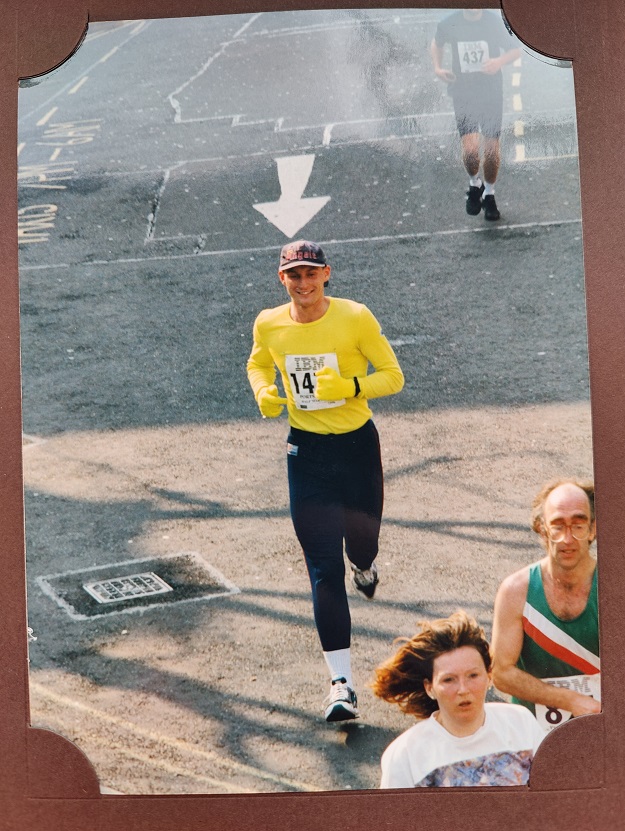
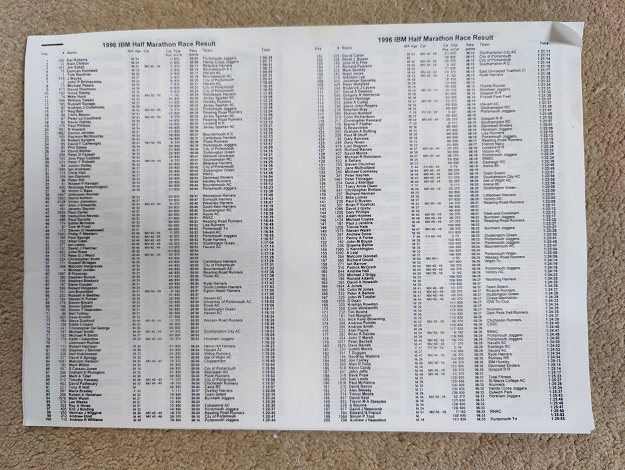
But step up to a longer distance where fueling plays an important part and it will happen. I got serious about running when I had my own hare/tortoise moment. At the time, I was capable of running a 5:55 mile and 21min 5K parkruns (6:45/mile) and I entered a half marathon. I did some training towards covering the distance in the preceding month or two but it wasn’t extensive. I made the mistake of looking at race calculators which suggested I’d be capable of running around 1hr35 – this didn’t seem out of the question as I’d run 1hr38 the previous year. My running had been sporadic since. Even so I certainly wasn’t that unfit.
Hareing off I ran the first mile in 7:22, the next with the field beginning to spread out in 7:05 followed by 7:31 and 7:20 to take me through four miles in under thirty mins. It was all reasonable so far but miles 5 and 6 came in at 7:45, 7:51. There was a stretch of gradual uphill in there so I wasn’t too concerned. It was after that when the wheels came off.
Mile 7 was 9:00 and mile 8 was 9:38. My legs had gone. My stride was non-existent, I felt terrible. While I didn’t stop for a nap like the hare, I stopped to talk to a couple of running mates. I walked a bit and took 20min30 to cover miles 9 and 10. Then I summoned up the energy to restart and jogged the last three miles averaging 8:40 surrounded by runners who were theoretically much slower than me. I finished in 1hr51. It was a frustrating debacle. If I’d known how bad it would be I could simply have set out at 8:30/mile and got round comfortably.
What it did though was to kickstart me into take running seriously. I spent the next couple of months building a decent aerobic base – a term I didn’t then understand – but which I now teach to runners. Six months later I ran a 1hr31 half marathon.
On that fateful day, I’d finished surrounded by the tortoises who had gone out steadily within their capabilities and knocked off mile by mile. Meanwhile I’d hared off at a pace which was slower than my 5K but without the training to back it up – giving myself no chance of success.
The moral of my running story is twofold:
For the hares – if you enter a long distance race make sure you have done the training to back up the pace you’re intending to run. If you haven’t then you need to take it a little easier.
For the tortoises – if you can plod along and finish the race comfortably, it’s time to dig out some speed and challenge yourself to leave your comfort zone.
If you’re interested in my “Build your Base” course or improving your speed please head over to the Contact page and let me know.
Here are the times from my last ten 5K parkruns – 23:31 … 23:16 … 23:06 … 23:27 … 22:54 … 23:06… 23:37 … 23:37 … 22:50 … 23:16.
What’s your prediction for my next 5K time?
If you said somewhere around 23 minutes – well done. Maybe you went for 22:45 to give me a booost – I wouldn’t be against that.
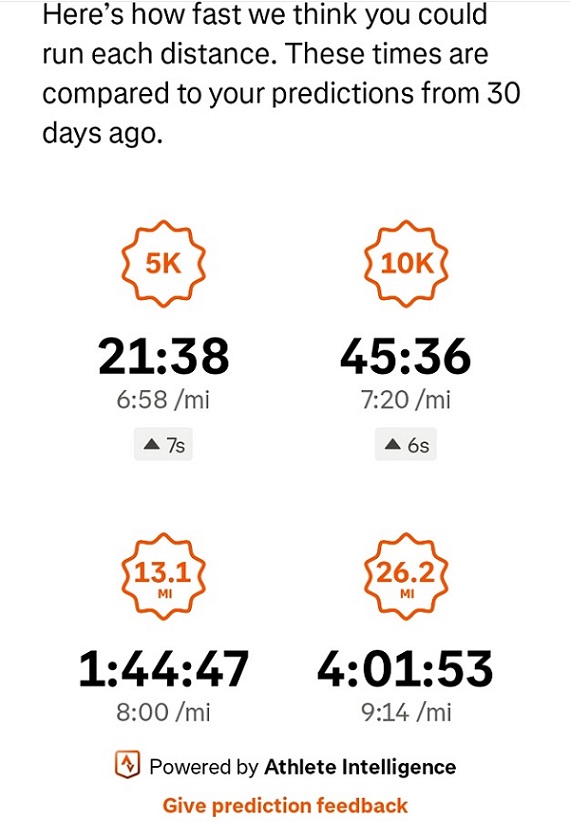
But would you have said 21:38? I certainly wouldn’t.
Yet Strava does.
Strava recently gave me a month’s free premium membership and they seem to have embraced AI with gusto. Among the features is its willingness to Predict Race Times. Despite having the perfect info available – weekly 5K – Strava is reckoning I can run over a minute faster. Clearly I can’t unless I change my training and then their prediction will probably change.
Race predictions
Last month I ran a 6:48 mile to celebrate Banister’s Mile. I know that’s not fast but I’ve been concentrated on building strength in the gym and working on very short distances – I expected my aerobic base to erode and it did. But if I take a look at Jack Daniels’ VDOT tables he estimates a 6:49 mile equates to a 23:09 5K which is relatively close to the 22:54 I ran at parkrun a few days later. It’s not perfect but it’s not frustrating me into thinking I can run over a minute quicker than I’m capable.
Looking at the other predictions – the 10K of 45:36 is essentially double this Season’s Best for 5K – so that isn’t going to happen. I reckon half marathon at 1hr45 is reasonable and JackD’s VDOT suggests 1hr46 although I wouldn’t be surprised to see myself slip to about 1hr50 given I haven’t run over five miles in almost a year.
VDOT predicts a 3hr40 marathon which is very unlikely and Strava’s 4hr time is probably closer to what I’d achieve. But again, if I entered a marathon tomorrow, I doubt I’d come close to either time because I’d wilt and be walking from fifteen miles. If I trained properly for the distance, I’d feel more confident about VDOT’s prediction; the Strava prediction would then be too slow but it would probably update itself with the training. But if it has to keep revising times as the training changes then that seems a little disingenuous – rather like the person who tells you “Oh I knew that” after you read out the answer to the trivia question they had just given up on.
With each run you upload there is Athlete Intelligence feedback to tell you about the run or workout you’ve just done. For example, this is what it stated for the run I’d just done at time of writing …
Recovery Run
It’s a bit bland.
And it’s only half correct.
It correctly managed to figure out I do the same route most days (“maintaining consistent 3-mile distance”) and it correctly figured out whether this was faster or slower than usual (“at a slower pace”) but the last sentence (“while exploring different intensity zones”) is complete rubbish. I went out at an easy, recovery pace and maintained the same intensity throughout. What did happen is that I ran up some hills which caused me to run slower (but using the same effort/intensity) and down some hills which caused me to run faster (still using the same effort/intensity) and under some trees which will have messed around with the GPS.
As for the first couple of words (“Recovery run”) Strava had enough intelligence to take this from the title of my run! When I changed the title to “Steady” the summary changed likewise. It really wasn’t rocket science to figure that out although when I changed the title back to “Recovered” with a deliberate -ED ending it went back to calling it a “recovery run” and when I tried “Interval session” it ignored that.
I decided to look at what it had to say about previous days. For example here’s an interval session …
This is a pretty good description of what I’d done but what does this final bit (“and a challenging mixed-pace run.”) say or mean? They’re just empty words describing what it thinks I’ve done but not what it really was – warm-up, intervals with rest breaks, warmdown. Technically it’s a mixed-pace run but not like going out and doing a proper fartlek session where you mix the paces up.
I looked back to a speed development session where I sprinted four efforts of 5 seconds followed by further efforts lasting 10seconds, 15seconds and 25 seconds. Between the efforts I walked back to where I started, stood around and had long rests. It ended up taking about 25mins to do seven efforts. Here’s what Strava had to say …
Sprints
It got the first line correct but not much else. There really were no varied effort levels, it was max effort from start to finish on the sprints. And I’m guessing it thinks this was “significantly slower” because the 0.7 mile of total sprinting and walking comes out at 12+ min/mile. Compared to a recovery run then this is significantly slower but of course it is – the aim and structure of the session is totally different.
Here’ s what it said about a 23:16 parkrun …
parkrun
Well that’s strange, I didn’t do any intervals – I ran a 10min warmup, a 5K parkrun, a 5min warmdown. And the parkrun was 25secs slower than my Season’s Best the week before so it can’t have been a “route personal record”.
What can I say? It all sounds like unintelligent garbage to me.
Of course I don’t help Strava much by having an old Garmin watch which doesn’t feature many of the latest variables and I stopped wearing a heart-rate monitor months ago. But I run just about every day and upload my data to Strava – there’s almost ten year’s worth of data about my running for Strava to crunch. And yet I don’t find it’s telling me anything useful.
That said, I haven’t investigated their Runna coaching service – why would I? I coach myself and know how to train others for results. If you need an individual plan then I can help you but equally standard plans have been available in magazines and on the internet for years – and while I’d expect Runna to adapt depending on how your training is going (which is what I do with the runners I coach), I’m not sure how good it is at that. I also question its ability to motivate – I’ve known a few people try to follow coaching plans given to them by their Garmin watches but have yet to hear of anyone who succeeds or even completes the programme.
At the moment AI feels rather like “cut & paste” software. It feels like the gym assessment I used to get where it would state “BMI is the relationship between your height and weight, with your value of [Insert value] kg/m2 shown above in Illustration 1. Your value places you in the [Insert rating] category. However, it is worth noting that BMI doesn’t take into account factors such as muscle and lean body mass.” Lots of description with just a couple of personalised bits of information added in.
I remember how these five or six page documents initially impressed me but after retesting, I came to realise that they were just padding out my numbers with waffle. Eventually all I did was look at the graphs and numbers. I suppose AI has an advantage because it can rephrase the same information in different ways thereby giving the impression for longer that it has something important to say.
I’m sure AI will improve in coming years and when that happens I’ll probably be out of a job. But one of the reasons AI will continue to improve is that it continues to scour the internet. I receive a significant number of hits from AI tools which are reading my blogs and trying to make sense of them.
In the meantime if you want personalised coaching from a real human being – this far I’ve not used AI in my blogs or plans – then click here to Contact me.
If I offered you the chance to take two mins off your 5K time in a couple of months – I’m sure you’d jump at the chance. Of course this depends on how fast your current 5K time is, but it’s exactly what I did when I went from a 5K parkrun time of 25:03 on 1st February to 23:11 on 15th March. Speaking accurately that’s not quite two mins improvement but it’s also much less than two months! And I did it through almost pure aerobic training.
That improvement is going from a pace of 8:03/mile to 7:24/mile – which is about 39secs – an average of 6-7secs/mile per week. Think about that if you did this training for three months you might expect to be running a mile per minute quicker than you were. What’s the catch? Why doesn’t everybody do this?
Anyone who’s read about aerobic training and especially a system like MAF training will know the literature says improvement will be slow. They interpret this to mean it will take months. They interpret it to mean that when 2-3months later they’re still doing the same pace for the same heart-rate, they just need to be a little more patient. That’s a wrong interpretation – if they’re months down the line with no change, then it’s clear indication their training is ineffective.
Here’s what aerobic training takes time really means …
Aerobic training log
On Saturday Feb 1st I ran 8:03/mile. On Sunday I did a 3-mile run at 8:05 pace. On Monday I did a 2-mile run at 7:45/mile. On Tuesday I did a 3-mile run at 8:11 pace. On Wednesday I did a 3-mile run at 7:58/mile. On Thursday it was another 2-mile run at 7:38 pace. On Friday it was a 3-mile run at 8min/mile.
On Saturday I returned to parkrun and ran 24:46. On Sunday I ran three miles at 8:37/mile. On Monday it was a three mile run again at 8:36/mile. On Tuesday it was two miles at 8:24/mile. On Wednesday, three miles at 8:26/mile. On Thursday three miles at 8:17/mile. On Friday it was the two mile run at 8:05/mile.
On Saturday I didn’t go to parkrun but ran from home for three miles at 8:31/mile and then did the same three mile run on the Sunday at 8:08/mile. On Monday it was the two mile run at 7:42/mile. On Tuesday it was three miles at 8:25/mile. On Wednesday the three miles came in at 8:01/mile. On Thursday it was the two mile run at 7:46/mile and on Friday a three mile run which was paced at 8:28/mile.
Are you bored yet? Keep on reading there’s still another three weeks of running data to go through.
On Saturday I returned to parkrun and ran 24:21 which is 40+ seconds than three weeks ago. Improvement is already showing up. Sunday I went out and ran three miles at 8:20/mile pace. On Monday I ran two miles at 7:31/mile. Tuesday was three miles at 8:08/mile. Wednesday’s run was the same three mile run, this time at 7:53/mile. Thursday I was back on the two mile run at 7:31/mile. And on Friday I did three miles at 8:23/mile.
On Saturday I was back at parkrun running 23:52. Another surprise thirty second improvement over the previous week. Sunday’s run was three miles at 8:00/mile. On Monday it was the two mile run at 7:26/mile followed by three miles at 8:15/mile on Tuesday. Wednesday was three miles at 7:53/mile and then on Thursday it was the two mile run at 7:36/mile. Friday was clearly a tired leg day as the three miles were run at 8:58/mile.
The tiredness meant I gave parkrun a miss on the Saturday allied to it being a wet and windy morning. Nonetheless I still did three miles from home at 8:37/mile pace. On Sunday it was another three miles at 8:22/mile. Monday was the two mile run at 7:43/mile. Tuesday, three miles at 8:35/mile with Wednesday’s three miles coming in at 7:56/mile. Thursday I did another two mile run at 7:41/mile and Friday was 7:58 pace on a three mile run.
On Saturday March 15th I went to parkrun. My legs felt great and I ran 23:11. Almost two minutes quicker than six weeks before.
If you didn’t bother to read all that in detail, I don’t blame you. I could have produced it in a graph or table to give quick visual understanding but I deliberately wrote it longwindedly to make a point. To read it properly requires great patience. And that’s what runners need if they’re going to get aerobic training to work for them.
The training consists of the same thing day-in, day-out with slight variation in pace. Some days are faster; some days are slower. There is no clear pattern of progression other than at the parkruns. Not every runner has the luxury of a local parkrun to measure their progress.
On top of the basic detail I give you, bear in mind this is just the running. Think about what you do with the other twenty-three hours of your day. Getting up. Breakfasting. Work. Lunch. More work. Evening meal. Watching Youtube or television. Sleeping. My week includes going to the gym on Mondays and Thursdays. That’s why Tuesday and Fridays are always notably slower. If you’ve been promised aerobic training will make you faster then you’re eager to see results and those other activities are taking up time before you can go for your next run.
Living through days after day of just doing simple aerobic runs where the pace might be a little faster or slower than the day before can be tough as it doesn’t bring clear results. It’s not like starting a weekly speed session where you will see quick gains. For example last summer when I was running a 440m lap of my road I went from 6:01/mile to 5:01/mile in three weeks.
There’s a temptation for runners – “I now feel better off the bit of aerobic training I’ve done and just jogging around every day surely won’t help forever; perhaps it’s time to drop in some speedwork as I know it’s worked for me in the past”.
They say “a watched pot never boils” but that’s what runners doing aerobic training often do. They keep checking, comparing their times and paces looking for that improvement. If they use a heart-rate monitor they’ll be including that data.
All this is a great example of where you have trust the process. Set the target of doing a block of aerobic work then just get out and do the runs and don’t worry about the results. In a few weeks’ time you’ll see they’re getting faster.
When coaches mean say “aerobic training takes time” I’ve tried to show you what they mean. You should begin to see some kind of improvement in three weeks whether that’s a faster pace, a lower heart-rate or just feeling better on the runs. It might take six weeks to begin to see notable change but if, by 8-10 weeks everything is still in the same place then your training isn’t effective. It’s time to change direction.
I needed to get stronger if I was ever to run faster. This was my reason for signing up to the gym. At home I have some weighted vests, dumbbells and other equipment for the workouts I’ve been doing the past few years but I realised if I wanted to get stronger, I needed to lift heavier. That presented a choice – either buy more equipment which would take up space in my house and get used relatively infrequently or join the gym.
Ahead of returning to the gym I began to get excited thinking back to the times I’d lifted weights before. There were two primary periods – at the start of the 1990s when I was a teenager and in 2007-08 in my late thirties. I remember being able to bench press multiple reps at 90kg as a teenager and squat reps of 130kg in the Smith machine in my thirties. Now in my fifties would I still be able to achieve these standards?
While these might have been classed as goals, I wasn’t interested in setting specific goals. I had a vague goal – get stronger and stay healthy. Consequently the first few weeks in the gym were spent very carefully setting up for squats, deadlifts and bench press in the free weights area. Partly making sure I understood how to set up the equipment correctly but also prioritisiting technique over lifting heavy weights. I also didn’t want to get sore by trying to lift anything too heavy, too soon.
In the first session I found myself comfortably half-squatting 8 reps of 50kg and bench pressing 5x60kg. Four weeks later I was doing some half squats at 110kg and struggling to bench a couple of reps at 70kg.
My priorities have changed over the months as I identified weaknesses. For example, with the bench press, I attempted to press 80kg at Christmas and failed. I didn’t make the progress I was hoping to make considering I’d been able to do 65kg on my second session. So I moved to using the Chest Press machine to see if that would help. It didn’t and when I attempted 80kg again in my final session I got stuck and had my spotter give me a little bit of help to get it past the sticking point. Maybe next year.
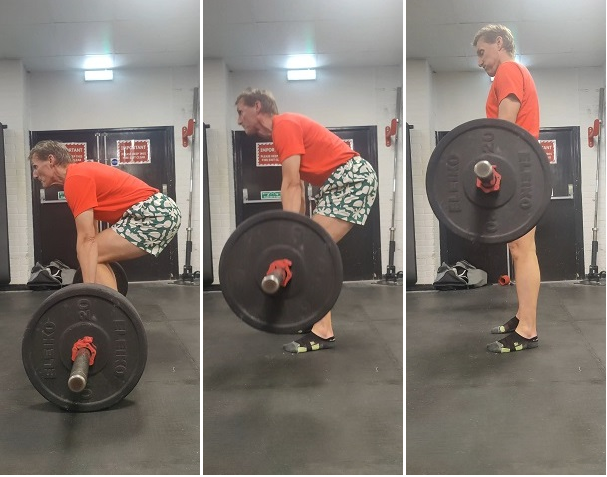
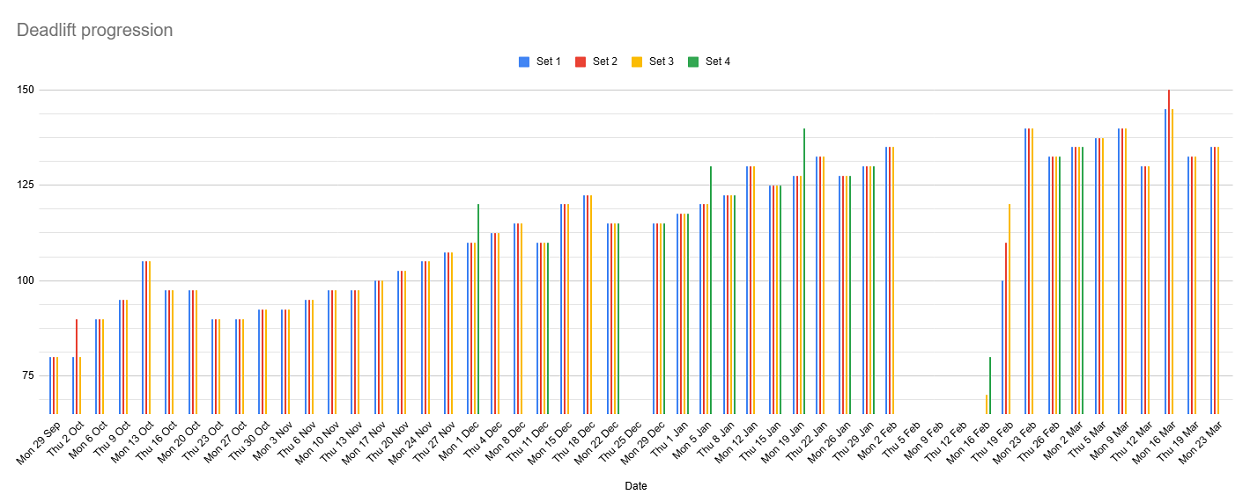
Similarly I went to the gym intending to strengthen glutes and quads using squats and deadlifts. I stopped deadlifting at Christmas because I had a pulled a muscle in my back and need it to recover.
Injuries like that have been a part of this gym training but not while there. Both sides of my back (rhomboids) and both hamstrings have been strained but these injuries occurred while doing sprints. I believe it’s because I’ve strengthed the muscles and am now putting forces through other parts of the body which aren’t used to it. Injuries led me to add exercises to strengthen the adductors, abductors and hamstrings (leg curl) which can only be beneficial.
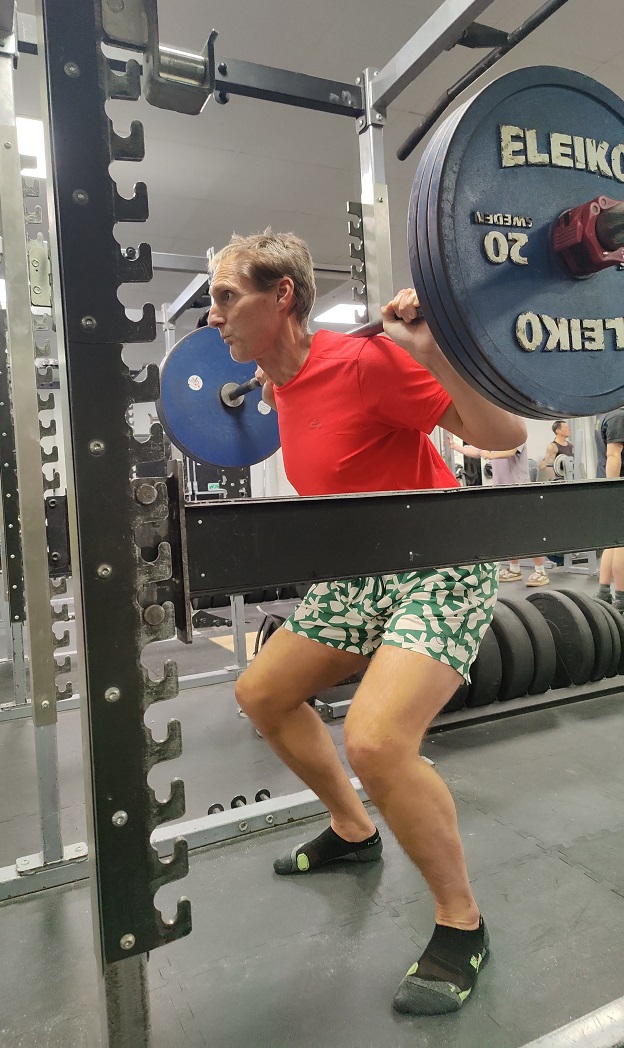
With squats my initial aim was to push the weight as high as possible over the training period. I reached 149kg just before Christmas in the Smith machine and added another 10kg just after but unracking the bar began to feel like it was squashing my torso even just standing with the weight on my shoulders. At the same time I realised my deep squats, where I could barely do a single effort at 70-80kg, were too low by comparison and since the New Year I focused on upping this. It’s been very successful as I managed to do a 100kg deep paused squat in my final week and felt there was capacity for another rep. I still occasionally worked the top end and managed to do multiple sets and reps of quarter-squats at 160kg in the free weights area.
On my final leg session I repeated my so-called Seb Squat Challenge which I did with half squats at Christmas and this time attempted it with deep squats. I completed it successfully but it might well have been the toughest session I’ve done. The ten reps at 85kg left me gulping for breath, just like when I’ve been sprinting!
Going to the gym twice per week has been enjoyable without feeling like I’m overdoing it. With my sessions on Mondays and Thursdays, it’s allowed me to go to parkrun on a Saturday with relatively fresh legs. While I didn’t have a benchmark run from before the weights I ran 23mins in my first month, the same again at Christmas, slipped to 25mins while injured and then have rebuilt it to 23mins with increased daily runs of 2-3 miles but no speedwork outside of very short sprints.
And this non-movement in parkrun time is while having putting on about 15lbs / 7kg / 1-stone in weight. My legs have grown by 2 inches / 5cm; as has my chest and arms – I look more like a rugby player than a runner. I detailed how my gym shorts ripped last month and when I put my tailored shorts on again a few weeks back they no longer fitted, they were far too tight. It’s been like that with most of my clothes.
It was never my aim to get bigger but I guess it’s inevitable as you add strength. I deliberately did low rep sets which are meant to avoid muscle hypertrophy. I particularly didn’t want to add upper body weight which doesn’t provide much, if any, benefit to running and maybe that’s why my bench press never improved back to my teenage days. But I was never in this to look good, it was always about functional training – providing muscle for power and health.
There is no doubt it has been an excellent investment of my time. As a general estimate I’ve added 20-30% strength in all the exercises I’ve been doing. I notice when I’m running I feel very stable around my core, my legs feel strong and that there is more to come.
While I could continue going to the gym over the summer, my aim is now to focus on turning the strength into power and rebuilding my lacate threshold to run faster over sprints and parkrun. I’m also interested to see how my body reshapes without any gym work, how much of the strength I’ve developed is retained and how quickly I can reaccess it next winter.
If there was any doubt my glutes and thighs have grown in size since going to the gym, it was proved when I split my shorts doing deep squats the other day! Fortunately I had a spare pair with me and was able to see out the session.
Deep squats, which are a staple of power lifters and gym goers, where you go ass-to-grass and your bum is lower than parallel, thereby putting you in ‘the hole’, aren’t found to serve much purpose for runners.
Yet having pushed my squat up to 160kg in the Smith machine in early January, I found my deep squat was barely half of this. I was straining to do even 1 rep at 70kg despite the Smith machine channelling all my force into the lift rather than having to worry about stability or balance.
The disparity between my 1/4 squat and deep squat seemed too much and after Christmas I decided to focus on improving my depth. For one thing, everything you can do from a deep squat means you can do that weight at 1/2 and 1/4 squat too. I also suspect the disparity is because there is some underdeveloped muscle somewhere in my legs/hips which would benefit from strengthening by getting lower.
I know when I unracked 160kg it was the first time I’d felt like my back might not like the squats. I felt a little bit of strain there and as I lowered the bar, I was really conscious I couldn’t go deeper than about 8-10”. Pushing back up to standing was less of an issue than the lowering phase. I was never in any danger because I always set the safety bars on the equipment, and while they have tested twice with crashing out, I don’t want to attempt any lift with a gung-ho mindset.
While the focus has been on improving my deep squat, every three weeks or so I slot in a heavy session to remind the body it’s still needed. In February that saw me do four sets of 6x150kg in the free squat area which suggests with the right training I’d be able to do 1 rep of 180kg. While these heavy lifts might only be a 1/4 squat at best – perhaps getting 30cm or so of depth – I’m still very pleased with them and what it might contribute to max velocity.
There is a suggestion that a 1/4 squat should be able to lift 30-45% more than a deep squat which works out as at between 124-138kg. Yet my latest deep squats see me only just able to do 3 reps at 90kg and I’m struggling with poor form such as hips lifting first.
This is why I’m working on the deep squat at the moment. The disparity is still too wide. I’m barely able to deep squat my body weight and from what I’ve read, focusing on 1/4 and 1/2 squats doesn’t become effective until you can deep squat at least 1.5x bodyweight which would be the upper end of the 124-138kg range.
Realistically I know I’m not going to get there in the month I have left at the gym during my winter membership but I’m certainly feeling the benefits of strength training and setting myself up to run faster through the summer and then get back to the gym to further improve next winter.
It’s January and a whole year of running is ahead. Perhaps you’ve already entered some races and begun training. Elite runners and their coaches certainly have. In fact they won’t only have planned out what to do this year – they’ll know what they will be doing next year and beyond. This year there are World Championships and again in two year’s time then in 2028 it’s the Olympics – probably the high point of runners’ careers.
But those are simply long term plans, there’s a preplanned year of racing in 2025 which they’re expected to take part in. During the winter they’ll be doing cross country, maybe indoor racing if the facilities are available, and then in the summer it’s the track season and Diamond League with the World Championships being the competition they aim to peak for.
Elite runners and their coaches are always thinking ahead – they have to. How exactly they divide up the training year really depends on what they’re targetting but generally in the autumn they are doing a base of mileage to prepare the body for what comes later. Many modern athletes, particularly the faster track athletes, will be doing some weight training to build strength and stability to support the miles they’re running.
Marathoners who have quit the track will be focused on running two marathons per year – one in spring, another in autumn. The Marathon Majors see Boston and London in April; while Berlin, Chicago and New York take place between the end of September and early November – this neatly allows marathoners to run a Spring and Autumn marathon – six months to train for each. Again those six months will be broken up into phases of base, pre-competition and tapering leading into the race.
Even though their training plans are focused towards major competitions, runners will be participating in other races. Some may be selected for international competitions like the European Championships, Commonwealth Games, World Cross Country championships or World Indoors. The marathoners, focused on their six month plan, might take part in a half marathon, both as a way to test their fitness and earn some extra appearance money.
But when the best runners take part in other races, their approach is different to that of a recreational runner; they won’t be looking for their fastest possible time they’ll be racing tactically and just looking to be the first across the line. Ideally they’ll want to win with the minimum expenditure of effort and fatigue in their legs. They may even run in a less than ideal state; as training for their goal race may only make minor allowances for a lesser race and certainly won’t see them running at their strongest. In marathons, runners who realise they aren’t going to win often drop out around the 20-mile mark to avoid unnecessarily fatiguing their legs thereby allowing them to recover quicker and potentially even reprioritise an alternative 10K, 10 mile or half marathon coming up just a few weeks later.
My own running followed a fairly standard pattern for many years. I entered half marathons in spring and autumn; 10Ks in the summer and preceding Christmas. That gave me a structure to the year which played out as doing base work after the September half marathon through to the end of October. Then a couple of months specifically training for the 10K. Then in the New Year repeat that cycle with trying to build on what I’d achieved at the 10Ks and preparing for an April half marathon. When the sunshine returned and my legs had recovered from the half marathon I would resume speedwork and prepare for the summer 10Ks before again turning back to do the miles to prepare for the autumn half.
This has all changed with my return to the gym. As I wrote in my previous post, my focus has shifted onto rebuilding leg strength through this winter. Two trips to the gym each week – Monday and Thursday – which allows decent recovery time in between. On the other days I’ve been working on my sprint speed – small sessions with short intervals and drills to improve form and efficiency. This format partly developed after an injury in July and when I returned I carefully tested the injury with short runs. I found I was enjoying the freedom this gave me. Where once I had always run every day for at least half an hour, currently I don’t even run for that long on any day. A 25min parkrun is currently my long run for the week!
My intention is to start rebuilding my running mileage when my gym membership finishes. Given it rarely gets that hot where I live, I won’t mind doing all the longer runs during the spring and summer. In the meantime it has been lovely not to have to train in the high winds, cold and rainy days of winter as I’ve done for the past decade. It’s given me a chance to mentally refresh myself after a decade-plus of running almost every day.
From time to time, this refreshed attitude tries to entice me into starting the rebuild now, but I remind myself the priority is the work I’m doing at the gym. It’s impossible to have your maximum speed/strength at the same time as your maximum stamina/endurance. If I start doing significant volumes of running, I may begin to impact my strength gains. When I leave the gym in March, I want to have maximised my strength as best possible with the training time I’ve had available. Once the summer begins I will be looking to convert that strength into power and therefore speed. The running will become the priority again and I will look to maintain whatever strength I’ve gained this winter.
There is no right way to divide up your training but all good athletes divide it up in some way because they recognise they can’t work on all the things they need to do at the same time. Sometimes they need to improve their speed, sometimes it’s their stamina, sometimes it’s their endurance. Having a training plan allows runners to organise all the different sessions they’re going to do so that they arrive at their goal race at their strongest, fittest and ready to race.
If you’re unsure how to develop training plans and set long term goals then maybe I can do that for you. If you’d like Coaching then please click over to Contact Mewhere we can start discussing how you can become a better runner.
Seb Coe is one of the legends of British running. Now known as the head of World Athletics and the organiser of the 2012 London Olympics, anyone who watched athletics in the early 1980s remembers his rivalry with Steve Ovett. The 1980 Moscow Olympics are one of my earliest sporting memories where Coe entered as world record holder for the 800m while Ovett hadn’t been beaten in the 1500m for three years. While the races resulted in two golds for Britain; it was a surprise when they each won the race the other was favoured in.
Coached by his father, Peter Coe; Seb won golds in 1500m at both the Moscow and Los Angeles Olympics. In 1979 he broke three world records, the 800m, 1500m and mile, in 41 days. In 1980 he broke the 1000m record then bettered it to 2:12.18 in 1981. That same year he also reduced his 800m WR to 1:41.73 – a record which lasted until August 1997.
It’s a highly successful career and his father’s training philosophy of improving lactate threshold through low volume, high intensity training became a training model which endured into the 2000s. It’s only later been understood that Coe’s low volume of fifty miles per week wasn’t really low volume as it neglected to count mileage done during warm-ups and cooldowns and explains why later attempts to follow a genuinely low volume approach led to a dearth of western success in middle distance for the following decades.
It’s clear Peter’s coaching was able to get the best out of Sebastian and he goes into great detailing about all aspects of training in his book – “Better Training for Distance Runners”. This isn’t a book I recommend to the average runner but, as a coach, it is a mine of information which I’ve regularly returned to.
This winter I’ve rejoined the gym with the express purpose of getting stronger and trying to maximise my muscle recruitment – mainly for running but with the view it is one of the most important things you can do to stave off the effects of ageing.
I’ve been focusing my weight training on the advice in running books like Peter Coe’s as well as reading decent articles and watching videos on YouTube from trusted sources. I’m not interested in Bro science or what the influencers have to say. When I need advice on lifting I chat to, Rich, a powerlifter at the gym who squatted 390kg / 850+ lbs at his peak.
In Chapter 6 of his book, Peter Coe explains the benefits of weight training and in describing squats on page 280 he gives this example …
“Seb Coe (130-lb body weight) doing six sets of half-squats, the number of reps will be 15, 15, 15, 10, 10, and 5, with the weight increasing by 10 lb per set set from 140-190 lb. Admittedly this is a challenging session – more than 11,000 lbs moved in 70 lifts – but over the years Seb became an accomplished weight lifter, and while this training session was not a “killer”, nevertheless it would have been accompanied by only an easy run that day and also the following day.”
To summarise and convert from Imperial to metric it is
Reps
LB
KG
15
140
63.5
15
150
68
15
160
72.8
10
170
77.3
10
180
81.8
5
190
86.3
990
2178
Although I’ve only been back in the gym for less than three months, I’ve already been squatting significantly heavier weights than these albeit not necessarily deeply. Having chatted to Rich he tells me that a half squat is when the thighs are parallel to the ground and while I find this difficult to judge accurately when looking straight on into a mirror, I’ve been able to half-squat reps at 100kg perhaps more. My heavier squats which reached 160kg after twelve weeks are certainly only 1/4 squats at best.
While Rich tells me that he would recommend only ever doing deep squats and working up from those, he is a powerlifter not a runner whereas Pete Magill states in his Speed Runner book “You don’t have to squat so low that your thighs are parallel to the ground. While a lower squat will help acceleration, a quarter squat gives you more bang for your max velocity buck.”
With Christmas week seeing the gym closed for a couple of days and it marking the three month mark since I started training, I wanted to see whether I could match what Seb was doing. As my gym’s weights are in kilograms I decided to keep things simple and work at 65, 70, 75, 80, 85, 90 kg with the same rep counts as he was doing.
I felt confident I could achieve this as I’ve done 10x90kg half squat; there was however a little doubt at the back of my mind as to how I’d find the 15rep efforts in the beginning because I never do sets past ten reps at lighter weights. While the overall set of lifts seemed like they would be easy to do, I wasn’t taking anything for granted.
Squats are always the first thing I do at the gym and this session – on the Monday before Christmas – wasn’t going to be any different. I warmed up for squats in the usual way by doing three deep reps with an empty 20kg bar which both begins to warm me up but also ensures I’ve set the equipment, in particularly the safety bars, in the right places. While I didn’t expect to need them for this, it doesn’t cost anything to put them in place. Once I’d done 3x20kg I then proceeded to do 3x40kg, 3x50kg and 3x60kg which all felt very simple and like I was barely training. I then took a few minutes before starting Seb’s Squat Challenge!
The first set of 15x65kg (143lb) felt easy. My legs were warmed up and it was a set well within my capabilities so I just did the 15 reps straight off and then added 2.5kg to each end of the bar for the 15x70kg (154lb). I took a minute or two rest and was then able to go through this second set with only a momentary pause around the 8th rep.
Having loaded the bar to 75kg (165lb) for the next fifteen reps I had confidence that if I could get through this things would get easier on the remaining sets. Unracking the bar I began to notice it was feeling a little heavier and once again paused around the 8th or 9th rep than as I reached the 12th I knew I had the strength for the last three reps but also that I would need to take a second or two extra rest at the top before starting the next rep. Things were beginning to get a little tougher.
At 80kg (176lbs) I felt confident in the knowledge that I now only needed to do ten reps which I have regularly done before. It proved relatively easy as did the next set at 85kg (187lbs). By now the bar was definitely feeling heavier when I unracked it but having unracked as high as 160kg I expected this.
With the final set only requiring five reps at 90kg (198lb), I even felt confident enough to repeat my first rep as I could see I didn’t go deep enough. Even though I’d already done 60+ reps it might have been the easiest set of the lot.
I’d done it – mission accomplished! Of course there is no official Seb’s Squat Challenge it’s just something I wanted to see if I could do. All told it took me about twenty mins with breaks of 2-3mins between sets. There was the occasional rep where I dug deeper but in all honesty it never felt that difficult. Most of the sets were done with barely a pause. The one remaining doubt is whether I was going deep enough. A half squat should see the thighs parallel and, if I were being hyper-critical, I’d like to have gone an inch or two deeper but it was close enough.
And yet there’s a catch. Seb Coe weighed 2/3rds of what I do – 59kg vs 90kg. Where the final set was about 1-1/2 time his body weight, it’s equal to mine. To truly take on this challenge, I’d need to up the weights and set them to the same percentage of body weight as Seb did. I know I’m not ready for that, and while I can probably get close to deep enough for five half-squats at 135kg, it’s all the preceding lifts which would be make it tough. Even so, maybe when I’m finishing up at the gym in March I will give it a go!
Weight training can be an important supplement to run training and if you decide to start doing squats – even just air squats with body weight or with a weighted vest, remember that Pete Magill states “Pause when your thighs are near-parallel or parallel to the ground – a quarter squat for maximum velocity training and half squat for acceleration”.
If, like me you end up at the gym, I think it’s worth working through all ranges of motion at different times. One day I train at getting used to squatting the heaviest weight I can and this might only allow me to confidently do a quarter squat. The next time I train I might focus on achieving half squats which are inevitably at a lighter weight but allow my legs to recover from the very heavy day. At the end of each session I usually do a set of the deepest squats I can, ass-to-grass as Rich terms it, where my thighs are touching the backs of calves – again these will be even lighter but useful in adding support and confidence for heavier lifts.