My sprint practice has taken a backseat over the last month because I’ve been feeling some fatigue around the lower core and to the right of my groin. Back in 2012 I strained something in there and I had to stop running for three months; so I’m very wary of that happening again especially as I’m now over a decade older. I have thrown a couple of sessions in but not been able to video them, so no piccies to show!
Nonetheless I’m still training every day and running longer intervals of 400m to a mile but not as all-out sprints. One day I was out on a typical training session and I’d planned to run 10x400m intervals. Somewhere around the 7th or 8th I became aware of how I was applying force. My leg would swing backwards from its high knee, my foot would hit the ground and then I’d stopped putting in effort and coast over the stationary foot. I immediately knew what I was doing wrong.
Last month I wrote about the mental image of how skateboarders paw the ground to push themselves forward. While I was referring to that in terms of sprint technique and, while on these 400s I wasn’t flat out sprinting, I realised I was doing the equivalent of the skateboarder bringing their foot down to the ground and then half-heartedly pushing through. In effect, creating friction and drag rather than adding energy to the stride.
I’ve written previously about hip extension and how elite runners push their foot back using the glutes until the leg is behind them. Yet it was only in this moment that I actually felt myself not doing this. A moment where I gained the awareness that as soon as my foot hit the ground, I let the ground slow me rather than put in effort to push through with the glute and attack back at the tarmac.
A few days later, on an easy jog, I noticed I was deliberately trying not to put in too much effort. My foot barely left the ground and to push all the way through with the glute felt like I was putting in more effort than I wanted for an easy run. It seems this had become a bad habit that had carried through to faster running.
While I haven’t been able to work on my sprinting, I have been able to focus on this during long intervals by being aware that I’m getting full hip extension and driving the leg through forcefully. It doesn’t always happen because tiredness sets in and those muscles aren’t necessarily used to applying effort all the time for longer periods but it does seem to be happening more regularly.
What I’m finding is that I’m naturally staying up on my toes more and and my glutes are beginning to burn. That’s a surefire sign that the correct muscles are firing.
When I arrived home and uploaded my run, I noticed my cadence graph is looking much smoother. There’s a couple of aberrations in there which happens as I navigate corners and slopes but otherwise it looks unusually smooth.
I went back to the start of October and compared it to what the graph looked liked then. Notably less smooth.
Overall I’m sure this is a good sign for my running. I suspect it may be the first time in my life where I’ve run with a mechanically advantageous stride. And lately I’ve noticed my running is getting quieter. I’m skimming over the ground more than pounding into it which is indicated by what the improved cadence smoothness shows.
I’m trying to improve my sprinting by videoing myself and then comparing it to the theoretical model of the best sprinters in the world. It’s not rocket science but I’d like to feel like I’m running rocket powered. While there are distinct differences between sprinting and distance running, even distance runners need to be able to sprint for the finish line and there should be some common mechanics which will carry over to make me efficient over any distance.
For example, as detailed in part 1, I noticed my foot was landing too far out in front of me causing me to vault over it. When I brought the foot closer, my runs began to feel like I’d taken the brakes off and my glutes were doing the work.
The best sprinters have cadences well over 250 steps per minute, often approaching 300 yet I struggle to even reach the 220s. Watching the video of my sprinting it all seems lumbering and cumbersome. While a still image can look fairly decent, watching actual footage tells a better story. When my foot lands it seems like I’m stuck to the ground for an age as my body passes over it.
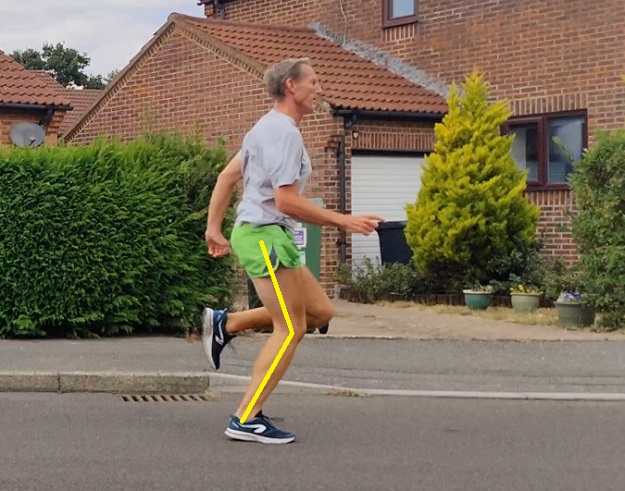
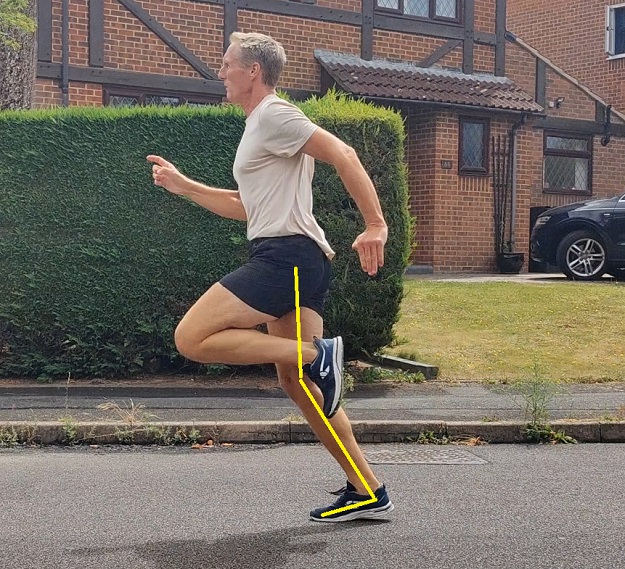
Watching and rewatching footage I began to see my head and shoulders were rising and falling against the background. The next questions was “Why is that happening?”. And from that I began to see both my knee and ankle were collapsing and I was flat footed with each step which produced the illusion of being stuck to the floor for so long.
Knee bend just after landing (thigh yet to reach vertical)
Ankle bend
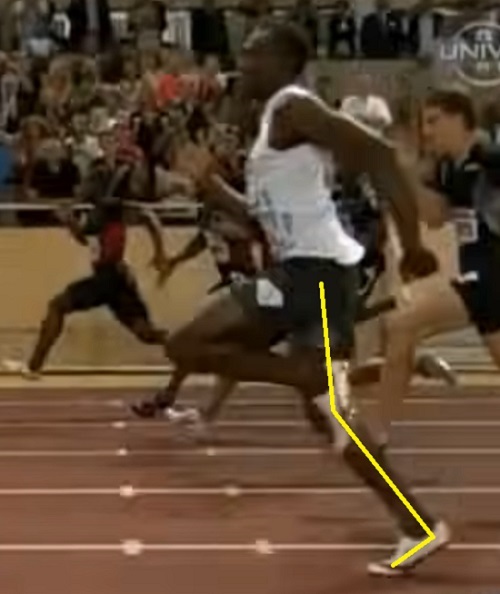
Good sprinters try to maintain leg stiffness (of their support leg) with the knee hardly bending. Their ankles don’t flex much either and they stay up on their toes – the heel never touches the ground. Inevitably there is some flexion in the knee and ankle due to the forces being generated as the weight of the runner lands but the more it can be minimised, the better. Likewise the heel will move towards the floor slightly but never makes contact. This flexing allows the Achilles tendon to load up with elastic energy and then release to help propel them forwards.
Usain Bolt – knee and ankle flexion
If you compare the pictures you’ll see both myself and Bolt are at the same stage of the stride; the arms match, the knee coming forward matches and the thigh of the support leg is vertical. But the foot is completely different. My ankle has collapsed and flexed and the heel is barely off the the ground; Bolt’s heel is notably raised and the foot is at right angles to the lower leg.
Initially I thought there was too much knee flexion but I’m no longer so sure. But there’s a definite lack of ankle stiffness which is causing an energy leak and it’s that which I’ve been looking at over the past month or so.
How to improve is of course always the harder question to answer when you locate an issue. Trying to resolve this became a matter of trial and error. I tried to focus on keeping the joints stiffer. I felt I had the requisite strength to keep my legs and ankles stiffer – after all when I skip / jump rope they don’t collapse, it was just the sprint technique wasn’t allowing me to get it right.
When I ran my sprints and strides I made an effort to maintain stiffness in the joints. I think it was a little beneficial but it put new stresses through my joints and for a time the tendons in the rear of my left knee were feeling swollen. It didn’t stop me running, it didn’t hurt training; but the knees were certainly unhappy if I was squatting down to say get something out of a cupboard. I made sure to keep the volume of these sprints lower though as I knew there was a danger of trying to do too much and injuring myself.
Note – while leg stiffness is important you don’t want your leg to be locked out at the knee because that has a high chance of leading to an injury. Failure to flex under high forces can lead to bone jarring into bone.
Similarly trying to stay up on the toes can lead to issues with calf muscles and tendons and there’s a good reason for allowing some ankle flexion. When the ankle flexes (i.e. the toes lift up and move closer to the knee) the Achilles tendon stretches and just like an elastic band it stores energy. When this elastic energy releases it provides some of the propulsion for moving forwards. While sprinters’ ankles flex the heel stays off the ground but a distance runner’s heel will come into contact with the ground momentarily and this needs to be allowed to happen for the storage of elastic energy.
One of the mental models I’ve been using is to think of how skateboarders paw the ground to keep their deck rolling. They time the kickback to add speed as the board begins to slow. It seems to me sprinters are doing the same thing; but where the skateboarders are able to take a foot off the board, paw the ground and then rest the foot back on the deck; sprinters are trying to stay airborne with just their legs extending down to make a short but powerful contact. You could think of the Roadrunner’s legs whirring along at speed..
The other adjustment I made was to try and get my foot down to the ground quicker – what coaches refer to as a hammer action. If I could move the leg down quicker then it would apply force quicker and the foot would go through quicker leaving less time for the joints to flex but still allowing some ankle flex to load the Achilles.
In trying for this quick contact and to stay more airborne, I’ve found my sprinting begin to morph and on occasions I have felt myself springing along as the Achilles does more of the work. There’s still more to do but I think it’s heading in the right direction.
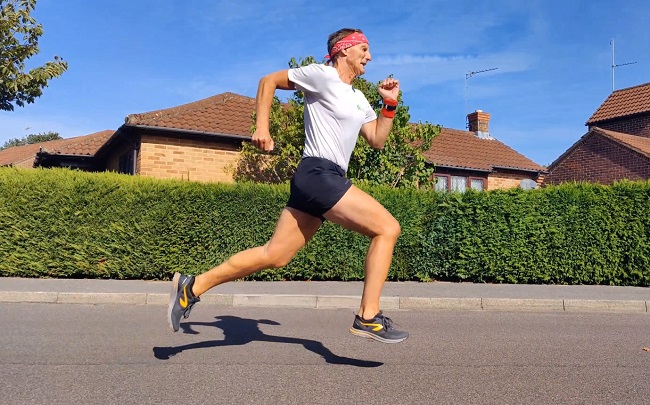
This me in full flow sprinting. Other than the pained expression, to the untrained eye I’d say it looks pretty good but I’m not fast and never have been. Improving my sprinting has been a large part of my summer training while doing 3-5miles each day along with an interval session and weekly 5K parkrun.
I’m very aware elite distance runners have good speed over short distances – a 400m lap in under one minute is normal to them. Yet despite my physical attributes, it something I’m not achieving and I don’t understand why. For sure I’m ageing but even when I was young I was never able to do it and yet my physical attributes suggest it, or something close, should be within my ability. There are men ten years old than me who can so I’m discounting the age problem.
Maybe it’s been down to the wrong training but I had a strong suspicion my form was poor so I bought a tripod off eBay to be able to film my sprints and analyse the technique. Last year I received a copy of Ralph Mann’s The Mechanics of Sprinting and Hurdling for my birthday which explains in great detail every important position the most efficient sprinters achieve. While I don’t expect to be able to replicate or measure them in the detail provided in the book, I hoped to be able to make some comparisons between what I’m doing, what the book states and then to rectify any anomalies.
Unfortunately my phone didn’t have a very good camera on it, or more specifically it could only capture 30 frames per second. At high speed that just doesn’t give enough detail, for example I couldn’t tell whether I was landing on my heel or toes. So I got a new-to-me phone from my nephew which has 4K and 120fps and enabled me to see what was happening.
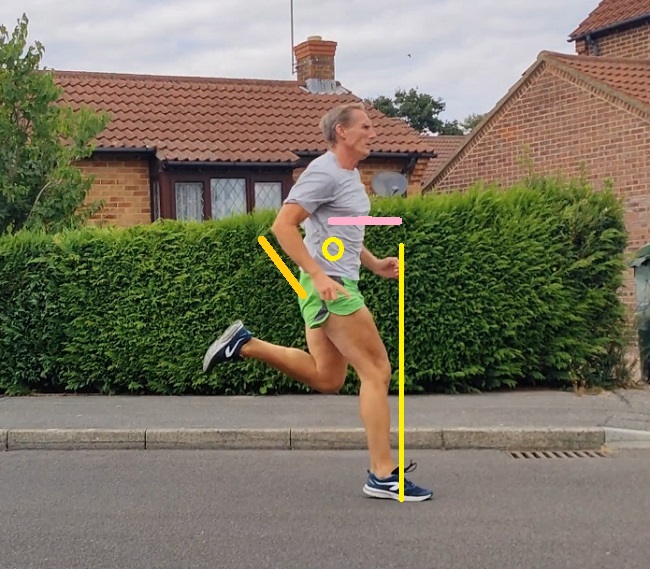
Landing foot in relation to Centre of Mass
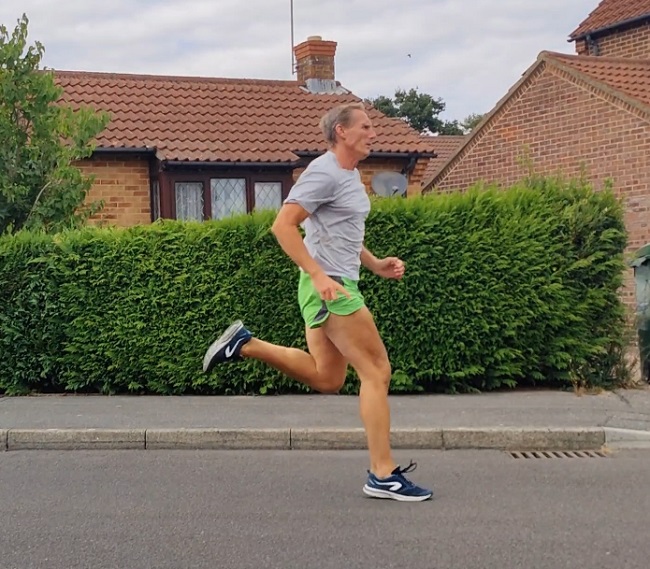
I took some footage and then stepped through frame by frame. I didn’t have any preconceived notions about what I was looking for but the nuances of how I was running began to emerge. Eventually I settled on this frame.
On the surface not that much seems wrong with it because it’s not heel striking – the toes are just touching first and from the knee down to the foot, the lower leg is almost vertical below the knee. Those are the sorts of pearls of modern wisdom that get preached as good technique.
But I could see the foot just seemed too far ahead of the body and when I checked Mann’s book, he states that while world class sprinters are unable to get their feet to land directly below their centre of mass, they can get it to land only 20cm ahead of them. For an average sprinter, it’s 28cm and a poor one it’s 35cm. Think about those numbers for a moment – they’re not particularly big distances so it’s easy to be unaware if they’re wrong.
I’ve drawn some lines on the picture below to explain how it’s calculated. The yellow circle is approximately where my centre of mass is, and the yellow line up from the foot shows where it is landing. The pink line indicates how far ahead it is and I’ve created an orange line of the same length and then measured it from my elbow. Getting out a tape measure it’s a distance of 35cm – poor sprint technique as predicted!
When I ran recovery the next day I worked on getting my foot to land closer to underneath me. The difference was immediate. Every step began to feel like I was being pushed along by my glutes and it became apparent my previous form was creating a braking force out in front – every step needed me to pull my body over the foot. I’ve heard this phenomenon likened to driving a car with square wheels rather than just rolling along. While the new form bedded in quickly, it took a while for the body to adjust to using a different set of muscles, I had a few aches and pains. I backed off training while this was the case.
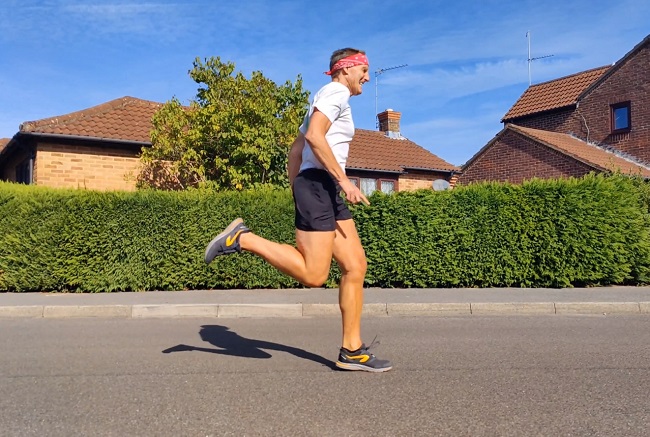
Five weeks later in early September this is how it looks. I’ve picked like-for-like frames based on the the foot placement with toes touching and heel about to touch. It’s clear the foot is now landing closer to my centre line and while there are some slight changes to my upper body posture, the non-landing leg is coiling up in the same position.
I’d say that’s an improvement and I certainly feel it’s easier when I run at any speed, not just sprint. I’m beginning to flow over the ground and I can hear it in a less noisy foot contact. And when I did the measurements again the foot is now landing 25cm out in front of me. Better than average, not quite elite!
Next time I’ll look at a couple of other changes I’ve spotted that might help!
The previous parts of this series can be accessed by clicking on the following links where they will open in new windows. Part 1, Part 2, Part 3, Part 4.
I wrote this series of posts because there is an idea out there that 180 steps per minute is the perfect number to run at and I want to investigate. Only this past weekend, I came across an interview with Chris McDougall, author of Born to Run, where he stated “For perfect running form you should be running at 90 strides per minute” therefore 180 steps.
The idea that there’s a perfect onesize fits all cadence for people of different heights, weights, speeds and abilities has always seemed wrong to me. Maybe it’s because I’m tall and, when I started running I counted my cadence at 150 steps per minute on easy runs rising to mid-150s when I picked up the pace but hardly ever going over 160 in a race. I always assumed it would increase as I got faster, after all I was rarely running any quicker than 7min/mile. On reflection these lower numbers are partly because my form was poor and I was overstriding yet even today with improved technique I’m still running easy runs in the mid-160s. It might reach 180 at 6min/mile and when I pick up my pace to 5min/mile I start to hit the 190s. When I sprint it rises above 200spm. This is the progression we glimpsed for some of the elites.
To recap, the trend for elite cadence data is that very high cadences are only seen over short distances. As the race distance gets longer, cadence drops until for the majority of runners it reaches 180. That gels with the ‘180-rule’ idea and the drop-off makes sense because the shorter races are run at lower speeds and we know speed is created through a combination of steps and stride length. Sprinters have both high cadences and very long strides – neither of which is sustainable for a distance runner. It is only at the end of a distance race where we see endurance athletes raise their cadence and/or stride length to sprint for the line.
Typically we see the 100m sprinters have cadences in the 280-300 range, 400m runners are 220-260, the middle distance runners at 190-210 and long distance is in the 180-190 range.
It’s very clear that if you want to be a sprinter or middle distance runner it’s going to involve high cadences – well over 200spm. Since writing the post on sprinters, I’ve been reading a book on sprint mechanics which began its research in the the early 1980s and now leads to the fastest sprinters training to create high cadences. But its author is very clear to point out this must not occur at the expense of stride length. An adequate stride length is still required. It points out that when some sprinters have pushed their cadence too high (over 300spm) this has been detrimental to their speed.
Whether or not this increase of cadence, which has worked for sprinters, can validly be transferred to long distance running is debateable. For one thing, if it were transferrable then we might expect to already be seeing numerous elite distance runners with cadences well over 200. Whereas the data I covered found only one long distance runner operating at over 200spm. A reason for this may be because sprinters achieve quicker cadence through use of the hip flexors, a relatively weak muscle group, and therefore distance runners would struggle to maintain high cadences for long periods. Even in the 400m we see the cadence of elite sprinters fatiguing and this is in a race lasting 45-50 seconds.
With most recreational runners being interested in races between 5K and marathon in length, the long distance data is most relevant. Thirty-two runners were detailed – eight men and women in their respective 10,000m and marathon races – and we see a different picture to the one presented by Jack Daniels in his book.
At the 1984 Olympics Daniels recorded only one runner having a cadence below 180, out of the fifty he surveyed. His method was very basic and done with the naked eye but, he has also conducted proper scientific research so while observing from the seats is not perfect; his findings are still worthwhile. Ultimately what’s been important throughout these posts has been to get a rough idea of what runners are doing, not coming up with a perfect number.
By contrast the data used in this series of posts, which is taken from the World Athletics reports, has a high standard of scientific rigour to it. High speed digital cameras filming an area which has been carefully measured and calibrated then using computers to analyse the film. This data showed nine of the distance runners (about 25%) had cadences below 180.
For me, the most interesting of these is seeing Mo Farah’s cadence at 173-178 while running at 4:15-30/mile. He is not just a run of the mill athlete, he won multiple Olympic and World titles, which highlights that while 180 may be something to aim for, it is not a prerequisite for success. While his best time in the marathon (2hr05) is not close to the best of the best; he won the 2018 Chicago marathon which is one of the majors.
Recreational paces
What we aren’t seeing from any of this data is what the elites are doing at typical recreational paces which are often 8min/mile or slower. In the marathon, we have data from the men at both the 30 and 40km marks and we see their cadence dropping as they slowed towards 6min/mile. That would suggest that if they run at even slower paces their cadence will drop further. Perhaps.
The marathon data also has three runners who are slower than 6min/mile which is a pace many decent club runners can achieve. The cadences are 175, 185, 186spm – so there is nothing conclusive there.
Rereading a later edition of Daniels’ Running Formula book he mentions that he treadmilled an Olympic marathon gold medallist for their cadence. At 7min/mile it was 184, at 6min/mile 186 and at 5min/mile had reached 190. This is very much in line with what we see in how the cadences drop off in the men’s marathon data reviewed. Yet it is also very different to what Mo Farah is doing in the 10,000m where he is running significantly faster than with lower cadences.
One reason often given for creating a high cadence is to avoid injury. There is some logic, particularly for marathoners, where a higher cadence means a short stride and less vertical displacement i.e. they don’t go as high in the air and therefore don’t hit the ground with as much force. Their effort is used to go more horizontally. A good example of this is Tirunesh Dibaba in the 10,000m race; where she has a high cadence especially when sprinting in the home straight (228spm) and she must be barely leaving the ground with each step. Some years before this race she had moved up to the marathon and so the lower impact is seen as beneficial when you’re running well over one hundred miles per week.
Final thoughts
Most recreational runners are interested in the distance races – anything from 5K to marathon and maybe beyond. When they go out on easy runs they are doing paces of 8min/mile or slower; some of the decent club runners are closer to 7min/mile.
We have no specific detail on what the elites do at these paces but if your cadence is already in the 180-190 range – when you run faster you will need to increase your stride length to get significantly quicker. It may be possible to increase your cadence towards 200 but the data suggests it won’t go much higher. To improve stride length you are going to have to work on strength and speed making sure you are getting full hip extension.
If your cadence is below 160 at slower paces, it may not be an issue particularly if you are tall or muscular but it may be something to consider looking at. Often the advice about 180 cadence is intended to stop runners from overstriding which can lead to injuries. Certainly if you have recurring injuries then it may be worth looking at video of yourself running in conjunction with considering whether to increase cadence.
Ultimately though, the cadence data is there to support your running; not be an end goal. Every step you take on a run is a combination of stride length which involves ground contact time, air time, vertical displacement among other things. All these variables interact. Changing one will affect others.
Elite runners run how they feel comfortable. Sometimes it is a high cadence, sometimes it is a low one. Some like Mo Farah have a long stride with low cadence, others like Tirunesh Dibaba are getting their feet to contact the ground as often as possible.
If you enjoyed these articles why not take a look at the ones I wrote about Stride Length – part 1 and part 2.
In the Introduction I detailed how, in his Running Formula book, Jack Daniels states that his survey of runners at the 1984 LA Olympics found everyone in events over 3000m had a cadence of 180 or greater – with one exception.
In this post, I’m looking at the 10000m and marathon races from the 2017 World Championships and finding more anomalies than Jack discovered. To read about the cadences of Sprinters and Middle-Distance runners – click the links.
Men’s 10,000m
The race was won by Great Britain’s Mo Farah in 26:49.51s with Uganda’s Joshua Cheptegui and Kenya’s Paul Tanui finishing less than a second behind him. Twenty-two runners had started the 25-lap race and while the early going was slow the race eventually settled down to running laps at around 4:15-30/mile pace. Gradually runners were dropped from the lead pack and at the bell Farah was leading a group of six; it was here that he kicked and covered the final lap in under 56 seconds.
The technical report on the race covers the first eight finishers and provides their data in the home straight on the 15th lap. We are given the Step Rate when the race has settled down and the runners are running at around 4:30/mile.
Step Rate (Hz)
Cadence (SPM)
Farah
2.89
173
Cheptegui
3.04
182
Tanui
3.07
184
Muchiri
3.44
206
Yimer
3.23
194
Kamworor
3.09
185
Hadis
3.07
184
Ahmed
2.85
171
Average
3.09
185
Table 1 – Step Rate (Hz) and Cadence (SPM) data for top 8 finishers in Men’s 10,000m
I’ve done the conversion from Step Rate to cadence and we can see there is a huge range from 171 up to 206spm. Mo Farah is just a couple of steps higher at 173 than Canada’s Mohammed Ahmed (171). It’s clear a sub-180 cadence was no hindrance to Farah because he won the gold and Ahmed finished 8th in 27min02 only fifteen seconds behind.
Many of the athletes are running at Jack Daniels’ predicted 180 cadence with Kenya’s Jemal Yimer (194) and Ethiopia’s Bedan Muchiri (206) being the notable exceptions. While the focus of these posts has been to ignore stride length; I think it is useful to recognise Muchiri’s is 1.75m here.
The technical report also provides greater detail (table 2) for the three medallists with their cadence from five points in the race including the home straight as they battle for gold at top speed.
Lap 5
Lap 10
Lap 15
Lap 20
Lap 25
Lap 5
Lap 10
Lap 15
Lap 20
Lap 25
Farah
2.93
3.09
2.89
2.97
3.33
176
185
173
178
200
Cheptegui
3.01
3.04
3.04
3.05
3.45
181
182
182
183
207
Tanui
3.10
3.15
3.07
3.12
3.45
186
189
184
187
207
Table 2 – Step Rate (Hz) and Cadence (SPM) data for Men’s 10,000m medallists
What we see is that, for much of the race, Mo Farah is operating at sub-180 cadence while Cheptegui and Tanui are operating at 180-190. It’s when they reach the final lap of the race that they put the afterburners on and here we see all three runners increase their cadence. Mo Farah continues to have the lowest of the three albeit he is achieving a cadence of 200 at this point.
Women’s 10,000m
The women’s race was run differently to the men’s 10000m. While initially both races began slowly with a pack of runners bunched together; it was about twelve minutes into the women’s race on the 9th lap that eventual winner Almaz Ayana took charge.
While the 8th lap had been completed in 1:15 (5min/mile) she now moved to the front and upped the pace with the next two laps coming in 1:08 and 1:07 (4:35-40/mile). Gradually she pulled away from the the rest of the field, lapping back markers and went on to win gold finishing almost a minute ahead of the other medallists. There was a tussle between Tirunesh Dibaba (silver) and Agnes Tirop (bronze) over the last lap with Alice Nanowuna following in fifty metres behind them.
The cadence data (table 3) is a little more conventional for the women with all the runners between 180-192 yet there is one exception – Kenya’s Alice Nawowuna who is down at 173. The race commentators mention Nawowuna is the tallest of the three Kenyans which could explain a longer stride.
Step Rate (Hz)
Cadence (SPM)
Ayana
3.14
188
Dibaba
3.17
190
Tirop
3.20
192
Nawowuna
2.88
173
Krumins
3.07
184
Infeld
3.02
181
Cheptai
3.07
184
Huddle
3.17
190
Average
3.09
185
Table 3 – Step Rate (Hz) and Cadence (SPM) data for top 8 finishers in Women’s 10,000m
As with the men’s data, the sample is from midrace approaching 6000m where they are running at about 4:50-55/mile with the exception of leader Ayana who is at 4:35 and Molly Huddle at 5:03.
Below in table 4 we see the race breakdown for the medallists and cadence increases in the final lap on the home straight. Ayana is unchallenged so never has to hit her highest gear. The battle between Dibaba and Tirop is close and we can see their cadences are very different. At this stage of her career, Dibaba had been running marathons for three years and it is notable how smooth her stride is sprinting against Tirop. At 228, Dibaba’s turnover in this finishing straight is as good as, or better, than many middle distance runners while throughout the rest of the race she is above average by hitting the low 190s.
Lap 5
Lap 10
Lap 15
Lap 20
Lap 25
Lap 5
Lap 10
Lap 15
Lap 20
Lap 25
Ayana
3.06
3.03
3.14
3.03
3.23
184
182
188
182
194
Dibaba
3.09
3.19
3.17
3.23
3.80
185
191
190
194
228
Tirop
3.08
3.09
3.20
3.03
3.26
185
185
192
182
196
Table 4 – Step Rate (Hz) and Cadence (SPM) data for Women’s 10,000m medallists
Marathon
The 2017 World Championship marathons were held on a four lap street circuit around London with each lap measuring about 10km. While there were some long straights on the course, it also had a number of corners to be negotiated which either required runners to run wider or adapt their pace. It was a true head-to-head race in the sense of trying to beat other runners rather than going for a time.
The marathon data is possibly the most interesting data in this whole study because we have two sets of data for the men recorded at around 30km and 40km and, with runners tiring in both men’s and women’s races, we get a glimpse of them running at paces we might expect from above average recreational runners.
The men’s race was won by Geoffrey Kirui of Ethiopia in 2:08:27. Table 5 shows his cadence on lap 3 is 191spm where he is recorded running at 4:50/mile. Having taken the lead at 35km and opened up a lead over silver medallist Tamirat Tola, he had slowed by the 40km mark. By this point he was running at 5:25/mile and his cadence had dropped to 186spm.
Lap3
Lap4
Step Rate (Hz)
Cadence (SPM)
Pace (per mile)
Step Rate (Hz)
Cadence (SPM)
Pace (per mile)
Kirui
3.19
191
4:50
3.10
186
5:25
Tola
3.05
183
4:58
3.00
180
5:51
Simbu
2.91
175
5:22
2.89
173
5:27
Hawkins
3.12
187
5:21
3.23
194
5:11
Kipketer
2.85
171
5:29
2.86
171
5:42
Meucci
3.14
186
5:29
—
—
—
Ghebregergis
2.96
178
5:37
2.99
179
5:49
Wanjiru
3.20
192
5:26
3.08
185
6:10
Average
3.05
183
5:19
3.02
181
5:39
Table 5 – Men’s marathon data at roughly 30 and 40km
Of the other six runners who data was recorded for, only Callum Hawkins increased his pace in the last 10km – this was consistent with him moving up in the race from 8th place to finish 4th. To run 10secs/mile quicker his cadence increased from 187 to 194.
Meanwhile Tola, who slowed by almost a minute per mile, dropped his cadence from 183 to 180; similarly Wanjiru who slowed to over 6mins/mile had his cadence drop from 192 to 185. The other three runners see a small drop in pace – Simbu slows by 5secs/mile – a relatively low cadence of 175 drops further to 173; Kipketer’s cadence remains the same as he slows by 13secs/mile and the one anomaly is Ghebregergis who fractionally increases Step Rate while slowing by 12secs/mile. I’d be inclined to see this as remaining the same with the 0.01Hz change attributable to the normal variations which occur while running.
The women’s marathon was won by Rose Chelimo in 2:27:11 – not a particularly fast time by modern standards – equating to an average pace of 5:37/mile (35min per 10K). But it was closely contested with the top four runners finishing within ten seconds of each other.
Unlike the men’s race, there is only data provided from the 4th lap – the 40km mark – and at this late stage of the race we see in table 6 a variety of paces from the 5:28/mile of USA’s Amy Cragg who is almost a minute per mile quicker than Kirwa and Dibaba at 6:17 (barely quicker then a 20min 5K parkrun).
Lap4
Step Rate (Hz)
Cadence (SPM)
Pace (per mile)
Chelimo
3.31
199
5:41
Kiplagat
3.07
184
5:41
Cragg
3.29
197
5:28
Daniel
3.09
185
5:37
Demise
2.95
177
5:56
Kirwa
3.10
186
6:17
Kiprop
2.75
165
5:58
Dibaba
2.92
175
6:17
Average
3.06
184
5:51
Table 6 – Women’s marathon data at roughly 40km
We see a significant range of cadences despite all eight finishers running 2hr27-28. Gold and bronze medallists, Chelimo and Cragg are hitting the 190s with Kiplagat, Daniel and Kirwa in the mid-180s – all in line with Jack Daniels’ findings.
Yet there are three runners with sub-180 cadences. There are Ethiopia’s Shure Demise and Mare Dibaba (unrelated to Tirunesh) in the mid-170s. And then there is Kenya’s Helah Kiprop running at only 165spm. Finishing seventh, a minute behind Chelimo this was far from her best race which was a Marathon Majors win in Tokyo in a time of 2:21:27. Knowing she can run a marathon around 20secs per mile faster opens up the question of whether she would achieve that pace through a quicker cadence, longer stride rate or a combination of the two. I would expect her to be capable of a quicker cadence as 165 is extremely low compared to all the other runners detailed.
Collating the data into table 7 for all 32 runners across the four races we see a symmetrical range of cadences where the majority are in the 180s – which aligns with the average cadence data being 183-185spm. But it also highlights that over a quarter of these runners can be running at sub-180 cadences.
< 170
170s
180s
190s
200+
Cadence (SPM)
1
8
14
8
1
Table 7 – number of runners for each cadence grouping
While the variety of paces goes from 4:15/mile in the men’s 10,000m down to 6:15+/mile in the women’s marathon – we should remember these are all world class athletes who are training many hours per week and getting excellent coaching. They are running times many of us will only dream of and among these runners having a sub-180 cadence is not holding them back.
We’ve also glimpsed cadence at slower paces – the marathons have three men running at 5:49, 5:51, 6:10 per mile and four women running at 5:56, 5:58, 6:17, 6:17 – these are the paces for a 18-20min 5K. The cadences for these seven runners are 179, 180, 185 and 177, 165, 175, 186.
This suggests, but is by no means definite that, as elite runners move towards recreational paces their cadence can be lower than 180. It’s also backed up by how when the men slowed in their race, four of six runners had lower cadences, while Callum Hawkins increased his pace by increasing his cadence as did each of the 10000m medallists.
In the final post in this series I will summarise what the cadence data can tell us about running and what it might mean for you as a recreational runner. Click here to go to it.
Having looked at sprinters, our attention now turns to the middle distance runners. Traditionally competing in the 800, 1500 and perhaps the 3,000m; the research hit a problem – World Athletics didn’t report on any of these races at the 2017 World Championships. Fortunately, as I was writing this series of posts, the 2024 European Championships in Rome were taking place and so, I had to be like Jack Daniels, and do my own bit of counting. Using the televised footage I was able to replay certain sequences of the races to get an idea of the cadences involved.
I watched each race through in its entirety to get an understanding of how it played out and identify which runners were near the front of the pack and of whom I could get an unobstructed view. Often the TV director regularly switched between close-ups and long shots of the race, on different runners and by necessity switching to different cameras positioned around the track. Typically I managed to count the paces for 15-20secs and then multiplied that up to get a value per minute. Being manually calculated in this way, I could be out by a few steps per minute but we’re interested in getting a rough idea of the numbers involved – not doing an exact scientific breakdown!
Having identified one runner for each race I then did a lap-by-lap breakdown for them. This was necessary because longer races can start off slowly, building the pace and then finishing in a mad dash to the line. We might expect different cadences as the race pace picks up or lulls. With only one runner analysed per race it’s by no means a perfect look at the cadences we see but it’s an indication.
800m
The men’s final was won by France’s Gabriel Tual in 1:44.87 and it was his data I collected for the two lap race. The first lap took 53sec which is around 3:30/mile and his cadence was 197spm.
The 2nd lap was marginally quicker at 52sec but in the home straight Tual put in a big sprint finish and this was what I measured. I watched and rewatched the video multiple times as my first calculation had him registering a cadence of 234spm, a second viewing it was 224 and I finally settled at 228spm. This is a significantly higher value than the rest of his race but what we expect when runners sprint.
For the women’s 800m, I used Great Britain’s Keely Hodgkinson as my subject. She’s run the fastest time in the world this year and is in with a chance of winning gold at the Paris Olympics. She actually won the gold at these championships, but I recorded her cadence in the semi-final where she ran 1:58.08.
The first lap of the race was run in 57.6s followed by a slightly slower second lap of 60.4sec. The cadence for the first lap was 202spm, rising to 206spm on the second. This might seem strange given the second lap was slower but from 400-600m the runners slowed before Keely accelerated away on the final bend where I measured her second lap cadence.
What we can see from both the men’s and women’s race is it’s not unusual for 800m runners to have cadences of over 200 during the main race. And with speed being a key requisite for its runners, it’s no surprise to see that a runner like Tual has the ability to hit even higher cadences.
1,500m
Norway’s Jakob Ingebrigtsen is arguably the star of male middle distance track racing at the moment. It was his data (table 1) I captured during the heats of the men’s 1,500m event. Due to the race being a 300m lap followed by three full 400m circuits, it is difficult to know where to place the short ‘lap’ when trying to ascertain split times.
Cadence (Spm)
Pace (per mile)
Lap 1
189
3:57
Lap 2
186
4:09
Lap 3
193
3:49
Lap 4
208
3:37
Table 1 – data for three medallists nearing the finish line
Being a heat, it was an easy race for Jakob and he seemingly jogged off the start line such that everyone was ten metres ahead of him. From there he sat at the back of the pack avoiding trouble until the final 300m when he overtook everyone and finished first. We can see his cadence is steady around the 186-194 mark while he was at the back and then when he accelerated it went over 200.
The women’s final where I obtained the cadence data was run even more tactically with the first two laps at a relatively sedate pace before it began to wind up and Ireland’s Ciara Mageean came through to take the gold. Even though the pace was a little slower we see that the cadences were all lower throughout.
Cadence (SPM)
Pace (per mile)
Lap 1
184
4:30
Lap 2
185
4:34
Lap 3
180
4:13
Lap 4
204
4:01
Table 2 – Ciara Mageean’s cadence at 1,500m
So that’s cadence for middle distance runners. Bear in mind, the data provided here is limited to four individuals – Gabriel Tual, Keely Hodgkinson, Jakob Ingebritsen and Ciara Mageean. There’s strong reason to believe its representative for all elite runners but there will be some individual variance with others.
If this data shows us anything in particular it’s that the faster you run – the higher your cadence. Intuitively that makes sense. We see the “magic 180” figure is being adhered to at paces around 4:30/mile and when middle distance runners break into a sprint they go over 200spm but never approach the cadence of the short sprints.
In the next post – we will look at the cadence of long distance runners. Most recreational runners only compete in these types of races so it should provide interesting data. Click here to go to it.
In the introduction to this series I wrote about how running coach Jack Daniels spent the 1984 LA Olympics measuring the cadence of runners, but what he didn’t measure was the cadence of elite sprinters. This may simply have been because, as a distance running coach, he wasn’t interested by sprinters; or it may be because sprinters are significantly quicker making counting harder.
Fortunately World Athletics produced a series of reports from the 2017 World Championships giving us the data for sprinters as well as distance runners. Through the use of digital technology the research is very accurate. Using cameras capable of capturing up to 250 frames per second, runners were recorded in the middle of the home straight and then again in the 10 metres before the finish line.
At this point, we need to recognise that sprinters don’t work in cadence (number of steps in a minute) probably because their races are over in seconds. They refer to frequency or Step Rate (Hz) – how many steps they take per second! Still to try and make it meaningful for this article, I’ve calculated the equivalent cadence – multiplying by sixty and rounding off – to get a value for a minute.
100m
Table 1 below shows the step rate and calculated cadence for the men’s 100m with competitors ordered by their finish place. Justin Gatlin took gold in 9.92secs, Christian Coleman silver in 9.94s and Usain Bolt took bronze in 9.95s – just 0.03seconds separating them.
The cadences were sampled during the mid-section of the race when athletes are accelerating and their cadences will still be high. We can see, with the exception of Bolt, that the cadences range from 278 (Prescod) to 300 (Simbine and Su). These are typical elite men’s values. Usain Bolt’s turnover is notably lower at 263 which is probably because he is tall (6’5” / 1.95m) and that makes it harder to recover the legs quickly. This obviously didn’t stop him having a successful career as his height gives him a longer stride.
Step Rate (Hz)
Cadence (SPM)
Gatlin
4.67
280
Coleman
4.95
297
Bolt
4.39
263
Blake
4.85
291
Simbine
5.00
300
Vicaut
4.90
294
Prescod
4.63
278
Su
5.00
300
Table 1 – Men’s 100m final data at around halfway
In any sprint the cadence is highest at the beginning where athletes take small, quick steps to accelerate. As the race goes on they begin to rely on stride length (which is why Bolt excels in the later stages of both the 100m and 200m) and the cadence drops partly due to spending longer in the air – ‘longer’ is measured in hundredths of a second though.
Table 2 details only the medallists in the final 10metres of the race we can see the Step Rate / Cadence has dropped albeit it is still notably high. In such a tight race we can be sure all three sprinters are giving their best effort and therefore these values are representative. There’s roughly a 10% drop-off from earlier in the race.
Step Rate (Hz)
Cadence (SPM)
Gatlin
4.24
254
Coleman
4.55
273
Bolt
3.97
238
Table 2 – data for three medallists nearing the finish line
These sprint values are matched by women sprinters as you will see in table 3 below. Perhaps their values are a little lower overall but we can see from Baptiste and Ahouré that women are capable of the highest cadences. Just as the men use no one set cadence (or step frequency) throughout – it changes and adapts as the race goes on – the three female medallists do too.
Likewise, as Bolt showed how height affects cadence, we see Schippers at 5.9” (1.79m) has a slightly lower cadence than the others in the field at 275. Approaching the line there is a slight increase in her cadence, which is probably a negligible difference, and which probably reflects two World Championship golds won in the 200m and would have involved training speed endurance for a longer race.
Step Rate (Hz)
Cadence (SPM)
Bowie
4.72 dropping to 3.97
283 dropping to 238
Talou
4.76 dropping to 4.46
286 dropping to 268
Schippers
4.59 increasing to 4.63
275 increasing to 278
Ahouré
4.95
297
Thompson
4.67
280
Ahye
4.85
291
Santos
4.81
289
Baptiste
5.00
300
Table 3 – Women’s 100m final at halfway plus medallists nearing the finish
400m
In running one lap of the track as fast as possible, a world class 400m runner completes the distance in around 45 seconds if they’re male, 50s if they’re female. It is an event where anaerobic energy plays a large part in creating the speed but where the build-up of ‘lactic acid’ causes the legs to start seizing up – particularly in the home straight. (It’s not really lactic acid but that’s the conventional wisdom).
The data presented in table 4 from the men’s 2017 World Championship final is taken at 350m – so the legs will be starting to struggle. Again runners are listed in their finishing order.
Step Rate (Hz)
Cadence (SPM)
Van Niekerk
3.33
200
Gardiner
3.37
202
Haroun
3.66
220
Thebe
3.75
225
Allen
3.41
205
Gaye
3.85
241
Kerley
3.66
220
Table 4 – Men’s 400m cadences in the home straight
And here in table 5 is the data for the women’s race.
Step Rate (Hz)
Cadence (SPM)
Francis
3.37
202
Naser
3.62
217
Felix
3.33
200
Miller-Uibo
3.29
197
Jackson
3.80
228
McPherson
3.44
206
Mupopo
3.58
215
Williams-Mills
3.75
225
Table 5 – Women’s 400m cadences in the home straight
With these values occurring in the home straight where the commentators say “the bear jumps on your back” due to the lactic build-up making the limbs feel heavy; we aren’t necessarily getting the entire picture of the cadences which 400m runners are capable of achieving.
Fortunately there is data available here detailing the cadences in the four quarters of the 2016 Rio Olympic final where Wayde van Niekerk set the world record running against two of his main rivals Kirani James and LaShawn Merrit; as well as the data from Michael Johnson’s previous world record run in 1999. While it appears these are manually counted by the blogger, the numbers are very close to those presented in the 2017 WC report for van Niekerk; a report which also contains data for Butch Reynolds who set the previous world record. This is all detailed in table 6.
0-100m
100-200m
200m-300m
300m-400m
0-100m
100-200m
200m-300m
300m-400m
Van Niekerk (43.03WR)
3.98
3.90
3.81
3.50
239
234
229
210
Johnson (43.18WR)
4.31
4.08
4.21
4.11
259
245
253
247
Reynolds (43.29WR)
3.65
3.74
3.74
3.64
219
224
224
218
James (43.76)
3.89
3.86
3.78
3.42
233
232
227
205
Merritt (43.85)
4.19
4.17
3.93
3.49
251
250
236
209
Table 6 – comparison of elite 400m runners Step Rate and Cadence across whole race
What’s notable is the variance across the runners. You go from Butch Reynolds who is consistently around 220 for the whole race up to Michael Johnson who is consistently around 250. In between the other runners all start off with a high cadence which is dropping off by the final 100m.
What we can say for sure is the longer sprint distance of 400m results in lower cadences than those in the 100m. Johnson has the highest cadence of anyone here at 259 in the first 100m and that’s below the 100m runners who, with the exception of Bolt, were in the 280-300 range.
This isn’t surprising as 400m runners tend to be taller than 100m runners, usually over 6’ / 1.85m taking long strides to cover the ground quickly which combines with a lower cadence. It’s not always the case – Michael Johnson has the highest cadence yet is slightly taller than van Niekerk. They may also have lower cadences or shorter strides because they are running slower – the male 400m runners are averaging just under 11 seconds per 100m.
I’ve deliberately not included stride lengths in this piece because it’s here to give an idea of cadences across events. But what Johnson and Reynolds show is how there is no one specific cadence or stride length being used to get them to a world record – each adopted what worked for them.
In the next article, it’s time to look at the middle distance runners – click here to go to it.
Is taking 180 steps per minute the magic number to aim for? Just about every search you do on the web will tell you it is. I’m not entirely sure though. As you will see almost all elites do indeed run with a cadence of 180+. But they’re elites and they’re typically only measured running at elite paces i.e. 5min / mile or better.
If you’ve arrived here by Google (or any other search engine of your choice) then you probably already know what cadence is. If you didn’t – it relates to how many steps you’re taking per minute – your step rate, sometimes inaccurately referred to as stride rate. The two tend to be used interchangeably. Maybe that’s why it’s easier to refer to it as running cadence!
Your running cadence is likely to be somewhere between 160-200; although at one stage mine was as low as 150. It’s also possible for it to be a little higher than 200. If you’re walking it will be significantly lower – something like 100-120. All of it, as we shall see, depends on how fast you’re moving.
In the days when information was less accessible and sport science was still evolving; I recall reading that running speed is simply the result of how many steps you take in a minute and how far you travel with each step. This was made to sound mathematical by saying Running Speed = Step Frequency x Step Length. If you take 200 steps in a minute and cover 1 metre with each then you run 200m in a minute therefore with 1,609 metres in a mile you’re running at 8min/mile.
I previously tackled Stride Length in a couple of articles written some time ago because I feel that’s more important for recreational runners to work on. But having written articles on how the glutes should power runners and how it’s possible to create high cadence by not using the glutes I wanted to dig further into the topic.
Origins of 180
In his Running Formula book, renowned coach Jack Daniels states that he and his wife spent the LA Olympics in 1984 counting the cadence of elite athletes. Rather than count the steps, they counted armswings because they’re always in sync – as a leg moves forward, an arm moves forward. It’s a good way of counting cadence which I use when I’m evaluating runners.
Jack found that 800m runners had the highest cadences of over 200 with other middle distance runners approaching this value. Once he turned to the runners in races longer than 3000m he found the cadence was lower; yet all but one runner had a cadence of 180 or more.
While I cannot state for certain this is where the magic 180 number came from, I think it’s quite likely. During those Olympics he counted 50 runners – male and female and therefore got a good sampling. These days we are lucky enough to have cadence monitoring built in to our GPS or smartwatches and if we want to look at elite runners we can watch playbacks on digital film or video.
In this series of posts, I’m going to provide you with the cadence data for contemporary runners. Some of it has been calculated with the latest digital cameras and film; others I’ve used Jack’s method of counting armswings! I’ll be looking at sprinters and middle distance runners as well as those doing the longer events like 10,000m and marathon that many recreational runners race too.
To read part 2 and find out the cadence of elite sprinters – click here.
Running seems easy. It’s the act of putting one foot in front of the other quickly. One of your legs swings out in front of you and you move onto it. Then the other leg moves out in front of you and you do it again.
This much everybody agrees on.
Yet the mechanics of running aren’t taught at school, it’s something we pick up from watching others. Some people seem to intuitively understand what to do to run fast while others seem to lumber along.
If you start to think about it, or look for guidance from the internet, it quickly becomes a morass of information. Is running the same as falling with gravity, repositioning your legs quick enough to avoid landing on your face? Or are you almost jumping or hopping forwards with each step and lifting your knees high to extend the stride? Which muscles do you use when?
Consider that the only thing which moves you forward is pushing the ground away behind you. Powerful muscular contractions of the glutes and hip muscles ‘out the back’ allow you to skim forward over the ground. Then when the step is complete, you do the same with the other leg. You don’t waste muscular effort repositioning the foot in front of you, you let the body’s natural stretch mechanisms do it.
It’s just like using a slingshot or catapult. You use all your effort to pull the elastic back to its maximum stretch and then, when you let go, it fires forward. You can’t make a catapult go forwards faster by doing anything other than letting go.
Just like the elastic on the catapult fires past the Y-mechanism eventually it slows down as it runs out of energy. Likewise the leg and foot shoot past the body and end up in front. That’s when you, as a runner, go back to putting the effort in to getting the foot and leg moving backwards to power the next step.
These are the first principles:
Use effort to drive the leg backwards with each step.
Let elastic energy in the hip flexors pull the leg forwards.
As the leg comes forward, muscular effort is only used to stabilise rather than power.
These simple principles will help you begin to sort through the advice you read. It won’t cover everything but it’s a good starting place.
Watch any elite runner and you’ll see their heel kicking up to their buttocks as the leg moves forwards. I have a whole bunch of terms for this – butt kick, heel lift, back lift which I am going to use interchangeably through this article.
From an efficiency perspective it is very important. The days of people owning mechanical clocks are now all but gone, so the majority of people probably have little idea about how the length of a pendulum affects its movement. Basically a long pendulum swings slower than a short one and vice versa. You can test this by grabbing a piece of string, tying an object to the bottom and swinging it at different lengths.
Applying this concept to running – a short leg will swing quicker than a long one. Tall people tend to have slightly slower cadences than shorter people and it is why, when small children run their legs appear to go like the clappers. Of course, once you’re fully grown you can’t change the leg of your legs, you’re stuck with your genetics, unless a disaster happens.
Yet shortening one’s leg is effectively what an elite runner does when they kick their heel up to their backside. As the foot passes closer to the body and above knee height they have essentially halved the length of their leg. It is now only as long as their femur measures from hip to knee. This is sometimes referred to as shortening the lever. A shorter leg comes forwards quicker than a straighter leg helping to reposition it ready for the next step.
With recreational runners we rarely see this butt kick taking place. With some runners it is like they are walking fast, keeping their legs straight – moving them back and forth with a high cadence and barely leaving the ground. To varying degrees, other runners will lift their trailing foot off the ground – some lift it just a few inches whereas others may have it passing the support leg at calf or even knee height. Once in a while you see recreational runners who have an exaggerated back lift even if they are only moving at a moderate pace, such as eight minute miles. It is almost certainly something they have been taught to do and there are certainly many coaches / Youtubers who advocate doing this. The trouble is while deliberately lifting the heel to the backside seems desirable for the efficiency reasons previously mentioned, it is not.
Don’t initiate ‘the pull’
It’s likely ‘shortening the lever’ will help you run faster, at least in the short-term. To do it you just pull your heel to your butt – to do this you engage the hamstrings. The problem is, this isn’t how it should occur or what the hamstrings are best used for. What they should do is control how quickly the lower leg unfurls once your leg is out in front of the body. This isn’t a conscious process, it just happens with every step you take. Like any muscle they will eventually become tired and fatigued so if you are mistakenly using your hamstrings to actively pull your heel, you’re going to tire them out needlessly.
How to butt kick
The reason you don’t need to actively lift your heel is because when you run correctly it naturally happens. In my look at glute-powered running, In a previous post, I discussed how an elite runner like David Rudisha uses his glutes to swing his leg from in front of him to behind. At some point the thigh physically cannot go any further back and he tips up into a toe-off.
Looking at a snapshot of what happens a few frames later we see his thigh has barely moved but the lower leg has begun to lift. This is momentum transferring down the leg through what is referred to as the kinetic chain. It generates power in many sporting actions from kicking a football, throwing a javelin, swinging a golf club to delivering a knockout punch. Energy is generated by big powerful muscles and then transferred to the smaller extremities to achieve a higher speed. It’s the same process that allows Indiana Jones to to crack his whip – his arm and body begin the movement and then the energy transfers through the handle and down the whip to create the cracking sound.
For Rudisha, after the leg appears to momentarily pause, it then begins to move forward. This is powered by the elastic energy that has been stored in the muscles on the front of the hip and thigh. When the leg was moving backwards these muscles were being stretched like an elastic band and now, just like when the elastic band is let go they ping back to their normal length. This pulls the thigh forward, but it doesn’t affect the lower leg so that continues its journey towards the runner’s butt.
Eventually the lower leg either runs out of momentum or reaches its closest point to the butt. If everything is timed well, it is enough to carry it under the runner’s body as a shortened lever.
Composite image of David Rudisha’s stride showing the heel lift and pass under the body
Not everybody butt kicks
Given that I’m describing this as a natural sequence of events, you might expect everybody to lift their heel to their backside and kick butt yet this isn’t what we see. The main reason is you have to be running at high speed for it to happen. You won’t see any sprinter who doesn’t butt kick and this isn’t taught to them except by bad coaches – it just happens.
Your legs have to be moving back and forth quickly to create the momentum in the lower leg. Quite how fast you need to be is some undefined combination of factors such as pace, leg length, foot weight and stride rate.
All elite distance runners back kick because they are rarely run slower than five minute miles. The women’s marathon is the slowest elite distance race and Tigist Assefa can be seen butt kicking on the way to her marathon world record.
Tigist Assefa running behind two pacers demonstrating a high heel lift at 5min/mile
Yet if you see an elite distance runner out for a jog, at say nine minute mile pace, their heel doesn’t kick their butt. The foot will come off the ground but it is not the efficient shortened lever. At slower speed the leg just doesn’t have the momentum to carry the foot up to recover close to the backside.
There is another reason why we often don’t see any backlift in recreational runners and this is because many over-rotate their hips which I discussed in this post. Instead of the leg swinging straight backwards and forwards with a long range of motion to create power and momentum, a shorter stride length is creating by turning the hips. Arguably this may simply be a factor explaining why they’re slower at running but I noticed in the footage of Tigist Asseffa breaking the world marathon record, she appears to have one foot lift higher than the other. I suspect this is due to over-rotation of the hips as it is reflected in one shoulder rolling more than the other. She is not the only long distance runner who seems to have some inefficiency in this area.
Final thoughts
Kicking the heel to butt for more efficient recovery is something which occurs with good running form and mechanics. Attempting to force it by pulling your heel up is unnecessary and will tire the hamstrings. Arguably it could be beneficial to slower runners but the counterargument is that spending the time learning to pull the foot up is training time that could be used to improve speed so it happens naturally. Ingraining bad form is unlikely to be a good idea because it is harder to undo later on. To get the natural heel lift, you need to get the glutes firing and the leg swinging through to an extended toe-off.
The information detailed here is based on personal experience and that contained in Steve Magness’ The Science of Running Book. Magness was the Cross Country coach at the University of Houston where he was able to speak with Tom Tellez, the track coach who coached many athletes including Carl Lewis who was the 100m world record holder during the 1980s and 1990s.






 Big Red Running