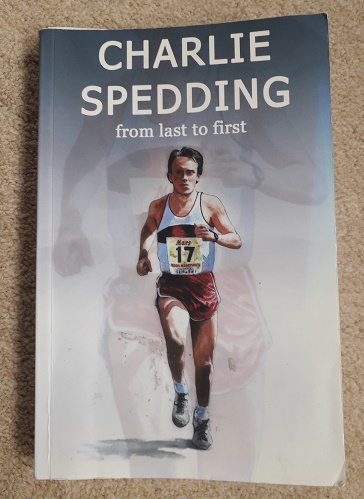
Recently I’ve been reading Charlie Spedding’s autobiography “from last to first”. He’s a runner I only remember because he was one of the early winners of the London Marathon and being a trivia buff it was the sort of factual list I knew off by heart at one time. The following year he finished second in a time of 2:08:33, which remained the English record until 2014, as he relinquished his title to Welshman Steve Jones.
Published in 2009, “from last to first” looks back to Charlie’s running career which ended twenty years earlier after the Seoul Olympics. Like all autobiographies, it tells of his early life, parents and formative years in running. It details his two major successes, winning the London Marathon and a bronze medal at the Los Angeles Olympic, events which occurred a few months apart in 1984 as well as a copy of his training diary between them. The final chapters of the book give an overview of how he trained and brings us up to date with some of his thoughts on the reasons behind the nation’s lack of health and prospects for future running success.
At just over two hundred pages, the book is well written and often humorous. As a pharmacist, he clearly has an understanding of science yet is able to tell his story without unnecessarily resorting to big words or jargon. I laughed out loud when he recalled his time at Chorister School in Durham where “One of the lads I played with was a boy called Tony Blair. I don’t recall his skill with the ball, but I do remember his ability to make up rules of the game to suit his team’s situation.” Also the tale of how he was invited to do an inspirational talk at a local psychiatric hospital. Introduced to a patient by the doctor as “This is Charlie Spedding. He’s an Olympic bronze medallist in the marathon”, the patient replied “That’s alright, I thought I was Henry the Eighth when I got here.”
About to undergo Achilles surgery in the 1970s, he almost died in hospital due to anaphylactic shock caused by an allergic reaction to a drug. It’s interesting to think that, at the time, surgery was deemed the way to fix these issues. Derek Clayton stated in his autobiography that he’d had nine operations for problems which included his Achilles. Nowadays we understand surgery isn’t necessarily the solution, heel drops can resolve it. My friend, Simon rehabilitated his Achilles simply by doing a month of very easy running after racing twenty-five times in a year. Charlie notes late on that he avoided further Achilles issues when he was in the United States by getting regular massages.
Throughout the book, Charlie impresses how important attitude and mindset were to his succcess. He talks about how he was fortieth or forty-first academically in a class of 42 at junior school but went on to achieve a degree and running his own business. When he first played sport, he wanted to be a footballer but wasn’t good enough; when he ran sprints he was last but then found cross-country and finished second in his first race. Having found what he was good at, he then worked hard at it.
After a decade of high level national running as part of Gateshead Harriers, he sat in a pub and rethought his attitude as to what he needed to do to reach his potential. He realised he needed to be more positive in his vocabulary, to be specific about his goals and to be willing to think differently if he was going to achieve more than the average person. His underlying philosophy was one of getting the best out of himself for whatever talent he had and accepting that as success.
I found many parallels in his writing to how I’ve lived my own life apart, of course, from winning the London marathon or going to the Olympics. The attitude and mindset of always giving your best to fulfil your potential are one that resonate with me. Also his willingness to try new approaches and not giving up when things haven’t worked out. It’s something of a cliché to say “how bad do you want it?” is the determining factor but I’ve met many people who say they want to achieve good times in their running but aren’t then willing to make it a priority or get out of their comfort zone. There’s nothing wrong with not doing those things but I believe it’s best not to talk about your desire for improvement if you’re not willing to do the things that are firmly within your control. It’s like wanting to win the lottery but refusing to buy a ticket.
I enjoyed reading this book for its refreshing honesty and humour. It was a very easy read and, as I was loaned this copy, I’ll probably look to pick up my own one in the future for a reread. As an aside, the hospital in which Charlie Spedding nearly died is the one where I was born!
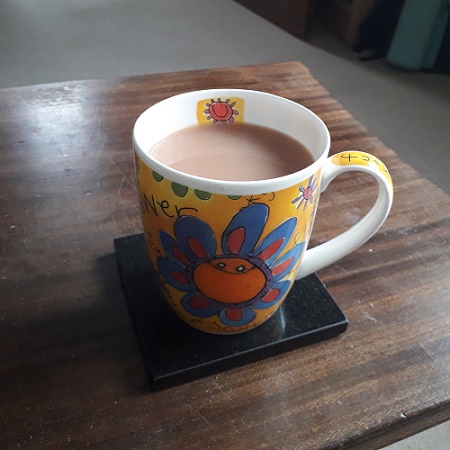
Beginner’s mind is a Zen concept about approaching situations with a non-judgemental, open-minded attitude. There’s a couple of stories which begin to explain it and both involve cups of tea!
In the first teaching, a university professor who has been studying Zen teachings goes to see the Master. On arrival, he states he wishes to learn about Zen and begins to tell the Master all that he already knows. The Master listens and, after a while, suggests they drink tea.
While the professor talks, the Master begins to pour. The cup begins to fill with tea and the Master continues to pour. The professor continues to explain what he has learned about Zen and soon the cup is nearly full. The Master continues to pour as the professor continues on. The tea reaches the brim of the cup and then begins to overflow. The professor’s voice falters as the Master continues to pour and the tea spills out of the saucer onto the table. The professor stops, thinking perhaps his explanations have distracted the Master, but the pouring continues. As the tea runs off the table onto the floor, the professor is unable to stand it any longer and says “Stop, stop, can you not see the cup is full and no more will go in?”
The Master stops, looks up and replies “Like the cup, your mind is already full of what you know and there is no room left until you empty it of your ideas and preconceptions.”
What I often see among my running friends is a propensity to struggle because they have become set in their routines. Often when they return from a running break they restart with a schedule that is not much smaller than when they stopped. Or if they’re struggling to make progress, they make only small changes to the training in the hope it will create some kind of large change. Or the same injury flairs up repeatedly. All of it is not that far off Einstein’s “Insanity is doing the same thing over and over again and expecting different results”. None of them seem able to take stock of the fact that what they’re doing isn’t working for them and go back to humble beginnings to build from the ground up.
In the second Zen teaching there is more tea to be drunk. Or rather, more tea to be poured into four different cups.
The first cup is upside down. When the teacher attempts to pour tea, it cannot, of course, go in the cup but instead splashes off the upturned china. This is like the student who is so blocked they cannot receive any wisdom.
The second cup is the right way up but has a hole in its base. When the tea is poured in, it immediately drains away. This is the student who says they want to learn, who listens to advice but then walks away but doesn’t implement or think any further on it. The advice has gone in one ear, out the other.
The third cup is normal but it contains a fine layer of dirt. When the tea is poured in it becomes muddy and undrinkable. This is the student who is already full of thoughts and ideas – the one who lacks beginner’s mind. They’re not receptive to new ideas, but only willing to listen to those which confirms their own preconceived beliefs and ideas.
The fourth cup represents the perfect student. It is clean, there are no cracks or holes and it is the right way up. When tea is poured in, it is retained and perfect to drink.
While experienced runners are not new students coming to a teacher to learn how to run; when they are struggling the situation they find themselves in is unfamiliar. If it were familiar, they would know how to run themselves to fitness and there would be no struggle.
Unbeknownst to them they are students approaching the master. They need to open their eyes and take stock of their situation. They need to consider all options before taking action, not just the ones they’ve become accustomed to. Just like the clean, upturned, perfectly formed cup they need an openness to learning anew and to rebuild using methods they may have forgotten from when they were younger or beginners.
Every day of your life is the first day of the rest of your life. The universe is gradual decay and entropy. You have to keep looking at it with fresh eyes and beginner’s mind to remain ahead of it.
(While these stories are often told by Zen practitioners, I have relied on Dr Joseph Parent’s versions in “Zen Golf”)
Arriving home from a run, I unlock the back door, step into the kitchen and find myself faced by a marauding list of things to do. Life used to be so easy when I was irresponsible – I could pay the price later but these days …
I’m stood in sweaty kit that I want to get off because, well, who wants to stand in sweaty kit?
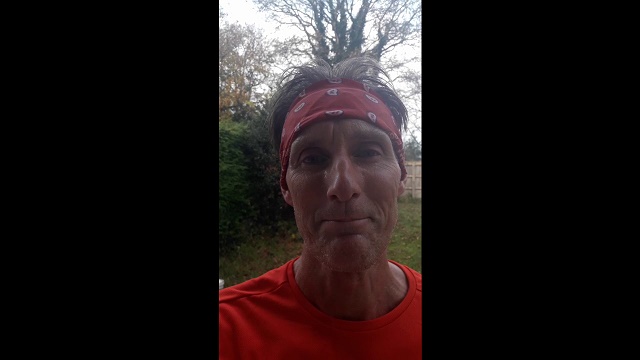
I particularly want to get my bandana off because it gets cold and damp quickly. I want to put it on the hallway radiator but I’m in the wrong part of the house and I’m wearing my shoes.
So my shoes need to be taken off (particularly if they’re muddy) but I also want to get my heart-rate monitor off.
I need to take my heart-rate monitor strap off but … if I wait a few seconds more … it’ll pop up a Heart rate recovery stat indicating how much heart-rate has dropped since I stopped running two minutes ago.
But once I’m thinking about my heart-rate and watch, I want to look at the splits from my run. I barely glance at the watch while I’m running, so arriving home is the first opportunity to get a good look at the numbers and … feel pleased or start rationalising.
I want a cup of tea. This one’s easily solved by flicking on the kettle. Unless of course, I forgot to fill it before going out and then I’m going to have to step across the kitchen in wet shoes.
Now drips of sweat are beginning to form. Previously they’ve been evaporating as I run, now I’m stationary they’re building up on me. I need to get to the towel I’ve left in the dining room but to get there I need to have taken off my shoes. Sometimes I’m still aching from the run and don’t feel ready or able to bend down and unlace my shoes. I got out of the habit of kicking my shoes off when I was about twelve. This is the downside of becoming responsible, growing up and doing things properly.
And then there’s nutrition. I should be eating something in the first few minutes after I arrive home, shouldn’t I? The first hour is the best time to reload the carbs and nutrients into the muscles. Miss that window and it impacts future workouts.
How did life get so complex? This is nothing like it used to be. Finish playing football, shake hands with the opposition then straight to the changing rooms to shower in the sports centre. Stick the sweaty kit in the backpack – maybe leave it there overnight by accident. Shower, change, walk back to the office and start sweating again. Pop to the shop and buy a bottle of Lucozade and a couple of packs of crisps to go with my sandwiches. Get back on with work.
My downstairs tasks are done. I need to get upstairs, get the sweaty kit off.
Take the heart-rate strap and put it in the bathroom sink for a quick soak. Maybe put the bandana in there too. While the sink is filling with water, I’ve just time to open up my laptop to leave my watch uploading to Garmin. Maybe also time to get the soggiest kit off.
But I also need to make sure I remember about the heart-rate strap. One afternoon, I came upstairs after sitting in the sun for hours and heard a curious noise. I couldn’t place it, it was unfamiliar. Walking into the bathroom, I discovered to my horror the tap on and the sink was full. Fortunately I’d left it filling slowly enough that the water was trickling out of the basin overflow. Phew!
The Critical Path Analysis skills from my project management days have me flitting from one task to the next. Many is the occasion when I’ve done an upstairs task and gone down to the kitchen to find a teabag stewing in the cup. In the 1-2 minute window between filling the cup and waiting for the teabag to brew, I’d thought there was enough time to ‘pop upstairs’ and do something else. But then a variation of Doorway Effect kicked in and, once elsewhere, I’d forgotten the teabag was steeping.
It’s still too soon to shower or wash if I’m sweating. Got to wait for the body to cool down and get back to a calm level. So much for the warmdown jog at the end of my run.
So while I wait, maybe I’ve got time to write some notes on my Garmin upload. Copy them to Strava – think of what to say about the session, make separate notes in my spreadsheet and training log. And that’s before I get out around to any kind of analysis or comparison to previous sessions.
Once I’ve logged into Garmin and Strava I’ll want to see how everybody else’s runs have gone, so there’s another time sink. Maybe I should nip downstairs first and get that cup of tea, grab a banana or bagel to put some immediate nutrition in. I might even risk putting on lunch but must remember to set the timer so there’s no chance of it boiling over while I’m upstairs.
If shoes are wet they need to be stuffed with newspaper and put by the radiator. That’s a job I can do while I wait for the second teabag in my fresh cup of tea to brew. All of this with no stretching or foam rolling in sight! That’s one thing never making my list.
Finally most of the jobs are done. I’ve got my cuppa, I’ve munched on a snack and it’s time to wash or shower and get some clean clothes on.
A few days ago I found a way to make it all seem easier. I stood outside my house when I arrived home. I didn’t go straight into the house but instead took a minute or two to look around and enjoy the quiet. I was able to take my headband off. Wait for the watch to ping up its recovery stat thing, take a look at the splits from my run and generally recompose myself before getting indoors. The extra minutes made all the difference and had eliminated some of the tasks I’d taken to fretting over.
It was like the days when I played football, volleyball or any other sport. We used to shake hands, walk off the pitch in a wearisome way and amble back to the changing rooms. Sometimes we would even stretch before we left the arena. But it was always much less hurried. Deliberately so.
Just don’t ask me about the days when I come home desperate for the toilet!
I’m a big believer you can train in all weathers. There’s only one thing that stops me and that’s ice, mainly because it’s too easy to get injured but anything else I’m willing to get out there. My resolve has been tested recently with a bitterly cold wind and driving rain alternating for what seems like the past month. But I suspect my body is trying to convince me to have a little break. I certainly don’t recall it being as tough this time last year.
I remember in the first winter after setting up Poole parkrun, I got in the car and its temperature gauge said -6C, or it may even have been -10. Whatever it was, by the time I arrived at the park it had risen to -2 degrees but with no wind it was a calm, still day. Not even a breeze. Wrapped up warm with thick leggings, long sleeve running top, t-shirt over it, plus obligatory hat and gloves it was a surprisingly pleasant morning run. The lack of wind chill made all the difference.
All layered up for a cold morning
At the other extreme I suffered heatstroke one summer. Or at least that’s my self-diagnosis of what happened. I’d planned a ten mile run at the beach on the prom – five miles out, five miles back. The outward leg went well but what I didn’t realise was the breeze on my back was pushing me along. It was intended as an easy-paced run and I found myself ticking along nicely at 7:45/mile but when I turned around the breeze hit me. I immediately began to find running harder. It was the height of summer so it shouldn’t have been a surprise but I’d done the same run the day before without incident. By seven miles I was slowing to nine minute miles and stopped to stand in the shade of a beach hut. Hands on knees, head down, not feeling great and my heart-rate only recovered to 115bpm – a good thirty or forty beats higher than I’d expect. I tried running the eighth mile and could barely struggle along at ten minute mile pace so eventually decided it would be safest walking the last two miles back to the car.
I’ve run in heat before without issue but the temperature registered as 26C which is higher than I’m used to. Normally I avoid running in the heat of the day, I either go early morning or in the evening. There’s no point running at the beach on a sunny day, I’ve tried it and you encounter walkers, the pushchair mafia three or four abreast, dogs on leads, as well as other exercisers running, cycling or roller-blading. It’s too crowded to have an enjoyable session and impossible to do a workout on target.
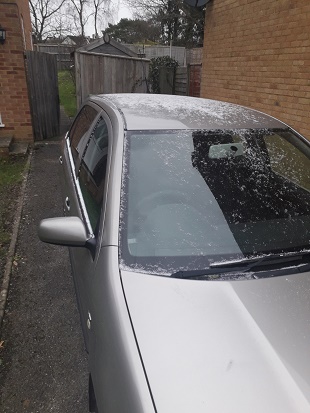
Running in snow is fine when you’re the first one out there. Sound is dampened, all is quiet and it feels fantastic. But Poole has its own microclimate so snow is a rare thing. In a lifetime of living here I can remember decent snowfalls in only six or seven winters. Most times it’s melted away within a day. I don’t think I saw a decent snowfall from 1993 to 2008; it’s that rare around here. This year the news outlets warned of the second coming of the Beast from the East hitting large parts of the country – the picture below shows the snowfall that hit us. So my snow running experience is limited and certainly never been tried in knee deep drifts.
Typical Bournemouth snowfall!
We did have two days of snowfall in March 2018 although it was barely a foot deep. The first morning was a Saturday so I ran to Poole parkrun and was highly disappointed to find it was called off even though there’d been no notice on the website when I checked at 8am. The great thing about the first day of snow is everything shuts down and no-one else goes out other than to sled, build snowmen or throw snowballs. The fresh snow is easy to run on and the council is good at getting the main roads gritted and cleared. Without traffic, the roads become the perfect track for running on. But the good times rarely last and by the second evening of our snowfall, everything was melting, turning slushy and the pavements packing down, turning to ice. Unfortunately I came a cropper only a few hundred metres from home after running five miles in the morning and five in the evening. I lost my footing and went straight down spread-eagled. I believe that may have been the cause of a groin injury that came on over the next month but I’m not sure as I was running big mileage during that period.
Rain is never fun to run in unless it’s warm rain on a hot summer’s day but that’s pretty rare. Most rain really isn’t that bad to run in. If you look out the window and it’s absolutely pelting down, just wait and it eases off within ten minutes. When it’s not pelting down, it looks worse than the reality of being out in it. Often I’ve looked out pessimistically at a rainy day before stepping out of the backdoor to find it’s not torrid at all.
A few years ago the big man-up phrase was “Skin is waterproof”, but my logic is slightly different – you’re going to get sweaty and shower when you get home so getting wet first doesn’t make much difference. Some like to wrap up with layers and rain jackets to keep from getting too wet. I take the opposite approach – the less wet kit there is clinging and weighing me down, the more enjoyable it stays. It’s easy for wet kit to become cold, uncomfortable kit. On arriving home a pair of shorts and a t-shirt can be thrown on the radiator, and it doesn’t take long to towel off dry.
I remember getting stoned one lunchtime along Baiter Park. I’d started off in bright sunshine in Poole Park but as I came round onto Whitecliff Park ominous black clouds were forming and then the rain came. My biggest concern was getting caught by lightning as I’d have nowhere to hide. But while it never struck, hail did. It only lasted five minutes but it was painful. Stinging with every hit, the wind blowing me back and the rain soaking me through. I found myself running bent over, head turned down to protect my eyes from getting haildashed. It was an occasion when I considered quitting the run but some part of me wouldn’t quit. Anyway what was I going to do? I’d still have had to get back to the car, so I might as well run back. Then just like that, the hail stopped, the rain ended and the clouds parted so I was back to blue skies and sunshine.
Windy days are my least enjoyable. At 6’2” with equivalent reach I bear the brunt of a headwind in a way smaller people will never understand. There’s too much surface area creating drag which in turn slows the pace to a crawl. But it’s the wind on cold days where the wind chill ramps up that have begun to do for me. Leaving the house with leggings, long sleeve top, gloves, hat, even a buff to try and cover up every piece of skin I’m like an Arctic explorer fearing frostbite if any part is left exposed. Captain Oates springs to mind on these days “I am just going outside and may be some time.”
I suffer with cold hands and feet, always have. I’ve even run with two pairs of gloves in the past and had my hands go numb. Feet going numb is something weird I’ve experienced on a few occasions, it’s very disconcerting not being able to feel how your foot is striking the ground. Generally I warm up once the blood gets pumping but if I forget gloves I’m in trouble. One September, I misjudged an unseasonably cold morning. An hour into my long run I’d lost half the feeling in my right hand. Two fingers, a thumb and most of the palm were numb. Returning home I could barely hold the door key and certainly didn’t have the dexterity to unlock it. I had to employ a two-handed, childlike manoeuvre with my palms pressed either side of the key to create enough pressure to turn it. Having gone through the pain of hands getting cold, I then had to endure the pain of them warming back up, tingling as the blood flowed into the constricted veins.
I recently ran at the beach during the cold spell. The wind was 20+ mph and the chill had it feeling like -4C. Sand was whipping across the prom, a danger of getting it in the eyes, and I only managed a mile before turning round. It was meant to be a recovery run so my legs weren’t at their best as it was. By the time I got back to the car, the tips of my fingers were numb, even in gloves, and the layers of clothing weren’t enough to stop me shivering sat back in the car. It reminded me of the Saturday morning two days before my run streak reached a year when it was a howling storm and pitch dark. So close to the goal I had to run but went out in shorts, t-shirt and no gloves; arriving home I was chilled to the bone. I stripped off my wet clothes, put on my dressing gown and went back to bed where it took over half an hour to warm back up.
I never used to be a big reader of weather forecasts. After all if you’ve planned to do something, you can’t control the weather, just get out there and do it. However in recent times, I’ve begun to look at what the weather will be like during the day to see if there’s a best time to run. Should I get out early at 10am, wait until midday or even the evening? Is the wind picking up or dying down as the day goes on, are the chances of rain increasing or decreasing? What is never in question is whether I’ll do a session. I don’t look at the weather forecast and use it to talk myself out of running. I only look at it to see when the best time to run might be. That’s been more applicable with pandemic lockdowns, but once we return to normal and life regains its own schedule the runs will have to be slotted in wherever the rest of life dictates. It’s just a case of making sure I wear the right kit for the conditions.
I was standing on an empty street. A grey January day but not cold. I’d run here from home. The plan said a 15-min warmup and that’s what I’d done. Just shy of two miles beginning with a jog until my breathing settled in, gradually picking up the pace with some downhill running that had got as quick as I was going to need for my first effort.
So now I wandered up and down the street. A minute to the lamp-post eighty metres away then a minute back. Two minutes wouldn’t be long enough to clear any lactate built up during warm-up. I decided to do another trip to the lamp-post and back.
As I reached the lamp-post, I now cued myself into what I was about to do. Six hundred metres at 6:18/mile pace, anywhere from 6:15 to 6:20 would be good enough. Jog the recovery then a five hundred metre effort at the same 6:18 pace with another jog to recover. Then it would get interesting. Four hundred metres followed by three efforts of three hundred metres all at a faster pace – 5:50/mile. Could I do these? I’d struggled to hit pace last Thursday on similar efforts over only two hundred metres. I’d run strides on Tuesday less than 48 hours earlier, did I overdo it? Would my legs be fresh enough to hit target? I needed to go out on the six hundred at the correct pace or risk jeopardising the later intervals. My mind whirred. Not overly anxious but enough thoughts to start getting on my nerves.
I called a halt to it. “Let’s see how it goes” I said to myself and instantly all the thoughts were gone. I was back in the present, walking the street on a grey January day. If I failed to hit target then so be it. I’d have some decisions to make about whether to adjust the plan or just put it down to fatigue from previous sessions. If I hit target it would be great as I’m on schedule. “But let’s just see how it goes” I told myself. The unsaid follow-on being “then figure out what to do once I’ve got concrete information to work with. Let’s work with reality not a bunch of needless fears and anxieties swirling around”.
I went through a phase a few years where I got very Zen about life. I was able to simply say “It’s all just information. Whatever happens today is information about what to do next”. No longer did I interpret events or add my own narrative to them; I simply saw them for what they were and it was impossible to rile me up. The simple truth is no-one can make good decisions when they’re riled up. They might luck into a good decision while making a panic choice but more often than not, fear and anxiety lead to the wrong decisions. People play it safe to avoid their worst fears coming true.
“It’s all just information. Whatever happens today is information about what to do next.”
In my update on 800m training, I wrote about how I sometimes felt nervous, or low-level anxiety going into a session. This doesn’t relate to the pain of what’s about to occur, only whether I’m going to hit the targets I’ve set. For someone else maybe it would be a fear of the pain or breathlessness.
How do I get round this? It’s simple and effective. I stop worrying about those targets or goals, and say “Let’s see how it goes”. Doing that immediately brings me back into the present. All fear and anxiety comes from the past or the future, the present is the only moment where you can take action and make a difference.
Does this mean I don’t plan for the future? Not at all. But what I don’t do is emotionally engage with it. The moment you start worrying about what’s going to happen is when you have to recognise you’ve become distracted and refocus back to now. Once calm you can go back to planning. The better you get at this refocusing, the more it becomes second-nature.
Mindfulness was a big watchword a couple of years ago and what is it? It’s about becoming present in the moment. It’s a variation on meditation which is also about focusing on what is happening now. Next time you go to a race and start feeling nervous about whether you can win (or whether you’ll be last), bring yourself back to the present moment. In a calmer moment begin to explore why it would an issue not to win, or to be last. What would that mean to you? What consequences do you imagine may occur because of it? Uncover the underlying fear and then dissolve it by sitting with it. Commit to facing up to it.
There’s one period of my life where I remember experiencing extreme levels of anxious thinking. It was when I was twenty and my fear of not being able to handle an upcoming situation would begin a domino stream of consciousness with one thought leading to the next. The trigger could be any sort of thing. Maybe my manager had arranged a meeting with me the next day but not said what it was about. Maybe I’d be invited to a party, accepting because I didn’t know how to decline, now worried my social skills would be lacking. Maybe it was about taking something back to a shop.
Night time was often when those thoughts came because I kept myself too busy the rest of the day to address them. But in the dark, quiet of my room, the express train of thoughts would depart, setting off down the tracks at high speed. With the party or returning something to a shop I could stop it by making a negative decision – simply decide not to turn up or keep the defective item. Anxiety derailed by avoiding the situation; that was my go-to strategy, ultimately to my detriment.
But there was no way I could avoid a meeting with my manager so I’d start going through all the possible things I’d done at work recently. I’d explore and examine each situation, I’d come up with excuses or reasons about why I’d done what I’d done. I’d imagine the response I’d get and how I could counter it. Fatigued, eventually my mind tired of the “This happens … what do I do next?” game of Twenty Questions and I’d fall asleep. I had no idea how to stop this whirlwind of thinking other than by avoidance wherever possible. But the one thing I came to realise about facing up to the unavoidable was that, despite all the scenarios I thought up, none of them ever came to pass. Never. Not once. When the actual time came to confront whatever I was scared of, it always played out in a way I’d never imagined.
I’ve read countless testimonials from runners who wouldn’t go to parkrun (“I’ll be at the back”), or join a running club (“club runners are snobby”), or even just go for a run (“people will be looking at me”). Yet when they did these things, they found it was a completely different story. Parkrun was friendly and welcoming, the running club wasn’t elitist and running round their neighbourhood didn’t raise eyebrows. All the imagined consequences never came to pass. It’s exactly what I used to experience and they follow the same self-defeating pattern I did. They get involved in their ego’s perception of how it will play out and when that becomes too much, they go with an avoidance strategy (not going to parkrun, not joining the running club, not going for a run) to stop the anxious thinking. But in the process their life becomes one size smaller as they close down an option that could open up so many possibilities.
Like I said back at the beginning I now realise there’s a better way. It’s to stop trying to predict the future and to live in this moment. When the future finally arrives, I deal with it based on whatever shows up. It makes everything so much easier. When the anxious thinking kicks in, nip it in the bud as early as possible by committing to let the future unfold and see what happens.
“Let the future unfold and let’s see what happens”
Have you heard of Ian Stewart? It’s a popular Scottish name and I used to work with one but I’m asking about the runner who was one of Britain’s talents in the 1970s claiming a bronze medal in the 5,000m at the Munich Olympics. Athletics Weekly recently ran this article detailing his top 30 races.
What struck me was this quote: “First’s first and second is nowhere as far as I’m concerned. This country’s full of good losers. It’s bloody good winners we want.” It brings to mind famous quotes by Liverpool’s Bill Shankly “Some people think football is a matter of life and death. I assure you, it’s much more serious than that” or the misquote of Vince Lombardi, head coach of the Green Bay Packers, with “Winning isn’t everything, it’s the only thing”.
It’s an attitude that was prevalent as I was growing up in the 1970s and 80s, even into the early 2000s but one you rarely hear uttered these days. Maybe it’s because we’ve been spoiled with success in athletics, swimming, cycling, rowing, tennis in recent years; whereas for many years championships or medals were rare.
Through my early twenties I fell firmly into Stewart’s camp believing only in the importance of winning and the pointlessness of placing. I first began to understand this could be wrong while watching the Atlanta Olympics where Britain only won one gold medal. “Being a good loser” was never more apparent than in the men’s 400 metres when Roger Black trailed in behind Michael Johnson. Whatever Black did that day he was never going to beat Johnson, the world record holder at 200m and 400m, unless injury or disqualification occurred. Roger Black did the best he could and made sure he won the silver medal. I’m sure he would have preferred gold but there was no disgrace in getting silver that day.
It’s incisive to ask “If winning means so much why not find situations where it’s guaranteed?”. Try racing your 8-year-old and see how important the win is then. On the other hand, try letting your 8-year-old win easily and they’ll be quick to say “You weren’t trying”. Against a mismatched opponent, it becomes obvious winning means nothing to all but the hyper-competitive. You will see people who go looking for guaranteed wins – witness the segment hunters on Strava or those who enter races with small fields or where the winning time was slow last year.
On the only occasion (so far) where I’ve been crowned “First Finisher” at parkrun, I recorded the slowest winning time of the 200+ occasions Moors Valley parkrun has been run. The best club runners were tucked up in bed on a day forecast to have 50mph winds, resting up for a Dorset Road Race League race the next day. But I never turned up that day looking to win, my intention had been to go for a recovery run!
While it was nice to be first, the week before Andy was fastest, the week after it was Tracy. Meanwhile there were another thousand people around the world who were fastest at their respective parkruns. My success was short-lived but for six years, Mo Farah was the undisputed champion at the Olympics and World Championships over both 5,000 and 10,000 metres but eventually someone surpassed him. Being undisputed champion of anything for a period of time elevates you but eventually it comes to an end and then what? You can either move on to pastures new or try to live off a legacy of the past.
For the rest of us, the truth is there’s always someone who’s better and someone who’s worse. Only one person can rise like Mo Farah, Usain Bolt or Eliud Kipchoge to say they’re the best in the world. Yet when you bring the three of them together, each has to accept they’re only the best in their respective events. Bolt is the best sprinter, Farah the best distance track runner and Kipchoge the best at the marathon. Being the best is event specific.
When I last watched BBC Sports Personality of the Year, a decade or so ago, they went through a list of Britain’s world champions which quickly became a list of sports you barely knew existed. A quick search pulls up a similar list from 2001 which The Guardian created. While I remember triple jumper Jonathan Edwards, rowers Cracknell and Pinsent, snooker’s Ronnie O’Sullivan and boxing’s Lennox Lewis; can anyone outside of the sports name our former world champions in waterskiing, billiards, real tennis or canoeing? This isn’t to diminish the efforts of the athletes in minor sports, only to point out how limited winning success is in its scope and recognition.
Could winning represent something deeper than simply coming first? I suspect many believe winning brings some kind of Midas touch. That it’ll turn them into a good person, bring them friends, a beautiful spouse, maybe make their lives easier by giving them power and influence, or even like King Midas bring them riches. While that may be true for Bolt and Farah, the effects of winning below the elite level quickly diminish. Whatever you might believe, the idea of outer success signifying some kind of inner worth is flawed. Many champions are still unhappy even while they’re winning. Their struggles show up time and time again, more so after they retire from competition. Winning hasn’t transformed them into happier or more secure people.
What I’m hopefully getting across is the idea that winning, in and of itself, is almost worthless. Firstly because in any race there’s only one winner and if you’re up against a vastly superior opponent you’re a guaranteed loser. Secondly winning is transitory – someone always replaces the current champion. Thirdly even if you win in your local talent pool there are others further afield who will be better. Finally because you’ve only won a specialised, measurable event; you’re one champion among many. How ever much BBC Sports Personality of the Year may want to single out someone as the champion of champions, genuinely ranking all the contenders across a spectrum of sports and athleticism is an impossible task.
If winning is worthless and, according to Ian Stewart, so is coming second then what is the point of competing?
I believe the answer lies in something we’ve all heard many times from school onwards. It’s the cliché of “doing your best” or more accurately “getting the best out of yourself”. Listening to Chris Hoy, Britain’s much decorated track-cyclist, commentate during the last Olympics, he told how he set challenging process goals for his training, recovery and all the other things involved in getting him to the start-line of races. If he could honestly say he’d ticked the box on those goals before the race started then he would be satisfied with the outcome whether it was gold, silver, bronze or whatever. He set himself challenging training targets to put himself in position to perform at his best on the day. If someone else then turned up who was fitter or stronger, he could accept it without any form of regret. While he never said it, probably because it never happened, if he hadn’t ticked the box on those process goals then he didn’t deserve to win but wouldn’t have complained if he did.
Compare that to the average runner who goes to the pub for birthday drinks when their schedule needed them to have an early night, or the runner who misses a couple of sessions in the depths of January because it’s cold or raining. Think about how these runners then rationalise and excuse themselves but also get upset when beaten over the line or missing a PB by seconds. Hoy had no need for excuses or rationalisations because he knew he’d given his best from start to finish.
This is where the desire to compete and win takes you. While you may begin with a level of natural talent that allows you to coast past your initial opponents eventually the competition becomes tough. At that point you make a choice – accept what you’ve achieved, or dig in and try for more. If you opt for the latter then you train harder, train more frequently, train more intensely. Taking the challenge to compete at higher standards will take you out of your comfort zone as you begin to try new things and look for alternative methods in your quest for success. Sometimes there’s a shortcut like buying better equipment – the new running shoes that promise to make you 4% faster. Sometimes innovation is good, sometimes it verges on breaking the spirit of the rules.
For some, winning becomes so all-consuming they take desperate measures. They break the rules – either through foul play during competition or behind the scenes like taking banned substances. Sometimes others push them into these situations like the state-sponsored doping of East Germany or the pressure exerted in sports where doping’s considered the norm. The choice to stay honest and drop out is a tough one when you’ve already invested so much of your life into something you love doing and which provides a livelihood.
Ultimately winning is being the best at a particular thing at a specific moment in time. That’s all. Nothing more. It only means something if it takes you to the next level, to new competition, gets you to push yourself harder and try new things; or comes as a result of them.
Returning to Lombardi’s quote, which as I say is often misquoted, what he actually said is “Winning is not everything, but making the effort to win is”. It’s a very different emphasis and one I’ve come to agree with.
“Winning is not everything, but making the effort to win is” – Vince Lombardi
“Who is the only neurologist who will still be remembered one hundred years from now?”
In his 1996 book “Why Michael Couldn’t Hit”, Harold L Klawans states he often asked a sports trivia question to spark up discussion in what otherwise promised to be uninspiring lectures. Klawans was the professor of neurology and pharmacology at Rush Medical College in Chicago and his book discussed sports topics such as why basketball’s Michael Jordan failed to be successful at baseball; why Muhammad Ali was one of the few boxers to contract Parkinson’s Disease among his peers and how conditions like acromegaly, Tourette’s and ALS affected other sports stars.
The answer to his question is a trick one – it’s Sir Roger Bannister who will most certainly be remembered for many years to come, not specifically for his career in neurology, but for becoming the first man to break the four-minute mile barrier. Sadly he died in 2018, aged 88 after a long and successful life in both sport and medicine.
When Bannister ran the first sub-4 minute mile in May 1954, it was based on a low-volume, high intensity approach. In 1949 he’d run 4:11; in 1950 it was 4:09.9; in 1951 it was 4:07.8; while in 1952 he only raced the mile once as he focused on the Olympics in Helsinki where he finished 4th in the 1,500m. In 1953 he ran 4:02 and would certainly have broken the 4-min barrier under modern conditions. The tracks in those days were cinder and runners’ spikes accumulated the ash as a race went on, costing one second per lap.
Bannister’s training schedule during the winter months reached a maximum of twenty-eight miles per week but, when he was training hardest in the spring, prior to the sub-4 he was down to as little as fifteen miles per week. His sessions never exceeded 48-minutes and many were fitted into the lunch hour during his medical studies.
Once out of winter training, two of his key sessions were as follows:
Run 3 x 1½ miles at 4:50/mile pace which would have equated to 7-minutes of running at Threshold pace.
Hard intervals of 10 x 440yd in 1min06 with a 440yd jog recovery in two minutes. Twenty laps of the track taking half an hour and totalling five miles of training. Bannister stated there was no warm-up or cooldown. This training started in the October of 1953 and the time for the ten efforts was reduced by a second each month so that by the time of the record-setting mile he was running them in sub-60, sometimes as quick as 56 seconds.
So, this all leads to the question, if Bannister was able to train this successfully with intervals why don’t more runners train like this? I believe there are two reasons.
Firstly it’s my opinion that Bannister had decent levels of natural endurance due to his genetics. He was 6’2” and weighed 11-stone. Compare this to Britain’s 400m record holder Iwan Thomas who is as tall yet weighs 2½-stone heavier. That extra muscle is a suggestion of larger, fast-twitch muscle fibres that lack endurance. Even though we consider Bannister fast, he doesn’t have the blazing speed of Thomas whose record is under 45 seconds. Another indication of Bannister’s natural endurance is his ability to do these sessions without warmups. It’s something only a natural could do.
Secondly Bannister was exclusively a middle distance runner in the 800m / 1,500m / mile events. His five mile training sessions were the longest runs he did. Most of the runners I meet are interested in parkruns and longer. Even a parkrun is over three miles long and therefore requires significantly more endurance than a four minute run.
This is the real meat of this story. The problem with low-volume training is it doesn’t stretch the demands of the race for most runners. Even though Bannister was training low-volume he was still doing 15-30x as much training each week as his mile race. Each session was 5x as long as he was racing. Obviously the longer your race, the harder it becomes to scale up like this (a marathon runner would have to run the impossible 400 miles each week to train 15x their race distance) but more miles is generally beneficial to improving endurance for your distance races. Now compare this to the average runner entering 10K races who are running twenty miles per week and barely doing 3x the distance. As I wrote in the How to Improve series, successful training requires runners to get out there frequently to build up a base of miles.
BONUS STORY – Klawans’ book also tells the story of Wilma Rudolph who was the Olympic champion in Rome 1960 in the 100m, 200m and 4x100m relay events. She was the fastest woman in the world and yet had suffered from polio as child. This entailed walking with a heavy leg brace for much of her childhood and intensive physiotherapy, massage and heat treatments for four years up to the age of ten. Once the polio had gone and her body had regrown the nerves, which can take one to two years for the muscles of the feet, she went onto become a basketball and track star.
Given our current circumstances with Covid-19, I found it thought-provoking to read how polio is also caused by a virus. Klawans states “When I was growing up it seemed as if one day you could be playing baseball with your friends and the next day you could be paralysed for life. In Chicago, every summer, you had to stay away from crowds, especially the crowds at the beach. Otherwise polio might get you.”
He explains polio existed from the time of the Egyptians but in those days was endemic, by which we mean it was always around. It was present in the water supply because there was no separation of faecal waste from drinking water. With people being exposed to the virus early on they built a resistance to it without ever knowing they’d had it. However once sanitation became the norm, it became an epidemic because people no longer grew up being exposed to it and gaining the immunity it would have brought. Of course, this is not to rally against sanitation, only to highlight how herd immunity was the endemic route to avoiding polio while the development of a vaccine was the thing that eventually wiped out the polio virus and its associated epidemics.
With 2020 now done and dusted, it’s an understatement to say it was a difficult year for everybody. From a running perspective, the lack of races, parkruns and even club sessions left many runners questioning why they run. Personally I run because I enjoy it, the races and parkruns are side attractions where I like to test my mettle. While my year started with a rebuild of my fitness, it ended with me having run every day, failing to get faster over 5K and heading in a new direction with 800m training.
The rebuild of fitness began after I suffered a four day illness in late November 2019. It was probably a standard winter flu virus although it’s tempting to claim it was an early version of Covid-19 but realistically the timing is wrong even though some of the symptoms, like loss of taste, were the same. Anyway whatever it was, this all took place the week before the Christchurch 10K and with my aerobic fitness wiped out, I struggled round to receive the annual reward of a Christmas pudding! After that I focused on the rebuild which I knew would take about six weeks and got out running every day. I attended Christmas Day parkrun at Poole with its record attendance of over 1,300 then went to visit friends and ran Rushmoor and Frimley Lodge parkruns on New Year’s Day. By February, the legs were perking up; I was running ten miles on a Sunday at a good clip and ready to up my training.
It was my intention to run Bournemouth Bay 1/2M at the start of April and take a few days rest going into it. But with the onset of Covid-19, I delayed my entry and we ended up entering lockdown in the last week of March. As leaving the house was limited, I continued to run every day and it was a fantastic time to be out running. The roads were traffic free, almost deserted and I remember running at 10am one morning barely seeing anyone for the first mile. It was eerie and quiet like a scene from “28 Days Later”, the 2002 film where the protagonist awakes from a coma to find London deserted. But then, if you’ve seen “28 Days Later”, you’ll know 2020 wasn’t far off a real life version of it.
By the end of March I’d been running for 115 days straight and there was no sign of stopping. I decided that with lockdown in place, no races in sight and uncertainty about when the world would be back to normal, this would be my chance to create the longest run streak of my lifetime. And I mean lifetime. All being well, I’ve got a few decades ahead but I always take rest days before and often after races. If I’m still running in my 70s and 80s, I’ll still be entering races. I don’t usually go more than three months without a race.
Streakwise I’d already surpassed my previous best of 76 days so the question was how long could this one go? I figured if I reached September I’d try to see out the whole of 2020. But that was still a long way off so I focused on now.
My standard running year is to build stamina in the winter then work on speed for 5K and 10K races in the summer. There weren’t going to be any of those coming up but I pressed on with the plan hoping, as we all did, that racing and parkrun would be back in a few months. I’d also noticed my vertical jump had dropped over the years. When I played basketball I was able to touch the ring and my jump was about 70cms, now it was 42cms at best and I felt little spring in my legs. This shouldn’t have been a surprise because I hadn’t done any dedicated running speedwork in over three years and it was over a decade since I’d been playing the sports that had built big thigh muscles for jumping. So while everybody else was following Joe Wicks’ classes on Youtube, I started my own fitness regime of hill sprints, skipping, side jumps, step-ups and depth jumps. I also started bounding, like a triple jumper, which was great fun and began to highlight some changes I needed to make to my running action.
I continued to run daily and began 5K training with a time trial at Poole Park benchmarking in at 22:05. I was twenty-five seconds slower than I’d been on New Year’s Day. My fastest kilometre had only been 4:14 and I found myself struggling to even hit 4:30 towards the end. But a benchmark is there to find out where you’re starting from and over the next six weeks I ran kilometre intervals twice per week and saw my speed pick up to reach a best time of 3:50. A second time trial at the beginning of July came in at 21:32. A 30+ second improvement isn’t to be sneezed at, but I’d also expected better from six weeks of training so there was something missing. What I didn’t immediately realise was that another rebuild was looming.
The day after the second time trial, it was obvious my body had switched over to speed mode rather than the endurance mode needed for distance running. I could feel it in my long runs where I felt like I was running fast, yet each week’s run came in within seconds of the previous weeks’. Nonetheless I thought I could train myself out of it with a more restrained approach to my interval work but I was wrong. By mid-August I had to admit defeat and think about another rebuild. There was another problem. I was struggling with many aches and pains in my ankles and feet, as well as my lower back. This is always a sign I’ve done too much fast running and need to do recovery work.
On top of all this I started a core stability programme in mid-August. I’d always thought my core was reasonably strong. Certainly whenever I planked against other people they’d struggle to hold it for as long as me and I could hold for 1-2 minutes. But I was wondering how on earth the guy who holds the record at over five hours for a plank could manage that. The longest I’d ever managed was three minutes which is a long way off. Researching I came across a statement that once you go over a minute there’s no benefit to planking for longer, and then I discovered the Big3 programme of Stuart McGill which he’d developed from working with spinal rehab patients.
I began doing the Big3 programme nightly but after a week it was too much, too soon so I backed off and let things settle down. A week later, after my Sunday long run, I bent down to untie my shoelace and felt an ache in my side that took two hours to subside. It wasn’t a bad pain just one that indicated I’d been working the core throughout my two hour run. I realised that while I may always have had a strong core, it had never been integrated into my running and was allowing me to twist and turn my shoulders and hips too much. I continued with the core stability and found an additional benefit was my golf swing became more connected.
Going into September the aches and pains in ankles and feet were becoming too much to bear. My streak was intact but I knew I wouldn’t get through four more months of daily running. I had to be honest with myself about this. It was tempting to think I could take it one day at a time but deep down I knew realistically it would be too many days. If this had been mid-November, with a month or so to go, it would have been different but not four months. I didn’t want to give up without trying to fix things before I took a rest day, so I made a deal with myself – I’d give it until October and if there was no respite from the pain by then, I’d end the streak.
Knowing the pains were a sign I was doing too much, I scaled back my daily one hour runs to forty minutes and shortened my Sunday long run to give less training to recover from. Over the first couple of weeks, the pain eased and I found myself sleeping up to nine hours each night. But despite running at over 9min/mile I returned from each run sweating. I knew from the sweat I was overcooked on the speed side. If I was to get out of this hole, I had to drop back and run even slower.
The week beginning September 21st, I dropped back to running at ten minutes per mile. The average pace of that week’s runs were 10:02/mile, 10:05, 9:48, 9:11, 9:27, 9:53, 9:25. It was a big step back when you consider my kilometre intervals had been easily faster than seven minute per mile. The following week wasn’t much faster but I was arriving home barely sweating and the aches and pains soon eased up. It was beginning to feel relaxing.
After three weeks I began to throw in a faster mid-week run at 8:30/mile and then a couple of strides into my Sunday long runs. By mid-November the midweek run was sub-8 pace and the aches and pains that had plagued me just a few months before were forgotten. Easing up the pace had allowed the muscles to recover, switch to building endurance and the pace to pick up. There was still a variance between the pace of all my runs – days of faster running needed to be followed by a day or two of slower but I was sleeping less and the general pace was improving. All the while I continued the core stability programme on Mondays and Thursdays and found my running form was transforming. Less rotation of the shoulders and hips, more glutes driving me forward.
Finally December of this difficult year rolled around. The streak was still on. I’d always had in mind to get to the 8th to achieve a year’s worth of running and that would then leave a few weeks to complete the whole calendar year. With the quiet of lockdown, I’d had time to think about my own running and why I’d struggled to run the sort of times that my training should have brought. Some years ago I half-joked that I would have been better suited to middle-distance running, or even the sprints, and now I decided to test this by trying my hand at 800-metre training.
To start off December I ran a 800m time trial in 2min58. Considering the world record is under 1min42, that’s a long way from being decent but considering I’d done no dedicated speedwork in years I figured this wasn’t terrible. The following week I began running two intervals sessions each week geared towards building speed over shorter distances. Now as we begin 2021, four weeks have been done and so far so good. My general runs are getting faster and I’m loving the interval work. I like the daily jogs but interval work has always been something I enjoyed much more than any distance run. Often what you enjoy doing is an indicator to what you’re best suited.
So that was the rollercoaster of my 2020 running. Three months spent rebuilding fitness. The following months working on strength and speed. Then back to rebuilding. The underlying positive has been one of a gradual improvement in running form through sprints, bounding and core stability work. I’ve wondered whether the need for the second rebuild was down to the revised form, the body discovering a need to rewrite all its motor programmes as lesser-used muscles began to take precedence over those that have turned out to be inefficient and overdeveloped. Could it be I’m like a beginner starting out and building up for the first time?
In the background there’s been the aim to complete a year of running every day. It never started off that way but became a goal as our circumstances change. The streak itself was never there to be a social media boast, it was a bucket list tick off so one day I’d be able to say I did it. But I also wanted to experience it and pass on what I learnt. While the early days of my streak never felt difficult, as the year wore on I began to feel jaded. Even when I reset things in September and lowered both the pace and volume of my running I began to lose my enjoyment of running. Completing the streak began to hang over me like a dark mist. With December’s nights drawing in, shorter days, colder and wetter weather I began to struggle to feel enthusiasm to get out on my runs. The introduction of 800m training added an extra stimulus to recover from and most likely contributed to that mood.
Yet as soon as I had streaked the year, the mist lifted and I felt happier in the knowledge that I didn’t haveto run if I didn’t want to. Where before I’d been thinking ahead, planning each day’s run with an eye on the run that followed, now I’m able to run in the moment. If I overdo things at any time, having a rest day is back on the table as an option. I realise run streaks are a good thing when they support your training but not when they stop you from listening to your body.
A year of running – 365 days with bonus Feb 29th for free
With Christmas past and 2021 around the corner, it’s a time when New Year’s Resolutions are being mulled over and decided upon then invariably they’re broken before January is out. In the sporting world we talk about goal-setting which is the same thing, it just isn’t confined to 1st January.
A typical New Year’s Resolution is to “Get fit”. The SMART acronym has been around long enough that most people know “Get fit” fails to be Specific, Measurable, Achievable, Realistic, Timed. It’s certainly not any SMARTER because it’s not Exciting and probably not Recorded (or wRitten down).
Personally I’m a fan of DUMB goals – these are “Doable, Understandable, Manageable, Believable”. Alternatively they can be “Dreamy, Uplifting, Methodical, Behaviour-driven” or even “Dangerously Unattainable, Monstrously Big” goals.
The difference between SMART and DUMB goals is inspiration. SMART goals are simply a project plan – a typical SMART goal could be to “Run three times every week in 2021”. You’ve specified what you’re going to do, how it’s measured, when it’s done by, it’s realistic and achievable. But oh my, how boring. For sure, you’ll be into that goal for January and even for February but by springtime what’s going to keep you going? Running three times each week has become part of your standard routine. And if you start to miss runs, what’s going to get you going again? The excitement of setting that goal back at New Year is gone, down the road you’ll be looking for new goals to liven up your life.
Now let’s look at the DUMB approach – it looks something like “Run a marathon in under 3 hours” or “Run sub-18 at parkrun” or even “Finish in the top ten of my local 10K race”. Ouch – those are seriously tough goals but they’re also goals which would put you in the upper echelon of runners and bring lots of spoils and glory. (I’m assuming you’re not someone who has run 3hr01, 18:05 or finished 11th! But if you are then start thinking sub-2hr30, sub-15 and winning) For the average person these goals look difficult and that’s the point.
What sort of commitment would you have to make to achieve them? A big one.
How much effort would you have to put in? Lots.
Would you be guaranteed to achieve it? Certainly not.
The uncertainty of success and risk of failure avoids complacency (providing the stick) for achieving something special (the carrot). But notice also these DUMB goals aren’t impossible, I’m not suggesting you try to set a world record or win the Olympics, only that you embark on achieving something special. It’s a special that has to be something you consider special – not something you hope will impress others on social media, at work or at home. It has to be a special that impresses you and would make you happy or glow with pride to achieve. The more personal and special you make it to you, the more driven you‘ll be to complete it.
When you set big goals – you have to commit and work hard. Setting goals that are out of your comfort zone, forces you to get out of your comfort zone. You can’t continue to simply do what you’ve done before. You have to get creative, maybe investigate hiring a coach, following a training plan, joining a running club and getting out on the cold, winter’s nights. But notice that it also means you have to run three times every week to have a chance of achieving it – you’ve automatically integrated what was a SMART goal to help on the journey to achieving the DUMB goal.
I used to say “Plans have to be realistic, dreams don’t”. You allow yourself to dream then create a realistic plan to get you there. Like any journey to a far off place, you keep checking the roadmap to ensure you’re on course. If things are going awry you take stock of where you are, reset your plan and then go onwards again. Of course your dream may be something you know will take many years to achieve but it’ll always be there in the background inspiring you; the thought of achieving it keeps energising you to take action. But you do have to buy-in and commit to it, it’s no use saying “I’d love to run a sub-4 marathon” and forget about it by the next day. That’s unproductive day-dreaming – it’s good to spend some quiet time thinking about what truly matters to you and evaluating how committed you’re really willing and able to be.
“Plans have to be realistic, dreams don’t”
A word of warning though. When you allow yourself to dream big and begin to get excited about what you might achieve, don’t go telling other people about it. If you’re a thirty minute parkrunner, who decides to run a three hour marathon; other people will want to be your voice of realism. All but a few will be quick to point out the flaw in your plan –you can barely run a parkrun at ten minutes per mile, let alone complete a marathon over three minutes per mile quicker. Limit conversations to telling people about your easily achieved SMART stepping stones such as “to go running three times per week” or “to join a running club” because their realism can handle that. Only start to tell other people about your big goals when they’re incredulous about how well you’re progressing and wondering why your parkrun times are tumbling. But even then, exercise caution in who you tell – keep it to people you know who will be supportive rather than crushing.
So dream big, find something that inspires YOU, but also something you’d be proud and excited one day to tell your friends and family you attempted. Ultimately it’s not about whether you achieve the goal, it’s about the journey and process of committing to something meaningful to YOU. When you find a goal that excites YOU, you’ll find yourself feeling alive and vibrant. Once you’ve got that big DUMB goal, figure out the specific, measurable, achievable, realistic, timed steps you can take on your way to achieving it. You’ll find the success or failure of the SMART goals doesn’t matter any longer because they’re simply steps along the way as you try to achieve your something special.




 Big Red Running