Even overnight rain and thunderstorms couldn’t dampen the enthusiasm for the return of parkrun. I was up at 6:15am for breakfast and headed out to Upton House parkrun a couple of hours later. As I parked the car, just a warm-up jog away, I saw familiar faces who I’d parked by so long ago.
Since I was last at the country park it’s undergone some renovations with bushes around the tea rooms being cleared and the children’s play area refurbished. Consequently the parkrunners have been shoved out through the gate to a new start line and the course revised. I quite like the new route as it’s more open although the uphill finish is going to be taxing when I get up to speed.
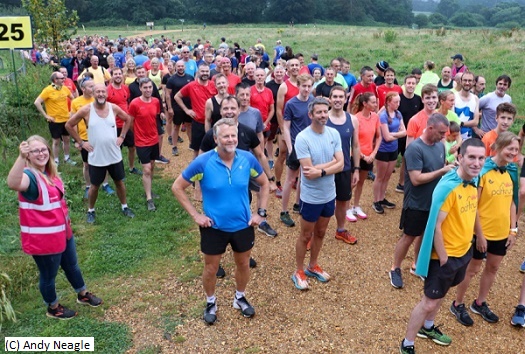
The Run Director struggled through the opening speeches because the PA system’s battery wouldn’t recharge after not being used in eighteen months but unusually all the runners stayed quiet so that was good. New parkrun protocols instruct the pre-start speeches to be over quickly and a prompt start at 9am to avoid runners gathering together too long. I was pleased we still had time to clap the one new First Timer who’d turned up, as well as the four runners who were about to complete their 250th run. Imagine being stuck on two hundred and forty-nine all that time. For me, it was number three hundred and twenty-five – but no t-shirts for that!
It’s like Where’s Wally – I’m somewhere in there with the red headband!
With runners expected to seed themselves according to time, I positioned myself just level with the 25-min marker and it didn’t seem like there were too many ahead of me. I ran with Rob for the first 2K and it was nice to run unhindered, able to pass others easily whenever we needed to. At the start of the mini-loop, I left Rob as I took the brakes off and went with the downhill. Despite a light rain, it was all rather enjoyable and I gradually eased past some of the fast starters; always keeping my breathing easy. First mile 7:56, second 7:40, third in 7:26 to finish 49th in a time of 23:57.
Collecting my finish token there was lots of space past the funnel to go and get my token scanned. I then returned to the finish line, chatted to a friend and cheered runners in. The tailwalker came round in just over an hour to complete the field of 295. Elsewhere Poole had 565 and Bournemouth 529 which were the 3rd and 5th biggest attendances in the country, then add in Blandford 133 for a total of over 1,500 local runners out at 9am on a Saturday morning. A successful return for parkrun and I even had my result before midday. Admittedly it was 11:58am but it’s still impressive.
I’m now six weeks into the second time round with my 800m training. My first go-round, following a Jack Daniel’s plan, lasted from December to May and didn’t provide great results as my 800 time only improved from 2min58 to 2min53. But I knew I was running faster, felt fitter and hoped a second go-around would show better results.
This training block is full of intervals ranging from 200-600m in length. As you’ll see in the stats the vast majority are short with just four 600s planned. Last time I was aiming to run at 48sec/200m but later realised I should have been using 48½ which I could only just scrape on the 400s and 600s.
I’ve been working to 47sec/200m which is the training for a 2:52 800m. Trouble is, I’ve been averaging 43s for 200m, 1:31 for 400m and 2:15 for 600m. It seems like this reflects the discrepancy between my time trials and how I actually felt my fitness had been progressing.
More speed
Last time I tried to be accurate with my interval efforts – not going fast than necessary but always hitting target. This time I’ve thrown caution to the wind and allowed myself to run without holding back. That’s not to say I’ve gone all-out, I haven’t; just not held back.
Target time
On target
Missed
Efforts
Fastest
200m
47s
66
4
70
(14.0km)
37.9s
(5:05/mile)
400m
1min34
24
–
24
(9.6km)
1:26.83
(5:49/mile)
600m
2min21-22
3
–
3
(1.8km)
2:13.78
(5:59/mile)
Total
93
4
97
(25.4km)
Some interval stats for those who love them!
I’ve also introduced 8 strides of 10secs after my Friday morning recovery run. Ideally Jack would have me doing these on two of my recovery days but I didn’t want to undermine my aerobic base too much. Last time around, I didn’t do any; this time I’m doing one set. Next time around, if everything is going well, I’ll introduce the other day.
I suspect it’s (a lack of) this faster running that was holding my 800m time back in the past. I’m beginning to see my fastest pace come down from 5min/miling to 4:30/mile during strides and this may partly be down to the limitations of how quickly my GPS watch can produce an accurate pace.
Injury risk
The bigger danger is pushing too hard may lead to injury and it happened. I suffered a minor hamstring issue in week 5. It was the final 200 of a session that had already totalled 2,800m, and when I’m feeling good as I was, I tend to like to finish strongly; so I pumped my legs as hard as I could but felt a tightening in the right hamstring and it began to knot. I eased off, finished out the effort and jogged home.
I was fortunate to have this happen on the Thursday as it gave me five days to recover before my next set of intervals. I still ran on the days in between and by the Tuesday my legs were feeling great during the warm-up. I eased into the efforts but by the 4th 200 I was getting a sense I might not last. The next 400m I felt some tightening and on the next it was even more notable so I backed out and jogged home. That was last week and I missed the final day of intervals opting to keep runs easy and never push them along. I did a couple of strides on my Sunday long run and that seem to confirm the hammy is ok so I’ll resume training to the plan.
Long runs and mileage
The switch from a block of pure endurance work to repicking up speed work left the legs struggling on the general runs but it didn’t last past the first couple of weeks. But the introduction of the strides also sapped the legs going into the Sunday and so I haven’t seen much progress on their pace, they’re still around the same pace as last time around.
The six weeks of training I’ve done so far have resulted in 41.3, 45.1, 44.7, 45.7, 42.0, 43.8 miles.
Running form
Since April, I’ve been looking at how sprinters run and trying to apply some of their techniques and drills to my own running. The strides have been useful for this and I’ve particularly been focused on minimising hip rotation through better knee lift. I seem to be getting higher cadences on many runs and that’s going to be an important part of getting faster. The higher cadence corresponds with a concomitant rise in my glutes doing the work.
Once again I’ve really enjoyed this block of training. Getting out and running fast is fun especially as I’ve been finding it so easy to hit target. The hamstring injury is frustrating but I’m hoping that with the next phase of training being longer intervals at a slower pace that it’ll survive. I can run on it as long as I don’t overdo the forces going through it.
In the next phase, I’m meant to up my paces for fast efforts by a 1-sec/200m but, given I’ve been finding it so easy, I’m going to compromise by adding 2-secs so that I’ll actually be aiming for 45s per 200 which is what I’ve usually been running them at. This isn’t recommended as you should train at paces that relate to proven times and I haven’t actually run a 2:48 800 that would justify it.
Parkrun is also due to restart at the end of July and I’d like to attend. I’m not going to run hard every week but I’d like to see where I’m after all this training. I feel like I’m close to sub-20 form. It’ll mean dropping a workout, which isn’t ideal when you’re following a plan, but a fast parkrun will still have benefits.
But the priority is keeping the hamstring healthy.
I never thought of myself as a decent runner. I may have mentioned this previously. I certainly never felt I had any natural talent for running. This wasn’t simply a case of low self-esteem or high personal expectations, life fed this back to me in clear, unambiguous terms. When I was at school I was at the back of cross-country. When we did sprints, I was at the back. When I ran around in the playground with friends they were always faster than me. When I went orienteering I was always one of the slowest in my age-category races.
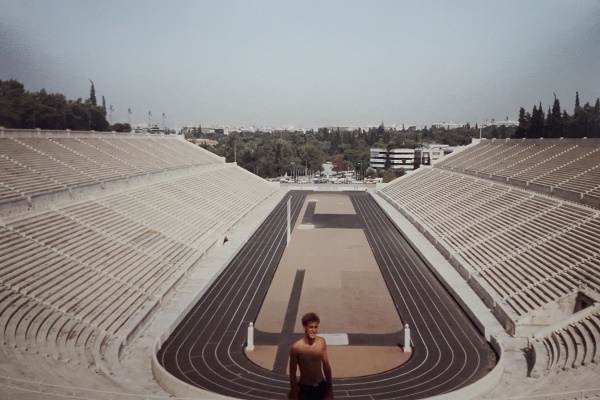
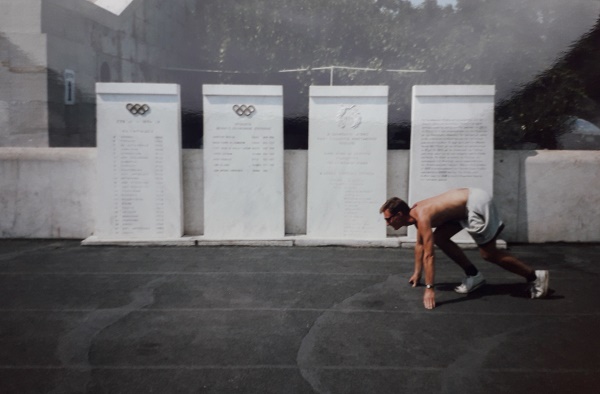
The only time I ever got a hint I might have some ability was when I inter-railed to Greece with my friend, Steve, and we had a sprint race in the original Athens Olympic stadium.
Steve backdropped by the unusually shaped 1896 Olympics stadium
Admittedly I false-started to get a couple of steps lead on him but as the race went on he wasn’t overtaking me and I was holding him off. It might not sound like much except he’d broken our school record for 400m on sports day when we were in Sixth Form, I believe a time of 56 seconds. Our race took place a few years after leaving school and a couple of months before my first ever 10K race.
A young sun-bronzed traveller poses pretending to awaits the gun
October 1992 and if I could remember anything about my first 10K, I’d lovingly regale you with its story. I know it was in Totton, near Southampton, but I’m not even sure where it started or where the course went, only that I took 48-minutes. The race was full of club runners with a few outsiders like myself testing our mettle.
I know these bits because in those simpler, pre-digital times, races used to send out results booklets about a month after the race (as long as you gave them a self-addressed envelope). It contained a list of everyone’s times – often split into male and female races along with team races, course records, past results and it was all very nice laid out. I poured over it to find my name and time, and somewhere past the middle page staples I found, from clear unambiguous feedback, that I wasn’t that good. The fastest people in the field were close to thirty minutes, the slowest just over an hour, so my forty-eight minutes was closer to the back than the front reinforcing the idea I was below average.
It was no different when I ran my first half marathons four years later. I did three in a couple of months and they all came in around 1hr51 – give or take thirty seconds. Wading through the results, I was somewhere down around the 60th percentile. The fastest runners were closing in on 1hr05, the slowest taking 2hr15. Once again I was closer to the back of the field than the front.
My first marathon followed on soon after the halfs and at 4hr23 it was the same back-of-the-pack story. Among my small group of running friends, the talk was always of being good if you could break four hours so clearly I wasn’t. Obviously the sub-3 was vaunted and only for seriously good runners, I remember looking at the London Marathon results of the time printed, over the next five days, in one of the broadsheet newspapers and seeing that only a thousand of the 40,000 strong field had broken three hours. It seemed like a benchmark which only the talented could achieve. It was a pipe dream for a below-average runner like me. I was a long way off the decent times.
Even ten years ago races were still generally organised by clubs. There were more charity runners and non-club runners than before but it was all relatively niche and those latter categories tended to be bucket listers rather than regulars. The majority still belonged to clubs.
By then I’d improved to have run a 1hr38 half and a 3hr41 marathon, both of which began to give me the idea I was better than I realised but I still wasn’t sure of myself. Unfortunately I was mixing with friends who could run sub-3 marathons and break 1hr20 in a half. Nonetheless I began to find myself running paces I’d never thought myself capable of while training with runners who I saw as much better.
My early parkruns were usually placing somewhere in the top 30-40 in a field of 150-200. That’s not bad but it’s not outstanding. But when I got my training together and started going sub-20 each week, I found myself up towards the front and enjoying the open space of few runners around me. There was no longer a need to navigate through the runner traffic and it felt good to be ahead of the pack.
I also discovered RunBritain with its custom handicap system and ranking of your times against the rest of the running population. I began to see my times over 5K, 10K, half marathon were all good enough to rank in the top 10% that year. While I was miles off the times of the elites, it’s obvious top 10% is decent and it gave me a measure of satisfaction, or rather an accurate measure of where I ranked within the running community.
The growth of running during the 2010s took me by surprise. Professional events companies began to organise more of the mass participation races while an influx of Couch25K and parkrunners gve them a market to sell medals to. The composition of modern results looks very different now when compared to what I saw in the nineties.
Half marathons that once had a 2hr30 cut-off now happily extend those numbers out to three hours and beyond. The consequence of this became clear when one of my friends ran the Liverpool Rock ‘n’ Roll half marathon a few years ago. In a field of 7,000 runners she finished in the top half. In fact closer to the 40th percentile. Now, remembering that I used to be down at the 60th percentile with my 1hr51 times, you’d expect she must have been significantly faster than me, wouldn’t you? Except she wasn’t – her time was 2hr07. When I looked deeper into the results of that race, my 1hr51 times of twenty years ago would have put me in the top 15%.
There’s no doubt I improved over the years. But my move up the field was as much about the other people in the field as it was about me. Where my 20-min parkrun in 2011 gave me a RunBritain ranking of 11.4%, when I ran 19:39 six years later it now put me at 4.2%. My time hadn’t improved but the attendance at parkrun had.
Your perception is shaped by reality.
What reality looks like depends on, how much of it ,and how clearly, you can see it.
When only committed runners took part in races, I perceived myself as a poor runner.
When races opened up to the general population, I began to perceive myself as a decent runner.
When parkrun began in Poole the majority were committed runners and my stock dropped again.
When parkrun grew, I once again began to see how far I’d come. Sometimes the evidence of your eyes and senses can fool or mislead you.
This post is the 4th in a series of six. Other posts can be accessed from the Readables menu tab.
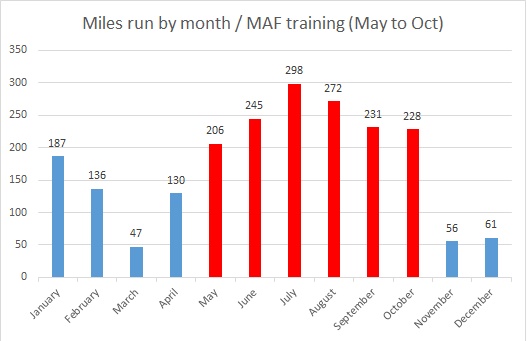
When I tried MAF training I ran for 5+ months, logged 200+ hours of training where only 4½ hours was spent above a heart-rate of 138bpm. This heart-rate was determined using Maffetone’s age-related formula that I can see no scientific basis to explain. I can’t say I got any notable benefit from the training as I could run a 21-min parkrun before I started and, at the end of it I was running 20:39. In the midst of it, I did run 19:52 but regressed after doing some sprints and drills on a coaching course.
The training itself was demoralizingly slow and I was always fearful of the heart-rate monitor beeping at me to slow down because I’d exceeded the maximum heart-rate. I said I’d never train with it again because it was so unenjoyable and because there are better ways to train.
Today I’m going to prove there are better ways to train to get the same benefits.
Six months of non-MAF training
Let’s roll back to November 29th at the end of last year when I ran my standard Sunday long run in 1:39:26. It’s an average pace of 8:31/mile and my heart was pumping away at an average of 148 beats per minute. Six months later, May 30th, I ran it again, a minute slower, but my heart-rate was now only 131bpm. That’s a drop of 17 beats and an indicator I’d improved my aerobic system.
Regular readers will know I’ve spent the intervening six months training for 800m following a plan from one of Jack Daniels’ books. Although I know much about coaching and how to train I’ve never tried middle distance before, so I decided to see how one of the world’s best coaches approaches it and see what I could learn.
As I’ve documented in monthly updates – January, February, March, April – I logged 40-45 miles per week with a mix of easy runs, long runs, intervals and threshold runs. The training got tough in the depths of winter but I got through it. I ran every day and while I got tight at times, I never got ill or injured. By April I was ready to test out my new found fitness and was highly surprised when I only achieved a 3-second improvement!
Nonetheless a few days after a second 800m time trial I ran my long run a minute faster (1:38:38) than in December and was now averaging a heart-rate of 140 – eight beats lower. So I’d done nothing like Maffetone training and improved by his measures.
I suspected the poor time trial results were due to a lack of endurance and embarked on six consecutive weeks of nearly fifty miles through April and May as I documented in my May 800m update. When I ran another 800m time trial it was still about the same at 2:53, a five second improvement over six months ago, but the rest of my running was feeling easier. My easy runs had sped up but more notably I broke 1hr30 on the long run in training. An improvement of ten minutes for a nearly twelve mile run.
What would MAF suggest?
Seven years ago at age forty-two, when I tried my MAF training experiment, I calculated a MAF-HR of 138. But actually, given I was coming off an illness, I should have taken ten beats off and used 128bpm which would have made things even harder and certainly slower.
Being older, Maffetone would suggest I now train to a lower heart-rate than I did last time around. At forty-nine this gives an initial MAF-HR of 131 but I’ve been running daily since late 2019 without issue. According to MAF you need to have trained for two years without issue to be allowed to add a further five beats, but for this comparison I’m going to do it anyway and analyse my recent training against a MAF-HR at 136bpm. This may sound like a cheat but if I used the lower figure, the stats would skew even more against MAF training.
If you’re wondering why I’m calculating my current MAF-HR when I said I was never going to use MAF training again, it’s purely to analyse the recent training I did and show I improved despite not following any of the low heart-rate training that MAF recommends.
Recent training
What follows is a look at my training for the six weeks after my mid-April time trial. There are one or two miles missing where I was coaching or giving a Personal Training session, as well as a couple of days where I didn’t wear my heart-rate monitor but the bulk of the training is shown.
The general format of each week:
Eight mile Steady runs on Tuesdays and Fridays with a ½-mile warm-up / cooldown aiming to run at my threshold.
On Sundays the long run, usually at the crack of dawn, again pushing it along and throwing in some strides along the way.
The other four days of the week I aimed for a forty minute recovery run.
With six consecutive 50-mile weeks, this block of training totalled 300+ miles and 42 hours.
Yet when you break down all this running, twice as much time was spent running in excess of my MAF-HR (136) as below it. (Note: there is a small issue with the software I used to total the Above-Below durations because it double-counts heart-rates of 136-137 into both categories. The actual figures were 28 hours above MAF-HR, 14hr45 below it but only 41hr50 total run time).
You can see in the graph below the length of each run in time and the proportion of it spent above or below MAF-HR. The yellow is the time spent exceeding it and accounts for 65% of running time. Almost every day I was exceeding MAF-HR for some of the run – that can’t be good according to Maffetone.
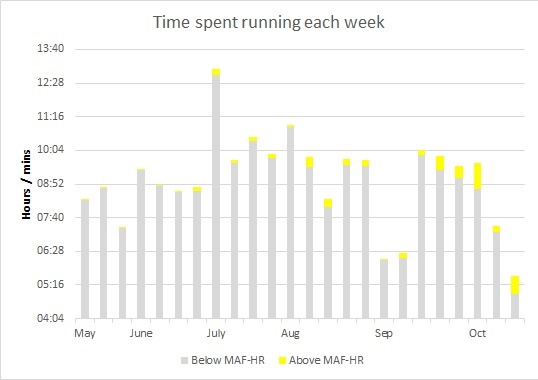
Now take a look at the graph of 2014’s MAF training where I only exceeded the MAF-HR for 2% of the time. You can barely see any yellow in the early weeks and it doesn’t increase a whole lot. In the graph above, I often spent more time above MAF-HR in a single run than I did in a week then.
Graph of MAF weekly MAF training in 2014
It’s not even close. It’s very clear I was constantly breaking the MAF-HR in my recent training and not just by one or two beats as happened back in 2014, but by large margins.
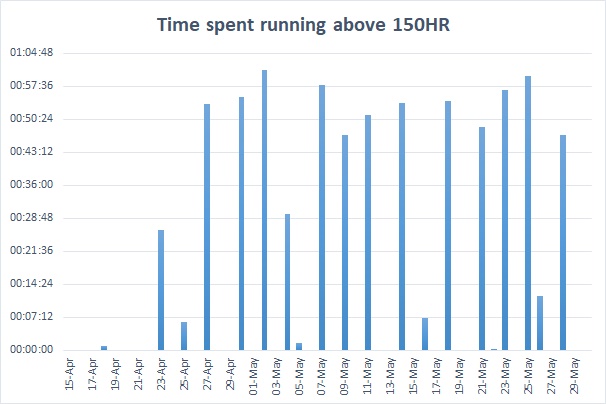
Here’s a graph of the time I spent in excess of 150HR on those runs. You can see I was regularly running for over 45-mins with heart-rates on the Steady and Long runs that were nowhere close to MAF-HR. I was effectively training to the MAF-HR of someone over twenty years younger than me.
Recent training – blue lines showing time spent running at 150+ heart-rate
What’s amazing is I accumulated twelve hours of running at over 150HR which isn’t much less than the nearly fifteen hours I ran below my recommended MAF-HR of 136. Yet somehow I got exceedingly better results than when I trained to MAF-HR in 2014.
Getting faster
Not only was I seeing improved heart-rates, my effort runs were improving too.
The November run was my fastest time on the long run course at 1:39:26 and with the 800m training this had reduced to 1:34:03 by March. On 2nd May I reduced it to 1:32:55 then on May 23rd took it down further to 1:29:15. The average heart-rate on this final run was 149 which is only one beat higher than when I was running it in late November. Then my fastest single mile was ripping along down Gravel Hill at 7:52, by late May I was sub-7 with a 6:58.
On the Steady runs I only have one comparator. Back on November. I ran a local 7 ½ mile course round Merley which took 58min52 at an average pace of 7:54/mile and the fastest mile was 7:33. In mid-May, during a spell of high winds I decided against going to the beach and opted to run the local route in 20mph winds. The run came in two minutes quicker at a pace of 7:38/mile with the fastest mile now at 7:08 along with a couple more showing in at 7:18 and 7:21. At the beach, I’ve begun to see miles in the 7:05-10 range. There’s no doubt I’m speeding up and if I were racing longer distances I’d certainly see better times.
Better ways to train
I’ve loved the past six months of training for all the reasons I hated the MAF training. I got to run fast, sometimes I even got to sprint as fast as I could. I rarely looked at my heart-rate while I was running and I certainly didn’t have the heart-rate monitor beeping at me to slow down. The variety of paces and training sessions kept me interested as well as nervously excited on occasions.
I haven’t cracked the 800m yet but I’m confident training is going in the right direction to get there. I’ve seen improvement and I’m running faster than six months ago with heart-rates at slower speeds being lower. That’s an indication the body is improving its fat-burning capability. I’ve been sleeping deeper, got leaner, faster and remained healthy and injury free which are the sorts of reasons Maffetone puts forward for following his method.
The premise of MAF training is that to improve fat-burning you have to run at low heart-rates and stop eating carbs. I did neither of those. Across six months I regularly hit higher heart-rates and I never restricted my diet or stopped eating carbs – if anything I’ve eaten more during the winter months with two bags of Doritos each week and regular cakes from the bakery. Yet I proved it’s possible to achieve the promised benefits of MAF training despite regularly breaking the heart-rate that it suggests a man of my age should use.
None of this was achieved by sticking to a heart-rate calculated from my age and is why I put no stock in MAF training as a system in itself. I believe there may be applications for it in certain circumstances but not general training.
I’d love to hear people’s comments and questions about this block of training and my MAF training review. All reasonable scepticism or thoughts are welcome!
Somehow, I’ve created a run streak that goes back into the 2010s. Admittedly it’s only just a decade ago as my last rest day was December 7th 2019 but it’s still a streak of over eighteen months. It’s been 5K every day often more.
It sounds impressive to anyone who isn’t a runner.
It sounds impressive to people who are runners.
No-one has asked me about it but I imagine the sort of question I’d get is “How do you motivate yourself to keep getting out there?”. Well, motivation has rarely been something I had to think about. I have running goals and to reach those goals, I have to get out and do the training, but equally I make it manageable so it never becomes a strain.
My seven day week splits into three workouts and four recovery runs. The workouts are the exciting part of the week where I get to do something that’s different, that’s exciting and which I know will progress me towards my goals. How can I not be motivated to go do those?
The recovery runs are more mundane but they’re usually only around forty minutes long. Once you’ve been running consistently for a while it’s the sort of run that seems to be over before it’s started. If I were a less experienced runner, I’d probably only do twenty or thirty minutes until the fitness expanded to make them feel achievable.
But it’s the pace of the recovery runs that makes them, and therefore the streak, achievable. I always keep them very easy. Some of them have been closer to ten minute miles even though I can run much, much quicker. I focus on my breathing from the beginning and never put in any undue effort on the hills. I never try to speed up, I just let my body take me along at the pace it wants to go. Sometimes there are days when I have to stumble through the run because the legs are feeling hollow but, more often than not, it’s a chance to get out, look around and think about life.
It wasn’t always like this. When I trained a decade ago, I pushed myself harder on every run but that then lowered my motivation for getting out there frequently. Your body is good at telling your mind when it’s had enough but, while people hear it, invariably they don’t act compassionately towards themselves. Some days I turned round after a mile because I knew my legs couldn’t handle the run. It’s just not possible for a poorly trained runner to run hard every day and not need the occasional break. I haven’t been taking rest days but that doesn’t mean I have been taking a break.
A decade ago I was simply someone who ran to keep myself active and occupied. The majority of my runs were completed quickly. Under half an hour. Occasionally I’d enter 10K races or half-marathons and put in more training to get ready but when I wasn’t racing, it was mostly short, fast runs.
As an eighteen-year-old, my first attempt to take up running was to go out of the door, run to the bottom of our road and then back as fast as I could. It was a 1½ mile round trip with a long uphill finish which, I think, took me around seventeen minutes. I tried to run every day but contented myself with doing six runs each week and kept up the regime for six weeks until other activities (like drinking, Christmas and training for the local Swimarathon charity event) distracted me.
In his book, Running to the Top, legendary coach Arthur Lydiard states:
“The stranger to jogging or running will follow his medical check by running easily out for, say, five minutes and then turning for home … That five minutes out-and-back routine should occupy a few days to accustom leg and arm and body muscles to the activity. The beginner can then start adding time on his/her feet … When you can do 15 minutes every day, at least every other day, step up to 30 minutes, followed by two days at 15 minutes, another 30, another two 15s and so on.”
Now I’ve paraphrased and left out bits but what I find relevant is that he’s telling people to start out with ten minutes running and to get out doing it almost every day.
In my first job at Chase, when they opened an onsite gym I joined because it was a good deal at £6 per month! Other people recognised that too and its membership quickly grew to the point where they expanded the size of the gym by knocking down a wall and building into the restaurant. During busy periods we were limited for how long we could use the cardio equipment; so my treadmill runs were no further than fifteen minutes. More often than not, it was only as long as I could last running at full pelt. The machine would whir away at 9.5mph, I’d gasp for breath and push myself to hang in there for a nice round ten minutes. My best ever performance was putting the treadmill at full speed and running three miles in 18:10. Those extra ten seconds were spent getting it up to full speed.
Eventually I tried a 10K race which was a big step up and had me going out to do some overdistance training in the lead up but then it was back to short runs. If I was bored at home, with nothing decent to watch on TV, a quick run round the local streets was often a solution and I’d only be out for 20-25 minute.
It was a few more years before I started entering half marathons and to complete those I went through a period of doing longer runs from Bournemouth pier to Shore Road and back. But once my interest in those died down I was back to the 20-25 minute runs round the block.
Off this relatively low level of training I could run 10K in 47-48 minutes and half marathons in 1hr50. I was getting decent results off 10-20 miles per week.
All of this is counter to what I see among the modern influx of runners. Most of them have graduated from the Couch25K so have a mentality of goal-setting for distance. Once they can do 5K, they set their sights on 10Ks and then onto half marathons and marathons. There’s nothing wrong with this per se, to an extent I did it myself, but my earliest beginnings were to start with runs that simply lasted as long as I could run. If I ran round the streets, I ran a route I knew was only going to last twenty minutes or so.
There now seems to be a mindset that every run has to last the better part of an hour; the idea that anything less than a 6-8 mile run isn’t worth doing. This turns it into something that needs scheduling rather than being fitted into the day wherever it can.
No planning’s needed to nip out for fifteen minutes while dinner is cooking, twenty-five minutes during lunch hour, twenty minutes round the block in the morning before a shower. A quick run boosts fitness and keeps everything ticking over between more meaningful workouts, sessions and parkruns. It’s a lot easier to get out more frequently when the runs are short.
I’ve been as guilty as anyone of promoting this mentality. In my “How to Improve” series I say one of my running rules is to make runs last thirty minutes. But I’m beginning to rethink things. If you’re committed to improving then aiming for a minimum of thirty minutes is a good idea but I suspect most people are struggling to commit in the first place, and I suspect it’s because they don’t have the time or haven’t found enough joy in running.
One of the ways you find joy is by getting fast and clocking decent times. Another is by blasting out the door for ten minutes, hammering round the block and arriving home feeling reinvigorated. This sort of run triggers all sorts of positive hormones and changes in your fitness. Shorter runs equal less to dread, less to go wrong and less to plan. The hidden benefit is there’s also less recovery needed. I reckon the more you do them, the easier it becomes for running to become a habit and you to stay motivated. Secretly you’ll discover you’re building the fitness in the background that filters down into your longer races.
A while ago I wrote about how noisy I am as a runner – it’s been a lifelong trait. So you can imagine my surprise when a few weeks ago on my long run I suddenly noticed an absence of heavy plodding.
It was 5:30am on a Sunday and being so early in the day there was an absence of traffic. I’ve come to love getting out early in the summer at the crack of dawn. I actually woke up an hour earlier because my curtains are thin, but I elected to have something of a lie-in. Eventually I recognised I should get out there while it was quiet, before it got hot, so I could be home by 7am and still have the whole day ahead of me.
Running this early is so peaceful and quiet. Sometimes the sun is just rising, there can still be a slight chill in the air but you barely notice it once you’re off down the road. The birds may be singing their dawn chorus and there can be fog in the fields or, as you cross over the bridge into Wimborne and look up the river.
But I digress. I was about twenty minutes into my run and began to go up the hill at the back of Merley and suddenly realised all I could hear from my feet was a tappity-tap. Each footfall was noticeably quieter than usual. I continued on and didn’t think too much more about it. My focus was on keeping the run genuinely easy and not kicking up into a higher gear.
I ran up Lower Blandford Road into Broadstone and, with the final few metres hitting a steeper incline, I found my legs go a little wobbly from the surge of lactate it manifested. On into The Broadway I went but now my feet were noisier. It was highlighted by two guys outside the papershop noticing me before I reached them.
I thought nothing more of it until I reached home. After uploading my run to Garmin I noticed the cadence graph had many blue dots in the first half of the run. They turned to green as I reached Darbys Corner and began to run up into Broadstone. Blue dots indicate a cadence of 174, green indicate it’s lower.
While I’m not someone who gets tied up about running at certain cadences, I have been working on improving my form over the past decade. Ten years ago my cadence was usually 150-155, maybe topping out at 160. This morning it was heading for the mid-170s when I was light on my feet and barely make a noise.
The latest form work I’ve been doing has been to use some sprint drills to improve knee lift and get my glutes working better. It would seem these may now be beginning to have an effect.
In April’s update I talked about the surprise of seeing no improvement in my 800m time despite seeing myself get fitter, faster and leaner over the course of training. After the time trials, I slipped into a six week block of endurance training taking me through to the end of May.
At the height of training back in January and February my weekly mileages were in the 40-45 range. As the April time trials approached I eased off to let the legs freshen up and recorded a couple of weeks in the high thirties. With the return of endurance training and the bigger runs midweek, the totals for the six week totals were 49, 49, 50, 52, 47, 48. May alone comes in at 220 miles.
My schedule for this block of endurance was:
Monday – 40min recovery run
Tuesday – 8-mile Steady run (with warm-up / cooldown)
Wednesday – 40min recovery run
Thursday – 40min recovery run
Friday – 8-mile Steady run (with warm-up / cooldown)
Saturday – 40min recovery run
Sunday – 11.7-mile fasted Long run
I adapted it once or twice, threw in some strides occasionally but always two Steady runs in the week with a Long run at similar effort level on a Sunday. Recovery runs on all the other days.
Steady improvement
Across the six week I did twelve Steady runs. May was unseasonably poor weather so the conditions varied from complete calm to 20mph winds. All but one was done at the beach where the wind doesn’t always blow in the same direction. I have a 9-mile out and back route from Durley Chine to near the end of the prom at Hengistbury Head. I always just allow the runs to get faster but the first half mile is taken carefully and I discount the split for this, then run four miles out, four miles back and run the last half mile back as a warmdown. This eight-mile exertion takes a little over an hour which is perfect.
Here’s a table of those eight mile runs at the beach. For ease of reading I’ve ordered the miles from fastest to slowest for each run as it allows you to see how the quickest are getting faster.
20-Apr
23-Apr
27-Apr
30-Apr
04-May
07-May
11-May
14-May
18-May
20-May
25-May
28-May
1
08:10
07:55
07:29
07:44
07:37
07:11
07:45
07:23
07:06
07:08
07:09
07:31
2
08:15
07:59
07:36
07:51
07:44
07:18
07:49
07:24
07:10
07:18
07:11
07:35
3
08:31
08:00
07:37
07:52
07:46
07:26
07:49
07:26
07:22
07:21
07:28
07:45
4
08:42
08:09
07:45
08:01
08:01
07:33
07:52
07:35
07:30
07:39
07:31
07:53
5
08:55
08:33
07:50
08:03
09:09
07:47
07:55
07:38
08:04
07:48
08:28
07:58
6
08:56
08:39
07:55
08:03
09:15
08:07
08:17
07:48
08:20
07:55
08:33
08:00
7
09:02
08:54
07:59
08:06
09:29
08:15
08:20
07:48
08:20
07:57
08:38
08:01
8
09:05
08:57
08:03
08:07
09:30
08:16
08:21
07:53
08:31
08:00
08:42
08:03
Avg
08:42
08:23
07:47
07:58
08:34
07:44
08:01
07:37
07:48
07:38
07:58
07:51
You can see in the first week I couldn’t even break 8-min mile pace on these runs whereas by the final week, every mile was faster. If you track across the fourth mile row, you can see it was beginning to consistently be around the 7:30 mark a solid improvement from the early weeks. The final run was a backslide but I suspect the legs were tired from the excellent 7:38/mile paced Sunday long run preceding them.
This table also highlights how improvement isn’t a linear thing. It can be two steps forward, one step back while you recover and consolidate but if you can stay injury-free there should be an improvement over time. Some of the ups and downs in the table are due to windy days!
Changing run form
In April, I began thinking about my form again. I’ve probably been looking at aspects of my form since 2013 when I bought a cadence monitor and started improving that. It’s a real work in progress and last year when I was doing hill sprints and bounding I began to feel some sense of how to get quicker. In the summer when I strengthened up my core I found it made a difference to my running but I still feel there’s been something missing from my sprint speed.
I reread some of my books which talk about technique and watched some Youtube videos of sprinters and how it is something of a difference action to how most distance runners run. I found some drills and exercises that began to improve my knee lift and instantly I could feel more drive when my feet hit the ground. At my coaching sessions, I do these drills as part of the warm-up to try and help the runners to improve.
Over the course of this training block, I’ve slowly been integrating this new knee drive action into my running and when it’s going well I feel like I’m running on air. My upper body seems to become almost still (other than armswing) and my lower body begins to feel like it’s doing all the work. It feels like I’m running from the hips and every step is driving me forward. My cadence is slightly up and I’ve even begun to notice quieter footfalls at times.
I still haven’t seen this translates to increased speed in my sprints as I haven’t done many strides but I think it may be responsible for the increased pace on my steady and long runs. I’m looking forward to when I get back to the speedier portions of 800 training as I’ll be hopefully be able to further ingrain this new action.
One small downside is that the outsides of my shoulders have ached towards the end of runs. I think this is because as my armswing is becoming freer and driven by running it’s causing muscles that haven’t previously been used to get involved.
Another time trial
Coming off the six week block of endurance I knew I’d speeded up on my easy runs and hoped it would transfer to my 800 time. It didn’t. At the start of June I did another time trial this time clocking 2:53 – so overall five seconds quicker than in December.
It’s possible that my legs weren’t ready for this recent time trial. The final week of the endurance training saw the paces pick up noticeably and this can sometimes lead to what I call a VO2max lull; a 10-14 day period where the body is adapting and takes a step back.
Truth be told I’m somewhat frustrated by the lack of significant progress in the 800 time, especially as I feel fitter and faster but also because I’ve been quicker following my own methods in the past.
I’m going to stick with JackD’s plan for a second go around and throw in the strides he suggests doing to see if this improves my top-end speed. I suspect there’s a missing linkwaiting to be filled in that will connect my general endurance to my speed and ability. Let’s see what happens.
This post is the 2nd in a series of six. Other posts can be accessed from the Readables menu tab.
Today I continue my in-depth review of MAF training with a look back at how it went for me in the summer of 2014. In part 1 of this series, I explained most people promote the Maffetone Method as low heart-training, but it’s actually a holistic system including re-evaluating your diet by taking a two week break from refined carbohydrates. I too was in the heretic camp and went with the low heart-rate training only. I didn’t change my diet or try any of the other things Dr Phil Maffetone recommends, partly because if I gave up carbs I wouldn’t have anything left to eat. I read a copy of his book while I was doing the training and was trying to make sense of it as I was going along.
This wasn’t my first experience of low heart-rate training, that occurred over twenty-five years ago as I recounted in this post about John Douillard’s Body, Mind and Sport book. Using “Darth Vader” diaphragmatic nose-breathing, while running to a sub-130 heart-rate, I saw no success at getting faster or achieving the effortless flow state he promised but I kept trying. It was only when I got good at running through pace-based training that I began to see the low heart-rates promised by Douillard. But the idea of low heart-rate training stuck with me and somehow I read about Maffetone training and when the opportunity arose I decided to give it a dedicated shot.
My first two years of committed running (2011-13) saw me recording personal bests at all distances raced but something was missing which was stopping me from hitting the heights I hoped for. I didn’t quite know what it was but the combination of The Redgrave Paradox, a return from a winter virus and wanting to try new things led me to give MAF training a try.
The winter virus knocked my training back for two months and while, I’d missed the half marathon I was aiming for, I was still running capable of running twenty-one minutes at parkrun. With the virus over I began to bulk up training with four mile runs in the morning and another thirty minutes of barefoot running in the evening.
In early May I clocked forty-three minutes at Lymington 10K. A week later I jogged round Bournemouth parkrun in 25:43 with heart-rate averaging 141bpm but hitting a max of 155bpm. I’m not sure why but, that evening I decided to try MAF training. I was 42-years-old, the formula gave me 138bpm and in the past I’d always found my running felt very comfortable at this level. When I was building my first aerobic base three years earlier it was where my heart-rate naturally seemed to fall on easy runs.
Beginnings – May and June
I followed the MAF low HR regime religiously. The first Sunday long run was hellish because I picked a hilly route. I must have stopped and walked thirty times to keep my heart-rate down on the hills but I managed the twelve miles without going over the limit. It was slow at 10:24/mile with the fastest mile being 9:40 and the long uphill into Broadstone taking over eleven minutes. The following week was even slower but I stuck with it. Like all spiritual adepts there were times where I unintentionally fell off the pew and I did have one deliberation exception; at the end of some runs I would do a 150m sprint back to my house. It sent my heart-rate soaring and those moments are not included in any of the stats that follow.
In the first six weeks of training I ran, on average, for eight hours and fifteen minutes covering fifty-five miles yet only spending 1min35 above my MAF-HR of 138. I’m doubtful it’s possible to do any better than this. By the end of June I’d accumulated fifty hours of training but less than ten minutes of it exceeded MAF-HR.
Miles
52
56
47
61
56
56
328
Total time
8hr 18min
8hr 44min
7hr 18min
9hr 23min
8hr 48min
8hr 36min
49hr 34min
Above MAF-HR
1min07
1min01
3min27
2min19
3 secs
1min28
9min25
Most days I was running morning and evening yet what’s incredible is, while I was accumulating all this, I still took Fridays off as a rest day. I’m sure that helped parkrun to feel good on a Saturday morning. Monday to Thursday mornings were a shoed run with a barefoot run round a local field in the evening. At weekends, the evening run was shoed. Here’s a sample week from this period.
Time run
Mileage
Avg pace
Time above MAF-HR
Monday
00:41:41
4.5
Morning run
9:22 / mile
–
00:30:38
3.6
Evening (barefoot)
8:31 / mile
–
Tuesday
00:41:06
4.5
Morning run
9:14 / mile
7 seconds
00:31:03
3.6
Evening (barefoot)
8:38 / mile
–
Wednesday
00:41:35
4.5
Morning run
9:21 / mile
–
00:30:27
3.6
Evening (barefoot)
8:27 / mile
–
Thursday
00:43:10
4.5
Morning run
9:42 / mile
8 seconds
00:30:52
3.6
Evening (barefoot)
8:34 / mile
–
Friday
–
–
–
–
–
–
–
–
–
–
Saturday
00:31:15
4.5
Bournemouth parkrun
9:42 / mile
11 seconds
00:34:39
3.6
Evening recovery
9:36 / mile
–
Sunday
01:59:51
11.7
Morning long run
10:16 / mile
35 seconds
00:34:28
3.5
Evening recovery
9:50 / mile
Going further – July into August
In July I decided to change tack. I was still going to train to MAF-HR but the arrangement of my week would be different. The barefoot running had to come to an end. It was a long, hot summer and through June the ground began to harden up. It eventually became like running on concrete and my body simply couldn’t handle it. One thing I’ve haven’t yet been able to sort out in my running is not being a loud and noisy runner who hammers their feet into the ground. I know one guy who can run half marathons comfortably in a pair of Vibram Five Fingers on tarmac but I can’t do it for more than a few yards.
Part of my experimental mindset also wanted to see what would happen if I ran longer distances so rather than splitting my training day into two runs, I usually only ran once but much further.
Below is a training week which totalled 67+ miles and 10+ hours while only exceeding my MAF-HR for nine minutes. This particular week, my Bournemouth parkrun time scraped under twenty-seven minutes compared to the thirty-one minutes when I started. This was as fast as it ever got during MAF-HR training and it stabilised in the twenty-seven minute range in the following weeks.
Time run
Mileage
Avg pace
Time above MAF-HR
Monday
01:15:47
8.1
Daily run
9:18 / mile
1min 23secs
Tuesday
01:50:44
11.7
Daily run
9:30 / mile
4min 15secs
Wednesday
01:14:22
8.2
Daily run
9:07 / mile
12 seconds
Thursday
01:52:09
11.7
Morning run
9:37 / mile
–
00:36:37
4
Evening recovery
9:09 / mile
12 seconds
Friday
–
–
–
–
Saturday
00:26:52
5.7
Bournemouth parkrun
8:39 / mile
2min 15secs
00:32:38
3.8
Evening recovery
8:35 / mile
–
Sunday
02:11:59
14.1
Long run
9:22 / mile
44secs
Many people who try low-HR training say they can’t run slowly. Part of it is they go off too fast but sometimes it’s their ego complaining. I never cared if people saw me running slowly. If anyone asked why I was jogging round at the back of parkrun I’d patiently explain the MAF training system with its focus on improving fat-burning over sugar-burning and then get on with doing my thing.
One of the reasons I stayed motivated was I knew the general approach of the elites is to do a block of ten weeks building their base. Sometimes they do this for longer but either way, the idea of replicating this helped me to overcome any doubt I was feeling when results weren’t showing up plus I had a reward in store to delay the gratification. When I’d completed three months of MAF training, I’d go to Poole parkrun and run all-out.
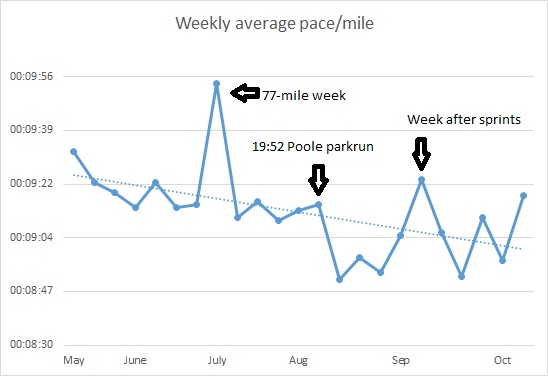
Even though I was completing Bournemouth parkrun 3-4 minutes faster, over those three months there was barely any improvement to my average weekly pace – it was always a few seconds faster or slower than 9:15/mile. The graph below shows this and the one notably slow week was when I totalled 77+ miles!
The reading I’d done suggested it would take three months for the aerobic base to be built. Not knowing better and not seeing any gradual improvement, I took it to be a timeframe where new speed or pace would appear at the end of it.
It therefore came as vindication when I ran Poole parkrun in 19:52 and I was very pleased to break twenty minutes. I’d been running twenty-one minutes before I started and I’d knocked a minute off with training. I now had the encouragement to continue on and see where this system could take me.
Peak experience – August into September
In the week following the parkrun my average pace improved to 8:51/mile – almost thirty seconds quicker. And it stayed there for the next three weeks. I thought I was finally beginning to see the promised gains and even put in occasional barefoot runs around the field again. These were proving quite efficient and I could run nine minutes with heart-rate averaging 115bpm. At my best I ran a sub-25 5K barefoot round the field without exceeding MAF-HR.
My Sunday long runs to Pamphill and back, which had originally been over ten minute miles, were now breaking nine minutes and I was even seeing a sub-8 mile on the downhill into Wimborne. The MAF training all seemed like it was going in the right direction.
Part of my year’s plan had been to do my UK Athletics coaching courses and I’d become a Leader in Running Fitness in May. The next level up, the Coach in Running Fitness course began with a full weekend in Exeter and meant I wasn’t going to be able to do my usual MAF training runs but I wasn’t too concerned as I figured a short rest would help. Over the two days we did many short practical sessions, both coaching and being coached by our partners but nothing extensive. We weren’t sent on one hour runs or anything, just technical drills, jogs and sprints and while my heart-rate was higher on the Sunday morning I thought nothing of it. I couldn’t get out of doing the practicals but I thought it would also be a test of MAF training’s effectiveness, no runner should have to be so perfect in their training if a system works.
Collapse – September into October
On the Monday morning I woke up … eventually. I’d slept for twelve hours, 10pm – 10am, and still felt exhausted. I played it safe and took the day off from running and resumed the next day. While the first couple of miles were ok, by the end of the run I was slowing my pace drastically to avoid breaking the MAF-HR.
Over a weekend I’d gone from being able to run over eight miles in 1hr10 to barely more than seven. In pace terms it had dropped by a minute per mile (8:38 to 9:40/mile pace). It clawed back slightly over the next four weeks but never back to where it had been. It was still an improvement over where it had been in June and July but not at the late August peak. I was still putting in the effort with weeks of 65, 63, 59 and 58 miles but the pace was often the wrong side of 9min/miles.
Enough – October into November and December
I was beginning to lose faith and needed to know where I was at, so in mid-October I went back to Poole parkrun. I’d run 19:52 nine weeks earlier but now I could only achieve 20:39. It had all fallen apart with one weekend of non-MAF training. I felt disheartened and ready to give up. I’d never truly seen the improvement that seems to be promised by low heart-rate training and I couldn’t see myself shuffling through months of my watch beeping at me.
I was scrabbling around for explanations and diving back into the Maffetone book I began to wonder if the increased heart-rates I was seeing were due to overtraining. It can be one of the signs and MAF’s recommendation for overtraining is to cut your training volume back. So this is what I did. All that happened was it became increasingly harder to run to MAF-HR off less and less training.
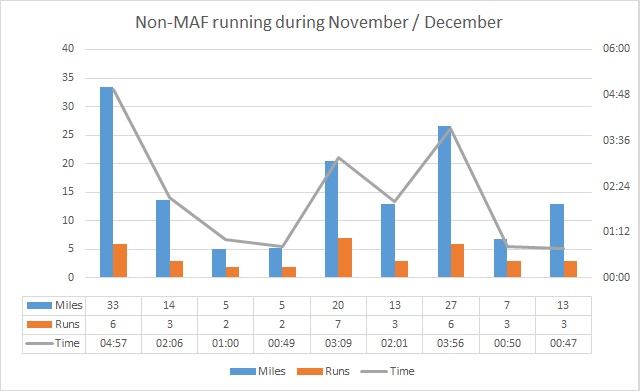
I was left wondering whether the previous winter’s virus had flared up again even though I otherwise felt fine. I took more and more rest days logging only 55-60 miles in each of November and December; mileages which had once been my weekly exercise had now become monthly. I was done with MAF training. I’d started it in May, shuffled around for months and not got anywhere closer to the best running I’d done in the preceding years. I felt like I was always waiting for it to come to fruition and it never did.
Looking back
Within this post, I’ve tried to sum up my training for people to understand what I experienced while avoiding getting bogged down in the details. Even now I feel it’s quite stat-heavy. Every run I did that summer is recorded in Garmin and on spreadsheets. So many of the runs are virtually identical in their splits, heart-rates and times that there’s little to be gained from reproducing them, a summation seems enough.
I’m split between saying MAF-training worked and saying it didn’t. Unfortunately I didn’t have an outright benchmark to compare between when I started training and the all-out August parkrun that clocked in at 19:52. I think it was an improvement but I’d been capable of running this sort of time in February before I got hit by a virus.
The first question mark is when you look at my average weekly pace over those first three months it doesn’t change. It’s always somewhere around 9:15/mile. It’s hard to make a perfect comparison because I changed routes from the beginning of July but whenever the opening miles were along the same paths, the splits were very similar. It suggests I wasn’t getting any improvement from the MAF training.
It was after the 19:52 Poole parkrun that things picked up. The pace of my Sunday runs were notably quicker than they’d been in May when I was trudging up hills taking over eleven minutes for a mile.
The trouble is the fast parkrun seems to have been the trigger for this improvement and that isn’t part of the MAF training. The whole theory of MAF training is that you will get quicker simply by running below MAF-HR. [It should be pointed out the book allows you to add in some Anaerobic Intervals from time to time, but if you follow what the Youtubers say it’s simply about low HR training. Once you start mixing aerobic and anaerobic work you’re heading back towards conventional training methods.]
The second big question mark about my MAF training is what happened after my run coaching course. I went backwards and never reached the same heights of the 19:52 parkrun again. If you look at it over the whole five months of training there was no improvement – I was capable of running 21-mins at parkrun before, I ran 20:39 after.
I believe I adhered to MAF training as well as anyone could or should be expected to. I logged hundreds of miles in over 200 hours of training at slow paces. In almost six months I only totalled 4½ hours above a heart-rate of 138bpm and that includes two 20-minute parkruns where it was averaging high 160s. The graph below shows the time running with the yellow blocks representing the small percentage of time spent in excess of my MAF-HR. You can barely see any yellow in the first six weeks which reflects how well I was following the system.
What my stats don’t include are the occasional 30-second sprints I did at the end of training runs two or three times each week, or what occurred on my run coaching course. If this were a true scientific experiment they would be question marks against the validity of what I did, but with over 98% of my training as MAF expects I don’t believe they should be the difference maker to its effectiveness.
The biggest disappointment of having followed the MAF training system for all those months is that any gains I did make, didn’t last. I ran 1,345 miles to try and build the fat-burning system as Phil Maffetone suggests. By the time I ran parkrun on Christmas Day I was only able to achieve 21:45 with notably higher heart-rates than they’d been in August. Where I’d averaged 165 then, now I averaged 169. Where the maximum had been 174, now it was 181. In a matter of months, I’d gotten slower and my fat-burning had got worse. While I trained less in November and December, I’d have hoped the conditioning would last for longer.
But perhaps more importantly, whether I think my experiment proved MAF training works or not, here’s how I felt about it.
My overriding memory is of how much I grew to hate it,
I grew to dread the watch beeping at me to slow down.
Many hours were spent each week trudging along at paces close to 10min/mile. There was never any chance to break out and run fast, I was always trudging along barely lifting my knees or opening my stride. I was always waiting for the watch to beep. Not just a single tone but an irritating diddle-iddle-eee like a demented doorbell from the Seventies.
I enjoyed the evening runs much more but that was more down to the novelty of running barefoot laps round a field and feeling the ground fly beneath my feet. The lack of footwear reduced the energy-cost of running and my heart-rate stayed lower so I got to run faster.
But too many hours were spent trudging along in the mornings; automatically slowing down to trudge up hills; forever aware and vigilant for the beep of the watch ordering me to slow down.
While I was highly motivated to give MAF training a good shot, grasping for any sign of improvement, the slow pace meant my legs barely got out of first gear and I was repeatedly trashing the same muscles day after day. Running so many miles left them feeling hollow and lacking spring, and the lack of variety just made it unenjoyable. The only redeeming factor was that this all took place in the warm of the summer months. I’m doubtful I could have stuck with it through a cold, windy, rainy winter.
The one bright spot was the 19:52 parkrun at Poole and that was it. I believe you need more intrinsic feedback and enjoyment when you’re training hard to stay motivated through the tough times. If, for some reason, you aren’t getting that feedback then this is where having a good coach helps out. They will reassure you that you’re on track to achieve what you’re aiming for. They find ways to say “Don’t worry, it’s going to work out”, to point out any successes you haven’t noticed, or explain why the slump you’re experiencing is normal. In this respect, my years of coaching enabled me to self-coach and keep giving positive messages and reinforcement.
Knowing how my running improved in the years after, I realise I’d never use MAF training again. Its monotony and the age-related MAF-HR meant it didn’t work for me. Becoming a slave to the beep of a watch and heart-rate monitor sucked the enthusiasm out of me.
I know, as I can show to anyone I coach, there are better ways to train. Endurance miles are an important part of the equation but not the only one. It’s possible to mix up bouts of fast and slow running in ways that allow you to get the best out of yourself and see intermediate improvement while the training comes together.
In part 3, I’ll talk further about what I believe the pros and cons of the MAF training system are. When it can work, what you can learn from it and what the issues are.
April arrived and I was excited, after four months of following a Jack Daniels 800m training plan, to see how it had paid off. I know I’ve been feeling fitter, faster and stronger but how would it affect my 800m time?
Back in December I ran 2:58 with estimated splits of 39sec followed by 45, 45, 49s.
My fastest 200 in training has been 37.45s, which multiplies to 2:30, so that gave me a cap to what my top end could be. There’s no way I was going to run all four at 37½ so any thoughts of hitting 2:30 were out.
At the other end, I’ve been feeling fairly comfortable running 200s at 44-45s in recent weeks so figured this would be the pace I’d slow to before the final sprint to the line.
This was my realistic range for what I might achieve – 2:35-45. I was hoping I might break 2:40, as that seems like a nice round number. Here’s what happened …
Time Trial #1 – Friday 9th April 2021
I had two recovery days after my last workout and, on the morning, I went for a 1½ mile run to loosen up. It didn’t feel that good aerobically but my legs felt ok.
I had a light lunch, earlier than usual, to ensure it would be digested by the time I ran at six in the evening. I’d selected this day and time predominantly based on weather. My original plan had been to run on Saturday morning thereby giving me three recovery days but the forecast was for it to be 15mph windy by 8-9am. Friday evening’s weather was only 5-6mph and gave the added bonus of having the day to eat and hydrate going into the run. I usually find my body is happier in the evenings.
While I know the 800 is all about effort, and I’d advise anyone to go out at about 90-95% top speed; I was no longer sure what 90-95% would feel like after all the training. I’m now going faster in sessions, even when legs are tired, than I was in December. Unfortunately I didn’t do any prediction workouts and even if I had I probably wouldn’t be able to pace accurately. I decided to just go out reasonably hard and hang on.
On arriving at the park, I ran warm-up and my legs/breathing felt ok. I did three sets of strides and while I felt I put a decent effort into them, my watch was suggesting they weren’t that quick but I put this down to my Garmin being unable to adjust quickly enough so I remained confident.
I gave myself an eight minute break between warm-up and the time trial to let any waste products get out of my legs. But it was a cold, grey evening and I felt a few spots of rain; so I didn’t hang around as long as I might have liked.
I went with the standing split start I’ve been learning, which makes it harder to start the watch, but I was away.
Oh my word, my legs felt unbelievable.
The first time I’ve run hard in months without any lactate in them. They felt so quick and unhindered that it surprised me. I was almost stumbling. I got to 300m and began to start breathing harder but it didn’t feel as tough as it did last December.
Further on my shoulders began to ache. A lot. This only happened to me once in training but apparently also on the last time trial. My legs began to tie up and stumble but I kept going and overall I was feeling confident that I was cutting through the air at pace.
I reached the final stretch, jumping into the empty road and then back onto the path because of walkers and then gave it my final sprint.
My time was astounding …
I could barely believe it …
Two minutes fifty-five seconds.
Only a three second improvement over last time.
It’s so far below expectations that I couldn’t even feel disappointed about it. Four months of good hard training where I’ve felt fitter, faster, stronger and leaner yet no notable improvement.
Perplexing is the word I’d use about it.
Before the next time trial I did recovery runs. On the Sunday I went for a 10-mile long run and began to wonder whether I was really getting the hip or knee extension required to get full force. I started looking at videos on sprint mechanics. Youtube videos and internet articles, the bane of all self-coached sportspeople, but for once I did glean some information that changed how I’ve been thinking about sprinting.
By the time I ran on the Monday, my legs felt like they’d recovered from the time trial and my mechanics were feeling powerful in a way they haven’t in years.
Time Trial #2 – Wednesday 14th April – five days after the first time trial
I decided to start off slower. The first time trial had estimated 400m splits of 1:23 / 1:32 – which are too far apart – ideally there should only be two or three seconds difference. I decided to go out slower, aiming for around 43s on the first 200 (it was 39s on TT1), and if I could replicate that for the second 200m it would take me through halfway in 1:26. In truth, I expected the first section still to be too quick but hopefully by not putting in as much effort, I would be closer to a decent pairing.
It didn’t work out anything like that. I started with less effort but once again my splits for the first 100-200-300 metres each came in at 20 / 40 / 60 seconds but by the 400m mark I was at 1:24 (compared to 1:22-23 on TT1). Once again I started to struggle with the lactate build-up in my legs and arms, and I began to feel my stride ebb away and become uncoordinated. I went through 600 in 2:12-13 (4=5 secs slower than TT1) and finished off with a somewhat lacking sprint to clock 3:00. Eke! Worse than my original time trial.
What to make of all this?
While the three second improvement between December and TT1 is technically quicker, to me it’s a negligible improvement, TT2 shows this. I feel there’s something I haven’t unlocked because as I said before I’ve felt fitter, faster and stronger as the months have gone by.
Thinking back on the training, I’ve struggled throughout on the longer intervals of 400 and 600 metres, which points to an endurance issue. I’ve definitely improved it but perhaps not as much as I needed. My Sunday long run has improved from around 8:35/mile to 8:10/mile but that’s still a long way from my 800m pace of 5:50/mile. I’m hoping the upcoming phase of endurance training will bring them closer together.
With regards to following Jack’s plan, I’ve been 95% faithful. I’ve done every effort of every session as he defined them. I’ve not dropped any workouts, swapped days around or changed any of the parameters of workouts. Admittedly my long runs have been longer than his suggested 1-hour but I don’t think that diminished anything.
The one omission that may have been crucial is not doing strides on two of my weekday Easy runs. That might have dug out more speed for the Time Trials but I deliberately didn’t do them as my running history has shown my endurance goes backwards when I do. Even without them, I have found my top end pace is registering as faster. Back in December I couldn’t break 5min/mile but when the time trials rolled around I hit 4:38/mile.
The next six weeks
I decided there wasn’t any point in doing a third time trial, after the second one came in slower, but to begin the endurance phase immediately. It was noticeable that in the following long run, my easy run pace had dropped.
My new schedule through to June involves running eight mile Steady runs on Tuesdays and Friday with a twelve mile long run on Sunday. The rest of the week will be recovery runs and I’ll slip in strides occasionally to keep all the faster muscles involved.
Week 1 – the Tuesday steady peak with an 8:10 mile and the last four miles were all run closer to 9min/mile. Three days later I was hampered by strong winds on the outward leg and pushed home with a peak 7:55 mile for a two-minute improvement.
Week 2 – the first Steady run of week 2 brought calm conditions and a decent improvement. The fastest mile came in at 7:29 and all the miles except the last were under eight minutes. Seven minutes taken off the previous Tuesday’s run. The Friday Steady was relatively calm but my legs must still have been recovering as the last five miles all came in at about 8:05/mile. The Sunday long run, straight out of bed and fasted at 5:55am, was a season’s best on a hillier route via Gravel Hill and Broadstone averaging 7:58/mile
Rounding up my thoughts and feelings
Overall I’m not too unhappy with how this went. As I’ve already said, I know I’m fitter, faster, stronger and lighter. I’ve lost about half a stone in weight since the beginning of January as I began to fire up some of the muscles fibres I’ve stopped using over the past few years. Simply from that perspective, the training has been worthwhile.
I am slightly frustrated though. I’ve done everything by the book and got no result from it. I’m questioning whether Jack’s plan is right for me as I know I’ve self-trained to run whole kilometres at quicker paces than my all-out 800m. I have one or two thoughts on how I could adjust things but I’m going to stick with it for another round of training. I have a suspicion that the endurance training I’ll be doing through May will actually lead to a faster 800 in June.
It became clear to me in February that, entering this training plan, I had a big gap between my easy pace and my 800m pace that needed to be closed up. I hadn’t run faster than 7:30/mile in the build-up and there was nothing to bridge the gap to my 800m pace. While the training did that to a good extent, I believe I now need to cement over the gap and then I’ll start making progress in my 800 time.
I’ll follow the plan again, which will take me through to September and then see where my 800 is at. But parkrun is due back in June so I may find myself attending one or two of those. If I do so, then I’m going to have to go off Jack’s plan somewhat but so be it.



 Big Red Running