Never before have I seen what happened at the World Athletics Championships in the last two races of the opening night occur.
First it was the women’s 10,000m where Netherland’s Sifan Hassan was attempting to complete a treble of winning, or at least medalling, in the 1500, 5000 and 10,000 metres. The race began slowly – the first km of 3min30 is one even I can run and Hassan tagged on to the back of the pack. With each passing lap the pace quickened up so that by the last lap it came down to a sprint. As the bell sounded, Hassan pulled away being tracked and challenged by the Ethiopian Gudaf Tsegay. Entering the home straight, Hassan was still leading by a metre but clearly tiring. She began to drift out and swung her elbow back into Tsegay’s chest. A second contact unbalanced Hassan and she stumbled and fell twenty metres from the line allowing Tsegay to pass and take gold. Already Hassan’s treble ambitions had gone.
Immediately after we watched the Mixed 4x400m relay where the USA were favoured. Great Britain & Northern Ireland had set a national record while running the 2nd quickest time in the heats and now had hopes of a medal. For the Dutch, Femke Bol had anchored their team to victory in the heats and seemed to sprint home with ease. At the final baton changeover, the USA and Netherlands handed over almost side by side but then Bol took off to open up a 2-3 metre lead. By the time she reached the home straight little had changed other than GB&NI had slipped 15metres behind but comfortably positioned in 3rd place for the bronze medal. With fifty metres left, USA’s Alexis Holmes closed on Femke Bol but still hadn’t passed her. As the finish line was about to come into view on screen, Bol began to stumble then fell with the line only metres away. The slow motion replay showed her scraping along the track with a full-on face plant. The fall was enough to allow the USA to pass for gold and then as Bol stood up, Britain’s Yemi Mary John also passed to take silver. To add insult to minor injury, although Bol managed to scramble across the line third the Netherlands were disqualified as she had dropped the baton.
You see runners get clipped in the middle of long distance races and even able to get back up and run. Sometimes they are down and out. I’ve rarely seen an athlete trip and fall at the end of the race. I don’t know what the odds on two runners from the same nation falling while leading in back-to-back races are – but they seem long.
It was early June when Faith Kipyegon became the first woman to run 1,500m in under 3:50; last night she shattered the mile record. Running 4:07.64 it was almost five seconds quicker than Sifan Hassan ran in 2019.
Faith Kipyegon on her way to a new women’s mile WR
There’s no doubt Kipyegon is in form, having also broken the 5,000m world record in Paris in June. She’s obviously training well but it’s not just her. While Kipyegon finished seven seconds clear, every other runner in the race recorded a Personal Best and there were three continental records and six national records. Five of the women taking part are now among the top-8 fastest milers of all-time. This is unprecedented and you have to wonder why.
The first and simplest explanation is that the mile isn’t raced often. It’s an old Imperial race distance which is still popular in the U.S.A. and holds significance for men with the four-minute mile. But the Olympics and World Championships race the metric distance of 1,500m.
An immediate assumption might be to point to performance-enhancing drugs. The spectre of doping is always a cloud hanging over athletics and while it’s possible, perhaps even probable, someone in the race is using, you can’t have a race full of dopers and somehow avoiding any one of them getting caught. There has to be something else going on.
Perhaps it’s the track as Monaco was also where Hassan set the previous record and it has a reputation for fast middle distance races in recent years. It wasn’t just the women’s 1,500 where fast times were recorded last night, there were three men running 12:42 in the 5,000m and eight men under 1:44 in the 800m. For comparison, Mo Farah’s personal best over 5,000m was 12:53 and at last year’s Oregon World Championships only one man ran under 1:44 in the 800m final.
Perhaps Monaco itself isn’t faster, it’s simply that its Diamond League meeting is usually held at this time of year and that coincides with athletes getting close to their best. Everyone will be looking to hit their peak in a month’s time at the World Championships in Budapest. For some there’s a little extra to come, some may have peaked too early and others will just be holding on.
It’s the shoes
Anyone who has been following athletics in recent years cannot have missed how many records have been shattered in the long distance races from 5,000m on up to marathon. It’s not just world records but national records as well as personal bests for many athletes. While there may be some improvement due to refined coaching and training methods, it’s impossible not to have heard about the shoes.
Nike introduced the Vaporfly shoes in 2017 and claim they can improve a runner’s performance by up to 4.2%. This occurs through a combination of a carbon-fibre plate in the sole and lighter, bouncier foam which results in the runner using lesser effort and saving energy. As the results show this has been massively beneficial to the point where they are standard for all elite distance runners now.
It’s also understood however that that the benefits of the Vaporflys and similar models only apply to long distance races. For sprinters and middle distance runners on the track they find the Vaporflys feel squishy whereas the spikes they use give better traction. This is why the shoe companies developed a superspike with prototypes beginning to appear in 2019. Again these spikes have a carbon-fibre plate and more efficient foam but with different shaping and geometry.
Although the exact reasons why superspikes help isn’t understood, we’re seeing it benefit track athletes. There have been world records set in the men’s and women’s 400m hurdles by Karsten Warholm and Sydney McLaughlin-Levrone respectively and by Tobi Amusan in the women’s 100m hurdles. It should be noted that, at the time of writing which is a year after she broke the record, Amusan has been provisionally suspended for missing drugs tests. In her case, it may not be the shoes! Undoubtedly though many athletes, especially women, in the short sprints have been setting Personal Bests and National Records, just as happened in the mile race.
Why allow the advantage?
Track and field athletics is no longer the crowd draw it once was. It’s fighting with other sports for television and media coverage and for the money and revenues those attract. Athletics will always be the centrepiece of the Olympics but outside of that, it often holds little interest to most people. Athletics stadia are not packed like football grounds, it is not a sport people regularly turn out to watch. In Britain, the TV coverage is hidden away on BBC3 which is only available online or by Red Button.
Keeping partners, whether official or not, happy is something World Athletics have to consider in a world where it is a business as much as a sport. For the shoe companies who introduce expensive new shoes promising to make every runner faster it is an important way to grow their profits. While it would have been an easy decision for World Athletics to ban the shoes it would likely lead to shoe companies cutting their budgets for research and development and focusing on the fashion trainer market and other sports. Many athletes have shoe deals with the shoe companies and therefore a ban could have impacted them. World Athletics did eventually introduce restrictions to the dimensions of the road shoes in 2020 but it didn’t ban them outright and consequently we have seen records being smashed time and time again.
All of this is a reminder of what happened in swimming in 2008 when new bodysuits were introduced and over 200 world records were broken. Eventually the governing body intervened, wiped those records and banned the suits. But this was different, your average person who goes swimming at the local pool wasn’t going to go out and buy a go-faster body suit so the commercial impact to the apparel companies was small.
Yet the same argument can be made about track superspikes. The market for them is small and if World Athletics were to ban them it wouldn’t impact the revenues of the shoe companies significantly.
Wiping the record books
It puzzled me why the super shoes have been allowed until I considered that perhaps Lord Coe, as head of World Athletics, is happy for the world records to be broken. Obviously it generates clicks and headlines for World Athletics which can never be a bad thing.
More importantly though, many of the women’s world records are disputed as they were set in an era before out of competition drug testing took place. Florence Griffith-Joyner set the 100 and 200m world records in the summer of 1988, East German Marita Koch’s 400m time was set in 1985 and Czechoslovakian Jarmila Kratochvilova’s 800m was set way back in 1983. We know the East Germans systematically doped and it’s highly likely the same applies to anyone else from the Eastern Bloc. There will always be suspicions about Flo-Jo’s times and certainly there is evidence her 100m was set with an unmeasured tailwind even if doping wasn’t involved. These times were thought beyond reach with other runners barely able to get close and yet, in recent years, it’s begun to look a possibility.
Even after out of competition testing was introduced in 1989 there was another notable set of suspect world records a few years later. These were in the women’s 1500, 3000, 5000 and 10,000m by Chinese athletes who were known as “Ma’s Army” after their coach Ma Junren. While the 1500, 5000 and 10,000m records have since been broken, Wang Junxia’s 3,000m time of 8:06 is still on the books. It came to light in 2015 that Wang and her teammates had written a letter in 1995 accusing their coach of forcing them to take drugs. It is hard, given the lack of subsequent success by Chinese athletes, to believe that their record setting success was simply down to hard work of running a daily marathon at altitude and eating turtle blood soup as Junren claimed.
Getting those records off the books is a desirable thing to World Athletics and if doing that happens to coincide with keeping the shoe companies happy then so be it. I think there is a good chance we will see an attempt at the women’s 3,000m world record at some stage if Faith Kipyegon continues to run well. She is the new 1,500m world record holder with a time which is a second quicker than Wang Junxia’s Personal Best. Like the mile, the women’s 3000m is not a distance which is raced often. It was contested at championships up until 1993 and then replaced with the 5,000m. It will require a special staging of the race, probably at a Diamond League meeting to achieve it. This isn’t out of the question as Jakob Ingebrigtsen of Norway ran a “World Best” in a two-mile race in June. It was the same Diamond League meeting in Paris where Kipyegon broke the women’s 5,000m world record.
Elite women run fast. We know the sprinters are very fast running under 11seconds for a 100m. On Friday June 2nd at the third Diamond League meeting of 2023, Faith Kipyegon showed she has great speed reaching 25km/hr at times. It was that speed, combined with endurance, which enabled her to become the first woman to run 1,500m in under 3:50 – a pace which would have brought her in for 4:06 for a mile.
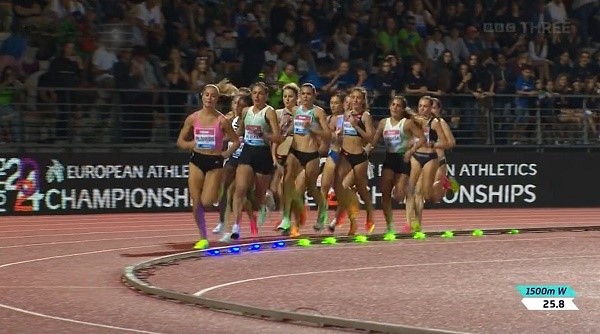
As the reigning Olympic and World Champion, Kenya’s Kipyegon who is approaching thirty years old was heavily favoured to win in Florence, Italy. While pacemakers are still present to lead runners out in the early laps, modern athletics now has a moving set of lights around the edge of the track to help with even pacing. These had been set at 62secs per 400m which equates to a 3:52.5 time.
The blue and yellow lights indicate the required pace
I took a look at the race to see how it was run and find out how the laps broke down. Due to its distance the 1,500 metres is unusual in starting at the beginning of the back straight – which allows athletes to cover 300m followed by three laps of 400m.
The splits as best I could determine them were:
100m – 14.5secs – imagine that. How many of us can even run that from a standing start without blocks even without having to run a further 1,400m?
300m – 46s – first crossing of the finish line
400m – 1:02.37s – first lap of the track
700m – 1:48.2s – second crossing of the finish line. Just before this around the 600m mark the first pacemaker dropped out
800m – 2:04 – second lap of the track taking 61.63s. The other pacemaker drops out at 900m
1100m – 2:50 – third crossing of the finish line – one full lap to go
1200m – 3:05.28 – third lap of the track taking 61.28s. The last 100m has only taken 15-16s
1500m – 3:49.11 – a new WORLD RECORD. The final lap has taken 58.81s – a pace of 3:57/mile
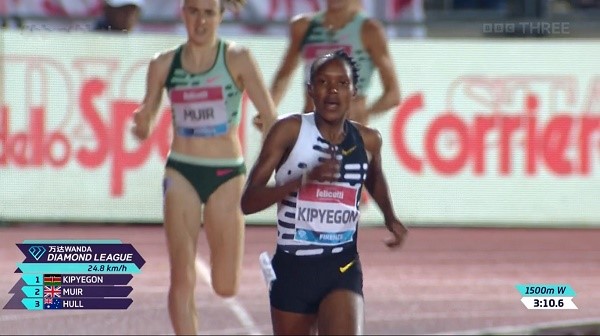
It’s a truly remarkable performance which saw Britain’s Laura Muir finishing eight seconds behind in a season’s best time of 3:57.09 and Australia’s Jess Hull setting a national record in 3:57.29 as she finished third. Both runners had worked their hardest to keep up with Faith Kipyegon yet they ended up thirty metres behind. No-one in the rest of the field could even crack four minutes which begins to give an indication of the gulf that exists between Kipyegon and the others.
Faith Kipyegon flies down the back straight on her way to a new world record
Watching her run, she has decent compact form and is very balanced. Every stride is powerful and I’d estimate she’s taking around 200 steps per minute. This isn’t unusual for a middle distance runner or for a shorter runner. Faith is listed at 1.57m / 5’2” and weighs 43kg / 93lbs. What’s surprising is when you calculate the distance she’s covering with each step it works out at around 2.08m and that’s over 30% longer than she is tall. And she’s doing it for almost four minutes!
As a coach, these are the things I think about and marvel at. I’ve previously written two articles on stride length (first and second) as well as what elite runners speed is. Developing these can take time but is worthwhile even for distance runners. Consider that on average Faith Kipyegon’s new world record is the equivalent of running fifteen consecutive 100m races in 15.2secs and there are no excuses available about having little legs!
Ahead of this year’s London Marathon, I happen to be reading a book all about it. This is pure coincidence as I picked it up off the charity bookshelf a couple of months ago for 50p. It’s been sat waiting to be read ever since but I had to finish off the badly written Chris Waddle autobiography first!
Published after the 25th running of the race, “The London Marathon – the History of the Greatest Race on Earth” was written by John Bryant. A marathoner himself by the time of his death in April 2020, he’d run London twenty-nine times, He was an established writer and journalist who’d worked for The Times, Daily Telegraph ad Daily Mail among other newspapers.
Often the people writing these sorts of books aren’t that involved, simply just writing up what they’ve researched on the subject. Bryant cannot be accused of that. He had run a 2hr21 marathon and coached Zola Budd when she was competing for Great Britain in the 1984 Olympics. It’s very clear he understands what he’s writing about and, also how to write it well. It’s a very engaging book split into twenty-two chapters with each detailing a piece of history or what the marathon experience is about.
I’m only about a third of the way through but so far I’ve read about Chris Brasher and John Disley, the founders. About the first race in 1981 and the dark years which followed in the life of its joint winner, Dick Bardsley. It details the British winners (including Charlie Spedding and Steve Jones) in the following years asking them why we no longer have the same success. It tells of Spirodon Louis, the winner of the first Olympic marathon in 1896 and interestingly that his win may have been assisted. How the marathon distance became established at its current distance rather than its differing distance of 22-25 miles. There’s a chapter about Ron Hill, who I previously wrote about, which confirmed my memory that the first 26.2 years of his streak involved running twice per day and once on Sundays.
Upcoming chapters promise a look whether the women’s time will match the men’s, the rise of African runners, what older runners can achieve, the celebrities and ordinary people taking on the marathon challenge. There’s a look at the logistics of organising as well as the demands on the runner’s body. It features the elite runners, the world record holders of the time Khalid Khannouchi and Paula Radcliffe, as well as discussing the potential for when a sub-2hr marathon might be run. Spoiler – it’s been done.
What is fascinating is how much of this info is now common knowledge. It’s easy to forget how far sports science and our understanding of how to train for, pace and prepare for marathons has come. Reading about the early Olympic marathons, the competitors like Dorando Pietri were breakfasting on beefsteak and coffee; gargling with Chianti, drinking wine and taking drugs such as strychnine ad atropine during the race. There’s even a brief look at shoes, barefoot running and the Tarahumara almost five years before Christopher McDougall wrote all about it in Born to Run.
At 260 pages, John Bryant provides an excellent and informative overview of the London marathon through its first twenty-five years. His well-written account is a pleasure to read, striking an excellent balance between story-telling and factual detail. It’s a book packed with looking at London from many different angles and I know it isn’t going to take me long to finish.
The 2023 London marathon takes place this Sunday, April 23, returning to its traditional Spring slot after three years displaced to October due to the pandemic. While it’s now too late for me to coach you for it, there’s always next year. If you think you might like to be coached, please feel free to contact me. I’m sure I can help you become a fitter, faster runner at any distance whether it’s the marathon, parkrun or any other race.
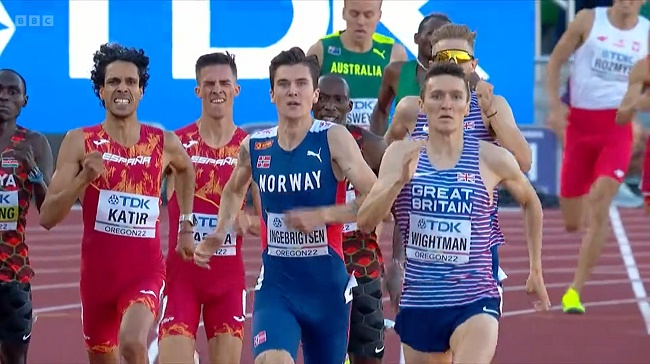
I woke up on Wednesday morning to discover Jake Wightman had won the 1,500m final. Quite a surprise given middle-distance racing has been dominated by Kenyans, Ethiopians and Moroccans for the past two decades or more. It’s only the last couple of years that we have seen the rise of Norway’s Jakob Ingebrigtsen challenging them, which led to him entering this race as the Olympic champion. It’s great to see the African dominance being shaken up as the world catches up on them.
Like Eilish McColgan, Jake has the genetics and support around him to help get the best out of himself. His father, Geoff, was a 2:13 marathoner and ran at the 1990 Commonwealth Games. His mother Susan, nee Tooby, and her twin sister Angela both ran at the 1988 Seoul Olympics. But, even with the family background, you have to have the motivation. Jake himself is a twin, and while brother Sam is still runs as a member of Edinburgh AC, he apparently didn’t continue to take it as seriously after he turned eighteen.
In seeing Jake winning the race in 3:29.23 – a personal best – I wondered how he had ascended to be the champion. He’s just turned 28 and his climb has been slow. Going back only eight years ago to the Commonwealth Games in Glasgow, he was knocked out in the heats in a time of 3:43.87, almost fifteen seconds slower than in Oregon.
It’s instructive to look at his UK Athletics Power of 10 record which lists the majority of his official races and times since he competed in the Scottish Schools championships in 2007 just before he turned 13 years old. At that time he was running 4:45 for 1,500 and it only improved to 4:33 a year later. It took the better part of a decade to knock a minute off that and get down to his current ability. As the graph below shows, he was running close to these times in 2014 and since then has been working to eke out the last improvements from 3:35 to sub-3:30. Even so, it’s a steady progression over the first seven years.
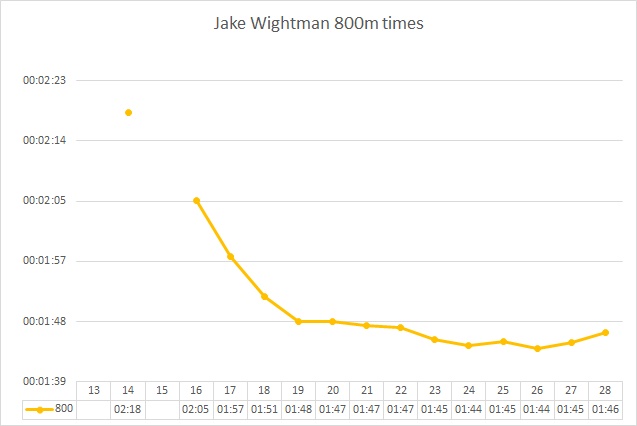
It’s the same story with the 800m. He began as a 2:18 runner in 2008 at age 14 and finally broke two minutes at 17. From there it was another two years to break 1:50 and then it wasn’t until he was ten years into his running career that he became the first British man since Peter Elliott in 1991 to break 1:45 for 800m and 3:35 for 1,500m. That is a lot of running, training and development to get near to his best.
Of course what we don’t know is what his training aims were during these periods. For example, from 2012 – 2016 he ran in some 400m races seeing his times improve from 52.7 to 48.3sec. Again this highlights how it took four years to make a decent improvement from already good times to even better ones – an average of one second per year.
This idea of long term development is one that the average runner doesn’t understand. It takes years to become the best runner you can be. For many runners training consistently for 3-6 months is considered long-term and they’re happy to knock a minute or two off their half marathon time. But as Jake’s record shows with consistent training and a long term approach, you can go much further than you ever expect.
Two days, seven events, sixteen women battling it out for the Heptathlon gold. The favourite was Nafi Thiam, the back-to-back Olympic champion who also won the World Championship in 2017. Britain’s Katarina Johnson-Thompson interrupted Nafi’s dynasty by taking the gold in 2019 and therefore arrived in Oregon as the reigning World champion.
The seven events of heptathlon are split into sprints (100m hurdles and 200m), throws (shot putt and javelin) and jumps (long and high) with a final 800m race providing a test of speed and endurance. Typically the best heptathletes tend to be good sprinters because their speed helps out in the jumps and 800m leaving only the throws to be developed.
As a running coach, I often feel it’s hard to fit in all the sessions I would like to do in preparation for a race. There’s speed work, lactate clearance and tolerance to be developed and there’s general work on the aerobic base; and there’s limited time and energy to do it all.
So how do heptathletes manage to conquer seven different events? The technicalities of hurdling, long jumping, high jumping, shot putting and throwing a javelin are things that rarely come naturally. Of course most multi-eventers begin when they are ten or eleven years old so the basic techniques are ingrained by the time they get to their late teens and begin competing in championships. But even so, trying to fit in training for seven different events each week must be difficult and I guess all you can do is periodise your training to allow for it. There’s probably a decision to be made whether to try and improve your strongest events vs. eliminating any weakness. These are difficult decisions for any coach and athlete.
I tuned in over the two days to snippets of the events but it was the final 800m race which I watched with most interest given it’s my event. While trained world-class 800m runners are running under 1:45 for men and 1:55 for women, watching the heptathletes provides a different look.
These women are very good athletes there’s no doubt about that but they are second echelon or they’d be 800m specialists. The nature of the heptathlon disciplines pushes them to develop speed and power over endurance and the limitations of training mean they can’t be running 40 miles or more per week as the specialists do.
After six events, the Netherlands’ Anouk Vetter had edged ahead of Nafi Thiam through a massive 58+ metre throw in the javelin leaving only the two of them contending for the gold and silver. Meanwhile the 21-year-old American sensation, Anna Hall, who had been setting personal bests in each event and bouncing around excitedly after each great throw, jump or sprint was favoured to be first across the line. She recently ran 2:03 for 800m and while she wouldn’t be able to reach Thiam or Vetter in the overall standings it was likely she’d take bronze.
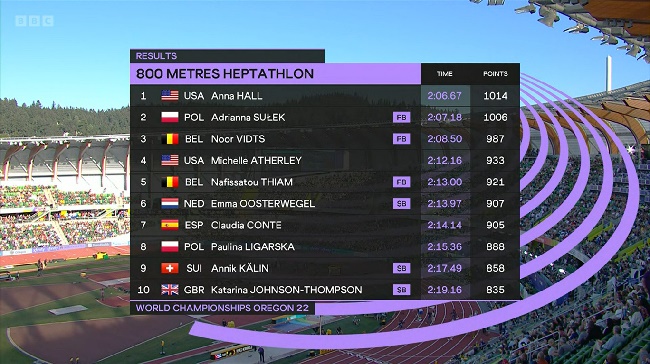
The race set off and Hall sprinted into the lead opening up a gap over the others. There wasn’t much drama but down the back straight of the second lap, about 1min20 into the run, you could see Hall beginning to suffer, breathing hard, looking a little less smiley as she dug in. Rounding the last bend, Sulek the Pole and Vidts from Belgium moved up onto her shoulder and challenged. Over the last 50m, Hall found a final burst to sprint away and cross the line in 2:06.67
The others trailed in over the next fifteen seconds and then after walking a few steps, with the competition over, they all collapsed to the floor gasping for breath. I remember the feeling on my first 800m time trial – lungs busting to the very end then hyperventilating to try and get the breath back. For me, it lasted a good few minutes and the unpleasant effects of lactic build-up were still causing me to cough an hour later. On my later time trials these effects were diminished as my endurance had improved.
Post race recovery
Breaking down Anna Hall’s race, it’s instructive to note she ran 23.08s in the 200m event at the end of the hep’s first day. The next best time was Johnson-Thompson’s 23.62s which is a significant drop off. Generally speaking the fastest runners over short distances become the fastest over long distances with the right training.
In running 2:06.67, Hall recorded 200m splits of 28.77, 31.98, 33.45 and 32.47. There’s no doubt she went out a little quick even though she was almost six seconds slower than she’s capable for 200m. The lap splits came in at 1:01.75 and 1:05.92 where a specialist aims to have a 2-second difference between the two. Let’s put those numbers into context the 800m was run at 4:15/mile, the fastest split at 3:51/mile, the slowest at 4:29! All very impressive stuff to us mere mortals.
Anouk Vetter trailed in at 2:20 to take silver behind the champion Thiam (2:13). The commentary team suggested that Vetter’s 7-second deficit, with her throws being better than everyone else, indicated she had spent more time in the weights room than the track. Of course that may have been a little tongue-in-cheek without a more detailed analysis of Vetter’s past abilities or knowing what her coaching were aiming to achieve, but likely there’s some truth in it.
Even so, the race highlights how much speed is an important factor in racing fast but also the need to balance training to build the endurance to support it. Hall may be able to run 200m at 3:05/mile pace but it quickly drops to only being able to run at 4:30/mile when another 600m is added. It really highlights the endurance work that runners need to do if they’re going to be competitive at longer distances like parkrun, 10K or even the marathon.
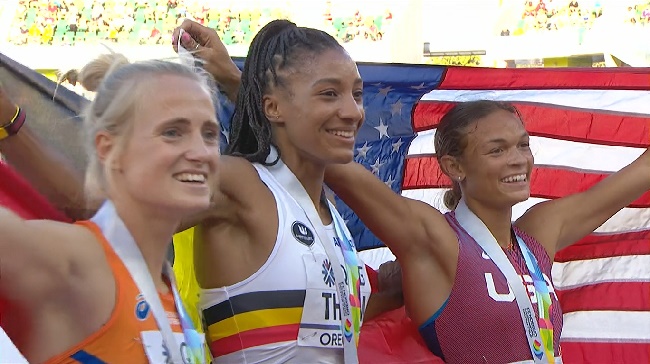
Anouk Vetter (silver), Nafi Thiam (gold), Anna Hall (bronze) from left to right.
The World Athletics championship opened on Friday 15 July 2022 in Oregon, USA. As I’m based in the UK, I’m not going to see much of it live as, while some events start in the evening in my time-zone, the majority take place after midnight.
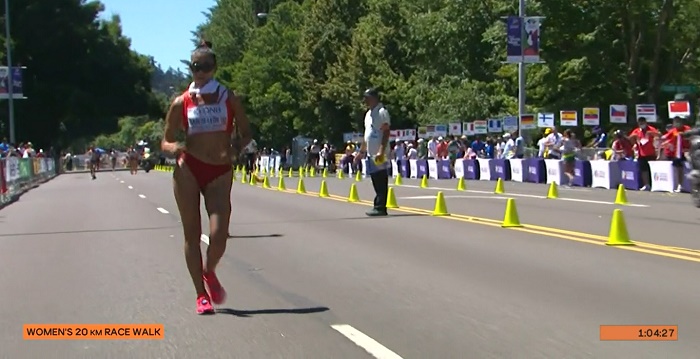
What I caught on Day 1 began with the field events of hammer and high jump along with a couple of track events, the Mixed 4x400M relay and preliminary heats of the Men’s 100M. But the real highlight was away from the stadium where we were treated to the Women’s 20KM walk!
Race walking is a sport which is somewhat derided and I am being slightly sarcastic when I say it’s a highlight. Yet, I have a fascination with all things sporty and what I can learn from them and I’ve actually watched race walking at some of the past Olympics. Given it’s similarity to running it’s interesting to dig into the details and analyse.
Race walking at the elite level is surprisingly fast and there are two event distances – 20 and 50km. A little bit shorter than half marathon (21.1km) and longer than a marathon (42.2km). It’s only in the past decade the women have been allowed to compete in the longer walking distance.
There are two basic rules that differentiate it from running.
You must always have one foot in contact with the ground as judged by the naked eye. This “naked eye” caveat was instituted in recent years because with the advent of high definition television pictures, it became clear everyone was lifting off and travelling through the air!
When the front foot lands the leg must stay straight until the body passes over it. The knee cannot bend.
Breaking either of these rules results in a warning red card and if three are received, the walker has to take a penalty stop of 1-minute per 10K of race distance. If they break the rules a fourth time they are disqualified. However, there’s a twist as in the last 100 metres, a walker may be disqualified even if they haven’t had any previous cards which avoids them gaming the system and breaking into a sprint at the line! The drama of the race begins to occur as competitors accumulate penalties or risk everything to go that bit faster.
The commentators made the point that tactically there’s not much you can do in race-walking. Its limitations, as I shall explain, means there is an inherent top speed. It’s not like distance running where you might decide to conserve your energy by sitting behind an opponent and then sprinting for the line!
By always having one foot in contact with the ground, a walker’s stride length is limited by the length of their legs. As one foot leaves the ground, the other must already be touching it.
This begins to highlight a big difference with running where runners can push off with each step and travel through the air. They get a longer stride length by doing this – as much as 2.70m for world class male sprinters and almost 2m for distance runners. The average man walking along the street usually has a stride of around 90cm and when I measured my biggest possible step it was a highly uncomfortable, full stretch 1.35m.
In his book Mathletics, John D. Barrow a professor at Cambridge University analyses how race walkers achieve their speeds and concludes that to achieve the world record pace, it requires the walker to have a leg length of 2.3m. Basically they have to be leaving the ground to go as fast as they do! What the walkers are good at is eliminating any up and down motion. Their centre of gravity always remains level and all effort goes into propelling themselves horizontally forwards.
This means their cadence – the number of steps taken per minute – is a big factor in how fast they walk. The best in the race I watched were hitting a cadence of around 200 steps per minute but again this has limitations. Sprinters achieve very high cadences of around 250 steps per minute but they can only hold onto this for a minute. Middle distance runners tend to be over 200-220 steps and are closer to the race walkers in this respect.
But it’s a key difference between running and race-walking that middle distance runners achieve high cadence by ‘shortening the lever”. When their back foot leaves the ground it comes up to almost kick their backside. This shortening allows the rear leg to travel under the body quicker than if it were staying straight. This is basic mechanics that occurs with the pendulum of a clock speeding up or slowing down depending on its length and which you can easily test by swinging a weight on a piece of string.
What a tall walker gains in stride length, they lose in cadence because their long levers move slower.
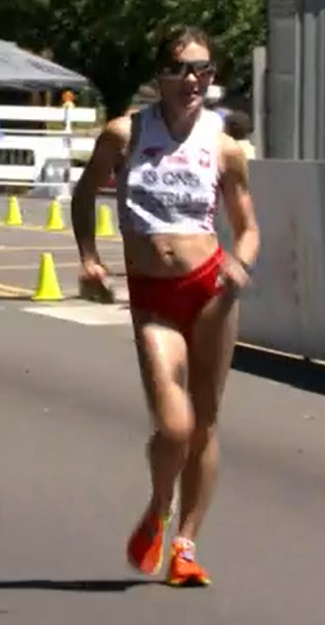
The pronounced tilt of the hips and shoulders
Watching a racewalker, you immediately notice they all employ a distinctive wiggling method with the arms notably swinging. The hands stay low to keep the centre of gravity low and help avoid losing contact with the ground.
The reason for the wiggle is that it maximises the length of each stride. It involves rotation of the hips which is counterbalanced by the shoulders rotating. Unfortunately, if you go watch any amateur distance race you will seem many runners at the slower end of the field using a similar technique. This isn’t entirely a surprise as many amateur runners are going at paces slower than race walkers.
Together these factors begin to explain why many amateur runners aren’t achieving better times. Firstly they do too much ‘wiggling’ – their hips and shoulders rotate around the body. While this creates a longer stride, it often causes a heel strike which at best creates braking forces to slow them, but at worst may cause injury. Neither is desirable.
A secondary consequence of hip rotation is that it doesn’t cause the trail leg to swing up which would make their running more efficient. All they’re doing is penduluming their legs back and forth.
Now there are running methods which encourage runners to deliberately lift the trailing leg but I don’t advocate that, it should happen naturally with good mechanics. How far the trail leg swings up is dependent on how fast you’re running. But certainly if you’ve got excessive hip rotation going on, it will be harder to hit the top speeds that enable it to happen.
The most impressive part of race walking is the speed – they are not just ambling down to the shops to pick up a pint of milk. In Friday night’s, 20km walk the first kilometre was completed in 4:20 – the equivalent of a 21:40 parkrun! In Imperial terms it’s 6:58/mile and they went through five miles in under 35 minutes.
The Chinese women, Shijie Qieyang and Hong Liu started out quickly but were eventually caught and overtaken by Kimberly Garcia Leon and then Poland’s Katarzyna Zdzieblo. After 1:26:58 it was Garcia Leon who claimed the first gold medal of these World Championships and Peru’s first ever.
Later on the men’s race took place won by Japan’s Toshikazu Yamnishi in 1:19:07. I didn’t stay up to watch it!
Both of these times were within three minutes of the world records which are:
Women’s 20K – 1:23:39 – Elena Lashmanova (Russia) – June 9, 2018
Women’s 50K – 3:59:13 – Liu Hong (China) – March 9, 2019
Putting those numbers into a more familiar format we find the
Men’s 20K – a pace of 3:50/km or 6:10/mile – the equivalent of a 19:09 parkrun or 1:21 half marathon.
Women’s 20K – a pace of 4:11/km or 6:44/mile – equating to a 20:54 parkrun or 1:28 half.
Men’s 50K – a pace of 4:15/km or 6:51/mile – equating to a 21:15 parkrun or 2:59 marathon.
Women’s 50K – a pace of 4:47/km or 7:42/mile – equating to a 23:55 parkrun or 3:22 marathon.
Many amateur runners would be happy to achieve these sort of times. While race-walking is often spoken of in insulting terms, the efforts and results of the athletes are more than impressive.
Tuesday afternoon, day eleven of the 2021 Tokyo Olympics, gave me an opportunity to look at world-class 800m running. It was the final of the women’s competition and from a British perspective there was huge interest. Three women making the final brought back memories of the 1980-84 Olympics when British men ruled middle distance running with Seb Coe, Steve Ovett, Steve Cram and Peter Elliott at the top of their game.
Racing two laps of the track, beginning in lanes with a standing start, runners break at the end of the first bend so that by the 200m mark they’re running together. I’d estimate the time for the first 200m was 27.7 seconds, the next 200 was a relatively slow 30.12s to give a first lap of 57.82s. The second lap was 57.39s (29.33s + 28.06s) for a winning time of 1:55.21
The race was won by USA’s 19-year-old Athing Mu and she is something of a sensation, as is silver medallist Keely Hodgkinson who is the same age. There’s a possibility they could be pushing each other to faster times for the next decade. There was almost a bronze medal for Britain’s Jemma Reekie but she was beaten on the line by Raevyn Rogers; and Britain’s third runner Alexandra Bell finished 7th out of eight.
This was one of the faster 800m finals but they’re usually won in the 1:55-57 range. From what I’ve learned about running the 800 the first lap is typically faster with the second about two seconds slower; but today was a negative split. The slower second 200m was the culprit and would have been part of Mu’s gameplan as she has run 49.57sec for the 400m. She would have been confident that if she could be leading at the bell, she’d be able to outpace the rest of the field over the second lap. Consequently she took the lead as the pack formed on the back straight of the first lap and then imperceptibly slowed the pace. She never relinquished first place and went on to win by two-thirds of a second which is huge at this level.
There is nothing slow about these women. The pace of the winning time is 3:52/mile (2:24/km) with the average per 200m being 28.8 secs. If they could do a parkrun at this pace, they’d be done in twelve minutes. But remember, as I wrote in my article on True Speed, top speed is a lot higher.
As it happened the women’s 800m final was followed twenty-five minutes later by the women’s 200m final and gives us a good chance to compare. Having already won the 100m title with the 2nd fastest time in history, Elaine Thompson-Herah was now going for a “double double”. She didn’t disappoint as she went on to run the 2nd fastest 200m time in history at 21.53s – that’s six seconds quicker than the fastest 800m split.
By comparison, the PBs of the three British women for 200m aren’t close. Alexandra Bell ran 25.74s in 2016, Keely Hodgkinson ran 26.5s in 2018 and Jemma Reekie a wind-assisted 27.3s in 2015. These times are not poor by the standards of the rest of us but, as you can see, they’re a long way off being close to competitive over a sprint distance. There’s a genetic element to what event you’re best suited to, but also note how the longer the distance you run, the more you trade off speed for endurance. Mu’s two laps of fifty-seven seconds were significantly slower than her 400m ability.
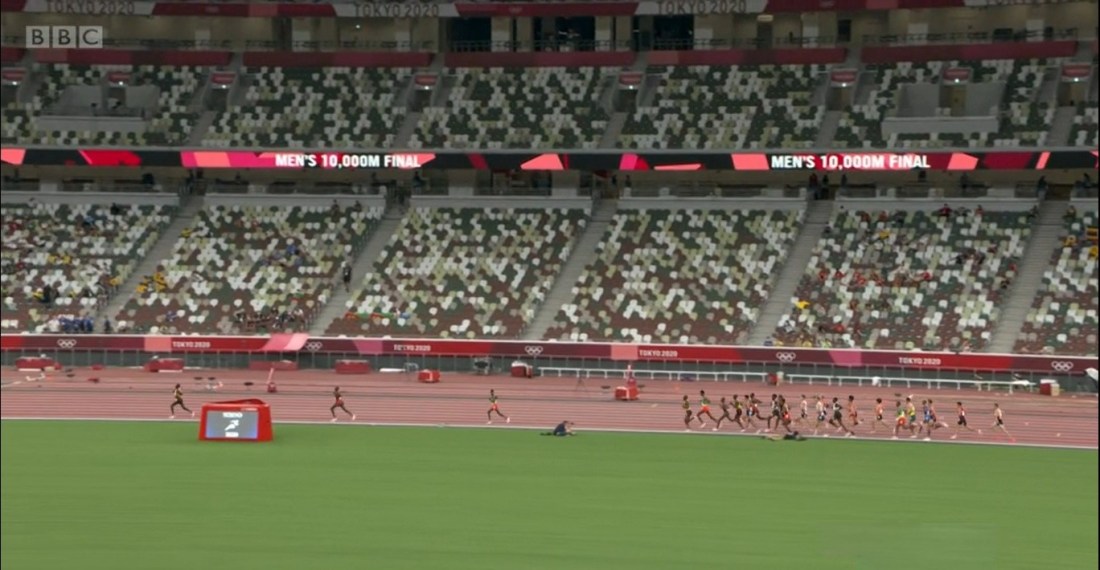
Day 7 of the Tokyo Olympics brought the opening sessions of the athletics. Empty seats have been a feature of sporting events throughout the pandemic and while the Japanese organisers had managed to break up the monotony of the seating with blocks of black, white, grey and brown creating something resembling QR codes or pixelated photos, it brought back memories for me. I attended the opening night of the athletics at the 2004 Olympics in Athens in a stadium that was three-quarters full.
The spectator-less seats of Tokyo provide a back drop to the men’s 10,000m final
It was the final night of my two-week trip to Greece during which, the second week had been spent rushing between Olympic venues to watch as many different sports as possible. To top it off, it was my birthday so a great way to finish off my holiday before heading for home.
The session started at 7:30pm and went on past midnight. The athletics ticket was the most expensive one I bought at 90 Euros, which was £60 at the exchange rates of the time, but I didn’t mind paying that to watch world-class athletics on my birthday. By comparison the much sought after swimming tickets, cost as much as 200 Euros if memory serves me right. Funnily enough I didn’t go to the swimming!
The Olympic stadium from the outside with Olympic flame alight.
I arrived early from an afternoon at the beach volleyball and took a final look round the Olympic complex before entering the stadium. I knew my way round the complex by now from all the time I’d spent there and I’d seen the inside of the stadium on grainy television from watching the torch lighting and opening ceremony a week earlier. Since then it had been Olympics morning, noon and night.
My seat was at the start of the back straight, opposite the finish line, at the end of the first bend. It was on the lower tier, many rows back and, as I walked down the aisle, there were already many other spectators in place. I had to squeeze past twenty people to get to my seat with all the attendant standing up, sitting down and apologising. Once I finally got to my seat, I realised how cramped it was going to be. Elbows touching with people on both sides of me and my knees against the seat in front. I wondered how I’d get through four hours of this.
As had become my tendency, I said “Hello” to the people either side of me and this turned into a chat with the chap on my left. “Are you on your own?” he asked. I replied affirmatively and he went on to explain that he and his wife had been given complimentary tickets by the IT company for whom he worked. The only problem was her ticket was at the other end of the stadium and they weren’t next to each other. Then he pounced.
“Would you mind swapping with her?”
Always happy to help and not feeling it could be any worse, I agreed and we went back through the embarrassing process of squeezing past the twenty seated people to get to the aisle. Up the stairs and out of the arena. We walked around the outside of the stadium, which seemed to take forever, until we were right below the Olympic flame that I’d seen being lit a week before.
I never questioned what was happening as the man phoned his wife. She came out of the stadium handed me her ticket, I handed her mine, they thanked me and that was it – I never saw them again. I walked up to the entrance, showed the ticket to the checker and they let me in with no problem. I emerged into a section full of empty white seats, my heart leapt into my mouth and I thought I’d been duped.
The rows of empty seats where I was to be seated. More empty seats are visible at the other end.
Rationality took over. The ticket was ok, security had let me in and I was just in a section where there was no-one else. On reflection, the organisers probably wanted to fill other areas first, particularly where my original seat was, as that would be seen on television. I strode down the steps to my seat in row 13 and was able to stretch out. There were perhaps fifteen people dotted around the whole section and I certainly wasn’t bumping elbows anymore.
I relax. Comfortably socially-distanced when it wasn’t needed!
There was no-one within ten metres of me – perfect for today’s social distancing but in 2004 we had different issues. Previous Olympics had been disrupted by a bomb in Atlanta and terrorists in Munich and we were only a few years removed from Sept 11th and the invasion of Iraq, security was always tight. There was a long list of things you couldn’t take into stadia and backpacks were always checked. I bought and lived off snack food and drink from vendors the whole week because you weren’t even allowed to take so much as bottled water into an event. Fortunately the prices were reasonable even if it wasn’t healthy. Looking at the photos I’m surprised at how bloated I look.
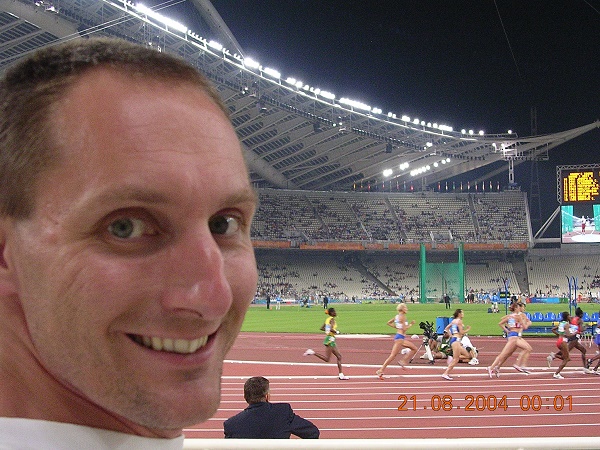
I tried to get a selfie at every event. The second heat of the women’s 5,000m going on in the background.
With only empty seats between me and the front, I wondered whether I could move down there but didn’t want to risk a confrontation with security or the threat of being removed from the stadium, so for half an hour I sat thirteen rows back with the raft of empty seats stretching out in front of me. At 8pm I snuck down to the front row and sat within metres of the track for the rest of the night. Whenever an event was due to take place, the competing athletes would enter the arena, parade clockwise around the edge for spectators to see them. For me, they were almost in touching distance.
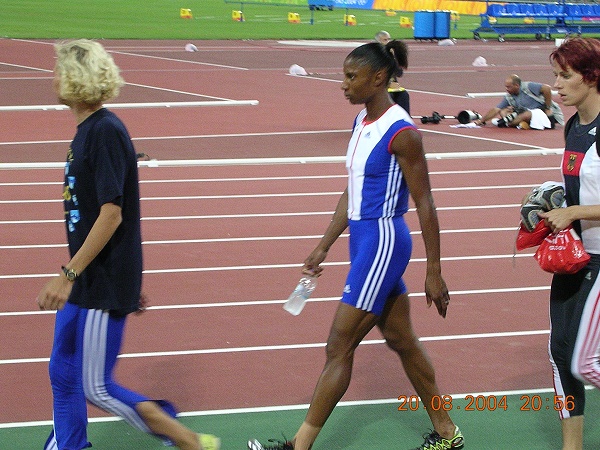
Denise Lewis and other heptathletes parade past on the way to their next event. Twenty-four hours later, Denise would no longer be the reigning champion.
Some events, such as the men’s high jump and discus, took place down the other end of the stadium so I watched them on the video screen. But situated where I was, on the bend, I got to see the 200m and shot putt of the women’s heptathlon featuring reigning champion Denise Lewis and fellow Brit Kelly Sotherton while, of course, all the other track events went past. It was amazing to be so close to the action. The organisers had scheduled a mixture of events for the session such that, almost every discipline was on display.
Kelly Holmes begins her pursuit of double gold beginning in the 800m.
The highlight of the night was the final of the men’s 10,000m; most other events were heats or qualifiers. I wasn’t into running enough then to appreciate the significance of reigning champion Heile Gebrselassie handing over his crown to Kenenisa Bekele. Of course, these days I know much more about running and looking back though all these photos has given me a new appreciation for what I experienced that night and who I saw.
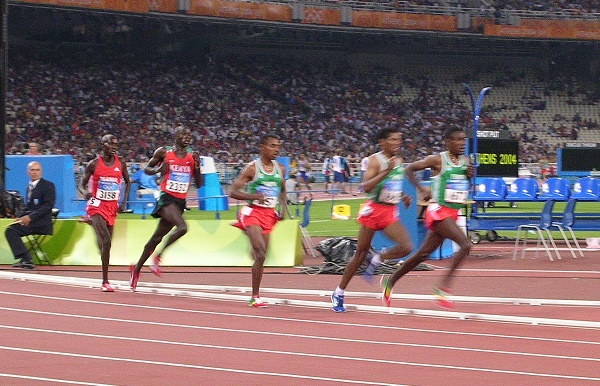
The final of the men’s 10,000m. Ethiopia’s Sileshi Sihine, Heile Gebrselassie and Keninisa Bekele ahead of Kenya’s Moses Mosop and Uganda’s Boniface Kiprop.
At 11pm some people from the neighbouring section realised it would be much more comfortable in my empty section than their own crowd-filled one so they snuck over. After having had it almost to myself, I felt strangely territorial about them entering my space even though there were more than enough seats for everyone. Maybe it was they were loud and noisy that irked me but no matter, it really didn’t take anything away from my experience. I was just tired after a week of constantly rushing from venue to venue; getting up at 6am, getting to bed at midnight and surviving on less sleep than I needed. Four hours of athletics had been a great end to my Olympic experience. When London rolled around eight years later, I was happy to sit at home and watch on television as I’d already been there, done that.
Another view of the empty seats as I stand below the scoreboard with Olympic torch towering behind it.
I would apologise for the low quality photos and video but it was the early days of digital. My camera was only 3MP, couldn’t record sound and I borrowed a 512MB SD card from someone at work to be able to store more images. Watching these video after so many years reminds me of the serendipity and luck that came my way when I agreed to swap seats with someone I’d never met!
A silent pan round the Olympic stadium – many empty seats
Eventual gold medallist Sweden’s Caroline Kluft runs in lane 3 (lane 1 is empty) while GB’s bronze medallist, Kellly Sotherton, runs nearest the camera. Powerful running in the final heptathlon event of day 1 – the 200m
Kenenisa Bekele in the final 200 metres on his way to gold holds off Sihine with the legendary Heile Gebrselassie twenty seconds adrift and featuring from 21-30secs in
A heat of the women’s 100m takes place in the distance. Heptathletes can be seen warming up in the foreground
Boardman accurately predicted it would take around 55-mins to cover the course, not too difficult maths when the riders are going at 48km/hr and the course is 44.1km long. At just under an hour it’s an event that’s comparable to elite men’s half marathon running, or in physiological terms it’s being run at Threshold. For lesser runners that might be a 10-mile run or only a 10K – it’s applies to whatever you can cover in an hour.
The nugget of commentary that really struck me was Boardman’s description about riding at Threshold. He stated:
“The first five minutes is free, you don’t feel the pain. That’s the bit where you have to use your head rather than your heart and then it becomes self-regulating, you start to get a feel for the pace, the pain sets in and then you manage it”
What he was describing was how, when you begin a race the legs are free of lactate and waste products that eventually begin to make them feel heavy and the effort to keep them moving gets tougher. With fresh legs it’s easy to go off too fast – build up the lactate quickly and then suffer; the ideal is to ration the build-up evenly over the course of the race. This is true at all race distances and even true during interval training.
After co-commentator Simon Brotherton mentioned that there’s a “fine line between pushing as hard as you can but not going too far into the red” to viewers, Boardman responded with more gold dust:
“There’s a constant calculation going on between …
How far is it to go?
How hard am I trying?
Is this sustainable? And if the answer is yes, you’re not going hard enough. If the answer is no, it’s too late so you’re looking for maybe”
What a fantastic piece of commentary. I must admit the idea of maybe seems quite novel to me. I’ve probably always pushed myself into maybe without realising it and just aimed to hang on, but I’d usually coach people to keep in the comfort zone of yes. We like things to be black-or-white, yes-or-no; Boardman showed that the best in world are risking playing on the edge with maybe!
Next time you’re on the start line at parkrun remember these quotes from Boardman and see how they reflect your experience. The great thing about parkrun is you can test “yes”, “no”, “maybe” over the weeks and begin to learn what each feels like.










 Big Red Running