Eilish’s low mileage

Scotland’s Eilish McColgan is the current golden girl of British Athletics. This year she has set distance records, the first occurred in February when she broke Paula Radcliffe’s British half marathon record by 21 seconds in 1:06:26. Then in May, she ran 30:19 to take Radcliffe’s 10K road record and on Monday (June 6th), she ran this time again on the track in Hengelo, Netherlands to set a Scottish record.
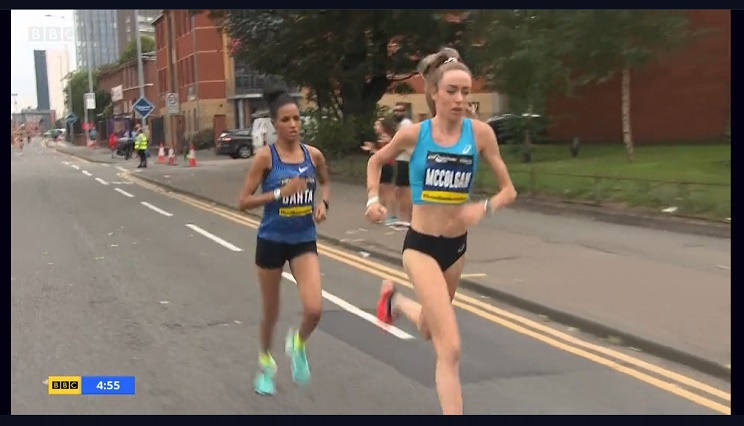
The McColgan name is not unfamiliar to followers of running. Her mother, Liz, was the World Champion in 1991 at the 10,000m having already been Commonwealth Games champion in 1986 and 1990 and silver medal winner at the 1988 Seoul Olympics. When she moved up to the marathon distance she won New York (1991), Tokyo (1992) and London (1996) marathons. Eilish’s father, Peter McColgan, was also a talented distance runner who competed for Northern Ireland in the 3,000m steeplechase and 5,000m at the Edinburgh Commonwealth games as well as for Great Britain in the steeplechase at the 1991 World Championships. What a pedigree for Eilish to have!

Not only does she have the genetic advantage but Eilish is also part of a generation of successful female Scottish distance runners. Laura Muir has been the most successful gaining a silver medal at last year’s Tokyo Olympics where she set a British record for the 1,500m in a time of 3:54.50  In 2012, Lynsey Sharp was European champion and competed at the London Olympics in the 800m. She followed this up four years later setting a Scottish record of 1:57.69 while finishing 6th in the Rio Olympic final.


A recent BBC article detailed that this year’s success is down to Eilish undertaking a reduced training load that Liz had to be persuaded would be in Eilish’s best interest. Liz had been running as much as 140 miles per week in her marathon prime.

But this highlights the event differences. Liz was always a long distance runner doing 10,000m and marathons. Following in her dad’s footsteps, Eilish competed in the 3,000m steeplechase for Great Britain at the London Olympics and then the 5,000m in Rio. It wasn’t until 2018 (when she 28 years old) that she began racing longer distances winning the ten mile Great South Run in 54:43. Roll on three years to the Tokyo Olympics and Eilish competed in both the 5,000 and 10,000m. Looking back at her Personal Bests, her time for 800m is 2:07.8 – over ten seconds slower than Lynsey Sharp and her mile is 4:00.97 which is five seconds slower than Muir. It’s clear that although Eilish competes in middle distance races, she lacks the top-end speed to be winner against the best and like her parents is better suited to the longer distances.

So it’s surprising when she talks in the article about how her training increased from 20, 30, 40, 50 miles per week and has only been operating at 65-70 over the last year and a half to two years. It’s not unusual for a world class 800m runner to operate on as little as forty miles per week but Eilish isn’t one. Typically world class 5,000 – 10,00m runners train between 70-100mpw. Given the recent increase in training mileage, it’s no surprise that when Eilish returned to the Great South run last October she was four minutes quicker than three years ago.

There’s no doubt decent mileage is critical to distance running success and Eilish’s approach of starting on low mileage and building up is a good one to follow but far too many runners simply aren’t doing enough mileage to support longterm improvement. Getting the balance right is important and, as Eilish shows, great results can be achieved off moderate mileage.

While I don’t wish to take anything away from how hard I’m sure she’s working in training, it should be noted many road and track records have been broken over the past couple of years due to the innovation of carbon plates in shoes. I am slightly sceptical Eilish would have been breaking Radcliffe’s records without them (at least in the near future); but many past records have been broken due to now-forgotten reasons outside of better athletic prowess. And in the longer term, unless the IAAF backtracks on the use of carbon plates, these records will become the new standard. All power to her – she’s still the best we’ve seen in a long time.

Whatever the reason, I have no doubt Eilish McColgan is going to go on to greater things as she gets the benefit of higher mileages and moves up to the longer distances permanently. At 31 years old, she has potential for another Olympic cycle in her and maybe more. I’m sure she will be looking to emulate her mother by taking on the London Marathon and other Majors.


Bonus content – Eilish is listed in Wikipedia at 1.80m (5’11). In my article on stride length I observed her cadence averaging 172 steps per minute giving her a stride length of 1.97m. It’s easy to think this is because she is tall and to an extent it is. But, as I also pointed out, Eliud Kipchoge (1.67m – 5’6”) has a stride length of almost two metres – about 15% greater than his height.

A quick look back at Paula Radcliffe running mile 5 of her record-setting 2003 London Marathon shows her running with a stride length of 1.67m (186-88 cadence) when she is 1.73m tall (5’8”). It’s a decent stride but it’s shorter than she is!

Update on my 800m training – May 2022

Was it the hills?  I entered the month feeling positive after some very quick short intervals in April but throughout May my legs have struggled. I started doing hills in April to build speed and they’re certainly feeling stronger but they also tend to take a few days to fully recover.

I’ve never been a decent sprinter but I think I probably should have been. Firstly because I find it easy to put on muscle, and secondly because I’ve never found it easy to be good at distance running. Once I got on Strava I began to see how often quicker runners are able to get better results despite training half as hard as I do. I seem to lack the natural aerobic capacity that many distance runners have.

This is all behind the reason why I decided to give 800m running a try. It’s an event that still needs decent sprint speed backing it up. But when I started following a plan by Jack Daniels eighteen months ago, it didn’t do much for speed recruitment and I made a deliberate decision not to overdo things as I found it easy to run quicker than expected. This again is another reason why I think I’m better suited to short distance racing.

Even so I felt my top-end speed was missing as I could barely get my peak speed below five minute mile. Last February, I started looking at how to improve cadence in the hope this would improve my form for sprinting and top end speed. Six months ago I started doing ten minutes of sprint drills twice per week to clean up my technique. It’s made a huge difference.


So here I am doing Summer Training to build speed and peak for my next 800m attempt. With my aerobic base enabling me to run seven minute miles for an hour in the winter, I decided it was time to introduce hill and flat sprints on a Monday to recruit more running muscle and get faster at the top end. It seems to be working.

Six years ago, I was doing the same set of workouts and my times then for 60m, 80m and 100m approx. were 10½ secs, 12 secs, 16½ secs. Admittedly I tended to do these after another session but this year I’ve recorded times of 8.75s (60m), 11.5s (80m), 14.6s (100m). A definite improvement and fairly good considering I’ve barely done anything like this in the past half-decade and I’m now in my fifties.

I also found on the most recent block of flat sprints I was hitting some high cadences with the two highest values coming in at 262 and 278 on different efforts. I’m slightly wary of whether the cadence monitor is wholly accurate but if it is these are genuine sprint numbers. Again this backs up the belief my form is improving.

The rest of May’s training was something of a slog to hit target paces. Quite often I missed my faster targets but the legs always seemed sluggish after the sprints. This resulted in a decision – I’ve decided though that working on speed over this summer is the priority so if other sessions are a little behind because of that, so be it. Overall my numbers are still an improvement over where they were a year ago.

On into June. This is the hardest block of training. I’ve felt tight and slow on recovery days but hopefully I’ll get through it!

Paula’s kids

In my article about marathon speed, I wrote about how the best marathoners of the Sixties could all run 400 metres in under a minute. They started out at clubs where they developed their speed and only later worked on endurance. This idea has been something rolling around in my mind for a while now and I wanted to provide another example

Back in the November 2019 issue, Runner’s World ran an interview with Paula Radcliffe on getting more kids into running. One question and answer stood out to me:

RW: With parents like you and your husband Gary [Lough, coach to Sir Mo Farah] your children must be pretty active?

PR: Absolutely. Both of them [Isla, 12 and Raphael, 8] will sometimes do kilometre events in Monaco where we live. Isla recently ran 3:25 and Raph can do 3:43. We also recently dropped Raph into a one-mile race with a bunch of men and he actually finished third in a time of 6:26! He absolutely loved it. I’m not sure that the men did though …

Imagine that! An 8-year-old boy running 3:43 for a kilometre and a 12-year-old girl running 3:25. Now go out and see how quick you are. When I ran my 800m time trial at start of December 2020 I clocked 2:58 which is the same pace as Raphael but I have no doubt I’d have lagged behind him had I run another 200m. That quickness over the kilometre enables him to run a fast mile – it’s not like he’d stop at 1,001 metres and have to walk the rest. I’m guessing he’d have been hitting 22-23 minutes for a parkrun if they dropped him into one.

Now I could make excuses about small children having a good weight-to-power ratio, lower centres of gravity and no idea about pacing. But whatever the reason, these kids are QUICK and I’m doubtful it’s down to the genetics of their parents. It will be the excuse those men beaten over the mile give “He’s Paula Radcliffe’s son so he’s born to be good”. But I suspect the truth is more down to how Paula and Gary are coaching their children to run quickly first before they step up the distance.

I suspect if you could find a snapshot of Raphael against all those other mile racers, he would have been up the front from beginning to end. He would be one of the fastest over quarter mile, half mile and so on. The speed he carried through the distance with him gradually slowing as he went into the uncharted territory of the mile.

I genuinely believe 90% of people can run significantly faster if they train for it. I got sucked into working exclusively on endurance for the past four years and while my times remained decent I was struggling to hit the heights I’d once reached so easily. I used to have oodles of speed available because I pushed hard on every run and gasped my way up every hill; but I always felt something was missing when I raced. As I began to understand endurance it turned me into a more efficient runner who recorded faster race times. The only trouble was I lost touch with my speed. You have to keep going back to speed to maintain it. If you’re constantly racing and training at 6-10 min/mile, you lose the ability to finish at sub-4 paces. People think all the slow training kills their speed, it doesn’t. It only goes when they stop working on it.

Now ask yourself, if you raced Raphael or Isla, who would win? If the answer isn’t to your liking then it’s time to do something about it!

What’s the objective?

Have you played Wordle – the word-guessing game that went viral at the start of this year?

If you haven’t, don’t worry; there IS a running-related point to this post. The aim of Wordle is to figure out a 5-letter word within six guesses. You enter a word and the app indicates if there are any letters correctly placed, or any correct letters placed wrongly.

Color-blind mode in case you’re wondering!

Most people realise they can improve their chances by starting with a word which has commonly used letters. There’s no point in beginning with a words that has Zs, Xs, Js or Qs for example. While it’s obvious they won’t come up often – it’s perhaps not so obvious that letters like B or G are well down the list of those likely to be used. I learned the most frequent letters are E, T, O, A, N, I, R, S, H, D when I was at middle school, so I start off with words that consist of them.

People also know every word has a vowel (or “Y”) so they think a word like ADIEU is a good starter because it identifies the vowels, but there’s a downside to this. When you take your next guess, you’re reusing those vowels and have less room to figure out the consonants. For example if the A and E are correct in the first guess and you then use LATER on your second word, you’ve only used four of the twenty possible consonants on your first two guesses. You might have the A and E as you enter your third word but still not have found any of the consonants out.

I realised that if I used my first three guesses to get fifteen different letters out on the board, I’d definitely identify the vowels and almost certainly get some consonants while being able to rule out Z, X, Q, J. Worst case scenario, I’ve still got three guesses left for figuring out which of the other seven letters I need to use.

The result of this strategy has been very successful. I’ve only failed once on Wordle in 100+ attempts. That was back on March 11th when the word was WATCH. Why did I fail on WATCH? Because it has multiple possibilities – PATCH, CATCH, HATCH, MATCH, LATCH, BATCH. At least seven different words to slot into a maximum of six guess. And it’s made even harder because CATCH and HATCH involve a double letter. On reflection, I should have then entered a word like BLIMP to eliminate four of the options in one go. That’s good strategy for you.

Playing this way, I found I was able to get the word in under thirty seconds (quick typist), some days as quick as seventeen seconds (slow broadband) but there was a downside to this.  You’re never going to get the word in fewer than four guesses (unless you luck in).

This was great while I was playing on my own and my objective was simply to get the word that day. But then I started playing against other people. Always being ‘guaranteed’ a 4th guess was good on the days while others were learning the game but eventually there would always be someone who came up a 3 or better. Now I never won. I had to rethink strategy and go boom-or-bust to try and get it in few than four. Or wait for them to play and see whether a 4 would be good enough!

My original objective when I started playing was to get the Wordle in six tries. Once I realised I could always do this, my objective became to get it done as fast as possible and get on with my day. When I started playing against others I changed strategy again. This is a lesson in life it’s taken me many years to realise. The strategy changes depending on the objective. There is no single perfect strategy or method that will enable you to always meet a variety of objectives.


I once spoke to a runner who found running hills brought her parkrun time down quickly and then, having entered a marathon, continued doing them. It was only when I pointed out over coffee that trying to improve her speed beyond 7:30/mile was fairly pointless as she was hoping to run a sub-4hr marathon at no faster than 9min/mile. Trying to improve speed was the wrong training for her objective.

This isn’t unusual. Runners have a collection of standard workouts and try to apply them to everything – the proverbial “to a man with only a hammer, every problem looks like a nail”. That said, most runners recognise that if they’re going to train for a marathon they’re going to do more mileage and some longer runs but that’s conventional wisdom tilting their training, not understanding the requirements of their objective.

There are certain underlying principles to training that work across all events – training daily is more effective than training a couple of times per week. You’ll always do better at Wordle with a starting guess of CLEAR than you will with VIVID. The high frequency letters enable you to build on later guesses, the low probability ones usually leave you with five guesses and probably no closer to a solve.

Just as high frequency letters like E, T, S are clearly better guesses in Wordle than X, J, Z; it’s obvious that sprinters train differently to marathon runners. But the difference in training between a parkrun, 10K and half marathon is not so obvious to the lay person, just as most Wordlers are unsure whether C, P or G is more prevalent.

It is possible to be good at different events at different times in a career. After all, Eliud Kipchoge was the 5,000m world champion back in 2003 and then when he changed his objective he became the best marathoner in the world. The change of objective necessitated a change in training plan.

You could look back to the 1950s and find Emil Zatopek winning the gold medal in the 5000, 10000 and marathon at the Helsinki Olympics and Lasse Viren trying to replicate the feat in 1976 where he won golds on the track but could only place 5th in the marathon. Training had moved on by then and people had begun to realise you specialise and train for the event rather than simply trying to be a good all-round runner. You certainly won’t find anyone attempting it these days. A local club runner might be able to do it against a sub-elite field just as getting Wordle in four guesses was successful until my competitors figured out how to play better.

It’s been a revealing yet simple reminder from playing Wordle this year that the strategy you use depends on your objective. Likewise with running there is no single way to train for every event and you cannot be world champion at them all on the same day. It’s always a choice between speed or endurance, or finding some combination of them. How you train depends on your objective.

Making Progress

The idea of progression is not new yet it’s rarely understood or utilised by runners. If they’re following a plan then it incorporates progression but if they’re doing their own training, they’re likely just hoping they will get faster by running runs quicker.

That said, anyone who has ever trained for a marathon has an inkling of what a progression looks like. They know can go out and run five to ten miles at the moment, but the idea of reaching 26.2 is enough of a gamechanger that they resort to some sort of plan to get there. How do you get from ten miles to twenty? You do it by progression – simply adding 1-2 miles each week … ten, twelve, fourteen, sixteen, eighteen, twenty.

Usually there’s a timeframe attached to training which forces the numbers. My last marathon, should have gone smoothly as I’d completed the twenty-mile run three months before the race but then I suffered an injury. Suddenly I only had eight weeks to go and I squeezed the progression to into six weeks – 9, 11, 14, 17, 18, 20½, dropped to 9 miles and then ran the marathon the following week.

So that’s the first thing you do. You look at how much time you have available and where you want to get to and then create an evenly stepped progression up to it. But it’s not only increasing distance that we can create progression for.


Most runners have a set interval session they like doing. It might be 12x400m equal jog recovery, or it might be my old favourite 5x1K with 3-min recovery. Runners usually aim to get faster at the efforts in the hope this will help them race quicker.

This is what Roger Bannister did back in the day on his way to the first four-minute mile. In the preceding October he was running 10x440yd in 1min06 with 440yd jog recovery in two minutes. Each month he would run the laps one second quicker so when he attempted the record in May he was running some laps as quick as 56 seconds.

But running laps faster isn’t the only way to make improvement. Notice we have four factors in Bannister’s session:

  • No of reps – 10
  • Lap distance – 440yds
  • Recovery time – 2mins
  • Pace – 1min06 initially

NB The combination of reps and effort distance gives a total distance of work – 4,400yds.

We can vary any of these factors to try and help us improve. The overall aim of the progression is to take us from a low point of fitness to a higher point in a safe and achievable way. Just like marathon runners try to go from ten to twenty miles over a number of weeks in training.


Usually we only change one of the variables at a time and keep everything else the same. For example we might start out doing 8x200m then 10x200m on to 12×200 to increase the overall volume from 1,600m to 2,000m to 2,400m.

We might then change to longer intervals 6x400m, which involves also adjusting the reps down from 12 to 6, to keep the overall volume the same at 2,400m. What we rarely do is go from 12×200 to 8×400 which increases both length (200 to 400) and overall volume at the same time (2,400 to 3,200).

For these examples we’d look to keep the pace and recoveries the same as before. Actually the recovery for longer intervals might also increase but it would still be in the same ratio as the previous efforts (e.g. both 8x200m with 200m jog recovery and 6x400m with 400m jog recovery have equal jog recovery).

Once we’ve increased the volume of work being done by varying the reps and interval lengths, we might reduce the recovery between them which makes the runner attempt the next effort in a more fatigued state. The challenge become whether they can continue to run all their efforts at the required pace despite the building fatigue.


For a progression to be effective, it needs to take place over a number of weeks. There’s no point doing one thing this week and something completely different the next. If you think about Bannister’s training, he was giving his body a month to adapt before moving onto the next step of the progression by improving the pace – he was doing the same session for six months!

Update on my 800m training – Apr 2022

April has been a month of weeks! Following on from Bournemouth Bay 1/2M on the 3rd, I took a few days break. That was the first week. Then I started training and it was a heavy-legged slog culminating with a not-too-great parkrun. That was the second week. It was followed by three workouts in a week and the legs finally beginning to lighten up. That was the third week. And finally, last week I’ve begun to feel back to where I was in March aerobically.

I’ve been wondering how to approach this block of training. While I liked the structure of JackD’s 800m training plan which I followed for two cycles last year, I didn’t feel I improved enough off of it. Having worked on my endurance all winter, I felt I would be safe to begin working on speed and wanted to use some of the concepts which Steve Magness talks about in his book – The Science of Running.  Most notably this would involve hills and breaking the interval work into sets of 800m.

Hills

Mondays has become hill sprint day. These are the tool espoused by Magness for improving speed and recruiting more muscle. It’s all about short, all-out efforts lasting only 8-10 seconds followed by long recoveries. By working as hard as possible on each effort, you maximise the speed and recruitment without having the legs tie up with fatigue. The long recoveries then allow the energy systems to recharge for the next effort.

My legs have lost a lot of muscle and size over the past ten years. When I was in my early twenties, the gym report states my quads were around 26”; these days they’re 23” at most. It’s no surprise my legs were so strong because every sport I played I went at full-force. Playing squash was lunging two or three steps in each direction. Running round a football pitch or basketball court was accelerations of 5-10 metres to close down an opponent. Playing volleyball gave my legs a good workout with constant jumping at the net or squatting down in the back court. When I went for a run, I started off at a sprint and held on to puff my way round. All of that is the antithesis to how I’ve been training for the past five years.

I followed Magness’ plan back in early 2016 but they were usually done on tired legs, after an hour effort run along the beach promenade. My training progressed during those months but I was doing other good effort sessions at the same time so I can’t quantify how effective they were.

I’ve certainly felt good on this year’s efforts and they have combined well with improved running form from the sprint drills I’ve done since October. The following day is always a little slow but that’s to be expected with the muscle fibres recovering.

Short intervals

My intention was to do my own version of speedwork on Wednesday and Fridays. For the first two weeks I decided to follow Jack’s plan of 200s and 400s until I was ready to implement my own ideas.

The reality is when I started doing these sessions, I found my pace was off-the-charts compared to last year. Having not run a recent 800 time trial, I had nothing to base my training on so I estimated, based on my half marathon training, that I was likely in around 2:36 form and therefore should be running efforts at 43secs per 200m. The first session of 200s all came in at 39-41secs despite having tired legs. The following week I was aiming for 1:26 for 400s and found myself running a couple at 1:17 and a couple at 1:22. This was a huge improvement over the same session in training last year when I was hanging on for 1:30-32. The previous cycle it was 1:35-36 hanging on.

Last year I would feel tired after sessions; this time I’ve been running far quicker than expected but not feeling torn down afterwards. Given I was so far ahead of my intended pace I’ve decided too stick with Jack’s plan and not change anything around in terms of the efforts and splitting it into sets. The only change I have made is not to adhere so stringently to the warm-up and cooldown durations.

The final session of April was two sets of 6x200m with 10-min jog recovery between. The first effort of the second set came in at 35.2 secs which is the fastest I’ve done. Compare this to the 48-secs I was running when I began 800m training in December 2020. It wasn’t just one fast effort, all but one effort was sub-40 and the average came in at 38.16sec.

Near disaster

Despite my success, I’m slightly concerned I may be overdoing these. At parkrun after the successful 200s session, my left Achilles ached and then popped on the Sunday long run. My first thought was “oh no” but I could run without pain and have just seen it as a warning sign. I’ve probably been doing these efforts closer to 800m pace than the intended mile pace and during May, I’m going to focus on pacing these at around 41½ sec per 200 (5:30 per mile).

Actual disaster (minor)

On arriving at Poole parkrun in mid-April, I cinched on my watch and the strap broke. I had to carry it all the way round. That evening I went away to a birthday party and danced until midnight. Next morning, waking early at 5:40am in a strange bed I went for my long run up the Basingstoke Canal. I intended to do my standard 10-12 mile run lasting 1hr20-40 and popped the watch in my back pocket. I didn’t mind running without the numbers but I had no indication of how fast or how far I was going. My legs were so tired from the all-out parkrun and a night of dancing that it was a trudge. The final miles back I gutted through, working mentally hard to avoid the urge to stop and walk. When I arrived back and pulled the watch out of my short’s back pocket, I was stunned to see I’d run for 2hr05 and 14+ miles. No wonder it was tough – that’s my longest run in time and duration in almost two years.

Can’t decide whether to change both parts of the strap!

I carried my watch around in my hand for the next two weeks. It’s impossible to know when to start or stop efforts in an interval session if you’re carrying it in your back pocket. What I noticed is the outsides of my shoulder aching towards the end of runs. I’m not sure if it’s down to carrying the (very light) watch with arms/hands locked in position or whether it’s just the effort of the sessions. I have had shoulder aches at other times when I’ve run fast. Nonetheless it got me wondering about those people who carry bottles which are much heavier.


It’s been a great month of running. I’m not sure whether it’s the hills or the winter training but something has improved about my running since the last cycle. I’m sure it’s down to improving my aerobic system over the winter and closing the gap between the fast paces and my general runs. Where last year the gap was the better part of 3-mins (9-min mile vs 6-min mile) now it’s closer to 2-mins (7:30 to 5:30).

I’m certainly finding it easier to recover between intervals and be ready for the next effort. But I also wonder if that’s partly because they’re being run quicker! Running an effort in 1:17 compared to 1:30 a year ago may not seem much but it’s 15% less time. Friday’s intervals, for example totalled around seven and a half minutes, a minute less than last June and ninety-seconds less than six months before that. While the individual efforts may be using as much concentration and energy, overall there’s less to recover from. This is why elite runners end up doing bigger workouts, they can do more as they get fitter. I could theoretically add a couple of more efforts to be doing the same volume of work as last year.

I’m looking forward to May’s training. My focus is on getting the pace right and ensuring I get enough recovery to avoid any injury.

My Last Marathon

I’ve only completed four marathons in my life. All of them were back in the days when I wasn’t a committed runner. It seems I was following, what is now, a familiar box-ticking approach to running. My first distance race was a 10K as parkrun didn’t exist then and 5K races were rare. But the sequence is standard – run a few races at a short distance then move on up to eventually do a full marathon. Now I realise training for, and successfully running, a full marathon is a big commitment if you want to do it well. Although I knew then you should do six months of training beforehand, I was only focused on getting the long run done. Again this is a familiar story of modern runners.

On the New Forest paths

My last marathon was way back in 2010 and, for the first time in my life, I was beginning to train more regularly. I began the year by entering a twenty mile race which, when the train had demoralised me enough, I downgraded to ten miles. I followed it up a few weeks later with the Bournemouth Bay 1/2M in 1hr38+ at the beginning of April. To that date, it was the best race I’d ever done and knocked 12-13 minutes off my old Personal Best.

In the weeks following the half I began to lose interest in running and it was by entering the New Forest marathon, scheduled for late September, that I found motivation to get out and train again. I was in decent shape and with five months training, it should have been easy. In fact by early June I’d completed the twenty-mile run leapfrogging from fourteen to seventeen to twenty. I spoke with an experienced runner and he suggested there was no need to do the twenty miles every week and my records show I only did a fourteen mile run after that before disaster struck and I pulled a calf muscle. I lost the whole of July and it was early August when I could run again.

Suddenly I only had eight weeks until the marathon and I’d gone from having over three months to improve on my twenty mile long run to needing to rebuild entirely. Still believing in the necessity of the twenty mile long run but also recognising I couldn’t do it the week before the marathon I squeezed training into six weeks – 9, 11, 14, 17, 18, 20½, dropped to 9 miles and then ran the marathon the following week. I often say the reason it worked so well for me is because I didn’t have time to overtrain or under-recover!


On the day, two non-running moments stand out in my memory.

Firstly I arrived to collect my number which my racepack said was something like #1600. In the sportshall, I saw two collection desks one with a sign saying “Marathon 1-999” and “Half Marathon 1000-2000”. I was confused as my number suggested I was running the half but I knew this wasn’t the case. What most surprised me is how devastating this was to my psyche. I’d prepared for the longer distance, so if I had to run half the distance it would surely be no trouble. I could see it would be a problem if you’d only trained for a half and then found yourself expected to somehow do double the distance but, not when you knew you’d run over seven miles further in training. Somehow it was devastating.

I talked to the organiser adamant that I’d entered the full marathon while he said I couldn’t have; fortunately he was willing to move me into that race anyway. Once I’d got my sub-1000 number I felt calm about what was ahead.

The second issue was forgetting my new running shoes. Of course I knew you don’t run a marathon in a new pair of shoes, so I’d broken them in before the race. But I forgot to bring them along and ended up running the marathon in the old battered pair which had lasted me all through training. Oh well. I didn’t get any lasting injuries so no harm, no foul. Not good race day preparation though, yet not the first time it happened to me!


The race itself went well. Classic autumn day and decent conditions – sunny, warm and not too humid. I’d borrowed a Garmin from a work colleague and watched the miles tick by. I’m not sure whether I went into it with an intended time – I suspect I did as I’d begun to discover the online race calculators. Whether I did or not I found myself running around 8:15/mile and with the help of the Garmin I was able to keep on track. I don’t remember much of the run other than it was scenic and all around the New Forest. I’d bought five gels, which is the only race I’ve ever used them in and on advice took one every forty-five minutes thereby consuming the 4th at the 3-hour mark. It worked well and when I finished in 3hr40min59, I still had one left.

As with any marathon the running got tough in the final miles. I’d covered the first twenty in 2hr45 and the final 10K in 55mins. It was slippage that cost me perhaps five minutes and had I gone into it better trained maybe I’d have achieved a sub 3hr30 time but I was happy with what I’d achieved. I still am.

Most important to me was I’d done the whole run without stopping or walking – the only one of my four. I started running in the early 1990s when races were still predominantly filled by club runners. The sub-4 marathon was the benchmark for any aspiring runner and while it was accepted you might run out of steam and need to walk at some stage; running all the way was a badge of honour.


Incidentally when I arrived home and checked my emails, I found had entered the half marathon five months before, back in April. I’m not sure how I mixed it up but there’s no doubt from the training that I always intended to do the full 26.2 miles.

Streak ends

Two years later than planned but my running streak finally came to an end at 845 consecutive days of 5K or more. The daily average was 6.3 miles, a touch over 10K. It started back on Dec 8th 2019 at the Christchurch 10K. I ran 46:30 that day and knew I needed to rebuild my running fitness. I’d been running 10K in 42-mins in the summer but about three weeks before the race, I’d caught a mystery illness that affected me for five days – headache, fever and then a loss of fitness. I’m tempted to say it was some early variant of Covid19 and well, who knows.

So I targeted rebuilding fitness thinking I’d enter Bournemouth Bay 1/2M at the start of April 2020. But, news of the Covid19 pandemic broke and I held off entering and it turned out to be the correct decision as we went into lockdown in late March. By then my running was beginning to pick up and I was running a nine mile Steady run around the locale in 1hr9.

My run streak was out to 100 days and I thought I’d see how far I could take it, fully expecting we’d be out of lockdown in 2-3 months and everything would be getting back to normal. If it went on longer and I reached September with my run streak then I’d try to take it through to the end of the year so I could say I’d done it. Of course, it didn’t work out like that.

With the endurance looking good, I dived into a routine of hill sprints, bounding and plyometrics to strengthen the legs. I overdid it and by mid-June I was feeling overcooked, suffering aches and pains every morning, before and after runs. These went on through July and August even though I adjusted my routine.

At the beginning of September I made an honest assessment of the situation. As much as I wanted to try to get to the end of the year with my running streak, I knew four more months of the aches and pains would be too much. If it had been say 4-6 weeks I could have pushed through. So I made a deal with myself, I’d back off the training pace but if I was still in agony at start of October, I’d take some rest days and end the streak. It worked, as after three weeks, the pain had eased but I still wasn’t fully recovered so I backed off even slower than the 9:15/mile I was jogging at. Some way off the seven minute mile pace I was running for 5K.

The true beginning of my rebuild, and all that has come since, began on September 21st 2020. I cut my daily recovery runs from an hour to forty minutes and dropped the pace down even further. My first three runs averaged 10:02/mile, 10:05/mile, 9:48/mile! I kept a Sunday long run and this came in at 9:25/mile. Within 2-3 weeks, I was beginning to feel much better, all the aches and pains had disappeared and the pace was a little quicker. There was still the occasional recovery run which was closer to 10min/mile but my 3rd Sunday run came in at a more effortful 8:41/mile (HR averaging 146bpm). By November I was beginning to feel strong, to add in strides and look for ways to work on adding more ‘stress’ to the runs. Everything was beginning to feel comfortable.

At the start of December, ten weeks after starting my rebuilding; I began 800m training with a time trial. And since then my training has been ever focused on that. I ran every day of 2020 and 2021 and continued on into 2022. Finally two years later than planned, I entered this year’s Bournemouth Bay run. I spent February and March running the nine mile Steady run again. Where in 2020 it had peaked at 1hr09, now it was 1hr03. My run streak finally ended two days before the half marathon and gave the legs a couple of days to carbo load and hopefully be at their best. It didn’t turn out that way but that’s a different story.

And so having run the half marathon I began a new streak … I didn’t run for the next five days!


This is the moral of the story. Streaks don’t matter – they should support your training – not be the goal. My run streak ended at 845 days because I had a race coming up. I didn’t run for five consecutive days because I was recovering from it.

On reflection there were one or two days in my run streak where I would have been better off taking a rest day or doing the run at a different time of day, or shorter distance – even I’m not immune to flights of ego but it never came to dominate. I was ready to give the streak up in September 2020 when the aches and pains were at their peak but some adjustments allowed everything to get on track.

But the streak itself? Well, it’s nice to talk about but the experience is more important to me. I’ve learned so much from going out every day. You get to see how the body is affected and reacts to tiredness. You begin to learn how quickly you recover, to learn when the legs genuinely don’t have more and when they do. And, of course, my fitness has improved. Recently able to run nine miles at the same pace as I would have run 5K a couple of years ago.

For the most part though, I’ve simply enjoyed going out for a run or jog. There is no new streak. I doubt I will ever run every day for over two years again. I hope to be entering more races and taking rest days before and after them.

Eleven Bay Run Half Marathons – a retrospective

This year was apparently the 39th running of the Bournemouth Bay runs. I did my first in 1996 but it was almost a decade before I got back to it. My sporting time back then was dominated by playing and coaching volleyball; as well as going to circuit training and just about any other sport that I could find to fill my time with.

In 1996, like the majority of runners in yesterday’s race, I did a couple of months’ worth of basic training registering 10-20 miles per week at most in my preparation. I’d run my first half marathon at Portsmouth a month before and, in the lead-up to that, my only training aim was to do the distance in training albeit at a slow pace. I recall running on the February 29 (leap year) from Bournemouth pier to Boscombe pier and back (I reckoned it was 3-miles – not bad given it’s actually 2.85!). Then from Bournemouth pier to Shore Road and back (6-miles estimate, actually 5.6) and then another run to and from Boscombe pier to take it out to twelve miles which with a bit of distance to and from the car parked up on the East Cliff gave me confidence I would manage the distance. Then I went to Poole Sports Centre and played a volleyball match. That’s how I rolled in those days, cram in as much sport and activity as possible. No thought or understanding for recovery or the impact of doing too much.

I didn’t worry about how fast I was running, it was all about completing it. It was a time when my legs were big and strong from all the volleyball jumping and on race day I felt I couldn’t run any faster. I now I understand I simply didn’t have the aerobic training required for a fast half marathon and that reflects in my average heart-rate being in the 170s during the 1996 race. I distinctly recall running along, feeling comfortable, chatting to the chap near me and saying my heart-rate was at 177bpm and him replying “That sounds a bit high”. I’d tend to agree with him now!!

YearTime (HH:MM:SS)RankPace (min/mile)Avg. HR
19961:50:3510th8:26170-175
20051:54:46Slowest8:45
20061:49:559th8:23
     
20101:38:304th7:31
20121:31:08Fastest6:57160
20131:39:436th7:36159
20161:40:178th7:39157
20171:35:373rd7:18157
20181:39:547th7:37158
20191:39:345th7:35155
20221:33:432nd7:08153

By the time I ran in 2010, I’d given up the volleyball and while my legs were still big I was running more regularly yet rarely more than twenty miles per week. I’d run a 1hr16 ten mile race three weeks before and most of my lunchtime 6K training runs were all-out efforts with a long run on the weekend. That was a game changing race as I set off fast from the beginning where previously I’d always lagged back then enjoyed working my way through the field. When I ran 1hr38 I was somewhat elated to take over ten minutes off my previous best.

It was late 2011 when I started taking running seriously and building my aerobic base. So at this stage, I still had the strong legs and while I didn’t fully understand how to train, I was beginning to learn. It led to my fastest half marathon ever and two-plus minutes ahead of this year.

What strikes me about most of the intervening half marathons is they’re all grouped around the 1hr39 mark. This could be a coincidence but I don’t think so. I’m sure it’s some kind of indicator of my natural level when I’ve done some training but not too much. The halfs in 2013, 2016, 2018 were all coming back from injury during the month or so before.

The one recent outlier is 2017 (my 3rd fastest) when I had deliberately done lots of jogging in the two months preceding it (400+ miles) and less than fifteen total miles at race pace. The result was good but I paid for it in the following days with soreness lasting until Thursday. Even so when I’d recovered three weeks later, I found myself running a 2½-mile effort run at 6:30/mile – significantly faster than the 7min/mile pace I had been running it in the weeks before the half.

Comparing 2012 vs 2022

In 2012, the average heart-rate was 160bpm and I spent fifty-nine minutes above it, maxing at 170bpm! Compare that to yesterday where my max only touched 160 a couple of times. It’s clear my aerobic base is improving yet that isn’t the only part of the story even for a half marathon. I was able to run a faster half marathon in 2012 with a worse base but the faster speed wasn’t there. I’m fairly sure my legs didn’t have enough taper from all the training but had I done so, I might have been in record-breaking form.

The flipside to the heart-rates is when I look back at my early Bay runs, I didn’t have enough of an aerobic base to run these sort of times. The high heart-rates in the 170s demonstrate that. There’s some kind of balance to be found.

Mileage isn’t everything

Another point of interest when comparing my 2012 and 2022 runs are my training logs for the preceding weeks. In 2012, my average weekly mileage was 33½ – 39, 26, 30, 36, 39 and 32; which is about 50% less than what I did this year when I was averaging 50.

I seem to run much better off lower mileage – perhaps in part because it leaves less to recover from. In those days I would take at least one day – Friday – off each week; this year I’d been running every day for over two years until I rested the two days before the half marathon.

I’m increasingly conscious that while some bang on about doing high mileage – it is not the be-all and end-all of running success. And certainly not critical if all you’re interested in is a parkrun or 10K race. Get quick over the shorter distances and the mileage will naturally increase.


I‘m hopeful once my legs recover I will be in a position to surpass everything I did in 2012. Back then I spent the year running sub-20 every Saturday at parkrun and training hard to break nineteen minutes but it never quite happened until the end of the year – after I’d done a block of endurance training. I always knew endurance training was important but could never quite understand how, ten years on I do.

2022 Bournemouth Bay Half Marathon recap

The result of my half marathon wasn’t quite what I hoped for. I’d gone into it with very decent training runs – the highlight of which was a session of 3x two miles which had been at 6:27, 6:32, 6:37 pace and consequently left me believing I might have a chance of breaking 1hr30 (6:52/mile). But it wasn’t to be and the run felt hard from start to finish as I ran 1hr33:43.

At eight miles I was just hanging onto 6:52 pace but there were hills to come and I faded badly. Reaching the 9th and 10th miles my quads began to ache and seize up. I struggled up the overcliff incline at about 7:40/mile with the added demoralisation of being overtaken by other runners. The steep descent down to Boscombe pier at mile 12 had the quads screaming as I hit close to 5min/mile and then there was the final run to the finish, again with runners overtaking me and barely able to summon a sprint at the end.

Going backwards isn’t a pleasant feeling but this was my 4th fastest half marathon ever and the 2nd fastest on this course – so it wasn’t a complete mess. And the other point of rationalisation is that six months ago, the aim of winter training was to improve my endurance base and I’m sure I’ve done that. My average heart-rate for the run came in at 153bpm which is notably lower than many of my past runs.

What went wrong?

At the start-line, I positioned myself near the front but my legs just never felt like they had any decent push. Usually if you’ve tapered well, when you get to a race you have to hold yourself back to avoid going off too fast. That simply didn’t happen and when I looked at the GPS data, I never went any faster than 6:40/mile apart from with the assistance of downhills. The mile down Alum Chine came in at 6:22!

Compare this to the training runs when I was doing back-to-back miles in training at 6:27/mile and there was something missing. I believe it was down to leaving my taper too late. Or more precisely that I barely did one. I’d been running fifty miles per week and then the week before the race was forty-five miles and then I only ran seventeen miles in the days preceding the race. It’s possible I dropped off too sharply but I’m inclined to think my legs never quite perked back up from some of the great training runs I did. I never felt the bounce of fresh legs going up and down the stairs at home.

Realistically legs being under recovered has always been a problem with my training and races. I tend to be a hard worker as I want to get the most out of myself. A few years ago, I used to know I was on the edge because the legs were sore, I got grumpy and couldn’t wait for the taper to begin. But these days it’s much subtler and I’ve gradually scaled back my efforts to account for this. But I simply didn’t scale back early enough this year. I felt I was flying in training and my legs were always feeling great. But the bounce disappeared about two weeks out which is when I started scaling back and I hoped it would return. It didn’t. On reflection, I should simply have gone out and jogged those last two weeks until the legs perked up. Even a three week taper wouldn’t be out of the question.

Quads

I don’t recall my quads ever hurting this much during or after a race. It may well have done but I don’t recall it happening recently – usually it’s my hips that hurt. I like to think this is a sign of how my running form is changing from the form drills I’ve been doing since October. It was the outsides of my legs that hurt all the way up to the glutes and I believe this is a sign I’m getting good hip extension. If I’ve got that right my stride should be lengthening as I push off more powerfully.

While I didn’t get the result I was hoping for I did come out of winter training with my primary goal met – improve endurance. I’m now ready to get back to training for speed as I hope (and expect) to improve my 800m time this summer. First I need a week or so to let the legs fully recover and then I’m going to start looking at hill sprints and other short interval work as a way to pick up the speed.