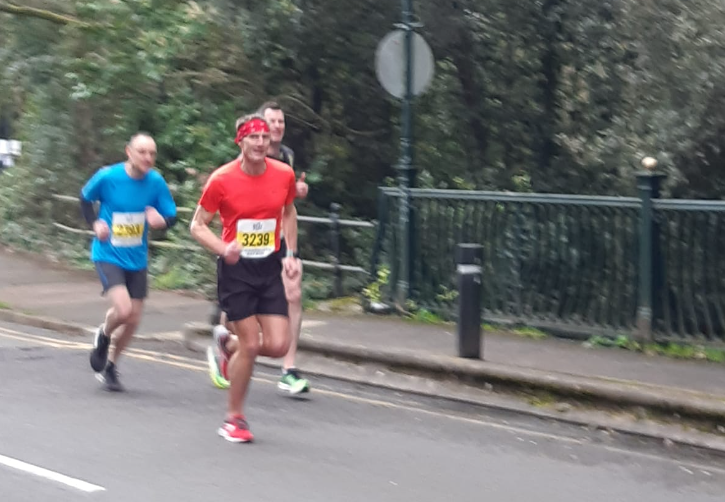
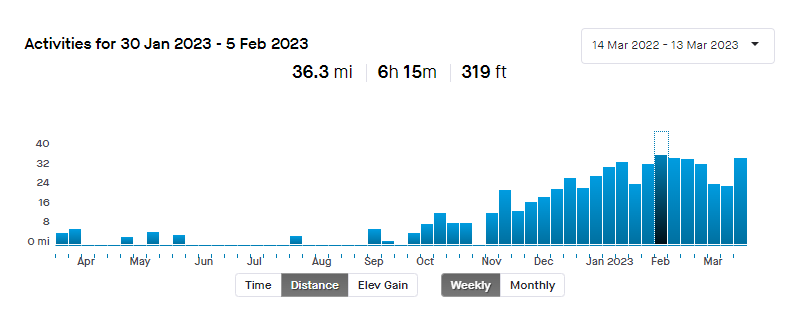
April has been a quiet month. Entering it I had high hopes of recording a decent time at Bournemouth Bay 1/2M but those were trashed when I ran three minutes slower than last year. I tapered better this year and my legs felt fresher on the day but, come the run it was a gradual slide with the first 2-3 miles coming in at just under seven minute miles. From mile five onwards the pace dropped to 7:25 and worse. I just had nothing and have easily done better runs in training. I documented last month how I ran six miles in 42-mins in training.
What was strange was how low my heart-rate was throughout the run. It ended up averaging 149bpm which when I consider I do Steady runs in the low 150s was very out of place. What it does go to prove is how little use a heart-rate monitor can be.
I took five days off after the half (no running at all) then went to Poole parkrun and ran 20:57. Both my calves and glutes were sore from it and I had a very slow, dreary Sunday 10-mile run. I ran thirty minutes each day through the following week and returned to Poole parkrun knocking my time down to 20:39. The following week was the same routine, a slightly faster but still drudgy ten mile run then thirty minutes each day. This resulted in a 20:17 parkrun! Three weeks of easy running, no speedwork and my racing simply got faster by forty seconds.
It now seems clear that I’d fatigued my legs too much in training. When I look back I’ve been doing fifty mile weeks since last summer and training hard in the week. The heart-rate monitor numbers were correct but the monitor itself can’t tell you how fatigued you are.
My overall feeling though is one of disillusionment – I’m simply not cut out for distance running. When I compare my training to others, I simply don’t get the results from training that they achieve off much less. I train hard with all sorts of different sessions but ultimately I’m physically not cut out for long distances.
I’ve known this for a while, it’s why I started training for the 800m. Thus far I haven’t really worked on developing my speed to a high level because I’ve been trying to keep the aerobic side in balance. As I’ve written in the Ageing series, the best male sprinters of my age are running under 11 seconds for 100m, 22s for 200m and 50s for 400m. While I’ve not gone all-out at any of these I’d be surprised if I could crack 14s for 100m, 30s for 200m or 1min15 for 400m – that’s just too far down and a gap I need to close up. It’s not because I’m not capable, it’s because I haven’t trained for it in years.
I’m beginning to conclude this has been where I’m going wrong. The first two iterations of training I followed JackD’s plan as he is a proven coach. It didn’t really help me. Last year I began hill training using a progression from Steve Magness’ The Science of Running and I felt this made a difference despite only doing one weekly session for three months.
I’m torn between entirely given up on the distance work until I’m notably nearer to the age-group records or trying to keep the two things in balance. All I know is when I started running seriously a decade ago, I was probably quicker on the speed side. I have little objective proof of this but my legs were much bigger and stronger. I was quickly able to build some of my best times at parkrun, 10K and half marathon on lower mileage than I’ve been doing recently because I had the speed first.
This summer’s plan is to repeat what I did last April / May / June. I combined Steve Magness’ hill sprints on a Monday with Jack Daniels’ 800m training plan on Wednesdays and Fridays. I lasted about nine weeks before I could see I’d peaked and my aerobic fitness was declining.
This year I’m intending to do the same but with some changes. Where I previously followed Jack’s plan for runners covering 30-40mpw, this year I’m downgrading to the 20-30mpw plan with shorter recovery and long runs. Actually Jack’s long run has always lasted only about an hour on these plans but I always did something in the 1hr30-40 range in an attempt to keep my aerobic system up.
The other change I’m going to make, as I’m not doing a time trial prior to starting training, is to be conservative on my numbers. I’m based my training level on my half marathon and fastest parkrun which basically have me running at the level of a 2:36 800m runner. It’s not that fast but I’m aiming to keep my legs fresher this year through less intensity and lower volume of training. Again this 2:36 start point is why I don’t think I’ve got the speedside sorted. It really isn’t that fast given how in shape and athletic I am. I just haven’t trained for speed enough in years.
I resumed faster training in the final week of April. I did 6x8sec hill sprints on Monday which felt great and I loved despite blowing hard at the end of each effort. On Wednesday I did 6x200m with 200m jog recovery aiming for 43s, they avg’ed 40.4sec. On Friday my legs were perking up and I repeated the session, this time with eight efforts, and they avg’ed 39.6sec. My body felt like it was hitting new territory. Or at least territory which it hasn’t been to in a long time. My breathing was gasping in the final efforts. I’ve been there before but this felt different for some inexplicable reason.
Before each of the workouts, I’ve been doing drills and strides to help warm-up and ingrain good form. I began these eighteen months ago and change has been gradual, notably beginning to kick in at the start of the year when I was doing my last block of short intervals. This explains why my glutes and calves hurt after the half marathon. It was the longest sustained effort I’ve done using that running form and therefore being powered by those muscles. My stride seems to be lengthening and when I begin an effort I can hit higher cadences than usual. This all suggests I can get quicker and build my speed up to the levels I desire.
Ahead of this year’s London Marathon, I happen to be reading a book all about it. This is pure coincidence as I picked it up off the charity bookshelf a couple of months ago for 50p. It’s been sat waiting to be read ever since but I had to finish off the badly written Chris Waddle autobiography first!
Published after the 25th running of the race, “The London Marathon – the History of the Greatest Race on Earth” was written by John Bryant. A marathoner himself by the time of his death in April 2020, he’d run London twenty-nine times, He was an established writer and journalist who’d worked for The Times, Daily Telegraph ad Daily Mail among other newspapers.
Often the people writing these sorts of books aren’t that involved, simply just writing up what they’ve researched on the subject. Bryant cannot be accused of that. He had run a 2hr21 marathon and coached Zola Budd when she was competing for Great Britain in the 1984 Olympics. It’s very clear he understands what he’s writing about and, also how to write it well. It’s a very engaging book split into twenty-two chapters with each detailing a piece of history or what the marathon experience is about.
I’m only about a third of the way through but so far I’ve read about Chris Brasher and John Disley, the founders. About the first race in 1981 and the dark years which followed in the life of its joint winner, Dick Bardsley. It details the British winners (including Charlie Spedding and Steve Jones) in the following years asking them why we no longer have the same success. It tells of Spirodon Louis, the winner of the first Olympic marathon in 1896 and interestingly that his win may have been assisted. How the marathon distance became established at its current distance rather than its differing distance of 22-25 miles. There’s a chapter about Ron Hill, who I previously wrote about, which confirmed my memory that the first 26.2 years of his streak involved running twice per day and once on Sundays.
Upcoming chapters promise a look whether the women’s time will match the men’s, the rise of African runners, what older runners can achieve, the celebrities and ordinary people taking on the marathon challenge. There’s a look at the logistics of organising as well as the demands on the runner’s body. It features the elite runners, the world record holders of the time Khalid Khannouchi and Paula Radcliffe, as well as discussing the potential for when a sub-2hr marathon might be run. Spoiler – it’s been done.
What is fascinating is how much of this info is now common knowledge. It’s easy to forget how far sports science and our understanding of how to train for, pace and prepare for marathons has come. Reading about the early Olympic marathons, the competitors like Dorando Pietri were breakfasting on beefsteak and coffee; gargling with Chianti, drinking wine and taking drugs such as strychnine ad atropine during the race. There’s even a brief look at shoes, barefoot running and the Tarahumara almost five years before Christopher McDougall wrote all about it in Born to Run.
At 260 pages, John Bryant provides an excellent and informative overview of the London marathon through its first twenty-five years. His well-written account is a pleasure to read, striking an excellent balance between story-telling and factual detail. It’s a book packed with looking at London from many different angles and I know it isn’t going to take me long to finish.
The 2023 London marathon takes place this Sunday, April 23, returning to its traditional Spring slot after three years displaced to October due to the pandemic. While it’s now too late for me to coach you for it, there’s always next year. If you think you might like to be coached, please feel free to contact me. I’m sure I can help you become a fitter, faster runner at any distance whether it’s the marathon, parkrun or any other race.
Winter training isn’t fun if the weather isn’t amenable to it. And it hasn’t been. We seem to have had windy, cloudy days through Feb and March. Fortunately not much rain although that doesn’t particularly bother me. But when you’re trying to do longer intervals or steady runs and track improvement week-to-week, windy is frustrating.
I came into these months looking to build endurance ready for a half marathon on April 2nd. I’m generally very pleased with how this training block has turned out although, as they say, the proof will be in the pudding. Let’s see how the actual race goes.
I did the race last year scraping under 1hr34 which was my fastest half marathon in almost ten years. While results-wise that is pleasing, I didn’t run my best race, my best running was left in training. On race day my legs had gone. They were heavy and lethargic and I couldn’t push any faster than 6:40/mile at any point. This despite having averaged 6:32/mile for three two-mile efforts on March 15th. The aim was to avoid that this year.
I went with the same training plan as last year but started the long interval build-up two weeks earlier to give myself more time for a longer taper. On Fridays I did my Steady hour run on the flats of the beach promenade whereas last year I ran a hilly local route. The knock-on of this latter point, as I shall explain later, is I ran quicker parkruns immediately the day after.
Below in the tables are the sessions I ran last year and this. You can see on the first week my mile repeats are very similar – both averaging around 6:55/mile with the first mile quick and then a slide as the endurance ebbs away. In the following weeks the body gets better at stamina work – holding a fast pace for longer and the efforts improve.
Last year
Effort 1
2
3
4
5
6
Total
Pace
15-Feb
6x1mile
6:49
6:52
6:52
6:54
6:45
7:02
41:14
6:53
22-Feb
4×1½ mile
10:02
10:09
10:01
10:11
40:23
6:44
1-Mar
3×2 mile
13:16
13:19
13:28
40:03
6:41
8-Mar
2×3 mile
19:42
20:24
40:06
6:40
15-Mar
3×2 mile
12:54
13:04
13:12
39:12
6:32
22-Mar
4×1½ mile
9:55
9:59
9:56
9:58
39:48
6:38
This year
Effort 1
2
3
4
5
6
Total
Pace
31-Jan
6x1mile
6:45
6:54
6:55
6:56
6:59
7:05
41:36
6:56
7-Feb
4×1½ mile
10:02
10:19
10:26
10:33
41:20
6:53
14-Feb
3×2 mile
13:11
13:50
14:16
41:17
6:53
21-Feb
2×3 mile
20:07
20:34
40:41
6:47
28-Feb
3×2 mile
13:31
14:53
14:35
42:59
7:10
7-Mar
4×1½ mile
9:44
9:56
10:06
10:16
40:02
6:40
14-Mar
6x1mile
6:25
6:35
6:34
6:42
6:49
6:55
40:00
6:40
While the general improvement seen is similar, this year’s numbers were behind last year’s. While the weather wasn’t perfect, I can’t blame that. There was something else at work. What these numbers don’t show is the effort being put in. While I could add heart-rate data, that doesn’t really show it either. This year my heart-rate has generally been 2-3 beats lower on these efforts which chimes with the slightly slower pace.
What’s not revealed is the effort I was putting in. When I ran last year’s effort, I would overcook them and go anaerobic. Gasping for breath in latter efforts and pushing hard to keep the pace up. I might have expected that effort to show up in higher max heart-rates, if not the average, but it doesn’t which is why I’ve moved away from gadget / data-driven training. This year I deliberately tried to keep my pace under control by focusing on my breathing and not pushing my self too hard. I still pushed hard but not too hard.
As a sidenote, it’s worth explaining what happened in the session on 28th February. The local roads were being dug up to install higher speed broadband cable so I went to the beach. I had hopes this would be quick as it’s on the flat but it was windy. Even so I set it up to have the benefit of the wind on two of my three efforts but my legs had nothing. On reflection, I was suffering a VO2 lull so I just tried to get through it as best I could. Trouble is, I also misprogrammed my watch and instead of having a 0.5mile recovery, the next effort started after 0.05mile which had only taken about thirty seconds to jog! I had to reprogramme the session on the fly and guesstimate the recovery. All in all it was, what we technically call, a balls-up. It would have been easy to get downhearted about the day’s numbers, but after all these years of running I have learned it is just part of the process.
Fridays and parkruns
I consider the hour long Friday sessions to be an important part of building endurance. They highlight where aerobic speed is at. This year’s sessions weren’t as fast as other years but what was incredible was going to parkrun the following day and running decent times. Last year my parkrun was around 24-25 minutes following a Steady run; in 2019 it was more like 27-28mins. That said, I think last year’s hilly route took more out of my legs but perhaps also provided the extra ounce of speed I was seeing in the long intervals.
Distance
Run Time
Pace per mile
Fastest mile
Parkrun
3-Feb
8 miles
1:02:18
7:47
7:09
22:53 Upton
10-Feb
9
1:07:00
7:24
6:43
22:22 Upton
17-Feb
9
1:12:24
8:00
7:29
21:53 Upton
24-Feb
9
1:06:24
7:20
6:58
21:19 Poole
1-Mar
9
1:04:22
7:06
6:59
21:44 Upton
10-Mar
9
1:05:26
7:13
6:40
21:17 Upton
17-Mar
8
1:00:18
7:31
7:11
Tapering
24-Mar
6 (local)
42:00
7:00
6:52
Tapering
26-Mar
7½ (fasted)
54:59
7:23
6:56
Tapering
One reason why I’ve moved away from data-driven training is that some of my endurance days are coming in at relatively low heart-rates yet I’m not racing significantly quicker. My 21:19 at Poole averaged 6:50/mile at a heart-rate of 147bpm – well below the 152HR I consider to be the top of my pure aerobic for a Steady run. I’m hopeful these numbers point to capacity for getting quicker in the summer but I think they actually point to simply having better endurance which is not that important in a shorter distance race especially the 800m which I’m targeting.
Recovery
The notable improvement in my running seems to have come in recovery. While not every session has been as hoped for, my average speed through the week has been improving. Being able to run fast on Tuesday, on Friday, on Saturday and then sub-8 on my long runs is a far cry from where I was a few years back. I could barely run 8-miles at a sub-8 pace once in a week. On top of the effort days, my recoveries have generally been approaching or faster than 8min/mile – a few years ago these would have been well over 9min/mile.
I think this has been the route of the problem. Running easy runs too fast – it is a perennial problem among runners – I can screw it up as well as anyone! Although the runs are manageable and haven’t been causing me any pain, I think they have been creating muscle damage and fatigue. That explains why I can’t run faster in actual workouts. Again, the data isn’t good enough – my heart-rates on runs have been low enough to be classed as recovery but the tech can’t measure muscle damage directly. We can only infer it from how training is going.
In the middle of March I made a decision to go slower on my recovery runs and I think it was the right one. Along with the taper my legs have begun to perk up.
The final workout
I did my final workout on Tuesday. I call it a workout but it wasn’t there for training effect, only to keep the legs reminded of what’s coming up. I did a 30-min Steady run with a half mile effort dropped in after two miles. The two mile warm-up came in at 7:10 pace and then the half mile was unexpectedly quick. It came in at three mins exactly – 6min/mile pace. I did push it a little towards the end but considering I went straight into it off the warmup I was pleased with it. Thinking back to December 2020 and my first 800m time trial that’s essentially what I ran that day – except I had fresh legs and my lungs burned for an hour afterwards. This time I jogged home and got on with life
Half marathon on Sunday April 2nd
The rest of the week has been some easy 30-min jogs and rest days. I’m hoping the 800 wasn’t too much of a shock for the legs. If it was, it’s probably not going to go well and I’ll be left rueing it but at least knowing I’m set up for excellent spring training.
I’m not sure what to expect on Sunday. I believe my stamina is better than last year and therefore I will record a better time. Last year I struggled because of the misjudged taper, this year I’ve hopefully corrected that. The weather forecast is decent – sunny with 7-8mph wind – I probably can’t ask for much more than that. Let’s see what happens.
I opened the Whatsapp message which she’d sent after finishing. “Tbh the whole thing felt easy” it read. It had taken 4hr35 to run the cobbled streets of Rome and not only was it her first marathon, she only started training in November and never ran further than 17½ miles (28km). Yet reaching that distance on race day she opened the jets and picked up her pace, running the final kilometres quicker than a 4hr15 marathoner and throwing in a 5:37 kilometre to the finish line. That is not how most marathoners, especially at the slower end of the field get through their first marathon.
Last September my daughter asked me whether she had enough time to train for Rome marathon. I said “Yes” and wrote her a training plan. She responded by not following it and barely doing any running! After six weeks her biggest week had only covered 12miles and a longest run of 1hr16. It was not a great start. It was the arrival of a new flatmate, with whom she could go running, which kickstarted things; I rewrote the plan and from there on she trained diligently for 4½ months to experience a great marathon and finish in the top half of women finishers.
When she signed up, she was barely running, just thirty miles in the preceding six months. In the past she had done occasional morning runs, pushing all-out to achieve around a 27-min 5K, but this needed a different approach. The training plan I gave her built up to running five times per week and peaking at 35 miles and needing a commitment of up to six hours. Apart from when it was raining, I never heard any complaints or desire for training to be over. All in all, I’m really pleased that my coaching and her hard work resulted in a successful first marathon.
With so little running done prior to starting I knew there were some challenges regarding how to prioritise training. There were a number of things needing to be done.
– Get her used to do high volumes of weekly running – I wanted her to run five days per week and train for 5-6 hours. After all if you can’t run five hours in a week, how can you expect to run it in one race?
– There was the all-important question of how to train a slower runner for the distance on the day? As I wrote in The 20-mile myth beginners are wedded to the idea that because committed runners of the past always trained to reach twenty miles they have to as well. Yet the training benefits are highly questionable and I’ve met many of these slower runners whose marathon training becomes a slog because they spend consecutive cold, wet Sundays in February out for four hours or more. On race day they end up walking anyway and taking five hours.
My decision was I would train her by time and the longest run would be 3hr15. But some of these long runs were to be preceded by a run the day before. This would take the total time spent running on a weekend to four hours and closer to her expected race time. It would have to be enough.
– Ideally I wanted to improve her speed because that would then trickle down to her other paces. It’s obvious if you can run a faster easy pace then the long run will cover more ground.
– The last three weeks of training would be taken up by a taper. By necessity this would cut into the weeks available to make progress through training.
– The final factor to account for was the non-running parts of her life. We had Christmas and New Year coming up and currently being based in Italy she was going to do some travelling as well as university exams. I managed to accommodate these around the training with only a few things moved around.
Once training began properly we built the base in November and December. By New Year I was satisfied she could do 5+ hours running every week without injury or illness coming up. To this point, every run had been at an easy pace of 11 minute miles or slower. She didn’t particularly like it as she prefers going out quickly but did what was asked.
Her first two hour long run was reached at the start of December and we built on from there in small manageable chunks so that by mid-January, she was able to do her first three hour run. This was followed by three more runs of three hours including a 3hr15 run which was the longest at 17½ miles, or two-thirds of the marathon distance.
With the base built, I introduced faster midweek runs lasting up to an hour. Initially at a 10:30/mile pace, as the weeks went by the runs quickened up to be as fast as 9:30/mile. These steady runs continued up until the taper began.
In late January I took her to Christchurch 10K – her first official race. I wanted her to get an idea of what a race is like. How much standing around there is, what it’s like to run with other people. Given her best 5K was around 27 minutes, I expected her to run 57-58 minutes. I was amazed when she finished in under 55 minutes – an 8:45/mile pace which was much faster than anything she’d been training at. It was a great result and informed me of the paces required for the rest of her training. With two months to go to race day it was now all about building stamina and endurance for the big day.
On race day, she was aiming to break 4hr30. To keep it simple, I gave instructions to pace at 6:20/km which is running three kilometres every nineteen minutes – nice simple maths. This would bring her in for a time of 4hr27. From the 10K race I knew this was within her capabilities, probably even faster. She was accompanied by her flatmate and they paced themselves consistently except they used a phone to measure the distance rather than going with the race markers. Consequently they were running 10-15sec/km too slow and went through halfway on pace for a 4hr40 marathon. Soon after her flatmate’s leg began to hurt so they separated at 28km and my daughter sped up running to the end at the pace of a 4hr18 marathoner. Not bad considering she’d never run past 28km in training!! Her flatmate, reportedly a 38-min 10K runner but who hadn’t followed any of my training plan, limped home in over five hours.
Later another Whatsapp said “The whole time I could talk easily and the time went very quickly. At no point did it feel long”.
Not many first time marathoners have as an experience as good as this. It all comes down to well-structured training, putting in the miles and running at the right paces. The postrace Whatsapp stated “Didn’t feel hard. Harder training sessions”. And there’s no doubt she put together some good training sessions. Come marathon day, after the taper, it all came together.
The highest volume of training came in January and February where it was eight consecutive weeks averaging around six hours. The monthly mileage was September 10miles, October 30miles, November 76miles, December 109miles, January 132miles, February 133miles and March 81miles including the marathon. Those figures in the middle may sound big and they are, but when carefully built up to and interspersed with lots of easy miles they accumulate without wearing you down. That was a focus of my coaching to maintain motivation and never let it feel like it was becoming too much.
There is no way to run a decent, comfortable marathon without doing the training. I’ve tried and it didn’t go well. Equally it’s possible to do heaps of training and still run a poor one. What I offer to runners is the knowledge of how to structure training optimally to give them a good shot at success on race day.
If you would like me to coach you, either on an ongoing basis, for a specific race or simply to have a one-off training review where I make recommendations on how you can improve your training then please Contact me for a no obligation look at whether I can help you.
I feel like I’m in wash-rinse-repeat with my training at the moment. I keep cycling through the right training sessions yet the race results keep coming out the same. I can see some improvement in the stats and speed, yet when I race it is no faster. But this really is the secret to coaching – figuring out where to apply effort.
Coming into January I was working on top-end speed using short intervals lasting around a minute. The pace was intended to be at my calculated 3K-pace broken into sets. The sessions I did were made harder by high winds and I ran my 300s along a section of road which caught the brunt of it along with a gradual hill in the first/last 100 metres depending on which direction I was headed.
Illness strikes …
I had done two sessions at the end of December then my Sunday run went backwards. I wasn’t too concerned as a VO2 lull usually happens at the start of a new training block. But there was a concern – my sister brought a hacking cough to visit over the Christmas period and I fell under its spell. I wasn’t terrible but I was struggling. Yet after a couple of days, I felt slightly better and mistakenly did a 3rd session which, while generally close to target, led me to scale back training as the coughing got worse. I missed the next session of 300s and focused on getting healthy, but was still running each day. By the following Monday it had gone. My mother is still coughing all these weeks later whereas mine was gone in ten days. This is why I believe in keeping fit and healthy especially as you get older. With a good aerobic system your body’s immune system can fight stuff.
Race taper
With only two weeks left to the rescheduled Christchurch Christmas 10K, I knew I needed to taper so I did one more session of 300s and then an even sharper session of 10x100m with 30s standing recovery aiming for 5:30/mile. I found them really easy which probably aligns with why I’m better suited to short distance than long.
A week ahead of the 10K, I went to Poole parkrun on what was an atrocious day. Very high winds and rain. It was absolutely pelting down as I arrived but had eased off by the start. Once again my speed seemed lacking as the first kilometre only came in at 4mins. Along the windiest stretch I ran a 4:20km – at 6’2” and broad I’ve got a large frontal surface area to be blown back. The finishing stretch headed into the wind a second time and having passed them earlier, five men now passed me as my pace dropped to 8min/mile and I felt like I was barely moving. My finish time of 21:02 was good enough to place 19th. I’d guess it’s a long time since Poole parkrun’s 19th finisher ran over twenty-one minutes. While I could make excuses for the wind and rain, the fact is my opening kilometre of 4-mins was fresh-legged and running with the wind; however much others may suggest a sub-20 was on the cards; it wasn’t.
Race
Christchurch 10K itself reinforced this analysis. The run was another cold morning and it was a shame to see the race not as well attended as it would have been before Christmas – less than 200 runners. Many of the others had deferred their places until next December because they’ve started marathon training or other races were taking place on the same day.
I set off quickly not holding back, but again my kilometres were all over four minutes. I reached 5K in 20:38 and then held on for the second half to finish in 42min08. I was somewhat disappointed as it was only fifteen seconds or so faster than last year. All my efforts from a year’s training had added barely anything. However my heart-rate monitor told a different story. Last year my average heart-rate was 159, on this day it was only 152. That’s incredibly low for me on any race. I’d expect it to be up around 161bpm. What it suggests is my fuel source is mostly aerobic but something is blocking me from running faster. When I look at the final miles the pace is consistently 7min/mile.
Finding the problem
On the Tuesday before the race I did a 7-8 mile Steady run averaging 7:17/mile. I felt blocked to run any faster, when I arrived home I realised I had put in more effort than I should have. On the Friday following the race, I did a Steady run at the beach – just letting my body pick up speed and it settled around 7:35-40/mile with heart-rate hitting 150ish. It was a completely comfortable run but slower than I expected.
The day after the Steady run at the beach I went to Upton House parkrun and ran 21:58 averaging only 149bpm. I started slowly and picked up pace as the run went on. But again, it was a big effort to get any much quicker than 7min/mile on tired legs.
A quick look at my old favourite, the Jack Daniels’ tables shows a VDOT of 49 results in a 20:18 5K and 42:04 10K. My Christmas Day parkrun was 20:27 so matches up quite nicely to this. Jack’s tables give a Threshold of 6:55, a Marathon pace of 7:24 and Easy run pace of 8:40. Each of these matches with what I’ve found in training.
Fixing the problem
All these facts – speed of steady runs, not being able to run quicker at parkrun or 10Ks, lower heart-rate when racing, feeling the pace at which I have to put effort in to go faster suggest my aerobic system is clogged and causing the anaerobic system to kick in too early.
In all my years I’ve learned that you have to trust the results from races, especially longer ones where speed counts less. However good things may feel in training or what the heart-rate monitor may suggest, race results are the best guide to what needs to be done.
I could probably just get faster doing Steady runs twice per week with easy runs or recoveries on other days but I want to experiment a little. I want to see whether I can do the same set of Threshold intervals I did this time last year but with more control. I’m going to stay at around 7min/mile as VDOT suggests it’s my Threshold and see if that filters things down.
The block of training I did last year through February and March went well and began with intervals at 6:50 pace and by the end I was closing in on 6:30; but when I arrived at April’s half marathon my legs had nothing. I’d overcooked it. This time I’m going to make sure I don’t exceed Threshold by focusing on my breathing. That will be my guide. Last year, I was pushing efforts to hit a target and it didn’t work.
I did my first session on Tuesday and having warmed up for two easy miles averaging 7:20/mile – not that far off the repeats pace – I began the session. I accelerated just past 7min/mile and the mile repeats then felt limited at around 6:55 – in line with Jack’s prediction. But, unlike last year, it never felt too taxing and I never had to push harder to hit similar numbers. I’m going to give it three weeks of these and see how things are progressing. If it isn’t going to plan then I’ll drop back to doing the Steady runs instead.
Growing up I drank my tea with sugar. It was a lovely sweet taste. Someone asked if I wanted a cuppa, I said “Yes” (being a teenager there was rarely any sign of a Please although there was usually a Thank-you when it was delivered) and it got drank quickly.
When I left education and started work in computing, we had tea and coffee rounds where seemingly every hour someone in the department would be wandering off to the vending machine to get them in for the team. I eventually dropped out of the rounds because I wanted to drink on my own schedule not someone else’s. I got a sense it was frowned upon because it was a rejection of their generosity and I was setting myself up as a non-team player but on reflection, I don’t care. I realise I was listening to my body. I was drinking tea when I felt thirsty not because someone was forcing it on me.
About eighteen months into this I realised I was drinking seven or eight cups per day. They were only small vending cups yet I knew that with each cup I was putting unnecessary sugar into my body. Multiply those eight cups per day across the week, across the year and on through a lifetime and it was probably mounting up for tooth rot and unnecessary calories. These were the days long before anyone worried about an obesity crisis or dangers of too much sugar. I suppose I was ahead of the curve!
I made a rational decision – I would stop drinking tea with sugar to save myself from all those extra lifetime calories. And so I went cold turkey and it was horrible. The tea became tasteless, like chewing on cardboard or paper. And being cheap, 7p per plastic cup tea, it was probably low quality anyway but I persevered. For months, drinking tea became a joyless experience. Then one day, either by accident or on purpose I had a cup with sugar. Ugh. It tasted horrible too. Far too sweet. So I was now between a rock and a hard place – tea without sugar tasted horrible, tea with it tasted horrible. Either way forward or backward was going through pain. In the end, it was about a year before I started to enjoy drinking tea again but now, looking back from thirty-odd years in the future it was a good decision given how many cups of tea I still drink each day.
Recently I’ve been working on building my shoulder muscles. I noticed last year my left pectoral muscle is beautifully square whereas the right pec has a slight curve to it. A little wiggling of my right shoulder forward and backward identified the underlying root cause of the aesthetic displeasure. There is a slouching, slumping of the right shoulder which when forward causes the pec to sag slightly.
While this is not devastatingly obvious or problematic, like the tea in sugar, I feel it’s worth correcting for when I’m older. Old people often become round shouldered and then hunched which then causes further issues. I already notice sometimes when I am sat typing or driving in the car that the right shoulder is slumping forward and it feels ungainly and may even ache a little. Getting my pec square is a goal not for the aesthetic but because it will indicate the shoulder muscles are working correctly to keep it in position. Of course, unlike the tea drinking, lifting some weights twice per week is hardly painful or something I couldn’t stop.
My training philosophy is that, while everybody is subtly different, each muscle in the body works in a certain way and for a certain purpose. If the shoulder muscles have got used to sagging then, if I can easily correct them with a bit of strength work and conscious repositioning then going to be worth it. In time they will start to hold the joint correctly and strengthen themselves.
It’s easy for muscles to weaken and stop working and the body to compensate with other muscles which aren’t best for the job. A simple example is lifting a heavy object, the best way to do it is by bending the knees and using the leg muscles whereas poor lifting technique has people bending over at the waist and straining their back muscles.
It’s the same with running. We have an array of muscles in our lower bodies which contribute to movement. Some runners power their runs predominantly using their glutes, others use the thighs while some tap into their hamstrings or calves. While my training approach is not interesting in changing form to look good, I do believe it’s worth spending a little time each week to try and improve form through drills and strength work.
My belief is twofold. By using the right muscles for the right job, you get maximum power applied when you are running. If the wrong muscles are doing the job, they aren’t going to be as powerful at it. Secondly, they may already be fatigued when they are asked to do the things they are good at which means you get less out of them and it might even lead to injury. At best using the wrong muscles is a power leak. At worst, you’re unnecessarily fatiguing muscles that aren’t then able to handle what you want them to do. You’re not getting the best out of yourself. Bear in mind, I’m not prescriptive about what is good or bad form, only that we need to get the right muscles firing in the right sequence to maximise our own physiology.
But change takes time and with a complicated action like running, where there are many moving parts, adopting new form doesn’t necessarily come quickly. Small improvements in one area can lead to a change in another area that may or may not be desirable. If change was easy, top class runners would all have amazing form but they don’t.
When we start getting the right muscles to fire correctly they may be too weak to carry the training load we’d previously reached. We may have to run slower or train a little less until they strengthen up enough. It takes conscious effort and a willingness to accept a short-term loss for a long term gain that will hopefully last a lifetime. Just like when I gave up drinking tea with sugar.
I reached December after three months of training to boost lactate threshold and began tapering for Christchurch 10K on Dec 11th. My performance at Boscombe 10K on Nov 27th was less than desirable but I knew I was still early in my taper. As I reported in November’s update, I ran easy all the following week and my legs began to freshen up nicely. It was quite a change to be simply going out and not doing any thing extra where usually there’s some kind of workout or longer steady effort each week. Each run was limited to forty mins and in the week before raceday I began to reduce this further. On the preceding Tuesday I found myself running five miles in under 36mins which is better than my last five mile race in 2019!
Anyone living in the UK this month knows how bitterly cold it got. Reading the forecast I had doubts whether the race would be on and come raceday I drove there with the car’s external temperature gauge reading -3C while slushy rain, or maybe it was snow, hit the windscreen. Walking to get my number presented a hazard in itself with the pavements very icy. I sat in my car shivering despite being wrapped up and, in a rare display of negativity, hoped the race would be called off. It was. Ice is my one major concern when it comes to running and I felt sure with the temperature still around freezing that it wouldn’t get warm enough to melt any on the course. The organisers came to the same decision.
I went for a run later in the day, taking it carefully around local roads then next day went to the beach to do some interval work. I figured the one place that wouldn’t be icy was somewhere with lots of salt water and sand!
That same day I received an email from the organisers saying they were hoping to reorganise the race in early 2023. While this was great news it also left me in limbo not knowing when it might be or how to train so I just continued with the easy / steady runs. On the following Saturday with the intervals out of my legs, my early morning run just flew. My forty-one minute run covered 5.8 miles and I barely got out of breath. The last mile and a half was on the roads by my house and I was hitting 6:35/mile. It felt great.
A week later, with Christmas Day falling on Sunday, my usual long run day, I ran down to Poole parkrun. My legs felt good but seemed to lack another gear. When the parkrun began my glutes fired in a way I’ve never known and I was propelled forward yet I didn’t seem to have the pace to break twenty minutes. I managed to put in some surges to overtake runners but could never up the pace for long and finished in 20:25. Slightly disappointing from the perspective of being fifteen seconds slower than last year yet a feeling that the run was a breakthrough as I’d jetted along. The run home felt comfortable and I found myself able to run closer to seven minute miles as I approached home despite having already put in 10+ miles. When I analysed my parkrun I found that while the kilometre splits reflected the small up and down gradients in the park, my mile splits came in at 6:31, 6:32, 6:33. A consistency suggesting I’d hit my lactate threshold but had nothing more to give. It identified the direction I now need to take training.
Looking back it’s almost six months since I did any dedicated speedwork. At the beginning of July I was passing my peak and finding my aerobic endurance starting to decline. All my training since then has been focused on rebuilding stamina and raising threshold. It seems I’ve been very successful at this but my fast-twitch have been deactivated in the process. This is very much expected and part of the periodisation process Arthur Lydiard coached his runners with back in the sixties.
The aim now is to start doing faster efforts lasting around a minute to rebuild anaerobic capacity and give me the speed to push harder at parkrun next time. The session I’ve picked is three sets of 4x300m with 45secs rest and three minutes between sets. I’ve done two sessions of this workout and the results have been good. I’m aiming for around 66-67secs per effort and on the first session, only two days after parkrun, I averaged 66½. The course I’ve picked is straight but does have an up / down nature to it and it’s been windy this past week. I’m finding the downs are closer to 61-62 whereas the ups are barely hitting target. The second time I did the workout my legs were fresher and I averaged under 65s and was able to hold back on the privileged efforts.
The news has come through that Christchurch 10K has been rescheduled for Jan 22nd so that’s what I’m now working towards with these. I think I should manage two more full weeks of them and then take it easier in the week preceding the race. After that I’ll look to go back to winter endurance training and prepare for an April half marathon. I’d also like to get to parkrun and run a quick one at some stage.
I’m meeting up soon with an old friend who I haven’t seen since 2013. It was then he lent me his copy of Stu Mittleman’s book Slow Burn – Slow Down, Burn Fat and Unlock the Energy Within and I’ve realised it’s now time to return it! Having taken it off the shelf in readiness for our meet up, I was reminded of its content which credits Phil Maffetone for helping Mittleman’s training.
When I first read the book almost ten years ago, the ideas within it weren’t entirely new but they were still a puzzle as to how they fitted into the picture of my training to improve it. Just like John Douillard’s book Body, Mind and Sportand Maffetone’s Big Book of Endurance Training the ideas of unlimited energy and running slower to get faster seemed so promising. It was the following summer when I tried MAF training with gusto and saw that it simply didn’t work as I hoped.
Stu Mittleman is not a household name but fortunately he gives us his credentials early on. The first marathon he ran was Boston in 1977. In those days you needed a sub-3 time to qualify so he trained for a couple of weeks then ran a 2hr46 marathon (6:20/mile)! Instantly he’s cluing us into his endurance capabilities. The book later tells us about how we was a champion ultrarunner who set a world record by running 1,000 miles in 11 days, 20 hours, 36min and 50 seconds. About how he ran almost 600 miles in six days but also how this was preceded by a struggle with injuries. It was Phil Maffetone who fixed him and taught him how to train using his age-related heart-rate formula. It’s fair to say some of what Mittleman wrote in this book, published in 2001, is based on Maffetone’s wisdom.
It’s a very readable book divided into three sections – how to THINK, TRAIN and EAT for the distance. Each section has short chapters giving you time to digest what they have to say before you move on. There’s a lot of good information to think about.
How to THINK for the distance
Mittleman explains shifting from a goal-oriented approach to a process-oriented one. He gives the example of a group of twenty-six first time marathoners he had to train for the New York marathon in only nine weeks. Instead of focusing on finishing, he got them to experience (and therefore enjoy) the day by focusing on the twenty six aid stations positioned at each mile. He also explains how he approaches training day-by-day and how to enjoy runs.
To a coach or anyone who has worked in project management the idea of breaking a big goal into a series of intermediate steps of milestones is second nature. Of course twenty-plus years ago, when the book was written, fewer people were clued up to this approach; and performance, times, goals and Personal Bests still dominated their thoughts. Today the culture of marathons has changed and it is now common to have complete novices running marathons in 5-6 hours and not worrying about times.
How to TRAIN for the distance
How to TRAIN is the section that most interested me to read. I glossed over the initial chapters which focus on listening to your body by muscle testing / applied kinesiology, use of acupressure or reflex points and buying the right shoes for your feet. I rarely getting injuries and since the book was written much more information has become available about which shoes to buy as well as instore gait analysis etc.
Where How to Train gets interesting is in its explanations on learning to breathe deeper and giving you metaphors for good running form. I already knew how to breathe deep from Body, Mind and Sport and while the metaphors themselves are nothing I’ve ever applied apart; the idea of them is great. The best metaphor is the idea of “rollercoastering the hills” i.e. slow down as you run up them and speed up again on the down.
Discussion then moves into an explanation of fat-burning vs sugar-burning and its effects on the body. This is much the same ideas Phil Maffetone puts forward about how fat-burning is the way to stay healthy while sugar-burning leads to stress, illness and injuries. As I explained in the MAF Training Review series the general principle is right but it has been oversimplified into inaccuracy. Mittleman is a little more moderated stating on page 120 “You’ll lose the point if you reduce [it] to sugar is bad and fat is good”. As we’ll see in his heart-rate training system learning to burn fat dominates his training system but he does allow you to do faster work each week.
Mittleman HR Training system
Like Maffetone, Mittleman’s system begins by subtracting your age from 180. As I stated in my MAF series there is no scientific connection between age and how the body burns fat or sugar so this system is off to a negative start from the beginning.
Nonetheless it breaks training into three zones termed Mostly Aerobic Pace (MAP), Mostly Efficient Pace (MEP), Speedy Anaerobic Pace (SAP). The top of the MEP is 180-age, the bottom is 10 beats lower. The MAP zone is the 20 beats below the MEP zone. The SAP zone is the 20 beats above it. Like the Maffetone formula, you are then allowed some adjustments depending on your experience and health. Finally Mittleman says to fine tune the zones based on how you feel in them. This final step seems to undo the point of using the formula.
Let’s work through for me as a 50-year-old runner:
180 – 50 = 130 MEP upper limit, so MEP lower limit is 10 lower at 120bpm.
I can raise it by 10 beats because I’m an experienced endurance athlete:
MEP range becomes 130-140bpm
MAP is there 110-130
SAP is 140-160
On paper these sound okay and Mittleman then details three levels of training for casual, recreational runners through to the more competitive. In his top level programme you run 3 MAPs, 2 MEPs, 1 SAP each week. This doesn’t seem like a bad mix.
The SAP training sessions are quite light volume (in my opinion) involving intervals lasting from one-to-five minutes. On the first week you total only seven minutes in the SAP zone and in week twelve it maxes out at four intervals of five minutes – twenty minutes worth. Then he strongly recommends taking a prolonged break of three months from SAP workouts; so only doing two blocks per year.
My training compared
The setup of my sessions for a week looks similar – I typically do three harder session each week and four recovery runs. One of my harder sessions is a long run which is not highly intense and would be the equivalent of an upper MEP / lower SAP session. The other two workout days would more likely involve entering the SAP and even going above it if I’m in a phase of shorter intervals. On recovery runs, when my legs are very depleted I struggle to get out of the MAP (sub-130) zone but more usually I’m hitting 130-140 thereby including some MAP work.
In “When You Need MAF” I analysed a typical training week for myself and looking at it again with these zones I find I’m nowhere close to what Mittleman is advocating. On the week in question I spent only 40mins in MAP, 2hr47 in MEP, 2hr55 in SAP and 22mins above SAP. When I look closer at his SAP programme I find I do more in one week than the whole twelve week’s programme (2hr27!)
The most significant line in the book is on page 195 “While running in my MEP target zone of 145-155, I reached the point where I could maintain a steady 5:45 per mile. I wasn’t straining or uncomfortable.” This is the sort of heart-rate I use on my twice-weekly Steady runs and sometimes approach on my long runs. While I don’t have the endurance ability of Stu Mittleman, I can run 7:00 per mile at heart-rates in this range with the same effortless feel.
I’ve been following my regime for months and continue to use it while making progress and seeing my pace vs heart-rate improve. I’ve yet to pick up any of the injuries or illness that seem to be put forward as a reason to use age-related heartrate training. It’s hard to see what benefit I would derive from running slower more often and barely doing any training at threshold or faster.
How to EAT for the distance
I have to admit I didn’t make it far into this section. I read a book on nutrition many years ago which I tried to follow but any running books pushing me towards a diet that cuts out sugar doesn’t appeal to me. My diet is dominated by carbohydrates and the suggestion that I cut these out leaves me wondering what I’d eat as I don’t like cooking and I don’t eat a lot of fruit and vegetables. That said, I don’t eat sweets or crisps although there’s usually room for a slice of fruitcake or a flapjack!
I have always eaten to my hunger and while this is not a perfect strategy, I’m fit and healthy. What I have noticed is once I finally figured out how to do endurance training, I stopped getting hungry, I even stopped wanting cake. While my diet is still dominated by carbs – cereal, bagels, bananas, rice, pasta, bread and potatoes – I only eat when I feel hungry. Often I don’t feel hungry even after coming back from a long run.
What I now understand is how I used to train depleted my muscles of their glycogen and set me up to crave carbs to replenish the stores. As you improve at endurance training two things happen; firstly you improve the aerobic quality of the intermediate fast-twitch so that they still use glycogen but much more efficiently and secondly you tend to stop doing sessions that use the fast-twitch muscles which are fuelled by glycogen.
Let’s return to the biography I gave in the beginning. Mittleman was already endurance-trained and capable of running a 2hr46 marathon when his journey began. He could run 6:20/mile off little training and later states he can run 5:45 at 145-155HR in his MEP zone. Mostly Efficient relates to what I see as aerobic glycolysis. It still uses sugar but efficiently as the zone name suggests.
He states on page 189 that he’s happy running at 12min/mile pace for his MAP run three days per week and that he was once asked by Runners World why he ran twenty miles per day to which he answered it’s all he had time for! That’s the sort of thing you expect from ultrarunners who are interested in running for five hours or more but it’s no route to success over shorter distances. Ultra training for long distances requires many hours and miles of training and it can only be done at slow paces or the body will break down.
So we see he’s recommending eating strategies that are appropriate to his event. What we have to remember is the context of Mittleman’s running career. He is a champion ultrarunner. He is out for hours on his races and no doubt trains for hours each week. The average pace of his 100-mile world record is 7:44/mile and while that might sound fast to some runners, it’s not in the context of shorter races. I’d expect that to be a heart-rate of around 115bpm. There’s no doubt fat-burning adaptions are very important for races lasting over an hour particularly marathons and ultras. Any runner interested in middle distance or parkrun will benefit from improving their aerobic base but will need to encourage both fuel sources and this is true for the 10K and half-marathon as well.
This is a book filled with information that can help people build a greater understanding of how to approaching training. What I particularly love is the chapter where Stu Mittleman describes the different sensations you will feel as you move up the training intensity scale. When you’re on a slow, low heart-rate jog you can be in tune with the sights and sounds of the world barely breathing; when you’re doing anaerobic intervals your attention will narrow and everything thing will be focused on trying to catch your breath and get to the end of the effort. I believe running by feel is one of the most important skills all runners could learn.
I don’t agree with using heart-rate monitors to train and applying an age-related formula even less so. I agree though with mixing up the week to have slower paced runs dominating the schedule and this fits with the 80:20 rule. The idea of improving the aerobic system by improving mitochondria is important to all distance runners but this doesn’t necessarily mean fat-burning.
The areas of the book I skip are the sections on muscle testing and what to eat. The latter is more down to my own preferences and the area of applied kinesiology is considered a pseudo-science. Linking say knee pain to stressed out adrenal glands affecting the Sartorius muscle seems tenuous to me and doesn’t fit with anything I’ve experienced but then I rarely get injured or ill.
When I read Slow Burn, I found it contained much I already knew but then I’m a voracious reader when I’m interested in a subject. I think for many people there’s much they could learn but they then need to put it into context of what it is for. This is a book about how to run marathons and ultras if you’re not too worried about your time or getting fast quickly. It doesn’t make any claims that it will help you over shorter distances and, if I’m being a little blunt, that’s because I don’t think it will.
Winter training continues with building the aerobic base. In October’s recap I detailed the nine weeks of solid aerobic and threshold work I’d done since late August. Now my thoughts turned to faster anaerobic training at 5K and 10K paces in preparation for two 10K races.
Each week I ran kilometre repeats twice. On Tuesday’s it was 5x1K with 3-min standing recovery aiming for 3:48; Thursday was 6x1K with 200m jog recovery aiming for 4:00. I returned to an undulating course which runs alongside a main road. In one direction it is net downhill which are the 1st/3rd/5th efforts while the uphill occurs on the way back. Despite November being full of high winds and rain, I couldn’t have had more perfect weather when I ran. Somehow every session was still, blue skies and sunny.
The sessions came in as follows:
Date
Session
Total time
Avg pace
1st
2nd
3rd
4th
5th
6th
Nov 1st
5K-pace
19:21
3:52
3:48
3:54
3:49
4:00
3:50
8th
(3:48)
19:10
3:50
3:43
3:51
3:48
3:59
3:49
15th
19:32
3:54
3:48
3:56
3:52
4:02
3:54
22th
19:46
3:57
3:47
4:01
3:53
4:05
4:00
3rd
10K-pace
24:16
4:03
3:56
4:05
3:56
4:08
3:58
4:13
10th
(4:00)
24:39
4:06
3:55
4:09
3:57
4:11
4:08
4:19
17th
24:22
4:04
3:55
4:02
3:58
4:07
4:03
4:17
Alongside this I started doing some body weight squat work on Tuesdays and Fridays to try and strengthen up my quads and glutes. When I tried these last year I discovered my left glute was particularly weak; this time it was strong from the first session and I decided to build up my volume slowly. I even started doing a couple of minute’s worth of balance work on each foot to try and improve balance as well as taxing the kinetic chain up the leg.
The net result of all this was, as you can see from the sessions, my legs couldn’t cope with what I was doing and I started going backwards. “No matter” I thought as I’d deliberately planned a three week taper into Christchurch 10K on December 11th.
The taper started on Sunday 20th November when I ran a shorter (10-mile) long run on a flatter course than usual. It was the best time I’ve ever recorded on the route – under 1hr14 on a fasted run straight out of bed. It was a real confidence builder but in retrospect perhaps it was too much only a week out from my first 10K at Boscombe.
The first week’s taper included the final 5K session which, coming two days after the best ever long run, was a little disappointing. But I still had five days for the legs to recover before running the 10K on the Sunday. It turned out to a somewhat disappointing race as I clocked 42:49. I thought my legs were beginning to perk up when I ran in warm-up (I was amazed to see myself running 8:20 pace at 122 heart-rate) but the first kilometre of the race was only 4:07 and I never cracked four minutes. When I compare that to my training intervals I’d expected to have some sub-4s and be holding back in the beginning.
The question is why did I not run well? The conclusion I came to is my legs were carrying too much fatigue and muscle damage. Now that isn’t necessarily a problem as the whole point of tapering is to let the legs freshen up. The first kilometre of the race not being able to get close to what I’ve done in training really highlights the legs were under recovered.
Looking back over the past few years of running this has been something of a perpetual theme. Trying to run races or parkruns without a decent taper. Or to put it the other way round, doing too much training during the week which I’ve been unable to recover from. I’m always a lot more careful with runners I coach but my legs more often than not haven’t felt painful or tired by the time a race comes around so it hasn’t seemed like that’s the reason I’ve underperformed.
I think the biggest culprit has been pushing the Sunday long runs along rather than allowing the pace to come to me. It becomes a third workout for the week. When I was racing well a few years back; I never pushed the long runs just did them easy. Yet I’ve been arriving home and not feeling tired or hungry which suggested I hadn’t overdone things. I’m not some of the weekday sessions haven’t been too big either – I’ve been chalking up fifty miles per week and following the 80-20 rule and that’s where the limitations of using heart-rate monitors and formulaic training appears – there is no easy way to identify how much muscular damage you’re suffering other than by results.
Three years ago I started a run streak that lasted until April this year when I finally took six days off around the Bournemouth Bay half marathon. That’s another race that didn’t go well because my legs were heavy and fatigued. That was why I decided I needed a three week taper for Christchurch 10K.
But I also didn’t recover enough after the half marathon. The rule of thumb is to recover for a day per mile of racing yet a week later I was beginning my next block of training and doing hills for the first time in a couple of years, so I accrued more damage on other damage. It’s hard to look back and know when I last had a block of training where I wasn’t on fatigued legs. Maybe it was late October 2021 after an 800m time trial or the May before that. Whenever it was, it was a long time ago. If I go back to 2020 I did some very easy running when I started all of my 800m training.
As I said before, the point of tapering is to give the legs time to freshen up. Since last Sunday’s race, I’ve gone out and run easy for forty minutes each day. Genuinely easy or effortless runs as I like to call them. It’s felt lovely to arrive home from every run and feel like I could go round again. The avg. pace has gradually improved over the week – Monday 8:24, Tuesday 8:11, Wednesday 8:03, Thursday 7:47, Friday 7:31, Saturday 7:27. None of this has been forced, it’s just what happens as the legs freshen up. Yet I can still feel a little bit of missing oomph and spring from my legs, there’s still more damage to repair.
With the improvement I’ve seen over this past week the temptation is to believe the legs are ready to run and squeeze in one last training session. That’s the mistake I’ve been making in the past. My legs function best when I let the fast-twitch freshen up. I’d really wanted to go to parkrun and see where I’m at but I only get one shot at my 10K; whereas I can go to parkrun on any other week after the race so I’m just going to keep taking it easy next week and see how it goes at Christchurch. If nothing else I’ll learn a little more about the effects of my taper and how I can best peak for a race.
Today America celebrates Thanksgiving Day. This annual tradition always falls on the fourth Thursday of November having begun in olden times as a celebration of having gathered the harvest in. Other countries Canada, Grenada, St Lucia and Liberia have their own Thanksgiving Days but it is not a widespread phenomenon.
As a Brit, I’ve only seen the romanticised version of Thanksgiving Day shown in films where it is portrayed as family coming together and feasting on roast turkey dinner and pumpkin pie. While that aspect is very much like our Christmas Day, I like the idea of taking time to sit quietly (although I’m not sure Americans ever sit quietly!) to count your blessings.
A few years back Gratitude Diaries were all the rage. People were encouraged to make a list each day of ten things they had to be grateful for. People who tried this reported that a month later they were happier with their lives. While this all sounds very New Age there is a simple reason why it works.
Writing a list of things to be thankful for gets you to think about your actual life. It gets you to look at what you actually have and what those things bring to you. Looking at it another way, it gets you away from wishing and dreaming about how you’d like your life to be. The blight of modern life is thinking happiness is out there.
While there’s nothing wrong with setting goals and dreaming big; for many people their emotional happiness is invested in believing that if they could only “have this” / “have that”, “be this” / “be that”, “achieve this” / “achieve that” then they would be happy. Except when they finally achieve their goal or dream, they discover it doesn’t make them happy.
There are many tales of Olympic gold medallists who have spent years training hard, sacrificing until they finally stand atop the podium singing their National Anthem and watching the flag be raised. It brings them immediate happiness but in the weeks which follow they feel an emptiness and uncertainty about what to do next. Why has the thing they focused so hard on, which was meant to bring happiness and fulfil them, failed to do so? Some athletes reorient themselves and set new goals; others wander aimlessly.
Giving thanks or writing a gratitude diary is one way of slowly changing your mindset to a more positive one. By doing it regularly it becomes a habit. The way you look at life is simply a lens. You can always choose whether to see the good or the bad. What you see leads to how you feel about your life.
Being thankful or writing gratitude diaries focuses us on the life we are actually living and with that comes the opportunity to make changes appropriately. If we’re unhappy with what we’ve got, chasing a goal is unlikely to make us happier. It simply distracts from the root cause of the unhappiness and helps us continue to avoid tackling it. Equally by focusing on what we do have, we begin to realise what is already good and matters to us. By knowing what makes us happy we can chase hopes and dreams that we know will be worthwhile.