At some stage, every runner picks up an injury or illness or even just stops running for a few months. Typically when they restart they try to get back up to their old mileage and paces quickly. Particularly with an injury this isn’t smart. You have to rebuild carefully from small beginnings and extend the runs as the fitness returns. The last thing you add back is intensity.
To give an example of how it should look, I’m going to rewind to when I last had a notable break. It was 2018 – over five years ago and as I documented in my running streak I’ve barely taken any time off since then. The only notable breaks were taking a few days off to taper into and recover from a half marathon.
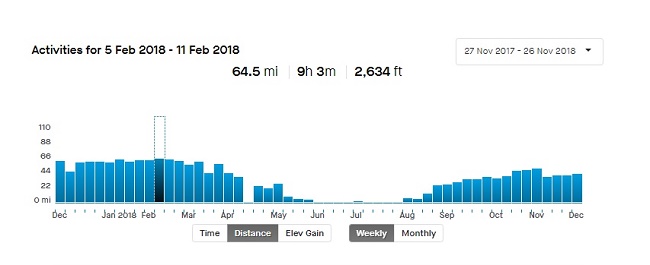
At the start of year I was running really well. I’d cracked the endurance conundrum and found myself comfortably running for 8-9 hours each week and covering 60-65 miles. I had organically built this mileage up and it all felt very comfortable. In fact, in late 2017 I’d been trying to limit myself to 8hrs per week but I began to feel like I wasn’t getting any benefit and needed to do more.
You can see from the Strava data that my mileage was consistently high through Jan-Feb as I prepared for an April half marathon. March began to taper down and then I had a minor accident slipping on some ice. I believe this was the beginning of the injury I had that summer. The half marathon went badly and when I returned to running afterwards I had some pains and while I hoped to be able to run through these, by the end of May I had to admit defeat and accept I needed to let the injury recover.
I had some kind of core injury which stopped me from doing any kind of sporting activity. I don’t believe there’s been a longer phase in my life where I was inactive than the following two months through June and July. With the core being literally the core, there was nothing I could do, I couldn’t go swing a golf club, I could barely do garden work. I just rested.
People I spoke to wonder how I was surviving without being able to go exercise. They know how it dominates my life yet I was quite comfortable sitting in a chair and reading, waiting for it to heal. Despite barely eating over the next two months I put on almost twenty pounds with the activity and my waistline went up a couple of inches. No-one would have accused me of being fat but I was bigger.
My one deference to the inactivity was a weekly lap of the road I live on. Being a crescent, it’s a very convenient loop so I would run a single lap each Sunday to see if the injury was still affecting me. Each week, I would discover it was still painful despite running for less than three minutes at a slow pace.
Eventually though, one day I sensed a difference and felt ready to return. Here’s what my training return looked like:
Week 1
Mon
Tues
2min test – the green light to restart
Weds
15 min run
Thurs
Fri
14 mins30
Sat
16 mins30
Sun
Total
4 runs totalling 48mins
Having felt good on the Tuesday test I was excited to restart. So I began with a single fifteen minute run. On reflection, possibly even this was too long and it should only have been 5-10minutes but it didn’t present issues. To be on the safe side, I took a rest day on Thursday and then ran again on Friday. I ran the same route and came in thirty seconds faster. I then ran again the next day and as I was a little quicker again, I tacked on an extra 400m loop of my road to take it past fifteen minutes. That was it for the week. Three main runs of fifteen minutes and lots of recovery time.
Remember I had been running an hour every day for weeks on end less than six months previously so it’s a huge cutdown.
Week 2
Mon
15 mins
Tues
30 mins
Weds
Thurs
35 mins
Fri
15 mins
Sat
33 mins – hilly parkrun
Sun
Total
5 runs totalling 2hr04
I had some coaching working to do on Monday so I ran the warm-up and had some aches and pains until I got going. Given that’s the case, I now question why I did a thirty minute run the next day but this is the curse of the returning runner. Wanting to pick back up sooner than they should. Sensibly I then took a rest day.
On the Thursday, I ran a fairly flat route and still had some pains but usually only at the beginning of runs. The Friday was a short recovery run.
On Saturday I went back to parkrun. I ran 33mins which is about 10min30/mile and my notes states “hardly an ache at this pace”. That’s the key with all injury recovery – you have to stay ‘below’ the injury. Certainly in terms of pace but also duration. If the injury starts to flare at a particular pace or after a certain distance, you back off to build the fitness you can without worsening matters.
Anyway I was very pleased to have now achieved two weeks of training without relapse.
Week 3
Mon
45 mins on the flat – dedicated 4.5 mile route
Tues
20 mins recovery
Weds
45 mins on the flat – dedicated 4.5 mile route
Thurs
30 mins on the flat
Fri
Sat
29 min parkrun – 4 mins quicker than last week
Sun
1hr22 long run – dedicated 7.5 mile route
Total
6 runs totalling 4hr14
Following the Sunday rest day, I went for a run on the prom at the beach. It was a forty-five minute effort and my notes state it wasn’t enjoyable. I guess because I’d managed to run for two weeks without injury returning I felt I now had to just rebuild. Running is always tough when your fitness is lacking so I just felt I had to go through it. Note I still did a short recovery run the next day and generally ran in the flattest places possible to keep intensity to a minimum.
After another Friday rest day, I knocked 4-mins off my parkrun despite trying no harder and then on the Sunday went for a long run. It was tough. It started out quite slow and the ‘new territory’ of the last three miles had me running at 11min30/mile pace – for some that may not seem that slow but consider I was capable of running close to 6min/mile at the start of the year.
Week 4
Mon
20mins Recovery
Tues
40mins Steady
30mins including 10mins faster (coaching)
Weds
20mins – Recovery AM
20mins – Recovery PM
Thurs
40min Recovery
Fri
Sat
30mins at Chichester parkrun
Sun
40min recovery
Total
6 runs totalling 4hr23
The following week I continued running and managed to do six days on the road. I even did a couple of small double sessions on the Tuesday and Wednesday. After a Friday rest, I went to Chichester parkrun as I was visiting friends and ran it in 27mins but on the Sunday morning, after a late night out I had nothing in the tank so only managed a 40-min run.
Training by time – you can see I did much less after returning from injury
By this point I’d completed four weeks and felt confident the injury wasn’t returning. Within a month I was running 23mins at Hasting parkrun and training continued on from there. I slowly rebuilt my running and it was almost six months before I was regularly running eight hours per week again. There simply wasn’t the need until I’d rebuilt my fitness.
I often say to runners who are coming back from injury that it’s better to take a little longer and avoid relapse than to get into a depressing cycle of restart, relapse, sit and wait then restart, relapse, sit and wait …
Of course many don’t want to hear that. They finally feel fit, they have goals, they feel they’re getting older and will lose their speed. Having been patient and unable to run for some time they want to get going again. What they don’t consider is that it doesn’t have to be an all-or-nothing approach. The swing between the two extremes of thinking they are either ready to run or still injured. Consequently when they restart, they dive back in rather than testing their fitness step by step.
My advice to any running returning from injury is :
Restart with very short runs to test how the affected area responds – run for only 5-15mins.
Rest the day after each run to give extra recovery time. If you run the very next day it might be too soon.
Don’t be too quick to add on mileage and every time you do, let it consolidate.
The last thing you add is intensity – wait until you’ve rebuilt a solid base of running.
In fact, much of the mileage you may have been doing before will have been because of aerobic efficiency. That will naturally return as your fitness rebuilds.
One final thought – when you restart after an injury, invariably you will encounter some pain. Sometimes it is hard to be sure of why this is happening. It could be the injury hasn’t fully healed in which case you have to give it more time. But it could be some scar tissue from the injury healing and this needs to be broken down. How do you know which is which? You can never be sure, so err on the side of caution, take the rehab slowly and see how it proceeds.
My run training odyssey which began with Maffetone Method, had tried FIRST training now became interested in “a renegade path to your fastest marathon” – Hansons Marathon Method. Looking back this is a little strange as I wasn’t interested in running a marathon. And the grammarian in me is distraught at the lack of an apostrophe in their title!
Brothers Keith and Kevin Hanson have been developing their eponymous method since Kevin’s first marathon in 1978. As he states in his foreword “What I found were cookie-cutter approaches … always including a long run that was usually 20 miles in American publications and 30 kilometres (18.6 miles) in foreign magazines. I came to find the reasoning behind this prescription was simple: These distances were round, even numbers”. As he goes on to say there wasn’t any science behind them and he needed to find a better way to train for the marathon.
Not only were the Hansons interested in rethinking how to run marathons they wanted to revitalise American distance running. To do this they decided to replicate what the Greater Boston Track Club had done in the 1970s by taking talented post-collegiate runners and giving them the opportunity to continue their training. The Hanson bought a house in 1999, recruited three athletes and provided them with the essentials to live and train together. When Brooks Sports came onboard as a sponsor they were able to buy a second house and recruit more athletes. Twenty years on, they support twenty athletes in four houses and have seen high level success. The most notable was Desiree Linden winning the Boston Marathon in 2018.
Their coaching isn’t only geared towards elite runners. They’ve helped thousands of novice and recreational runners to complete marathons along the way. Their book, authored by Luke Humphrey one of the their training group, is very well written and packed with information from physiology to nutrition, stretching, strength training and kit. And of course it contains two 18-week training plans – one for beginners and another for advanced runners.
The USP of their plans is the idea that a runner shouldn’t train further than 16 miles on their long run. Instead they go into it with tired legs by running on the preceding day(s). I’ve previously recounted the details of this in “The 20-mile myth” as well as how I used this principle method for my daughter’s first marathon where she never ran longer than 17 miles / 29km in training yet, on race day, was able to speed up from that point and finish strongly.
While regular running, six days per week, to build aerobically is key to their training, it isn’t just a long run and easy runs. There are two SOS workouts each week – Something of Substance. In the first half of the 18-week plans the first SOS workout has you improving your speed while in the second half the focus is on strength. The second SOS workout is a tempo run at your marathon pace which builds from five miles up to ten as the weeks go by.
I picked up my copy of their book at a time when I was just reading how the elite Kenyans approach marathon training differently to westerners. Traditionally western runners building their long run mileage up to twenty miles at relatively easy paces and then look to add speed in the last few weeks. The Kenyans take the approach of running at the pace they want to run their marathon and gradually increasing the distance for which they can hold it. So when I saw the Hansons were doing something similar with their second SOS workout increasing the distance, I decided to give their method a try even though, as I said before I wasn’t going to be running a marathon.
Principally this was the training method I used over the latter half of the year albeit with some hiccups and digressions. The first block ran for six weeks through May-June. I used the basis of their Strength workout progression each Tuesday and the Tempo on a Thursday. Where their Strength workout is a 7-week progression, I only did the first three weeks then repeated them at a faster pace. On the Tempos I increased the distance each week whereas Hansons tend to progress matters more gradually by only increasing it after three weeks.
There’s a reason I didn’t specifically stick with the detail of their plan and it’s that I quickly found myself getting faster by the week. This raised a question I couldn’t quite see how to resolve. When you begin a Hanson training plan, you decide what your target marathon time will be based on a recent race. But when you see yourself getting quicker at the shorter distances and the workouts are becoming easy, it seems pointless to continue training at this. So this is why after three weeks, I went back to the beginning and stepped up the paces. While all the training suggested I was going to be in a better place, race results said otherwise. I had run a 41:43min 10K in early May before I started the training and ran a 41:24 10K at its end on a hillier course. It seemed to me that for all the hard work and miles I’d put in this was a poor return especially given I’d run quicker 10Ks previously.
Consequently, given my disgruntlement at the meagre 20sec improvement, I went back to working on my speed with short intervals. Then I picked up an injury doing something stupid (won’t detail that!) and managed to rebuild my fitness for a 1hr37 half marathon in mid-September.
Coming out of the half marathon, I went with another block of pseudo-Hansons. The first three weeks I did the Strength work intervals at 7:10/mile and the Tempo at 7:25 then moved them up to 6:55/7:10 for a second block. Allied to running fifteen miles on a Sunday, by the end of these six weeks I was beginning to feel fatigued and once again I changed direction as I had another 10K coming up in December. Through November, I peaked and come the 10K I broke 40mins for the first time – 39:57.
My view of the training was it could be a good system to follow for a marathon and certainly it helped in the run up to my best ever 10K. The idea of longer tempo runs lasting up to an hour is now one of the key tenets of all my training plans. I’ve also continued to use the Hansons Strength workout progressions particularly when I’m training for a longer distance race.
My only significant doubt about the Hansons book is their Beginner programme peaks at 57 miles which is perhaps fine if you’ve got a decent running base and its your first marathon after many other races but is too much for anyone who isn’t going to run close to 3hr30 in their marathon. Even then I’d say it may be too much. I reckon 45-50 should easily be enough as a peak for a slower runner and only once they’ve built up to it.
While I was very much into training to pace at the time I’ve gradually moved away from it and now work more often based on feel. There are obvious problems with working to pace if you can’t find a flat course or it’s windy but those weren’t my concern. While training to pace worked well for me then, I found if I misjudged it because I lacked a recent race time, it was either unachievable or at worst could lead me towards overtraining. I don’t want to blame Hansons for that as I think it can be a feature of all pace-based training if you get the volume / intensity wrong.
I also passed on the Hansons ideas to a couple of sub-3 marathoners who tried an Advanced version of the training. This was in the days before I was coaching. This isn’t the Advanced programme in the book but a bought plan which has a little more variety and really doesn’t look much like what is in the book. Being designed for faster runners it doesn’t have the 16-mile limitation on the long run. Both runners profited off the training and were racing quicker as the weeks went by. One of them who had a previous marathon PB of 2hr37, took two minutes off his half marathon time and three minutes off his marathon. If he hadn’t gone into it with an injury he picked up in the last week, he would likely have run close to 2hr30.
What you can learn from Hansons training is good ideas about how often to go out running and what sort of distances to cover. The idea of doing frequent runs at expected marathon pace is a great one as are the demonstrations of how to progress sessions by extending the distance rather than trying to run faster.
While you can buy a copy of the Hanson Marathon Method or their Half Marathon Method for a few pounds or dollars and follow their plan which is designed to apply to millions of runners – if you would like more personalised coaching I’m here to help. I will identify where your strengths and weaknesses lie, what will be achievable and how best to fit training to your lifestyle and circumstances. Sprint over to the Contact page and drop me a line!
The marketing sounds great – train less, run faster. The FIRST Training system is one which Runner’s World first promoted in 2005 then followed up with a book. I was lent it in 2012 by a parkrunner who reckoned it was great and I quickly devoured my way through it.
My gut feel after reading was it worked for many of their testimonial runners because it found a mid ground which many runners don’t fall into. You either have dedicated runners who are doing too many workouts and running too fast on their easy days; or recreational runners who simply do all their training at the same pace. With the dedicated runners, FIRST would give them more recovery by getting them to do less. With the recreationals, it would get them running faster instead of jogging around to log miles.
A couple of years on I decided to give FIRST training a try, this followed my unsuccessful months of MAF training. I had ended that when I began to go backwards and became concerned I was somehow overtrained. To try and alleviate the effects I did less and less training during the dark months and things just got worse. With hindsight the idea I was overtrained was a preposterous notion. I’d read the words in Maffetone’s book about anaerobic training, read elsewhere about over-reaching and was prepared to believe my sluggish performance and rising heart-rates were a sign of this. Certainly it’s possible to fit my symptoms to the descriptions of overtraining and this is the danger of reading words in a book rather than talking to some who knows. (This seems a good opportunity to plug my Training Reviews if you think you might want a check-up!)
So with its three runs per week FIRST training seemed like a perfect compromise for getting me back into serious running while allowing decent amounts of recovery.
FIRST training stands for Furman Institute of Running and Scientific Training. It is a method create by two long-time triathletes who were finding it difficult to fit the demands of training for three disciplines into their busy lives. What they found was they could cut their training down to three runs each week and still produce good race times. They then followed this up with a study of twenty-five runners – fifteen of whom recorded marathon PBs.
The three runs in the FIRST system are an interval session, a tempo run and a long run at marathon pace. Looking closely at their programme now, I see how I trained was only an approximation of FIRST training as all their workouts have different distances over the weeks. Their intervals range from 400m to a mile, tempo runs from 3-8 miles, long runs build up to 20 miles for the marathon. I simply did kilometre reps, a 20min threshold run and a 10 mile long run that grew to 14 as I got fitter.
What’s hidden in the details of the original FIRST promotions, but stated more clearly later, on is that it’s a 3+2 system. Three runs with two cross-training workouts lasting 40-45mins. This is another reason why I was only doing an approximation of it; I didn’t have the inclination to cross-train. On the flipside, my coaching commitments meant I often jogged a couple of very easy miles on a Tuesday evening and I was still a keen parkrunner so did a 30-minute 4th run each week at Bournemouth parkrun.
All in it I wouldn’t begin to claim this was a scientific approach to evaluating FIRST training’s effectiveness but I certainly got a flavour of it.
Re-evaluating FIRST training now a decade on with a better understanding of running, I think it has some very strong points. The range of workout distances is great because these implicitly challenge the runner over a variety of paces. Your 400m efforts will naturally be paced quicker than mile efforts. The downside of FIRST’s workouts is a lack of clear progression. The distances seem to jump around and I couldn’t identify a pattern other than for the long runs. When I coach, I like to progress in a logical fashion, You take the runner from point A to Z with points B, C, D etc clear to see.
There is one notable failing if you follow FIRST training accurately and that is the idea of doing two days cross-training each week. Why not just do easy recovery runs at the correct pace on those days? While there may be some benefit carrying over from cross-training, going swimming or cycling isn’t going to produce the same benefit you would get from running. The principle of specificity tells us the best way to build running fitness is by running. Even running on a treadmill isn’t going to provide exactly the same benefits as running outdoors where you will race.
My experience was that I enjoyed the training. I always felt strong and ready to run when I got to the workouts. This is probably the thing which stands out in my memory about it. It was enjoyable and I got myself back up to fitness with it.
The results were decent enough although I didn’t really have a benchmark to test against but I saw the workouts getting quicker and heart-rates getting lower.
For example, my 5K tempo runs began in January at 24:30 with heart-rates in the mid-170s and maxing in the 180s. By the end of March, they were down to 22:30 with heart-rates in the low 160s and maxing in the low 170s. The route I followed had a long uphill in the 2nd kilometre then after that the remainder was a gradual down. This led to uneven splits and needing to gauge my efforts by breathing but in the early weeks the fastest kilometres were around 5min/km (8min/mile) and by the end they were sub-7, that is about 4:18/km.
Likewise my 5x1K intervals went from totalling around 21:30 (avg 4:18/km) down to 19:45 (3:57). A decent improvement over three months.
My long runs began on a ten mile route averaging 9:18/mile and by the end they were around 8:30/mile on a longer fourteen mile route.
Those are decent improvements albeit only getting me somewhere closer to where I’d been a year before. Of course, MAF training had taken its toll and, at least I now felt like the days of overtraining had been banished and I could get back on with training.
The one negative for me was I didn’t like running only three days per week. By the time I got to mid-March I was ready to do more running. I had to talk myself into sticking with the programme for a couple more weeks so that I could feel I’d given it a decent shot. Compared to MAF it was night and day. I got tired of MAF because I wasn’t seeing any tangible results and I was forever trudging round holding back on my pace. With FIRST I was holding back on how often I went running but every time I did run I enjoyed it and felt like I was improving. Trouble is, I just wanted more.
Once April came around, I went back to running six days per week. What I noticed is how quickly my heart-rate began to drop on all these workouts and long runs. During FIRST training, my heart-rate was always up at 150 or higher, once I introduced more recovery days It generally stayed a little lower despite me running similar workouts. By the end of the year I was running my fastest ever 10K so while FIRST kickstarted that, it was other training which got me there.
Running seems easy. It’s the act of putting one foot in front of the other quickly. One of your legs swings out in front of you and you move onto it. Then the other leg moves out in front of you and you do it again.
This much everybody agrees on.
Yet the mechanics of running aren’t taught at school, it’s something we pick up from watching others. Some people seem to intuitively understand what to do to run fast while others seem to lumber along.
If you start to think about it, or look for guidance from the internet, it quickly becomes a morass of information. Is running the same as falling with gravity, repositioning your legs quick enough to avoid landing on your face? Or are you almost jumping or hopping forwards with each step and lifting your knees high to extend the stride? Which muscles do you use when?
Consider that the only thing which moves you forward is pushing the ground away behind you. Powerful muscular contractions of the glutes and hip muscles ‘out the back’ allow you to skim forward over the ground. Then when the step is complete, you do the same with the other leg. You don’t waste muscular effort repositioning the foot in front of you, you let the body’s natural stretch mechanisms do it.
It’s just like using a slingshot or catapult. You use all your effort to pull the elastic back to its maximum stretch and then, when you let go, it fires forward. You can’t make a catapult go forwards faster by doing anything other than letting go.
Just like the elastic on the catapult fires past the Y-mechanism eventually it slows down as it runs out of energy. Likewise the leg and foot shoot past the body and end up in front. That’s when you, as a runner, go back to putting the effort in to getting the foot and leg moving backwards to power the next step.
These are the first principles:
Use effort to drive the leg backwards with each step.
Let elastic energy in the hip flexors pull the leg forwards.
As the leg comes forward, muscular effort is only used to stabilise rather than power.
These simple principles will help you begin to sort through the advice you read. It won’t cover everything but it’s a good starting place.
Watch any elite runner and you’ll see their heel kicking up to their buttocks as the leg moves forwards. I have a whole bunch of terms for this – butt kick, heel lift, back lift which I am going to use interchangeably through this article.
From an efficiency perspective it is very important. The days of people owning mechanical clocks are now all but gone, so the majority of people probably have little idea about how the length of a pendulum affects its movement. Basically a long pendulum swings slower than a short one and vice versa. You can test this by grabbing a piece of string, tying an object to the bottom and swinging it at different lengths.
Applying this concept to running – a short leg will swing quicker than a long one. Tall people tend to have slightly slower cadences than shorter people and it is why, when small children run their legs appear to go like the clappers. Of course, once you’re fully grown you can’t change the leg of your legs, you’re stuck with your genetics, unless a disaster happens.
Yet shortening one’s leg is effectively what an elite runner does when they kick their heel up to their backside. As the foot passes closer to the body and above knee height they have essentially halved the length of their leg. It is now only as long as their femur measures from hip to knee. This is sometimes referred to as shortening the lever. A shorter leg comes forwards quicker than a straighter leg helping to reposition it ready for the next step.
With recreational runners we rarely see this butt kick taking place. With some runners it is like they are walking fast, keeping their legs straight – moving them back and forth with a high cadence and barely leaving the ground. To varying degrees, other runners will lift their trailing foot off the ground – some lift it just a few inches whereas others may have it passing the support leg at calf or even knee height. Once in a while you see recreational runners who have an exaggerated back lift even if they are only moving at a moderate pace, such as eight minute miles. It is almost certainly something they have been taught to do and there are certainly many coaches / Youtubers who advocate doing this. The trouble is while deliberately lifting the heel to the backside seems desirable for the efficiency reasons previously mentioned, it is not.
Don’t initiate ‘the pull’
It’s likely ‘shortening the lever’ will help you run faster, at least in the short-term. To do it you just pull your heel to your butt – to do this you engage the hamstrings. The problem is, this isn’t how it should occur or what the hamstrings are best used for. What they should do is control how quickly the lower leg unfurls once your leg is out in front of the body. This isn’t a conscious process, it just happens with every step you take. Like any muscle they will eventually become tired and fatigued so if you are mistakenly using your hamstrings to actively pull your heel, you’re going to tire them out needlessly.
How to butt kick
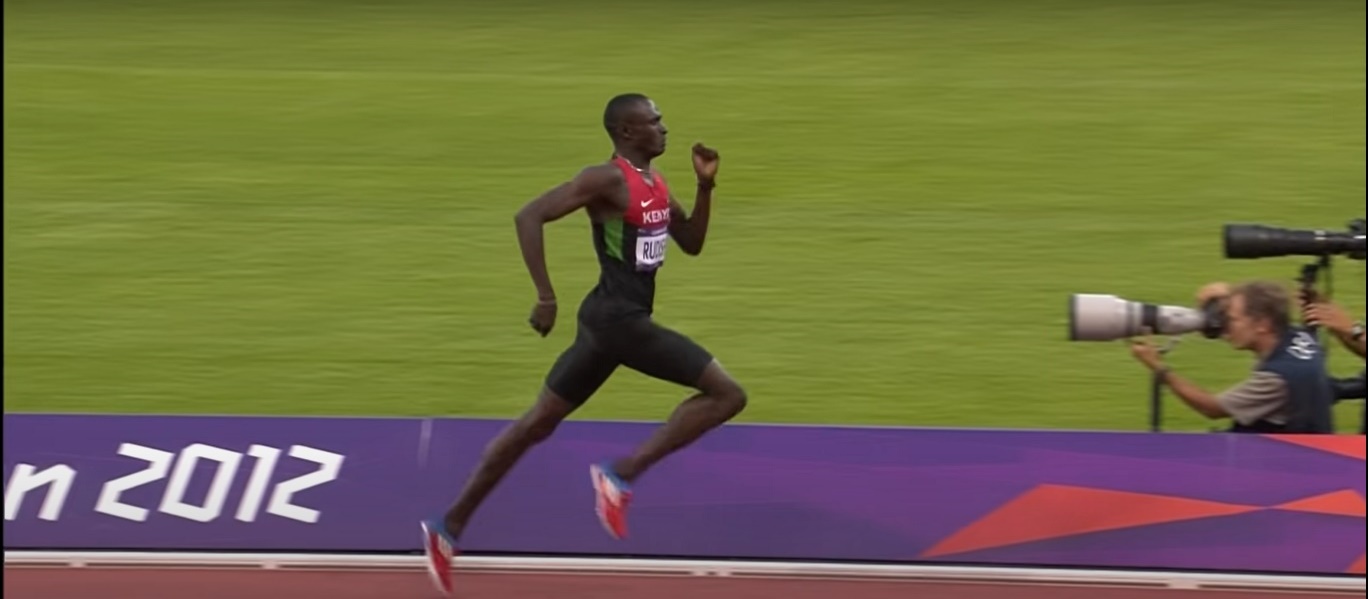
The reason you don’t need to actively lift your heel is because when you run correctly it naturally happens. In my look at glute-powered running, In a previous post, I discussed how an elite runner like David Rudisha uses his glutes to swing his leg from in front of him to behind. At some point the thigh physically cannot go any further back and he tips up into a toe-off.
Looking at a snapshot of what happens a few frames later we see his thigh has barely moved but the lower leg has begun to lift. This is momentum transferring down the leg through what is referred to as the kinetic chain. It generates power in many sporting actions from kicking a football, throwing a javelin, swinging a golf club to delivering a knockout punch. Energy is generated by big powerful muscles and then transferred to the smaller extremities to achieve a higher speed. It’s the same process that allows Indiana Jones to to crack his whip – his arm and body begin the movement and then the energy transfers through the handle and down the whip to create the cracking sound.
For Rudisha, after the leg appears to momentarily pause, it then begins to move forward. This is powered by the elastic energy that has been stored in the muscles on the front of the hip and thigh. When the leg was moving backwards these muscles were being stretched like an elastic band and now, just like when the elastic band is let go they ping back to their normal length. This pulls the thigh forward, but it doesn’t affect the lower leg so that continues its journey towards the runner’s butt.
Eventually the lower leg either runs out of momentum or reaches its closest point to the butt. If everything is timed well, it is enough to carry it under the runner’s body as a shortened lever.
Composite image of David Rudisha’s stride showing the heel lift and pass under the body
Not everybody butt kicks
Given that I’m describing this as a natural sequence of events, you might expect everybody to lift their heel to their backside and kick butt yet this isn’t what we see. The main reason is you have to be running at high speed for it to happen. You won’t see any sprinter who doesn’t butt kick and this isn’t taught to them except by bad coaches – it just happens.
Your legs have to be moving back and forth quickly to create the momentum in the lower leg. Quite how fast you need to be is some undefined combination of factors such as pace, leg length, foot weight and stride rate.
All elite distance runners back kick because they are rarely run slower than five minute miles. The women’s marathon is the slowest elite distance race and Tigist Assefa can be seen butt kicking on the way to her marathon world record.
Tigist Assefa running behind two pacers demonstrating a high heel lift at 5min/mile
Yet if you see an elite distance runner out for a jog, at say nine minute mile pace, their heel doesn’t kick their butt. The foot will come off the ground but it is not the efficient shortened lever. At slower speed the leg just doesn’t have the momentum to carry the foot up to recover close to the backside.
There is another reason why we often don’t see any backlift in recreational runners and this is because many over-rotate their hips which I discussed in this post. Instead of the leg swinging straight backwards and forwards with a long range of motion to create power and momentum, a shorter stride length is creating by turning the hips. Arguably this may simply be a factor explaining why they’re slower at running but I noticed in the footage of Tigist Asseffa breaking the world marathon record, she appears to have one foot lift higher than the other. I suspect this is due to over-rotation of the hips as it is reflected in one shoulder rolling more than the other. She is not the only long distance runner who seems to have some inefficiency in this area.
Final thoughts
Kicking the heel to butt for more efficient recovery is something which occurs with good running form and mechanics. Attempting to force it by pulling your heel up is unnecessary and will tire the hamstrings. Arguably it could be beneficial to slower runners but the counterargument is that spending the time learning to pull the foot up is training time that could be used to improve speed so it happens naturally. Ingraining bad form is unlikely to be a good idea because it is harder to undo later on. To get the natural heel lift, you need to get the glutes firing and the leg swinging through to an extended toe-off.
The information detailed here is based on personal experience and that contained in Steve Magness’ The Science of Running Book. Magness was the Cross Country coach at the University of Houston where he was able to speak with Tom Tellez, the track coach who coached many athletes including Carl Lewis who was the 100m world record holder during the 1980s and 1990s.
I used to coach a triathlete who had decided to run a marathon. In our discussions he told me that one of the tough parts of a triathlon is the transition from cycling to running. You get off the bike and then when you start to run, the legs feel like rubber and they take a couple of minutes to adjust. I later heard people say cycling is quad-dominant whereas running is glute-dominant. While nice descriptors it didn’t really explain what was going on.
The glutes are the muscles in your backside or rear, the quads are in your thighs. You can find many articles written about runners who have lazy glutes due to sitting at a desk all day and suggesting exercises to activate them. Along the way I’ve tried many of these, both for strengthening and activation without much success. As a kid, I cycled everywhere so my thighs grew big and muscular and no doubt that led me to be quad-dominant in powering all the exercise I did.
If you’re a cyclist, or like me were one, this post is going to help you understand how it could be holding you back from achieving your running potential. If you’re a runner, like I’ve been for over a decade, you’ll probably benefit from understanding how using your glutes to their full extent might help your running. I’ll explain the difference between quad and glute dominant exercising; showing why runners should be aiming to get their glutes active and providing some ideas on how to do this.
Cycling is quad-dominant
Here is a cyclist sitting in a recommended position for setting up the saddle. Opinions vary as to the correct method but they are all small variations of what you can see – the leg almost, but not quite, straight when the pedal crank is at the bottom. The yellow lines indicate parts of the bike – the saddle position and the pedal cranks. When they’re vertical the cyclist will have one foot at the highest and the other at the lowest point of the pedal stroke. We’re particularly interested in the lower point because that is the furthest the foot gets away.
Most of us have been on a bike and we know that each stroke is powered by pushing down on the pedal. When the foot reaches the bottom, the other foot has reached the top and it then takes over pushing down to keep the pedals turning. In essence the cyclist is always pushing down on the pedal to power the bike forward. There is also some debate as to whether cyclists should pull on the upstroke to assist. Even so, all this pushing down, and any pulling up, is due to the quad muscles in the thighs – along with some assistance from the hamstrings and calves.
What doesn’t contribute to the stroke (very much) are the glute muscles sitting on the saddle. There may be a contribution but it’s minimal because the pedals limit how high and low the thighs can move and therefore how much effect the glutes have. You can see the thighs are about 45 degrees apart and as you will see the glutes don’t move much.
Running is glute-dominant
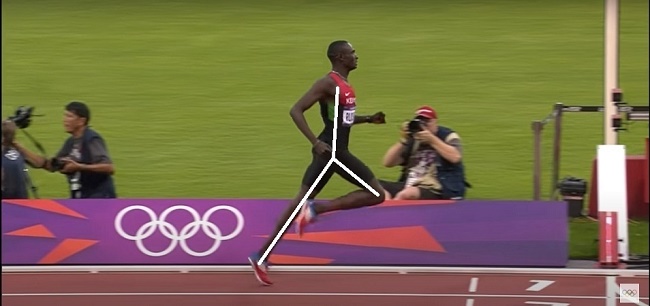
Now let’s look at a world class runner – David Rudisha. I examined his stride length in a previous article where I estimated it to be 2.45m. You can see in the picture below his legs are about 90 degrees apart. So already his glutes are moving through a greater range of motion than the cyclist’s.
His knees don’t come up as high as the cyclist when they come forward. A runner with good form allows the knee lift to occur naturally through elastic energy rather than a conscious lifting of the thighs. This elastic energy is created by the hip flexors on the front side stretching as the leg goes backwards. When the ‘backside’ work has been done, just like an elastic band snapping tight, the hip flexors pull the leg forward.
We also see David Rudisha is extending his leg behind him to the point where only his toes are still in contact with the ground. His back leg is straight from hip to ankle as it transfers force to the ground. His ankle is still a little flexed but having looked at multiple pictures and video, it doesn’t appear Rudisha can fully straighten at the ankle which would be better. The key point to notice is that his leg is extending behind his body which is due to a powerful hip extension. To run forward, he has pushed the ground away behind him.
Running and cycling side by side
If we now compare Rudisha to the cyclist, but rotate the latter so his torso is upright, we see a massive difference between them.
It’s clear from this picture that the legs of the cyclist are always in front of him. There may be some pelvic tilt in his seating to achieve a better aerodynamic position but it’s not enough to be relevant. The position of the saddle, the pedals and cranks ensure his thighs and feet only move in a limited range – the equivalent of 2 – 3:30pm on a clock face. By comparison, Rudisha’s legs are working from about 4:30 – 7pm. The ranges of motion don’t even overlap.
In the cyclist’s rotated position, it’s easier to see how their thighs and knees will piston up and down in front of them. In the normal orientation we see the pedal being pushed down, here perhaps we can think of it being pushed away from the body. This push is achieved by the thigh muscles straightening the knee until it almost locks out. It’s similar to how rowers power each stroke by straightening their legs. This is why cycling is considered a thigh-dominant activity. Of course, dominant doesn’t mean only; so there can be contribution from other muscle groups – just not as much.
Glutes power the stride
Let’s now see why running is glute-dominant with another look at David Rudisha. In this picture he is still airborne with his leg having come forward as far as it will during this stride. Although it’s not easy to see – his lead foot hasn’t even touched the ground yet. He is about to start using his glutes to continue running fast!
As the yellow arrows show his leg will swing backwards with the foot hitting the ground just ahead of his body. He will continue to propel his leg backwards and his foot will momentarily be stationary on the ground as his body passes over it, just like a pole vaulter arcs over the planted pole. As best possible, his leg will remain straight all the way through to the toe-off. Typically the quicker the running speed, the stiffer the landing leg tends to be.
He will attempt to maximise pushing the ground away behind him by fully extending his rear leg until only his toes are in contact with the ground as we saw in the earlier photo. When that point is reached the leg will naturally fold up behind him and pass forward under the body due to the elastic energy created by the stretched hip flexors. The runner doesn’t need to trying to do anything to bring the leg forward or lift the knee.
The glutes
Swinging the leg backwards is powered by the glute muscles which are a group of three muscles in the buttock area. In recent years the Kim Kardashians of the influencer world have attracted attention to them by getting implants and doing exercises specifically intended to make them larger.
Gluteus minimus not shown
In running we’re interested in using the glutes to extend the hip. Again this is the sort of phrase that doesn’t mean much without thought, and it’s possibly easier to understand it by thinking about what happens when you stand up. The legs move from being at 90 degrees in front of you to straightened below you. Extension of a joint is straightening it. Hip extension is straightening at the hip – it increases the angle on the front side.
In this picture of a glute muscle we can see them crossing the back of the hip and pelvis. If the person were now to stand we can imagine that the glute muscles would ball up to give the Kardashian look – just as a biceps muscle gets bigger when it is flexed. This is why runners, especially sprinters want big, strong glute muscles.
When runners flex the glute muscles the leg moves backwards and the front of their hip straightens. When the foot hits the ground, the continued action of contracting the glutes causes the leg to pass below the torso and then behind. Of course we rarely feel this as contracting our glutes, it feels more like pushing the ground behind.
The issue is people usually have no reason to flex the glutes that far back and if we’re not practiced on it, we don’t do it as runners. When we stand we only contract the glute as much as necessary to bring ourselves to an upright position. We only need our knees and feet to be directly below us. When we walk we move the leg a little behind us but do it slowly and not too far. Then we often take our next step by falling forward and rolling onto the heel of the lead foot.
As Rudisha shows there is a range of motion where using the glutes deliberately will create a full and powerful hip extension so that the leg and foot move further behind. Unfortunately this is not what quad-dominant runners or cyclists with their strong thighs and poor glute activation do when they run.
How cyclists often run
We saw in previous pictures, the typical cycling position doesn’t even bring the cyclist’s feet to the ground if they are turned upright. Obviously this isn’t what happens in real life when a cyclist tries to run.
While cyclists are very good at pushing the foot to the ground using the thighs and exerting push, they often don’t learn to extend the leg back past the vertical. Instead almost as soon as the foot has landed they feel the stride is complete and pick the knee back up. Where the runner’s leg comes forward using elastic energy, the cyclist uses their strong thigh muscles and hip flexors to lift the knee ready for the next stride.
Statistically this gives them the sort of measures their sportswatch likes – high cadence and short ground contact time – so they think they’re doing the right thing. What they lose though is stride length as the foot doesn’t push them as far forwards as it could with a longer range of motion. As Steve Magness writes in The Science of Running “Often, the mistake is made in trying to get the foot off the ground as quickly as possible, but remember it is only when the foot is on the ground that force is transferred to the ground. While having a short ground contact time is beneficial, it should be a result of transferring force faster and not of getting quicker with the foot.” (p.307)
Strengthening glutes
I’m a big believer that once you start using the correct muscles to do the job they quickly strengthen themselves up with regular running. Even so there are a variety of initial strengthening exercises you can try which may help. These include step-ups, one-legged deadlifts, hip thrusts or frog-legged bridges. As starter exercises for getting more strength into the glutes and supporting muscles they are good options but they don’t take you past straight hips and therefore don’t mimic that extra bit of power we’re looking for.
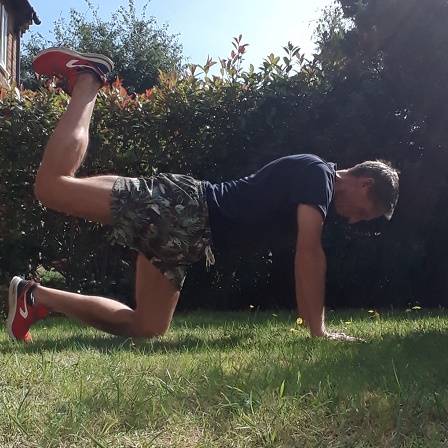
Donkey kick demo in the garden
Donkey kicks may be the best exercise for really squeezing the glutes but other than by adding ankle weights it’s not possible to create resistance for adding strength and power. If you lie on your back and do hip thrusts you can add resistance especially if you progress to doing them on a one-legged, on a step or with a weight across your hips.
But having strong muscles doesn’t guarantee using them during runs. If your movement patterns are wrong, it doesn’t matter how strong the muscle is they won’t help out. A simple example of this principle is when people try to pick up a heavy object. Health and safety advises them to bend their knees and use their legs. More often than not people simply bend over at the waist and strain their back. It doesn’t matter how strong their legs are if they don’t use the correct technique.
I haven’t described these exercises in detail but a quick internet search will turn up a myriad of articles or Youtube videos demonstrating them.
Activating glutes
To begin to get the movement correct you need activation exercises. A simple one is to imagine pushing a shopping trolley or pushchair. Basically to imagine there is something that will block your legs from swinging ahead of you which forces you to push the foot or leg backwards to create the propulsion to go forwards.
You can also try standing with your back against a wall and then stepping away from it. Feel the back of the leg and heel push off the wall using the muscles around the hips.
Walking lunges can be a good exercise for creating the hip flexor stretch and getting the glutes to work. They also work as a good balance and coordination exercise. You really have to focus on getting the glutes to work.
These sort of activation exercises may work at giving you the feeling you’re looking for but personally I never managed to carry them over into my running.
Toeing off
While David Rudisha doesn’t appear able to full point his toes he is certainly pushing his foot and toes as far back as possible. The following compilation of pictures of Seb Coe show how great his form was in this area.
Practicing toeing off has been the exercise I found most useful. When your foot hits the ground put pressure through your big toe and push your foot all the backwards until the leg is fully extended behind you and you are up on your toes. NB This is not running on your toes but pivoting up onto them when the leg is at its furthest point back.
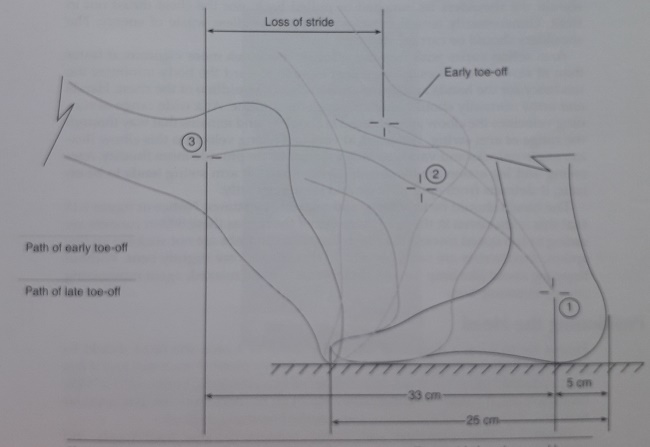
Peter Coe, coach and father of Seb, highlights in Better Training for Distance Runners” that a fully straightened ankle which has pivoted over will leave the ground late and create extra stride length over that of a runner who either keeps their foot flat on the floor or with the heel barely lifted off. This pivoting can adds over the length of the runner’s foot to each stride.
To achieve strong ankles and good rear leg extension, Arthur Lydiard the great running coach of the 1960s, had three strengthening exercises – steep hill running, hill bounding and hill springing – which he scheduled as a four week phase prior to speedwork. He is quoted in Healthy Intelligent Training as saying “Increase in speed comes from flicking of the ankles. If you want speed, you don’t need to be built like a body-builder. You need to be like a ballet dancer, with springy and bouncy ankles” (p.118). However Steve Magness writes “Unlike what many suggest, do not try to get any extra propulsion out of pushing off with the toes consciously.” (p. 307)
There’s clearly a contradiction between what these two coaches are proposing but there is no doubt a fully extended leg with pointed toes is critical to achieving speed and stride length. My own interpretation is that by pushing the foot through for the full stride, you naturally lever up onto the tip of the shoe and your toes. Knowing that Lydiard’s hill strengthening came at the end of months of aerobic distance training, his exercises were there to help runners get used to this action again. Once you’ve got strong ankles and good technique you probably won’t even notice it happening and there will be no flick. I think the key to Magness’ statement is about not consciously flicking the ankle, as there runners who try to get a bit extra by doing this but are actually creating inefficiency in the mechanics.
Whether Lydiard or Magness is right about ‘the flick’ doesn’t matter for most runners as it’s a “1% improvement” whereas many runners haven’t mastered the gross movement of pushing with their glutes to end up toeing off which is where the big gains will be made. Initially if you aren’t pivoting up to toe-off, you aren’t getting the most out of your glutes and will need to go through a conscious phase of deliberately toeing off to achieve this.
Lydiard’s hill exercises also work on getting that rear leg extension we’re seeing in Coe and Rudisha. I’ve found this is best achieved by ensuring the back of the knee straightens, that it feels almost as if it’s being pushed back beyond what is physically possible.
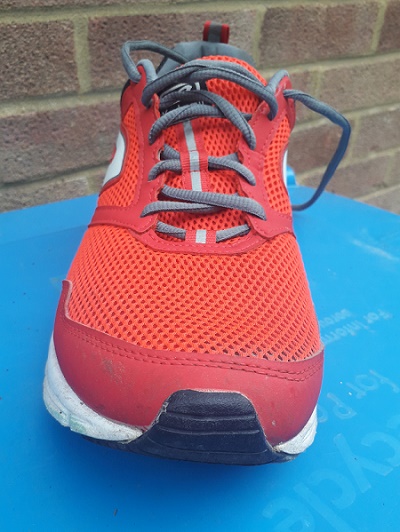
Ultimately even your running shoes are built to enable you to toe-off. Every pair has the sole extending forward, up over the front of the shoe yet few runners actually wear this down. When you look at how far it turns up you realise how much encouragement you have to do this.
Summing up
The best runners in the world power their running by using their glutes. The glute muscles swing the leg backwards from its further point out in front of the body to the furthest point behind. Elite runners push the ground away behind them and then allow elastic energy to bring the leg forward again for the next step. Each time their foot hits the ground they are pushing themselves on to maintain speed or accelerate just as a skateboarder keeps the deck rolling by occasionally pawing the ground with their foot.
This contrasts to the average runner, or those who are thigh-dominant, who stopping pushing with their glutes when their foot hits the ground, allowing their momentum to carry them over it as they pick the knee back up. In doing this they decelerate while the foot is on the ground, miss out on stride length and the free elastic energy available for bringing the leg forwards. As Matt Fitzgerald states in The Cutting Edge Runner “when you retract your leg properly, your foot feels as though it grips the ground rather than lands on it. From this point all you have to do is keep thrusting backwards, and you will have effectively minimised any stance phase and the deceleration that comes with it.” (p.152)
Making changes is never easy and if you start using muscles that have never been engaged before, they will have some catching up to do. Like a slower runner trying to keep up with a faster pack, they’ll be left fatigued and sore until they have gained the fitness to be part of the group. If necessary back off the pace and distance of your runs, take extra days rest until you begin to feel adapted. Once the correct muscles are active they will start to work for you, the new form will increasingly become second nature and the muscles and tendons will strengthen for themselves as you get faster or try more demanding sessions.
References
Coe, P. & Martin, D. (1997) Better Training for Distance Runners.
Fitzgerald, M. (2005) Runner’s World The Cutting Edge Runner.
Livingstone, K. (2009) Healthy Intelligent Training.
Never before have I seen what happened at the World Athletics Championships in the last two races of the opening night occur.
First it was the women’s 10,000m where Netherland’s Sifan Hassan was attempting to complete a treble of winning, or at least medalling, in the 1500, 5000 and 10,000 metres. The race began slowly – the first km of 3min30 is one even I can run and Hassan tagged on to the back of the pack. With each passing lap the pace quickened up so that by the last lap it came down to a sprint. As the bell sounded, Hassan pulled away being tracked and challenged by the Ethiopian Gudaf Tsegay. Entering the home straight, Hassan was still leading by a metre but clearly tiring. She began to drift out and swung her elbow back into Tsegay’s chest. A second contact unbalanced Hassan and she stumbled and fell twenty metres from the line allowing Tsegay to pass and take gold. Already Hassan’s treble ambitions had gone.
Immediately after we watched the Mixed 4x400m relay where the USA were favoured. Great Britain & Northern Ireland had set a national record while running the 2nd quickest time in the heats and now had hopes of a medal. For the Dutch, Femke Bol had anchored their team to victory in the heats and seemed to sprint home with ease. At the final baton changeover, the USA and Netherlands handed over almost side by side but then Bol took off to open up a 2-3 metre lead. By the time she reached the home straight little had changed other than GB&NI had slipped 15metres behind but comfortably positioned in 3rd place for the bronze medal. With fifty metres left, USA’s Alexis Holmes closed on Femke Bol but still hadn’t passed her. As the finish line was about to come into view on screen, Bol began to stumble then fell with the line only metres away. The slow motion replay showed her scraping along the track with a full-on face plant. The fall was enough to allow the USA to pass for gold and then as Bol stood up, Britain’s Yemi Mary John also passed to take silver. To add insult to minor injury, although Bol managed to scramble across the line third the Netherlands were disqualified as she had dropped the baton.
You see runners get clipped in the middle of long distance races and even able to get back up and run. Sometimes they are down and out. I’ve rarely seen an athlete trip and fall at the end of the race. I don’t know what the odds on two runners from the same nation falling while leading in back-to-back races are – but they seem long.
When I began running it wasn’t uncommon for it to be known as jogging. Being a jogger or going out for a jog was the standard term. Yet somewhere in the last decade or so, this term has almost become pejorative and insulting. Everyone now wants to think of themselves as a runner.
In his book Better Training for Distance Runners, which was first published in 1991, Peter Coe describes jogging as “very slow running – 7 to 8 min/mi for talented young-adult men (4:21 to 4:58 min/km) and 8 to 9 min/mi for talented young-adult women (4:58 to 5:36 min/km). For runners not so talented, as well as for older runners, these paces would be slower.” (p.177)
It’s always stuck in my mind that he put a number on it yet revisiting the quote I notice he actually defines jogging relative to ability (or expected ability). He doesn’t simply say “anything slower than 7 minute miling is jogging” he qualifies it. He sees jogging as a slower version of running.
I have to say I don’t find moving at 7min/mile pace to be easy or what I think of as a jog but then I am neither talented nor young!
Even so the idea of jogging is one I feel is underrated. My recovery days are all jogs as I define them and which I suspect Peter Coe would agree with. Very easy runs that barely feel like I’m putting in effort. On a good day this is currently around 8:20/mile, on the bad days it is slower and still feels a little struggle due to soreness or tired muscles.
A while back I was working on building my stride length by running sprints on the flat and hills. I did this through May and then my right hip-glute area felt fatigued. I put the sprints on hold and went jogging. After a week or two the hip area felt good enough to resume the sprints. I then upped them to twice per week and felt the creep of fatigue coming back into my right hip area. After five weeks, there came a point when I knew I’d done enough and I went back to jogging. This time the jogging was very slow by my standards – slower than 9 minute miling and on one run averaging 9:50/mile. It doesn’t really matter whether this is objectively fast or slow, it was jogging and felt very easy at my current level.
I am a big proponent of jogging, without looking at your watch for pace or heart-rate, to aid recovery. As I write above, sometimes I think this needs to be for an extended period until the body feels good. One of the extra benefits is you can still go out for a ‘run’ every day and mentally tick off the exercise box.
For some reason, the vast majority of ‘runners’ don’t seem to embrace jogging these days. They always feel they have to be doing some kind of session. They might throw in the occasional easier day but more often they take a rest day instead. When they have an ache or pain they never see it as worthwhile to go with a period of easy running until the body recovers. I think they are missing out.
It was early June when Faith Kipyegon became the first woman to run 1,500m in under 3:50; last night she shattered the mile record. Running 4:07.64 it was almost five seconds quicker than Sifan Hassan ran in 2019.
Faith Kipyegon on her way to a new women’s mile WR
There’s no doubt Kipyegon is in form, having also broken the 5,000m world record in Paris in June. She’s obviously training well but it’s not just her. While Kipyegon finished seven seconds clear, every other runner in the race recorded a Personal Best and there were three continental records and six national records. Five of the women taking part are now among the top-8 fastest milers of all-time. This is unprecedented and you have to wonder why.
The first and simplest explanation is that the mile isn’t raced often. It’s an old Imperial race distance which is still popular in the U.S.A. and holds significance for men with the four-minute mile. But the Olympics and World Championships race the metric distance of 1,500m.
An immediate assumption might be to point to performance-enhancing drugs. The spectre of doping is always a cloud hanging over athletics and while it’s possible, perhaps even probable, someone in the race is using, you can’t have a race full of dopers and somehow avoiding any one of them getting caught. There has to be something else going on.
Perhaps it’s the track as Monaco was also where Hassan set the previous record and it has a reputation for fast middle distance races in recent years. It wasn’t just the women’s 1,500 where fast times were recorded last night, there were three men running 12:42 in the 5,000m and eight men under 1:44 in the 800m. For comparison, Mo Farah’s personal best over 5,000m was 12:53 and at last year’s Oregon World Championships only one man ran under 1:44 in the 800m final.
Perhaps Monaco itself isn’t faster, it’s simply that its Diamond League meeting is usually held at this time of year and that coincides with athletes getting close to their best. Everyone will be looking to hit their peak in a month’s time at the World Championships in Budapest. For some there’s a little extra to come, some may have peaked too early and others will just be holding on.
It’s the shoes
Anyone who has been following athletics in recent years cannot have missed how many records have been shattered in the long distance races from 5,000m on up to marathon. It’s not just world records but national records as well as personal bests for many athletes. While there may be some improvement due to refined coaching and training methods, it’s impossible not to have heard about the shoes.
Nike introduced the Vaporfly shoes in 2017 and claim they can improve a runner’s performance by up to 4.2%. This occurs through a combination of a carbon-fibre plate in the sole and lighter, bouncier foam which results in the runner using lesser effort and saving energy. As the results show this has been massively beneficial to the point where they are standard for all elite distance runners now.
It’s also understood however that that the benefits of the Vaporflys and similar models only apply to long distance races. For sprinters and middle distance runners on the track they find the Vaporflys feel squishy whereas the spikes they use give better traction. This is why the shoe companies developed a superspike with prototypes beginning to appear in 2019. Again these spikes have a carbon-fibre plate and more efficient foam but with different shaping and geometry.
Although the exact reasons why superspikes help isn’t understood, we’re seeing it benefit track athletes. There have been world records set in the men’s and women’s 400m hurdles by Karsten Warholm and Sydney McLaughlin-Levrone respectively and by Tobi Amusan in the women’s 100m hurdles. It should be noted that, at the time of writing which is a year after she broke the record, Amusan has been provisionally suspended for missing drugs tests. In her case, it may not be the shoes! Undoubtedly though many athletes, especially women, in the short sprints have been setting Personal Bests and National Records, just as happened in the mile race.
Why allow the advantage?
Track and field athletics is no longer the crowd draw it once was. It’s fighting with other sports for television and media coverage and for the money and revenues those attract. Athletics will always be the centrepiece of the Olympics but outside of that, it often holds little interest to most people. Athletics stadia are not packed like football grounds, it is not a sport people regularly turn out to watch. In Britain, the TV coverage is hidden away on BBC3 which is only available online or by Red Button.
Keeping partners, whether official or not, happy is something World Athletics have to consider in a world where it is a business as much as a sport. For the shoe companies who introduce expensive new shoes promising to make every runner faster it is an important way to grow their profits. While it would have been an easy decision for World Athletics to ban the shoes it would likely lead to shoe companies cutting their budgets for research and development and focusing on the fashion trainer market and other sports. Many athletes have shoe deals with the shoe companies and therefore a ban could have impacted them. World Athletics did eventually introduce restrictions to the dimensions of the road shoes in 2020 but it didn’t ban them outright and consequently we have seen records being smashed time and time again.
All of this is a reminder of what happened in swimming in 2008 when new bodysuits were introduced and over 200 world records were broken. Eventually the governing body intervened, wiped those records and banned the suits. But this was different, your average person who goes swimming at the local pool wasn’t going to go out and buy a go-faster body suit so the commercial impact to the apparel companies was small.
Yet the same argument can be made about track superspikes. The market for them is small and if World Athletics were to ban them it wouldn’t impact the revenues of the shoe companies significantly.
Wiping the record books
It puzzled me why the super shoes have been allowed until I considered that perhaps Lord Coe, as head of World Athletics, is happy for the world records to be broken. Obviously it generates clicks and headlines for World Athletics which can never be a bad thing.
More importantly though, many of the women’s world records are disputed as they were set in an era before out of competition drug testing took place. Florence Griffith-Joyner set the 100 and 200m world records in the summer of 1988, East German Marita Koch’s 400m time was set in 1985 and Czechoslovakian Jarmila Kratochvilova’s 800m was set way back in 1983. We know the East Germans systematically doped and it’s highly likely the same applies to anyone else from the Eastern Bloc. There will always be suspicions about Flo-Jo’s times and certainly there is evidence her 100m was set with an unmeasured tailwind even if doping wasn’t involved. These times were thought beyond reach with other runners barely able to get close and yet, in recent years, it’s begun to look a possibility.
Even after out of competition testing was introduced in 1989 there was another notable set of suspect world records a few years later. These were in the women’s 1500, 3000, 5000 and 10,000m by Chinese athletes who were known as “Ma’s Army” after their coach Ma Junren. While the 1500, 5000 and 10,000m records have since been broken, Wang Junxia’s 3,000m time of 8:06 is still on the books. It came to light in 2015 that Wang and her teammates had written a letter in 1995 accusing their coach of forcing them to take drugs. It is hard, given the lack of subsequent success by Chinese athletes, to believe that their record setting success was simply down to hard work of running a daily marathon at altitude and eating turtle blood soup as Junren claimed.
Getting those records off the books is a desirable thing to World Athletics and if doing that happens to coincide with keeping the shoe companies happy then so be it. I think there is a good chance we will see an attempt at the women’s 3,000m world record at some stage if Faith Kipyegon continues to run well. She is the new 1,500m world record holder with a time which is a second quicker than Wang Junxia’s Personal Best. Like the mile, the women’s 3000m is not a distance which is raced often. It was contested at championships up until 1993 and then replaced with the 5,000m. It will require a special staging of the race, probably at a Diamond League meeting to achieve it. This isn’t out of the question as Jakob Ingebrigtsen of Norway ran a “World Best” in a two-mile race in June. It was the same Diamond League meeting in Paris where Kipyegon broke the women’s 5,000m world record.
It was New Year’s Day 2012. I’d returned to the scene of my first parkrun around the University of Southampton playing fields in Eastleigh. Ten months earlier, it had been a cold, frosty February morning and I’d gone haring off the start line slowly fading to get round in 23:38. Now with another thirty-five parkruns under my belt, I’d almost broken twenty minutes.
As we stood listening to the briefings, applauding new runners and visitors; it became apparent we had an Olympian in midst. Standing 6’2” with bleached blonde hair and broad chested it was hard to miss Iwan Thomas, especially as he stood head and shoulders above many of the other runners present. Like me, this would be his second Eastleigh parkrun.
As we set off running, I kept an eye on him but my legs were fatigued. I’d run all-out the day before at Poole so gradually he opened up a lead of fifty metres. It stayed like that for the first two laps then on the final one, the gap extended and he finished in 20:45; I trailed in almost a minute behind in 21:35. Of course he never even knew we were racing!
These days Iwan Thomas is often seen on television either as a panellist, contestant or doing roving reports on The One Show. As an international athlete, he was a key part of Great Britain’s 400m success in the 1990s. He won silver in the 4x400m relay at the Atlanta Olympics and gold at the World Championships a year later. He and compatriot Roger Black competed in the Olympic 400m final which was easily won by the legendary Michael Johnson. Roger raced as the 400m British record holder and held it until Iwan broke it in a time of 44.36s. This stood for almost twenty-five years and it was only in May 2022 that Matthew Hudson-Smith finally ran faster than either of these legends.
When his athletics career wound down Iwan began trying longer distances. The London Marathon was an obvious choice where he clocked 3hr58 in 2009 and over the next six years he set personal bests of 40:16 for 10K, 1hr12 for 10 miles and 1hr37 for half marathon. He also took up parkrunning and has racked up over one hundred with a best of 19:18 at Netley Abbey where he usually runs. Currently he’s running around 22-23 minutes there as he approaches fifty.
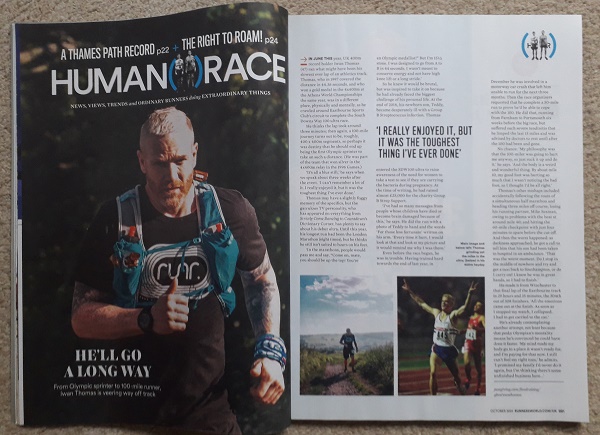
A couple of years ago in the October 2021 edition of Runners World they detailed his ultrarunning in the South Downs Way 100. That’s one hundred miles from Winchester to Eastbourne. A significant motivator for doing this was to raise money for charity due to difficulties his son suffered after birth. Iwan recognised he’s not built to run ultras saying “I’m 15½ stone. I was designed to go from A to B in 44 seconds. I wasn’t meant to conserve energy and not have high knee lift or a long stride.” When it came to the race, he ended up finishing 304th of 308 finishers in 29hr35. It was a tough race and he was left believing he might have completed it faster as he wasn’t physically ready for it. He’d barely trained in the preceding months due to a tendinitis injury and motorway accident; although race organisers had got him to run a 50-mile ultra as evidence he would capable of the longer event.
Back at Eastleigh parkrun, with only 68 of us having braved any New Year’s Eve hangovers it was easy to find the opportunity to say a brief “Hello”. What struck me wasn’t anything he had to say – it was his size and build. I was looking eye-to-eye with him, standing just as tall and strong.
While Iwan is now 15½ stone, I’d guess he was somewhere around 13-14stone in his prime. Research on other elite 400m runners shows Matthew Hudson-Smith is 6’4” / 12st4lbs, Martin Rooney is 6’6” / 12st 11lbs, Roger Black ran at 6’3” / 12st 6lbs and Michael Johnson at 6’1” / 12st 7lbs. Those physiques are very comparable to my own. I’m 6’2” and have slimmed down over the past two years to just over 12stone and under 10% body fat. In my younger days, I was usually around 14 stone and more muscular.
I’ve been training and running consistently for the past decade and I’ve come to the conclusion that I’m not particularly suited to distance running. This fits with me being built more like a 400m runner. I’ve always believed everybody is capable of doing everything to a decent standard so it’s a bit galling to have to admit that perhaps you can be genetically limited. My personal bests are all similar to Iwan’s and it’s fair to say they are decent times and many runners would be happy with them. Yet they’re a long way off the best – about 50% worse than the world records and I see many runners around me who naturally run faster off less training.
Does this mean I should give up distance running? Not at all, I’m still determined to get the best out of myself. It just means I’m reconsidering my approach. If speed is where my strengths lie then I need to keep working at that. Looking back to when I started parkrunning, I had good speed but I didn’t understand how to create endurance and stamina or how to convert that speed into better parkrun times. In my pursuit of figuring this out, I got away from speed, allowing it to decay as I spent sessions logging miles and experimenting with different training systems. Now I’m going to dedicating myself to redeveloping my speed.
If you too are interested in improving your speed then contact me to purchase my Get Faster … Speed Training course.









 Big Red Running