What a block of training this has been! You’ll recall from my previous update that I’ve been following an 800m plan written by Jack Daniels and in his notes he said this phase would be the most demanding. He didn’t lie. In the previous update, most of my workouts were short intervals at paces between 5:30 – 6:30/mile to get the legs used to running faster. The rest of my week was easy running to recover. It never felt too bad as my legs have always liked faster running and coped very well with it.
What I hadn’t appreciated about my fitness was … the huge gap in it. Before starting this training I did three months of easy running where the majority of it was 8-10 min/mile. My long runs for example were averaging 8:30/mile in November. Along the way I clocked a few miles close to 7:30 (but only a few) and this is where the gap opened up. I had nothing to connect me between those autumn runs, at 7:30 or slower, to the 800m speedwork at 6:30 or quicker. Bridging the gap is what this phase aimed to do as you’ll see when I explain JackD’s T-pace and I-paced running.
To begin the recap let’s rewind to mid-January and the start of this phase. The first thing was to up the paces to account for (hopefully) improved fitness coming off of the previous block of training. This meant where I’d been running 200s at 48secs they were now expected to be run in 47 secs. Faster 200m repetitions quickened up from 44 to 43s and the other short interval distances were all increased using equivalent paces to these.
The sessions focused on what JackD terms I-pace training which are longer intervals at your predicted 5K pace. These began at three mins (where I managed 700 metres) and incrementally stretched out to five minutes (1,200m). I like what he says on p.108 of his 3rd edition book about how this “adds an aerobic stress but not any faster running speeds, which would be an additional new stress for the body to deal with.” i.e. you only add one stress, not two. My I-pace has been 6:50/mile (4:15/km).
The T-pace (Threshold) running should have been around 7:20/mile but I’ve found myself running them at 7:10-15 fairly comfortably. I think my recent years of endurance training probably made this easier to achieve than expected. There was also one 40-minute run at M-pace (Marathon) which I ran at 7:45/mile but could feel myself flagging in the last 5-10 minutes. Another gap filler.
There were still lots of 200s, 300s, 400s and 600s being run at fast paces but not the 100+ efforts of last time. Once again I’ve summarised it all in a table below and you can see, while the shorter efforts were generally successful, I struggled on the longer 400s and 600s. I think this is because my legs were often still recovering from the I- and T-paced sessions which totalled well over 45km.
Target time
On target
Missed
Efforts
Fastest
200m
47s
10
–
10
(2km)
38.44s
(5:10/mile)
43s
12
2
14
(2.8km)
300m
1min05
9
–
9
(2.7km)
59.77s
(5:21/mile)
400m
1min34
6
4
10
(4km)
1:24.9
(5:42/mile)
1min26
1
4
5
(2km)
500m
1min57
1
–
1
(0.5km)
1:53.54
(6:06/mile)
600m
2min23
4
6
10
(6km)
2:17.2
(6:08/mile)
I-Pace
6min50
33
1
34
(27.7km)
T-Pace
7min20
7
–
7
(11.2km)
M-Pace
7min45
4
1
5
(8km)
Total
87
18
105
(66.9km)
Stats for those who love them!
What’s been most interesting is Sundays have alternated between doing a Long Run one week, and a workout the next. By the time I’d run warm-up, efforts, jogged recoveries and warmed down home; the Sunday workouts were close to ten miles – not far off my standard 11-12 mile Long Run. Some of the midweek workouts have also been in the 8-10 mile range.
The first couple of weeks had their usual slump as the legs got used to the new regime. There were some aches and pains occurring especially in my left knee and right calf but these disappeared about three weeks in. My body began to feel comfortable with the training but I fatigued after a heavy fourth week. I found myself sleeping more and the fifth week of training was the toughest I’ve encountered so far. Thursday of week 5 was the workout where I physically couldn’t run fast enough on a set of fast 400m efforts missing target by 2-3 seconds. Fortunately in week 6, my legs perked up and I reaped the benefits of all the training so far. In the final workout I recorded my three fastest 200m times since I started – hurrah! Arriving home my Garmin promptly corrupted the workout so it wouldn’t upload. Fortunately I’d done a cursory review of the numbers in the kitchen. Frustrating but not the end of the world.
My overall mileage stayed about the same as previously and the six weeks resulted in 45 / 45 / 42 / 45 / 41 / 46 miles. These have been achieved with 6hr10 – 40 mins running each week depending on how my other commitments allow.
Weatherwise the training was a nightmare. As a golfer I’ve always found the end of January / start of February to be the worst conditions and I usually took a month off to stay warm at home. But, as a runner, you need to be getting out as often as possible so it’s a case of wrapping up warm, wearing the right gear. This year’s weather was rather diabolical – a combination of high winds, minus-figures temperatures, almost some snow, and two weeks of heavy rain. It seemed to dominate the forecast for every scheduled workout but there were one or two nice sunny days jumping out from nowhere to give surprise relief. Even so, when you’re struggling with fatigue, it’s not encouraging to go into a session knowing high winds will be suppressing your pace. But it’s already beginning to feel like “Spring is here” with mornings getting brighter and even birds tweeting!
The next six weeks focus on T-paced work which so far I’ve found fairly easy, but it includes fast repeats out to 600m which are going to need to be run in 2:06 – the fastest I’ve run so far is 2:13. I’m not looking forward to those but let’s see what happens ..
Sprinting into the finish of Lordshill 10K, I was overtaking other runners and feeling strong. Yet my Garmin only recorded a Best Pace of 4:45/mile, which while useful, is slower than Kipchoge runs a whole marathon. Looking at the races photos of my sprint finish, I began to see why and started to think about some form changes. Sadly I never got a copy of the photo so I can’t reveal its horrors but this one from the 2010 New Forest Marathon begins to hint at my lack of form. Here, I was only running at eight minute mile pace, not even trying to sprint. If I hadn’t mentioned it you might not see much wrong. But there’s issues, notice the heelstrike of the right foot.
At least I look as if I’m enjoying it!
Below is another picture I came across as I was reading through my backlog of Runner’s Worlds. It’s a happy photo, you can see the joy of the runners. I’m guessing they’re approaching the finish as they’re spaced out and smiling, not overwhelmed by already having run for two hours with many more miles left to do. But my eye wasn’t drawn to the runner’s joy, it’s another photo where heelstriking is visible. (This isn’t criticism of the ladies in the image, they’re simply demonstrating something which is common among runners, myself included, that can even be seen at the elite level).
But heel-striking isn’t the focus of this article. That’s because it isn’t caused by, or easily corrected by adjusting, how the foot lands. Heel-striking is simply a reaction to a chain of events. The foot is connected to the ankle, which connects to the shin, to the knee, to the thigh and on up to the hip and pelvis. This is where the problem is really occurring. The pelvis is rotating forward, thereby flinging the leg forward, so the only place the runners can land is on the heel.
It’s hard to see pelvic rotation because the hip and thigh muscles obscure it but there’s another way to identify it. Here’s a close up of the same picture with some lines added. You’ll see I’ve highlighted the shoulders because this is where the issue is obvious. Shoulders also rotate around the spine, which is the centre axis connecting the upper and lower bodies. Whatever happens in the lower half is mirrored in the top half, for example as you walk or run, your arms and legs swing in opposite time. Unless you consciously block it, or have your hands in your pockets, your arms always swing back and forth when moving.
Lower half travelling forwards, top half turning
When there’s excessive pelvic rotation you get excessive shoulder rotation. In the RW photo, the runners’ arms aren’t so much swinging as being turned. If you look back to my photo, you’ll see the opposite shoulder is coming around, emphasised by the arm moving towards the middle of the body. The disaster photo from 2017 of me sprinting, shows an even more pronounced rotation of the shoulders and hips. I would hazard to say my shoulders were 45 degrees to the square – but I’m trying to mask this by swinging my arms straight forward and back despite the turning! I really wish I had the photo to show you how bad it was.
A good way to see why this is a problem is to imagine yourself riding a bike along the road. If you begin to wobble the handlebars then the front wheel wobbles. You end up zigzagging in danger of falling off, continuously understeering and oversteering to try and keep stable. When you keep the handlebars steady your bike travels effortlessly straight. It’s the same issue for the runner. Keep over-rotating the pelvis and you’re constantly fighting to run in a straight line. No longer do the muscles which are most efficient do the work, but lots of auxiliary muscles have to compensate which is both energy costly and puts you at risk of injury.
Sprinters
If you compare this to any world-class sprinter you’ll see their shoulders and hips stay relatively square. Of course some rotation has to happen, we’re simply interested in avoiding excessive rotation. Here’s a video of a sprinter doing 26+ mph on a treadmill. Helpfully, the university researchers have put reflective dots on the sprinter’s body which allow us to see the rotation of the upper and lower bodies. Or rather the lack of it.
We can see there isn’t much rotation occurring in the hips. I’d estimate one hands width, so maybe 3-4 inches. The dot under the armpit is moving more but we never see the shoulder on the far side coming into view. The stability of the hips is reflected in minimal shoulder turn. And if you look at the footstrike while the leg comes out in front, as the foot strikes the treadmill it’s flat – no heelstrike in sight.
If you see sprinters head on, you’ll see their arms and legs are moving straight backwards and forwards. Coaches actually teach sprinters not to let their arms cross the centreline of the body which happens when the shoulders turn.
Improving your form
I don’t focus very much on running technique, certainly not like when I played other sports. But I have been working on reducing my hip and shoulder rotation because it’s a cure-all for a bunch of problems. If you reduce rotation you raise cadence, reduce heelstrike, power your running with your glutes and reduce quad involvement which can lead to lower back pain.
Here are some ideas and things to try that I’ve found helpful over the years.
Exercise
Try running with one hand on your hip and feel how it affects you. The hand on hip forces the shoulders to stop rotating and the other arm then has to swing. Do it for thirty seconds then change over. This exercise isn’t intended to be used to rework your form i.e. don’t go run for an hour with one hand on a hip (for one thing you’ll look silly); it’s to give you an understanding of what the proper form feels like and which muscles should be working.
Strengthening
The problem of excessive rotation is often down to not stabilising the core and not using the glute muscles to power the running. I get runners doing exercises at my sessions in Poole Park when time allows. I recommend Planks and especially Side Planks for core stability. For glutes, try Glute Bridges progressing to the Single Leg version. Also Single Leg Deadlifts. You can find examples of these exercises on the web and Youtube if you can’t make my session.
Glute Activation
Once strengthened you need to ensure the glutes are being activated when you run. Here are simple exercises to do before running, perhaps while waiting for your GPS watch to lock in or a friend to arrive:
Stand with one foot out in front, the other underneath you. Then push up on to the toes of the rear foot to rock forward onto the front foot. Relax back down before doing it again four times then switch legs.
Imagine pushing a shopping trolley in front of you which doesn’t allow your legs to swing forward while walking. Forward motion has to be powered by pushing away behind. Walk twenty yards then break into a jog and try to keep the same feeling.
Standing against a wall, walk away from it by pushing against it with the back of your leg and heel. Do five push offs with each leg..
Walking up the stairs at the office or home, push up off the lower foot to fully straighten the leg. Barely lift the other leg onto the next step. Practice every time you use stairs.
In all these exercises the leg that is behind the body does the work, the one in front remains ‘quiet’. Your aim is avoid using the quads to power the exercise. Again, I incorporate this activation work into coached sessions during warm-ups.
Integrating the two – my journey
Last Easter I started an exercise program to rebuild the strength and power I’d lost while focused on building endurance. One of the exercises I did was “Bounding”. Very long loping strides where you hang in the air (like a triple jumper) aiming to cover distance rather than go quickly. Pushing off with each bound, it became obvious if there’s over-rotation going on because you start to zigzag down the road. I started to find myself pushing with the glutes and maintaining hip stability.
In the summer, I started a new core stability programme and the work I did on side planks helped with minimising rotation. I’d always been strong in the core but when combined with improved running form the two things began to work together. I came home from one of my Sunday long runs and found the oblique muscles either side of my core were aching because they’d been stabilising me for the first time ever. You can run for years with bad form and never know it!
But still I wasn’t sorted. As I’ve moved in to 800m training with its emphasis on shorter 200m efforts, I began to notice my right hip was rotating forwards. I had to work on keeping my hips squared and getting the glutes to fire.
I know I’ve still work to do on this. It’s slowly coming together. Form change is difficult and tends to be a series of plateaus then improvements as you find something that helps you move to the next level. I started trying to improve my cadence back in 2013 and I’m still working on it. The recent form changes for getting glutes to fire have been a stepping stone for that. No doubt I will be looking again at photos in five years’ time and still finding fault.
A Final Thought
You often see people carrying drinks bottles. I believe it’s something that causes runners to engage in shoulder rotation. After all, if you carry a cup of tea or glass of wine through to the living room, you try to keep it as level as possible, you don’t want to spill any. A correct armswing will cause the bottle to shake up and down and the liquid in it to slosh around putting strain on the arm and shoulder muscles. I don’t know what the answer is for those who want to carry a drinks bottle, personally I’ve never found a need for them even on the longest of runs. My encouragement would be to learn to trust your body can handle running without needing to take a drink. Obviously in hotter, more humid condition this may be unavoidable.
I was standing on an empty street. A grey January day but not cold. I’d run here from home. The plan said a 15-min warmup and that’s what I’d done. Just shy of two miles beginning with a jog until my breathing settled in, gradually picking up the pace with some downhill running that had got as quick as I was going to need for my first effort.
So now I wandered up and down the street. A minute to the lamp-post eighty metres away then a minute back. Two minutes wouldn’t be long enough to clear any lactate built up during warm-up. I decided to do another trip to the lamp-post and back.
As I reached the lamp-post, I now cued myself into what I was about to do. Six hundred metres at 6:18/mile pace, anywhere from 6:15 to 6:20 would be good enough. Jog the recovery then a five hundred metre effort at the same 6:18 pace with another jog to recover. Then it would get interesting. Four hundred metres followed by three efforts of three hundred metres all at a faster pace – 5:50/mile. Could I do these? I’d struggled to hit pace last Thursday on similar efforts over only two hundred metres. I’d run strides on Tuesday less than 48 hours earlier, did I overdo it? Would my legs be fresh enough to hit target? I needed to go out on the six hundred at the correct pace or risk jeopardising the later intervals. My mind whirred. Not overly anxious but enough thoughts to start getting on my nerves.
I called a halt to it. “Let’s see how it goes” I said to myself and instantly all the thoughts were gone. I was back in the present, walking the street on a grey January day. If I failed to hit target then so be it. I’d have some decisions to make about whether to adjust the plan or just put it down to fatigue from previous sessions. If I hit target it would be great as I’m on schedule. “But let’s just see how it goes” I told myself. The unsaid follow-on being “then figure out what to do once I’ve got concrete information to work with. Let’s work with reality not a bunch of needless fears and anxieties swirling around”.
I went through a phase a few years where I got very Zen about life. I was able to simply say “It’s all just information. Whatever happens today is information about what to do next”. No longer did I interpret events or add my own narrative to them; I simply saw them for what they were and it was impossible to rile me up. The simple truth is no-one can make good decisions when they’re riled up. They might luck into a good decision while making a panic choice but more often than not, fear and anxiety lead to the wrong decisions. People play it safe to avoid their worst fears coming true.
“It’s all just information. Whatever happens today is information about what to do next.”
In my update on 800m training, I wrote about how I sometimes felt nervous, or low-level anxiety going into a session. This doesn’t relate to the pain of what’s about to occur, only whether I’m going to hit the targets I’ve set. For someone else maybe it would be a fear of the pain or breathlessness.
How do I get round this? It’s simple and effective. I stop worrying about those targets or goals, and say “Let’s see how it goes”. Doing that immediately brings me back into the present. All fear and anxiety comes from the past or the future, the present is the only moment where you can take action and make a difference.
Does this mean I don’t plan for the future? Not at all. But what I don’t do is emotionally engage with it. The moment you start worrying about what’s going to happen is when you have to recognise you’ve become distracted and refocus back to now. Once calm you can go back to planning. The better you get at this refocusing, the more it becomes second-nature.
Mindfulness was a big watchword a couple of years ago and what is it? It’s about becoming present in the moment. It’s a variation on meditation which is also about focusing on what is happening now. Next time you go to a race and start feeling nervous about whether you can win (or whether you’ll be last), bring yourself back to the present moment. In a calmer moment begin to explore why it would an issue not to win, or to be last. What would that mean to you? What consequences do you imagine may occur because of it? Uncover the underlying fear and then dissolve it by sitting with it. Commit to facing up to it.
There’s one period of my life where I remember experiencing extreme levels of anxious thinking. It was when I was twenty and my fear of not being able to handle an upcoming situation would begin a domino stream of consciousness with one thought leading to the next. The trigger could be any sort of thing. Maybe my manager had arranged a meeting with me the next day but not said what it was about. Maybe I’d be invited to a party, accepting because I didn’t know how to decline, now worried my social skills would be lacking. Maybe it was about taking something back to a shop.
Night time was often when those thoughts came because I kept myself too busy the rest of the day to address them. But in the dark, quiet of my room, the express train of thoughts would depart, setting off down the tracks at high speed. With the party or returning something to a shop I could stop it by making a negative decision – simply decide not to turn up or keep the defective item. Anxiety derailed by avoiding the situation; that was my go-to strategy, ultimately to my detriment.
But there was no way I could avoid a meeting with my manager so I’d start going through all the possible things I’d done at work recently. I’d explore and examine each situation, I’d come up with excuses or reasons about why I’d done what I’d done. I’d imagine the response I’d get and how I could counter it. Fatigued, eventually my mind tired of the “This happens … what do I do next?” game of Twenty Questions and I’d fall asleep. I had no idea how to stop this whirlwind of thinking other than by avoidance wherever possible. But the one thing I came to realise about facing up to the unavoidable was that, despite all the scenarios I thought up, none of them ever came to pass. Never. Not once. When the actual time came to confront whatever I was scared of, it always played out in a way I’d never imagined.
I’ve read countless testimonials from runners who wouldn’t go to parkrun (“I’ll be at the back”), or join a running club (“club runners are snobby”), or even just go for a run (“people will be looking at me”). Yet when they did these things, they found it was a completely different story. Parkrun was friendly and welcoming, the running club wasn’t elitist and running round their neighbourhood didn’t raise eyebrows. All the imagined consequences never came to pass. It’s exactly what I used to experience and they follow the same self-defeating pattern I did. They get involved in their ego’s perception of how it will play out and when that becomes too much, they go with an avoidance strategy (not going to parkrun, not joining the running club, not going for a run) to stop the anxious thinking. But in the process their life becomes one size smaller as they close down an option that could open up so many possibilities.
Like I said back at the beginning I now realise there’s a better way. It’s to stop trying to predict the future and to live in this moment. When the future finally arrives, I deal with it based on whatever shows up. It makes everything so much easier. When the anxious thinking kicks in, nip it in the bud as early as possible by committing to let the future unfold and see what happens.
“Let the future unfold and let’s see what happens”
The Hansons’ Marathon Method contains an interesting approach to training for the marathon. The idea of the traditional “20-mile run” is abandoned with the longest run being only sixteen miles in their plans. Within the book they explore and compare the recommendations of other coaches and plans.
The idea of the 20-22 mile run comes from the days of Arthur Lydiard in the 1960s when he had his middle-distance runners doing this distance every Sunday! It might sound hard but remember these were runners with the capability of racing four minute miles. They’d begin the season taking 2hr35 and slowly work down to completing the runs in little more than two hours – quicker than 6min/mile, but that’s typically the easy pace of a world class runner. I don’t know if it was deliberate to create a course this long or down to the natural geography of Auckland, running in the Waitakere mountain range where Lydiard lived.
Derek Clayton, the world record holder for the marathon through the 1970s ran 150-160 miles every week. It was his belief, and he put it into practice, that he needed to run a 25-mile run every Saturday to be ready for his marathons. It’s hard to argue with a man whose record stood for so long yet Clayton suffered injuries and needed surgery eight times. Very few, if any, modern elites would do this level of mileage regularly now. Although there’s no record of how long these runs took him, given his toughness and general mileage, it’s hard to believe they would have been run any slower than 6-min/mile therefore being completed in 2½ hours.
In Jack Daniels’ Running Formula book he states a Long Run should never be more than 25% of the weekly mileage. The problem with this statement is it suggests you have to be running eighty miles per week to train for a marathon which is unnecessary for all but the best runners. This 25% limit is better applied to his training plans for shorter race distances but even with the marathon he says don’t go over 2½ hours. He makes the point that for someone only running four times per week, the runs are automatically 25% of the weekly mileage!
The 20-mile run is actually an arbitrary distance, there’s no science to this number. In Europe where they work in kilometres the Long Run is often 30K or 35K which are 18.6 miles and 21.7 respectively. People love round numbers! Of course, it’s true that runners used to say “Twenty miles is the halfway point of the marathon” as a reference to when the body starts to hit the wall and you have to dig deeper, but it’s also because they rarely trained much past it so the body wasn’t used to longer runs.
The most interesting approach to the marathon long run is the one detailed in Steve Magness’ The Science of Running. Magness coached at the Nike Oregon Project under Alberto Salazaar, himself once a world-class marathoner. The training knowledge at NOP was of the highest calibre so this method is one used by some of the best runners in the world. The first two months of a training programme are used to build up the Long Run to the twenty mile mark but then after this, there’s rarely specific Long Runs scheduled. They’re replaced by workouts that typically total the mileage. A world-class marathoner running at 5min/mile might do a Tempo run of 15-miles taking 1hr15 and when you add in a 4-mile warm-up and warmdown the session totals twenty miles. US Marathoner Josh Cox demonstrates this workout in the Training Day video.
The Hansons believe your marathon should be based on good physiological principles. They conclude that running for significantly longer than 2½ – 3 hours doesn’t provide those benefits to runners. Certainly in my own limited marathon training, I used to find that a three hour run left me feeling dehydrated whereas I happily run between 2 – 2hr15 every Sunday without taking food or drinks and arrive home feeling fine.
Hansons may limit the Long Run to sixteen miles but they include a run of eight miles the day before which results in a total of twenty-four miles over the two days. As they describe it, those sixteen miles then become the “last sixteen miles of your marathon” rather than the “first sixteen” which runners who set off fresh legged typically do. This is a method called cumulative fatigue and is used by ultrarunners to train for their races which can be in excess of one hundred miles. On a training weekend they might run for 5-6 hours each day to enable them to compile a total closer to their race distance.
When I was marathon training because I was capable of a 22-min parkrun I could reach twenty miles in three hours, it happily coincided with my 9-minutes per mile easy pace. For a slower runner, I would look for them to improve their pace and to use the principles of cumulative fatigue to help them prepare for a marathon. I’ve met far too many 5-hour marathoners focused on reaching the mythical 20-mile run in training because that’s what the guys who were capable of running four minute miles in the Sixties did. The problem is, as they build up through fourteen, sixteen, eighteen, twenty miles they start tearing themselves down Sunday after Sunday with demoralising trudges lasting four hours or more, often in unpleasant winter conditions. Motivation sags, they can’t wait for the taper and end up walking large chunks of the marathon anyway. If you must build up to twenty miles get it done early interspersing the progression with less-taxing two hour runs on alternate weeks to give the body a chance to recover.
This far I’ve focused on the marathon distance but I find many runners don’t believe a Long Run is necessary for anything other than half or full marathons. This is a mistake and maintaining a weekly Long Run is an important part of building your aerobic base. By running further once a week you dig out muscle fibres that would otherwise lie dormant. Does it need to be 20-miles? Definitely not unless you’ve reached the capabilities of the Lydiard crowd.
Middle distance runners typically do a run of 10-12 miles and it goes up from there depending on the distance being raced and the runner’s capabilities. But it’s equally important to think in terms of time. I always aim for a minimum duration of 1½ hours for my weekly Long Runs and a maximum of 2½ hours. Of course, this distance needs to be in proportion to my other running, I wouldn’t do that if I were rebuilding after a layoff and only doing thirty minute runs the rest of the week.
Whatever your event, whether it’s parkrun, 10K or longer don’t neglect a weekly long run. It’ll keep you positioned to pick up on a half or full marathon at short notice while helping you get fitter and faster for your chosen distance.
Just before Christmas, I was lent a copy of Ron Hill’s two-part autobiography “The Long Hard Road” which is packed with detail on his life and running up to when he wrote them at the start of the 1980s. I talked briefly about it in my Marathon Speed post. Coincidentally the latest issue of Runner’s World (February 2021) contains a feature on Ron which, of course, goes nowhere into the same level of detail but does give an outsider’s view of what he was like.
The legendary Ron Hill adorns the cover of Runner’s World – Feb 2021 issue
Ron’s famous for his fifty-two year run streak and I’ve read analysis elsewhere suggesting he overtrained prior to big races. But let’s rewind, as I’m two hundred or so pages into part one and still learning about his early training and racing. On page 91 he details a week’s training which was the general schedule he began to follow from August 1961 and on through the next couple of years.
Details of a week’s training from Ron Hill’s book “The Long Hard Road” Pt. 1
About two weeks after formalising the schedule he won his first marathon, Liverpool, in 2:24:22 which gives us an indication of his level of fitness. Up to this point his training had been irregular with weekly mileage varying between 50-80 miles. He even took days off at that stage!
The training week I’m analysing follows the format he used throughout 1962-64, averaging 85-90mpw. His diary begins on a Saturday before Christmas …
The first thing to note is while 91½ miles of training sounds daunting, he’s actually only doing about 1hr – 1hr15 of training each day. The morning sessions are 25-30 mins; and the evening sessions tend to be eight miles of faster training which I’d estimate took 40-45 mins. The Sunday ‘long run’ of 11 miles will be just over the hour. What makes the 91½ miles achievable is being a fast runner – the majority of his running is done between 5-6 min/mile so he’s covering 10-12 miles per hour.
Saturday Dec. 16th
Morning – 4 mile course – 24:27 (6min05/mile)
Evening – 12 miles total.Ten mile race – 1st in 49min59 (5min/mile)
My thoughts – the 10-mile race is 5min/mile. According to Jack Daniels this gives Ron a marathon pace of 5:20/mile – which fits with his first marathon being run at 5:30/mile.
This 5:20/mile gives us a boundary for the 80-20 rule modern elites follow – 80% of their training will be slower than this. This 10-mile race is definitely in the 20% category.
Meanwhile the morning run is in the 80% category. JackD suggests an easy pace of 5:55 – 6:40/mile for someone at Ron’s level of development, so at 6:05/mile it looks about right.
Sunday Dec. 17th
11-mile long run. No time given but run with two others at a “very gentle” pace
My thoughts – at over an hour, it’s slightly longer than an ideal recovery run from yesterday’s race but it certainly falls into the 80% category.
I find it interesting Ron had now been running over four years and his long run was only 11 miles. He managed to win Liverpool marathon without any specific build-up – there was no 20-mile run. It suggests he had natural talent for distance running but, as you’ll see, he ran hard almost every day and in doing so he used the same principle of ‘cumulative fatigue’ that ultra runners use to train for their big races.
Monday Dec. 18th
Morning – 4 ½ mile course – 26:51 (6min/mile). Says he “pushed it a bit”
Evening – 8½ miles – 6 laps of fartlek including fast lap (4:49)
My thoughts – the morning run is slightly longer and faster than on Saturday but Ron’s Sunday was easy by his standards. Falls into an 80% run.
We have few specifics on the how long the fartlek efforts lasted but due to the fast lap, I’d classify this as a 20% run.
Tuesday Dec. 19th
Morning – 4½ mile course – 28:36 (6min20/mile) – “fartlek” “pushed intervals along a bit towards the end”
Evening – 8½ miles – at Firs – 4 laps at race pace (19:35 – 4:54/mile) + 2 laps fartlek
My thoughts – once again, while the average pace suggests it falls within the 80%, by doing a fartlek and pushing along the intervals, this begins to get into the 20% zone.
The evening session is definitely a 20% run, in modern terminology you’d call this a 20-min Threshold or Tempo run.
Wednesday Dec. 20th
Morning – 4½ mile course – 28:08 (6min15/mile) “pushed it where I could”
Evening – 10 miles – 20x440s in 1min10 with 220yd recovery
My thoughts – once again the pace of the morning run is under 80% but Ron isn’t allowing his legs the recovery they need from the race (80% session).
The evening session is the 6th consecutive session where he’s putting in effort rather than simply running easily (20% session).
Thursday Dec. 21st
Morning – 4½ mile course – no time given – “fartlek” “legs tired and leaden at the end”
Evening – 8 miles – “number stride fartlek” up to 60 and back down twice over
My thoughts – finally we see the results of hard racing on Saturday followed by trying to push things on Monday to Wednesday. I’m guessing the legs felt particularly tired because the previous evening was five miles worth of interval work. Yet Ron wanted to do a fartlek that morning. It would probably qualify as an 80% session on average pace but it’s another hard one in my book.
In the evening he did the “number stride fartlek” workout he invented:
“I ran 10 double strides hard effort, counting each time my left leg pushed off then jogged 10 double paces, then 15 double strides with the same number of paces jogged, 20, 25, 30, and so on, up to 55 or 60, then back down again to 10. Half mile jog, then repeat the sequence again. The bursts were relatively short, but it meant a lot of hard work in the acceleration phase each time, and I found it very tiring.”
Ron describes his “number stride fartlek” session (p.73)
I calculate this to be over twelve minutes of all-out hard running. First effort of 10 double strides only takes around 5 seconds, the second effort about 8 seconds. By the time he’s on the 60 double strides it’s taking over 30-seconds for each effort and he’s still got to come back down the ladder again. In total there are 21 efforts ranging from 5 – 30+ seconds. He’s packing in a lot of acceleration and hard running here. When you add it all up he’s totalling over 6-mins of all-out hard running on one of these efforts. That’s a session in itself for sprinters and he did it twice over.
Now compare that to the recommendations of Jack Daniels who would suggest doing eight strides after an easy run and describes them as “light, quick 10- to 20-second runs (not sprints) with 40 to 50 seconds of recovery between” (Daniels’ Running Formula 3rd ed. P.152). That’s around 2-3 minutes worth and not all-out. I begin to wonder how Ron ever survived running all those years – definitely a 20% session.
Evening – 7 miles – ran to Firs and back for six laps of field
My thoughts – at last we see a day of easy running. After the “number stride fartlek” his legs probably weren’t able to do anything else in the morning (80% session).
No time is given for the evening session but it was probably an easier run (80% session).
To summarise, what I’m seeing here is almost constant pushing to run fast. The only days where this doesn’t happen are Friday and Sunday. He raced every Saturday so probably took things easier on Friday to give himself fresher legs and recovered on Sunday.
In terms of the 80-20 rule, it’s hard to know for sure which category sessions fell into I’d estimate he was closer to 50-50. The rule relates to doing training 80% of the training at an intensity where no waste products from anaerobic metabolism are being produced. Their presence upsets the body’s chemistry, uses fuel stores quicker and fatigues muscles thereby leaving the body less able to perform effectively in the next workout.
But beyond the anaerobic metabolites, there’s a question of muscular recovery. When racing or running at high speeds, the muscle fibres get micro tears that have to rebuild stronger. Without adequate recovery this mending doesn’t occur. Ron has it going in his favour that he’s in his early 20s so he’ll still be recovering quickly, but even a young person is only capable of doing three workouts per week – maybe more occasionally. If I’m sounding critical I’m happy to admit when I was Ron’s age, I had no respect for the recovery process either. I used to play sport hard almost every day. It wasn’t unheard of for me to play an hour of competitive basketball then go to volleyball training for another hour. Or play a game of squash at lunchtime and another in the evening.
On p. 108 Ron provides the bare bones of his schedule … (“It was hard training, but as I was seeing improvement and success, I didn’t mind it. Morning sessions rotated on a weekly basis. Evening sessions on a fortnightly basis. I had a card in my training log and I ticked off each session as it was done.“) … it’s a lot easier to see the pattern and intensity of sessions:
MORNING
(4½ mile runs)
EVENING
Mon
Fartlek
Week 1
Mon
Fartlek with bursts
Tues
Fast
Tues
Four laps of the Firs (3½ miles) at racing speed
Weds
Fartlek
Weds
20 x 440 (usually around 68sec)
Thurs
Fast
Thurs
“number stride” fartlek
Fri
Easy
Fri
7 miles easy
Sat
Easy
Week 2
Mon
20 x 440
Tues
4 laps at racing speed
Weds
20 x 440
Thurs
4x repetition laps at the Firs
Fri
7 miles easy
Saturday would have been a race later in the day and Sunday only one longer run
Ron is doing four specific workouts plus a race each week. He ran 64 races in 1962! And he’s pushing it on four mornings. His body is under a huge amount of stress and it’s no wonder that, after a year of it, he was eventually forced to back off and take three easy weeks (30-40 miles) in December 1962. As he recounts his year, he’s usually trying to run through some kind of nagging Achilles, foot or quad injury.
I’m certain if he had simply jogged the morning runs each day he would have been in a much better position (but still not an optimal one). Some people can handle more intensity and training than others and it’s clear Ron could. But it’s also clear from how his body reacted that his training was too much even though it helped him get faster over the next couple of years. More recovery sessions would almost certainly have allowed him to do stronger workouts to make the same gains and possibly even run faster.
But enough of the analysis, Ron says he was seeing improvement and it’s certainly the case. As he started this training he won the Liverpool marathon in 2:24:22 in August 1961. A year later he won the Polytechnic Marathon in 2:21:59. It led to him representing Great Britain and Northern Ireland at the European Championships in Belgrade. He didn’t finish the race pulling out at 30km five minutes down on the leaders. In 1963, he tried to defend his Polytechnic title and, while running faster (2:18:06), he came 2nd to Buddy Edelen. In 1964, Ron ran his fastest time yet with 2:14:12 at the Polytechnic which would have been a World Record had Basil Heatley not been beaten him. It gave them both a place at the Tokyo Olympics but Ron could only finish 19th in the marathon (2:25:34) and 18th in the 10,000 metres – a distance he’d been ranked at 3rd in the world in 1963. Nonetheless in three years he took ten minutes off his marathon time with his training regime. At other race distances he also saw improvements – his 2-mile time going from 9:12 to 8:50; his 3-mile time from 14:08 to 13:29; and his mile time down to 4min 12.5sec.
This is the question mark against Ron’s training methods. He was capable of winning one week, struggling the next. He won the Boston Marathon and Commonwealth Games in 1970 but then failed to even secure a medal at the Munich Olympics when he was the favourite.
I believe more recovery runs each week and fewer workouts would have allowed him to find the consistency to be a winner more frequently. Maybe I’m being unfair to him and as I get into the later parts of his autobiography, I’ll find he did what I suggest but his hard-working reputation leads me to doubt it. It’s instructive that as he prepared for the AAA Championship 6-mile race, key to selection for the Olympics, he was still running in local races. Modern runners are more selective about when they race. Constantly pushing his body meant it had to give out at some stage, so it often happened when everybody else was rested, at the top of their game and able to push harder.
Regardless of the results, I believe Ron got the best out of his talent and had a career to be proud of. His best marathon time was 2:09:28, only a minute or so behind the world record in place a decade and a half later. As a coach, you love people who are committed to their training and willing to work hard so there’s no complaints there.
Part two of Ron Hill’s “The Long Hard Road” – 400 pages each
Have you heard of Ian Stewart? It’s a popular Scottish name and I used to work with one but I’m asking about the runner who was one of Britain’s talents in the 1970s claiming a bronze medal in the 5,000m at the Munich Olympics. Athletics Weekly recently ran this article detailing his top 30 races.
What struck me was this quote: “First’s first and second is nowhere as far as I’m concerned. This country’s full of good losers. It’s bloody good winners we want.” It brings to mind famous quotes by Liverpool’s Bill Shankly “Some people think football is a matter of life and death. I assure you, it’s much more serious than that” or the misquote of Vince Lombardi, head coach of the Green Bay Packers, with “Winning isn’t everything, it’s the only thing”.
It’s an attitude that was prevalent as I was growing up in the 1970s and 80s, even into the early 2000s but one you rarely hear uttered these days. Maybe it’s because we’ve been spoiled with success in athletics, swimming, cycling, rowing, tennis in recent years; whereas for many years championships or medals were rare.
Through my early twenties I fell firmly into Stewart’s camp believing only in the importance of winning and the pointlessness of placing. I first began to understand this could be wrong while watching the Atlanta Olympics where Britain only won one gold medal. “Being a good loser” was never more apparent than in the men’s 400 metres when Roger Black trailed in behind Michael Johnson. Whatever Black did that day he was never going to beat Johnson, the world record holder at 200m and 400m, unless injury or disqualification occurred. Roger Black did the best he could and made sure he won the silver medal. I’m sure he would have preferred gold but there was no disgrace in getting silver that day.
It’s incisive to ask “If winning means so much why not find situations where it’s guaranteed?”. Try racing your 8-year-old and see how important the win is then. On the other hand, try letting your 8-year-old win easily and they’ll be quick to say “You weren’t trying”. Against a mismatched opponent, it becomes obvious winning means nothing to all but the hyper-competitive. You will see people who go looking for guaranteed wins – witness the segment hunters on Strava or those who enter races with small fields or where the winning time was slow last year.
On the only occasion (so far) where I’ve been crowned “First Finisher” at parkrun, I recorded the slowest winning time of the 200+ occasions Moors Valley parkrun has been run. The best club runners were tucked up in bed on a day forecast to have 50mph winds, resting up for a Dorset Road Race League race the next day. But I never turned up that day looking to win, my intention had been to go for a recovery run!
While it was nice to be first, the week before Andy was fastest, the week after it was Tracy. Meanwhile there were another thousand people around the world who were fastest at their respective parkruns. My success was short-lived but for six years, Mo Farah was the undisputed champion at the Olympics and World Championships over both 5,000 and 10,000 metres but eventually someone surpassed him. Being undisputed champion of anything for a period of time elevates you but eventually it comes to an end and then what? You can either move on to pastures new or try to live off a legacy of the past.
For the rest of us, the truth is there’s always someone who’s better and someone who’s worse. Only one person can rise like Mo Farah, Usain Bolt or Eliud Kipchoge to say they’re the best in the world. Yet when you bring the three of them together, each has to accept they’re only the best in their respective events. Bolt is the best sprinter, Farah the best distance track runner and Kipchoge the best at the marathon. Being the best is event specific.
When I last watched BBC Sports Personality of the Year, a decade or so ago, they went through a list of Britain’s world champions which quickly became a list of sports you barely knew existed. A quick search pulls up a similar list from 2001 which The Guardian created. While I remember triple jumper Jonathan Edwards, rowers Cracknell and Pinsent, snooker’s Ronnie O’Sullivan and boxing’s Lennox Lewis; can anyone outside of the sports name our former world champions in waterskiing, billiards, real tennis or canoeing? This isn’t to diminish the efforts of the athletes in minor sports, only to point out how limited winning success is in its scope and recognition.
Could winning represent something deeper than simply coming first? I suspect many believe winning brings some kind of Midas touch. That it’ll turn them into a good person, bring them friends, a beautiful spouse, maybe make their lives easier by giving them power and influence, or even like King Midas bring them riches. While that may be true for Bolt and Farah, the effects of winning below the elite level quickly diminish. Whatever you might believe, the idea of outer success signifying some kind of inner worth is flawed. Many champions are still unhappy even while they’re winning. Their struggles show up time and time again, more so after they retire from competition. Winning hasn’t transformed them into happier or more secure people.
What I’m hopefully getting across is the idea that winning, in and of itself, is almost worthless. Firstly because in any race there’s only one winner and if you’re up against a vastly superior opponent you’re a guaranteed loser. Secondly winning is transitory – someone always replaces the current champion. Thirdly even if you win in your local talent pool there are others further afield who will be better. Finally because you’ve only won a specialised, measurable event; you’re one champion among many. How ever much BBC Sports Personality of the Year may want to single out someone as the champion of champions, genuinely ranking all the contenders across a spectrum of sports and athleticism is an impossible task.
If winning is worthless and, according to Ian Stewart, so is coming second then what is the point of competing?
I believe the answer lies in something we’ve all heard many times from school onwards. It’s the cliché of “doing your best” or more accurately “getting the best out of yourself”. Listening to Chris Hoy, Britain’s much decorated track-cyclist, commentate during the last Olympics, he told how he set challenging process goals for his training, recovery and all the other things involved in getting him to the start-line of races. If he could honestly say he’d ticked the box on those goals before the race started then he would be satisfied with the outcome whether it was gold, silver, bronze or whatever. He set himself challenging training targets to put himself in position to perform at his best on the day. If someone else then turned up who was fitter or stronger, he could accept it without any form of regret. While he never said it, probably because it never happened, if he hadn’t ticked the box on those process goals then he didn’t deserve to win but wouldn’t have complained if he did.
Compare that to the average runner who goes to the pub for birthday drinks when their schedule needed them to have an early night, or the runner who misses a couple of sessions in the depths of January because it’s cold or raining. Think about how these runners then rationalise and excuse themselves but also get upset when beaten over the line or missing a PB by seconds. Hoy had no need for excuses or rationalisations because he knew he’d given his best from start to finish.
This is where the desire to compete and win takes you. While you may begin with a level of natural talent that allows you to coast past your initial opponents eventually the competition becomes tough. At that point you make a choice – accept what you’ve achieved, or dig in and try for more. If you opt for the latter then you train harder, train more frequently, train more intensely. Taking the challenge to compete at higher standards will take you out of your comfort zone as you begin to try new things and look for alternative methods in your quest for success. Sometimes there’s a shortcut like buying better equipment – the new running shoes that promise to make you 4% faster. Sometimes innovation is good, sometimes it verges on breaking the spirit of the rules.
For some, winning becomes so all-consuming they take desperate measures. They break the rules – either through foul play during competition or behind the scenes like taking banned substances. Sometimes others push them into these situations like the state-sponsored doping of East Germany or the pressure exerted in sports where doping’s considered the norm. The choice to stay honest and drop out is a tough one when you’ve already invested so much of your life into something you love doing and which provides a livelihood.
Ultimately winning is being the best at a particular thing at a specific moment in time. That’s all. Nothing more. It only means something if it takes you to the next level, to new competition, gets you to push yourself harder and try new things; or comes as a result of them.
Returning to Lombardi’s quote, which as I say is often misquoted, what he actually said is “Winning is not everything, but making the effort to win is”. It’s a very different emphasis and one I’ve come to agree with.
“Winning is not everything, but making the effort to win is” – Vince Lombardi
The standard approach to marathon training has always been to build up the distance to the “20-mile run” three weeks before race day and then taper. Runners of the 1980s talked about doing the 20-mile run six times before a marathon to get the legs used to the distance but it was always about building up to the distance.
But a few years ago, I came across the idea that the Kenyans start out with running short distances at the pace they want to run their marathon and then extend the distance. I discovered this around the same time I was reading the Hansons Marathon Method which sets out ever-longer “Tempo runs” at marathon pace. These two approaches of the traditional Western build-up vs the Kenyan build-long have names in the sprint world – Long-to-short and Short-to-long respectively.
When I began running, I started out with a sort of Short-to-long approach. I went out the door at high speed and tried to hold onto it for as long as possible. Of course fatigue quickly kicked in and I gradually slowed down. This is the Short-to-long approach at its simplest – start at a particular speed and build up the distance for which you can hold it. I’m currently using this approach with my 800m training – I began with strides of 10-20secs to get my legs used to running at speed. Then it was 200m efforts at a particular pace, subsequently progressing onto 400m then 600m efforts at the same pace.
The alternative approach of Long-to-short is one where you get used to running longer intervals at a slow speed and then gradually quicken them up. As I documented in my post about Roger Bannister, in the six months preceding his iconic moment he began running 440yd intervals at 1min06 then reduced the time by a second per month until he could run them at 56 seconds e.g. 1:06, 1:05, 1:04.
In his “The Science of Running” book, Steve Magness refers to “Top down” and “Bottom up” approaches which are the distance running equivalents of Long-to-short and Short-to-long. Below are his suggested set of workouts for the 5K parkrun distance. On the left you can see the distance is long intervals of a mile or 1km which begin at threshold pace and quicken to 10K and 5K pace as the weeks go by. On the right, everything is run at 5K pace from the beginning but starts with short intervals of 400m and lengthens out.
Top Down (Long-to-short)
Bottom Up (Short-to-long)
6 x 1-mile at threshold with 1-2 min rest
3 sets of (4x400m) at 5K pace with 30sec rest, 5-mins between sets
5 x 1-mile at 10K pace with 2-3 min rest
3 sets of (3x600m) at 5K pace with 40sec rest, 5-mins between sets
3 x 1-mile at 10K pace 2 x 1000m at 5K with 3 min rest
2 sets of (3x800m) at 5K pace with 45sec rest, 5-mins between sets
1 x 1-mile at 10K pace 1 x 1-mile at 5K 2 x 1000m at 5K with 3 min rest
2 sets of (1000, 800, 700m) at 5K pace with 45sec rest, 5-min between sets
3 x 1-mile at 5K pace with 3 min rest
5x1000m at 5K pace with 60-75sec rest
Of course these are general outlines of the approach. The truth is you still do a bit of each as you progress through your running career. Eliud Kipchoge didn’t start out sprinting as a small boy at his marathon pace of 4:40/mile and keeping lengthening it out until he could run a sub-2 marathon. He did some faster running in shorter races (his mile time is 3:50) and he did lots of general runs at slower paces to build support for what he eventually achieved.
The second truth is that neither approach is “The Way” to train. Some runners will adapt better using a Short-to-Long approach, others using a Long-to-Short. I’ve met a number of guys who were natural marathoners and benefitted hugely from the traditional Western approach to marathon training. They went out each week, covered big distances and pushed a little harder. I, myself, on the other hand have always struggled to run big distances but find the shorter stuff easier and so tag on distance when I have a longer race coming up.
Whichever way you currently approach your training, think about your preferred style and then have a think about the alternative and whether applying it might get you better results.
I noticed during the 2020 lockdown my speed and strength have been declining and, as I’m not getting any younger, I thought it would be good to try something different while I’ve still got the opportunity to maximise whatever talent is left.
I’ve been toying over the years with trying my hand at middle distance running – 800m or mile. Having always struggled at 10K and half marathons more than my training suggested I should, it’s been a slow realisation that maybe I’m built more towards middle-distance or even shorter. I met Iwan Thomas, the British 400m record holder at Eastleigh parkrun once, and noticed we’re of similar size and build at 6’2” and 13+ stone. (Obviously this isn’t to begin to suggest I could ever have challenged him). But I have all the hallmarks of being packed with speed-generating fast-twitch muscle – I build muscle easily, I sweat profusely, have high heart-rates when running at easy paces, start off too fast and love doing interval work. The only trouble is I was never fast at sprinting!
While I understand the principles behind training for 800m, I’ve never actually done it so I decided to use one of the plans from Jack Daniels’ Running Formula book. I wanted to get a sense of how he structures workouts and what volumes he uses. I’d been running forty miles per week through the autumn so went with the plan based on that mileage. I ran an 800m time trial on Dec 2nd to baseline where I was at and ran a lung-busting 2min58. Not great but a starting place.
The plan has been to run two workouts each week, on Tuesday and Thursday, and a long run on Sunday. While I’ve trained to the workouts scheduled, I’ve continued with a long run of 1hr30+ that I was doing through the autumn rather than Jack’s recommended one hour. He also recommends doing six to eight strides on two of the recovery days but again I haven’t done these. This is because I’ve found in the past it’s easy to develop my speed but, in doing so, I wipe out my endurance. I wanted to try and keep the aerobic side propped up with the long run. The six weeks of training I’ve done so far have resulted in 45 / 41 / 48 / 47 / 43 / 44 miles.
The first workout began with a total of 1,600m training (8x200m) progressing to 2,400 – 3,000m in most sessions with a peak of 3,200m. It’s been exclusively a mixture of 200m – 600m efforts with equal jog recoveries. I’m surprised at how low volume this is compared to what many runners do when training themselves.
Target time
On target
Missed
Efforts
Fastest
200m
48s
67
9
76
(15.2km)
40.6s
(5:27/mile)
300m
1min13
6
–
6
(1.8km)
1:05.79
(5:53/mile)
400m
1min37
26
1
27
(10.8km)
1:29.01
(5:58/mile)
600m
2min26
4
–
4
(2.4km)
2:13.87
(5:59/mile)
Total
103
10
113
(30.2km)
Some interval stats for those who love them!
The first few weeks created an overload and the pace of my Sunday and other runs went backwards. This was to be expected as it takes 10-14 days to recover from a new stimulus. I found myself sleeping 8-10 hours the night after big workouts and experiencing more muscular tightness than in the past. As my running form has (hopefully) improved, I’ve found myself landing more on the fore and midfoot and my calves have been taking more load. I’ve had a few aches and pains in random muscles – the inside of the right thigh, below the knee, my left glute but none of them lasted long and the slower, paced recovery days allowed them to heal. I’ve been stretching more to keep everything loose.
Once or twice, I looked at the upcoming session with dread – not because of whether it’ll hurt, but whether I can be on-target for some of the bigger efforts. That’s a real ego thing and something that isn’t good to get too judgemental about. Ultimately there was only one interval I missed by a big margin and that was in the first session of the 400s. It started on an uphill section and I took it too casual – so I learned from it. When I was younger, I’d have beaten myself up about it but now I see a missed target as feedback to whether I’m on track for training. If you start missing targets regularly then there you’re trying to do something you’re not ready for. But once I got into the training I rarely missed target and was more likely to run them too fast. The silly thing is while you can feel you’ve failed for running 48.2s and only marginally missing, you think nothing of it when you run 45 or 46s. Certainly that’s how I would have looked at it when I was younger. But with a wiser head on my shoulders, I tried to ensure efforts weren’t too fast either, there’s no use in adding extra stress when the plan is calculated to give you an optimum loading to recover from.
One of the side-effects of training with all these short intervals – especially the 200s – has been that it’s given me a chance to practice my running form, or rather to play around with it. I noticed I run faster with lower knee lift, that my left leg wasn’t straightening ‘out the back’ and my right hip was coming forward and therefore dragging the trail leg. I noticed over the past week that my left knee was tracking from side-to-side but the lower knee lift gave it more power to push down and straight through. All little things I could only figure out and experiment with by training at faster speeds than a jog. Jack Daniels says in his book that Repetition training is good for improving efficiency but I’d never experienced it to be true until this block of training.
Overall I’ve really enjoyed this training. I’ve been lucky with the weather. It was icy around New Year but I ran at lunchtime when it was warmer and lighter. Some of the sessions have been 15-20mph wind but nothing gale force. Getting out and running fast is fun even when it leads to heavy legs and gasping for breath. It leaves you feeling stronger and better able to cope with running on other days. The next phase of the plan is geared towards supporting this with longer intervals but run at a slightly, slower pace.
Recently I’ve been loaned biographies about Bill Adcocks, Derek Clayton and Ron Hill. These are names from a long-forgotten past but, in the late 1960s, they were three of the best, if not the best, marathoners in the world.
Derek Clayton was the marathon world record holder for fourteen years including the whole of the 1970s. Born in Northern Ireland, he emigrated to Australia in his early twenties and set his mind on becoming the world record holder. His training regime consisted of 150-160 miles each week which enabled him to set the record, first in 1967 with a time of 2hr09min36 in Fukuoka (Japan) then improve it two years later to 2hr08min34 in Antwerp (Belgium). There was however controversy over this latter record as the course was thought to be short. Nonetheless it stood until 1981 when it was broken by Rob de Castella.
Derek Clayton looks out from the cover of “Running to the Top”. Part autobiography / part advice
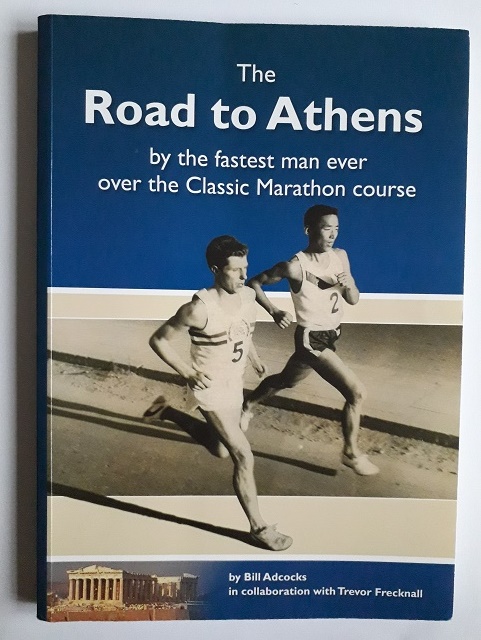
Bill Adcocks was another great marathoner and, the year after Clayton’s recordsetter, he became the sole Briton ever to win Fukuoka marathon in 2hr10min48. He was only a minute slower than Clayton and, while he never held the world record, until 2004 he held the course record for the original Marathon route in Greece with a time of 2hr11min07. Among his other accomplishments were to place 5th in the heat and altitude of the 1968 Mexico Olympic marathon and win silver at the Empire (Commonwealth) Games in 1966.
Bill Adocks running on the left. The cover ofhis autobiography “The Road To Athens”
Ron Hill is better known these days as he’s continued running into the 21st century and is famed for his daily run streak that stretched from 1964 to 2017. Arguably he was slightly better than Bill Adcock at the marathon but it’s a close contest. Ron competed for Great Britain at the 1964, ‘68 and ‘72 Olympics. In 1970, he set a course record in Boston in 2hr10min30 then followed it up by winning the Commonwealth Games gold in 2hr09min28. He claimed this was the world record as it was faster than Clayton’s Fukuoka time and the Antwerp course had never been successfully remeasured.
Part two of Ron Hill’s “The Long Hard Road” – both parts are 400 pages
Having graduated with a PhD in textile chemistry, Ron began his own clothing line. I remember when I was a sixteen year old attendant at Broadstone Sports Centre, the other lads (Warren, Justin, Eddie, Tim) all wore RonHill Tracksters – navy blue leggings with a thin red stripe down the side and stirrup loops at the bottom. While they were tighter than the woollen tracksuits of the day, they were still looser compared to the lycra of today. Of course I had to get a pair to try and fit in with the cooler, older lads!
The legendary RonHill Tracksters. A favourite of the lads at Broadstone Sports Centre in the ’80s
What I found revealing from these books was that each of them began at clubs where they did regular intervals sessions to develop their speed. Mileage was secondary and a big week in their early years was 30-40 miles. Their best times for 400m and the mile were as follows:
400m / 440yd time
Mile time
Derek Clayton
52 secs
4:07
Ron Hill
55 secs
4:10
Bill Adcock
57 secs
4:12
1960s world record
45 secs
3:51
My big takeaway is that even the best marathoners in the world, who are the most naturally talented towards endurance, could run a 400m or 440yds in under sixty seconds. Yet I know few runners entering parkruns, 10Ks or other distance events who can do this. Do you have to be freakishly endowed with speed to achieve this? I don’t believe so – simply committed to a good training programme. Of course there will be some who aren’t capable but I suspect many more could if they tried.
The related takeaway is that in being able to run 2hr10 marathons, Clayton, Hill and Adcocks were running at 5-minutes per mile. It’s an obvious statement yet most people approaching the marathon are more concerned about training for the distance than being able to run a single mile faster. To an extent, you can build decent times off general runs and progressively pushing harder but often this only leads to being a decent runner at the front of local races with times that are far off those of the best club runners.
When you think about it, it’s obvious – “if you want to run a fast distance race, you have to be fast over a shorter distance”. I know lots of people who do speedwork with the intention of getting fast for their current races but no-one who’s taken a dedicated approach to improving their speed at shorter distances before working on the distance of longer races.
“Who is the only neurologist who will still be remembered one hundred years from now?”
In his 1996 book “Why Michael Couldn’t Hit”, Harold L Klawans states he often asked a sports trivia question to spark up discussion in what otherwise promised to be uninspiring lectures. Klawans was the professor of neurology and pharmacology at Rush Medical College in Chicago and his book discussed sports topics such as why basketball’s Michael Jordan failed to be successful at baseball; why Muhammad Ali was one of the few boxers to contract Parkinson’s Disease among his peers and how conditions like acromegaly, Tourette’s and ALS affected other sports stars.
The answer to his question is a trick one – it’s Sir Roger Bannister who will most certainly be remembered for many years to come, not specifically for his career in neurology, but for becoming the first man to break the four-minute mile barrier. Sadly he died in 2018, aged 88 after a long and successful life in both sport and medicine.
When Bannister ran the first sub-4 minute mile in May 1954, it was based on a low-volume, high intensity approach. In 1949 he’d run 4:11; in 1950 it was 4:09.9; in 1951 it was 4:07.8; while in 1952 he only raced the mile once as he focused on the Olympics in Helsinki where he finished 4th in the 1,500m. In 1953 he ran 4:02 and would certainly have broken the 4-min barrier under modern conditions. The tracks in those days were cinder and runners’ spikes accumulated the ash as a race went on, costing one second per lap.
Bannister’s training schedule during the winter months reached a maximum of twenty-eight miles per week but, when he was training hardest in the spring, prior to the sub-4 he was down to as little as fifteen miles per week. His sessions never exceeded 48-minutes and many were fitted into the lunch hour during his medical studies.
Once out of winter training, two of his key sessions were as follows:
Run 3 x 1½ miles at 4:50/mile pace which would have equated to 7-minutes of running at Threshold pace.
Hard intervals of 10 x 440yd in 1min06 with a 440yd jog recovery in two minutes. Twenty laps of the track taking half an hour and totalling five miles of training. Bannister stated there was no warm-up or cooldown. This training started in the October of 1953 and the time for the ten efforts was reduced by a second each month so that by the time of the record-setting mile he was running them in sub-60, sometimes as quick as 56 seconds.
So, this all leads to the question, if Bannister was able to train this successfully with intervals why don’t more runners train like this? I believe there are two reasons.
Firstly it’s my opinion that Bannister had decent levels of natural endurance due to his genetics. He was 6’2” and weighed 11-stone. Compare this to Britain’s 400m record holder Iwan Thomas who is as tall yet weighs 2½-stone heavier. That extra muscle is a suggestion of larger, fast-twitch muscle fibres that lack endurance. Even though we consider Bannister fast, he doesn’t have the blazing speed of Thomas whose record is under 45 seconds. Another indication of Bannister’s natural endurance is his ability to do these sessions without warmups. It’s something only a natural could do.
Secondly Bannister was exclusively a middle distance runner in the 800m / 1,500m / mile events. His five mile training sessions were the longest runs he did. Most of the runners I meet are interested in parkruns and longer. Even a parkrun is over three miles long and therefore requires significantly more endurance than a four minute run.
This is the real meat of this story. The problem with low-volume training is it doesn’t stretch the demands of the race for most runners. Even though Bannister was training low-volume he was still doing 15-30x as much training each week as his mile race. Each session was 5x as long as he was racing. Obviously the longer your race, the harder it becomes to scale up like this (a marathon runner would have to run the impossible 400 miles each week to train 15x their race distance) but more miles is generally beneficial to improving endurance for your distance races. Now compare this to the average runner entering 10K races who are running twenty miles per week and barely doing 3x the distance. As I wrote in the How to Improve series, successful training requires runners to get out there frequently to build up a base of miles.
BONUS STORY – Klawans’ book also tells the story of Wilma Rudolph who was the Olympic champion in Rome 1960 in the 100m, 200m and 4x100m relay events. She was the fastest woman in the world and yet had suffered from polio as child. This entailed walking with a heavy leg brace for much of her childhood and intensive physiotherapy, massage and heat treatments for four years up to the age of ten. Once the polio had gone and her body had regrown the nerves, which can take one to two years for the muscles of the feet, she went onto become a basketball and track star.
Given our current circumstances with Covid-19, I found it thought-provoking to read how polio is also caused by a virus. Klawans states “When I was growing up it seemed as if one day you could be playing baseball with your friends and the next day you could be paralysed for life. In Chicago, every summer, you had to stay away from crowds, especially the crowds at the beach. Otherwise polio might get you.”
He explains polio existed from the time of the Egyptians but in those days was endemic, by which we mean it was always around. It was present in the water supply because there was no separation of faecal waste from drinking water. With people being exposed to the virus early on they built a resistance to it without ever knowing they’d had it. However once sanitation became the norm, it became an epidemic because people no longer grew up being exposed to it and gaining the immunity it would have brought. Of course, this is not to rally against sanitation, only to highlight how herd immunity was the endemic route to avoiding polio while the development of a vaccine was the thing that eventually wiped out the polio virus and its associated epidemics.






 Big Red Running