My First Half Marathon

It’s thirty years since I ran my first half marathon. It was in Portsmouth and had 1,600+ runners taking part. Earlier this week I went up into the loft and dug out my box of old race packs. To look through it is to be amazed by how the culture around running has changed. It’s also quite amazing to see how badly I trained for the race.

The day was Sunday March 10th 1996 putting it six weeks ahead of that year’s London Marathon and therefore it was perfect for anyone taking part in the longer distance. For those doing so it provided a chance to find out where their fitness is at; practice any race strategies and time enough to recover with some further training thrown in. We should note I was not doing London that year!

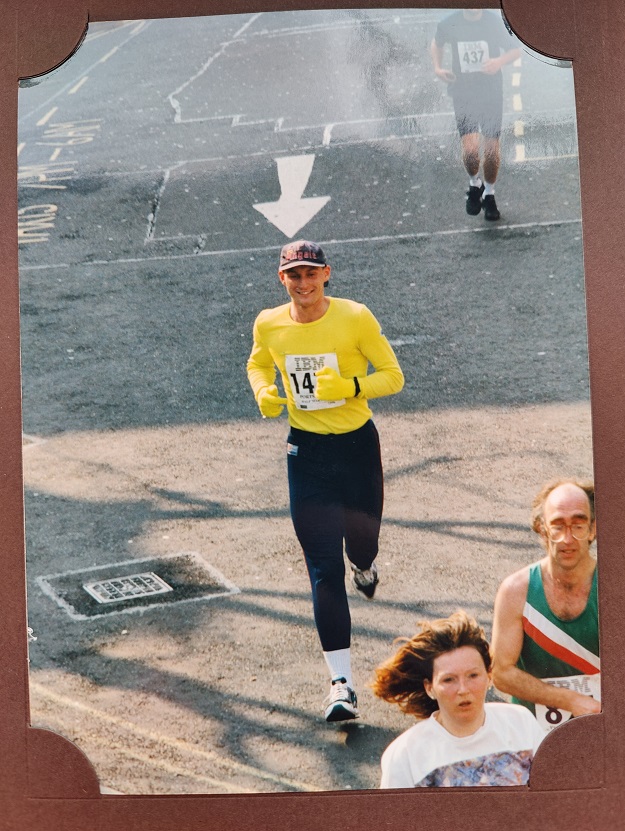
Looking pleased as the finish line approaches …

These days races take place every weekend; there are even races on the same day as London – a day which was once sacred to runners. This proliferation of races has taken place over the past fifteen years as running has become more egalitarian and diverse with professional race companies capitalising on the gaps which were once available in the club racing calendar. Clubs used to organise the vast majority of races and looking at the results leaflet from my half that’s very clear.

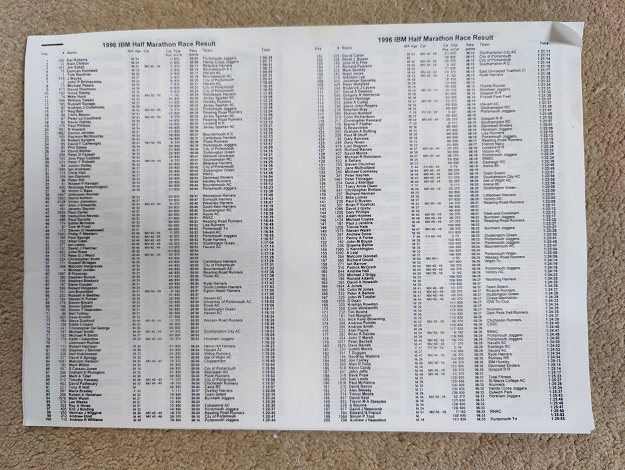
Race results – sheets of A4 stapled together

To get that I probably supplied a stamped Self-Addressed Envelope and received the results three weeks later. Today we expect the results with hours of the race – for example last Saturday my parkrun time came through at 10:41am which isn’t bad considering the tailwalker finished just before 10am!

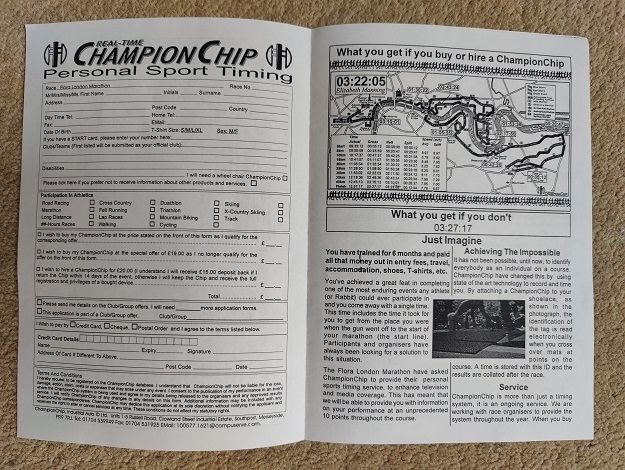
These were also the days without chip timing. Or at least they almost weren’t because in my race pack there’s a leaflet where you could BUY your own Champion Chip for the London Marathon for £18 or hire one for £20 which also required a £15 deposit to be paid to ensure you returned it within a fortnight. The application form is very detailed and full of marketing info. It’s quite incredible to consider that the first attempts to get chip timing into races would have involved everybody buying and owning their own chips whereas now they are supplied by professional timing companies and while a chip may be attached to your shoelaces and reused; they are often simply disposable on the back of race numbers.

Marketing the Champion Chip

As for the results themselves what’s obvious from a glance is how many of the runners belonged to a club. Of the top one hundred finishers; only ten are without a club and there’s only another twenty-two in the next hundred. Even I entered as a club runner although I didn’t consider myself one. There was a running club at work and they got me to put it on the form as there was the possibility of my placing counting towards a team prize while getting me a cheaper entry fee. Realistically given my lack of distance running ability  I don’t think there was ever a chance of my time being quick enough to count but that was the deal we made.

The other clear thing about the results is how quick everyone is. Seven runners breaking 1hr10; the 200th runner is under 1hr26 and the average time is under 1hr43. At the other end of the field, I can’t tell you the time of the last finisher because the slowest recorded time is 2:16:33 and then the last one hundred runners who follow are given the same time. Race cut-offs were a lot stricter then.

My run came in at 1:51:36 which by today’s standards would be considered a decent time for a first half marathon especially when you consider how poor my training was but we’ll look at that lower down!

For now let’s compare the results from 1996 to last year’s Bournemouth Half which attracted 5,300+ runners yet only has forty-one runners breaking 1hr20. The median average time is almost twenty minutes slower at 2hr03 and while a 1hr51 half marathon would have put me just outside the top quarter in Bournemouth, in Portsmouth I was 65% of the way down the results sheet.

While those last hundred runners in Portsmouth represent about 5% of the field, at Bournemouth which is admittedly a course with more hills, 30% of the field clocked that time or slower. It seems many more people now feel more comfortable with attempting a half marathon than they did then.

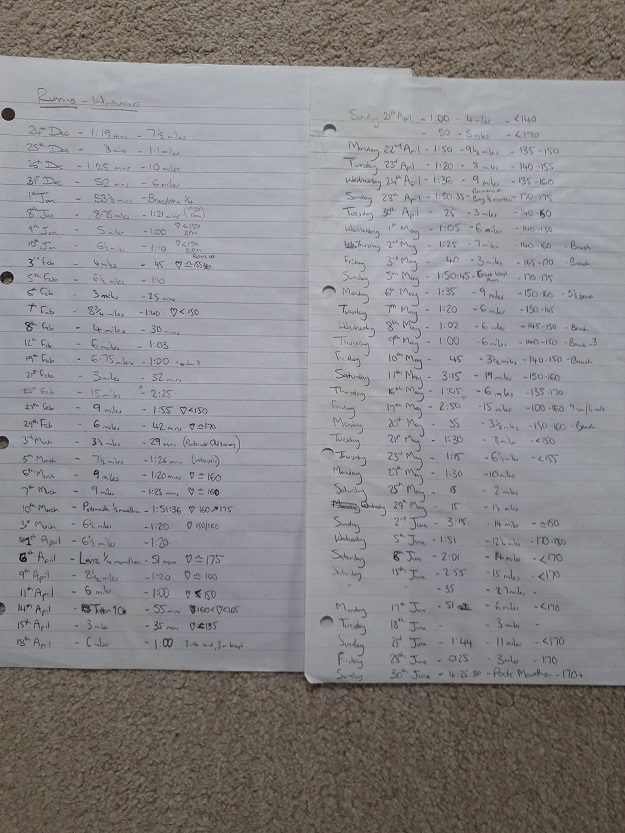
At Christmas 1995 I started logging my runs. While I used a computer at work, I didn’t have one at home so they were handwritten on paper. There’s a heading indicating this was specifically the mileage I did in the fresh new pair of Nike Windrunner II shoes I’d bought.

I guess I’d been running at various times during 1995 – I often went to the beach after work and ran three, six or nine miles along the prom. I also had a 3 mile loop from my house and another measuring 4.5miles. I figured out the distance of those by driving round the course in my car. I couldn’t take my car on the prom so I estimated the distance using a piece of string in the local mapbook and convert the distance based on the scale. Bear in mind this was long before GPS became a thing or there were route plotting services on the internet.

My handwritten training log

Looking at my training I’d summarise it as being rubbish. Rather than have you squint at the photo of my handwritten notes I’ve put the relevant info into a table. I suspect around Christmas time I went running fairly frequently because there was nothing else to do. The gym would have been closed for a few days and our volleyball league was having a break. Quite why I did six miles the day before a New Year’s Day quarter marathon I’m not sure but I recall not wanting to do the race due to a cracking headache from our New Year’s Eve night out. My friend Christian dragged me off the sofa, gave me a cuppa and made me go to the run. There was a bit of running the following week and then nothing until February.

It’s quite possible I didn’t enter the half marathon until late January hence no motivation to run. I also recall it was a cold winter to the extent that my hands wouldn’t warm up at the start of runs even while I wore two pairs.

Training seems to have begun in earnest with five weeks to go. I now realise that’s nowhere long enough to build mitochondria or capillaries for a better aerobic system which is why the runs where I have recorded a heart-rate show it to be as high as the 170s.

Once I actually began training I was running 3-4 times per week which isn’t bad although the week beginning 12th doesn’t seem like I ran much. I think that was the weekend I went to visit my friend Gary who was living in Cologne, Germany so I was catching flights on the Friday and Sunday and being a tourist in between.

What is somewhat galling to look at is what I did in the final days leading up to the race. Three runs of 7.5 – 9miles and including some interval training. There is nothing you can do in that final week to get fitter. You need to keep running to signal to the body that you haven’t given up but there’s also no point in doing too much or too fast when you want the legs to be fresh to run.

I recall very little about the race other than I got up early on the Sunday, it was a sunny morning and I was able to get to Portsmouth in about 45mins without any trouble. Like any other first time half marathoner I would have felt a little overawed by the experience although I had done 10K races some years before.

What I most remember about the race is somewhere around the ten mile mark there was a woman perhaps 20-30yards ahead of me. She was older than me probably in her fifties. Yet as much as I tried I couldn’t close the gap. As a very fit twentysomething who played all manner of sports this unsettled me. I felt almost indignant that this woman, who I judged to be nowhere near as fit or healthy as me should be uncatchable. But as much as it bothered me, it also gave me a great moment of insight and that’s why I remember it. The simple fact is I knew nothing about this woman. For all I know she might have been the marathon world record holder thirty years prior. Realistically she wasn’t but the point stands, I knew nothing about who she is, who she had been or how much she had trained for this race so what did it matter that I couldn’t catch her. It was an immature judgement based on looks and personal preconceptions but it triggered insight that has stayed with me ever since about how we can’t compare ourselves to other people.

Today I now realise why I couldn’t catch her. My lack of decent training meant my aerobic system hadn’t been developed and I was being limited by lactate build-up. I’m sure I managed to find a finishing sprint for the line but other than a few seconds quicker my time wasn’t going to be significantly faster that day than it was.  That was proven in the other three half marathons I ran that summer where they each came in around the same time.

And so we need to discuss that race photo. I love that the big arrow painted on the road is perfectly aligned to point at me, the photographer did well there. I look in horror at the heelstrike I’m perpetrating and horror at what I’m wearing.

In fairness the preceding winter had been cold so I’m not entirely surprised I’ve gone with warmer clothing and I don’t recall feeling hot on the day. I used to sweat profusely on runs even if I was wearing just shorts and a t-shirt. But my word, it does seem a little overdressed with long sleeve top, Ron Hill leggings, gloves and California Angels baseball cap. The cap actually served an important purpose it was keeping a Boston Redsox bandana in place on my head because without that the sweat poured into my eyes. I’m not really a baseball fan but I’d picked those items up on holidays in America and while I never usually wore them, they became an important part of my running kit. To this day I still run with a bandana.

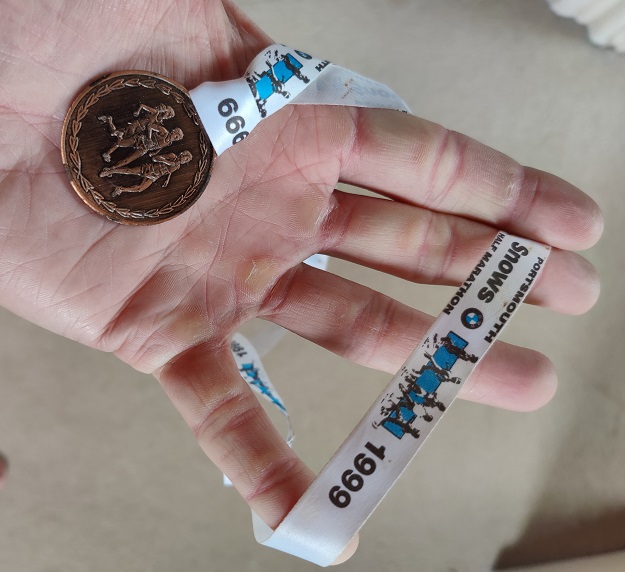
I said at the beginning times have changed. I can’t find the race medal but I’m fairly sure it’ll have been similar to the one from when I ran the race three years later. And I think the difference with today will be obvious. It’s barely bigger than a coin. If modern races offered that I suspect the participants would be up in arms. The only reason they’d post it on social medal would be to complain about it!

1990s race medal

My box of old race packs has many medals like this. I’m sure it’s significantly easier to get custom designed medals cheaply created for races these days whereas they were uninspired and samey then. But I recall that as the 90s turned into the Noughties runners became less enamoured with these medals. With races mostly populated by club runners who were entering perhaps a race per month for years on end, they simply didn’t need another when they had a drawer full of them already. Different times.

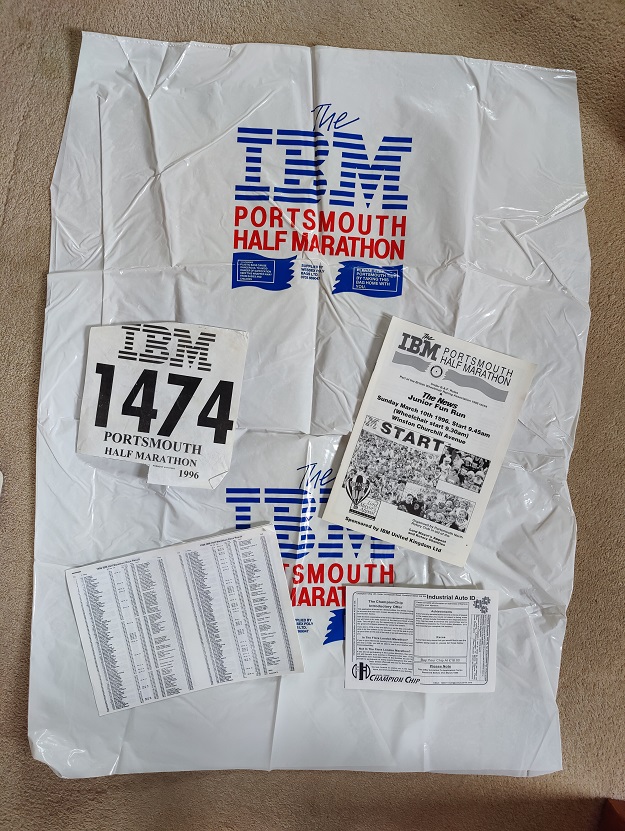
The final picture below is of my race pack. There’s the Information Pack which you’d now download for yourself off the website; the Results booklets I received three weeks later; my Race Number with a rectangle missing from the corner because they tore that off to marry up the race times to positions and the chip timing offer. All of it neatly presented on a massive IBM sponsored white bin bag which was for putting my kit in and taking to bag collection.

Race pack

2,840 miles in a year

I have to admit running all those miles didn’t happen last year. It was almost a decade ago and came a few years after I’d started running seriously. The mileage was never something I specifically set out to achieve, it came as a result of how I decided to approach my training. It was the result of a Process Goal.

These days I believe the mileage you run should support your race goals but this happened at a time when I thought more miles were better and couldn’t understand why I wasn’t getting faster. I had speed, I just didn’t seem able to apply it effectively.

When I first took up running seriously, by which I mean going out to run six days per week and building a decent aerobic base; my mileage went from a few hundred miles each year to around 1,800 miles. In that circumstance increased mileage certainly helped. Over the next few years my mileage always hovered around this mark. Sometimes 1,700; sometimes 2,000 but never significantly different.

Each year had the same problem. I would have some months where I easily racked up well over 200 miles putting me on track for 2,500 for the year but then an injury, a virus or illness would strike for a month or two and, at year end, I’d end up back around 1,800 for the year.

The lower mileage isn’t specifically the concern, it’s that inconsistent training is always undoing the gains. Imagine picking up an injury, perhaps it’s a strain or tear in the hamstring and you think “I can run through this” so you take the next couple of weeks a bit easier, no workouts but eventually realise it’s not improving and you’re going to have to rest. You rest for the next month until it’s recovered, fretting in the meantime that you’re losing fitness and then begin to rebuild. First you have to do a couple of weeks just to be sure you can resume training without reinjuring yourself and then you have to rebuild the lost fitness. By now it’s two months since the injury occurred and at best, your fitness is still at the same level as before the injury. Realisitically it might take another month or two before you start to feel you’re back where you were. One injury has struck off three months, maybe more, without making any progress. If you start the rehab process too soon, you might set yourself back and have to start over again.


My solution for my lack of consistency was to think about what I could do rather than what I wanted to do.

Looking at my training logs, it was fairly clear I could run for up to 7 hours per week without any issue. But if I put in a string of weeks where I was doing over 8 hours that was when the issues began to occur.

My aim for the year simply became to do 7-8 hours training per week – no more, no less. Less than seven hours left me feeling like I wasn’t doing enough; more than eight was a potential recipe for setback. It meant holding back on the weeks where I felt able to do more and saying “I’ve done enough”. The result was 2,840 miles for the year! Mission accomplished.

I wasn’t perfect. There were still some weeks where I exceeded eight hours but the time goal focused me in. I knew that if I’d done too much one week I couldn’t afford to do it again the following week and needed to rejig my upcoming schedule. On the flipside there were weeks when I didn’t quite reach the seven hours and this was fine – workouts are often completed in a shorter time than steady endurance runs. And certainly if I had a race coming up, I’d taper and might only end up doing 4-6hrs.

The most fascinating part occurred towards the end of the year as I got fitter and my endurance built up – I began to feel doing eight hours per week wasn’t enough. When I say feel I literally mean the signals my body were sending to my brain were that I would arrive home from training runs feeling fresh. In the past my bigger weeks didn’t feel that draining but now there was a notable difference – I felt ready to do more.


You probably aren’t doing 7-8 hours running per week but process goals are a good way of getting into a pattern of consistency. It might be to …

Notice that, for the most part these are just specifying the process, not the outcome. When I used to think “I want to run 200miles every month” that’s an outcome goal, it made no allowance for tapering into races or low-volume speed sessions. It didn’t care that February only has 28 days while August has 31; or that running in winter might not be possible if it gets icy; it just becomes a goal to fixate on. Sometimes that is good – it creates a get it done however you need to mentality but it can also lead to burnout, injury or overtraining if it’s pitched wrongly.

If you need help setting goals or deciding how to structure your training – please consider Contacting Me and I will help you get the best out of yourself. We can do a 1-hr training review or even look at working together for longer term.

Back at the gym

At the end of September I rejoined the gym for another six months of lifting weights. The great intrigue was how much strength would I have lost? The answer is pretty much all of it! By the end of last year I was able to deep squat 100kg and unrack 160kg to 1/4 squat it. Arriving back in the gym I took things lightly in the first session or two and then thought I would quickly build back to where I was. It didn’t happen like that.

Despite the drop-off I wasn’t too bothered as last year I put on over 5kg of muscle which wasn’t great for carting round on my runs. Having lots that weight over the summer, going back to basics gave me a chance to rebuild the strength without adding the weight.


Talking to one of the powerlifters, Alex, he suggested I needed to start doing squats with barefeet as the old running shoes I used were causing me to go knockkneed on heavier lifts. Removing the shoes has forced me onto the outside of my feet and that in turn has led me to use my glutes even more. So there’s been an element of building a new base to take account of this new style but also the glutes seem to be firing better.  Last year I initially focused on pushing the 1/4 squat up as heavy as possible – reaching 140kg by Christmas – then worked on deep squats in the New Year. This time around everything has been deep with only the occasional foray above 100kg.

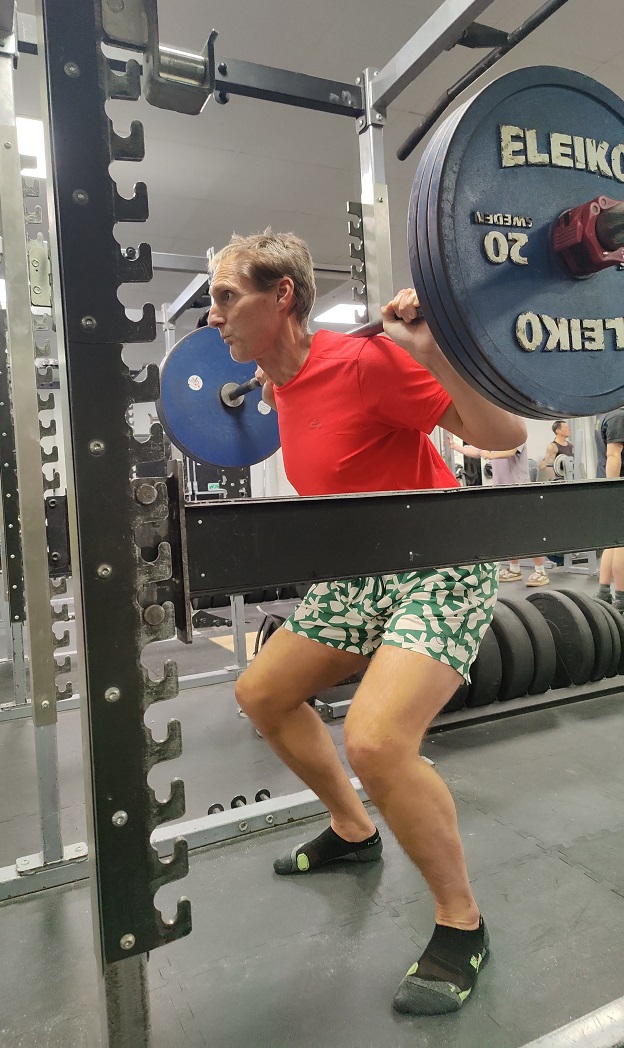
140kg on my back – only able to make it a 1/4 squat though

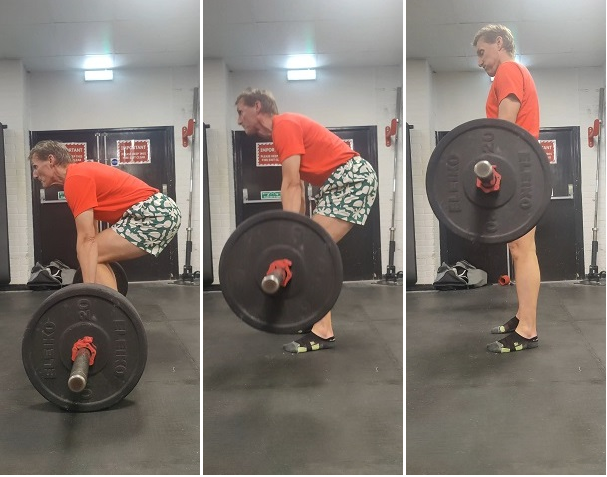
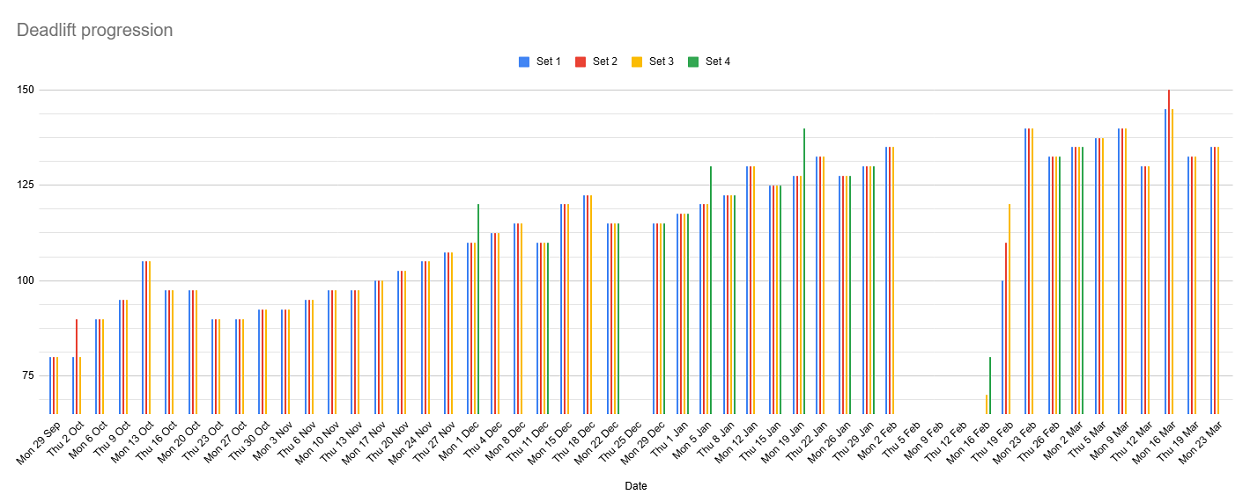
I’ve also put more focus on deadlifting as that is helpful for maximum velocity. Last year I gave up after a couple of months because some minor injuries to my lat and hamstring muscles made it impossible to do. Then I only reached attempting sets at 105kg with terrible form and it didn’t take me long to get back to that level this year. But I knew I wasn’t lifting safely so I first dropped the weight to 97.5kg and then down again to 90kg. From there it was a straight line up, I added 2.5kg per session completing 3 sets of 6 until I reached 122.5kg a week or so before Christmas. By that point I’d overdone things and the Christmas break couldn’t arrive quickly enough. Again I’ve dropped back down to reinforce the basics doing 4 sets of 115kg this week.

I’ve been really pleased by how the deadlifts have improved and more importantly I’ve felt it transferring to my running. Until it got dark and cold in November, I was coming home from the gym and doing some strides to ingrain the muscle recruited by the deadlifts. That was really useful even if my legs didn’t feel they wanted to do any more.


While I try to shy away from goals they are creeping in. Being able to deadlift 122.5kg is about 1.4 times my bodyweight – the target range is 1.5 – 1.8x which equates to about 135-160kg. Clearly the low end of this is within range and while I don’t expect to hit the top end I think with the three months I have until the end of March something like 145-150kg will be possible. Ultimately I’m not tied to any goal or target; I’m pleased that I’m already stronger than I was. Everything from here onwards is a bonus.

Along with the squats and deadlifts, I’m trying to improve my bench press. These three exercises are the main compound lifts for beginning to produce whole body fitness. Of course for runners a big upper body is not desirable as it is unnecessary weight to carry around but runners do need some upper body strength and across the core. There is just a little bit of ego creeping in as when I was young I never made it to being able to bench press 100kg (good old round numbers) and I’d like to see if I can get there now with my improved understanding of how to train. As I recall I managed to do some sets/reps at 90kg as a teenager so I’d like to see if I can get back there. Currently though I’m around the 70kg mark – so work to do.

The impressive part of my training this year is that I’ve barely added any weight – less than two imperial pounds / one kilogram. I just need to ensure I don’t eat too many extra calories while the gym is closed over Christmas.

Improving Sprint Technique Part 3

My sprint practice has taken a backseat over the last month because I’ve been feeling some fatigue around the lower core and to the right of my groin. Back in 2012 I strained something in there and I had to stop running for three months; so I’m very wary of that happening again especially as I’m now over a decade older. I have thrown a couple of sessions in but not been able to video them, so no piccies to show!

Nonetheless I’m still training every day and running longer intervals of 400m to a mile but not as all-out sprints. One day I was out on a typical training session and I’d planned to run 10x400m intervals. Somewhere around the 7th or 8th I became aware of how I was applying force.  My leg would swing backwards from its high knee, my foot would hit the ground and then I’d stopped putting in effort and coast over the stationary foot. I immediately knew what I was doing wrong.

Last month I wrote about the mental image of how skateboarders paw the ground to push themselves forward. While I was referring to that in terms of sprint technique and, while on these 400s I wasn’t flat out sprinting, I realised I was doing the equivalent of the skateboarder bringing their foot down to the ground and then half-heartedly pushing through. In effect, creating friction and drag rather than adding energy to the stride.

I’ve written previously about hip extension and how elite runners push their foot back using the glutes until the leg is behind them. Yet it was only in this moment that I actually felt myself not doing this. A moment where I gained the awareness that as soon as my foot hit the ground, I let the ground slow me rather than put in effort to push through with the glute and attack back at the tarmac.

A few days later, on an easy jog, I noticed I was deliberately trying not to put in too much effort. My foot barely left the ground and to push all the way through with the glute felt like I was putting in more effort than I wanted for an easy run. It seems this had become a bad habit that had carried through to faster running.


While I haven’t been able to work on my sprinting, I have been able to focus on this during long intervals by being aware that I’m getting full hip extension and driving the leg through forcefully. It doesn’t always happen because tiredness sets in and those muscles aren’t necessarily used to applying effort all the time for longer periods but it does seem to be happening more regularly.

What I’m finding is that I’m naturally staying up on my toes more and and my glutes are beginning to burn. That’s a surefire sign that the correct muscles are firing.

When I arrived home and uploaded my run, I noticed my cadence graph is looking much smoother. There’s a couple of aberrations in there which happens as I navigate corners and slopes but otherwise it looks unusually smooth.

I went back to the start of October and compared it to what the graph looked liked then. Notably less smooth.

Overall I’m sure this is a good sign for my running. I suspect it may be the first time in my life where I’ve run with a mechanically advantageous stride. And lately I’ve noticed my running is getting quieter. I’m skimming over the ground more than pounding into it which is indicated by what the improved cadence smoothness shows.

Improving Sprint Technique Part 2

I’m trying to improve my sprinting by videoing myself and then comparing it to the theoretical model of the best sprinters in the world. It’s not rocket science but I’d like to feel like I’m running rocket powered. While there are distinct differences between sprinting and distance running, even distance runners need to be able to sprint for the finish line and there should be some common mechanics which will carry over to make me efficient over any distance.

For example, as detailed in part 1, I noticed my foot was landing too far out in front of me causing me to vault over it. When I brought the foot closer, my runs began to feel like I’d taken the brakes off and my glutes were doing the work.


The best sprinters have cadences well over 250 steps per minute, often approaching 300 yet I struggle to even reach the 220s. Watching the video of my sprinting it all seems lumbering and cumbersome. While a still image can look fairly decent, watching actual footage tells a better story. When my foot lands it seems like I’m stuck to the ground for an age as my body passes over it.

Watching and rewatching footage I began to see my head and shoulders were rising and falling against the background. The next questions was “Why is that happening?”.  And from that I began to see both my knee and ankle were collapsing and I was flat footed with each step which produced the illusion of being stuck to the floor for so long.

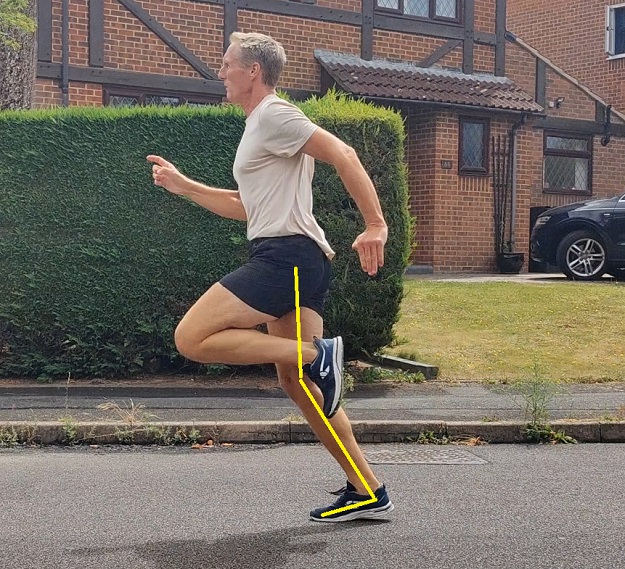
Knee bend just after landing (thigh yet to reach vertical)
Ankle bend

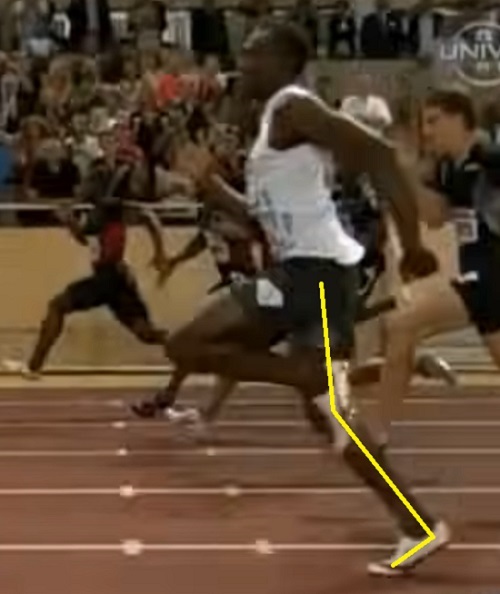
Good sprinters try to maintain leg stiffness (of their support leg) with the knee hardly bending. Their ankles don’t flex much either and they stay up on their toes – the heel never touches the ground. Inevitably there is some flexion in the knee and ankle due to the forces being generated as the weight of the runner lands but the more it can be minimised, the better. Likewise the heel will move towards the floor slightly but never makes contact. This flexing allows the Achilles tendon to load up with elastic energy and then release to help propel them forwards.

Usain Bolt – knee and ankle flexion

If you compare the pictures you’ll see both myself and Bolt are at the same stage of the stride; the arms match, the knee coming forward matches and the thigh of the support leg is vertical. But the foot is completely different. My ankle has collapsed and flexed and the heel is barely off the the ground; Bolt’s heel is notably raised and the foot is at right angles to the lower leg.

Initially I thought there was too much knee flexion but I’m no longer so sure. But there’s a definite lack of ankle stiffness which is causing an energy leak and it’s that which I’ve been looking at over the past month or so.


How to improve is of course always the harder question to answer when you locate an issue. Trying to resolve this became a matter of trial and error. I tried to focus on keeping the joints stiffer. I felt I had the requisite strength to keep my legs and ankles stiffer – after all when I skip / jump rope they don’t collapse, it was just the sprint technique wasn’t allowing me to get it right.

When I ran my sprints and strides I made an effort to maintain stiffness in the joints. I think it was a little beneficial but it put new stresses through my joints and for a time the tendons in the rear of my left knee were feeling swollen. It didn’t stop me running, it didn’t hurt training; but the knees were certainly unhappy if I was squatting down to say get something out of a cupboard. I made sure to keep the volume of these sprints lower though as I knew there was a danger of trying to do too much and injuring myself.

Note – while leg stiffness is important you don’t want your leg to be locked out at the knee because that has a high chance of leading to an injury. Failure to flex under high forces can lead to bone jarring into bone.

Similarly trying to stay up on the toes can lead to issues with calf muscles and tendons and there’s a good reason for allowing some ankle flexion. When the ankle flexes (i.e. the toes lift up and move closer to the knee) the Achilles tendon stretches and just like an elastic band it stores energy. When this elastic energy releases it provides some of the propulsion for moving forwards. While sprinters’ ankles flex the heel stays off the ground but a distance runner’s heel will come into contact with the ground momentarily and this needs to be allowed to happen for the storage of elastic energy.


One of the mental models I’ve been using is to think of how skateboarders paw the ground to keep their deck rolling. They time the kickback to add speed as the board begins to slow. It seems to me sprinters are doing the same thing; but where the skateboarders are able to take a foot off the board, paw the ground and then rest the foot back on the deck; sprinters are trying to stay airborne with just their legs extending down to make a short but powerful contact. You could think of the Roadrunner’s legs whirring along at speed..

The other adjustment I made was to try and get my foot down to the ground quicker – what coaches refer to as a hammer action. If I could move the leg down quicker then it would apply force quicker and the foot would go through quicker leaving less time for the joints to flex but still allowing some ankle flex to load the Achilles.

In trying for this quick contact and to stay more airborne, I’ve found my sprinting begin to morph and on occasions I have felt myself springing along as the Achilles does more of the work. There’s still more to do but I think it’s heading in the right direction.

Improving Sprint Technique Part 1

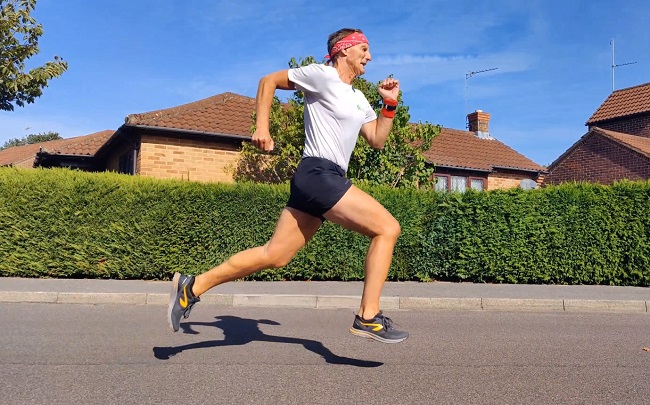
This me in full flow sprinting. Other than the pained expression, to the untrained eye I’d say it looks pretty good but I’m not fast and never have been. Improving my sprinting has been a large part of my summer training while doing 3-5miles each day along with an interval session and weekly 5K parkrun.

I’m very aware elite distance runners have good speed over short distances – a 400m lap in under one minute is normal to them. Yet despite my physical attributes, it something I’m not achieving and I don’t understand why. For sure I’m ageing but even when I was young I was never able to do it and yet my physical attributes suggest it, or something close, should be within my ability. There are men ten years old than me who can so I’m discounting the age problem.

Maybe it’s been down to the wrong training but I had a strong suspicion my form was poor so I bought a tripod off eBay to be able to film my sprints and analyse the technique. Last year I received a copy of Ralph Mann’s The Mechanics of Sprinting and Hurdling for my birthday which explains in great detail every important position the most efficient sprinters achieve. While I don’t expect to be able to replicate or measure them in the detail provided in the book, I hoped to be able to make some comparisons between what I’m doing, what the book states and then to rectify any anomalies.

Unfortunately my phone didn’t have a very good camera on it, or more specifically it could only capture 30 frames per second. At high speed that just doesn’t give enough detail, for example I couldn’t tell whether I was landing on my heel or toes. So I got a new-to-me phone from my nephew which has 4K and 120fps and enabled me to see what was happening.

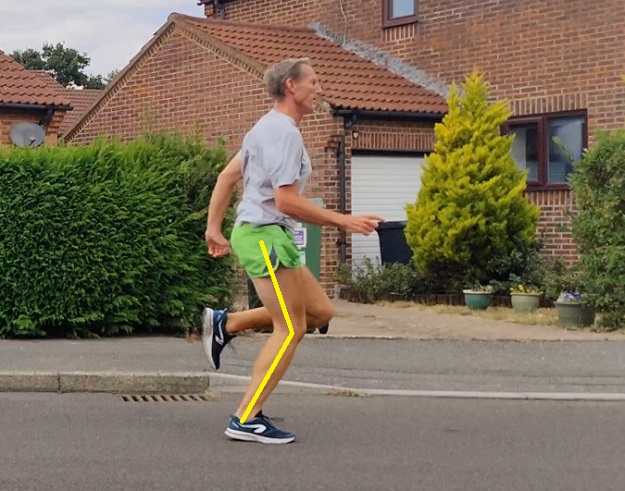
Landing foot in relation to Centre of Mass

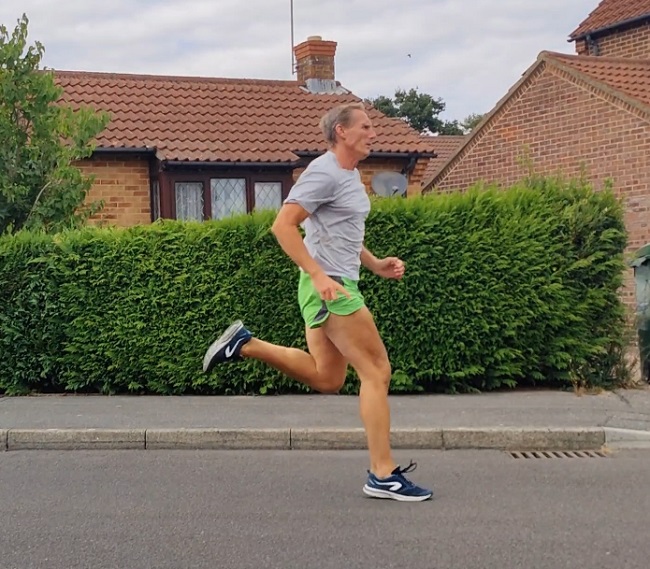
I took some footage and then stepped through frame by frame. I didn’t have any preconceived notions about what I was looking for but the nuances of how I was running began to emerge. Eventually I settled on this frame.

On the surface not that much seems wrong with it because it’s not heel striking – the toes are just touching first and from the knee down to the foot, the lower leg is almost vertical below the knee. Those are the sorts of pearls of modern wisdom that get preached as good technique.

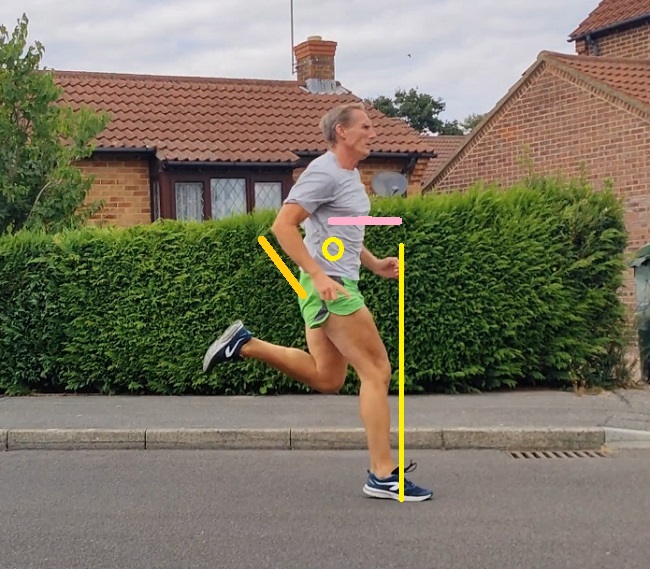
But I could see the foot just seemed too far ahead of the body and when I checked Mann’s book, he states that while world class sprinters are unable to get their feet to land directly below their centre of mass, they can get it to land only 20cm ahead of them.  For an average sprinter, it’s 28cm and a poor one it’s 35cm. Think about those numbers for a moment – they’re not particularly big distances so it’s easy to be unaware if they’re wrong.

I’ve drawn some lines on the picture below to explain how it’s calculated. The yellow circle is approximately where my centre of mass is, and the yellow line up from the foot shows where it is landing. The pink line indicates how far ahead it is and I’ve created an orange line of the same length and then measured it from my elbow. Getting out a tape measure it’s a distance of 35cm – poor sprint technique as predicted!

When I ran recovery the next day I worked on getting my foot to land closer to underneath me. The difference was immediate. Every step began to feel like I was being pushed along by my glutes and it became apparent my previous form was creating a braking force out in front – every step needed me to pull my body over the foot. I’ve heard this phenomenon likened to driving a car with square wheels rather than just rolling along. While the new form bedded in quickly, it took a while for the body to adjust to using a different set of muscles, I had a few aches and pains. I backed off training while this was the case.

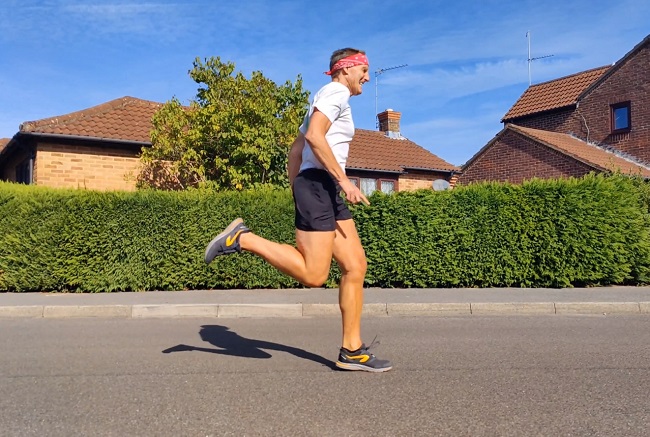
Five weeks later in early September this is how it looks. I’ve picked like-for-like frames based on the the foot placement with toes touching and heel about to touch. It’s clear the foot is now landing closer to my centre line and while there are some slight changes to my upper body posture, the non-landing leg is coiling up in the same position.

I’d say that’s an improvement and I certainly feel it’s easier when I run at any speed, not just sprint. I’m beginning to flow over the ground and I can hear it in a less noisy foot contact. And when I did the measurements again the foot is now landing 25cm out in front of me. Better than average, not quite elite!

Next time I’ll look at a couple of other changes I’ve spotted that might help!

Another year of running

I happened to notice the other day that my current run streak is now over a year. In the past I documented how my streak of 800+ days ended but actually, full disclosure, this streak isn’t quite a year as I missed a day last December. I went to a funeral in another part of the country and stayed with a friend but I could easily have taken some kit and gone out for a jog. It’s still over 250 days. For me, creating a run streak isn’t that difficult – in part because I like going out for a run but also because they don’t need to be complicated to achieve them.

Ron Hill is the gold standard for run streaks claiming to have run at least one mile every day for 52 years and 39 days. It started in 1965 and finally ended when he was approaching eighty years old. I remember reading an article in an Runner’s World back in the early 1990s where he detailed his run streak, but it was different then. Ron had run twice every day during that period and he was excited that in 1991-92 he would be coming up to have completed a streak of 26.2 years – a marathon’s worth of two-a-days. He had surgery for a bunion in 1993 so it was probably then he downgraded to once per day.

While I would debate whether Ron’s 27min completion of a mile following the foot surgery really counts as running, there is one thing to take away – his streak only required him to do a mile. When I started my streak last July it was after a hamstring injury and I was only doing about 400 metres. A lap of the road I live on – running it in 2-1/2mins or less. It wasn’t because I wanted to start a streak but it was the sensible way to test the injury, get some blood flowing to it and rebuild.  After a week or so, I began to add a second lap making it a 4-5 minute run and then extending to a mile most days. I even added in a Sunday ‘long’ run of two miles which took 16+mins! All this added up to weekly mileage of around ten miles. Not massive mileage but consistent.

Once I was sure the injury was gone I could easily have gone back to higher mileage but I began to enjoy just getting up from my computer, throwing on some kit, doing four laps of the road in 8-9minutes and walking back into the house barely having broken sweat. Where for many years I had run for at least thirty minutes per day and often the better part of an hour; now I was enjoying how quickly it was all done – it was mentally refreshing.

In the following months I joined the gym and, with that being the focus, continued the low-volume training while doing high intensity interval work four times per week. It was only about six months ago that I began to increase my daily runs and once the gym was complete for the winter I’ve been rebuilding higher volume of almost forty miles per week.

I’m heading back to the gym in a few weeks’ time for another winter of strength training and will be experimenting again with low volume running. That’s out of necessity as high mileage isn’t going to be complementary to all the squats and deadlifts I intend to do. The body needs to get some rest along the way. It only has a certain amount of recuperative power.

The Hare and the Tortoise

You may recall as a child being told Aesop’s fable about the hare and the tortoise – the story of the speedy hare taking on the slow tortoise in a race. From the start, the hare races off into a lead, certain to win, while the plodding tortoise is left behind. Confident of victory, the hare takes a nap and while he is asleep the tortoise passes him. When the hare awakens he see the tortoise approaching the finish line and, despite his best efforts, the hare is unable to catch him and ends up being beaten. Parents and teachers love to tell this story as a way of saying “don’t rest on your laurels”, “don’t get lazy”, “keep putting in the effort”. The hare doesn’t, the tortoise does.

Now if, like the hare, you’re a runner for whom speed comes naturally – racing 5Ks or 10Ks is never going to be a problem. You might slow a little towards the end but fatigue is rarely enough of an issue that you need to have a lie down and sleep. And as much as the slower runners may plod steadily they’re unlikely to beat the hare.

But step up to a longer distance where fueling plays an important part and it will happen. I got serious about running when I had my own hare/tortoise moment. At the time, I was capable of running a 5:55 mile and 21min 5K parkruns (6:45/mile) and I entered a half marathon. I did some training towards covering the distance in the preceding month or two but it wasn’t extensive. I made the mistake of looking at race calculators which suggested I’d be capable of running around 1hr35 – this didn’t seem out of the question as I’d run 1hr38 the previous year. My running had been sporadic since. Even so I certainly wasn’t that unfit.

Hareing off I ran the first mile in 7:22, the next with the field beginning to spread out in 7:05 followed by 7:31 and 7:20 to take me through four miles in under thirty mins. It was all reasonable so far but miles 5 and 6 came in at 7:45, 7:51. There was a stretch of gradual uphill in there so I wasn’t too concerned. It was after that when the wheels came off.

Mile 7 was 9:00 and mile 8 was 9:38. My legs had gone. My stride was non-existent, I felt terrible. While I didn’t stop for a nap like the hare, I stopped to talk to a couple of running mates. I walked a bit and took 20min30 to cover miles 9 and 10. Then I summoned up the energy to restart and jogged the last three miles averaging 8:40 surrounded by runners who were theoretically much slower than me. I finished in 1hr51. It was a frustrating debacle. If I’d known how bad it would be I could simply have set out at 8:30/mile and got round comfortably.


What it did though was to kickstart me into take running seriously. I spent the next couple of months building a decent aerobic base – a term I didn’t then understand – but which I now teach to runners. Six months later I ran a 1hr31 half marathon.

On that fateful day, I’d finished surrounded by the tortoises who had gone out steadily within their capabilities and knocked off mile by mile. Meanwhile I’d hared off at a pace which was slower than my 5K but without the training to back it up – giving myself no chance of success.

The moral of my running story is twofold:

If you’re interested in my “Build your Base” course or improving your speed please head over to the Contact page and let me know.

A.I. coaching

Let’s play a game …

Here are the times from my last ten 5K parkruns – 23:31 … 23:16 … 23:06 … 23:27 … 22:54 … 23:06 … 23:37 … 23:37 … 22:50 … 23:16.  

What’s your prediction for my next 5K time?

If you said somewhere around 23 minutes – well done. Maybe you went for 22:45 to give me a booost – I wouldn’t be against that.

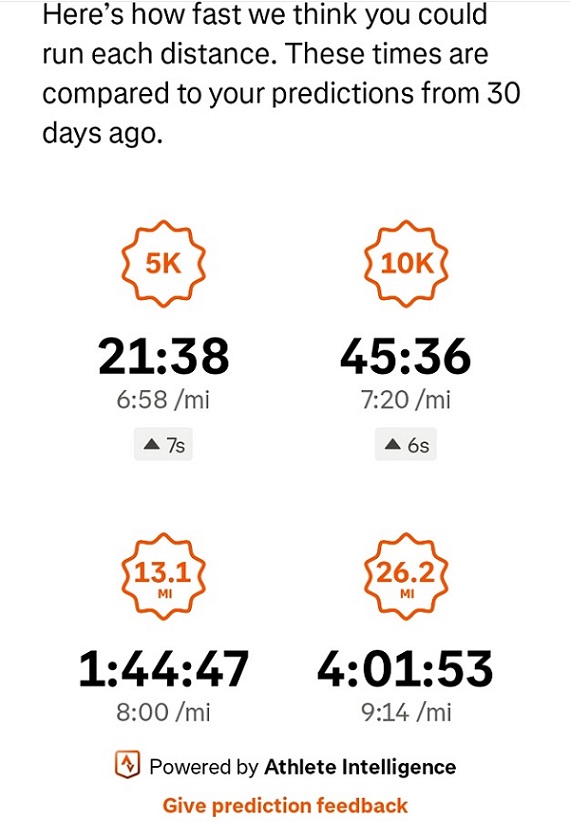
But would you have said 21:38? I certainly wouldn’t.

Yet Strava does.


Strava recently gave me a month’s free premium membership and they seem to have embraced AI with gusto. Among the features is its willingness to Predict Race Times. Despite having the perfect info available – weekly 5K – Strava is reckoning I can run over a minute faster. Clearly I can’t unless I change my training and then their prediction will probably change.

Race predictions

Last month I ran a 6:48 mile to celebrate Banister’s Mile. I know that’s not fast but I’ve been concentrated on building strength in the gym and working on very short distances – I expected my aerobic base to erode and it did. But if I take a look at Jack Daniels’ VDOT tables he estimates a 6:49 mile equates to a 23:09 5K which is relatively close to the 22:54 I ran at parkrun a few days later.  It’s not perfect but it’s not frustrating me into thinking I can run over a minute quicker than I’m capable.

Looking at the other predictions – the 10K of 45:36 is essentially double this Season’s Best for 5K – so that isn’t going to happen. I reckon half marathon at 1hr45 is reasonable and JackD’s VDOT suggests 1hr46 although I wouldn’t be surprised to see myself slip to about 1hr50 given I haven’t run over five miles in almost a year.

VDOT predicts a 3hr40 marathon which is very unlikely and Strava’s 4hr time is probably closer to what I’d achieve. But again, if I entered a marathon tomorrow, I doubt I’d come close to either time because I’d wilt and be walking from fifteen miles. If I trained properly for the distance, I’d feel more confident about VDOT’s prediction; the Strava prediction would then be too slow but it would probably update itself with the training.  But if it has to keep revising times as the training changes then that seems a little disingenuous – rather like the person who tells you “Oh I knew that” after you read out the answer to the trivia question they had just given up on.


With each run you upload there is Athlete Intelligence feedback to tell you about the run or workout you’ve just done. For example, this is what it stated for the run I’d just done at time of writing  …

Recovery Run

It’s a bit bland.

And it’s only half correct.

It correctly managed to figure out I do the same route most days (“maintaining consistent 3-mile distance”) and it correctly figured out whether this was faster or slower than usual (“at a slower pace”) but the last sentence (“while exploring different intensity zones”) is complete rubbish. I went out at an easy, recovery pace and maintained the same intensity throughout. What did happen is that I ran up some hills which caused me to run slower (but using the same effort/intensity) and down some hills which caused me to run faster (still using the same effort/intensity) and under some trees which will have messed around with the GPS.

As for the first couple of words (“Recovery run”)  Strava had enough intelligence to take this from the title of my run!  When I changed the title to “Steady” the summary changed likewise. It really wasn’t rocket science to figure that out although when I changed the title back to “Recovered” with a deliberate -ED ending it went back to calling it a “recovery run” and when I tried “Interval session” it ignored that.

I decided to look at what it had to say about previous days. For example here’s an interval session …

This is a pretty good description of what I’d done but what does this final bit (“and a challenging mixed-pace run.”) say or mean? They’re just empty words describing what it thinks I’ve done but not what it really was – warm-up, intervals with rest breaks, warmdown. Technically it’s a mixed-pace run but not like going out and doing a proper fartlek session where you mix the paces up.

I looked back to a speed development session where I sprinted four efforts of 5 seconds followed by further efforts lasting 10seconds, 15seconds and 25 seconds. Between the efforts I walked back to where I started, stood around and had long rests. It ended up taking about 25mins to do seven efforts. Here’s what Strava had to say …

Sprints

It got the first line correct but not much else. There really were no varied effort levels, it was max effort from start to finish on the sprints. And I’m guessing it thinks this was “significantly slower” because the 0.7 mile of total sprinting and walking comes out at 12+ min/mile. Compared to a recovery run then this is significantly slower but of course it is – the aim and structure of the session is totally different.

Here’ s what it said about a 23:16 parkrun …

parkrun

Well that’s strange, I didn’t do any intervals – I ran a 10min warmup, a 5K parkrun, a 5min warmdown. And the parkrun was 25secs slower than my Season’s Best the week before so it can’t have been a “route personal record”.

What can I say? It all sounds like unintelligent garbage to me.


Of course I don’t help Strava much by having an old Garmin watch which doesn’t feature many of the latest variables and I stopped wearing a heart-rate monitor months ago. But I run just about every day and upload my data to Strava – there’s almost ten year’s worth of data about my running for Strava to crunch. And yet I don’t find it’s telling me anything useful.

That said, I haven’t investigated their Runna coaching service – why would I? I coach myself and know how to train others for results. If you need an individual plan then I can help you but equally standard plans have been available in magazines and on the internet for years – and while I’d expect Runna to adapt depending on how your training is going (which is what I do with the runners I coach), I’m not sure how good it is at that. I also question its ability to motivate – I’ve known a few people try to follow coaching plans given to them by their Garmin watches but have yet to hear of anyone who succeeds or even completes the programme.


At the moment AI feels rather like “cut & paste” software. It feels like the gym assessment I used to get where it would state BMI is the relationship between your height and weight, with your value of [Insert value] kg/m2 shown above in Illustration 1. Your value places you in the [Insert rating] category. However, it is worth noting that BMI doesn’t take into account factors such as muscle and lean body mass.  Lots of description with just a couple of personalised bits of information added in.

I remember how these five or six page documents initially impressed me but after retesting, I came to realise that they were just padding out my numbers with waffle. Eventually all I did was look at the graphs and numbers.  I suppose AI has an advantage because it can rephrase the same information in different ways thereby giving the impression for longer that it has something important to say.

I’m sure AI will improve in coming years and when that happens I’ll probably be out of a job. But one of the reasons AI will continue to improve is that it continues to scour the internet. I receive a significant number of hits from AI tools which are reading my blogs and trying to make sense of them.

In the meantime if you want personalised coaching from a real human being – this far I’ve not used AI in my blogs or plans – then click here to Contact me.

Curiousity

Everybody talks about goal setting for success. Setting SMART goals, DUMB goals, setting targets.  I have always been a focused person and goal setting came naturally to me. I never needed to specifically set or write down goals, I always just wanted to achieve excellence. To be the best I could at whatever I was doing. It turns out this was a mistake for me.

The problem is I was always pushing my limits. There’s nothing wrong with that in principle, but it meant I often left myself exhausted. And what I didn’t realise is that physical exhaustion impacts you emotionally.

Eventually I’d reach a state of emotional burnout and give up. Giving up didn’t happen immediately but if I was trying to reach a target and I wasn’t moving closer to it, I’d start to get discouraged. All the effort I was putting in wasn’t reaping any dividends. To an extent I could rationalise this as I know things take time and need patience. It’s the same reason some people will give MAF training a go for far longer than they should without progress.

I’d never get discouraged immediately as I’m resourceful and would look for ways to change things or put in more effort. When I played sports which had a break between seasons, these would allow me to recharge my batteries. But if the lack of progress went on too long, burnout would ensue.

With runners, quite often their change of direction or resourcefulness is to try a new race distance. If all they’ve done is 5Ks, they might move up to the 10K then the half marathon then the marathon. Each of these changes means they change how they train especially for the longer distances where they might be running for two or three hours for the first time; covering distances of up to twenty miles. While they might be nervous come race day, it’s easy to get inspired about doing something different.

This isn’t to say goal setting is a bad thing – it can be really useful for creating motivation to follow training plans and, if or when training stops working it might give impetus to look for alternative ways to kickstart improvement.

But my attitude has changed. I guess it’s partly down to being old and knowing that however hard I try or train I will never achieve the peaks I might have been able to attain when I was younger. Now my driver is curiousity.

I’m simply interested to know how far I can get at something given the constraints of training time and an ageing body’s slower recovery. For example when I went to the gym over the winter, I was curious to know whether I’d still be able to squat 130kg like I was doing 15+ years ago. In fact, within twelve weeks I’d surpassed that.

What I like about not setting targets is that there is no failure. Yet in being curious about the process and what is happening I learn something, and I see that as a success.