Watch any elite runner and you’ll see their heel kicking up to their buttocks as the leg moves forwards. I have a whole bunch of terms for this – butt kick, heel lift, back lift which I am going to use interchangeably through this article.

From an efficiency perspective it is very important. The days of people owning mechanical clocks are now all but gone, so the majority of people probably have little idea about how the length of a pendulum affects its movement. Basically a long pendulum swings slower than a short one and vice versa. You can test this by grabbing a piece of string, tying an object to the bottom and swinging it at different lengths.
Applying this concept to running – a short leg will swing quicker than a long one. Tall people tend to have slightly slower cadences than shorter people and it is why, when small children run their legs appear to go like the clappers. Of course, once you’re fully grown you can’t change the leg of your legs, you’re stuck with your genetics, unless a disaster happens.
Yet shortening one’s leg is effectively what an elite runner does when they kick their heel up to their backside. As the foot passes closer to the body and above knee height they have essentially halved the length of their leg. It is now only as long as their femur measures from hip to knee. This is sometimes referred to as shortening the lever. A shorter leg comes forwards quicker than a straighter leg helping to reposition it ready for the next step.
With recreational runners we rarely see this butt kick taking place. With some runners it is like they are walking fast, keeping their legs straight – moving them back and forth with a high cadence and barely leaving the ground. To varying degrees, other runners will lift their trailing foot off the ground – some lift it just a few inches whereas others may have it passing the support leg at calf or even knee height. Once in a while you see recreational runners who have an exaggerated back lift even if they are only moving at a moderate pace, such as eight minute miles. It is almost certainly something they have been taught to do and there are certainly many coaches / Youtubers who advocate doing this. The trouble is while deliberately lifting the heel to the backside seems desirable for the efficiency reasons previously mentioned, it is not.
Don’t initiate ‘the pull’
It’s likely ‘shortening the lever’ will help you run faster, at least in the short-term. To do it you just pull your heel to your butt – to do this you engage the hamstrings. The problem is, this isn’t how it should occur or what the hamstrings are best used for. What they should do is control how quickly the lower leg unfurls once your leg is out in front of the body. This isn’t a conscious process, it just happens with every step you take. Like any muscle they will eventually become tired and fatigued so if you are mistakenly using your hamstrings to actively pull your heel, you’re going to tire them out needlessly.
How to butt kick
The reason you don’t need to actively lift your heel is because when you run correctly it naturally happens. In my look at glute-powered running, In a previous post, I discussed how an elite runner like David Rudisha uses his glutes to swing his leg from in front of him to behind. At some point the thigh physically cannot go any further back and he tips up into a toe-off.
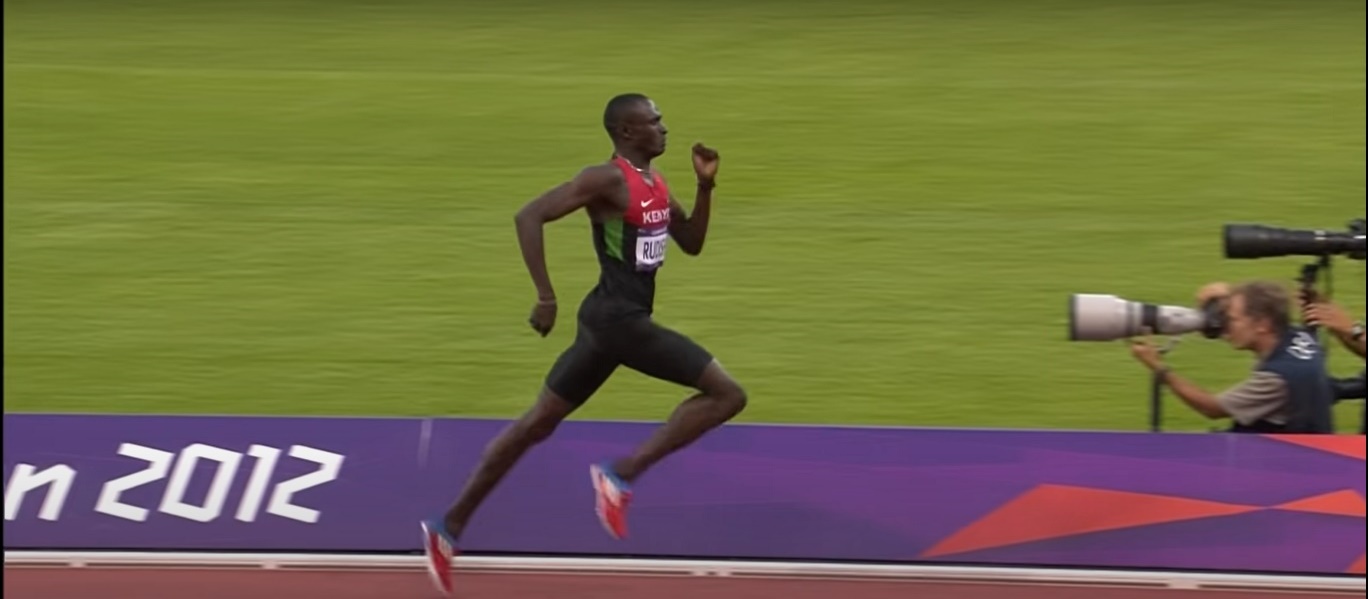
Looking at a snapshot of what happens a few frames later we see his thigh has barely moved but the lower leg has begun to lift. This is momentum transferring down the leg through what is referred to as the kinetic chain. It generates power in many sporting actions from kicking a football, throwing a javelin, swinging a golf club to delivering a knockout punch. Energy is generated by big powerful muscles and then transferred to the smaller extremities to achieve a higher speed. It’s the same process that allows Indiana Jones to to crack his whip – his arm and body begin the movement and then the energy transfers through the handle and down the whip to create the cracking sound.

For Rudisha, after the leg appears to momentarily pause, it then begins to move forward. This is powered by the elastic energy that has been stored in the muscles on the front of the hip and thigh. When the leg was moving backwards these muscles were being stretched like an elastic band and now, just like when the elastic band is let go they ping back to their normal length. This pulls the thigh forward, but it doesn’t affect the lower leg so that continues its journey towards the runner’s butt.
Eventually the lower leg either runs out of momentum or reaches its closest point to the butt. If everything is timed well, it is enough to carry it under the runner’s body as a shortened lever.

Not everybody butt kicks
Given that I’m describing this as a natural sequence of events, you might expect everybody to lift their heel to their backside and kick butt yet this isn’t what we see. The main reason is you have to be running at high speed for it to happen. You won’t see any sprinter who doesn’t butt kick and this isn’t taught to them except by bad coaches – it just happens.
Your legs have to be moving back and forth quickly to create the momentum in the lower leg. Quite how fast you need to be is some undefined combination of factors such as pace, leg length, foot weight and stride rate.
All elite distance runners back kick because they are rarely run slower than five minute miles. The women’s marathon is the slowest elite distance race and Tigist Assefa can be seen butt kicking on the way to her marathon world record.

Yet if you see an elite distance runner out for a jog, at say nine minute mile pace, their heel doesn’t kick their butt. The foot will come off the ground but it is not the efficient shortened lever. At slower speed the leg just doesn’t have the momentum to carry the foot up to recover close to the backside.
There is another reason why we often don’t see any backlift in recreational runners and this is because many over-rotate their hips which I discussed in this post. Instead of the leg swinging straight backwards and forwards with a long range of motion to create power and momentum, a shorter stride length is creating by turning the hips. Arguably this may simply be a factor explaining why they’re slower at running but I noticed in the footage of Tigist Asseffa breaking the world marathon record, she appears to have one foot lift higher than the other. I suspect this is due to over-rotation of the hips as it is reflected in one shoulder rolling more than the other. She is not the only long distance runner who seems to have some inefficiency in this area.
Final thoughts
Kicking the heel to butt for more efficient recovery is something which occurs with good running form and mechanics. Attempting to force it by pulling your heel up is unnecessary and will tire the hamstrings. Arguably it could be beneficial to slower runners but the counterargument is that spending the time learning to pull the foot up is training time that could be used to improve speed so it happens naturally. Ingraining bad form is unlikely to be a good idea because it is harder to undo later on. To get the natural heel lift, you need to get the glutes firing and the leg swinging through to an extended toe-off.
The information detailed here is based on personal experience and that contained in Steve Magness’ The Science of Running Book. Magness was the Cross Country coach at the University of Houston where he was able to speak with Tom Tellez, the track coach who coached many athletes including Carl Lewis who was the 100m world record holder during the 1980s and 1990s.

 Big Red Running