April has been a quiet month. Entering it I had high hopes of recording a decent time at Bournemouth Bay 1/2M but those were trashed when I ran three minutes slower than last year. I tapered better this year and my legs felt fresher on the day but, come the run it was a gradual slide with the first 2-3 miles coming in at just under seven minute miles. From mile five onwards the pace dropped to 7:25 and worse. I just had nothing and have easily done better runs in training. I documented last month how I ran six miles in 42-mins in training.
What was strange was how low my heart-rate was throughout the run. It ended up averaging 149bpm which when I consider I do Steady runs in the low 150s was very out of place. What it does go to prove is how little use a heart-rate monitor can be.
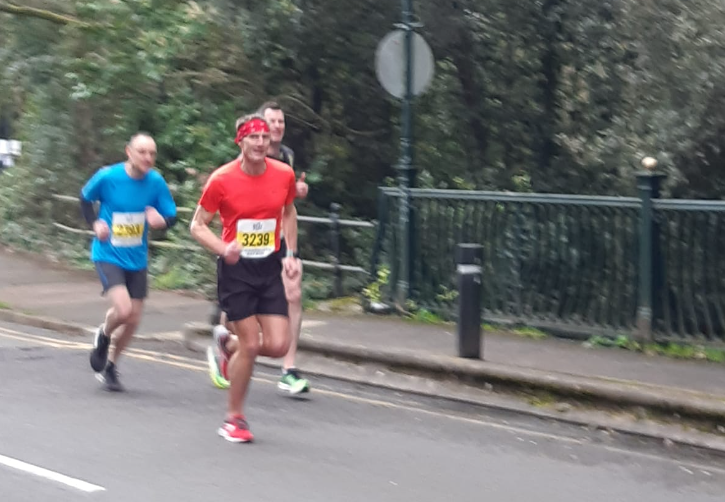
I took five days off after the half (no running at all) then went to Poole parkrun and ran 20:57. Both my calves and glutes were sore from it and I had a very slow, dreary Sunday 10-mile run. I ran thirty minutes each day through the following week and returned to Poole parkrun knocking my time down to 20:39. The following week was the same routine, a slightly faster but still drudgy ten mile run then thirty minutes each day. This resulted in a 20:17 parkrun! Three weeks of easy running, no speedwork and my racing simply got faster by forty seconds.
It now seems clear that I’d fatigued my legs too much in training. When I look back I’ve been doing fifty mile weeks since last summer and training hard in the week. The heart-rate monitor numbers were correct but the monitor itself can’t tell you how fatigued you are.
My overall feeling though is one of disillusionment – I’m simply not cut out for distance running. When I compare my training to others, I simply don’t get the results from training that they achieve off much less. I train hard with all sorts of different sessions but ultimately I’m physically not cut out for long distances.
I’ve known this for a while, it’s why I started training for the 800m. Thus far I haven’t really worked on developing my speed to a high level because I’ve been trying to keep the aerobic side in balance. As I’ve written in the Ageing series, the best male sprinters of my age are running under 11 seconds for 100m, 22s for 200m and 50s for 400m. While I’ve not gone all-out at any of these I’d be surprised if I could crack 14s for 100m, 30s for 200m or 1min15 for 400m – that’s just too far down and a gap I need to close up. It’s not because I’m not capable, it’s because I haven’t trained for it in years.
I’m beginning to conclude this has been where I’m going wrong. The first two iterations of training I followed JackD’s plan as he is a proven coach. It didn’t really help me. Last year I began hill training using a progression from Steve Magness’ The Science of Running and I felt this made a difference despite only doing one weekly session for three months.
I’m torn between entirely given up on the distance work until I’m notably nearer to the age-group records or trying to keep the two things in balance. All I know is when I started running seriously a decade ago, I was probably quicker on the speed side. I have little objective proof of this but my legs were much bigger and stronger. I was quickly able to build some of my best times at parkrun, 10K and half marathon on lower mileage than I’ve been doing recently because I had the speed first.
This summer’s plan is to repeat what I did last April / May / June. I combined Steve Magness’ hill sprints on a Monday with Jack Daniels’ 800m training plan on Wednesdays and Fridays. I lasted about nine weeks before I could see I’d peaked and my aerobic fitness was declining.
This year I’m intending to do the same but with some changes. Where I previously followed Jack’s plan for runners covering 30-40mpw, this year I’m downgrading to the 20-30mpw plan with shorter recovery and long runs. Actually Jack’s long run has always lasted only about an hour on these plans but I always did something in the 1hr30-40 range in an attempt to keep my aerobic system up.
The other change I’m going to make, as I’m not doing a time trial prior to starting training, is to be conservative on my numbers. I’m based my training level on my half marathon and fastest parkrun which basically have me running at the level of a 2:36 800m runner. It’s not that fast but I’m aiming to keep my legs fresher this year through less intensity and lower volume of training. Again this 2:36 start point is why I don’t think I’ve got the speedside sorted. It really isn’t that fast given how in shape and athletic I am. I just haven’t trained for speed enough in years.
I resumed faster training in the final week of April. I did 6x8sec hill sprints on Monday which felt great and I loved despite blowing hard at the end of each effort. On Wednesday I did 6x200m with 200m jog recovery aiming for 43s, they avg’ed 40.4sec. On Friday my legs were perking up and I repeated the session, this time with eight efforts, and they avg’ed 39.6sec. My body felt like it was hitting new territory. Or at least territory which it hasn’t been to in a long time. My breathing was gasping in the final efforts. I’ve been there before but this felt different for some inexplicable reason.
Before each of the workouts, I’ve been doing drills and strides to help warm-up and ingrain good form. I began these eighteen months ago and change has been gradual, notably beginning to kick in at the start of the year when I was doing my last block of short intervals. This explains why my glutes and calves hurt after the half marathon. It was the longest sustained effort I’ve done using that running form and therefore being powered by those muscles. My stride seems to be lengthening and when I begin an effort I can hit higher cadences than usual. This all suggests I can get quicker and build my speed up to the levels I desire.

 Big Red Running