Staying healthy

I was in my early twenties when I made, what I now realise was, a very insightful observation. Where I worked the majority of people were older than me. (That’s not the insight). Of course when you’re young you have no judgement of how old other people are. Thirty seems wise and mature when you’re twenty and anyone over forty is ancient like your parents!

Now while I didn’t go around asking people their age you get a feel based on their seniority. There were the people who did the actual work, like myself, and we were all under thirty. The people who were middle management were usually in their thirties and the senior managers were over forty. Of course there were some workers in their forties who only made it to supervisor or team leader level or not even that far.

I’d get an idea of their age based on their family circumstances or how long they’d been working and the stories they told about when they were growing up. Whether it was supporting a football team that had success in the Sixties, their drinking stories from the Seventies or being single in the Eighties.

Despite this inability to accurately age people, what I noticed about the men who were under forty was they generally looked similar to people in their twenties. Yet the men who were over forty-five were overweight, grey or bald and wearing spectacles. Something happened to men between the age of forty and forty-five and it wasn’t flattering. This was the big insight!

This forty to forty-five change isn’t quite as prevalent today as it was thirty years ago. There’s certainly some artificial manipulation going on with hair dye, shaving the head completely bald rather than a combover and eye surgery or contact lenses instead of spectacles. But generally people look after themselves a little better and fifty has become the new forty! There are even people looking amazing in their sixties – think Tom Cruise.

I decided then I didn’t want this rapid ageing disaster to befall me and I would stay fit and healthy as best I could. The prevailing wisdom was that you can’t stop the ageing process but I’ve never been one for believing that and you did occasionally see people who looked much better than their years.


As I exited my thirties I found the occasional grey hair and a very gradually receding hairline, but it wasn’t until I turned forty-five that I saw a photo where my hair looked notably greyer. Even then I looked good for my age yet my reaction was to start learning what I could do to slow the decline. I bought a copy of Joe Friel’s “Fast After 50” as I wanted a headstart on what I should be doing when I hit them. That’s all summed up in my “The Ageing Runner” series of posts.

I’ve continued to decline a little more over the past five years. My eyesight is declining but I’m holding off on the specs and have tried various exercises to strengthen them. My hair is beginning to grey up on top where before it was just the temples. I still have a decent head of hair but my male pattern baldness is following the same trend as my uncle who is now seventy-two and looks exactly like I recall my grandad looking.


Now at fifty, I’m thinking ahead again. I don’t want to be one of those people who reaches their eighties and stoops, shuffles, struggles to get up and downstairs and has a variety of illnesses that keep flaring up. I’ve seen my parents, relatives and neighbours hitting this age and it’s saddening to see the decline kick in more strongly because they haven’t done any exercise beyond the housework, gardening and walking around town.

It doesn’t have to be the end, I keep telling them they could build more fitness. Over the past few years the BBC has aired programmes taking groups of sedentary seventy-somethings and improving their health and fitness by having them doing appropriate weightlifting and fitness exercises. This is good news for those who’ve left it until later but it’s much harder to build up when you’re faced with a big reclamation project rather than an ongoing maintenance task. If you get too far overweight or unfit, you may struggle to be able to get an exercise programme started plus you’ll have lived your fifties and sixties with many of the effects of ill-health – aches, pains, getting out of breath on stairs, fatigued and possibly feeling unhappy when you look in the mirror.

It might seem strange to be thinking thirty years into the future but doing so gives you a chance to identify and build good habits and if you take a month off, it really isn’t going to cause too much decline. On the other hand, it’s not uncommon for sedentary adults to put on 1-2 pounds of fat each year (and that’s a conservative amount for people who don’t exercise) which will leave them two to four stone heavier in thirty years’ time with all the problems that brings.

This is why I’ve been training for the 800m. I think it’s the best blend of aerobic exercise and speed you can do. To support it, I do press-ups, bicep curls and corework to keep my upper body toned and strong. The trick to slowing the ageing decline is to make sure you maximise using what you have got. The reason others get slow is they stop doing hard all-out exercise at all, get comfy and think going for a jog or walk is enough. It really isn’t.

This all began the better part of thirty years ago for me when I spotted the rapid decline between forty and forty-five. Reaching fifty, I’m pleased to consider myself about as fit and healthy as I can be at this age. It’s worth pointing that I haven’t been obsessive about this over that span. There have been periods where I didn’t exercise or ate badly but it was never too difficult to get back into shape because I was never too far away from my best!
Overcoming the inner talk on race day

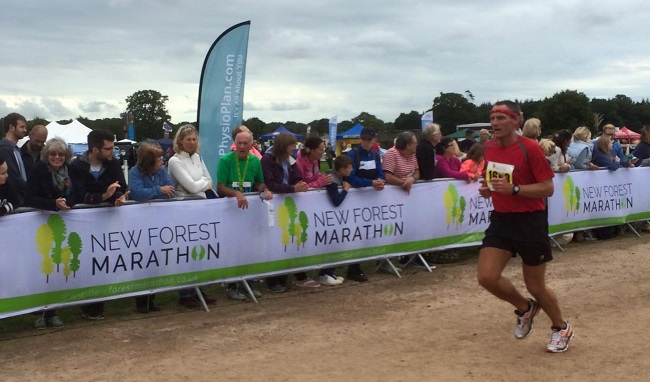
I originally wrote this back in 2015 for someone I was coaching for a half marathon. It’s my account of a race I ran three weeks before theirs. I wanted to give them an idea of how, whatever your fitness level, if you’re pushing to your limits, you will experience voices / self talk trying to get you to ease up or even give up. But I also wanted to provide some of the phrases and ways I use to counter that voice. It’s a skill I learned while coaching volleyball to try and keep a team playing hard to the end of match even if all seems lost.

My race was the New Forest half marathon which took place in mid-September. I’d entered it when I was fit and healthy. I’d written a training plan aiming to get under 1hr30, but then July’s training didn’t go well and I picked up a calf problem in early August. Two weeks before the race I wasn’t even sure I’d be able to run it as I was exhausted at the end of my Sunday ‘long’ runs on Sundays and these were only covering 7½ miles at paces close to 9min/mile. Nothing like the 13+ miles I’d need to cover in the half.

Nonetheless in the last week my fitness seemed to return and I went from thinking 1hr45 was a possibility to turning up on race day and deciding to target sub-1hr40 (which is 7min36/mile pace).  Basically I hadn’t run longer than 10-miles since July 19th and almost all my recent miles have been up around 9min/mile so nothing close to where I was actually intending to run. I really didn’t know how it would go.


About 20 mins before the start – I had a 5-min jog at 10min/mile pace [2½ mins slower than race pace] and then finished off with a couple of strides at 8min/mile pace [engaging race pace muscles]. That was my warmup.

In the start funnel I was in the wrong place for 1hr40 due to the way they organised it so I knew I had a few people to get past but just took it nice and easy and told myselfIt’s extra warmup“. With the early bunching of runners and wanting to get past them, I told myselfWait until the gaps appeared then move through them”. The first mile came in at 7min40. The next at 7min30. Everything was feeling comfortable and I was on target.

I continued running at around this pace and it felt ok. Much of the course was on gravel paths at this stage and I felt pretty strong over the next four miles (7min29, 33, 37, 25). So now I’d reached at mile six with things still feeling manageable, but I was also slightly questioning how long will I be able to keep this up given my lack of training?

The watch was beginning to consistently read around 7min25, and I was a little concerned I might be overdoing things given my original 1hr40 intention, . But I decided to just stick with it and take whatever comes. The seventh mile came in at 7min27 and mile 8 at 7min16, but things were beginning to feel tough within my body. We’d also hit a little bit of light headwind out in the open and there were some gradients to go up, but gradients also go down which explains the quicker mile 8.

By this point my accumulated time was putting me in for 1hr37 and I was averaging about 7min25/mile. With only five miles to go, I told myself “Just hang on as best I can and get whatever time that brings me“. Even if I ran a minute per mile slower from here onwards, I’d only be adding five minutes to 1hr37 and finishing in 1hr42. But realistically you aren’t going to slow by that much if you keep putting one foot in front of the other as best you can. So most likely it would be 20secs/mile over the next 2-3 (+1min) and then maybe 1-min/mile over the last two (+2mins) which would still be 1hr40.

When the Mile 9 marker rolled around, I felt like giving up and downgrading to a jog as the legs were really beginning to feel it. But the mile itself clocked in at 7min25 – so no time added to the new 1hr37 goal. I told myselfJust keep running hard and see how far you can get“.

Mile 10 was 7min26 – I told myself3.1 miles to go. Just a parkrun – I do those all the time“.

Mile 11 was 7min25. I was basically running on my physical limit rather than really good pacing. This pace was the leftover from when my training was good in July.

But now with only two miles to go, I DEFINITELY wanted to give up. Told myselfIt’s only 15mins running left.“. Somewhere in the back of my mind a voice was sayingYou’re going to crash and have to walk these last two miles and end up running 1hr50“. I ignored that voice.

I was really beginning to struggle mentally. Then the tail end of the 10K race merged in with us, they were significantly slower and spread out across the path because of where the organisers had placed the drinks station. Mentally it was distracting and frustrating, especially when you’re tired; I wanted to shout at them to “MOVE” but it would be wasting energy. I got past safely after a few hundred yards.

At 11½ miles I glimpsed the finish area through the trees and told myselfNot far to go now. It’s only 1.6 miles, I can see the finish. I do 1.6 miles in warmup all the time.

At mile 12 I felt I was running like a zombie. My legs had slowed, it felt awful. I would have guessed my split time was 8min25 … actually it was 7min40 … within 15 seconds of my other miles. All that had happened is I’d dropped to my marathon pace. So now my predicted time had become 1hr37 and 15 seconds due to the slightly slower mile.

The final mile felt so slowwwww in my legs and it felt like I was jogging. The path became gravelly again, runners around me were starting to leave me behind thereby highlighting my perceived slowness, and although the finish was in sight the course took us on a mile lap around the outside of it. On top of that, one side of the field had a strong headwind to run into. It was all I could do to keep putting one foot in front of the other but that’s what I did and eventually I reached the final finish straight and tried to pick up the pace for a ‘sprint’ finish. I could only top out at 6min25 pace which is my 10K pace! The final mile had felt so slow – yet it came in at 7min30 pace.

So that was my half marathon finishing in 1hr37min07. Well above my expectations of a week before and above what I’d set out to do. On the day I had to give everything to achieve that time. Obviously fully fit I’d have been a much more capable runner but the lack of training put me on my limits.


What can you learn from this?  I want you to understand that when you really run a race to get a PB, it’s going to be as much about having the correct mental attitude as it is to being physically fit. I’ve tried to give you indications on what my self-talk was and what I had to do to hang on in there.

  • Mostly it’s a process of continuing to run as hard as your body will allow, counting down the miles and realising that with the fewer miles left there are, the smaller effect it can have on your overall time.
  • Understand that your mind will tell you anything to try and get you to slow down but you can hang in there and override it to a good extent.
  • When you feel like you’re running through treacle, but you know you’re trying your hardest, the reality is that you’ve probably only dropped by 15-20seconds/mile and ultimately that won’t destroy the time anywhere near as much as you thought it would.

Eilish’s low mileage

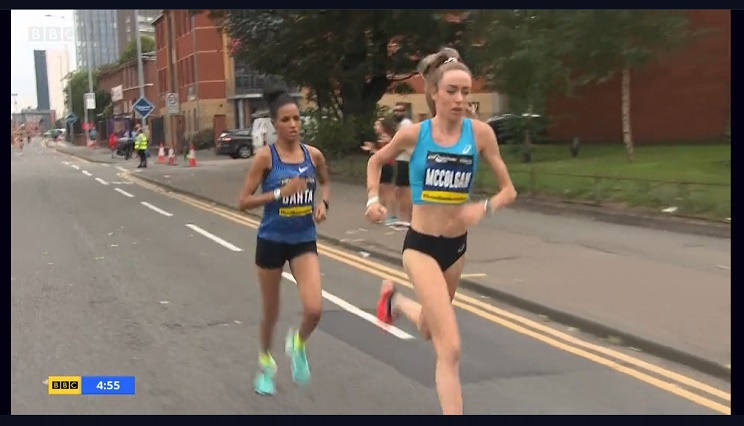
Scotland’s Eilish McColgan is the current golden girl of British Athletics. This year she has set distance records, the first occurred in February when she broke Paula Radcliffe’s British half marathon record by 21 seconds in 1:06:26. Then in May, she ran 30:19 to take Radcliffe’s 10K road record and on Monday (June 6th), she ran this time again on the track in Hengelo, Netherlands to set a Scottish record.

The McColgan name is not unfamiliar to followers of running. Her mother, Liz, was the World Champion in 1991 at the 10,000m having already been Commonwealth Games champion in 1986 and 1990 and silver medal winner at the 1988 Seoul Olympics. When she moved up to the marathon distance she won New York (1991), Tokyo (1992) and London (1996) marathons. Eilish’s father, Peter McColgan, was also a talented distance runner who competed for Northern Ireland in the 3,000m steeplechase and 5,000m at the Edinburgh Commonwealth games as well as for Great Britain in the steeplechase at the 1991 World Championships. What a pedigree for Eilish to have!

Not only does she have the genetic advantage but Eilish is also part of a generation of successful female Scottish distance runners. Laura Muir has been the most successful gaining a silver medal at last year’s Tokyo Olympics where she set a British record for the 1,500m in a time of 3:54.50  In 2012, Lynsey Sharp was European champion and competed at the London Olympics in the 800m. She followed this up four years later setting a Scottish record of 1:57.69 while finishing 6th in the Rio Olympic final.


A recent BBC article detailed that this year’s success is down to Eilish undertaking a reduced training load that Liz had to be persuaded would be in Eilish’s best interest. Liz had been running as much as 140 miles per week in her marathon prime.

But this highlights the event differences. Liz was always a long distance runner doing 10,000m and marathons. Following in her dad’s footsteps, Eilish competed in the 3,000m steeplechase for Great Britain at the London Olympics and then the 5,000m in Rio. It wasn’t until 2018 (when she 28 years old) that she began racing longer distances winning the ten mile Great South Run in 54:43. Roll on three years to the Tokyo Olympics and Eilish competed in both the 5,000 and 10,000m. Looking back at her Personal Bests, her time for 800m is 2:07.8 – over ten seconds slower than Lynsey Sharp and her mile is 4:00.97 which is five seconds slower than Muir. It’s clear that although Eilish competes in middle distance races, she lacks the top-end speed to be winner against the best and like her parents is better suited to the longer distances.

So it’s surprising when she talks in the article about how her training increased from 20, 30, 40, 50 miles per week and has only been operating at 65-70 over the last year and a half to two years. It’s not unusual for a world class 800m runner to operate on as little as forty miles per week but Eilish isn’t one. Typically world class 5,000 – 10,00m runners train between 70-100mpw. Given the recent increase in training mileage, it’s no surprise that when Eilish returned to the Great South run last October she was four minutes quicker than three years ago.

There’s no doubt decent mileage is critical to distance running success and Eilish’s approach of starting on low mileage and building up is a good one to follow but far too many runners simply aren’t doing enough mileage to support longterm improvement. Getting the balance right is important and, as Eilish shows, great results can be achieved off moderate mileage.

While I don’t wish to take anything away from how hard I’m sure she’s working in training, it should be noted many road and track records have been broken over the past couple of years due to the innovation of carbon plates in shoes. I am slightly sceptical Eilish would have been breaking Radcliffe’s records without them (at least in the near future); but many past records have been broken due to now-forgotten reasons outside of better athletic prowess. And in the longer term, unless the IAAF backtracks on the use of carbon plates, these records will become the new standard. All power to her – she’s still the best we’ve seen in a long time.

Whatever the reason, I have no doubt Eilish McColgan is going to go on to greater things as she gets the benefit of higher mileages and moves up to the longer distances permanently. At 31 years old, she has potential for another Olympic cycle in her and maybe more. I’m sure she will be looking to emulate her mother by taking on the London Marathon and other Majors.


Bonus content – Eilish is listed in Wikipedia at 1.80m (5’11). In my article on stride length I observed her cadence averaging 172 steps per minute giving her a stride length of 1.97m. It’s easy to think this is because she is tall and to an extent it is. But, as I also pointed out, Eliud Kipchoge (1.67m – 5’6”) has a stride length of almost two metres – about 15% greater than his height.

A quick look back at Paula Radcliffe running mile 5 of her record-setting 2003 London Marathon shows her running with a stride length of 1.67m (186-88 cadence) when she is 1.73m tall (5’8”). It’s a decent stride but it’s shorter than she is!

Update on my 800m training – May 2022

Was it the hills?  I entered the month feeling positive after some very quick short intervals in April but throughout May my legs have struggled. I started doing hills in April to build speed and they’re certainly feeling stronger but they also tend to take a few days to fully recover.

I’ve never been a decent sprinter but I think I probably should have been. Firstly because I find it easy to put on muscle, and secondly because I’ve never found it easy to be good at distance running. Once I got on Strava I began to see how often quicker runners are able to get better results despite training half as hard as I do. I seem to lack the natural aerobic capacity that many distance runners have.

This is all behind the reason why I decided to give 800m running a try. It’s an event that still needs decent sprint speed backing it up. But when I started following a plan by Jack Daniels eighteen months ago, it didn’t do much for speed recruitment and I made a deliberate decision not to overdo things as I found it easy to run quicker than expected. This again is another reason why I think I’m better suited to short distance racing.

Even so I felt my top-end speed was missing as I could barely get my peak speed below five minute mile. Last February, I started looking at how to improve cadence in the hope this would improve my form for sprinting and top end speed. Six months ago I started doing ten minutes of sprint drills twice per week to clean up my technique. It’s made a huge difference.


So here I am doing Summer Training to build speed and peak for my next 800m attempt. With my aerobic base enabling me to run seven minute miles for an hour in the winter, I decided it was time to introduce hill and flat sprints on a Monday to recruit more running muscle and get faster at the top end. It seems to be working.

Six years ago, I was doing the same set of workouts and my times then for 60m, 80m and 100m approx. were 10½ secs, 12 secs, 16½ secs. Admittedly I tended to do these after another session but this year I’ve recorded times of 8.75s (60m), 11.5s (80m), 14.6s (100m). A definite improvement and fairly good considering I’ve barely done anything like this in the past half-decade and I’m now in my fifties.

I also found on the most recent block of flat sprints I was hitting some high cadences with the two highest values coming in at 262 and 278 on different efforts. I’m slightly wary of whether the cadence monitor is wholly accurate but if it is these are genuine sprint numbers. Again this backs up the belief my form is improving.

The rest of May’s training was something of a slog to hit target paces. Quite often I missed my faster targets but the legs always seemed sluggish after the sprints. This resulted in a decision – I’ve decided though that working on speed over this summer is the priority so if other sessions are a little behind because of that, so be it. Overall my numbers are still an improvement over where they were a year ago.

On into June. This is the hardest block of training. I’ve felt tight and slow on recovery days but hopefully I’ll get through it!