Bad loser

As a kid I was a bad loser. I know this because my parents would point it out when I went stomping off with my arms crossed, a big scowl on my face and tears streaming down my cheeks! Certainly there was much whingeing and while I don’t recall any particular moments, I know I didn’t enjoy losing.

I played all sorts of sports over the following years, some with more regular commitment than others. I played badminton for a year, squash for two, volleyball for many years as well as basketball and 5-a-side football with work colleagues and it didn’t really matter which I was playing, I never enjoyed losing.

That “hate-losing” temperament powered me to try and get better at any sport I tried. If it was a team sport, I would stew for hours about how we’d lost. I’d pick holes in my own play and that of my teammates. I could never understand how they took losing so lightly and would turn up to the next training session and put in low levels of effort. I guess some people are better at rationalising and making up excuses.

Watching televised sport, I’ve often wondered how I would come across if I had to face a post-match interview. Very badly I suspect. Somewhere along the way I at least managed to find the social grace to say and do the right things after matches. I could shake hands with the opposition and congratulate them if they’d won. But if you were actually to ask me to talk about my thoughts and feelings after a match it would be messy and miserable. Once in a while we could lose but if I saw everyone had given their utmost, I could accept losing with good grace.


This hate for losing died down over the past couple of decades. For one thing, I learned losing was an essential skill for getting along with others in life. You can’t win every argument without breaking relationships. Taking up golf helped because the competitive aspect isn’t immediate enough to trigger my competitive instincts. With running I knew I was never going to be good enough to win so my expectations were always low and I always knew I’d run the hardest I could.


Now all of this suggested that being a bad loser was mostly genetic and a state of mind, but as I got further into running I came across an interesting fact about speedwork. If you do too much of it, it turns your system more acidic. Now, we’re not talking like the Xenomorph in Alien whose blood dissolves the floors in spaceships just mildly acidic.

If you ever studied Chemistry at school, you’ll know of the pH scale which runs from 0 – 14 with 7.0 being neutral. Acids are 0 – 7, alkalis are 7 – 14 with the extremes being, as you would expect, very acidic or alkaline. Usually your body usually has a pH value that is the alkaline side of neutral which is something akin to chalk.

Typical pH values for fluids within the human body are 7.35 – 7.45 for blood; 7.4 – 7.6 for saliva and 4.6 – 8.0 for urine. Quite why the latter can be more significantly in the acidic range I’m not sure other than urine involves fluids which have passed through many other areas of the body including the stomach where there are high levels of hydrochloric acid involved in digestion.

If, however, you do high levels of speedwork you can push the body across to the acidic side. The pH value of blood can drop towards the low sixes (e.g. 6.3 – 6.4) and be part of a general imbalance within the body. This is one aspect of overtraining identified by Phil Maffetone. While I don’t like his age-based training formula, his book highlights these sorts of issues with the body and anaerobic training revving up the central nervous system and all the issues that can bring.

Now the whole point here is not to know exactly what pH value your body is at, only to understand that it usually runs in a mildly alkaline state but repeated high intensity training can push it into an undesirable mildly acidic state. This is one reason why recovery runs on the day before and after speedwork, or any other effort session are recommended.


When I ran my first 800m time trial last December it was tough. By the end, I was breathing very hard and I coughed for almost an hour afterwards due to acidosis. But I also found I was in a very bad mood for the rest of the day. When I did my next time trial in April, while I didn’t have the postrun after effects quite so badly, I did get into another black mood. For sure the results of the two time trials weren’t too my liking but they didn’t specifically bother me. The first was simply setting a benchmark, the second was so below expectations that I couldn’t get angry at it. Yet I was grumpy following each of these big runs.

Back in August when I ran my first all-out parkrun for two years, I once again noticed I wasn’t happy afterwards. I’d offered to write the Run Report and fortunately, having pre-prepared it, needed only to fill in a few details before sending it off for publishing within a short time of arriving home. It was strange though because I’d been so enthusiastic earlier in the week with it and then simply submitted it with the minimum of remaining effort.

It would be tempting to put all this down to disappointment at the runs but the depth of moods hinted at something more. When younger me got moody, I assumed it was down to hating to lose and not understanding how to handle it. With a more mature outlook and the rarity of these recent moods, it was clear they were more physiological than psychological.

This came home to me over the past weekend. Once again I ran a fast parkrun. Again I wasn’t overly happy with the time but my mood was ok. I chatted to a couple of friends then nipped into the supermarket to pick up some items on the way home. There was no mood until much later in the day. When I think about it, I did some strength and conditioning when I got home which seems to have tipped me over the edge. I slept badly for the next two nights – another sign of possible overtraining.


When I think back to my black moods in the nineties, I always thought it was down to immaturity and poor psychology. I’m sure to some extent this is correct. But I cannot escape the fact I used to train and play sport a lot harder than I ever do these days. It wasn’t uncommon for me to be playing sport on a lunchtime and again in the evening. Sprinting up and down a basketball court, jumping up and down at a volleyball net, lunging around a squash court or simply doing thirty minutes worth of high intensity effort at circuit training. I was constantly revving the engine playing sport, working a 9-5 job and socialising at clubs and bars on evenings or weekends. No wonder I would sleep for ten hours or more on a weekend. I could be moody, depressive and unable to snap out of it.

I’m sure I was guilty of pushing my pH values into the acidic side of the scale regularly. I was probably young enough to cope with it to some extent. given the younger body recovers quicker. And by training so hard, so frequently, I expect my body had learned to cope better with it. At least able to cope with it until it couldn’t and then my mind would go off down the rabbit hole and see things through the worst possible lens.
Comparing natural talent

The more I look this year, the more I realise what natural talent for distance running is. And I don’t have much of it! But that’s not to say I can’t develop into a decent distance runner with good training.

Let’s talk about three runners. There’s me – whose talent is for speed and building muscle. There’s Slow-twitch Sam– who I believe has talent for distance – he’s light and thin. Then there’s Intermediate Ian who sits somewhere around the average – he’s got decent speed and endurance but doesn’t excel one way or the other. (Names have been changed).

Both Sam and Ian ran a half marathon last weekend. Ian ran sub-1:29 while Sam ran 1:24. My Personal Best – dating back to 2012-13, when I was at one of my running peaks, is 1hr31.


I’ve seen Ian’s training on Garmin and he generally trains five days per week.  Mondays and Wednesday are some kind of workout, either short intervals at fast paces, or longer intervals lasting 5-10 minutes at threshold or marathon pace. On a Friday he runs a 10-mile long run. On the days in between – Tuesday and Thursday he usually does an easy 5K. That’s it.

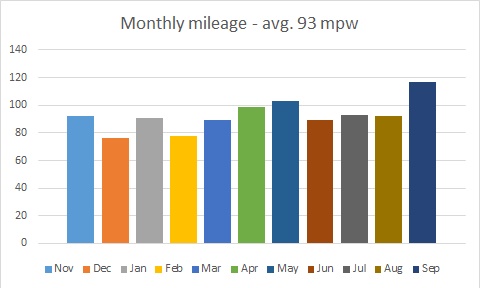
I looked back at his run training over the past year and he’s totalled 1,219 miles. Here’s the monthly totals from November to September, notably there’s only two months where he exceeded 100 miles.

I used to be a low volume runner barely eking out more than one hundred miles per month, same as he does now. A decent, concentrated block of training in 2010 reduced my half marathon PB from 1hr50 to 1hr38. I ran a decent marathon in 3hr41. The next year I upped my mileage to 150 per month, worked on my endurance and set my half marathon PB (1hr31). I had to do more mileage to get there.

The most notable thing about Ian’s ability to run a half marathon in under 1hr29 is that he never did the distance in training. His long runs topped out at ten mile runs. By comparison, if I don’t doing my long run for a few weeks, I’m struggling in the final miles when I next do one. Some years ago Ian’s first marathon was 3hr25, the next 3hr15 then he ran close to 3hrs a few times before finally breaking it.


Sam took up running again in April and got down to nineteen minutes at parkrun in six weeks. In July he ran a 1hr32 half off a total of around 500 miles training. Since then he has trained harder with back-to-back 200+ mile months in August and September but still hasn’t totalled a thousand miles this year. Yet he’s running even faster than Ian. And much quicker than I have ever even though I run close to two hundred miles every month with a variety of sessions. Of course my training is dedicated towards the 800m so I wouldn’t necessarily expect to run great times in a half at the moment.


What all this begins to show is how natural talent helps out at the beginning of your running career.

My early half marathons were 1hr51, Ian’s is 1hr29, Sam’s is 1hr24. But, due to my lack of natural talent I’ve been forced to figure out what needs to be done to get quicker. I’ve improved from 1hr51 to 1hr31. Ian has only gone from 1hr29 to 1hr25; Sam from 1hr24 to 1hr21. I’m sure they’ve trained hard to achieve what they have but what I’m seeing is how easily it comes with natural talent. Of course, that IS the definition of natural talent.

Short sprint – Big Goals

As I completed my long run this morning, I was thinking about recent televised races. In particular I was thinking about Charlotte Purdue running 2hr23 in London to become the second fastest British woman ever. What does she do now? That’s what goal-setting is all about, giving yourself and your training a direction.

I’m sure she will sit down with her coach and come up with a plan towards running at the next Olympics in 2024 given that she missed out this year. And in the intervening three years there will be other championships and races to focus on. Each of these will be used as goals to chase.

What I was also wondering was whether she’ll target becoming the fastest British woman ever. To do that she’d have to run 2hr15 to outdo Paula Radcliffe. Knocking eight minutes off your marathon time at that level, especially in her thirties will be almost impossible but that doesn’t mean she shouldn’t target it.


My belief about goals is somewhat existential. It’s not necessarily the achievement of the goal that matters but the act of setting it and going after it. Because having a goal, and a tough one at that, forces you to go to your limits. It forces you to explore all the options.

Let’s say Purdue does decide to try and get down to 2hr15, it’s such a big goal that she’s going to have to look at every single aspect of her training. If it were me I’d look at the coaching, the diet, kit, shoes, strength training, running form. I’d look for gaps in my training e.g. altitude (or hypobaric chamber in place of it); hills, psychology, aids to recovery and so on. Every single aspect.

This is how Alberto Salazaar ran the Nike Oregon Project to try and create success. Unfortunately while it looked to be innovative (e.g. ice caps at aid stations in hot marathons) it also tested the “grey areas” which eventually resulted in Salazaar’s four year ban for overseeing doping.

At the same time as trying to find the untapped potential, you can’t get too far away from what has been successful. In Charlotte’s case, she needs to ensure she can still perform in races to earn her living as a professional. Too much change could see her getting slower or missing her athletic peak.

For us lesser runners you wouldn’t necessarily try every avenue of opportunity. After all, most couldn’t afford to go altitude training or train in the latest shoes every day. But there could certainly be simple changes which leverage into big benefits. For example, getting a coach or even simply following a plan.

Bear in mind that if you have big goals but aren’t logging the miles to begin with, there’s little point in trying the stuff which makes 1% difference. Regular and frequent training is first and foremost the thing that gets you fast. Someone at Purdue’s level is looking for the just noticeable differences that could give her an advantage.


Returning to what I said about it not mattering whether you succeed in achieving big goals, it’s because while Charlotte might not reach Paula’s 2hr15 standard, she could end up breaking 2hr20. That would be a great experience and achievement in itself. Note: Charlotte may not go after Paula’s record because she decides on other goals, I’m just using the suggestion for clarity of writing this.

If you only set goals which are easily ticked off*, you have no reason to explore and investigate all the options. That’s how most people operate, they keep setting achievable goals a little above where they’re at until they repeatedly fail to achieve one. At this point, they believe they’ve reached their potential and go in search of new vistas which have fresh, new easily-achievable goals to accomplish. Think of how many runners quickly move from parkrun to 10K to half marathon to full ones.

* When you set a major, longterm goal it’s important to have milestones on your plan to achieving it. Those milestones are what most people consider to be goals.

More stride length – Eliud Kipchoge

Previously I talked about the stride length of 400m hurdlers, 800m runners and 10K runners. I thought it would be interesting to have a look at Eliud Kipchoge – the world’s premier marathoner.

Kipchoge is famed for his excellent running form and economical stride and in Oct. 2019 he became the first man to run a marathon in under two hours. I found footage of the run on Youtube and watched a section from the last kilometre to calculate his stride length.

How to calculate stride length manually

You can skip past this section if you’d rather not get into the details

As we know Speed = Stride Length x Stride Frequency.  We can rearrange that as Stride Length = Speed divided by Frequency. And because Speed is actually the distance covered in a time period (e.g. miles per hour); we can convert it to a Pace (e.g. 15mph is 4min/mile because 60mins / 15 = 4).

We need to find out how fast he’s running and how many steps he’s taking in a set period to be able to calculate the stride length.


Step 1 – Watching the footage I found a section where the camera showed Kipchoge for a decent length of time; the longer the better as it gives a more accurate sample. The particular segment lasted twenty seconds.

Step 2 – I counted the number of times his left arm swings. It doesn’t matter whether you count armswings or footsteps they’re going to match. Generally though I find armswings are easier to count. I counted thirty armswings.

Step 3 – As this was a twenty second clip, I had to triple it to get the cadence for a minute (3×30 = 90). But this was only for the swing of one arm so I doubled it (90 x 2 = 180) to get the total for both arms. Given arms and legs swing at the same rate, it gives the number of steps per minute – 180. Very conveniently it’s also three steps per second.

Step 4 – The marathon was run in 1:59:40 – an average pace of 4:34/mile. I remember Kipchoge was very consistent in his pacing so I’ve got a high level of confidence that his is how quick he was covering the ground.

Now I calculate how many steps Eliud covers in his 4:34 mile. In four minutes he covers 720 steps (180×4) and then in the remaining thirty-four seconds takes another 102 (34×3) for a grand total of 822 steps per mile.

Step 5 – As a mile is 1,609 metres and we know Kipchoge takes 822 steps to cover it, it works out that his stride length is 1.96metres  (1609 / 822).

NB This final step has an implicit conversion from Imperial to Metric measuring systems. I could have gone metric earlier as I know he was running at 2:50/km, so he was taking 510 steps per km (1000/510 = 1.96) to get the same stride length.

Kipchoge’s Stride Length

If you skipped straight down here, let’s recap …. at his marathon pace of 4:34/mile, Eliud Kipchoge is taking 180 steps per minute with a stride length of 1.96 metres. What’s interesting, and defeats those people who say they have little legs, is that Kipchoge is only 1.67m tall (5’6”) – his stride is over 15% longer than he is tall.

I also found video of 18-year-old Eliud Kipchoge winning the 5000m gold at the 2003 World Championships in Paris. His running form looks a little less smooth than these days but he was still able to win in 12min52. I counted steps for one of his 400m laps close to the end of the race – he completed it in a touch under 1min05 – a pace of 4:21/mile. He took 202 steps and that works out to a stride length of 1.83 metres. Surprisingly it was shorter than he ran for a whole sub-2 marathon but may begin to explain why his form looked less smooth.

Nonetheless whichever race you look at Kipchoge’s stride length is bigger than he is tall and that’s worth thinking about.

If you found these posts about Stride Length interesting, you might want to take a look at the series I’ve written on Cadence or Stride Frequency as it’s also known. Click here to access the introduction.

Signs of overtraining, overreaching and being past your peak

No wonder I’ve been on the decline for the past month. I went for my long run at 6:25am this morning, in the dark, determined to keep it easy. Remember easy is a feeling, not a pace. It took me thirteen minutes longer than last week to do the same ten mile run. My heart-rate barely got out of the 120s yet my body didn’t want to run any faster. I’m sure I could have run faster but that wasn’t the aim, I was listening to my body and letting it decide. Truth is, I’ve spent most of the past month training faster than this and it explains why I’ve slowly been spiralling towards decrepitude.

I can’t call this overtraining because that’s a serious condition that can take months to recover from. Usually the term for having pushed the body past its best while not having become overtrained is known as overreaching. Overreaching is something most athletes actually want to do just prior to competition because it gives them a higher level of performance yet because they taper they get to freshen up. Generally speaking overreaching can be recovered from quickly whereas overtaining takes months.

Whatever I should call it, my training and running isn’t going forwards like it was a few weeks ago. I sensed the signs of a couple of weeks ago, but I wanted to finish out JackD’s 800m training plan so I could say I followed it to the letter.

These are the signs I spotted

Loss of motivation

A couple of weeks ago I found myself no longer caring about the next 800m time trial. After almost four months training I should have been excited that it was only a couple of weeks away but I wasn’t. My mind didn’t care and I was actually looking past it to the next phase of training I’ve got planned.

For someone as dedicated as I am, the loss of motivation was a huge red flag that my body wanted to back off. I’ve had it before and it’s always the same – simply wishing that I could get past the remainder of training, start tapering (which is of course reduced training) and get to the race. Often I never made it to the race as an injury or illness would kick in – those were probably the result of doing too much.

As an aside, I believe many first time marathoners experience this sort of thing. They start off their training excited and motivated, then as the long runs pile up and they trudge through four hour Sunday runs, they start to wish it all over.

High resting heart-rate

Before I start a run I have to wait for my GPS watch to lock in the satellites. This usually takes at least a minute of standing around on my driveway or by the car before I can start running. When I’m fit and healthy my heart-rate will drop to somewhere around 40bpm, quite possibly in the high 30s. When I’ve trained harder the day before it may be mid-40s. When I’ve trained very hard the day before it’ll be in the 50s. It might even do this for a day or two extra.  Over the past two weeks I’ve barely seen my heart-rate barely dip into the 40s, moreover it’s been low 50s. That’s a red flag.

Sometimes, while HR will still drop down it takes a while to occur. It seems to be stuck in the 50s for thirty seconds before dropping rapidly to the low 40s. That’s an amber flag that things may be becoming problematic.

I don’t think there’s an issue per se with the occasional high resting heart-rate but, as I say, I’ve been seeing these without fail for the past couple of weeks.

Tightness, aches and pains

I previously wrote about how tightness, aches and pains are a sign of overdoing things in this post. They’re probably the earliest physical sign that crops up but also isn’t actually debilitating unless you continue to push hard. Usually though when any aches or pains ease off during running as joints and muscles get warm and loosen up. It’s later in the day or first thing in the morning when they’re a problem.  I’ve been struggling with stiff ankles and hip pains regularly recently.

Other signs

These first three things are the most reliable, obvious indicators that things aren’t right. Any one of these three would usually be enough for me to begin reconsidering my training plan and slot in recovery sessions until the issue is gone.

What follows are less noticeable or isolated. The following signs usually need to be seen as one part of the jigsaw. Individually I don’t think they’re enough because they’re also somewhat vague and harder to measure accurately. Diagnosing yourself as overcooked is no easy thing to spot with certainty.

Affected sleep

If you overtrain and rev up your central nervous system it can affect your sleep patterns. These past couple of weeks I’ve found myself waking multiple times during the night and dropping straight back to sleep. But on a couple of occasions, I found myself sleeping solidly for nine hours on back-to-back nights.

When I seriously overreached a few years ago, I found I’d wake in the night to use the toilet. Then struggle to drop back to sleep and just lie there for 2+ hours thinking of absolutely nothing. No stress or anxious thinking, simply unable to drop off to sleep. This is another way the over-revved CNS can affect sleep.

Affected appetite

When I’m training too hard I find I tend to start wanting more sugary foods – crisps, cakes, beer. Basically my body is craving anything that will give me more calories and quickly. This isn’t always an issue as for many years I used to eat a lot more calories in response to playing sports hard. Similarly, I have found myself drinking more cups of tea or fluid in general.

While I haven’t experienced it, I’m sure overdoing things could also result in loss of appetite.

Failing to hit target times in workouts

Missing workout targets happens from time to time so you need to see it becoming a pattern. Throughout the earlier periods of my 800 training there were days where I struggled to hit targets but would come back refreshed a few days later and be on time. One session isn’t a problem, two should be noted, three in a row becomes a concern.

General runs are slightly slower

Looking back my Sunday long runs peaked a month ago and I’ve struggled to run them as quick since. Likewise when parkrun returned in July, I was running them at the limits of comfort in 23-24 minutes; this has slipped closer to 25-minutes. It’s been a small difference that I’d attributed to my legs being tired from the fastest speedwork being done in this phase of training.

But sometimes heavy legs or slower general runs can be a symptom of the initial response to an increase in training.

Loss of strength

I do strength training once per week. Two Wednesdays ago I found myself barely able to flex my biceps and lift the weight. The struggle was there again this week. I wasn’t sure if it was the “introducing new stuff” drop off that I mention above so I gave it another week.

Steve Magness lists examples of CNS fatigue as including reduced grip strength, worse ground reaction times during depth jumps or hops, and slower reaction times.

Summary

I’ve listed some of the key things I’ve noticed in the past two weeks that were suggesting I’d overcooked it. As I said, the main reason I didn’t back off was because I wanted to see JackD’s plan through to completion but it was also because I was so close to finishing that I was trying to hang on – that becomes a dilemma.

Many elite runners say they notice their moods before any physical signs show up. Apart from aches and pains, I’d certainly say my change in motivation was the most noticeable harbinger for me this time around.

And in case you’re wondering, the solution if you do decide you’re overcooked is to back off your training. Ensure easy runs are easy – as I did this morning. Cut some or all of the intensity out and give the body less training to recover from. It often only needs a few days to two weeks get back on track, and I don’t think it’s been more than three weeks at the most.

Stride Length

Like all runners I want to get faster. How you do this is, of course, the difficult part. Having a coach or following a plan takes you through the workouts you need to do to improve speed, stamina and endurance appropriately to your event.

There are certain guidelines for what you’re trying to do; for example, 100m sprinters are working on top-end speed and trying to be as efficient with their running form as possible.  Marathon runners are training to improve their aerobic efficiency and top-end speed isn’t too important to them. Everybody in between is working on some variation between these.

Paula Radcliffe still getting air time at mile 25 of 2002 Chicago marathon

But even when you think the marathon is more about endurance than speed, you discover world class marathoners are fast. Take Paula Radcliffe, she can run 4min25 for a single mile where most parkrunners can’t even run 200 metres at this pace.

The Formula

The simple mechanical explanation of speed is that it’s the amalgamation of how quickly you move your legs and how far you travel with each step. More commonly this is quoted as a formula of Speed = Stride Length x Stride Frequency. I first learned about this in the mid-1990s but never really thought about what to do with it.

On the stride frequency (cadence) side there’s a lot of talk about how the magic number of steps to take is 180 per minute. I’m not going to dig into that here today as it’s much discussed around the internet, only to say there is no magic number to achieve. It’s the Stride Length side I’m currently interested in. [Note: I have now written a series of articles on Cadence which begin here and provide some interesting data – clicking on the link will cause it to open in a new browser tab].

What is Stride Length?

Around the time I learned the formula, I started to hear about how the great 400m hurdler Ed Moses had a stride length of 2.70 metres which enabled him to take thirteen steps between each hurdle.

When I looked up what a stride was, it was defined as two steps e.g. right foot then left foot or vice versa. So by that definition your stride length would be how far you cover from when your left foot hits the ground to when it hits the ground again. That would suggest each single step by Moses was only covering 1.35 metres yet when I did the calculations that didn’t seem right.

It turns out when runners, coaches or commentators talk about stride length they’re using the term interchangeably with step length. For runners, stride length is the distance you cover with one step. If you stand with both feet together and step onto the right foot, it is the distance you’ve covered in this step.

If you’re going to try measuring it, remember to measure consistently from the heel-to-heel or toe-to-toe. Often though you can find out from the stats produced by GPS watches – if they’re capable of measuring cadence.

Garmin stats from a run – avg stride length highlighted

Elite stride length

400m hurdlers

I said that Ed Moses is famous for his 2.70 metre stride but it’s not just him. When I was watching the Tokyo Olympics over the summer, I switched onto the final of the women’s 400m hurdles. The commentators were discussing how Sydney McLaughlin – the world record holder – runs 14 steps between the hurdles until the final one when she increases to 15 steps because of fatigue shortening her stride. I found out the distance between the hurdles is thirty-five meters making her long stride to be 2.50 metres and dropping down to 2.35 metres when she tires. That’s big and it’s stunning.

Measure out 2.50 metres and you’ll realise why I still harboured some doubt about whether I was understanding what stride length is. Were elite runners really covering the length of a small car in one step? Or was their stride the technical ‘two step’ definition? I went looking for direct evidence.

David Rudisha – 800m

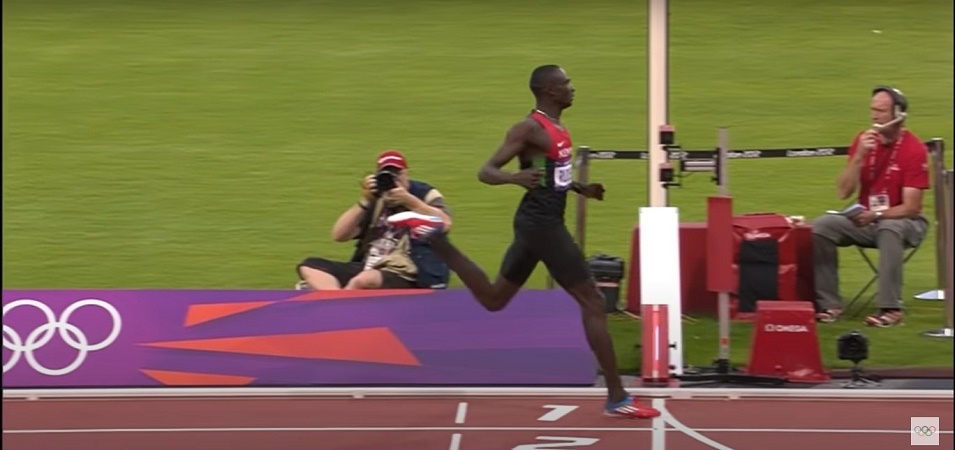
I found some decent Youtube footage of David Rudisha running the 800m at the London Olympics. It’s the race where he set a new world record. As he crossed the line he was well ahead of the rest of the field and there was a good angle on it.

And below he is one step before! It seems unimaginable how he will go from toeing off at the red triangle next to the Olympic logo and ending up on the finish line but he does.

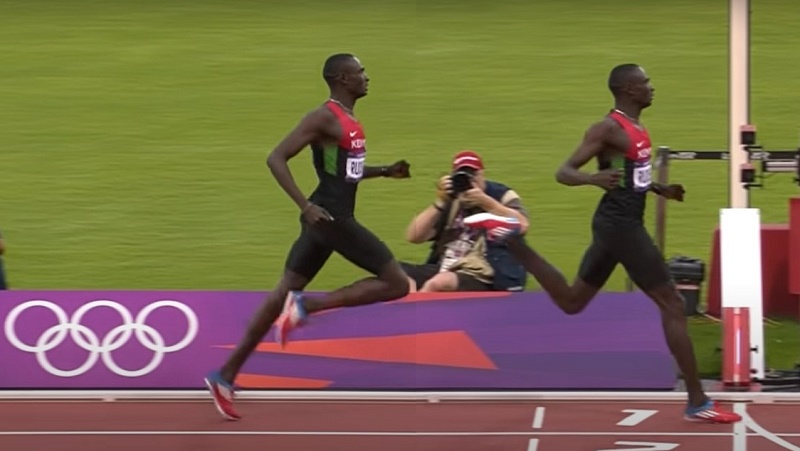
Here’s a combined picture to make things simpler. We can see it’s quite some distance.

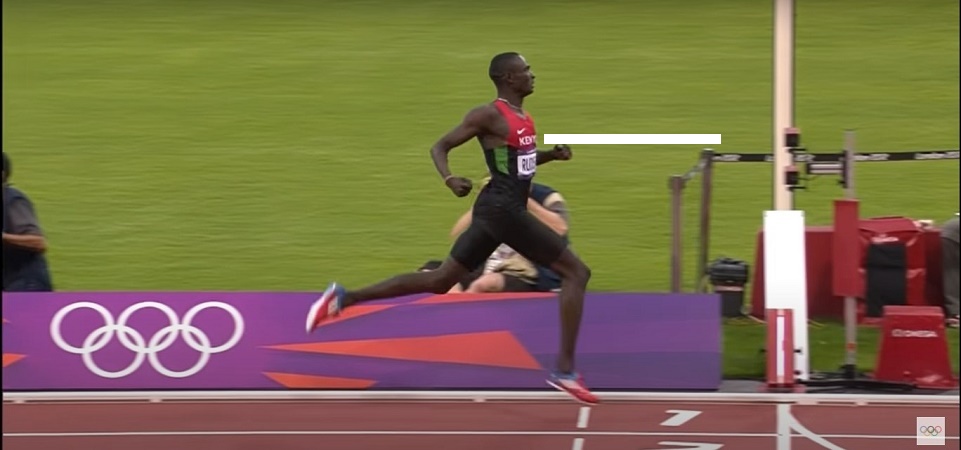
Rudisha is recorded as being 1.88m tall so let’s put some lines on the photo and estimate how long his stride is.

He’s not standing fully upright so the yellow line is around 1.75m. The red line is just above his knee and, fortunately as I’m the same height, I can estimate it to be around 70cm. That’s a total of 2.45m.

The exact measurement doesn’t really matter, what’s important is we now have visual proof that a world class runner takes well over two metres with a single step.

Finally here’s a look at his last two steps, he’s easily covering the better part of five metres. His black shorts make it harder to identify which leg is forward or backwards but if you look at his shoulders there’s no doubt about it. And you can also see how far his body moves over the top of his support leg as he pivots from landing up to toe-off.

Women’s 10K

So far I’ve talked about the stride length of the 400m hurdler and 800m runners. These shorter distance track athletes always have a longer stride than distance runners because the speeds they run (around 3 – 3min30/mile) are that much quicker.

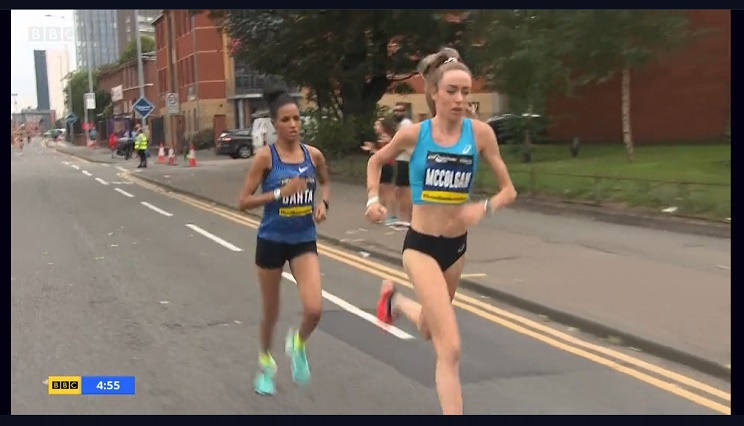
Last weekend the BBC were showing the Great Manchester Runs. A friend who was watching the women’s 10K race messaged to point out the difference in running styles of the two lead ladies – Eilish McColgan and Meraf Bahta.

It was clear McColgan has a long, bouncy stride with a high back kick – probably because she’s still doing shorter track races – whereas Bahta’s stride was shorter and flatter. By flatter I mean she’s staying more level with the ground, less bounce.

Rewatching footage from the second kilometre I counted their respective cadences. McColgan was running at 172 steps per minute, Bahta up at 200.  It’s a notable difference and knowing that they were running together slightly faster than 3min/km (4:45/mile) you get an indication of their stride lengths –  McColgan’s is 1.97m and Bahta’s 1.70m.

Ordinary runners

McColgan is impressive but it’s Bahta who really makes the point. Even for a high cadence runner, she still has a stride length far above that of most runners. Most of the ordinary runners I know have short stride lengths according to their Garmins. If it’s much over a metre on a general run that’s unusual. Of course you can’t big stride all the time but I doubt many have the strength and technique to extend their stride out when required.

My 10K races have an upper end value of something like 1.4m when I’m fresh and usually drop into the 1.30s by the end. I’m sure I’m not unusual in this respect and of course I’m not running world class pace so it’s naturally going to be shorter at my slower race paces.

Most ordinary runners work on their cadence with no thought for improving their mechanics or top-end speed to create a longer stride length. This is a mistake because as we’re seeing with someone like Bahta, that longer stride length is still beneficial when you have a high cadence.

The way you develop a decent stride length is by pushing off more powerfully. You don’t reach out in front of you, you launch yourself forwards through the air with each step. Think of it like being on a pogo stick using the spring to load up and travel forwards for as much distance as possible. As a runner when your leg is behind you, you extend your hip, your knee, your ankle to push forwards. Learning this technique is best done during strides or hill sprints. Short efforts where you’re not concerned about running out of energy or fatiguing.


One last picture of David Rudisha to marvel at. It’s during the flight phase of the last step. His foot is a good half metre or more before the line and looks like he will land there yet somehow he travels on., His effort at toe-off propels him forwards the extra distance before his foot hits the ground. It happens quickly and horizontally. There is very little drop which is what the white line is there to help see.

The white line is lined up with the word “Kenya” on his vest and level just above the black tape by the finish. Take another look below at the finish line photo and you can see he’s only dropped a matter of inches to now be level with it.

When he was in the air, he wasn’t actually high off the ground. His effort goes towards pushing him forwards not up into the air. If you watch slow runners they use a lot of energy bouncing up and down rather than going forwards – this is bad.

If you want to marvel at Rudisha’s running, here’s the video of his 2012 Olympic run. There’s a good, slow motion close-up at the 7min10 mark.

I wrote another article looking at Eliud’s Kipchoge’s stride length and detailing how I calculated it here.

Update on my 800m training – Sept 2021

The second cycle of 800m training is coming to a close. Next week I’ll go do an 800 time trial and see how successful it’s been. The last block of training through July-August was mixed in its success. I felt stronger by the end of it but quite often missed the target times due to overly tired legs. Missing target was a little demoralising yet seeing other things going well helped offset that.

This month’s training has been about sharpening up for the 800TT. Its focus has been miles at Threshold pace to help build Lactate Clearance, along with short intervals at 800m and mile pace for building Lactate Tolerance. The hardest efforts, which need some psyching up for, are the long 600m efforts at 800m pace. On their own it wouldn’t be awful but often they’re thrown in as one part of a bigger session. For example, the first week was simply three 600m efforts with a 1km jog recovery – each effort takes a full-on effort.

Threshold running (T-pace)

The early efforts for these came in around 6:50-55/mile pace. This was a good twenty seconds faster than the same workouts six months ago. But as my fitness sharpened up I began to run them faster and by the past week I was running at 6:40.

The dilemma has been whether to stick to pace or trying to go based on how the body is reacting. As I’m not one for staring at the GPS anymore I’ve opted for the latter hence why my fastest effort came in at 6:34! Considering during July-August I was struggling to run my kilometre intervals at this pace, it all suggests training has been going in the right direction.

Mile-pace running (R-pace)

The plan has been packed with 200s at mile pace but, they’re often at the end of a Threshold session when the legs are tired and heavy with lactate. Sometimes they’ve been hard to get on-target, needing lots of effort to scrape in; other times it’s seemed easy to hit target with lots to spare.

Given the aim was to hit 44sec there’s only been one over 44½sec which was into a headwind; I judge them as having been a success.

800m-pace running (FR-pace)

These have been the rewarding part of training. Last time I was aiming to complete 600s in 2:06 and I only managed it once. This time, I was aiming for 2:00 and managed to get under it three times along with two more at sub-2:02 – not too far off.

There have also been some slower 600s and last Thursday finished on a low note with them coming in at 2:07 and 2:09. I can throw out excuses about high winds but, in the end, I still like to hit target. Yet when I think back to the start of the year I was running my initial 600s in around 2:23 there is something good happening overall.

There were a couple of 400s mid-month which came in on target at 1:18-19 compared to 1:27-29 in the equivalent session six months ago. And again at the beginning of training I remember one misjudged effort came in at 1:41!

The shorter intervals of 200, 300 have been interesting. Generally I’ve struggled to run them much faster than last time around. Fastest 200 in March was 37.45s, this time it’s 36.73sec; so there is a little more quickness but it’s not been a massive leap.  I got a couple of sub-37s on a wind-assisted day and sub-59 300s on another.

So it really seems like I’ve improved my speed endurance this go-around but haven’t done much for my actual top end speed. The 200s are averaging sub-5 pace now which is pleasing given I couldn’t even hit that pace at the start of the year. Doing strides has been a factor on the speed side and I managed to get the pace down to 4:07/mile momentarily on one so hopefully there is more to come.

Stats

I’m not going to go overboard on the stats as they’ve been so variable. But to give an indication of my fastest efforts in time and pace; plus what that multiplies up to over 800m. It’s noticeable that the longer efforts of 400-600 are about the same pace.

FastestPace800m pro-rata
200m36.73s(4:55/mile)2:26.9
300m58.23s(5:12/mile)2:35.3
400m1:18.9(5:17/mile)2:37.7
600m1:58.22(5:17/mile)2:37.6

Running form

Since starting the second time around with the plan, I’ve been working on my running form. I’ve specifically been trying to figure out how to sprint faster and somewhere over the past month or so it all began to come together. I found my legs were beginning to spring off the pavement and each stride would cover more distance. This has caused muscles in my right hip and glutes to get more active to fire produce thee springing action but also involved protecting muscles around the calves and quads that absorb the landing forces. These actions are beginning to become second nature now and with the initial stimulus over, I expect them to build in coming weeks.

Summary

The most pleasing part of training is that my fitness has remained throughout. There have been one or two sessions where I couldn’t get it done but that’s to be expected. There are always ups and downs.

When I did this same training block six months ago, I struggled to get any of the 600s on target and they even slipped backwards by the last couple of weeks. I think this is part of why my time trial barely improved last time around (2:58-55). This time I’ve been hanging in there and am now hoping my 800TT will see a significant improvement – at least scraping down into the 2:30s.

My easy runs have begun to get quicker over the last week or so and I’m beginning to feel like I’m getting back to the form I had back in 2012. Not quite there yet but I am intending to do a fast parkrun in October as well. So that’s all to look forward to in the next update!